


ASTM C722-18(2023)
(Specification)Standard Specification for Chemical-Resistant Monolithic Floor Surfacings
Standard Specification for Chemical-Resistant Monolithic Floor Surfacings
ABSTRACT
This specification covers the requirements for aggregate-filled, resin-based, monolithic surfacing for use over concrete floors in areas where chemical resistance and the protection of concrete are required. The application methods for these floor surfacing shall include troweled, broadcast, slurry broadcast, self-leveling, sprayed, and reinforced. The resin chemistries include epoxy, urethane, polyester, and vinyl ester. Service conditions such as chemical exposure; traffic, and temperature conditions shall be considered in selecting the flooring system. The flooring material shall conform to the physical properties, chemical resistance, and performance requirements of the specific flooring system. The following methods shall be performed for the specific system to be tested: chemical resistance of mortars, grouts, and monolithic surfacing; test method for tensile strength of chemical-resistant mortars, grouts, and monolithic surfacing; test method for absorption of chemical-resistant mortars, grouts, and monolithic surfacing; test method for compressive strength of chemical-resistant mortars, grouts, monolithic surfacing, and polymer concretes; test method for flexural strength and modulus of elasticity of chemical-resistant mortars, grouts, monolithic surfacing, and polymer concretes; test method for determining the static coefficient of friction of ceramic tile and other like surfaces by horizontal dynamometer pull-meter method.
SCOPE
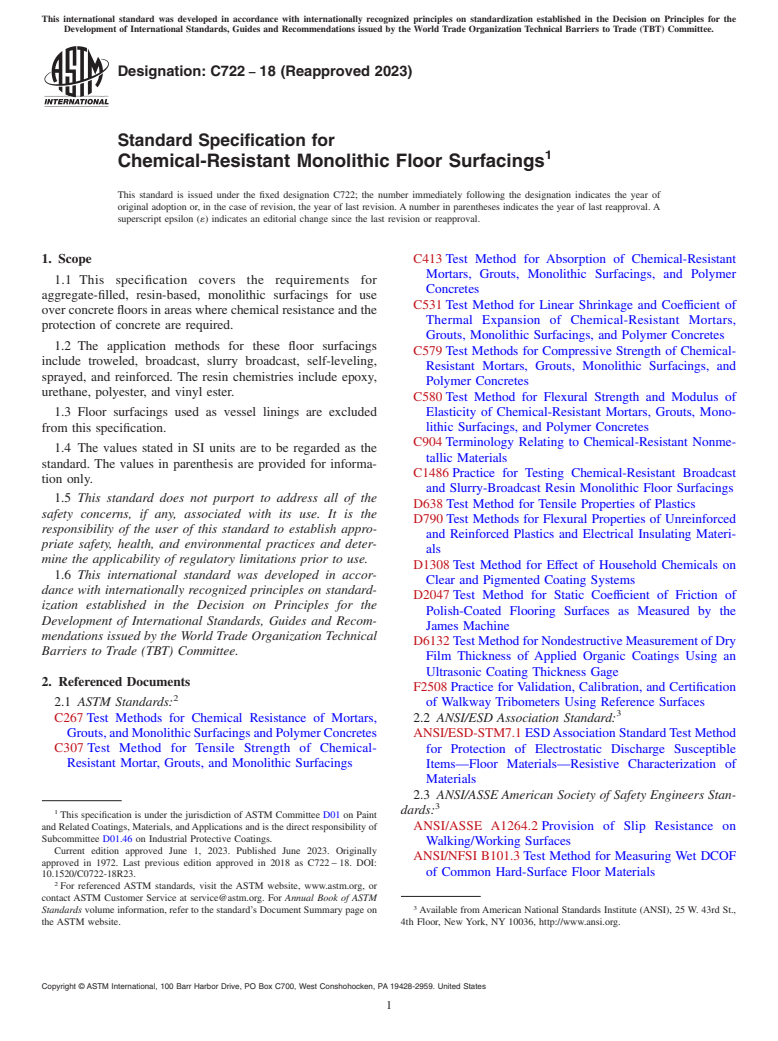
1.1 This specification covers the requirements for aggregate-filled, resin-based, monolithic surfacings for use over concrete floors in areas where chemical resistance and the protection of concrete are required.
1.2 The application methods for these floor surfacings include troweled, broadcast, slurry broadcast, self-leveling, sprayed, and reinforced. The resin chemistries include epoxy, urethane, polyester, and vinyl ester.
1.3 Floor surfacings used as vessel linings are excluded from this specification.
1.4 The values stated in SI units are to be regarded as the standard. The values in parenthesis are provided for information only.
1.5 This standard does not purport to address all of the safety concerns, if any, associated with its use. It is the responsibility of the user of this standard to establish appropriate safety, health, and environmental practices and determine the applicability of regulatory limitations prior to use.
1.6 This international standard was developed in accordance with internationally recognized principles on standardization established in the Decision on Principles for the Development of International Standards, Guides and Recommendations issued by the World Trade Organization Technical Barriers to Trade (TBT) Committee.
General Information
Standards Content (Sample)
This international standard was developed in accordance with internationally recognized principles on standardization established in the Decision on Principles for the
Development of International Standards, Guides and Recommendations issued by the World Trade Organization Technical Barriers to Trade (TBT) Committee.
Designation: C722 − 18 (Reapproved 2023)
Standard Specification for
1
Chemical-Resistant Monolithic Floor Surfacings
This standard is issued under the fixed designation C722; the number immediately following the designation indicates the year of
original adoption or, in the case of revision, the year of last revision. A number in parentheses indicates the year of last reapproval. A
superscript epsilon (´) indicates an editorial change since the last revision or reapproval.
1. Scope C413 Test Method for Absorption of Chemical-Resistant
Mortars, Grouts, Monolithic Surfacings, and Polymer
1.1 This specification covers the requirements for
Concretes
aggregate-filled, resin-based, monolithic surfacings for use
C531 Test Method for Linear Shrinkage and Coefficient of
over concrete floors in areas where chemical resistance and the
Thermal Expansion of Chemical-Resistant Mortars,
protection of concrete are required.
Grouts, Monolithic Surfacings, and Polymer Concretes
1.2 The application methods for these floor surfacings
C579 Test Methods for Compressive Strength of Chemical-
include troweled, broadcast, slurry broadcast, self-leveling,
Resistant Mortars, Grouts, Monolithic Surfacings, and
sprayed, and reinforced. The resin chemistries include epoxy,
Polymer Concretes
urethane, polyester, and vinyl ester.
C580 Test Method for Flexural Strength and Modulus of
1.3 Floor surfacings used as vessel linings are excluded Elasticity of Chemical-Resistant Mortars, Grouts, Mono-
lithic Surfacings, and Polymer Concretes
from this specification.
C904 Terminology Relating to Chemical-Resistant Nonme-
1.4 The values stated in SI units are to be regarded as the
tallic Materials
standard. The values in parenthesis are provided for informa-
C1486 Practice for Testing Chemical-Resistant Broadcast
tion only.
and Slurry-Broadcast Resin Monolithic Floor Surfacings
1.5 This standard does not purport to address all of the
D638 Test Method for Tensile Properties of Plastics
safety concerns, if any, associated with its use. It is the
D790 Test Methods for Flexural Properties of Unreinforced
responsibility of the user of this standard to establish appro-
and Reinforced Plastics and Electrical Insulating Materi-
priate safety, health, and environmental practices and deter-
als
mine the applicability of regulatory limitations prior to use.
D1308 Test Method for Effect of Household Chemicals on
1.6 This international standard was developed in accor-
Clear and Pigmented Coating Systems
dance with internationally recognized principles on standard-
D2047 Test Method for Static Coefficient of Friction of
ization established in the Decision on Principles for the
Polish-Coated Flooring Surfaces as Measured by the
Development of International Standards, Guides and Recom-
James Machine
mendations issued by the World Trade Organization Technical
D6132 Test Method for Nondestructive Measurement of Dry
Barriers to Trade (TBT) Committee.
Film Thickness of Applied Organic Coatings Using an
Ultrasonic Coating Thickness Gage
2. Referenced Documents
F2508 Practice for Validation, Calibration, and Certification
2
2.1 ASTM Standards: of Walkway Tribometers Using Reference Surfaces
3
C267 Test Methods for Chemical Resistance of Mortars,
2.2 ANSI/ESD Association Standard:
Grouts, and Monolithic Surfacings and Polymer Concretes ANSI/ESD-STM7.1 ESD Association Standard Test Method
C307 Test Method for Tensile Strength of Chemical-
for Protection of Electrostatic Discharge Susceptible
Resistant Mortar, Grouts, and Monolithic Surfacings Items—Floor Materials—Resistive Characterization of
Materials
2.3 ANSI/ASSE American Society of Safety Engineers Stan-
3
1 dards:
This specification is under the jurisdiction of ASTM Committee D01 on Paint
and Related Coatings, Materials, and Applications and is the direct responsibility of ANSI/ASSE A1264.2 Provision of Slip Resistance on
Subcommittee D01.46 on Industrial Protective Coatings.
Walking/Working Surfaces
Current edition approved June 1, 2023. Published June 2023. Originally
ANSI/NFSI B101.3 Test Method for Measuring Wet DCOF
approved in 1972. Last previous edition approved in 2018 as C722 – 18. DOI:
of Common Hard-Surface Floor Materials
10.1520/C0722-18R23.
2
For referenced ASTM standards, visit the ASTM website, www.astm.org, or
contact ASTM Customer Service at service@astm.org. For Annual Book of ASTM
3
Standards volume information, refer to the standard’s Document Summary page on Available from American National Standards Institute (ANSI), 25 W. 43rd St.,
the ASTM website. 4th Floor, New York, NY 10036, http://www.ansi.org.
Copyright © ASTM International, 100 Barr Harbor Drive, PO Box C700, West Conshohocken, P
...
Questions, Comments and Discussion
Ask us and Technical Secretary will try to provide an answer. You can facilitate discussion about the standard in here.