

ASTM B250/B250M-19
(Specification)Standard Specification for General Requirements for Wrought Copper Alloy Wire
General Information
- Abstract
ABSTRACT
This specification establishes the general requirements common to wrought copper and copper alloy wires. The materials for manufacture shall be a cast bar, billet, rod, or other form of such purity and soundness as to be suitable for processing by hot working, cold working, and subsequent annealing to produce finished products that meet the specified temper properties and have a uniform wrought structure. Products shall be sampled and prepared, then tested accordingly to examine their conformance to dimensional (diameter, thickness, specific and stock lengths, width, straightness, and edge contour), mechanical (tensile, yield and bend strengths, elongation, and Rockwell hardness), electrical (resistivity and conductivity), chemical composition, and grain size requirements. In the event of conflict between this specification and the individual casting product specifications, the requirements of the casting specification shall take precedence.
SIGNIFICANCE AND USE
12.1 For the purpose of determining compliance with the specified limits for requirements of the properties listed in the following table, an observed value or calculated value shall be rounded as indicated in accordance with the rounding method of Practice E29.
Property
Rounded Unit for Observed
or Calculated Value
Dimensions
Chemical composition
Hardness
Electrical resistivity/conductivity
nearest unit in the last
right-hand significant
digit used in expressing
the limiting value
Tensile strength
Yield strength
nearest ksi [5 MPa]
Elongation
Below 5 %
nearest multiple of 0.5 %
5 % and over
nearest 1 %
Grain size
Under 0.060 mm
nearest multiple of 0.005 mm
0.060 mm and over
nearest 0.01 mm
SCOPE
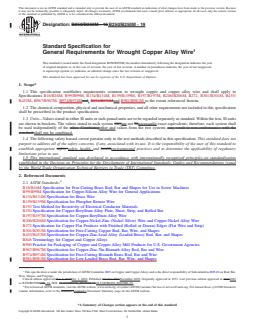
1.1 This specification establishes requirements common to wrought copper and copper alloy wire and shall apply to Specifications B16/B16M, B99/B99M, B134/B134M, B159/B159M, B197/B197M, B206/B206M, B272, B301/B301M, B453/B453M, B967/B967M, B974/B974M, and B981/B981M to the extent referenced therein.
1.2 The chemical composition, physical and mechanical properties, and all other requirements not included in this specification shall be prescribed in the product specification.
1.3 Units—Values stated in either SI units or inch-pound units are to be regarded separately as standard. Within the text, SI units are shown in brackets. The values stated in each system are not necessarily exact equivalents; therefore, each system shall be used independently of the other and values from the two systems shall not be combined.
1.4 The following safety hazard caveat pertains only to the test methods described in this specification. This standard does not purport to address all of the safety concerns, if any, associated with its use. It is the responsibility of the user of this standard to establish appropriate safety, health, and environmental practices and to determine the applicability of regulatory limitations prior to use.
1.5 This international standard was developed in accordance with internationally recognized principles on standardization established in the Decision on Principles for the Development of International Standards, Guides and Recommendations issued by the World Trade Organization Technical Barriers to Trade (TBT) Committee.
- Status
- Published
- Publication Date
- 30-Sep-2019
- Technical Committee
- B05 - Copper and Copper Alloys
- Drafting Committee
- B05.02 - Rod, Bar, Wire, Shapes and Forgings
Buy Documents
ASTM B250/B250M-19 - Standard Specification for General Requirements for Wrought Copper Alloy Wire
REDLINE ASTM B250/B250M-19 - Standard Specification for General Requirements for Wrought Copper Alloy Wire
Overview
ASTM B250/B250M-19: Standard Specification for General Requirements for Wrought Copper Alloy Wire establishes overarching requirements for wrought copper and copper alloy wires. This international standard, developed by ASTM and recognized by the World Trade Organization (WTO), ensures consistency and quality across a wide variety of copper alloy wires, supporting industries that rely on precise materials for electrical and mechanical applications.
By providing a unified framework, ASTM B250/B250M-19 sets the expectations for chemical composition, dimensional tolerances, mechanical properties, electrical characteristics, and the methods for sampling, testing, and inspection. This ensures wire products are manufactured and tested against clear, internationally accepted benchmarks, strengthening reliability for manufacturers and end users.
Key Topics
- Material and Manufacture: The standard covers the use of cast bar, billet, rod, or other suitable forms of copper or copper alloy as the starting material, with requirements for processing by hot working, cold working, and annealing to achieve a uniform wrought structure.
- Dimensional Requirements: Guidelines for wire dimensions, including diameter, thickness, specific and stock lengths, width, straightness, and edge contour; detailed tables specify permissible variations and tolerances.
- Mechanical Properties: Mandates for tensile strength, yield strength, elongation, bend strength, and Rockwell hardness, along with standardized methods for determining compliance.
- Electrical Properties: Requirements for electrical resistivity and conductivity to ensure performance in electrical applications.
- Chemical Composition: Direction to confirm copper alloy chemical purity, including guidance on permissible analytical variances.
- Sampling and Inspection: Procedures for representative sampling, retesting, and rejection protocols, ensuring statistical confidence and product conformity.
- Marking and Packaging: Instructions for clear identification, packaging, and protection during shipment, including special provisions for government agencies.
Applications
ASTM B250/B250M-19 impacts multiple industries where wrought copper and copper alloy wires are essential, such as:
- Electrical and Electronics: Ensures the quality of wires used in electrical conductors, power transmission, and electronic interconnections, providing reliable conductivity and long-term performance.
- Automotive and Transportation: Specifies wire grades and tolerances necessary for wiring harnesses, connectors, and signal transmission in vehicles and aerospace equipment.
- Industrial Equipment: Guides manufacturers of machinery, instrumentation, and heat exchangers that require robust, corrosion-resistant copper alloy wires.
- Construction and Infrastructure: Supports building and infrastructure projects relying on copper wiring for safe and efficient energy distribution.
- Government and Defense: Offers supplementary requirements for packaging, marking, and quality assurance when products are procured by military or government agencies.
Consistent adherence to ASTM B250/B250M-19 improves material reliability, streamlines procurement, and enhances safety in applications demanding high-quality copper alloy wires.
Related Standards
ASTM B250/B250M-19 operates in conjunction with several product-specific and test method standards, including:
- ASTM B16/B16M - Free-Cutting Brass Rod, Bar, and Shapes for Screw Machines
- ASTM B99/B99M - Copper-Silicon Alloy Wire for General Applications
- ASTM B134/B134M - Brass Wire
- ASTM B159/B159M - Phosphor Bronze Wire
- ASTM B197/B197M - Copper-Beryllium Alloy Wire
- ASTM B206/B206M - Copper-Nickel-Zinc (Nickel Silver) Wire
- ASTM B272 - Copper Flat Products (Flat Wire and Strip)
- ASTM B301/B301M - Free-Cutting Copper Rod, Bar, Wire, and Shapes
- ASTM B453/B453M - Leaded-Brass Rod, Bar, and Shapes
- ASTM B967/B967M - Copper-Zinc-Tin-Bismuth Alloy Rod, Bar, and Wire
- ASTM B974/B974M - Free-Cutting Bismuth Brass Rod, Bar, and Wire
- ASTM B981/B981M - Low-Leaded Brass Rod, Bar, Wire, and Shapes
Test methods referenced:
- ASTM E8/E8M (Tension Testing)
- ASTM E18 (Rockwell Hardness)
- ASTM E112 (Grain Size)
- ASTM B193 (Resistivity)
Terminology: ASTM B846
Adoption of ASTM B250/B250M-19 supports compliance with these related standards, ensuring end-to-end quality and compatibility for applications requiring wrought copper alloy wires.
Keywords: wrought copper alloy wire, copper alloy wire specification, ASTM B250, copper wire standards, mechanical properties, electrical properties, wire tolerances, copper alloy testing.
Relations
- Replaces
ASTM B250/B250M-16 - Standard Specification for General Requirements for Wrought Copper Alloy Wire - Effective Date
- 01-Oct-2019
- Effective Date
- 01-Jan-1995
- Effective Date
- 01-Jan-2024
- Effective Date
- 01-Aug-2019
- Effective Date
- 01-Apr-2019
- Effective Date
- 01-Apr-2019
- Effective Date
- 01-Apr-2019
- Effective Date
- 01-Jan-2019
- Effective Date
- 01-Jul-2018
- Effective Date
- 01-Oct-2017
- Effective Date
- 01-Oct-2017
- Effective Date
- 01-Jul-2017
- Effective Date
- 01-May-2017
- Effective Date
- 01-Apr-2017
- Refers
ASTM B967/B967M-16 - Standard Specification for Copper-Zinc-Tin-Bismuth Alloy Rod, Bar and Wire - Effective Date
- 01-Oct-2016
Buy Documents
ASTM B250/B250M-19 - Standard Specification for General Requirements for Wrought Copper Alloy Wire
REDLINE ASTM B250/B250M-19 - Standard Specification for General Requirements for Wrought Copper Alloy Wire
Get Certified
Connect with accredited certification bodies for this standard

Element Materials Technology
Materials testing and product certification.

Inštitut za kovinske materiale in tehnologije
Institute of Metals and Technology. Materials testing, metallurgical analysis, NDT.
Sponsored listings
Frequently Asked Questions
ASTM B250/B250M-19 is a technical specification published by ASTM International. Its full title is "Standard Specification for General Requirements for Wrought Copper Alloy Wire". This standard covers: ABSTRACT This specification establishes the general requirements common to wrought copper and copper alloy wires. The materials for manufacture shall be a cast bar, billet, rod, or other form of such purity and soundness as to be suitable for processing by hot working, cold working, and subsequent annealing to produce finished products that meet the specified temper properties and have a uniform wrought structure. Products shall be sampled and prepared, then tested accordingly to examine their conformance to dimensional (diameter, thickness, specific and stock lengths, width, straightness, and edge contour), mechanical (tensile, yield and bend strengths, elongation, and Rockwell hardness), electrical (resistivity and conductivity), chemical composition, and grain size requirements. In the event of conflict between this specification and the individual casting product specifications, the requirements of the casting specification shall take precedence. SIGNIFICANCE AND USE 12.1 For the purpose of determining compliance with the specified limits for requirements of the properties listed in the following table, an observed value or calculated value shall be rounded as indicated in accordance with the rounding method of Practice E29. Property Rounded Unit for Observed or Calculated Value Dimensions Chemical composition Hardness Electrical resistivity/conductivity nearest unit in the last right-hand significant digit used in expressing the limiting value Tensile strength Yield strength nearest ksi [5 MPa] Elongation Below 5 % nearest multiple of 0.5 % 5 % and over nearest 1 % Grain size Under 0.060 mm nearest multiple of 0.005 mm 0.060 mm and over nearest 0.01 mm SCOPE 1.1 This specification establishes requirements common to wrought copper and copper alloy wire and shall apply to Specifications B16/B16M, B99/B99M, B134/B134M, B159/B159M, B197/B197M, B206/B206M, B272, B301/B301M, B453/B453M, B967/B967M, B974/B974M, and B981/B981M to the extent referenced therein. 1.2 The chemical composition, physical and mechanical properties, and all other requirements not included in this specification shall be prescribed in the product specification. 1.3 Units—Values stated in either SI units or inch-pound units are to be regarded separately as standard. Within the text, SI units are shown in brackets. The values stated in each system are not necessarily exact equivalents; therefore, each system shall be used independently of the other and values from the two systems shall not be combined. 1.4 The following safety hazard caveat pertains only to the test methods described in this specification. This standard does not purport to address all of the safety concerns, if any, associated with its use. It is the responsibility of the user of this standard to establish appropriate safety, health, and environmental practices and to determine the applicability of regulatory limitations prior to use. 1.5 This international standard was developed in accordance with internationally recognized principles on standardization established in the Decision on Principles for the Development of International Standards, Guides and Recommendations issued by the World Trade Organization Technical Barriers to Trade (TBT) Committee.
ABSTRACT This specification establishes the general requirements common to wrought copper and copper alloy wires. The materials for manufacture shall be a cast bar, billet, rod, or other form of such purity and soundness as to be suitable for processing by hot working, cold working, and subsequent annealing to produce finished products that meet the specified temper properties and have a uniform wrought structure. Products shall be sampled and prepared, then tested accordingly to examine their conformance to dimensional (diameter, thickness, specific and stock lengths, width, straightness, and edge contour), mechanical (tensile, yield and bend strengths, elongation, and Rockwell hardness), electrical (resistivity and conductivity), chemical composition, and grain size requirements. In the event of conflict between this specification and the individual casting product specifications, the requirements of the casting specification shall take precedence. SIGNIFICANCE AND USE 12.1 For the purpose of determining compliance with the specified limits for requirements of the properties listed in the following table, an observed value or calculated value shall be rounded as indicated in accordance with the rounding method of Practice E29. Property Rounded Unit for Observed or Calculated Value Dimensions Chemical composition Hardness Electrical resistivity/conductivity nearest unit in the last right-hand significant digit used in expressing the limiting value Tensile strength Yield strength nearest ksi [5 MPa] Elongation Below 5 % nearest multiple of 0.5 % 5 % and over nearest 1 % Grain size Under 0.060 mm nearest multiple of 0.005 mm 0.060 mm and over nearest 0.01 mm SCOPE 1.1 This specification establishes requirements common to wrought copper and copper alloy wire and shall apply to Specifications B16/B16M, B99/B99M, B134/B134M, B159/B159M, B197/B197M, B206/B206M, B272, B301/B301M, B453/B453M, B967/B967M, B974/B974M, and B981/B981M to the extent referenced therein. 1.2 The chemical composition, physical and mechanical properties, and all other requirements not included in this specification shall be prescribed in the product specification. 1.3 Units—Values stated in either SI units or inch-pound units are to be regarded separately as standard. Within the text, SI units are shown in brackets. The values stated in each system are not necessarily exact equivalents; therefore, each system shall be used independently of the other and values from the two systems shall not be combined. 1.4 The following safety hazard caveat pertains only to the test methods described in this specification. This standard does not purport to address all of the safety concerns, if any, associated with its use. It is the responsibility of the user of this standard to establish appropriate safety, health, and environmental practices and to determine the applicability of regulatory limitations prior to use. 1.5 This international standard was developed in accordance with internationally recognized principles on standardization established in the Decision on Principles for the Development of International Standards, Guides and Recommendations issued by the World Trade Organization Technical Barriers to Trade (TBT) Committee.
ASTM B250/B250M-19 is classified under the following ICS (International Classification for Standards) categories: 77.150.30 - Copper products. The ICS classification helps identify the subject area and facilitates finding related standards.
ASTM B250/B250M-19 has the following relationships with other standards: It is inter standard links to ASTM B250/B250M-16, ASTM B250M-95, ASTM E8/E8M-24, ASTM B846-19a, ASTM B272-12(2019), ASTM B453/B453M-19, ASTM B981/B981M-19, ASTM B846-19, ASTM E18-18, ASTM B159/B159M-17, ASTM B453/B453M-11(2017), ASTM E18-17, ASTM E581-17, ASTM B206/B206M-12(2017), ASTM B967/B967M-16. Understanding these relationships helps ensure you are using the most current and applicable version of the standard.
ASTM B250/B250M-19 is available in PDF format for immediate download after purchase. The document can be added to your cart and obtained through the secure checkout process. Digital delivery ensures instant access to the complete standard document.
Standards Content (Sample)
This international standard was developed in accordance with internationally recognized principles on standardization established in the Decision on Principles for the
Development of International Standards, Guides and Recommendations issued by the World Trade Organization Technical Barriers to Trade (TBT) Committee.
Designation:B250/B250M −19
Standard Specification for
General Requirements for Wrought Copper Alloy Wire
This standard is issued under the fixed designation B250/B250M; the number immediately following the designation indicates the year
of original adoption or, in the case of revision, the year of last revision.Anumber in parentheses indicates the year of last reapproval.
A superscript epsilon (´) indicates an editorial change since the last revision or reapproval.
This standard has been approved for use by agencies of the U.S. Department of Defense.
1. Scope* B16/B16MSpecification for Free-Cutting Brass Rod, Bar
and Shapes for Use in Screw Machines
1.1 This specification establishes requirements common to
B99/B99MSpecification for Copper-Silicon Alloy Wire for
wrought copper and copper alloy wire and shall apply to
General Applications
Specifications B16/B16M, B99/B99M, B134/B134M, B159/
B134/B134MSpecification for Brass Wire
B159M, B197/B197M, B206/B206M, B272, B301/B301M,
B159/B159MSpecification for Phosphor Bronze Wire
B453/B453M,B967/B967M,B974/B974M,andB981/B981M
B193Test Method for Resistivity of Electrical Conductor
to the extent referenced therein.
Materials
1.2 The chemical composition, physical and mechanical
B194SpecificationforCopper-BerylliumAlloyPlate,Sheet,
properties, and all other requirements not included in this
Strip, and Rolled Bar
specification shall be prescribed in the product specification.
B197/B197M Specification for Copper-Beryllium Alloy
Wire
1.3 Units—Values stated in either SI units or inch-pound
units are to be regarded separately as standard.Within the text, B206/B206MSpecification for Copper-Nickel-Zinc (Nickel
Silver) Wire and Copper-Nickel Alloy Wire
SI units are shown in brackets. The values stated in each
system are not necessarily exact equivalents; therefore, each B272Specification for Copper Flat Products with Finished
(Rolled or Drawn) Edges (Flat Wire and Strip)
system shall be used independently of the other and values
from the two systems shall not be combined. B301/B301MSpecification for Free-Cutting Copper Rod,
Bar, Wire, and Shapes
1.4 The following safety hazard caveat pertains only to the
B453/B453M Specification for Copper-Zinc-Lead Alloy
testmethodsdescribedinthisspecification.Thisstandarddoes
(Leaded-Brass) Rod, Bar, and Shapes
not purport to address all of the safety concerns, if any,
B846Terminology for Copper and Copper Alloys
associatedwithitsuse.Itistheresponsibilityoftheuserofthis
B900Practice for Packaging of Copper and Copper Alloy
standard to establish appropriate safety, health, and environ-
Mill Products for U.S. Government Agencies
mental practices and to determine the applicability of regula-
B967/B967M Specification for Copper-Zinc-Tin-Bismuth
tory limitations prior to use.
Alloy Rod, Bar and Wire
1.5 This international standard was developed in accor-
B974/B974MSpecification for Free-Cutting Bismuth Brass
dance with internationally recognized principles on standard-
Rod, Bar and Wire
ization established in the Decision on Principles for the
B981/B981MSpecificationforLow-LeadedBrassRod,Bar,
Development of International Standards, Guides and Recom-
Wire, and Shapes
mendations issued by the World Trade Organization Technical
E3Guide for Preparation of Metallographic Specimens
Barriers to Trade (TBT) Committee.
E8/E8MTest Methods for Tension Testing of Metallic Ma-
terials
2. Referenced Documents
E18Test Methods for Rockwell Hardness of Metallic Ma-
2.1 ASTM Standards:
terials
E29Practice for Using Significant Digits in Test Data to
ThisspecificationisunderthejurisdictionofASTMCommitteeB05onCopper
Determine Conformance with Specifications
and CopperAlloys and is the direct responsibility of Subcommittee B05.02 on Rod,
E54Test Methods for ChemicalAnalysis of Special Brasses
Bar, Wire, Shapes and Forgings.
and Bronzes (Withdrawn 2002)
Current edition approved Oct. 1, 2019. Published November 2019. Originally
E62Test Methods for Chemical Analysis of Copper and
approved in 1951. Last previous edition approved in 2016 as B250/B250M–16.
DOI: 10.1520/B0250_B0250M–19.
For referenced ASTM standards, visit the ASTM website, www.astm.org, or
contact ASTM Customer Service at service@astm.org. For Annual Book of ASTM
Standards volume information, refer to the standard’s Document Summary page on The last approved version of this historical standard is referenced on
the ASTM website. www.astm.org.
*A Summary of Changes section appears at the end of this standard
Copyright © ASTM International, 100 Barr Harbor Drive, PO Box C700, West Conshohocken, PA 19428-2959. United States
B250/B250M−19
CopperAlloys(PhotometricMethods)(Withdrawn2010) 6. Dimensions and Permissible Variations
E75Test Methods for Chemical Analysis of Copper-Nickel
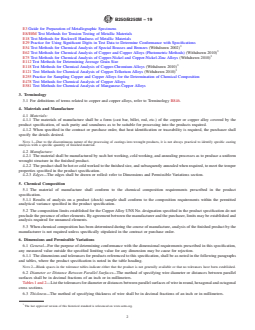
6.1 General—For the purpose of determining conformance
and Copper-Nickel-Zinc Alloys (Withdrawn 2010)
with the dimensional requirements prescribed in this
E112Test Methods for Determining Average Grain Size
specification,anymeasuredvalueoutsidethespecifiedlimiting
E118 Test Methods for Chemical Analysis of Copper-
value for any dimension may be cause for rejection.
Chromium Alloys (Withdrawn 2010)
6.1.1 The dimensions and tolerances for products refer-
E121Test Methods for Chemical Analysis of Copper-
enced to this specification, shall be as noted in the following
Tellurium Alloys (Withdrawn 2010)
paragraphs and tables, where the product specification is noted
E255Practice for Sampling Copper and Copper Alloys for
in the table heading.
the Determination of Chemical Composition
NOTE 2—Blank spaces in the tolerance tables indicate either that the
E478Test Methods for ChemicalAnalysis of CopperAlloys
product is not generally available or that no tolerances have been
E581Test Methods for Chemical Analysis of Manganese-
established.
Copper Alloys
6.2 Diameter or Distance Between Parallel Surfaces—The
method of specifying wire diameter or distances between
3. Terminology
parallel surfaces shall be in decimal fractions of an inch or in
3.1 For definitions of terms related to copper and copper
millimeters.
alloys, refer to Terminology B846.
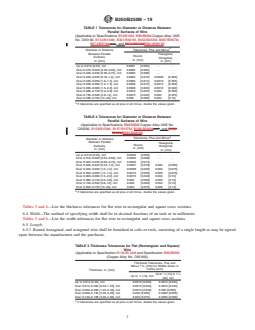
Tables1and2—Listthetolerancesfordiameterordistances
between parallel surfaces of wire in round, hexagonal and
4. Materials and Manufacture
octagonal cross sections.
4.1 Materials:
6.3 Thickness—The method of specifying thickness of wire
4.1.1 Thematerialsofmanufactureshallbeaform(castbar,
shall be in decimal fractions of an inch or in millimeters.
billet, rod, etc.) of the copper or copper alloy covered by the
Tables 3 and 4—List the thickness tolerances for flat wire in
product specification, of such purity and soundness as to be
rectangular and square cross sections.
suitable for processing into the products required.
6.4 Width—The method of specifying width shall be in
4.1.2 When specified in the contract or purchase order, that
decimal fractions of an inch or in millimeter.
heat identification or traceability is required, the purchaser
Tables 5 and 6—List the width tolerances for flat wire in
shall specify the details desired.
rectangular and square cross sections.
NOTE 1—Due to the discontinuous nature of the processing of castings
6.5 Length:
intowroughtproducts,itisnotalwayspracticaltoidentifyspecificcasting
6.5.1 Round, hexagonal, and octagonal wire shall be fur-
analysis with a specific quantity of finished material.
nished in coils or reels, consisting of a single length as may be
4.2 Manufacture:
agreed upon between the manufacturer and the purchaser.
4.2.1 The material shall be manufactured by such hot
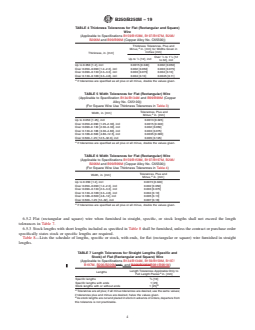
6.5.2 Flat (rectangular and square) wire when furnished in
working, cold working, and annealing processes as to produce
straight, specific, or stock lengths shall not exceed the length
a uniform wrought structure in the finished product.
tolerances in Table 7.
4.2.2 Theproductshallbehotorcoldworkedtothefinished
6.5.3 Stock lengths with short lengths included as specified
size, and subsequently annealed when required, to meet the
in Table 8 shall be furnished, unless the contract or purchase
temper properties specified in the product specification.
order specifically states stock or specific lengths are required.
4.2.3 Edges—The edges shall be drawn or rolled: refer to
Dimensions and Permissible Variations section.
TABLE 1 Tolerances for Diameter or Distance Between
5. Chemical Composition
Parallel Surfaces of Wire
5.1 The material of manufacture shall conform to the (Applicable to Specifications B16/B16M, B99/B99M Copper Alloy UNS
No. C65100, B134/B134M, B301/B301M, B453/B453M, B967/B967M,
chemical composition requirements prescribed in the product
B974/B974M, and B981/B981M)
specification.
A
Tolerances, Plus and Minus
Diameter or Distance
5.1.1 Results of analysis on a product (check) sample shall
Between Parallel
Hexagonal,
conform to the composition requirements within the permitted
Round,
Surfaces,
Octagonal,
in. [mm]
analytical variance specified in the product specification.
in. [mm]
in. [mm]
Up to 0.010 [0.25], incl 0.0001 [0.003] . . . . . .
5.2 ThecompositionlimitsestablishedfortheCopperAlloy
Over 0.010–0.020 [0.25–0.50], incl 0.0002 [0.005] . . . . . .
UNS No. designation specified in the product specification do
Over 0.020–0.030 [0.50–0.75], incl 0.0003 [0.008] . . . . . .
not preclude the presence of other elements. By agreement
Over 0.030–0.040 [0.75–1.0], incl 0.0004 [0.010] 0.0008 [0.020]
Over 0.040–0.050 [1.0–1.2], incl 0.0005 [0.013] 0.0010 [0.025]
between the manufacturer and the purchaser, limits may be
Over 0.050–0.060 [1.2–1.5], incl 0.0006 [0.015] 0.0012 [0.030]
established and analysis required for unnamed elements.
Over 0.060–0.080 [1.5–2.0], incl 0.0008 [0.020] 0.0016 [0.040]
Over 0.080–0.150 [2.0–3.8], incl 0.0010 [0.025] 0.002 [0.050]
5.3 When chemical composition has been determined dur-
Over 0.150–0.500 [3.8–12], incl 0.0015 [0.040] 0.003 [0.075]
ing the course of manufacture, analysis of the finished product
Over 0.500–0.750 [12–20], incl 0.002 [0.050] 0.004 [0.10]
by the manufacturer is not required unless specifically stipu- A
If tolerances are specified as all plus or all minus, double the values given.
lated in the contract or purchase order.
B250/B250M−19
TABLE 2 Tolerances for Diameter or Distance Between TABLE 5 Width Tolerances for Flat (Rectangular) Wire
Parallel Surfaces of Wire (Applicable to Specification B134/B134M and B99/B99M (Copper
(Applicable to Specifications B99/B99M Copper Alloy UNS No. Alloy No. C65100))
C65500, B159/B159M, B197/B197M, B206/B206M, and B981/B981M) (For Square Wire Use Thickness Tolerances in Table 3)
A
Tolerances, Plus and Minus Tolerances, Plus and
Diameter or Distance
Width, in. [mm]
A
Minus, in. [mm]
Between Parallel
Hexagonal,
Round,
Surfaces,
Octagonal, Up to 0.050 [1.25], incl 0.0013 [0.025]
in. [mm]
in. [mm]
in. [mm] Over 0.050–0.090 [1.25–2.30], incl 0.0015 [0.040]
Over 0.090–0.130 [2.30–3.30], incl 0.002 [0.050]
Up to 0.010 [0.25], incl 0.0002 [0.005] . . . . . .
Over 0.130–0.188 [3.30–4.80], incl 0.003 [0.075]
Over 0.010–0.020 [0.25–0.50], incl 0.0003 [0.008] . . . . . .
Over 0.188–0.500 [4.80–12.5], incl 0.0035 [0.090]
Over 0.020–0.030 [0.50–0.75], incl 0.0005 [0.013] . . . . . .
Over 0.500–1.25 [12.5–32.0], incl 0.005 [0.125]
Over 0.030–0.040 [0.75–1.0], incl 0.0007 [0.018] 0.002 [0.050]
A
Over 0.040–0.050 [1.0–1.2], incl 0.0008 [0.020] 0.003 [0.075]
If tolerances are specified as all plus or all minus, double the values given.
Over 0.050–0.060 [1.2–1.5], incl 0.0010 [0.025] 0.003 [0.075]
Over 0.060–0.080 [1.5–2.0], incl 0.0015 [0.040] 0.004 [0.10]
Over 0.080–0.150 [2.0–3.8], incl 0.002 [0.050] 0.004 [0.10]
TABLE 6 Width Tolerances for Flat (Rectangular) Wire
Over 0.150–0.500 [3.8–12], incl 0.002 [0.050] 0.004 [0.10]
Over 0.500–0.750 [12–20], incl 0.003 [0.075] 0.005 [0.13] (Applicable to Specifications B159/B159M, B197/B197M, B206/
B206M and B99/B99M (Copper Alloy No. C65500))
A
If tolerances are specified as all plus or all minus, double the values given.
(For Square Wire Use Thickness Tolerances in Table 4)
Tolerances, Plus and
Width, in. [mm]
A
Minus, in. [mm]
TABLE 3 Thickness Tolerances for Flat (Rectangular and Square)
Up to 0.050 [1.2], incl 0.0015 [0.040]
Wire
Over 0.050–0.090 [1.2–2.3], incl 0.002 [0.050]
(Applicable to Specification B134/B134M and Specification B99/B99M
Over 0.090–0.130 [2.3–3.3], incl 0.003 [0.075]
(Copper Alloy No. C65100))
Over 0.130–0.188 [3.3–4.8], incl 0.004 [0.10]
Thickness Tolerances, Plus and Over 0.188–0.500 [4.8–12], incl 0.005 [0.13]
A
Minus, in. [mm] for Widths Given in Over 0.500–1.25 [12–32], incl 0.007 [0.18]
Inches [mm]
Thickness, in. [mm]
A
If tolerances are specified as all plus or all minus, double the values given.
1 1
Over ⁄2 [12] to 1 ⁄4
Up to ⁄2 [12], incl
[32], incl
Up to 0.013 [0.33], incl 0.0010 [0.025] 0.0013 [0.033]
TABLE 7 Length Tolerances for Straight Lengths (Specific and
Over 0.013–0.050 [0.33–1.25], incl 0.0013 [0.033] 0.0015 [0.040]
Stock) of Flat (Rectangular and Square) Wire
Over 0.050–0.090 [1.25–2.30], incl 0.0015 [0.040] 0.002 [0.050]
(Applicable to Specifications B134/B134M, B159/B159M, B197/
Over 0.090–0.130 [2.30–3.30], incl 0.002 [0.050] 0.0025 [0.065]
Over 0.130–0.188 [3.30–4.80], incl 0.003 [0.075] 0.0035 [0.090]
B197M, B206/B206M, and B981/B981M)
A
If tolerances are specified as all plus or all minus, double the values given.
Length Tolerances Applicable Only to
Lengths
A
Full Length Pieces in. [mm]
Specific lengths ⁄8 [10]
Specific lengths with ends 1 [25]
TABLE 4 Thickness Tolerances for Flat (Rectangular and Square)
B
Stock lengths with or without ends 1 [25]
Wire
A
Tolerances are all plus; if all minus tolerances are desired, use the same values;
(Applicable to Specifications B159/B159M, B197/B197M, B206/
if tolerances plus and minus are desired, halve the values given.
B206M and B99/B99M (Copper Alloy No. C65500))
B
Asstocklengthsarecutandplacedinstockinadvanceoforders,departurefrom
Thickness Tolerances, Plus and
this tolerance is not practicable.
A
Minus, in. [mm] for Widths Given in
Inches [mm]
Thickness, in. [mm]
1 1
Over ⁄2 to 1 ⁄4 [12
Up to ⁄2 [12], incl
TABLE 8 Schedule of Lengths (Specific and Stock) With Ends
to 32], incl
for Flat (Rectangular and Square) Wire Furnished in Straight
Up to 0.050 [1.2], incl 0.0015 [0.040] 0.002 [0.050]
Lengths
Over 0.050–0.090 [1.2–2.3], incl 0.002 [0.050] 0.003 [0.075]
(Applicable to Specifications B134/B134M, B159/B159M, B197/
Over 0.090–0.130 [2.3–3.3], incl 0.003 [0.075] 0.004 [0.10]
B197M, B206/B206M, and B981/B981M)
Over 0.130–0.188 [3.3–4.8], incl 0.004 [0.10] 0.0045 [0.11]
A
Maximum Permissible
If tolerances are specified as all plus or all minus, double the values given. Shortest Permissible
A
Nominal Length, ft [mm] Weight of Ends
Length (in%of
Nominal Length) (in % of Lot Weight)
6–14 [2000–4500], incl 75 20
A
Table 8—Lists the schedule of lengths, specific or stock, Expressed to the nearest ⁄2 ft [150 mm].
with ends, for flat (rectangular or square) wire furnished in
straight lengths.
6.6 Straightness—For flat (rectangular and square) wire 6.7 Edge Contours—Flat (rectangular and square) wire
furnished in straight lengths in applicable specifications the applicabletolistedspecificationsshall,unlessotherwisespeci-
deviation from straightness shall not exceed the limitations fied in the contract or purchase order, be finished with
specified in Table 9. commercially square corners with a maximum permissible
1 1 1
6.6.1 To determine compliance with this tolerance, the radius of ⁄100 in. [0.3 mm] for wire ⁄32 to ⁄16 in. [1 to 1.5 mm]
1 1
lengths shall, in case of disagreement, be checked by placing inclusiveinthickness,andof ⁄64in.[0.4mm]forwireover ⁄16
the lengths on a level table so that the arc or departure from to ⁄16 in. [1.5 to 5 mm] inclusive in thickness.
straightness is horizontal. Measure the depth of the arc to the 6.7.1 Sharp Corners—When specified in the contract or
nearest ⁄32 in. [1 mm] using a straight edge. purchaser order, the corner radius shall be 0.003 in.
B250/B250M−19
TABLE 9 Straightness Tolerances for Flat (Rectangular and
Square) Wires
(Applicable Specifications B134/B134M, B159/B159M, B197/B197M,
B206/B206M, and B981/B981M)
Applicable to any longitudinal edge of material supplied in
flat straight lengths and on reels or coils.
For material having a cross-sectional ⁄2 in. [12 mm] maximum edgewise
NOTE 1—The arc of the rounded edge shall not necessarily be tangent
2 2
area of 0.010 in. [6.5 mm ] and curvature (depth of arc) in any
at Points A, but shall be substantially symmetrical with the axis of the
over and a thickness of 0.010 in. 6-ft [2000 mm] portion of the
product, and the product shall be commercially free from sharp, rough, or
[0.25 mm] and over, furnished total length
projecting edges.
in straight lengths, on reels or
coils FIG. 2Full Rounded Edge
For material having a cross-sectional No straightness tolerances established.
area of less than 0.010 in.
[6.5 mm ], or a thickness of less
than 0.010 in. [0.25 mm], and all
material furnished on reels or
coils
[0.080mm] maximum on all sizes of flat wire up to and
including 0.188 in. [5 mm] between flats.
6.7.2 Rounded Corners—When specified in the contract or
1 3
purchase order, flat wire over ⁄8 to ⁄16 in. [3 to 5 mm], NOTE 1—The arc of the rounded edge shall be substantially symmetri-
cal with the axis of the product. The CornersAwill usually be sharp but
inclusive in thickness may be finished with corners rounded as
shall not have rough or projecting edges.
shown in Fig. 1 to a quarter of a radius of ⁄32 in. [1 mm]. The
FIG. 3Rounded Edge
tolerance on the radius shall be 625%. Wire up to ⁄8in.
[3mm] inclusive in thickness, may be finished with a full
rounded edge as described in 6.7.4.
6.7.3 Round Edge—When specified in the contract or pur-
chase order, flat wire may be finished with edges rounded as
shown in Fig. 2, the radius of curvature being 1 ⁄4 times the
thickness for flat wire with a thickness up to ⁄16 in. [5 mm]
inclusive. The tolerance on the radius is 6 ⁄2 times the wire
thickness.
6.7.4 FullRoundedEdge—Whenspecifiedinthecontractor
purchase order, flat wire may be finished with a substantially
uniform round edge, the radius of curvature being approxi-
NOTE 1—Any configuration within A is a corner radius.
mately ⁄2 the thickness of the wire, as shown in Fig. 3, but in
FIG. 4Corner Radius
nocasetoexceed ⁄2thethicknessbymorethan25%(seealso
Fig. 4).
7.2.1 Necessary joints in the wire shall be made prior to
final drawing and in accordance with current practice.
7. Workmanship, Finish, and Appearance
7.3 Appearance:
7.1 Workmanship:
7.3.1 The surface finish and appearance shall be the normal
7.1.1 The product shall be free of defects, but blemishes of
quality for product ordered.
a nature that do not interfere with the intended application are
7.3.2 When application information is provided with the
acceptable. The product shall be free of dirt.
contract or purchase order, the surface condition shall be
7.2 Finish:
suitable for the application.
7.3.3 Superficialfilmsofdiscoloration,suchaslubricantsor
tarnish inhibitors, are permissible unless otherwise specified.
8. Sampling
8.1 Thelotsize,portionsize,andselectionofsamplepieces
shall be as follows:
8.1.1 Lot Size—An inspection lot shall be 10 000 lb
[5000kg] or less, of the same mill form, alloy, temper and
nominal dimensions, subject to inspection at one time.
Alternatively, a lot shall be the product of one cast bar from a
NOTE 1—The arc of the rounded corner shall not necessarily be tangent
singlemeltcharge,oronecontinuouscastingrunwhoseweight
at PointsA, but the product shall be commercially free from sharp, rough,
does not exceed 20000 lb [10000 kg] that has been continu-
or projecting edges.
FIG. 1Rounded Corners ously processed and subject to inspectio
...
This document is not an ASTM standard and is intended only to provide the user of an ASTM standard an indication of what changes have been made to the previous version. Because
it may not be technically possible to adequately depict all changes accurately, ASTM recommends that users consult prior editions as appropriate. In all cases only the current version
of the standard as published by ASTM is to be considered the official document.
Designation: B250/B250M − 16 B250/B250M − 19
Standard Specification for
General Requirements for Wrought Copper Alloy Wire
This standard is issued under the fixed designation B250/B250M; the number immediately following the designation indicates the year
of original adoption or, in the case of revision, the year of last revision. A number in parentheses indicates the year of last reapproval.
A superscript epsilon (´) indicates an editorial change since the last revision or reapproval.
This standard has been approved for use by agencies of the U.S. Department of Defense.
1. Scope*
1.1 This specification establishes requirements common to wrought copper and copper alloy wire and shall apply to
Specifications B16/B16M, B99/B99M, B134/B134M, B159/B159M, B197/B197M, B206/B206M, B272, B301/B301M, B453/
B453M, B967/B967M, B974/B974Mand, B974/B974Mand B981/B981M to the extent referenced therein.
1.2 The chemical composition, physical and mechanical properties, and all other requirements not included in this specification
shall be prescribed in the product specification.
1.3 Units—Values stated in either SI units or inch-pound units are to be regarded separately as standard. Within the text, SI units
are shown in brackets. The values stated in each system mayare not benecessarily exact equivalents; therefore, each system shall
be used independently of the other. Combiningother and values from the two systems may result in non-conformance with the
standard.shall not be combined.
1.4 The following safety hazard caveat pertains only to the test methods described in this specification. This standard does not
purport to address all of the safety concerns, if any, associated with its use. It is the responsibility of the user of this standard to
establish appropriate safety safety, health, and healthenvironmental practices and to determine the applicability of regulatory
limitations prior to use.
1.5 This international standard was developed in accordance with internationally recognized principles on standardization
established in the Decision on Principles for the Development of International Standards, Guides and Recommendations issued
by the World Trade Organization Technical Barriers to Trade (TBT) Committee.
2. Referenced Documents
2.1 ASTM Standards:
B16/B16M Specification for Free-Cutting Brass Rod, Bar and Shapes for Use in Screw Machines
B99/B99M Specification for Copper-Silicon Alloy Wire for General Applications
B134/B134M Specification for Brass Wire
B159/B159M Specification for Phosphor Bronze Wire
B193 Test Method for Resistivity of Electrical Conductor Materials
B194 Specification for Copper-Beryllium Alloy Plate, Sheet, Strip, and Rolled Bar
B197/B197M Specification for Copper-Beryllium Alloy Wire
B206/B206M Specification for Copper-Nickel-Zinc (Nickel Silver) Wire and Copper-Nickel Alloy Wire
B272 Specification for Copper Flat Products with Finished (Rolled or Drawn) Edges (Flat Wire and Strip)
B301/B301M Specification for Free-Cutting Copper Rod, Bar, Wire, and Shapes
B453/B453M Specification for Copper-Zinc-Lead Alloy (Leaded-Brass) Rod, Bar, and Shapes
B846 Terminology for Copper and Copper Alloys
B900 Practice for Packaging of Copper and Copper Alloy Mill Products for U.S. Government Agencies
B967/B967M Specification for Copper-Zinc-Tin-Bismuth Alloy Rod, Bar and Wire
B974/B974M Specification for Free-Cutting Bismuth Brass Rod, Bar and Wire
B981/B981M Specification for Low-Leaded Brass Rod, Bar, Wire, and Shapes
This specification is under the jurisdiction of ASTM Committee B05 on Copper and Copper Alloys and is the direct responsibility of Subcommittee B05.02 on Rod, Bar,
Wire, Shapes and Forgings.
Current edition approved Oct. 1, 2016Oct. 1, 2019. Published October 2016November 2019. Originally approved in 1951. Last previous edition approved in 20132016
as B250/B250M–13.–16. DOI: 10.1520/B0250_B0250M-16.10.1520/B0250_B0250M–19.
For referenced ASTM standards, visit the ASTM website, www.astm.org, or contact ASTM Customer Service at service@astm.org. For Annual Book of ASTM Standards
volume information, refer to the standard’sstandard’s Document Summary page on the ASTM website.
*A Summary of Changes section appears at the end of this standard
Copyright © ASTM International, 100 Barr Harbor Drive, PO Box C700, West Conshohocken, PA 19428-2959. United States
B250/B250M − 19
E3 Guide for Preparation of Metallographic Specimens
E8/E8M Test Methods for Tension Testing of Metallic Materials
E18 Test Methods for Rockwell Hardness of Metallic Materials
E29 Practice for Using Significant Digits in Test Data to Determine Conformance with Specifications
E54 Test Methods for Chemical Analysis of Special Brasses and Bronzes (Withdrawn 2002)
E62 Test Methods for Chemical Analysis of Copper and Copper Alloys (Photometric Methods) (Withdrawn 2010)
E75 Test Methods for Chemical Analysis of Copper-Nickel and Copper-Nickel-Zinc Alloys (Withdrawn 2010)
E112 Test Methods for Determining Average Grain Size
E118 Test Methods for Chemical Analysis of Copper-Chromium Alloys (Withdrawn 2010)
E121 Test Methods for Chemical Analysis of Copper-Tellurium Alloys (Withdrawn 2010)
E255 Practice for Sampling Copper and Copper Alloys for the Determination of Chemical Composition
E478 Test Methods for Chemical Analysis of Copper Alloys
E581 Test Methods for Chemical Analysis of Manganese-Copper Alloys
3. Terminology
3.1 For definitions of terms related to copper and copper alloys, refer to Terminology B846.
4. Materials and Manufacture
4.1 Materials:
4.1.1 The materials of manufacture shall be a form (cast bar, billet, rod, etc.) of the copper or copper alloy covered by the
product specification, of such purity and soundness as to be suitable for processing into the products required.
4.1.2 When specified in the contract or purchase order, that heat identification or traceability is required, the purchaser shall
specify the details desired.
NOTE 1—Due to the discontinuous nature of the processing of castings into wrought products, it is not always practical to identify specific casting
analysis with a specific quantity of finished material.
4.2 Manufacture:
4.2.1 The material shall be manufactured by such hot working, cold working, and annealing processes as to produce a uniform
wrought structure in the finished product.
4.2.2 The product shall be hot or cold worked to the finished size, and subsequently annealed when required, to meet the temper
properties specified in the product specification.
4.2.3 Edges—The edges shall be drawn or rolled: refer to Dimensions and Permissible Variations section.
5. Chemical Composition
5.1 The material of manufacture shall conform to the chemical composition requirements prescribed in the product
specification.
5.1.1 Results of analysis on a product (check) sample shall conform to the composition requirements within the permitted
analytical variance specified in the product specification.
5.2 The composition limits established for the Copper Alloy UNS No. designation specified in the product specification do not
preclude the presence of other elements. By agreement between the manufacturer and the purchaser, limits may be established and
analysis required for unnamed elements.
5.3 When chemical composition has been determined during the course of manufacture, analysis of the finished product by the
manufacturer is not required unless specifically stipulated in the contract or purchase order.
6. Dimensions and Permissible Variations
6.1 General—For the purpose of determining conformance with the dimensional requirements prescribed in this specification,
any measured value outside the specified limiting value for any dimension may be cause for rejection.
6.1.1 The dimensions and tolerances for products referenced to this specification, shall be as noted in the following paragraphs
and tables, where the product specification is noted in the table heading.
NOTE 2—Blank spaces in the tolerance tables indicate either that the product is not generally available or that no tolerances have been established.
6.2 Diameter or Distance Between Parallel Surfaces—The method of specifying wire diameter or distances between parallel
surfaces shall be in decimal fractions of an inch or in millimeters.
Tables 1 and 2—List the tolerances for diameter or distances between parallel surfaces of wire in round, hexagonal and octagonal
cross sections.
6.3 Thickness—The method of specifying thickness of wire shall be in decimal fractions of an inch or in millimeters.
The last approved version of this historical standard is referenced on www.astm.org.
B250/B250M − 19
TABLE 1 Tolerances for Diameter or Distance Between
Parallel Surfaces of Wire
(Applicable to Specifications B16/B16M, B99/B99M Copper Alloy UNS
No. C65100, B134/B134M, B301/B301M, B453/B453M, B967/B967M,
B974/B974Mand , and B974/B974MB981/B981M)
A
Tolerances, Plus and Minus
Diameter or Distance
Between Parallel
Hexagonal,
Round,
Surfaces,
Octagonal,
in. [mm]
in. [mm]
in. [mm]
Up to 0.010 [0.25], incl 0.0001 [0.003] . . . . . .
Over 0.010–0.020 [0.25–0.50], incl 0.0002 [0.005] . . . . . .
Over 0.020–0.030 [0.50–0.75], incl 0.0003 [0.008] . . . . . .
Over 0.030–0.040 [0.75–1.0], incl 0.0004 [0.010] 0.0008 [0.020]
Over 0.040–0.050 [1.0–1.2], incl 0.0005 [0.013] 0.0010 [0.025]
Over 0.050–0.060 [1.2–1.5], incl 0.0006 [0.015] 0.0012 [0.030]
Over 0.060–0.080 [1.5–2.0], incl 0.0008 [0.020] 0.0016 [0.040]
Over 0.080–0.150 [2.0–3.8], incl 0.0010 [0.025] 0.002 [0.050]
Over 0.150–0.500 [3.8–12], incl 0.0015 [0.040] 0.003 [0.075]
Over 0.500–0.750 [12–20], incl 0.002 [0.050] 0.004 [0.10]
A
If tolerances are specified as all plus or all minus, double the values given.
TABLE 2 Tolerances for Diameter or Distance Between
Parallel Surfaces of Wire
(Applicable to Specifications B99/B99M Copper Alloy UNS No.
C65500, B159/B159M, B197/B197M, B206/B206Mand , and B206/
B206MB981/B981M)
A
Tolerances, Plus and Minus
Diameter or Distance
Between Parallel
Hexagonal,
Round,
Surfaces,
Octagonal,
in. [mm]
in. [mm]
in. [mm]
Up to 0.010 [0.25], incl 0.0002 [0.005] . . . . . .
Over 0.010–0.020 [0.25–0.50], incl 0.0003 [0.008] . . . . . .
Over 0.020–0.030 [0.50–0.75], incl 0.0005 [0.013] . . . . . .
Over 0.030–0.040 [0.75–1.0], incl 0.0007 [0.018] 0.002 [0.050]
Over 0.040–0.050 [1.0–1.2], incl 0.0008 [0.020] 0.003 [0.075]
Over 0.050–0.060 [1.2–1.5], incl 0.0010 [0.025] 0.003 [0.075]
Over 0.060–0.080 [1.5–2.0], incl 0.0015 [0.040] 0.004 [0.10]
Over 0.080–0.150 [2.0–3.8], incl 0.002 [0.050] 0.004 [0.10]
Over 0.150–0.500 [3.8–12], incl 0.002 [0.050] 0.004 [0.10]
Over 0.500–0.750 [12–20], incl 0.003 [0.075] 0.005 [0.13]
A
If tolerances are specified as all plus or all minus, double the values given.
Tables 3 and 4—List the thickness tolerances for flat wire in rectangular and square cross sections.
6.4 Width—The method of specifying width shall be in decimal fractions of an inch or in millimeter.
Tables 5 and 6—List the width tolerances for flat wire in rectangular and square cross sections.
6.5 Length:
6.5.1 Round, hexagonal, and octagonal wire shall be furnished in coils or reels, consisting of a single length as may be agreed
upon between the manufacturer and the purchaser.
TABLE 3 Thickness Tolerances for Flat (Rectangular and Square)
Wire
(Applicable to Specification B134/B134M and Specification B99/B99M
(Copper Alloy No. C65100))
Thickness Tolerances, Plus and
A
Minus, in. [mm] for Widths Given in
Inches [mm]
Thickness, in. [mm]
1 1
Over ⁄2 [12] to 1 ⁄4
Up to ⁄2 [12], incl
[32], incl
Up to 0.013 [0.33], incl 0.0010 [0.025] 0.0013 [0.033]
Over 0.013–0.050 [0.33–1.25], incl 0.0013 [0.033] 0.0015 [0.040]
Over 0.050–0.090 [1.25–2.30], incl 0.0015 [0.040] 0.002 [0.050]
Over 0.090–0.130 [2.30–3.30], incl 0.002 [0.050] 0.0025 [0.065]
Over 0.130–0.188 [3.30–4.80], incl 0.003 [0.075] 0.0035 [0.090]
A
If tolerances are specified as all plus or all minus, double the values given.
B250/B250M − 19
TABLE 4 Thickness Tolerances for Flat (Rectangular and Square)
Wire
(Applicable to Specifications B159/B159M, B197/B197M, B206/
B206M and B99/B99M (Copper Alloy No. C65500))
Thickness Tolerances, Plus and
A
Minus, in. [mm] for Widths Given in
Inches [mm]
Thickness, in. [mm]
1 1
Over ⁄2 to 1 ⁄4 [12
Up to ⁄2 [12], incl
to 32], incl
Up to 0.050 [1.2], incl 0.0015 [0.040] 0.002 [0.050]
Over 0.050–0.090 [1.2–2.3], incl 0.002 [0.050] 0.003 [0.075]
Over 0.090–0.130 [2.3–3.3], incl 0.003 [0.075] 0.004 [0.10]
Over 0.130–0.188 [3.3–4.8], incl 0.004 [0.10] 0.0045 [0.11]
A
If tolerances are specified as all plus or all minus, double the values given.
TABLE 5 Width Tolerances for Flat (Rectangular) Wire
(Applicable to Specification B134/B134M and B99/B99M (Copper
Alloy No. C65100))
(For Square Wire Use Thickness Tolerances in Table 3)
Tolerances, Plus and
Width, in. [mm]
A
Minus, in. [mm]
Up to 0.050 [1.25], incl 0.0013 [0.025]
Over 0.050–0.090 [1.25–2.30], incl 0.0015 [0.040]
Over 0.090–0.130 [2.30–3.30], incl 0.002 [0.050]
Over 0.130–0.188 [3.30–4.80], incl 0.003 [0.075]
Over 0.188–0.500 [4.80–12.5], incl 0.0035 [0.090]
Over 0.500–1.25 [12.5–32.0], incl 0.005 [0.125]
A
If tolerances are specified as all plus or all minus, double the values given.
TABLE 6 Width Tolerances for Flat (Rectangular) Wire
(Applicable to Specifications B159/B159M, B197/B197M, B206/
B206M and B99/B99M (Copper Alloy No. C65500))
(For Square Wire Use Thickness Tolerances in Table 4)
Tolerances, Plus and
Width, in. [mm]
A
Minus, in. [mm]
Up to 0.050 [1.2], incl 0.0015 [0.040]
Over 0.050–0.090 [1.2–2.3], incl 0.002 [0.050]
Over 0.090–0.130 [2.3–3.3], incl 0.003 [0.075]
Over 0.130–0.188 [3.3–4.8], incl 0.004 [0.10]
Over 0.188–0.500 [4.8–12], incl 0.005 [0.13]
Over 0.500–1.25 [12–32], incl 0.007 [0.18]
A
If tolerances are specified as all plus or all minus, double the values given.
6.5.2 Flat (rectangular and square) wire when furnished in straight, specific, or stock lengths shall not exceed the length
tolerances in Table 7.
6.5.3 Stock lengths with short lengths included as specified in Table 8 shall be furnished, unless the contract or purchase order
specifically states stock or specific lengths are required.
Table 8—Lists the schedule of lengths, specific or stock, with ends, for flat (rectangular or square) wire furnished in straight
lengths.
TABLE 7 Length Tolerances for Straight Lengths (Specific and
Stock) of Flat (Rectangular and Square) Wire
(Applicable to Specifications B134/B134M, B159/B159M, B197/
B197M, B206/B206Mand , and B206/B206MB981/B981M)
Length Tolerances Applicable Only to
Lengths
A
Full Length Pieces in. [mm]
Specific lengths ⁄8 [10]
Specific lengths with ends 1 [25]
B
Stock lengths with or without ends 1 [25]
A
Tolerances are all plus; if all minus tolerances are desired, use the same values;
if tolerances plus and minus are desired, halve the values given.
B
As stock lengths are cut and placed in stock in advance of orders, departure from
this tolerance is not practicable.
B250/B250M − 19
TABLE 8 Schedule of Lengths (Specific and Stock) With Ends
for Flat (Rectangular and Square) Wire Furnished in Straight
Lengths
(Applicable to Specifications B134/B134M, B159/B159M, B197/
B197M, B206/B206Mand , and B206/B206MB981/B981M)
Maximum Permissible
Shortest Permissible
A
Nominal Length, ft [mm] Weight of Ends
Length (in % of
Nominal Length)
(in % of Lot Weight)
6–14 [2000–4500], incl 75 20
A
Expressed to the nearest ⁄2 ft [150 mm].
6.6 Straightness—For flat (rectangular and square) wire furnished in straight lengths in applicable specifications the deviation
from straightness shall not exceed the limitations specified in Table 9.
6.6.1 To determine compliance with this tolerance, the lengths shall, in case of disagreement, be checked by placing the lengths
on a level table so that the arc or departure from straightness is horizontal. Measure the depth of the arc to the nearest ⁄32 in. [1
mm] using a straight-edge.straight edge.
6.7 Edge Contours—Flat (rectangular and square) wire applicable to listed specifications shall, unless otherwise specified in the
contract or purchase order, be finished with commercially square corners with a maximum permissible radius of ⁄100 in. [0.3 mm]
1 1 1 1 3
for wire ⁄32 to ⁄16 in. [1 to 1.5 mm] inclusive in thickness, and of ⁄64 in. [0.4 mm] for wire over ⁄16 to ⁄16 in. [1.5 to 5 mm] inclusive
in thickness.
6.7.1 Sharp Corners—When specified in the contract or purchaser order, the corner radius shall be 0.003 in. [0.080 mm]
maximum on all sizes of flat wire up to and including 0.188 in. [5 mm] between flats.
1 3
6.7.2 Rounded Corners—When specified in the contract or purchase order, flat wire over ⁄8 to ⁄16 in. [3 to 5 mm], inclusive
in thickness may be finished with corners rounded as shown in Fig. 1 to a quarter of a radius of ⁄32 in. [1 mm]. The tolerance on
the radius shall be 625 %. Wire up to ⁄8 in. [3 mm] inclusive in thickness, may be finished with a full rounded edge as described
in 6.7.4.
6.7.3 Round Edge—When specified in the contract or purchase order, flat wire may be finished with edges rounded as shown
1 3
in Fig. 2, the radius of curvature being 1 ⁄4 times the thickness for flat wire with a thickness up to ⁄16 in. [5 mm] inclusive. The
tolerance on the radius is 6 ⁄2 times the wire thickness.
6.7.4 Full Rounded Edge—When specified in the contract or purchase order, flat wire may be finished with a substantially
uniform round edge, the radius of curvature being approximately ⁄2 the thickness of the wire, as shown in Fig. 3, but in no case
to exceed ⁄2 the thickness by more than 25 % (see also Fig. 4).
7. Workmanship, Finish, and Appearance
7.1 Workmanship:
7.1.1 The product shall be free of defects, but blemishes of a nature that do not interfere with the intended application are
acceptable. The product shall be free of dirt.
7.2 Finish:
7.2.1 Necessary joints in the wire shall be made prior to final drawing and in accordance with current practice.
7.3 Appearance:
7.3.1 The surface finish and appearance shall be the normal quality for product ordered.
TABLE 9 Straightness Tolerances for Flat (Rectangular and
Square) Wires
(Applicable Specifications B134/B134M, B159/B159M, B197/B197M,
B206/B206Mand , and B206/B206MB981/B981M)
Applicable to any longitudinal edge of material supplied in
flat straight lengths and on reels or coils.
For material having a cross-sectional ⁄2 in. [12 mm] maximum edgewise
2 2
area of 0.010 in. [6.5 mm ] and curvature (depth of arc) in any
over and a thickness of 0.010 in. 6-ft [2000 mm] portion of the
[0.25 mm] and over, furnished total length
in straight lengths, on reels or
coils
For material having a cross-sectional No straightness tolerances established.
area of less than 0.010 in.
[6.5 mm ], or a thickness of less
than 0.010 in. [0.25 mm], and all
material furnished on reels or
coils
B250/B250M − 19
NOTE 1—The arc of the rounded corner shall not necessarily be tangent at Points A, but the product shall be commercially free from sharp, rough, or
projecting edges.
FIG. 1 Rounded Corners
NOTE 1—The arc of the rounded edge shall not necessarily be tangent at Points A, but shall be substantially symmetrical with the axis of the product,
and the product shall be commercially free from sharp, rough, or projecting edges.
FIG. 2 Full Rounded Edge
NOTE 1—The arc of the rounded edge shall be substantially symmetrical with the axis of the product. The Corners A will usually be sharp but shall
not have rough or projecting edges.
FIG. 3 Rounded Edge
NOTE 1—Any configuration within A is a corner radius.
FIG. 4 Corner Radius
7.3.2 When application information is provided with the contract or purchase order, the surface condition shall be suitable for
the application.
7.3.3 Superficial films of discoloration, such as lubricants or tarnish inhibitors, are permissible unless otherwise specified.
8. Sampling
8.1 The lot size, portion size, and selection of sample pieces shall be as follows:
8.1.1 Lot Size—An inspection lot shall be 10 000 lb [5000 kg] or less, of the same mill form, alloy, temper and nominal
dimensions, subject to inspection at one time. Alternatively, a lot shall be the product of one cast bar from a single melt charge,
or one continuous casting run whose weight does not exceed 20 000 lb [10 000 kg] that has been continuously processed and
subject to inspection at one time.
8.1.2 Portion Size—The portion shall be four or more pi
...