


ASTM E2838-11(2016)
(Test Method)Standard Test Method for Determination of Thiodiglycol on Wipes by Solvent Extraction Followed by Liquid Chromatography/Tandem Mass Spectrometry (LC/MS/MS)
Standard Test Method for Determination of Thiodiglycol on Wipes by Solvent Extraction Followed by Liquid Chromatography/Tandem Mass Spectrometry (LC/MS/MS)
SIGNIFICANCE AND USE
5.1 This is a performance based method, and modifications are allowed to improve performance.
5.1.1 Due to the rapid development of newer instrumentation and column chemistries changes to the analysis described in this standard are allowed as long as better or equivalent performance data result. Any modifications shall be documented and performance data generated. The user of the data generated by this Standard shall be made aware of these changes and given the performance data demonstrating better or equivalent performance.
5.2 TDG is a Schedule 2 compound under the Chemical Weapons Convention (CWC).6 Schedule 2 chemicals include those that are precursors to chemical weapons, chemical weapons agents or have a number of other non-military commercial uses. Schedule 2 chemicals can also be found in applications unrelated to chemical weapons. These chemicals are used as ingredients to produce insecticides, herbicides, lubricants, and some pharmaceutical products. TDG is a mustard gas precursor and a degradant as well as an ingredient in water-based inks, ballpoint pen inks, dyes, and some pesticides.
5.3 This method has been investigated for use on surface wipes. TDG is also a human metabolite resulting from sulfur mustard exposure but this method has not been investigated for such determinations.
SCOPE
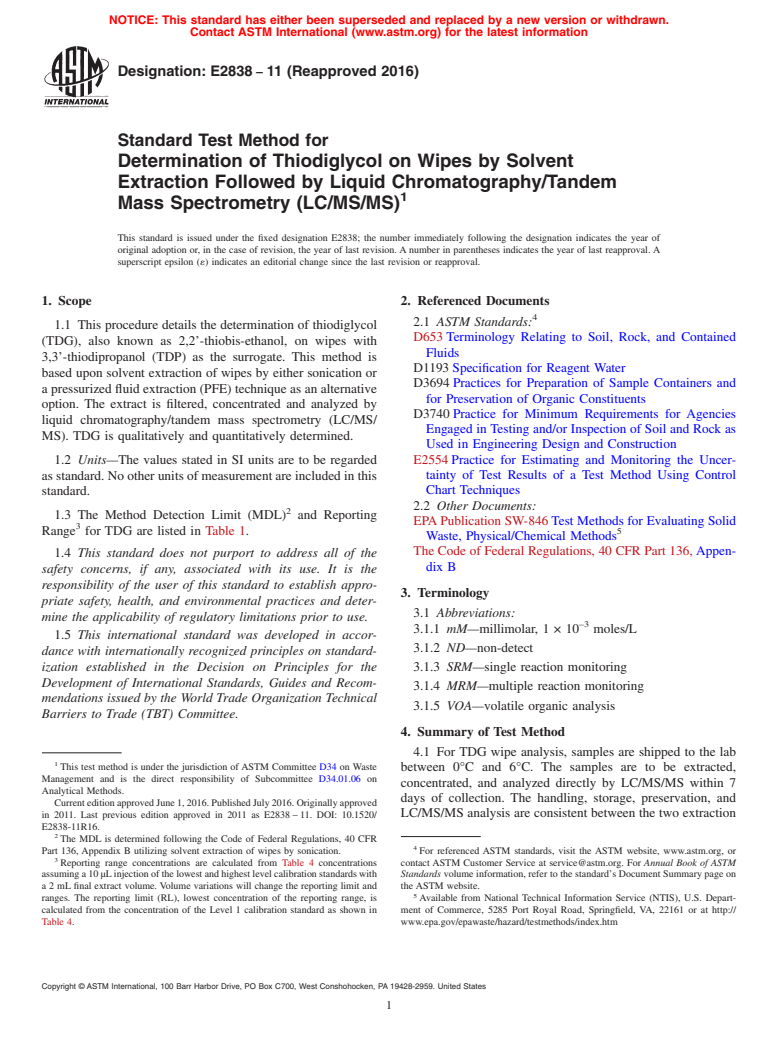
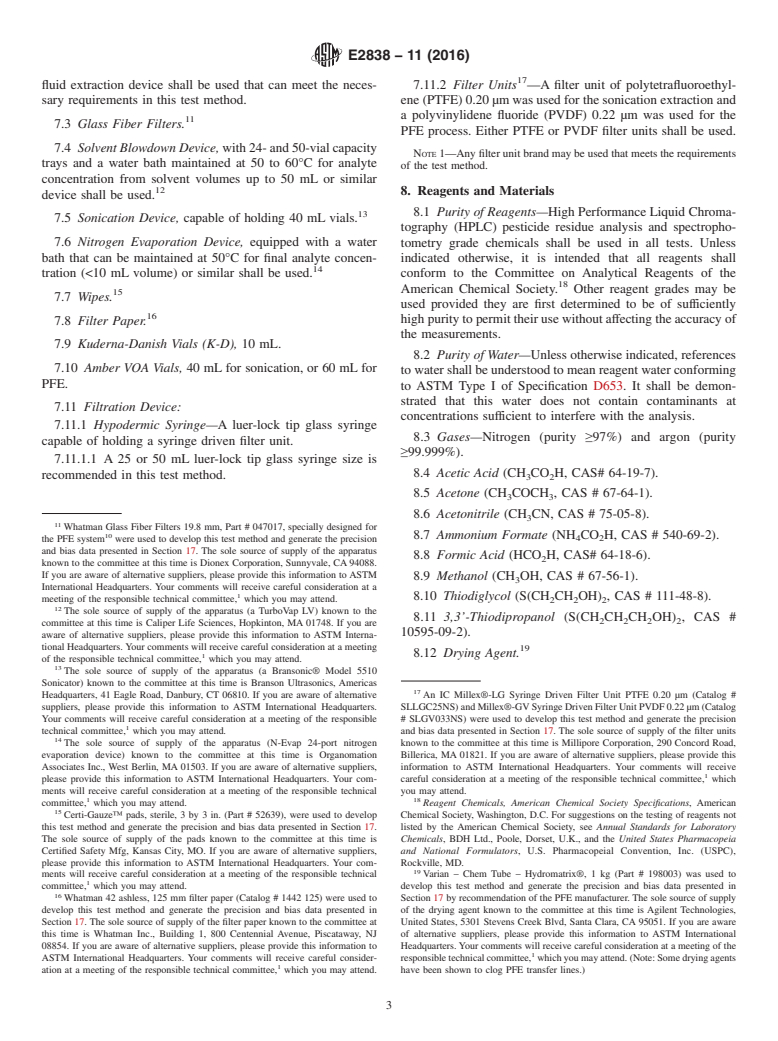
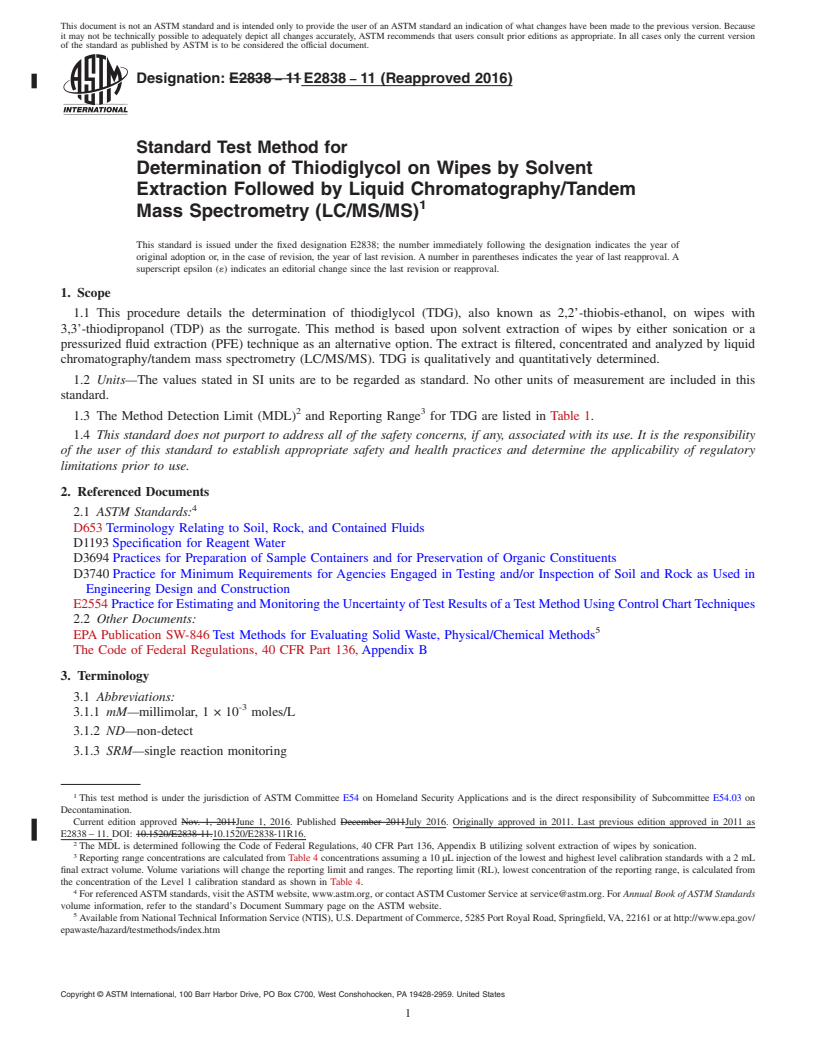
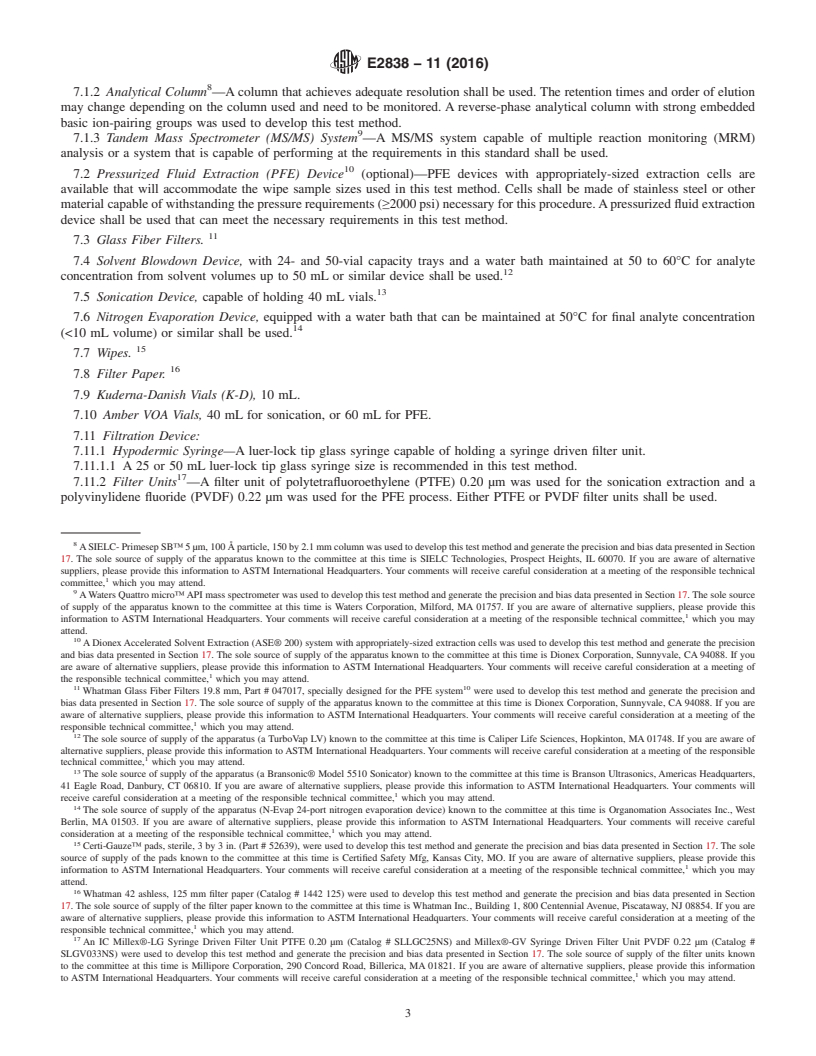
1.1 This procedure details the determination of thiodiglycol (TDG), also known as 2,2’-thiobis-ethanol, on wipes with 3,3’-thiodipropanol (TDP) as the surrogate. This method is based upon solvent extraction of wipes by either sonication or a pressurized fluid extraction (PFE) technique as an alternative option. The extract is filtered, concentrated and analyzed by liquid chromatography/tandem mass spectrometry (LC/MS/MS). TDG is qualitatively and quantitatively determined.
1.2 Units—The values stated in SI units are to be regarded as standard. No other units of measurement are included in this standard.
1.3 The Method Detection Limit (MDL)2 and Reporting Range3 for TDG are listed in Table 1.
1.4 This standard does not purport to address all of the safety concerns, if any, associated with its use. It is the responsibility of the user of this standard to establish appropriate safety and health practices and determine the applicability of regulatory limitations prior to use. (A) Chemical Abstract Service (CAS), A division of the American Chemical Society, 2540 Olentangy River Road, Columbus, OH, 43202, USA.
General Information
Buy Standard
Standards Content (Sample)
NOTICE: This standard has either been superseded and replaced by a new version or withdrawn.
Contact ASTM International (www.astm.org) for the latest information
Designation: E2838 − 11 (Reapproved 2016)
Standard Test Method for
Determination of Thiodiglycol on Wipes by Solvent
Extraction Followed by Liquid Chromatography/Tandem
Mass Spectrometry (LC/MS/MS)
This standard is issued under the fixed designation E2838; the number immediately following the designation indicates the year of
original adoption or, in the case of revision, the year of last revision.Anumber in parentheses indicates the year of last reapproval.A
superscript epsilon (´) indicates an editorial change since the last revision or reapproval.
1. Scope 2. Referenced Documents
2.1 ASTM Standards:
1.1 This procedure details the determination of thiodiglycol
D653Terminology Relating to Soil, Rock, and Contained
(TDG), also known as 2,2’-thiobis-ethanol, on wipes with
Fluids
3,3’-thiodipropanol (TDP) as the surrogate. This method is
D1193Specification for Reagent Water
based upon solvent extraction of wipes by either sonication or
D3694Practices for Preparation of Sample Containers and
apressurizedfluidextraction(PFE)techniqueasanalternative
for Preservation of Organic Constituents
option. The extract is filtered, concentrated and analyzed by
D3740Practice for Minimum Requirements for Agencies
liquid chromatography/tandem mass spectrometry (LC/MS/
Engaged inTesting and/or Inspection of Soil and Rock as
MS). TDG is qualitatively and quantitatively determined.
Used in Engineering Design and Construction
1.2 Units—The values stated in SI units are to be regarded E2554Practice for Estimating and Monitoring the Uncer-
tainty of Test Results of a Test Method Using Control
asstandard.Nootherunitsofmeasurementareincludedinthis
Chart Techniques
standard.
2.2 Other Documents:
1.3 The Method Detection Limit (MDL) and Reporting
EPAPublication SW-846Test Methods for Evaluating Solid
Range for TDG are listed in Table 1. 5
Waste, Physical/Chemical Methods
The Code of Federal Regulations, 40 CFR Part 136,Appen-
1.4 This standard does not purport to address all of the
dix B
safety concerns, if any, associated with its use. It is the
responsibility of the user of this standard to establish appro-
3. Terminology
priate safety, health, and environmental practices and deter-
3.1 Abbreviations:
mine the applicability of regulatory limitations prior to use.
–3
3.1.1 mM—millimolar,1×10 moles/L
1.5 This international standard was developed in accor-
3.1.2 ND—non-detect
dance with internationally recognized principles on standard-
ization established in the Decision on Principles for the 3.1.3 SRM—single reaction monitoring
Development of International Standards, Guides and Recom-
3.1.4 MRM—multiple reaction monitoring
mendations issued by the World Trade Organization Technical
3.1.5 VOA—volatile organic analysis
Barriers to Trade (TBT) Committee.
4. Summary of Test Method
4.1 For TDG wipe analysis, samples are shipped to the lab
This test method is under the jurisdiction ofASTM Committee D34 on Waste
between 0°C and 6°C. The samples are to be extracted,
Management and is the direct responsibility of Subcommittee D34.01.06 on
concentrated, and analyzed directly by LC/MS/MS within 7
Analytical Methods.
days of collection. The handling, storage, preservation, and
CurrenteditionapprovedJune1,2016.PublishedJuly2016.Originallyapproved
in 2011. Last previous edition approved in 2011 as E2838–11. DOI: 10.1520/ LC/MS/MS analysis are consistent between the two extraction
E2838-11R16.
The MDL is determined following the Code of Federal Regulations, 40 CFR
Part 136, Appendix B utilizing solvent extraction of wipes by sonication. For referenced ASTM standards, visit the ASTM website, www.astm.org, or
Reporting range concentrations are calculated from Table 4 concentrations contact ASTM Customer Service at service@astm.org. For Annual Book of ASTM
assuminga10µLinjectionofthelowestandhighestlevelcalibrationstandardswith Standardsvolumeinformation,refertothestandard’sDocumentSummarypageon
a 2 mLfinal extract volume. Volume variations will change the reporting limit and the ASTM website.
ranges. The reporting limit (RL), lowest concentration of the reporting range, is Available from National Technical Information Service (NTIS), U.S. Depart-
calculated from the concentration of the Level 1 calibration standard as shown in ment of Commerce, 5285 Port Royal Road, Springfield, VA, 22161 or at http://
Table 4. www.epa.gov/epawaste/hazard/testmethods/index.htm
Copyright © ASTM International, 100 Barr Harbor Drive, PO Box C700, West Conshohocken, PA 19428-2959. United States
E2838 − 11 (2016)
TABLE 1 Method Detection Limit and Reporting Range
6.2 All reagents and solvents shall be of pesticide residue
A
MDL Reporting Range purity or higher to minimize interference problems.
CAS
Analyte
Number (µg/wipe) (µg/wipe)
6.3 Matrix interferences may be caused by contaminants
Thiodiglycol 111-48-8 0.085 1-80
that are co-extracted from the sample. The extent of matrix
3,3’-Thiodipropanol 10595-09-2 Not done 1-80
(Surrogate) for surrogates
interferences can vary considerably from sample source de-
A
ChemicalAbstract Service (CAS),Adivision of theAmerican Chemical Society, pending on variations of the sample matrix.
2540 Olentangy River Road, Columbus, OH, 43202, USA.
7. Apparatus
7.1 LC/MS/MS System:
procedures described in this test method. Only one extraction
7.1.1 Liquid Chromatography (LC) System —ALC system
procedure is required, documenting which was performed.
is required in order to analyze samples. A LC system that is
4.2 TDG and TDP are identified by retention time and one
capable of performing at the flows, pressures, controlled
SRM transition. The target analyte and surrogate are quanti-
temperatures, sample volumes, and requirements of the stan-
tated using the SRM transitions utilizing an external calibra-
dard shall be used.
tion. The final report issued for each sample lists the concen-
7.1.2 Analytical Column —A column that achieves ad-
tration of TDG and the TDP recovery.
equate resolution shall be used. The retention times and order
ofelutionmaychangedependingonthecolumnusedandneed
5. Significance and Use
tobemonitored.Areverse-phaseanalyticalcolumnwithstrong
5.1 This is a performance based method, and modifications
embedded basic ion-pairing groups was used to develop this
are allowed to improve performance. test method.
5.1.1 Due to the rapid development of newer instrumenta-
7.1.3 Tandem Mass Spectrometer (MS/MS) System —A
tion and column chemistries changes to the analysis described
MS/MS system capable of multiple reaction monitoring
in this standard are allowed as long as better or equivalent
(MRM) analysis or a system that is capable of performing at
performance data result. Any modifications shall be docu-
the requirements in this standard shall be used.
mented and performance data generated. The user of the data
7.2 Pressurized Fluid Extraction (PFE) Device
generated by this Standard shall be made aware of these
(optional)—PFE devices with appropriately-sized extraction
changes and given the performance data demonstrating better
cellsareavailablethatwillaccommodatethewipesamplesizes
or equivalent performance.
used in this test method. Cells shall be made of stainless steel
5.2 TDG is a Schedule 2 compound under the Chemical
or other material capable of withstanding the pressure require-
Weapons Convention (CWC). Schedule 2 chemicals include
ments (≥2000 psi) necessary for this procedure.Apressurized
those that are precursors to chemical weapons, chemical
weapons agents or have a number of other non-military
A Waters Alliance® High Performance Liquid Chromatography (HPLC)
commercial uses. Schedule 2 chemicals can also be found in
System was used to develop this test method and generate the precision and bias
applications unrelated to chemical weapons. These chemicals
data presented in Section 17. The sole source of supply of the apparatus known to
the committee at this time is Waters Corporation, Milford, MA 01757. If you are
are used as ingredients to produce insecticides, herbicides,
aware of alternative suppliers, please provide this information to ASTM Interna-
lubricants, and some pharmaceutical products. TDG is a
tional Headquarters.Your comments will receive careful consideration at a meeting
mustardgasprecursorandadegradantaswellasaningredient 1
of the responsible technical committee, which you may attend.
in water-based inks, ballpoint pen inks, dyes, and some
A SIELC- Primesep SB™ 5 µm, 100 Å particle, 150 by 2.1 mm column was
used to develop this test method and generate the precision and bias data presented
pesticides.
in Section 17. The sole source of supply of the apparatus known to the committee
5.3 This method has been investigated for use on surface
atthistimeisSIELCTechnologies,ProspectHeights,IL60070.Ifyouareawareof
alternative suppliers, please provide this information to ASTM International
wipes. TDG is also a human metabolite resulting from sulfur
Headquarters.Yourcommentswillreceivecarefulconsiderationatameetingofthe
mustardexposurebutthismethodhasnotbeeninvestigatedfor
responsible technical committee, which you may attend.
such determinations. 9
AWatersQuattromicro™APImassspectrometerwasusedtodevelopthistest
method and generate the precision and bias data presented in Section 17. The sole
6. Interferences
source of supply of the apparatus known to the committee at this time is Waters
Corporation, Milford, MA 01757. If you are aware of alternative suppliers, please
6.1 Methodinterferencesmaybecausedbycontaminantsin
provide this information toASTM International Headquarters.Your comments will
solvents, reagents, glassware, and other apparatus producing
receive careful consideration at a meeting of the responsible technical committee,
which you may attend.
discrete artifacts or elevated baselines. All of these materials
A Dionex Accelerated Solvent Extraction (ASE® 200) system with
shall be demonstrated to be free from interferences by analyz-
appropriately-sized extraction cells was used to develop this test method and
ing laboratory reagent blanks under the same conditions as
generate the precision and bias data presented in Section 17. The sole source of
samples. supplyoftheapparatusknowntothecommitteeatthistimeisDionexCorporation,
Sunnyvale, CA94088. If you are aware of alternative suppliers, please provide this
information to ASTM International Headquarters. Your comments will receive
6 1
AdditionalinformationaboutCWCandthiodiglycolisavailableontheInternet careful consideration at a meeting of the responsible technical committee, which
at http://www.opcw.org (2009). you may attend.
E2838 − 11 (2016)
fluid extraction device shall be used that can meet the neces- 7.11.2 Filter Units —A filter unit of polytetrafluoroethyl-
sary requirements in this test method. ene(PTFE)0.20µmwasusedforthesonicationextractionand
a polyvinylidene fluoride (PVDF) 0.22 µm was used for the
7.3 Glass Fiber Filters.
PFE process. Either PTFE or PVDF filter units shall be used.
7.4 Solvent Blowdown Device,with24-and50-vialcapacity
NOTE1—Anyfilterunitbrandmaybeusedthatmeetstherequirements
trays and a water bath maintained at 50 to 60°C for analyte
of the test method.
concentration from solvent volumes up to 50 mL or similar
8. Reagents and Materials
device shall be used.
13 8.1 Purity of Reagents—HighPerformanceLiquidChroma-
7.5 Sonication Device, capable of holding 40 mL vials.
tography (HPLC) pesticide residue analysis and spectropho-
7.6 Nitrogen Evaporation Device, equipped with a water
tometry grade chemicals shall be used in all tests. Unless
bath that can be maintained at 50°C for final analyte concen- indicated otherwise, it is intended that all reagents shall
tration (<10 mL volume) or similar shall be used. conform to the Committee on Analytical Reagents of the
American Chemical Society. Other reagent grades may be
7.7 Wipes.
used provided they are first determined to be of sufficiently
highpuritytopermittheirusewithoutaffectingtheaccuracyof
7.8 Filter Paper.
the measurements.
7.9 Kuderna-Danish Vials (K-D), 10 mL.
8.2 Purity of Water—Unless otherwise indicated, references
7.10 Amber VOA Vials, 40 mLfor sonication, or 60 mLfor
towatershallbeunderstoodtomeanreagentwaterconforming
PFE.
to ASTM Type I of Specification D653. It shall be demon-
strated that this water does not contain contaminants at
7.11 Filtration Device:
concentrations sufficient to interfere with the analysis.
7.11.1 Hypodermic Syringe—A luer-lock tip glass syringe
8.3 Gases—Nitrogen (purity ≥97%) and argon (purity
capable of holding a syringe driven filter unit.
≥99.999%).
7.11.1.1 A 25 or 50 mL luer-lock tip glass syringe size is
8.4 Acetic Acid (CH CO H, CAS# 64-19-7).
recommended in this test method.
3 2
8.5 Acetone (CH COCH , CAS # 67-64-1).
3 3
8.6 Acetonitrile (CH CN, CAS # 75-05-8).
Whatman Glass Fiber Filters 19.8 mm, Part # 047017, specially designed for
10 8.7 Ammonium Formate (NH CO H, CAS # 540-69-2).
4 2
the PFE system were used to develop this test method and generate the precision
and bias data presented in Section 17. The sole source of supply of the apparatus
8.8 Formic Acid (HCO H, CAS# 64-18-6).
known to the committee at this time is Dionex Corporation, Sunnyvale, CA94088.
If you are aware of alternative suppliers, please provide this information toASTM
8.9 Methanol (CH OH, CAS # 67-56-1).
International Headquarters. Your comments will receive careful consideration at a
8.10 Thiodiglycol (S(CH CH OH) , CAS # 111-48-8).
meeting of the responsible technical committee, which you may attend.
2 2 2
The sole source of supply of the apparatus (a TurboVap LV) known to the
8.11 3,3’-Thiodipropanol (S(CH CH CH OH) , CAS #
2 2 2 2
committee at this time is Caliper Life Sciences, Hopkinton, MA01748. If you are
10595-09-2).
aware of alternative suppliers, please provide this information to ASTM Interna-
tional Headquarters.Your comments will receive careful consideration at a meeting 19
8.12 Drying Agent.
of the responsible technical committee, which you may attend.
The sole source of supply of the apparatus (a Bransonic® Model 5510
Sonicator) known to the committee at this time is Branson Ultrasonics, Americas
Headquarters, 41 Eagle Road, Danbury, CT 06810. If you are aware of alternative An IC Millex®-LG Syringe Driven Filter Unit PTFE 0.20 µm (Catalog #
suppliers, please provide this information to ASTM International Headquarters. SLLGC25NS)andMillex®-GVSyringeDrivenFilterUnitPVDF0.22µm(Catalog
Your comments will receive careful consideration at a meeting of the responsible # SLGV033NS) were used to develop this test method and generate the precision
technical committee, which you may attend. and bias data presented in
...
This document is not an ASTM standard and is intended only to provide the user of an ASTM standard an indication of what changes have been made to the previous version. Because
it may not be technically possible to adequately depict all changes accurately, ASTM recommends that users consult prior editions as appropriate. In all cases only the current version
of the standard as published by ASTM is to be considered the official document.
Designation: E2838 − 11 E2838 − 11 (Reapproved 2016)
Standard Test Method for
Determination of Thiodiglycol on Wipes by Solvent
Extraction Followed by Liquid Chromatography/Tandem
Mass Spectrometry (LC/MS/MS)
This standard is issued under the fixed designation E2838; the number immediately following the designation indicates the year of
original adoption or, in the case of revision, the year of last revision. A number in parentheses indicates the year of last reapproval. A
superscript epsilon (´) indicates an editorial change since the last revision or reapproval.
1. Scope
1.1 This procedure details the determination of thiodiglycol (TDG), also known as 2,2’-thiobis-ethanol, on wipes with
3,3’-thiodipropanol (TDP) as the surrogate. This method is based upon solvent extraction of wipes by either sonication or a
pressurized fluid extraction (PFE) technique as an alternative option. The extract is filtered, concentrated and analyzed by liquid
chromatography/tandem mass spectrometry (LC/MS/MS). TDG is qualitatively and quantitatively determined.
1.2 Units—The values stated in SI units are to be regarded as standard. No other units of measurement are included in this
standard.
2 3
1.3 The Method Detection Limit (MDL) and Reporting Range for TDG are listed in Table 1.
1.4 This standard does not purport to address all of the safety concerns, if any, associated with its use. It is the responsibility
of the user of this standard to establish appropriate safety and health practices and determine the applicability of regulatory
limitations prior to use.
2. Referenced Documents
2.1 ASTM Standards:
D653 Terminology Relating to Soil, Rock, and Contained Fluids
D1193 Specification for Reagent Water
D3694 Practices for Preparation of Sample Containers and for Preservation of Organic Constituents
D3740 Practice for Minimum Requirements for Agencies Engaged in Testing and/or Inspection of Soil and Rock as Used in
Engineering Design and Construction
E2554 Practice for Estimating and Monitoring the Uncertainty of Test Results of a Test Method Using Control Chart Techniques
2.2 Other Documents:
EPA Publication SW-846 Test Methods for Evaluating Solid Waste, Physical/Chemical Methods
The Code of Federal Regulations, 40 CFR Part 136, Appendix B
3. Terminology
3.1 Abbreviations:
-3
3.1.1 mM—millimolar, 1 × 10 moles/L
3.1.2 ND—non-detect
3.1.3 SRM—single reaction monitoring
This test method is under the jurisdiction of ASTM Committee E54 on Homeland Security Applications and is the direct responsibility of Subcommittee E54.03 on
Decontamination.
Current edition approved Nov. 1, 2011June 1, 2016. Published December 2011July 2016. Originally approved in 2011. Last previous edition approved in 2011 as
E2838 – 11. DOI: 10.1520/E2838-11.10.1520/E2838-11R16.
The MDL is determined following the Code of Federal Regulations, 40 CFR Part 136, Appendix B utilizing solvent extraction of wipes by sonication.
Reporting range concentrations are calculated from Table 4 concentrations assuming a 10 μL injection of the lowest and highest level calibration standards with a 2 mL
final extract volume. Volume variations will change the reporting limit and ranges. The reporting limit (RL), lowest concentration of the reporting range, is calculated from
the concentration of the Level 1 calibration standard as shown in Table 4.
For referenced ASTM standards, visit the ASTM website, www.astm.org, or contact ASTM Customer Service at service@astm.org. For Annual Book of ASTM Standards
volume information, refer to the standard’s Document Summary page on the ASTM website.
Available from National Technical Information Service (NTIS), U.S. Department of Commerce, 5285 Port Royal Road, Springfield, VA, 22161 or at http://www.epa.gov/
epawaste/hazard/testmethods/index.htm
Copyright © ASTM International, 100 Barr Harbor Drive, PO Box C700, West Conshohocken, PA 19428-2959. United States
E2838 − 11 (2016)
TABLE 1 Method Detection Limit and Reporting Range
A
MDL Reporting Range
CAS
Analyte
Number (μg/wipe) (μg/wipe)
Thiodiglycol 111-48-8 0.085 1-80
3,3’-Thiodipropanol 10595-09-2 Not done 1-80
(Surrogate) for surrogates
A
Chemical Abstract Service (CAS), A division of the American Chemical Society,
2540 Olentangy River Road, Columbus, OH, 43202, USA.
3.1.4 MRM—multiple reaction monitoring
3.1.5 VOA—volatile organic analysis
4. Summary of Test Method
4.1 For TDG wipe analysis, samples are shipped to the lab between 0°C and 6°C. The samples are to be extracted, concentrated,
and analyzed directly by LC/MS/MS within 7 days of collection. The handling, storage, preservation, and LC/MS/MS analysis are
consistent between the two extraction procedures described in this test method. Only one extraction procedure is required,
documenting which was performed.
4.2 TDG and TDP are identified by retention time and one SRM transition. The target analyte and surrogate are quantitated
using the SRM transitions utilizing an external calibration. The final report issued for each sample lists the concentration of TDG
and the TDP recovery.
5. Significance and Use
5.1 This is a performance based method, and modifications are allowed to improve performance.
5.1.1 Due to the rapid development of newer instrumentation and column chemistries changes to the analysis described in this
standard are allowed as long as better or equivalent performance data result. Any modifications shall be documented and
performance data generated. The user of the data generated by this Standard shall be made aware of these changes and given the
performance data demonstrating better or equivalent performance.
5.2 TDG is a Schedule 2 compound under the Chemical Weapons Convention (CWC). Schedule 2 chemicals include those that
are precursors to chemical weapons, chemical weapons agents or have a number of other non-military commercial uses. Schedule
2 chemicals can also be found in applications unrelated to chemical weapons. These chemicals are used as ingredients to produce
insecticides, herbicides, lubricants, and some pharmaceutical products. TDG is a mustard gas precursor and a degradant as well
as an ingredient in water-based inks, ballpoint pen inks, dyes, and some pesticides.
5.3 This method has been investigated for use on surface wipes. TDG is also a human metabolite resulting from sulfur mustard
exposure but this method has not been investigated for such determinations.
6. Interferences
6.1 Method interferences may be caused by contaminants in solvents, reagents, glassware, and other apparatus producing
discrete artifacts or elevated baselines. All of these materials shall be demonstrated to be free from interferences by analyzing
laboratory reagent blanks under the same conditions as samples.
6.2 All reagents and solvents shall be of pesticide residue purity or higher to minimize interference problems.
6.3 Matrix interferences may be caused by contaminants that are co-extracted from the sample. The extent of matrix
interferences can vary considerably from sample source depending on variations of the sample matrix.
7. Apparatus
7.1 LC/MS/MS System:
7.1.1 Liquid Chromatography (LC) System —A LC system is required in order to analyze samples. A LC system that is capable
of performing at the flows, pressures, controlled temperatures, sample volumes, and requirements of the standard shall be used.
Additional information about CWC and thiodiglycol is available on the Internet at http://www.opcw.org (2009).
A Waters Alliance® High Performance Liquid Chromatography (HPLC) System was used to develop this test method and generate the precision and bias data presented
in Section 17. The sole source of supply of the apparatus known to the committee at this time is Waters Corporation, Milford, MA 01757. If you are aware of alternative
suppliers, please provide this information to ASTM International Headquarters. Your comments will receive careful consideration at a meeting of the responsible technical
committee, which you may attend.
E2838 − 11 (2016)
7.1.2 Analytical Column —A column that achieves adequate resolution shall be used. The retention times and order of elution
may change depending on the column used and need to be monitored. A reverse-phase analytical column with strong embedded
basic ion-pairing groups was used to develop this test method.
7.1.3 Tandem Mass Spectrometer (MS/MS) System —A MS/MS system capable of multiple reaction monitoring (MRM)
analysis or a system that is capable of performing at the requirements in this standard shall be used.
7.2 Pressurized Fluid Extraction (PFE) Device (optional)—PFE devices with appropriately-sized extraction cells are
available that will accommodate the wipe sample sizes used in this test method. Cells shall be made of stainless steel or other
material capable of withstanding the pressure requirements (≥2000 psi) necessary for this procedure. A pressurized fluid extraction
device shall be used that can meet the necessary requirements in this test method.
7.3 Glass Fiber Filters.
7.4 Solvent Blowdown Device, with 24- and 50-vial capacity trays and a water bath maintained at 50 to 60°C for analyte
concentration from solvent volumes up to 50 mL or similar device shall be used.
7.5 Sonication Device, capable of holding 40 mL vials.
7.6 Nitrogen Evaporation Device, equipped with a water bath that can be maintained at 50°C for final analyte concentration
(<10 mL volume) or similar shall be used.
7.7 Wipes.
7.8 Filter Paper.
7.9 Kuderna-Danish Vials (K-D), 10 mL.
7.10 Amber VOA Vials, 40 mL for sonication, or 60 mL for PFE.
7.11 Filtration Device:
7.11.1 Hypodermic Syringe—A luer-lock tip glass syringe capable of holding a syringe driven filter unit.
7.11.1.1 A 25 or 50 mL luer-lock tip glass syringe size is recommended in this test method.
7.11.2 Filter Units —A filter unit of polytetrafluoroethylene (PTFE) 0.20 μm was used for the sonication extraction and a
polyvinylidene fluoride (PVDF) 0.22 μm was used for the PFE process. Either PTFE or PVDF filter units shall be used.
A SIELC- Primesep SB™ 5 μm, 100 Å particle, 150 by 2.1 mm column was used to develop this test method and generate the precision and bias data presented in Section
17. The sole source of supply of the apparatus known to the committee at this time is SIELC Technologies, Prospect Heights, IL 60070. If you are aware of alternative
suppliers, please provide this information to ASTM International Headquarters. Your comments will receive careful consideration at a meeting of the responsible technical
committee, which you may attend.
A Waters Quattro micro™ API mass spectrometer was used to develop this test method and generate the precision and bias data presented in Section 17. The sole source
of supply of the apparatus known to the committee at this time is Waters Corporation, Milford, MA 01757. If you are aware of alternative suppliers, please provide this
information to ASTM International Headquarters. Your comments will receive careful consideration at a meeting of the responsible technical committee, which you may
attend.
A Dionex Accelerated Solvent Extraction (ASE® 200) system with appropriately-sized extraction cells was used to develop this test method and generate the precision
and bias data presented in Section 17. The sole source of supply of the apparatus known to the committee at this time is Dionex Corporation, Sunnyvale, CA 94088. If you
are aware of alternative suppliers, please provide this information to ASTM International Headquarters. Your comments will receive careful consideration at a meeting of
the responsible technical committee, which you may attend.
11 10
Whatman Glass Fiber Filters 19.8 mm, Part # 047017, specially designed for the PFE system were used to develop this test method and generate the precision and
bias data presented in Section 17. The sole source of supply of the apparatus known to the committee at this time is Dionex Corporation, Sunnyvale, CA 94088. If you are
aware of alternative suppliers, please provide this information to ASTM International Headquarters. Your comments will receive careful consideration at a meeting of the
responsible technical committee, which you may attend.
The sole source of supply of the apparatus (a TurboVap LV) known to the committee at this time is Caliper Life Sciences, Hopkinton, MA 01748. If you are aware of
alternative suppliers, please provide this information to ASTM International Headquarters. Your comments will receive careful consideration at a meeting of the responsible
technical committee, which you may attend.
The sole source of supply of the apparatus (a Bransonic® Model 5510 Sonicator) known to the committee at this time is Branson Ultrasonics, Americas Headquarters,
41 Eagle Road, Danbury, CT 06810. If you are aware of alternative suppliers, please provide this information to ASTM International Headquarters. Your comments will
receive careful consideration at a meeting of the responsible technical committee, which you may attend.
The sole source of supply of the apparatus (N-Evap 24-port nitrogen evaporation device) known to the committee at this time is Organomation Associates Inc., West
Berlin, MA 01503. If you are aware of alternative suppliers, please provide this information to ASTM International Headquarters. Your comments will receive careful
consideration at a meeting of the responsible technical committee, which you may attend.
Certi-Gauze™ pads, sterile, 3 by 3 in. (Part # 52639), were used to develop this test method and generate the precision and bias data presented in Section 17. The sole
source of supply of the pads known to the committee at this time is Certified Safety Mfg, Kansas City, MO. If you are aware of alternative suppliers, please provide this
information to ASTM International Headquarters. Your comments will receive careful consideration at a meeting of the responsible technical committee, which you may
attend.
Whatman 42 ashless, 125 mm filter paper (Catalog # 1442 125) were used to develop this test method and generate the precision and bias data presented in Section
17. The sole source of supply of the filter paper known to the committee at this time is Whatman Inc., Building 1, 800 Centennial Avenue, Piscataway, NJ 08854. If you are
aware of alternative suppliers, please provide this information to ASTM International Headquarters. Your comments will receive careful conside
...
Questions, Comments and Discussion
Ask us and Technical Secretary will try to provide an answer. You can facilitate discussion about the standard in here.