


ASTM E2488-09(2014)
(Guide)Standard Guide for the Preparation and Evaluation of Liquid Baths Used for Temperature Calibration by Comparison
Standard Guide for the Preparation and Evaluation of Liquid Baths Used for Temperature Calibration by Comparison
SIGNIFICANCE AND USE
5.1 The design of a controlled temperature bath will determine what thermometers can be calibrated and to what extent an isothermal condition is achieved. The lack of thermal stability and uniformity of the bath are sources of error that contribute to the overall calibration uncertainty.
5.2 This guide describes a procedure for determining the effective working space for a controlled temperature fluid bath.
5.3 This guide describes a procedure for determining the thermal stability within a controlled temperature fluid bath. Overall thermal stability is composed of the bath performance as specified by the manufacturer of the bath equipment and as a component of calibration uncertainty.
5.4 This guide describes a procedure for determining the temperature uniformity of the working space of the controlled temperature fluid bath.
SCOPE
1.1 This guide is intended for use with controlled temperature comparison baths that contain test fluids and operate within the temperature range of –100°C to 550°C.
1.2 This guide describes the essential features of controlled temperature fluid baths used for the purpose of thermometer calibration by the comparison method.
1.3 This guide does not address the details on the design and construction of controlled-temperature fluid baths.
1.4 This guide describes a method to define the working space of a bath and evaluate the temperature variations within this space. Ideally, the working space will be as close as possible to isothermal.
1.5 This guide does not address fixed point baths, ice point baths or vapor baths.
1.6 This guide does not address fluidized powder baths.
1.7 This guide does not address baths that are programmed to change temperature.
1.8 The values stated in SI units are to be regarded as standard. No other units of measurement are included in this standard.
1.9 This standard does not purport to address all of the safety concerns, if any, associated with its use. It is the responsibility of the user of this standard to establish appropriate safety and health practices and determine the applicability of regulatory limitations prior to use.
General Information
Buy Standard
Standards Content (Sample)
NOTICE: This standard has either been superseded and replaced by a new version or withdrawn.
Contact ASTM International (www.astm.org) for the latest information
Designation: E2488 − 09 (Reapproved 2014)
Standard Guide for
the Preparation and Evaluation of Liquid Baths Used for
Temperature Calibration by Comparison
This standard is issued under the fixed designation E2488; the number immediately following the designation indicates the year of
original adoption or, in the case of revision, the year of last revision. A number in parentheses indicates the year of last reapproval. A
superscript epsilon (´) indicates an editorial change since the last revision or reapproval.
INTRODUCTION
Many of the Standards and Test Methods under the jurisdiction of ASTM committee E20 on
Temperature Measurement make reference to the use of controlled temperature fluid baths for the
calibration of thermometers by the comparison method. In this method the thermometer under test is
measured while immersed in an isothermal medium whose temperature is simultaneously determined
by a calibrated reference thermometer. The uncertainty of all such comparison calibrations depends
upon how well the isothermal conditions can be maintained.The bath temperature must be stable over
time and uniform within the working space at the operating temperatures. This guide provides basic
information, options and instructions that will enable the user to prepare and evaluate controlled
temperature baths for calibrations.
1. Scope 1.9 This standard does not purport to address all of the
safety concerns, if any, associated with its use. It is the
1.1 This guide is intended for use with controlled tempera-
responsibility of the user of this standard to establish appro-
ture comparison baths that contain test fluids and operate
priate safety and health practices and determine the applica-
within the temperature range of –100°C to 550°C.
bility of regulatory limitations prior to use.
1.2 This guide describes the essential features of controlled
temperature fluid baths used for the purpose of thermometer
2. Referenced Documents
calibration by the comparison method.
2.1 ASTM Standards:
1.3 Thisguidedoesnotaddressthedetailsonthedesignand
E1 Specification for ASTM Liquid-in-Glass Thermometers
construction of controlled-temperature fluid baths.
E344 Terminology Relating to Thermometry and Hydrom-
etry
1.4 This guide describes a method to define the working
E644 Test Methods for Testing Industrial Resistance Ther-
space of a bath and evaluate the temperature variations within
mometers
this space. Ideally, the working space will be as close as
E839 Test Methods for Sheathed Thermocouples and
possible to isothermal.
Sheathed Thermocouple Cable
1.5 This guide does not address fixed point baths, ice point
2.2 Other Documents:
baths or vapor baths.
ITS-90 The International Temperature Scale of 1990
1.6 This guide does not address fluidized powder baths.
NIST Monograph 126 Platinum Resistance Thermometry
1.7 This guide does not address baths that are programmed
NIST Monograph 150 Liquid-in-Glass Thermometry
to change temperature.
NIST SP250-22 Platinum Resistance Thermometer Calibra-
tions
1.8 The values stated in SI units are to be regarded as
standard. No other units of measurement are included in this
standard.
For referenced ASTM standards, visit the ASTM website, www.astm.org, or
contact ASTM Customer Service at service@astm.org. For Annual Book of ASTM
Standards volume information, refer to the standard’s Document Summary page on
This guide is under the jurisdiction of ASTM Committee E20 on Temperature the ASTM website.
Measurement and is the direct responsibility of Subcommittee E20.07 on Funda- Preston-Thomas, H., METROLOGIA, Vol. 27, 1990, pp 3-10 and 107 (errata).
mentals in Thermometry. Mangum, B. W., JOURNAL OF RESEARCH, National Institute of Standards and
Current edition approved Dec. 1, 2014. Published December 2014. Originally Technology, Vol 95, 1990 , p. 69.
approved in 2009. Last previous edition approved in 2009 as E2488 – 09. DOI: Available from National Institute of Standards and Technology (NIST), 100
10.1520/E2488-09R14. Bureau Dr., Stop 1070, Gaithersburg, MD 20899-1070, http://www.nist.gov.
Copyright © ASTM International, 100 Barr Harbor Drive, PO Box C700, West Conshohocken, PA 19428-2959. United States
E2488 − 09 (2014)
NIST SP 250-23 Liquid-in-Glass Thermometer Calibration 5.4 This guide describes a procedure for determining the
Service temperature uniformity of the working space of the controlled
temperature fluid bath.
2.3 Military Standards:
MIL-STD-202G Test Methods for Electronic and Electrical
Component Parts 6. Procedure
6.1 Bath System—A controlled temperature fluid bath sys-
3. Terminology
tem will incorporate most, if not all, of the following compo-
3.1 Standard terms used in this guide are defined in Termi-
nents: a fluid medium; a mechanical design that provides for
nology E344.
containment and circulation of the fluid; a monitoring
3.2 Definitions of Terms Specific to This Standard:
thermometer, a temperature control unit; and, elements that
3.2.1 bath gradient error, n—the error caused by tempera-
provide for heating, cooling or both. There are many commer-
ture differences within the working space of the bath.
cially available controlled temperature baths. These baths
3.2.2 immersion error, n—an error caused by heat
operate from as low as -100°C to as high as +550°C; although
conduction, radiation or both between the temperature sensing
no single bath system is capable of operation over that entire
portion of the sensor used in the bath and the environment
range. The design of each individual bath will create practical
external to the measurement system. Immersion error is caused
limits for the working temperature range. These limits are
by an incorrect immersion length and the resulting incorrect
determined by considering the minimum and maximum tem-
thermal contact of the temperature sensing portion of the
perature ratings for each of the components in the bath system.
sensor with the medium under measurement.
The user is advised to carefully review the bath manufacturer’s
3.2.3 isothermal, adj—of, related to, or designating a region literature to be certain that the bath system is suitable for the
of nominally uniform temperature.
intended calibration temperature range and the types of ther-
mometers to be tested. Figs. 1-4 represent various designs of
3.2.4 thermal stability, n—the degree of variability of the
controlled temperature fluid bath systems. Fig. 4 shows a block
temperatures within a specified working space over a specified
diagram of a comparison calibration setup.
time interval.
6.1.1 Fluid Medium—There are many types of fluid media
3.2.5 working space, n—the region within a controlled
suitable for use in liquid temperature comparison baths. The
temperature bath where the temperature uncertainty is main-
physical properties of the medium will establish the limits for
tained within acceptable limits for the purpose of performing
the safe operating temperature range as well as determine the
calibrations by the comparison method.
overall performance of the bath system. Fig. 5 provides a
3.2.6 working temperature range, n—the minimum to maxi-
partial listing of common bath media that have been used
mum temperature range for which the bath system provides
successfully for liquid temperature comparison baths. This
adequate stability and uniformity.
guide is not intended to restrict the user to only those fluids
4. Summary of Practice shown in Fig. 5. It is advisable for the user to review carefully
the manufacturer’s literature on any alternative fluid to be
4.1 This guide is intended to provide basic information that
certain that it complies with the safety considerations of
will enable the user to evaluate various controlled temperature
6.1.1.1.
bath features and to enable the user to prepare and properly
utilize such controlled temperature baths for calibration of 6.1.1.1 Safety and Environmental Impact Considerations—
(See 1.8.) It is strongly recommended that the Material Safety
thermometers by the comparison method.
Data Sheet (MSDS) of any material used as a fluid medium be
5. Significance and Use
reviewed and understood by the user before the material is
handled for the first time. The data sheets of all test fluids
5.1 The design of a controlled temperature bath will deter-
should be kept readily available during bath operation in case
mine what thermometers can be calibrated and to what extent
of accidents or spills. Additionally, some producers of bath
an isothermal condition is achieved. The lack of thermal
stability and uniformity of the bath are sources of error that fluids provide a Global Warming Potential Index in their
contribute to the overall calibration uncertainty. specifications that should be considered when choosing a bath
fluid.
5.2 This guide describes a procedure for determining the
(1) Temperature Limits—Fig. 5 provides minimum and
effective working space for a controlled temperature fluid bath.
maximum safe operating temperatures for several common
5.3 This guide describes a procedure for determining the
bath media. Flash point temperatures are also given for certain
thermal stability within a controlled temperature fluid bath.
flammable media. Consult the manufacturer’s MSDS docu-
Overall thermal stability is composed of the bath performance
ment for each bath fluid used.
as specified by the manufacturer of the bath equipment and as
(2) Flammability—Fluids are easily ignited above their
a component of calibration uncertainty.
flash point. Whenever possible, the bath fluid shall be main-
tained below the specified flash point. Some fluids are flam-
5 mable at room temperature so the user must exercise caution to
Available from Superintendent of Documents, U.S. Government Printing
Office, Washington, DC 20401. prevent the exposure of these fluids to open flames or sparks.
E2488 − 09 (2014)
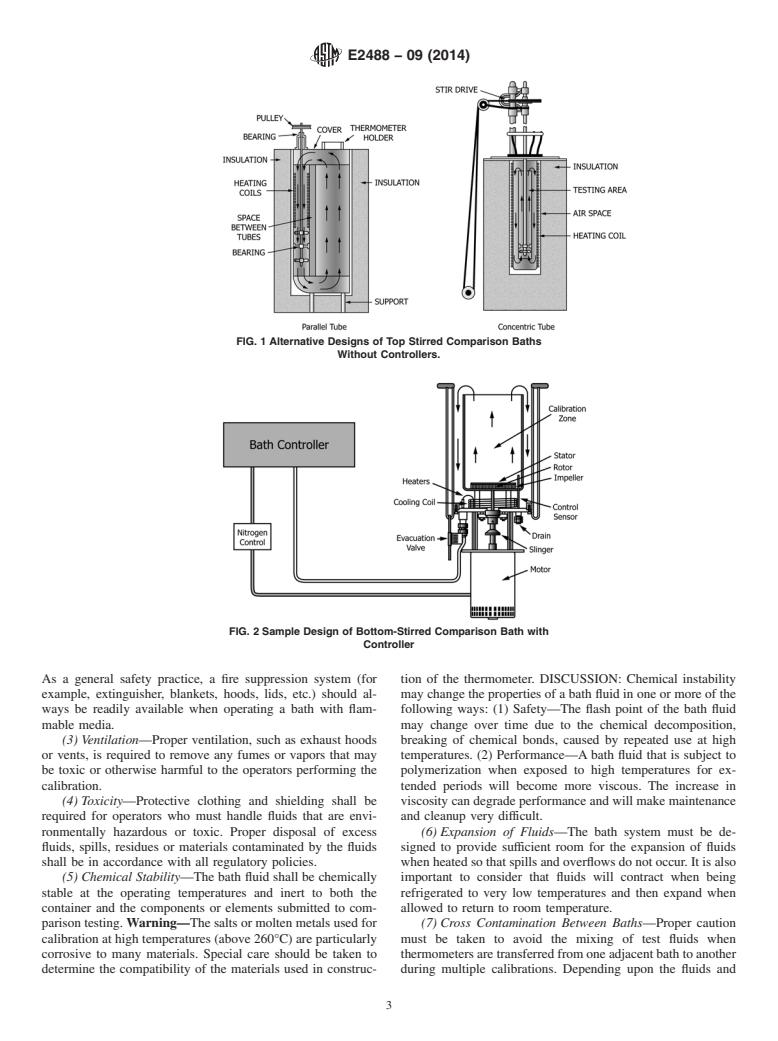
FIG. 1 Alternative Designs of Top Stirred Comparison Baths
Without Controllers.
FIG. 2 Sample Design of Bottom-Stirred Comparison Bath with
Controller
As a general safety practice, a fire suppression system (for tion of the thermometer. DISCUSSION: Chemical instability
example, extinguisher, blankets, hoods, lids, etc.) should al- may change the properties of a bath fluid in one or more of the
ways be readily available when operating a bath with flam- following ways: (1) Safety—The flash point of the bath fluid
mable media. may change over time due to the chemical decomposition,
(3) Ventilation—Proper ventilation, such as exhaust hoods breaking of chemical bonds, caused by repeated use at high
or vents, is required to remove any fumes or vapors that may temperatures. (2) Performance—A bath fluid that is subject to
be toxic or otherwise harmful to the operators performing the polymerization when exposed to high temperatures for ex-
calibration. tended periods will become more viscous. The increase in
(4) Toxicity—Protective clothing and shielding shall be viscosity can degrade performance and will make maintenance
required for operators who must handle fluids that are envi- and cleanup very difficult.
ronmentally hazardous or toxic. Proper disposal of excess (6) Expansion of Fluids—The bath system must be de-
fluids, spills, residues or materials contaminated by the fluids signed to provide sufficient room for the expansion of fluids
shall be in accordance with all regulatory policies. when heated so that spills and overflows do not occur. It is also
(5) Chemical Stability—The bath fluid shall be chemically important to consider that fluids will contract when being
stable at the operating temperatures and inert to both the refrigerated to very low temperatures and then expand when
container and the components or elements submitted to com- allowed to return to room temperature.
parison testing. Warning—The salts or molten metals used for (7) Cross Contamination Between Baths—Proper caution
calibration at high temperatures (above 260°C) are particularly must be taken to avoid the mixing of test fluids when
corrosive to many materials. Special care should be taken to thermometers are transferred from one adjacent bath to another
determine the compatibility of the materials used in construc- during multiple calibrations. Depending upon the fluids and
E2488 − 09 (2014)
FIG. 3 Sample Design of Comparison Bath with Integral Heating,
Cooling and Controller
FIG. 4 Block Diagram of Comparison Calibration Setup
temperatures involved, this can be a minor problem compro- These viscosity numbers are intended only as a general
mising bath performance, or it can be a major safety issue. For observation. The selection of a test fluid should be based upon
example, fluids at temperatures above 100ºC may react vio- a careful consideration of many factors.
lently if water or a wet object is immersed into them. The (2) Volatility—Fluids operated near their boiling points, or
introduction of water or organic materials into a molten salt that have a high vapor pressure under normal laboratory
bath can also produce violent reactions. environments will present a problem in controlling the bath
6.1.1.2 Performance Considerations —The physical proper- temperature. Evaporation from the surface of the liquid will
ties of the fluid media will determine the overall performance produce an undesirable temperature gradient because of the
of the bath system. increased cooling effect at the surface. In addition, the loss of
(1) Fluid Viscosity—The fluid viscosity can vary greatly bath fluid over time due to evaporation will cause the length of
over a wide temperature range and this can lead to problems immersion of the thermometers to vary unless the bath design
with stirring, agitation, or the establishment of undesirable is such that it replenishes the lost fluid.
temperature gradients. In practice, a bath fluid with a viscosity (3) Moisture Condensation—Refrigerated baths can cause
of ten centistokes, or less, usually provides good stirring and atmospheric moisture to condense on the surfaces above the
mixing action. When the viscosity of the fluid becomes 50 fluid. Precipitation of this moisture into the test fluid can
centistokes, or greater, the stirring and mixing becomes less seriously degrade the performance of the bath system.
effective and the possibility of temperature gradients is in- (4) Dielectric Properties—The volume resistivity, dielec-
creased. High viscosity also leads to excessive fluid drag-out. tric strength and dielectric constant of the fluid are important
E2488 − 09 (2014)
FIG. 5 Typical Bath Fluid Media and Useful Operating Temperature Ranges.
considerations whenever the thermometer or device under test for precision calibr
...
This document is not an ASTM standard and is intended only to provide the user of an ASTM standard an indication of what changes have been made to the previous version. Because
it may not be technically possible to adequately depict all changes accurately, ASTM recommends that users consult prior editions as appropriate. In all cases only the current version
of the standard as published by ASTM is to be considered the official document.
Designation: E2488 − 09 E2488 − 09 (Reapproved 2014)
Standard Guide for
the Preparation and Evaluation of Liquid Baths Used for
Temperature Calibration by Comparison
This standard is issued under the fixed designation E2488; the number immediately following the designation indicates the year of
original adoption or, in the case of revision, the year of last revision. A number in parentheses indicates the year of last reapproval. A
superscript epsilon (´) indicates an editorial change since the last revision or reapproval.
INTRODUCTION
Many of the Standards and Test Methods under the jurisdiction of ASTM committee E20E20 on
Temperature Measurement make reference to the use of controlled temperature fluid baths for the
calibration of thermometers by the comparison method. In this method the thermometer under test is
measured while immersed in an isothermal medium whose temperature is simultaneously determined
by a calibrated reference thermometer. The uncertainty of all such comparison calibrations depends
upon how well the isothermal conditions can be maintained. The bath temperature must be stable over
time and uniform within the working space at the operating temperatures. This guide provides basic
information, options and instructions that will enable the user to prepare and evaluate controlled
temperature baths for calibrations.
1. Scope
1.1 This guide is intended for use with controlled temperature comparison baths that contain test fluids and operate within the
temperature range of –100°C to 550°C.
1.2 This guide describes the essential features of controlled temperature fluid baths used for the purpose of thermometer
calibration by the comparison method.
1.3 This guide does not address the details on the design and construction of controlled-temperature fluid baths.
1.4 This guide describes a method to define the working space of a bath and evaluate the temperature variations within this
space. Ideally, the working space will be as close as possible to isothermal.
1.5 This guide does not address fixed point baths, ice point baths or vapor baths.
1.6 This guide does not address fluidized powder baths.
1.7 This guide does not address baths that are programmed to change temperature.
1.8 The values stated in SI units are to be regarded as standard. No other units of measurement are included in this standard.
1.9 This standard does not purport to address all of the safety concerns, if any, associated with its use. It is the responsibility
of the user of this standard to establish appropriate safety and health practices and determine the applicability of regulatory
limitations prior to use.
2. Referenced Documents
2.1 ASTM Standards:
E1 Specification for ASTM Liquid-in-Glass Thermometers
E344 Terminology Relating to Thermometry and Hydrometry
E644 Test Methods for Testing Industrial Resistance Thermometers
E839 Test Methods for Sheathed Thermocouples and Sheathed Thermocouple Cable
This practiceguide is under the jurisdiction of ASTM Committee E20 on Temperature Measurement and is the direct responsibility of Subcommittee E20.07 on
Fundamentals in Thermometry.
Current edition approved Nov. 1, 2009Dec. 1, 2014. Published February 2010December 2014. Originally approved in 2009. Last previous edition approved in 2009 as
E2488 – 09. DOI: 10.1520/E2488-09.10.1520/E2488-09R14.
For referenced ASTM standards, visit the ASTM website, www.astm.org, or contact ASTM Customer Service at service@astm.org. For Annual Book of ASTM Standards
volume information, refer to the standard’s Document Summary page on the ASTM website.
Copyright © ASTM International, 100 Barr Harbor Drive, PO Box C700, West Conshohocken, PA 19428-2959. United States
E2488 − 09 (2014)
2.2 Other Documents:
ITS-90 The International Temperature Scale of 1990
NIST Monograph 126 Platinum Resistance Thermometry
NIST Monograph 150 Liquid-in-Glass Thermometry
NIST SP 250-22 Platinum Resistance Thermometer Calibrations
NIST SP 250-23 Liquid-in-Glass Thermometer Calibration Service
2.3 Military Standards:
MIL-STD-202G Test Methods for Electronic and Electrical Component Parts
3. Terminology
3.1 Standard terms used in this guide are defined in Terminology E344.
3.2 Definitions of Terms Specific to This Standard:
3.2.1 bath gradient error, n—the error caused by temperature differences within the working space of the bath.
3.2.2 immersion error, n—an error caused by heat conduction, radiation or both between the temperature sensing portion of the
sensor used in the bath and the environment external to the measurement system. Immersion error is caused by an incorrect
immersion length and the resulting incorrect thermal contact of the temperature sensing portion of the sensor with the medium
under measurement.
3.2.3 isothermal, adj—of, related to, or designating a region of nominally uniform temperature.
3.2.4 thermal stability, n—the degree of variability of the temperatures within a specified working space over a specified time
interval.
3.2.5 working space, n—the region within a controlled temperature bath where the temperature uncertainty is maintained within
acceptable limits for the purpose of performing calibrations by the comparison method.
3.2.6 working temperature range, n—the minimum to maximum temperature range for which the bath system provides adequate
stability and uniformity.
4. Summary of Practice
4.1 This guide is intended to provide basic information that will enable the user to evaluate various controlled temperature bath
features and to enable the user to prepare and properly utilize such controlled temperature baths for calibration of thermometers
by the comparison method.
5. Significance and Use
5.1 The design of a controlled temperature bath will determine what thermometers can be calibrated and to what extent an
isothermal condition is achieved. The lack of thermal stability and uniformity of the bath are sources of error that contribute to
the overall calibration uncertainty.
5.2 This guide describes a procedure for determining the effective working space for a controlled temperature fluid bath.
5.3 This guide describes a procedure for determining the thermal stability within a controlled temperature fluid bath. Overall
thermal stability is composed of the bath performance as specified by the manufacturer of the bath equipment and as a component
of calibration uncertainty.
5.4 This guide describes a procedure for determining the temperature uniformity of the working space of the controlled
temperature fluid bath.
6. Procedure
6.1 Bath System—A controlled temperature fluid bath system will incorporate most, if not all, of the following components: a
fluid medium; a mechanical design that provides for containment and circulation of the fluid; a monitoring thermometer, a
temperature control unit; and, elements that provide for heating, cooling or both. There are many commercially available controlled
temperature baths. These baths operate from as low as -100°C to as high as +550°C; although no single bath system is capable
of operation over that entire range. The design of each individual bath will create practical limits for the working temperature
range. These limits are determined by considering the minimum and maximum temperature ratings for each of the components in
the bath system. The user is advised to carefully review the bath manufacturer’s literature to be certain that the bath system is
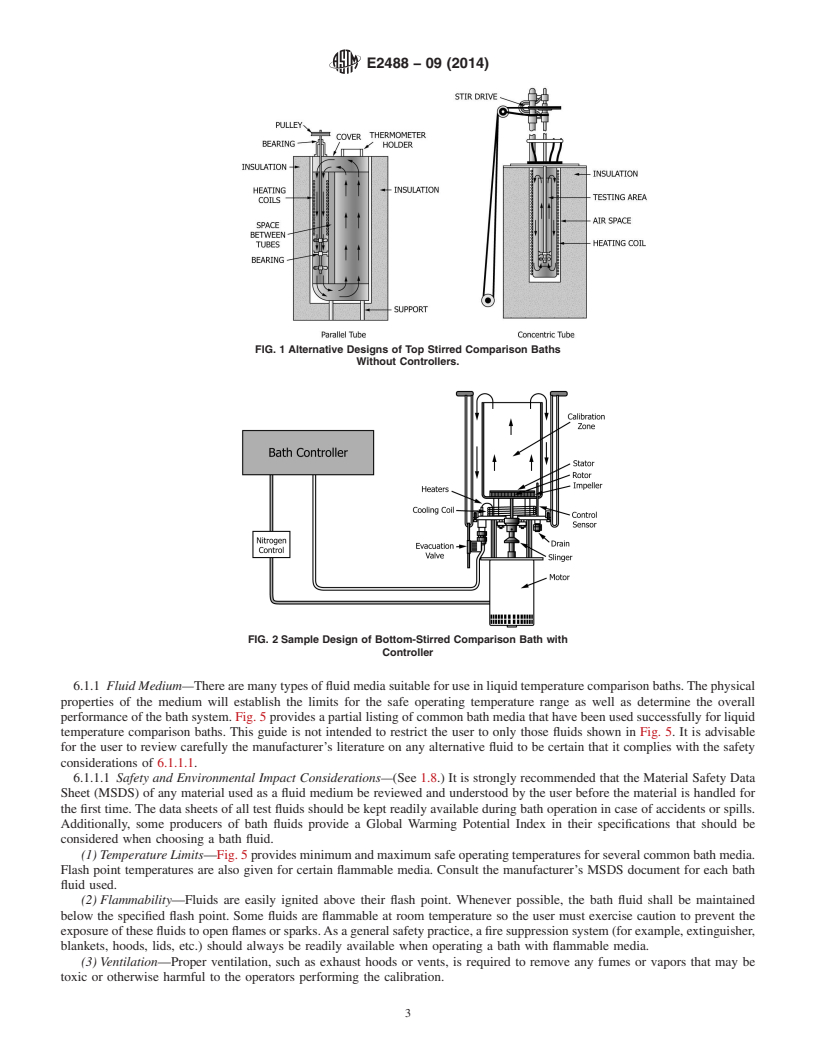
suitable for the intended calibration temperature range and the types of thermometers to be tested. Figs. 1-4 represent various
designs of controlled temperature fluid bath systems. Fig. 4 shows a block diagram of a comparison calibration setup.
Preston-Thomas, H., METROLOGIA, Vol. 27, 1990, pp 3-10 and 107 (errata). Mangum, B. W., JOURNAL OF RESEARCH, National Institute of Standards and
Technology, Vol 95, 1990 , p. 69.
Available from National Institute of Standards and Technology (NIST), 100 Bureau Dr., Stop 1070, Gaithersburg, MD 20899-1070, http://www.nist.gov.
Available from Superintendent of Documents, U.S. Government Printing Office, Washington, DC 20401.
E2488 − 09 (2014)
FIG. 1 Alternative Designs of Top Stirred Comparison Baths
Without Controllers.
FIG. 2 Sample Design of Bottom-Stirred Comparison Bath with
Controller
6.1.1 Fluid Medium—There are many types of fluid media suitable for use in liquid temperature comparison baths. The physical
properties of the medium will establish the limits for the safe operating temperature range as well as determine the overall
performance of the bath system. Fig. 5 provides a partial listing of common bath media that have been used successfully for liquid
temperature comparison baths. This guide is not intended to restrict the user to only those fluids shown in Fig. 5. It is advisable
for the user to review carefully the manufacturer’s literature on any alternative fluid to be certain that it complies with the safety
considerations of 6.1.1.1.
6.1.1.1 Safety and Environmental Impact Considerations—(See 1.8.) It is strongly recommended that the Material Safety Data
Sheet (MSDS) of any material used as a fluid medium be reviewed and understood by the user before the material is handled for
the first time. The data sheets of all test fluids should be kept readily available during bath operation in case of accidents or spills.
Additionally, some producers of bath fluids provide a Global Warming Potential Index in their specifications that should be
considered when choosing a bath fluid.
(1) Temperature Limits—Fig. 5 provides minimum and maximum safe operating temperatures for several common bath media.
Flash point temperatures are also given for certain flammable media. Consult the manufacturer’s MSDS document for each bath
fluid used.
(2) Flammability—Fluids are easily ignited above their flash point. Whenever possible, the bath fluid shall be maintained
below the specified flash point. Some fluids are flammable at room temperature so the user must exercise caution to prevent the
exposure of these fluids to open flames or sparks. As a general safety practice, a fire suppression system (for example, extinguisher,
blankets, hoods, lids, etc.) should always be readily available when operating a bath with flammable media.
(3) Ventilation—Proper ventilation, such as exhaust hoods or vents, is required to remove any fumes or vapors that may be
toxic or otherwise harmful to the operators performing the calibration.
E2488 − 09 (2014)
FIG. 3 Sample Design of Comparison Bath with Integral Heating,
Cooling and Controller
FIG. 4 Block Diagram of Comparison Calibration Setup
(4) Toxicity—Protective clothing and shielding shall be required for operators who must handle fluids that are environmentally
hazardous or toxic. Proper disposal of excess fluids, spills, residues or materials contaminated by the fluids shall be in accordance
with all regulatory policies.
(5) Chemical Stability—The bath fluid shall be chemically stable at the operating temperatures and inert to both the container
and the components or elements submitted to comparison testing. Warning—The salts or molten metals used for calibration at
high temperatures (above 260°C) are particularly corrosive to many materials. Special care should be taken to determine the
compatibility of the materials used in construction of the thermometer. DISCUSSION: Chemical instability may change the
properties of a bath fluid in one or more of the following ways: (1) Safety—The flash point of the bath fluid may change over time
due to the chemical decomposition, breaking of chemical bonds, caused by repeated use at high temperatures. (2) Performance—A
bath fluid that is subject to polymerization when exposed to high temperatures for extended periods will become more viscous.
The increase in viscosity can degrade performance and will make maintenance and cleanup very difficult.
(6) Expansion of Fluids—The bath system must be designed to provide sufficient room for the expansion of fluids when heated
so that spills and overflows do not occur. It is also important to consider that fluids will contract when being refrigerated to very
low temperatures and then expand when allowed to return to room temperature.
(7) Cross Contamination Between Baths—Proper caution must be taken to avoid the mixing of test fluids when thermometers
are transferred from one adjacent bath to another during multiple calibrations. Depending upon the fluids and temperatures
involved, this can be a minor problem compromising bath performance, or it can be a major safety issue. For example, fluids at
temperatures above 100ºC may react violently if water or a wet object is immersed into them. The introduction of water or organic
materials into a molten salt bath can also produce violent reactions.
E2488 − 09 (2014)
FIG. 5 Typical Bath Fluid Media and Useful Operating Temperature Ranges.
6.1.1.2 Performance Considerations —The physical properties of the fluid media will determine the overall performance of the
bath system.
(1) Fluid Viscosity—The fluid viscosity can vary greatly over a wide temperature range and this can lead to problems with
stirring, agitation, or the establishment of undesirable temperature gradients. In practice, a bath fluid with a viscosity of 10ten
centistokes, or less, usually provides good stirring and mixing action. When the viscosity of the fluid becomes 50 centistokes, or
greater, the stirring and mixing becomes less effective and the possibility of temperature gradients is increased. High viscosity also
leads to excessive fluid drag-out. These viscosity numbers are intended only as a general observation. The selection of a test fluid
should be based upon a careful consideration of many factors.
(2) Volatility—Fluids operated near their boiling points, or that have a high vapor pressure under normal laboratory
environments will present a problem in controlling the bath temperature. Evaporation from the surface of the liquid will produce
an undesirable temperature gradient because of the increased cooling effect at the surface. In addition, the loss of bath fluid over
time due to evaporation will cause the length of immersion of the thermometers to vary unless the bath design is such that it
replenishes the lost fluid.
(3) Moisture Condensation—Refrigerated baths can cause atmospheric moisture to condense on the surfaces above the fluid.
Precipitation of
...
Questions, Comments and Discussion
Ask us and Technical Secretary will try to provide an answer. You can facilitate discussion about the standard in here.