


ASTM D5284-09(2023)
(Test Method)Standard Test Method for Sequential Batch Extraction of Waste with Acidic Extraction Fluid
Standard Test Method for Sequential Batch Extraction of Waste with Acidic Extraction Fluid
SIGNIFICANCE AND USE
4.1 This test method is intended as a means for obtaining sequential extracts of a waste. The extracts may be used to estimate the release of certain constituents of the waste under the laboratory conditions described in this test method.
4.2 The pH of the extraction fluid used in this test method is to reflect the pH of acidic precipitation in the geographic region in which the waste being tested is to be disposed.
Note 1: Possible sources of information concerning the pH of precipitation in the geographic region of interest include state and federal environmental agencies, state universities, libraries, etc.
Note 2: For sequential batch extraction of waste using a nonacidic extraction fluid, see Test Method D4793.
4.3 An intent of this test method is for the final pH of each of the extracts to reflect the interaction of the extractant with the buffering capacity of the waste.
4.4 This test method is not intended to provide extracts that are representative of the actual leachate produced from a waste in the field or to produce extracts to be used as the sole basis of engineering design.
4.5 This test method has not been demonstrated to simulate actual disposal site leaching conditions.
4.6 This test method produces extracts that are amenable to the determination of both major and minor (trace) constituents. When minor constituents are being determined, it is especially important that precautions be taken in sample storage and handling to avoid possible contamination of the samples.
4.7 This test method has been tested to determine its applicability to certain inorganic components in the waste. This test method has not been tested for applicability to organic substances, volatile matter (see Note 5), or biologically active samples.
4.8 The agitation technique, rate, liquid-to-solid ratio, and filtration conditions specified in the procedure may not be suitable for extracting all types of wastes (see Sections 7 and 8 and Appendix X1).
SCOPE
1.1 This test method provides a procedure for the sequential leaching of a waste containing at least 5 % dry solids in order to generate solutions to be used to determine the constituents leached under the specified testing conditions.
1.2 This test method calls for the shaking of a known weight of waste with acidic extraction fluid of a specified composition as well as the separation of the liquid phase for analysis. The pH of the extraction fluid is to reflect the pH of acidic precipitation in the geographic region in which the waste being tested is to be disposed. The procedure is conducted ten times in sequence on the same sample of waste, and it generates ten solutions.
1.3 This test method is intended to describe the procedure for performing sequential batch extractions only. It does not describe all types of sampling and analytical requirements that may be associated with its application.
1.4 The values stated in SI units are to be regarded as standard. No other units of measurement are included in this standard.
1.5 This standard does not purport to address all of the safety concerns, if any, associated with its use. It is the responsibility of the user of this standard to establish appropriate safety, health, and environmental practices and determine the applicability of regulatory limitations prior to use.
1.6 This international standard was developed in accordance with internationally recognized principles on standardization established in the Decision on Principles for the Development of International Standards, Guides and Recommendations issued by the World Trade Organization Technical Barriers to Trade (TBT) Committee.
General Information
- Status
- Published
- Publication Date
- 31-Oct-2023
- Technical Committee
- D34 - Waste Management
- Drafting Committee
- D34.01.04 - Waste Leaching Techniques
Relations
- Effective Date
- 01-Nov-2023
- Refers
ASTM D4793-09(2023) - Standard Test Method for Sequential Batch Extraction of Waste with Water - Effective Date
- 01-Nov-2023
- Effective Date
- 01-May-2020
- Effective Date
- 01-May-2020
- Refers
ASTM D4793-09(2017) - Standard Test Method for Sequential Batch Extraction of Waste with Water - Effective Date
- 01-Sep-2017
Overview
ASTM D5284-09(2023), "Standard Test Method for Sequential Batch Extraction of Waste with Acidic Extraction Fluid," is an internationally recognized ASTM test method designed to generate sequential extracts from waste materials. These extracts are used to estimate the release of selected constituents from waste under controlled laboratory conditions, simulating the effects of acidic precipitation found in specific geographic regions. The standard offers a reliable and repeatable leaching procedure to support waste characterization, regulatory evaluation, and environmental risk assessment.
Key Topics
- Sequential Batch Extraction: The method involves shaking a known weight of waste containing at least 5% dry solids with a specially prepared acidic extraction fluid. The process is repeated ten times on the same sample, generating ten distinct extracts.
- Acidic Extraction Fluid: The pH of the extraction fluid is adjusted to reflect the pH of acidic precipitation pertinent to the region where waste disposal is anticipated. Sources for regional pH reference may include local environmental agencies or academic institutions.
- Waste Characterization: The procedure targets assessment of both major and minor (trace) inorganic constituents leached from waste, focusing on the interaction between acidic conditions and the waste’s buffering capacity.
- Applicability Limits: The method is primarily validated for inorganic compounds and may not yield accurate results for organic substances, volatile matter, or biologically active samples.
- Safety and Compliance: The standard emphasizes the necessity for proper safety, health, and environmental practices, as well as regulatory review before use.
Applications
ASTM D5284-09(2023) provides practical value in multiple domains:
- Regulatory Compliance: Helps determine the potential for waste constituents to leach into groundwater, supporting compliance with environmental regulations.
- Site Characterization: Used by environmental consultants and laboratories to simulate the effects of acid rain on disposed waste in a consistent, reproducible manner.
- Risk Assessment: Offers data for modeling contaminant mobility from industrial, mining, and municipal waste under acidic precipitation scenarios.
- Waste Management: Informs the design of waste containment systems by identifying the buffering capacity and leaching potential of materials.
- Analytical Support: Laboratories use the extracts for further analysis (e.g., using ICP spectrometry for elemental composition), following relevant sampling and analytical procedures.
Related Standards
ASTM D5284-09(2023) refers to and complements several other standards such as:
- ASTM D4793: Sequential Batch Extraction of Waste with Water - for nonacidic extractions.
- ASTM D75/D75M, D420, D2234/D2234M: Standard practices and guides for sampling of aggregates, site characterization, and coal.
- ASTM D653 & D1129: Terminology for soil, rock, and water-related materials and fluids.
- ASTM D1193 & D3370: Specifications for reagent water and practices for water sampling from process streams.
- ASTM D2777: Practice for precision and bias in committee D19 on water analytical methods.
These related standards help ensure consistency and accuracy in sample collection, extraction procedures, and analytical determinations.
By utilizing ASTM D5284-09(2023), waste management professionals, laboratories, and regulatory agencies are provided with a standardized, scientifically robust approach for evaluating the impact of acidic precipitation on waste leaching behavior, enabling better decision-making and environmental stewardship.
Get Certified
Connect with accredited certification bodies for this standard

NSF International
Global independent organization facilitating standards development and certification.

CIS Institut d.o.o.
Personal Protective Equipment (PPE) certification body. Notified Body NB-2890 for EU Regulation 2016/425 PPE.

Kiwa BDA Testing
Building and construction product certification.
Sponsored listings
Frequently Asked Questions
ASTM D5284-09(2023) is a standard published by ASTM International. Its full title is "Standard Test Method for Sequential Batch Extraction of Waste with Acidic Extraction Fluid". This standard covers: SIGNIFICANCE AND USE 4.1 This test method is intended as a means for obtaining sequential extracts of a waste. The extracts may be used to estimate the release of certain constituents of the waste under the laboratory conditions described in this test method. 4.2 The pH of the extraction fluid used in this test method is to reflect the pH of acidic precipitation in the geographic region in which the waste being tested is to be disposed. Note 1: Possible sources of information concerning the pH of precipitation in the geographic region of interest include state and federal environmental agencies, state universities, libraries, etc. Note 2: For sequential batch extraction of waste using a nonacidic extraction fluid, see Test Method D4793. 4.3 An intent of this test method is for the final pH of each of the extracts to reflect the interaction of the extractant with the buffering capacity of the waste. 4.4 This test method is not intended to provide extracts that are representative of the actual leachate produced from a waste in the field or to produce extracts to be used as the sole basis of engineering design. 4.5 This test method has not been demonstrated to simulate actual disposal site leaching conditions. 4.6 This test method produces extracts that are amenable to the determination of both major and minor (trace) constituents. When minor constituents are being determined, it is especially important that precautions be taken in sample storage and handling to avoid possible contamination of the samples. 4.7 This test method has been tested to determine its applicability to certain inorganic components in the waste. This test method has not been tested for applicability to organic substances, volatile matter (see Note 5), or biologically active samples. 4.8 The agitation technique, rate, liquid-to-solid ratio, and filtration conditions specified in the procedure may not be suitable for extracting all types of wastes (see Sections 7 and 8 and Appendix X1). SCOPE 1.1 This test method provides a procedure for the sequential leaching of a waste containing at least 5 % dry solids in order to generate solutions to be used to determine the constituents leached under the specified testing conditions. 1.2 This test method calls for the shaking of a known weight of waste with acidic extraction fluid of a specified composition as well as the separation of the liquid phase for analysis. The pH of the extraction fluid is to reflect the pH of acidic precipitation in the geographic region in which the waste being tested is to be disposed. The procedure is conducted ten times in sequence on the same sample of waste, and it generates ten solutions. 1.3 This test method is intended to describe the procedure for performing sequential batch extractions only. It does not describe all types of sampling and analytical requirements that may be associated with its application. 1.4 The values stated in SI units are to be regarded as standard. No other units of measurement are included in this standard. 1.5 This standard does not purport to address all of the safety concerns, if any, associated with its use. It is the responsibility of the user of this standard to establish appropriate safety, health, and environmental practices and determine the applicability of regulatory limitations prior to use. 1.6 This international standard was developed in accordance with internationally recognized principles on standardization established in the Decision on Principles for the Development of International Standards, Guides and Recommendations issued by the World Trade Organization Technical Barriers to Trade (TBT) Committee.
SIGNIFICANCE AND USE 4.1 This test method is intended as a means for obtaining sequential extracts of a waste. The extracts may be used to estimate the release of certain constituents of the waste under the laboratory conditions described in this test method. 4.2 The pH of the extraction fluid used in this test method is to reflect the pH of acidic precipitation in the geographic region in which the waste being tested is to be disposed. Note 1: Possible sources of information concerning the pH of precipitation in the geographic region of interest include state and federal environmental agencies, state universities, libraries, etc. Note 2: For sequential batch extraction of waste using a nonacidic extraction fluid, see Test Method D4793. 4.3 An intent of this test method is for the final pH of each of the extracts to reflect the interaction of the extractant with the buffering capacity of the waste. 4.4 This test method is not intended to provide extracts that are representative of the actual leachate produced from a waste in the field or to produce extracts to be used as the sole basis of engineering design. 4.5 This test method has not been demonstrated to simulate actual disposal site leaching conditions. 4.6 This test method produces extracts that are amenable to the determination of both major and minor (trace) constituents. When minor constituents are being determined, it is especially important that precautions be taken in sample storage and handling to avoid possible contamination of the samples. 4.7 This test method has been tested to determine its applicability to certain inorganic components in the waste. This test method has not been tested for applicability to organic substances, volatile matter (see Note 5), or biologically active samples. 4.8 The agitation technique, rate, liquid-to-solid ratio, and filtration conditions specified in the procedure may not be suitable for extracting all types of wastes (see Sections 7 and 8 and Appendix X1). SCOPE 1.1 This test method provides a procedure for the sequential leaching of a waste containing at least 5 % dry solids in order to generate solutions to be used to determine the constituents leached under the specified testing conditions. 1.2 This test method calls for the shaking of a known weight of waste with acidic extraction fluid of a specified composition as well as the separation of the liquid phase for analysis. The pH of the extraction fluid is to reflect the pH of acidic precipitation in the geographic region in which the waste being tested is to be disposed. The procedure is conducted ten times in sequence on the same sample of waste, and it generates ten solutions. 1.3 This test method is intended to describe the procedure for performing sequential batch extractions only. It does not describe all types of sampling and analytical requirements that may be associated with its application. 1.4 The values stated in SI units are to be regarded as standard. No other units of measurement are included in this standard. 1.5 This standard does not purport to address all of the safety concerns, if any, associated with its use. It is the responsibility of the user of this standard to establish appropriate safety, health, and environmental practices and determine the applicability of regulatory limitations prior to use. 1.6 This international standard was developed in accordance with internationally recognized principles on standardization established in the Decision on Principles for the Development of International Standards, Guides and Recommendations issued by the World Trade Organization Technical Barriers to Trade (TBT) Committee.
ASTM D5284-09(2023) is classified under the following ICS (International Classification for Standards) categories: 13.030.40 - Installations and equipment for waste disposal and treatment. The ICS classification helps identify the subject area and facilitates finding related standards.
ASTM D5284-09(2023) has the following relationships with other standards: It is inter standard links to ASTM D5284-09(2017), ASTM D4793-09(2023), ASTM D1129-13(2020)e2, ASTM D1129-13(2020)e1, ASTM D4793-09(2017). Understanding these relationships helps ensure you are using the most current and applicable version of the standard.
ASTM D5284-09(2023) is available in PDF format for immediate download after purchase. The document can be added to your cart and obtained through the secure checkout process. Digital delivery ensures instant access to the complete standard document.
Standards Content (Sample)
This international standard was developed in accordance with internationally recognized principles on standardization established in the Decision on Principles for the
Development of International Standards, Guides and Recommendations issued by the World Trade Organization Technical Barriers to Trade (TBT) Committee.
Designation: D5284 − 09 (Reapproved 2023)
Standard Test Method for
Sequential Batch Extraction of Waste with Acidic Extraction
Fluid
This standard is issued under the fixed designation D5284; the number immediately following the designation indicates the year of
original adoption or, in the case of revision, the year of last revision. A number in parentheses indicates the year of last reapproval. A
superscript epsilon (´) indicates an editorial change since the last revision or reapproval.
1. Scope 2. Referenced Documents
2.1 ASTM Standards:
1.1 This test method provides a procedure for the sequential
D75/D75M Practice for Sampling Aggregates
leaching of a waste containing at least 5 % dry solids in order
D420 Guide for Site Characterization for Engineering De-
to generate solutions to be used to determine the constituents
sign and Construction Purposes
leached under the specified testing conditions.
D653 Terminology Relating to Soil, Rock, and Contained
1.2 This test method calls for the shaking of a known weight
Fluids
of waste with acidic extraction fluid of a specified composition
D1129 Terminology Relating to Water
as well as the separation of the liquid phase for analysis. The
D1193 Specification for Reagent Water
pH of the extraction fluid is to reflect the pH of acidic
D2234/D2234M Practice for Collection of a Gross Sample
precipitation in the geographic region in which the waste being
of Coal
tested is to be disposed. The procedure is conducted ten times
D2777 Practice for Determination of Precision and Bias of
in sequence on the same sample of waste, and it generates ten
Applicable Test Methods of Committee D19 on Water
solutions.
D3370 Practices for Sampling Water from Flowing Process
Streams
1.3 This test method is intended to describe the procedure
D4793 Test Method for Sequential Batch Extraction of
for performing sequential batch extractions only. It does not
Waste with Water
describe all types of sampling and analytical requirements that
may be associated with its application.
3. Terminology
1.4 The values stated in SI units are to be regarded as
3.1 Definitions—For definitions of terms used in this test
standard. No other units of measurement are included in this
method, see Terminology D1129.
standard.
3.2 Symbols—Variables listed in this test method are defined
1.5 This standard does not purport to address all of the
in the individual sections in which they are discussed. A list of
safety concerns, if any, associated with its use. It is the
the defined variables is also provided in Section 11.
responsibility of the user of this standard to establish appro-
4. Significance and Use
priate safety, health, and environmental practices and deter-
mine the applicability of regulatory limitations prior to use.
4.1 This test method is intended as a means for obtaining
1.6 This international standard was developed in accor-
sequential extracts of a waste. The extracts may be used to
dance with internationally recognized principles on standard-
estimate the release of certain constituents of the waste under
ization established in the Decision on Principles for the
the laboratory conditions described in this test method.
Development of International Standards, Guides and Recom-
4.2 The pH of the extraction fluid used in this test method is
mendations issued by the World Trade Organization Technical
to reflect the pH of acidic precipitation in the geographic region
Barriers to Trade (TBT) Committee.
in which the waste being tested is to be disposed.
NOTE 1—Possible sources of information concerning the pH of precipi-
tation in the geographic region of interest include state and federal
This test method is under the jurisdiction of ASTM Committee D34 on Waste
Management and is the direct responsibility of Subcommittee D34.01.04 on Waste
Leaching Techniques. For referenced ASTM standards, visit the ASTM website, www.astm.org, or
Current edition approved Nov. 1, 2023. Published November 2023. Originally contact ASTM Customer Service at service@astm.org. For Annual Book of ASTM
approved in 1992. Last previous edition approved in 2017 as D5284 – 09 (2017). Standards volume information, refer to the standard’s Document Summary page on
DOI: 10.1520/D5284-09R23. the ASTM website.
Copyright © ASTM International, 100 Barr Harbor Drive, PO Box C700, West Conshohocken, PA 19428-2959. United States
D5284 − 09 (2023)
environmental agencies, state universities, libraries, etc.
5.14 Carboy-Type Container, with spigot, 20 to 50 L
capacity, of a composition suitable to the nature of the analyses
NOTE 2—For sequential batch extraction of waste using a nonacidic
to be performed (see Practices D3370).
extraction fluid, see Test Method D4793.
5.15 Large Glass Funnel.
4.3 An intent of this test method is for the final pH of each
5.16 Crucibles, porcelain, 20 mL capacity each, two per
of the extracts to reflect the interaction of the extractant with
the buffering capacity of the waste. waste.
5.17 Analytical Balance, capable of weighing to 0.1 mg.
4.4 This test method is not intended to provide extracts that
are representative of the actual leachate produced from a waste
5.18 Wash Bottle, 500 mL capacity.
in the field or to produce extracts to be used as the sole basis
5.19 Agitation Equipment, of any type that rotates the
of engineering design.
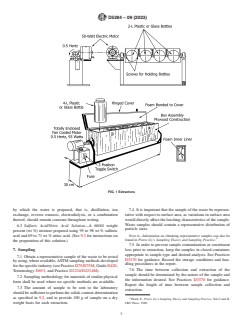
extraction vessel in an end-over-end fashion at a rate of 0.5 6
4.5 This test method has not been demonstrated to simulate
0.03 Hz such that the axis of rotation is horizontal and it passes
actual disposal site leaching conditions.
through the center of the bottle (see Fig. 1 and Appendix X1).
4.6 This test method produces extracts that are amenable to
NOTE 3—Similar devices having a different axial arrangement may be
the determination of both major and minor (trace) constituents.
used if equivalency can be demonstrated.
When minor constituents are being determined, it is especially
5.20 Pressure Filtration Assembly—A pressure filtration
important that precautions be taken in sample storage and
device of a composition suitable to the nature of the analyses
handling to avoid possible contamination of the samples.
to be performed and equipped with a 0.45 or 0.8 μm pore size
filter (see Note 8).
4.7 This test method has been tested to determine its
applicability to certain inorganic components in the waste. This
5.21 Extraction Vessels, cylindrical, wide mouth, of a com-
test method has not been tested for applicability to organic
position suitable to the nature of the waste and analyses to be
substances, volatile matter (see Note 5), or biologically active
performed, constructed of materials that will not allow sorption
samples.
of the constituents of interest, and sturdy enough to withstand
the impact of the falling sample fragments. The size of the
4.8 The agitation technique, rate, liquid-to-solid ratio, and
container should be selected so that the sample plus extraction
filtration conditions specified in the procedure may not be
fluid occupy approximately 95 % of the container. The con-
suitable for extracting all types of wastes (see Sections 7 and 8
tainers must have watertight closures. Containers for samples
and Appendix X1).
in which gases may be released should be provided with
venting mechanisms.
5. Apparatus
NOTE 4—Suitable container sizes range from 10 to 11 cm in diameter
5.1 Straightedge, such as a thin-edged yardstick.
and 22 to 33 cm in height.
5.2 Impermeable Sheet, of glazed paper, oil cloth, or other
flexible material of a composition suitable to the analytes of NOTE 5—Venting the container has the potential to affect the concen-
tration of volatile compounds in the extracts.
interest.
5.21.1 Extraction vessels should be cleaned in a manner
5.3 Drying Pans or Dishes (for example, aluminum tins,
consistent with the analyses to be performed (see Section 13 of
porcelain dishes, glass weighing pans), two per waste, suitable
Practices D3370).
to the waste being tested and the instructions given in 9.2.
5.4 Drying Oven—Any thermostatically controlled drying
6. Reagents
oven capable of maintaining a steady temperature of 62 °C in
6.1 Purity of Reagents—Reagent grade chemicals shall be
a range of 100 to 110 °C.
used in all tests. Unless otherwise indicated, it is intended that
5.5 Desiccator, having a capacity to hold the drying pans
all reagents shall conform to the specifications of the Commit-
described in 5.3 and the crucibles described in 5.16.
tee on Analytical Reagents of the American Chemical Society,
where such specifications are available. Other grades may be
5.6 Laboratory Balance, capable of weighing to 0.1 g.
used, provided it is first ascertained that the reagent is of
5.7 Erlenmeyer Flask, 2 L capacity, equipped with a mag-
sufficiently high purity to permit its use without lessening the
netic stir bar.
accuracy of the determination.
5.8 Magnetic Stir Plate.
6.2 Purity of Water—Unless otherwise indicated, references
to water shall be understood to mean Type IV reagent water at
5.9 Graduated Cylinder, 1 or 2 L capacity.
18 to 27 °C conforming to Specification D1193. The method
5.10 Pipet, 1 mL capacity.
5.11 Volumetric Flask, 1 L capacity.
Reagent Chemicals, American Chemical Society Specifications, American
5.12 Pipet, 10 mL capacity. (Various other sized pipets,
Chemical Society, Washington, DC. For suggestions on the testing of reagents not
including micropipets, may be necessary for 9.3.2.) listed by the American Chemical Society, see Analar Standards for Laboratory
Chemicals, BDH Ltd., Poole, Dorset, U.K., and the United States Pharmacopeia
5.13 pH Meter—Any pH meter with a readability of 0.01
and National Formulary, U.S. Pharmacopeial Convention, Inc. (USPC), Rockville,
units and an accuracy of 60.05 units at 25 °C. MD.
D5284 − 09 (2023)
FIG. 1 Extractors
by which the water is prepared, that is, distillation, ion 7.4 It is important that the sample of the waste be represen-
exchange, reverse osmosis, electrodialysis, or a combination tative with respect to surface area, as variations in surface area
thereof, should remain constant throughout testing. would directly affect the leaching characteristics of the sample.
Waste samples should contain a representative distribution of
6.3 Sulfuric Acid/Nitric Acid Solution—A 60/40 weight
particle sizes.
percent (wt %) mixture prepared using 95 to 98 wt % sulfuric
acid and 69 to 71 wt % nitric acid. (See 9.3 for instructions on NOTE 6—Information on obtaining representative samples can also be
found in Pierre Gy’s Sampling Theory and Sampling Practice.
the preparation of this solution.)
7.5 In order to prevent sample contamination or constituent
7. Sampling loss prior to extraction, keep the samples in closed containers
appropriate to sample type and desired analysis. See Practices
7.1 Obtain a representative sample of the waste to be tested
D3370 for guidance. Record the storage conditions and han-
by using, where available, ASTM sampling methods developed
dling procedures in the report.
for the specific industry (see Practice D75/D75M, Guide D420,
7.6 The time between collection and extraction of the
Terminology D653, and Practice D2234/D2234M).
sample should be determined by the nature of the sample and
7.2 Sampling methodology for materials of similar physical
the information desired. See Practices D3370 for guidance.
form shall be used where no specific methods are available.
Report the length of time between sample collection and
7.3 The amount of sample to be sent to the laboratory
extraction.
should be sufficient to perform the solids content determination
as specified in 9.2, and to provide 100 g of sample on a dry
Pitard, F., Pierre Gy’s Sampling Theory and Sampling Practice, Vols I and II,
weight basis for each extraction. CRC Press, 1989.
D5284 − 09 (2023)
8. Sample Preparation 9.2.1 Dry to a constant weight, at 104 6 2 °C, two dishes or
pans of size suitable to the solid waste being tested. Cool in a
8.1 For free-flowing particulate solid wastes, obtain a
desiccator and weigh. Record the values to 60.1 g.
sample of the approximate size required in the test by quarter-
9.2.2 Place 50 g of the waste to be tested into each pan.
ing the sample (Section 7) received for testing on an imper-
Record the mass of sample in each pan to 60.1 g.
meable sheet of glazed paper, oil cloth, or other flexible
material having a composition suitable to the analytes of 9.2.3 Dry 16 to 20 h at 104 6 2 °C. Record the temperature
interest, as follows: and time of the drying period.
8.1.1 Empty the sample container into the center of the
9.2.4 Cool to room temperature in a desiccator and reweigh.
sheet.
Record the mass to 60.1 g.
8.1.2 Gently flatten the sample out with a suitable straight-
9.2.5 Repeat the steps given in 9.2.3 and 9.2.4 until constant
edge until it is spread uniformly to a depth at least twice the
container-sample masses are obtained. Discard the dried
maximum particle diameter.
samples following completion of this step.
8.1.3 Remix the sample by lifting a corner of the sheet and
9.2.6 Calculate the solids content of the sample from the
drawing it low across to the opposite corner in such a manner
data obtained in 9.2.1, 9.2.2, and 9.2.4 as follows:
that the material is made to roll over and over and does not
S 5 A/B (1)
merely slide along. Continue the operation with each corner,
proceeding in a clockwise direction. Repeat this operation ten
where:
times.
A = mass of sample after drying, g,
8.1.4 Lift all four corners of the sheet toward the center and,
B = original mass of sample, g, and
holding all four corners together, raise the entire sheet into the
S = solids content, g/g.
air to form a pocket for the sample.
Average the two values obtained. Record the solids content.
8.1.5 Repeat the procedure described in 8.1.2 to flatten the
sample out.
9.3 Preparation of Extraction Fluid—Prepare a 60/40 wt %
8.1.6 With a straightedge (such as a thin-edged yardstick) at mixture of sulfuric acid/nitric acid. Cautiously mix 60 g of
concentrated sulfuric acid with 40 g of concentrated nitric acid.
least as long as the flattened mound of sample, gently divide
the sample into quarters. Make an effort to avoid using pressure The preparation of this mixture should be performed in a
on the straightedge sufficient to cause damage to the particles. laboratory fume hood.
8.1.7 Discard the alternate quarters.
9.3.1 Using the 60/40 sulfuric acid/nitric acid mixture,
8.1.8 If further reduction of the sample size is necessary, prepare a second solution by diluting 1.0 mL of the 60/40
repeat the steps given in 8.1.3 – 8.1.7. Use a sample size to
mixture to 1000 mL using water and a 1 L volumetric flask.
provide 100 g of solid on a dry weight basis for each
9.3.2 Using the 1/1000 solution prepared in 9.3.1, prepare
extraction. Provide additional samples for the determination of
the extraction fluid having the desired pH 6 0.05 (see 4.2) by
solids content (see 9.2). Use of a sample size other than 100 g
pipeting a volume of the 1/1000 solution into 2000 mL of water
of solid on a dry weight basis for extraction is not recom-
with mixing until the desired pH 6 0.05 is achieved. A
mended; however, if a different sample size is used, report this
recommended method for preparing the extraction fluid is to
fact.
add 2000 mL of water to a 2 L Erlenmeyer flask equipped with
a magnetic stir bar. Place the Erlenmeyer flask on a magnetic
NOTE 7—For other acceptable methods of mixing and subsampling
free-flowing solid particulate wastes, see Pierre Gy’s Sampling Theory stir plate and add the 1/1000 solution to the flask with stirring.
and Sampling Practice. The method of subsampling should be deter-
Shake the mixture vigorously and measure its pH once the
mined by the physical properties of the waste, analytes of interest, and
solution is static. Continue this process until the desired
equipment available.
solution pH 6 0.05 is reached. Record the amount of 1/1000
8.2 For field-cored solid wastes or castings produced in the
solution added to 2000 mL of water to achieve the desired pH
laboratory, cut a representative section weighing approxi-
6 0.05. Record the pH value of the solution. Additional 2 L
mately 100 g for testing, plus samples for the determination of
batches of the extraction fluid can be prepared by mixing the
solids content. Shape the sample so that the leaching solution
determined volume of 1/1000 solution with 2000 mL of water.
will cover the material to be leached.
The pH of the extraction fluid must be within 60.05 of the
desired value for use in the extraction procedure. For extracting
8.3 For multiphasic wastes, mix thoroughly to ensure that a
different wastes requiring the same extraction fluid pH or
representative sample will be withdrawn. Take samples for the
performing replicate extractions, multiple batches of extraction
determination of solids content at the same time that test
fluid can be prepared and measured for correct pH, and if the
samples are taken.
pH is within 60.05 of the desired value, the batches can be
combined in a carboy-type container of a composition suitable
9. Procedure
to the nature of the analyses to be performed. The pH of the
9.1 Record a physical description of the sample to be tested,
resulting solution in the carboy must be measured once again
including particle size so far as it is known.
to verify the correct pH before using the solution in the
extraction procedure and as a rinse solution (see the procedures
9.2 Solids Content—Determine the solids content of two
separate portions of the sample as follows: given in 9.4 and 9.7). If the pH value is not within the above
D5284 − 09 (2023)
specification, the solution shall not be used, and fresh extrac- content in 9.6, and then preserve the extract in a manner
tion fluid shall be prepared. Record the pH value of each batch, consistent with the chemical analyses or biological testing
and of the solution in the carboy, prior to its use. procedures to be performed (Practices D3370, Section 15).
9.4 Extraction Procedure—If the entire procedure cannot be
NOTE 8—Analytical results may be affected by the type of filter used.
conducted without interruption, at least the first four extraction
If a 0.8 μm filter pore size is used, the resulting extract should be digested
prior to elemental analysis. The composition of the filter should also be
sequences must be conducted without interruption.
considered. If the filter is composed of material that may contaminate the
9.4.1 Determine the mass of the extraction vessel to be used
extract during filtration, the filter should be washed in the filtration device
in the extraction procedure to the nearest 0.1 g. Record the
in a manner consistent with the chemical analyses or biological testing
mass of the extraction vessel, M . Use one extraction vessel
v1
procedures to be performed on the extract. For example, for elemental
per waste throughout the sequence of extractions.
analysis of the extract, if a filter composed of borosilicate glass fiber is
9.4.2 Add 100 g (weighed to 60.1 g) of solid waste on a dry used, in order to prevent contamination, it should be washed in the
filtration device with a dilute acid solution and rinsed with approximately
weight basis to the extraction vessel. Calculate the amount of
2 L of water prior to filtration.
as-received waste to add using the following equation:
NOTE 9—Prefilters can be used only if it is absolutely necessary (filtrate
M 5 (2)
S for analysis or testing cannot be obtained unless a prefilter is used) due to
the loss of sample trapped in the pores of the prefilter and the possibility
where:
of the prefilter disintegrating during rinsing.
S = solids content (g/g) determined in 9.2.6, and
NOTE 10—It is recommended that all filtrations be performed in a hood.
M = mass of as-received waste (weighed to 60.1 g) to add
to the extraction vessel to yield 100 g of solid waste.
9.6 Total Dissolved Solids Content (TDS)—Add a 10.0 g
9.4.2.1 If a mass of solid waste on a dry weight basis other aliquot of the extract to each of two 110 6 2 °C dried,
than 100 g is used, Eq 2-4 must be modified to reflect the use preweighed crucibles. Place the samples in a drying oven at
of a mass other than 100 g. Replace 100 in these equations with 110 6 2 °C for 3 h. Record the drying oven temperature and
drying time. Remove the crucibles and let them cool in a
the mass used. The use of a mass other than 100 g is not
recommended. desiccator. Reweigh the crucibles and record their weights to
60.1 mg.
9.4.3 Add a mass in g, M , of extraction fluid (see 9.3) to
ef
the extraction vessel determined using the following equations:
NOTE 11—Only one drying is performed to limit the contact time
M 5 M 2 100 (3)
between the solid and the rinse solution in the extraction vessel prior to the
sw
next extraction step (see 9.7, Section 10, and 10.7).
where:
9.6.1 If the mass of solid lost through dissolution, M (see
d
M = mass of moisture (g) in the sample added to the
sw
10.2), in the first extract is less than 1 % of the mass of solid
extraction vessel, and
used in the first extraction step, and if the percent of solid lost
M 5 ~20! ~100! 2 M (4)
ef sw
through dissolution in the second extraction step is less than or
equal to the percent of solid lost through dissolution in the first
This will provide a solid-to-liquid ratio of 1:20 in the
extraction step, the determination of TDS in the following
extraction vessel.
extracts is not required, and the user can assume that TDS and
9.4.4 Agitate continuously for 18 6 0.25 h at 18 to 27 °C.
M are equal to 0 for Eq 6 and 7 for Extracts 3 through 10.
Record the agitation time and temperature.
d
9.4.5 Open the extraction vessel. Observe and record any
9.7 Quantitatively transfer the damp solid from the filter
visible physical changes in the sample and leaching solution.
back to the original extraction vessel, including the filter. Use
Record the pH of the waste/leaching solution slurry.
extraction fluid prepared as described in 9.3 from a preweighed
9.5 Filtration—Transfer as much of the waste/leaching wash bottle to assist in this transfer and to rinse the filtration
solution as possible through a large glass funnel to a pressure device. No more than 500 g of rinse solution should be used.
filtration device equipped with a 0.45 or 0.8 μm filter. Transfer Use the smallest amount of rinse solution possible to achieve a
the mixed slurry. Do not decant. Invert the extraction vessel thorough transfer. Using tweezers or a similar device, recover
over the filtration device and allow the liquid to drain for 1 min the filter and rinse the adhering solid into the extraction vessel
from the solid remaining in the extraction vessel. It is impor- with rinse extraction fluid from the pre-weighed wash bottle.
tant to achieve as complete a transfer of fluid from the Do not leave the filter in the extraction vessel. Reweigh the
extraction vessel to the filtration device as possible. Pressure wash bottle to determine the amount of rinse solution used in
filter the liquid through the filter using nitrogen gas or an inert the transfer. Record this value as M . Weigh the extraction
R
gas that will not contaminate or change the integrity of the vessel following the transfer described above, and record this
sample. After the extract has passed through the filter, continue value as M . The extraction vessel may be sealed until a
v
running gas through the filtration device at 30 psi for 3 min. feasible time for the addition of new extraction fluid. This is to
The filtrate obtained is the extract mentioned in this test enable filtration during the next sequence at a reasonable time
method (see 9.6 and 10.8). Determine the mass of the filtrate during the day. If the slurry is stored for longer than 6 h in the
collected and report it as M for the extraction step. Measure the extraction vessel prior to the addition of new extraction fluid,
f
pH of the extract immediately, remove the amount of filtrate the data generated by analysis of the extracts should be plotted
necessary for the determination of total dissolved solids to check for perturbation of the data curve.
D5284 − 09 (2023)
e21
10. Calculation C 5 M /20 M C (11)
@ ~ !#@ #
j li s i
10.1 Calculate the TDS in milligrams per gram of the filtrate
where:
using the following equation:
C = concentration of the constituent in the filtrate from
i
TDS 5 ~M 2 M !/~10 g! (5)
the previous extraction step,
sc c
M = M from the previous extraction step, and
li l
where:
e−1
M = mass of solid extracted in the current extraction step
s
M = mass of the crucible and dried solids, mg, and
sc
(see Note 12).
M = mass of the crucible, mg.
c
10.2 Calculate the mass of the solid in grams lost through
11. Definitions of Variables
dissolution, M , using the following equation:
d
11.1 The following variables must be determined when
M 5 ~TDS! ~M !~0.001! (6)
d f
performing the sequential batch extraction procedure:
where:
11.1.1 Solids Content Determination:
M = mass of filtrate collected in that extraction, g, and
f
M = mass lost through dissolution.
d
A = mass of sample after drying in the determination of
10.3 Calculate the mass of the solid in grams corrected for
solids content of the waste to be extracted, g,
TDS remaining for the next extraction step, M , using the
s
B = original mass of the sample prior to drying in the
following equation:
determination of solids content of the waste to be
e21
M 5 M 2 M (7)
s s d extracted, g, and
S = solids content of the waste to be extracted, g/g.
where:
e−1
M = mass of the solid extracted in the
...
Questions, Comments and Discussion
Ask us and Technical Secretary will try to provide an answer. You can facilitate discussion about the standard in here.
Loading comments...