

ASTM D5658-20
(Practice)Standard Practice for Sampling Unconsolidated Waste from Trucks
General Information
- Abstract
SIGNIFICANCE AND USE
5.1 This practice is intended for use in the waste management industries to collect samples of unconsolidated waste from trucks. The sampling procedures described are general and should be used in conjunction with a site-specific work plan.
5.2 The purpose of collecting waste samples directly from a truck (rather than the waste source) is often to verify (usually with screening analyses) that the waste contained in the truck is the same or similar material from a waste source that has been previously characterized and approved for treatment or disposal, or both. Additionally, it may be a safer or logistically easier to sample the waste from a truck over the waste source.
SCOPE
1.1 This practice covers several methods for collecting waste samples from trucks. These methods are adapted specifically for sampling unconsolidated solid wastes in bulk loads using several types of sampling equipment.
1.2 This standard does not purport to address all of the safety concerns, if any, associated with its use. It is the responsibility of the user of this standard to establish appropriate safety, health, and environmental practices and determine the applicability of regulatory limitations prior to use. See Section 6 for specific precautionary statements.
1.3 This international standard was developed in accordance with internationally recognized principles on standardization established in the Decision on Principles for the Development of International Standards, Guides and Recommendations issued by the World Trade Organization Technical Barriers to Trade (TBT) Committee.
- Status
- Published
- Publication Date
- 30-Nov-2020
- Technical Committee
- D34 - Waste Management
- Drafting Committee
- D34.01.02 - Sampling Techniques

Overview
ASTM D5658-20, titled Standard Practice for Sampling Unconsolidated Waste from Trucks, establishes guidance for obtaining representative waste samples from trucks in the waste management industry. This standard outlines practical methods for collecting samples from bulk loads of unconsolidated solid waste using various types of sampling equipment. Its focus is to support quality assurance and compliance during waste handling, treatment, and disposal operations, especially when sampling at the truck is safer or more feasible than sampling at the waste source. This standard is maintained by ASTM Committee D34 on Waste Management.
Key Topics
- Sampling Methods: Several techniques for collecting representative samples, including the use of concentric tube thieves, thin-walled tube samplers, triers, augers, barrel augers, and scoops, are presented. The suitability of each method depends on the physical characteristics of the waste material and sampling objectives.
- Sample Collection Procedures: Includes pre-sampling practices such as equipment selection, paperwork verification, and waste inspection; as well as sampling execution, containerization, documentation, and labeling.
- Health and Safety: Emphasizes the importance of implementing safety measures in waste sampling work plans, with consideration for hazards posed by both truck operations and waste contents. Use of proper platforms and personal protective equipment is advised.
- Sample Integrity and Quality Assurance: Recommends decontamination of sampling equipment, correct use of chain-of-custody forms, and adherence to data quality objectives, referencing additional ASTM standards for best practices.
- Screening Analyses and Waste Profiling: Recognizes the use of preliminary qualitative or semi-quantitative testing to verify waste identity and compatibility for subsequent handling, treatment, or disposal.
Applications
- Waste Acceptance Verification: Ensuring that materials delivered in trucks match previously characterized and approved waste profiles prior to treatment or disposal.
- Regulatory Compliance: Supporting conformance with environmental regulations, such as EPA Land Disposal Restrictions, by documenting waste characteristics based on representative samples collected according to standardized procedures.
- Hazard Identification and Management: Screening for unexpected waste properties or contaminants that could impact worker safety or facility operations.
- Site-Specific Work Plans: Adapting general sampling procedures to meet unique site, waste type, and regulatory requirements by integrating ASTM D5658-20 with other pertinent guidelines.
Related Standards
ASTM D5658-20 is often implemented in conjunction with other ASTM guidelines and standards to ensure comprehensive waste sampling and data quality:
- ASTM D4687 - Guide for General Planning of Waste Sampling
- ASTM D4700 - Guide for Soil Sampling from the Vadose Zone
- ASTM D5088 - Practice for Decontamination of Field Equipment Used at Waste Sites
- ASTM D5283 - Practice for Environmental Data Quality Assurance and Quality Control in Waste Management
- ASTM D5451 - Practice for Sampling Using a Trier Sampler
- ASTM D5633 - Practice for Sampling with a Scoop
- ASTM D5681 - Terminology for Waste and Waste Management
Practical Value
By adopting ASTM D5658-20, organizations benefit from:
- The ability to collect credible, defensible, and reproducible waste samples directly from trucks.
- Enhanced safety and logistical efficiency when sampling difficult-to-access or high-risk waste sources.
- A structured approach for waste sampling that supports regulatory compliance, risk assessment, and operational decision-making in the waste management sector.
- Harmonization with international standardization principles, enabling consistent application across global operations.
Relations
- Effective Date
- 01-Nov-2023
- Effective Date
- 01-May-2020
- Effective Date
- 01-Nov-2018
- Effective Date
- 01-May-2018
- Effective Date
- 01-Sep-2017
- Effective Date
- 01-Nov-2016
- Effective Date
- 01-Feb-2016
- Effective Date
- 01-Aug-2015
- Effective Date
- 01-Feb-2015
- Effective Date
- 15-Jan-2015
- Effective Date
- 01-Feb-2013
- Effective Date
- 01-Sep-2012
- Effective Date
- 01-Sep-2012
- Effective Date
- 01-Jul-2009
- Effective Date
- 01-Feb-2009
Get Certified
Connect with accredited certification bodies for this standard

CIS Institut d.o.o.
Personal Protective Equipment (PPE) certification body. Notified Body NB-2890 for EU Regulation 2016/425 PPE.

Kiwa BDA Testing
Building and construction product certification.
Kmetijski inštitut Slovenije
Agricultural Institute of Slovenia. Soil testing, plant health, agricultural product analysis.
Sponsored listings
Frequently Asked Questions
ASTM D5658-20 is a standard published by ASTM International. Its full title is "Standard Practice for Sampling Unconsolidated Waste from Trucks". This standard covers: SIGNIFICANCE AND USE 5.1 This practice is intended for use in the waste management industries to collect samples of unconsolidated waste from trucks. The sampling procedures described are general and should be used in conjunction with a site-specific work plan. 5.2 The purpose of collecting waste samples directly from a truck (rather than the waste source) is often to verify (usually with screening analyses) that the waste contained in the truck is the same or similar material from a waste source that has been previously characterized and approved for treatment or disposal, or both. Additionally, it may be a safer or logistically easier to sample the waste from a truck over the waste source. SCOPE 1.1 This practice covers several methods for collecting waste samples from trucks. These methods are adapted specifically for sampling unconsolidated solid wastes in bulk loads using several types of sampling equipment. 1.2 This standard does not purport to address all of the safety concerns, if any, associated with its use. It is the responsibility of the user of this standard to establish appropriate safety, health, and environmental practices and determine the applicability of regulatory limitations prior to use. See Section 6 for specific precautionary statements. 1.3 This international standard was developed in accordance with internationally recognized principles on standardization established in the Decision on Principles for the Development of International Standards, Guides and Recommendations issued by the World Trade Organization Technical Barriers to Trade (TBT) Committee.
SIGNIFICANCE AND USE 5.1 This practice is intended for use in the waste management industries to collect samples of unconsolidated waste from trucks. The sampling procedures described are general and should be used in conjunction with a site-specific work plan. 5.2 The purpose of collecting waste samples directly from a truck (rather than the waste source) is often to verify (usually with screening analyses) that the waste contained in the truck is the same or similar material from a waste source that has been previously characterized and approved for treatment or disposal, or both. Additionally, it may be a safer or logistically easier to sample the waste from a truck over the waste source. SCOPE 1.1 This practice covers several methods for collecting waste samples from trucks. These methods are adapted specifically for sampling unconsolidated solid wastes in bulk loads using several types of sampling equipment. 1.2 This standard does not purport to address all of the safety concerns, if any, associated with its use. It is the responsibility of the user of this standard to establish appropriate safety, health, and environmental practices and determine the applicability of regulatory limitations prior to use. See Section 6 for specific precautionary statements. 1.3 This international standard was developed in accordance with internationally recognized principles on standardization established in the Decision on Principles for the Development of International Standards, Guides and Recommendations issued by the World Trade Organization Technical Barriers to Trade (TBT) Committee.
ASTM D5658-20 is classified under the following ICS (International Classification for Standards) categories: 13.030.40 - Installations and equipment for waste disposal and treatment. The ICS classification helps identify the subject area and facilitates finding related standards.
ASTM D5658-20 has the following relationships with other standards: It is inter standard links to ASTM D5681-23, ASTM D5088-20, ASTM D5681-18, ASTM D5283-18, ASTM D5681-17, ASTM D5681-16a, ASTM D5681-16, ASTM D5088-15a, ASTM D4700-15, ASTM D5088-15, ASTM D5681-13, ASTM D5633-04(2012), ASTM D5451-93(2012), ASTM D5681-09, ASTM D5283-92(2009). Understanding these relationships helps ensure you are using the most current and applicable version of the standard.
ASTM D5658-20 is available in PDF format for immediate download after purchase. The document can be added to your cart and obtained through the secure checkout process. Digital delivery ensures instant access to the complete standard document.
Standards Content (Sample)
This international standard was developed in accordance with internationally recognized principles on standardization established in the Decision on Principles for the
Development of International Standards, Guides and Recommendations issued by the World Trade Organization Technical Barriers to Trade (TBT) Committee.
Designation: D5658 − 20
Standard Practice for
Sampling Unconsolidated Waste from Trucks
This standard is issued under the fixed designation D5658; the number immediately following the designation indicates the year of
original adoption or, in the case of revision, the year of last revision. A number in parentheses indicates the year of last reapproval. A
superscript epsilon (´) indicates an editorial change since the last revision or reapproval.
1. Scope 3.1.1 For definitions of terms used in this practice, refer to
Terminology D5681.
1.1 This practice covers several methods for collecting
3.2 Definitions of Terms Specific to This Standard:
waste samples from trucks. These methods are adapted spe-
3.2.1 authoritative sampling—a sample selected without
cificallyforsamplingunconsolidatedsolidwastesinbulkloads
regard to randomization.
using several types of sampling equipment.
3.2.2 screening analysis—a preliminary qualitative or semi-
1.2 This standard does not purport to address all of the
quantitative test that is designed to efficiently give the user
safety concerns, if any, associated with its use. It is the
specific information about a waste that will aid in determining
responsibility of the user of this standard to establish appro-
waste identification, process compatibility, and safety in han-
priate safety, health, and environmental practices and deter-
dling.
mine the applicability of regulatory limitations prior to use.
See Section 6 for specific precautionary statements. 3.2.3 waste profile—specific information about the waste
1.3 This international standard was developed in accor-
including its properties and composition, chemical
dance with internationally recognized principles on standard- constituents, waste codes, transportation information, etc.
ization established in the Decision on Principles for the
Development of International Standards, Guides and Recom- 4. Summary of Practice
mendations issued by the World Trade Organization Technical
4.1 The truck and its contents are inspected and appropriate
Barriers to Trade (TBT) Committee.
sampling equipment is selected. A clean sampling device is
then used to scoop, core, or auger into the waste material. The
2. Referenced Documents
sample or samples are collected and transferred to a sample
2.1 ASTM Standards:
container. The sampling device is then cleaned and decontami-
D4687 Guide for General Planning of Waste Sampling
nated or disposed of.
D4700 Guide for Soil Sampling from the Vadose Zone
D5088 Practice for Decontamination of Field Equipment
5. Significance and Use
Used at Waste Sites
5.1 This practice is intended for use in the waste manage-
D5283 Practice for Generation of Environmental Data Re-
ment industries to collect samples of unconsolidated waste
lated to Waste ManagementActivities: QualityAssurance
from trucks. The sampling procedures described are general
and Quality Control Planning and Implementation
and should be used in conjunction with a site-specific work
D5451 Practice for Sampling Using a Trier Sampler
plan.
D5633 Practice for Sampling with a Scoop
D5681 Terminology for Waste and Waste Management 5.2 The purpose of collecting waste samples directly from a
truck (rather than the waste source) is often to verify (usually
3. Terminology
with screening analyses) that the waste contained in the truck
is the same or similar material from a waste source that has
3.1 Definitions:
been previously characterized and approved for treatment or
disposal, or both.Additionally, it may be a safer or logistically
easier to sample the waste from a truck over the waste source.
This practice is under the jurisdiction of ASTM Committee D34 on Waste
Management and is the direct responsibility of Subcommittee D34.01.02 on
Sampling Techniques.
6. Safety Precautions
Current edition approved Dec. 1, 2020. Published December 2020. Originally
6.1 Safety precautions must always be observed when
approved in 1995. Last previous edition approved in 2013 as D5658 – 13. DOI:
10.1520/D5658-20.
sampling waste. The work plan must include a Worker Health
For referenced ASTM standards, visit the ASTM website, www.astm.org, or
and Safety section, because there are potential hazards associ-
contact ASTM Customer Service at service@astm.org. For Annual Book of ASTM
ated with working around trucks as well as their potentially
Standards volume information, refer to the standard’s Document Summary page on
the ASTM website. hazardous contents.
Copyright © ASTM International, 100 Barr Harbor Drive, PO Box C700, West Conshohocken, PA 19428-2959. United States
D5658 − 20
6.2 Truck sampling should be conducted from a properly 8.3 Generic Equipment List—The following is a general
designed platform to allow the sampler to safely access the identification of equipment required for sampling unconsoli-
truck bed with a minimum of difficulty. dated waste from trucks.
8.3.1 Scoop, with extension handle.
8.3.2 Trier.
7. Sampling Design
8.3.3 Auger.
7.1 Truck sampling can be conducted for many different
8.3.4 Concentric tube thief, single slot, split tube, Missouri
purposes. It is important that the purpose be integrated into the
trier.
sample design. If the purpose of sampling is to characterize the
8.3.5 Thin-walled tube.
waste, the sample should be collected from the waste source
8.3.6 Barrel auger.
during the loading or unloading of the truck, if possible. This
8.3.7 Sample collection sheet.
allows access to all portions of the material in the truck. If the
8.3.8 Sample containers, with lids and liners.
purpose is to determine if the material in the truck conforms to
8.3.9 Chain-of-custody forms.
a waste profile (that is, waste material that has previously been
8.3.10 Paperwork and site forms.
characterized) and/or certain waste profiling (such as EPA’s
8.3.11 Sample labels.
Land Disposal Restrictions), then a less rigorous sampling
8.3.12 Cloths or wipes.
approach can be used. Because of the difficulties of sampling
thematerialinthetruck in situ,(authoritative)grabsamplesare
9. Sampling
usually collected from the top portion of the material and
9.1 Basic Sampling Practices:
subjected to screening type analysis. This method will quickly
9.1.1 Access the truck by way of the sampling platform and
demonstrate that the sampled material (top portion) does or
collect the required number of samples using techniques in
does not match the waste profile.
accordance with 9.2 – 9.7.
7.2 Aworkplanshouldbeprepareddescribingthesampling
9.1.2 Place the collected material in a sample container.
locations, number of samples, depth of sampling, and type of 9.1.3 Close the sample container.
sampling equipment (see Practice D5283 and Guide D4687).
9.1.4 Wipe the outside of the sample container. Dispose of
the wipe cloth properly.
NOTE 1—Because of limited access to the truck bed for sampling, the
9.1.5 Note on site forms all relevant conditions and physical
samples collected are usually near-surface samples. There is a possibility
characteristics associated with the collection of the sample.
that the material in the middle or on the bottom of the bed is different.
9.1.6 Fill out all required paperwork for each sample, as
required by the work plan.
8. Pre-Sampling
9.1.7 Completeandattachthelabeltothesideofthesample
8.1 Basic Pre-Sampling Practices:
container after the sample has been collected.
8.1.1 Review all paperwork.
9.2 Sampling with a Concentric Tube Thief:
8.1.2 Access the truck by way of the sampling platform so
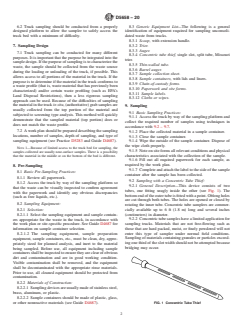
9.2.1 General Description—This device consists of two
that the waste can be visually inspected to confirm agreement
tubes, one fitting snugly inside the other (see Fig. 1). The
with the paperwork and identify any obvious discrepancies
bottomendoftheoutertubeisfittedwithapoint.Oblongholes
(such as free liquids, etc.).
are cut through both tubes. The holes are opened or closed by
8.2 Sampling Equipment:
rotating the inner tube. Concentric tube samplers are commer-
8.2.1 Selection:
cially available up to 6 ft (1.8 m) long and several inches
(centimeters) in diameter.
8.2.1.1 Select the sampling equipment and sample contain-
ers appropriate for the waste in the truck, in accordance with 9.2.2 Concentrictubesampleshavealimitedapplicationfor
the work plan or site-specific procedure. See Guide D4687 for sampling trucks. Materials that are not free-flowing such as
those that are hard packed, moist, or finely powdered will not
information on sample container selection.
enter this type of sampler und
...
This document is not an ASTM standard and is intended only to provide the user of an ASTM standard an indication of what changes have been made to the previous version. Because
it may not be technically possible to adequately depict all changes accurately, ASTM recommends that users consult prior editions as appropriate. In all cases only the current version
of the standard as published by ASTM is to be considered the official document.
Designation: D5658 − 13 D5658 − 20
Standard Practice for
Sampling Unconsolidated Waste Fromfrom Trucks
This standard is issued under the fixed designation D5658; the number immediately following the designation indicates the year of
original adoption or, in the case of revision, the year of last revision. A number in parentheses indicates the year of last reapproval. A
superscript epsilon (´) indicates an editorial change since the last revision or reapproval.
1. Scope
1.1 This practice covers several methods for collecting waste samples from trucks. These methods are adapted specifically for
sampling unconsolidated solid wastes in bulk loads using several types of sampling equipment.
1.2 This standard does not purport to address all of the safety concerns, if any, associated with its use. It is the responsibility
of the user of this standard to establish appropriate safety safety, health, and healthenvironmental practices and determine the
applicability of regulatory limitations prior to use. See Section 6 for specific precautionary statements.
1.3 This international standard was developed in accordance with internationally recognized principles on standardization
established in the Decision on Principles for the Development of International Standards, Guides and Recommendations issued
by the World Trade Organization Technical Barriers to Trade (TBT) Committee.
2. Referenced Documents
2.1 ASTM Standards:
D4687 Guide for General Planning of Waste Sampling
D4700 Guide for Soil Sampling from the Vadose Zone
D5088 Practice for Decontamination of Field Equipment Used at Waste Sites
D5283 Practice for Generation of Environmental Data Related to Waste Management Activities: Quality Assurance and Quality
Control Planning and Implementation
D5451 Practice for Sampling Using a Trier Sampler
D5633 Practice for Sampling with a Scoop
D5681 Terminology for Waste and Waste Management
3. Terminology
3.1 Definitions:
3.1.1 For definitions of terms used in this practice, refer to Standard Terminology for Waste and Waste Management D5681.
3.1 Definitions:
3.1.1 For definitions of terms used in this practice, refer to Terminology D5681.
3.2 Definitions of Terms Specific to This Standard:
This practice is under the jurisdiction of ASTM Committee D34 on Waste Management and is the direct responsibility of Subcommittee D34.01.02 on Sampling
Techniques.
Current edition approved April 1, 2013Dec. 1, 2020. Published April 2013December 2020. Originally approved in 1995. Last previous edition approved in 20062013 as
D5658 – 95D5658 – 13.(2006). DOI: 10.1520/D5658-13.10.1520/D5658-20.
For referenced ASTM standards, visit the ASTM website, www.astm.org, or contact ASTM Customer Service at service@astm.org. For Annual Book of ASTM Standards
volume information, refer to the standard’s Document Summary page on the ASTM website.
Copyright © ASTM International, 100 Barr Harbor Drive, PO Box C700, West Conshohocken, PA 19428-2959. United States
D5658 − 20
3.2.1 authoritative sampling—a sample selected without regard to randomization.
3.2.2 screening analysis—a preliminary qualitative or semiquantitative test that is designed to efficiently give the user specific
information about a waste that will aid in determining waste identification, process compatibility, and safety in handling.
3.2.3 waste profile—specific information about the waste including its properties and composition, chemical constituents, waste
codes, transportation information, etc.
4. Summary of Practice
4.1 The truck and its contents are inspected and appropriate sampling equipment is selected. A clean sampling device is then used
to scoop, core, or auger into the waste material. The sample or samples are collected and transferred to a sample container. The
sampling device is then cleaned and decontaminated or disposed of.
5. Significance and Use
5.1 This practice is intended for use in the waste management industries to collect samples of unconsolidated waste from trucks.
The sampling procedures described are general and should be used in conjunction with a site-specific work plan.
5.2 The purpose of collecting waste samples directly from a truck (rather than the waste source) is often to verify (usually with
screening analyses) that the waste contained in the truck is the same or similar material from a waste source that has been
previously characterized and approved for treatment or disposal, or both. Additionally, it may be a safer or logistically easier to
sample the waste from a truck over the waste source.
6. Safety Precautions
6.1 Safety precautions must always be observed when sampling waste. The work plan must include a Worker Health and Safety
section, because there are potential hazards associated with working around trucks as well as their potentially hazardous contents.
6.2 Truck sampling should be conducted from a properly designed platform to allow the sampler to safely access the truck bed
with a minimum of difficulty.
7. Sampling Design
7.1 Truck sampling can be conducted for many different purposes. It is important that the purpose be integrated into the sample
design. If the purpose of sampling is to characterize the waste, the sample should be collected from the waste source during the
loading or unloading of the truck. truck, if possible. This allows access to all portions of the material in the truck. If the purpose
is to determine if the material in the truck conforms to a waste profile (that is, waste material that has previously been
characterized), characterized) and/or certain waste profiling (such as EPA’s Land Disposal Restrictions), then a less rigorous
sampling approach can be used. Because of the difficulties of sampling the material in the truck in situ, (authoritative) grab samples
are usually collected from the top portion of the material and subjected to screening type analysis. This method will quickly
demonstrate that the sampled material (top portion) does or does not match the waste profile.
7.2 A work plan should be prepared describing the sampling locations, number of samples, depth of sampling, and type of
sampling equipment (see Practice D5283 and Guide D4687).
NOTE 1—Because of limited access to the truck bed for sampling, the samples collected are usually near-surface samples. There is a possibility that the
material in the middle or on the bottom of the bed is different.
8. Pre-Sampling
8.1 Basic Pre-Sampling Practices:
8.1.1 Review all paperwork.
D5658 − 20
8.1.2 Access the truck by way of the sampling platform so that the waste can be visually inspected to confirm agreement with the
paperwork and identify any obvious discrepancies (such as free liquids, etc.).
8.2 Sampling Equipment:
8.2.1 Selection:
8.2.1.1 Select the sampling equipment and sample containers appropriate for the waste in the truck, in accordance with the work
plan or site-specific procedure. See Guide D4687 for information on sample container selection.
8.2.1.2 The sampling equipment, sample preparation equipment, sample containers, etc., must be clean, dry, appropriately sized
for planned analysis, and inert to the material being sampled. Before use, all equipment including sample containers shall be
inspected to ensure they are clear of obvious dirt and contamination and are in good working condition. Visible contamination shall
be removed, and the equipment shall be decontaminated with the appropriate rinse materials. Prior to use, all cleaned equipment
should be protected from contamination.
8.2.2 Materials of Construction:
8.2.2.1 Sampling devices are usually made of stainless steel, brass, aluminum, or aluminum.plastic.
8.2.2.2 Sample containers should be made of plastic, glass, or other nonreactive materials (see Guide D4687).
8.3 Generic Equipment List—The following is a general identification of equipment required for sampling unconsolidated waste
from trucks.
8.3.1 Scoop, with extension handle.
8.3.2 Trier.
8.3.3 Auger.
8.3.4 Concentric tube thief, single slot, split tube, Missouri trier.
8.3.5 Thin-walled tube.
8.3.6 Barrel auger.
8.3.7 Sample collection sheet.
8.3.8 Sample containers, with lids and liners.
8.3.9 Chain of custody Chain-of-custody forms.
8.3.10 Paperwork and site forms.
8.3.11 Sample labels.
8.3.12 Cloths or wipes.
9. Sampling
9.1 Basic Sampling Practices:
9.1.1 Access the truck by way of the sampling platform and collect the required number of samples using techniques in accordance
with 9.29.2 – 9.7 through 9.7.
9.1.2 Place the collected material in a sample container.
D5658 − 20
9.1.3 Close the sample container.
9.1.4 Wipe the outside of the sample container. Dispose of the wipe cloth prop
...