

ASTM F1233-21
(Test Method)Standard Test Method for Security Glazing Materials And Systems
General Information
- Abstract
SIGNIFICANCE AND USE
6.1 This test method is based on field experience rather than laboratory analysis. It provides a basis for the comparative evaluation of ballistic/forced entry/containment resistance of security glazings and systems and should not be used to establish or confirm the absolute prevention of forcible entries or forced exits. This test method defines three factors which determine the success or failure of any attempt to forcefully enter (or exit) the glazing or system. They are: (1) the tools employed, (2) the techniques and methods used by the attackers, and (3) the total time available to effect the entry or exit. This test method defines two of the three factors (tools and techniques) and allows the third (duration) to vary in order to establish levels of forced entry or exit resistance.
SCOPE
1.1 This test method sets forth procedures whose purpose is limited to the evaluation of the resistance of security glazing materials and systems against the following threats:
1.1.1 Ballistic Impact,
1.1.2 Blunt Tool Impacts,
1.1.3 Sharp Tool Impacts,
1.1.4 Thermal Stress, and
1.1.5 Chemical Deterioration.
Note 1: Specifically exempted from this test method are the use of power (motor or engine-driven) tools or devices, explosives, military ordinance (excepting small arms) and tools, processes or devices requiring more than two persons to transport and operate.
1.2 The values stated in inch-pounds are to be regarded as the standard. The values given in parentheses are for information only.
1.3 This standard does not purport to address all of the safety concerns, if any, associated with its use. It is the responsibility of the user of this standard to establish appropriate safety, health, and environmental practices and determine the applicability of regulatory limitations prior to use. For a specific warning statement, see Warning in 10.1.1.6.
1.4 This international standard was developed in accordance with internationally recognized principles on standardization established in the Decision on Principles for the Development of International Standards, Guides and Recommendations issued by the World Trade Organization Technical Barriers to Trade (TBT) Committee.
- Status
- Published
- Publication Date
- 14-Oct-2021
- Technical Committee
- F12 - Security Systems and Equipment
- Drafting Committee
- F12.10 - Systems Products and Services
Overview
ASTM F1233-21: Standard Test Method for Security Glazing Materials and Systems establishes a comprehensive framework for evaluating the resistance of security glazing-including both materials and assembled systems-to various forms of physical and ballistic attack. Developed by ASTM International, this standard is widely referenced in the fields of architectural security, risk management, and protective construction. The test method outlined in ASTM F1233-21 is designed to measure and compare the forced entry, ballistic penetration, and containment resistance of security glazing products based on field scenarios.
Crucially, the standard is comparative in nature, focusing on the performance of products under specified testing protocols. It does not guarantee that any glazing system is impervious to forced entry or exit, but helps users select materials with suitable resistance levels for their application.
Key Topics
Threat Types Evaluated:
- Ballistic impacts (with a range of firearms and ammunition types)
- Blunt tool impacts (hammers, sledgehammers, pipes)
- Sharp tool impacts (chisels, axes)
- Thermal stress (application of fire and extreme temperature gradients)
- Chemical deterioration (exposure to solvents such as acetone and gasoline)
Testing Methodology:
- Defines attack tools and techniques
- Varies test duration to establish different resistance levels
- Uses field-relevant procedures rather than theoretical lab simulations
Performance Criteria:
- Ballistic resistance classes based on weapon and ammunition type (e.g., handguns, rifles, shotguns)
- Forced entry classes, determined by the sequence, number, and types of physical attacks
- Pass/fail determined by penetration criteria: passage of objects or contraband, or body passage
Applicability:
- Suitable for both individual glazing materials (unframed) and complete security glazing systems (framed and installed)
Applications
ASTM F1233-21 is widely utilized in the following scenarios:
Security Planning for Critical Infrastructure:
Used by architects, engineers, and security consultants to select and specify glazing for banks, government buildings, embassies, detention centers, and other high-risk facilities where threats such as ballistic attack, forced entry, arson, or vandalism are a concern.Product Development and Verification:
Manufacturers of security glass, laminates, or glazing systems use the test method to demonstrate compliance with recognized standards, gaining market credibility and streamlining procurement for buyers with defined protection needs.Risk Assessment:
Facility operators and asset managers employ results from ASTM F1233-21-compliant tests to benchmark security products and make informed choices in facility upgrades or new construction.Regulatory Compliance:
Referenced in bid specifications, insurance requirements, and facility certification processes, ensuring that installed security glazing meets minimum industry-standard levels of resistance.
Related Standards
ASTM E2395 - Standard Specification for Voluntary Security Performance of Window and Door Assemblies
Addresses security requirements for windows and doors beyond just glazing.UL 752 - Standard for Bullet-Resisting Equipment
Provides additional reference for assessing ballistic resistance in glazing and associated assemblies.ANSI Z97.1 – Safety Glazing Materials Used in Buildings
Focuses on safety requirements for glazing materials, complementing security-focused standards.EN 356 - Glass in Building: Security Glazing - Testing and Classification
European standard for glass security testing, often referenced in international projects.
The ASTM F1233-21 test method for security glazing materials and systems provides a valuable, practical tool for enhancing building security, supporting risk management strategies, and ensuring that glazing solutions meet rigorous, industry-accepted criteria for resistance to attack. Employing this standard helps organizations mitigate threats and protect people and assets using reliable, comparable security glazing performance benchmarks.
Relations
- Effective Date
- 01-Mar-2024
- Effective Date
- 01-Oct-2016
- Effective Date
- 01-Apr-2013
- Effective Date
- 01-Nov-2012
- Effective Date
- 01-Apr-2012
- Effective Date
- 01-Mar-2012
- Effective Date
- 01-May-2011
- Effective Date
- 01-Oct-2010
- Effective Date
- 01-Dec-2008
- Effective Date
- 15-May-2008
- Effective Date
- 01-Sep-2007
- Effective Date
- 01-Oct-2006
- Effective Date
- 01-May-2006
- Effective Date
- 01-Oct-2005
- Effective Date
- 01-Mar-2005
Frequently Asked Questions
ASTM F1233-21 is a standard published by ASTM International. Its full title is "Standard Test Method for Security Glazing Materials And Systems". This standard covers: SIGNIFICANCE AND USE 6.1 This test method is based on field experience rather than laboratory analysis. It provides a basis for the comparative evaluation of ballistic/forced entry/containment resistance of security glazings and systems and should not be used to establish or confirm the absolute prevention of forcible entries or forced exits. This test method defines three factors which determine the success or failure of any attempt to forcefully enter (or exit) the glazing or system. They are: (1) the tools employed, (2) the techniques and methods used by the attackers, and (3) the total time available to effect the entry or exit. This test method defines two of the three factors (tools and techniques) and allows the third (duration) to vary in order to establish levels of forced entry or exit resistance. SCOPE 1.1 This test method sets forth procedures whose purpose is limited to the evaluation of the resistance of security glazing materials and systems against the following threats: 1.1.1 Ballistic Impact, 1.1.2 Blunt Tool Impacts, 1.1.3 Sharp Tool Impacts, 1.1.4 Thermal Stress, and 1.1.5 Chemical Deterioration. Note 1: Specifically exempted from this test method are the use of power (motor or engine-driven) tools or devices, explosives, military ordinance (excepting small arms) and tools, processes or devices requiring more than two persons to transport and operate. 1.2 The values stated in inch-pounds are to be regarded as the standard. The values given in parentheses are for information only. 1.3 This standard does not purport to address all of the safety concerns, if any, associated with its use. It is the responsibility of the user of this standard to establish appropriate safety, health, and environmental practices and determine the applicability of regulatory limitations prior to use. For a specific warning statement, see Warning in 10.1.1.6. 1.4 This international standard was developed in accordance with internationally recognized principles on standardization established in the Decision on Principles for the Development of International Standards, Guides and Recommendations issued by the World Trade Organization Technical Barriers to Trade (TBT) Committee.
SIGNIFICANCE AND USE 6.1 This test method is based on field experience rather than laboratory analysis. It provides a basis for the comparative evaluation of ballistic/forced entry/containment resistance of security glazings and systems and should not be used to establish or confirm the absolute prevention of forcible entries or forced exits. This test method defines three factors which determine the success or failure of any attempt to forcefully enter (or exit) the glazing or system. They are: (1) the tools employed, (2) the techniques and methods used by the attackers, and (3) the total time available to effect the entry or exit. This test method defines two of the three factors (tools and techniques) and allows the third (duration) to vary in order to establish levels of forced entry or exit resistance. SCOPE 1.1 This test method sets forth procedures whose purpose is limited to the evaluation of the resistance of security glazing materials and systems against the following threats: 1.1.1 Ballistic Impact, 1.1.2 Blunt Tool Impacts, 1.1.3 Sharp Tool Impacts, 1.1.4 Thermal Stress, and 1.1.5 Chemical Deterioration. Note 1: Specifically exempted from this test method are the use of power (motor or engine-driven) tools or devices, explosives, military ordinance (excepting small arms) and tools, processes or devices requiring more than two persons to transport and operate. 1.2 The values stated in inch-pounds are to be regarded as the standard. The values given in parentheses are for information only. 1.3 This standard does not purport to address all of the safety concerns, if any, associated with its use. It is the responsibility of the user of this standard to establish appropriate safety, health, and environmental practices and determine the applicability of regulatory limitations prior to use. For a specific warning statement, see Warning in 10.1.1.6. 1.4 This international standard was developed in accordance with internationally recognized principles on standardization established in the Decision on Principles for the Development of International Standards, Guides and Recommendations issued by the World Trade Organization Technical Barriers to Trade (TBT) Committee.
ASTM F1233-21 is classified under the following ICS (International Classification for Standards) categories: 81.040.20 - Glass in building. The ICS classification helps identify the subject area and facilitates finding related standards.
ASTM F1233-21 has the following relationships with other standards: It is inter standard links to ASTM A53/A53M-24, ASTM A574-16, ASTM A574-13, ASTM A36/A36M-12, ASTM A574-12, ASTM A53/A53M-12, ASTM A574-11, ASTM A53/A53M-10, ASTM A574-08, ASTM A36/A36M-08, ASTM A53/A53M-07, ASTM A53/A53M-06a, ASTM A53/A53M-06, ASTM A53/A53M-05, ASTM A36/A36M-05. Understanding these relationships helps ensure you are using the most current and applicable version of the standard.
ASTM F1233-21 is available in PDF format for immediate download after purchase. The document can be added to your cart and obtained through the secure checkout process. Digital delivery ensures instant access to the complete standard document.
Standards Content (Sample)
This international standard was developed in accordance with internationally recognized principles on standardization established in the Decision on Principles for the
Development of International Standards, Guides and Recommendations issued by the World Trade Organization Technical Barriers to Trade (TBT) Committee.
Designation: F1233 − 21
Standard Test Method for
Security Glazing Materials And Systems
This standard is issued under the fixed designation F1233; the number immediately following the designation indicates the year of
original adoption or, in the case of revision, the year of last revision.Anumber in parentheses indicates the year of last reapproval.A
superscript epsilon (´) indicates an editorial change since the last revision or reapproval.
1. Scope A574SpecificationforAlloySteelSocket-HeadCapScrews
F1029GuideforSelectionofPhysicalSecurityMeasuresfor
1.1 This test method sets forth procedures whose purpose is
a Facility (Withdrawn 2004)
limited to the evaluation of the resistance of security glazing
2.2 Other Documents:
materials and systems against the following threats:
Sporting Arms and Ammunition Manufacturer’s Institute
1.1.1 Ballistic Impact,
(SAAMI)— Ammunition
1.1.2 Blunt Tool Impacts,
United States Military Ammunition Specifications— Am-
1.1.3 Sharp Tool Impacts,
munition
1.1.4 Thermal Stress, and
Federal Specification GGG-313U— Cold Chisel
1.1.5 Chemical Deterioration.
American Iron and Steel Institute M-1020— Structural
NOTE 1—Specifically exempted from this test method are the use of
Steel
power (motor or engine-driven) tools or devices, explosives, military
UL 10BC— Fire Extinguisher
ordinance(exceptingsmallarms)andtools,processesordevicesrequiring
more than two persons to transport and operate.
3. Terminology
1.2 The values stated in inch-pounds are to be regarded as
3.1 Definitions:
the standard. The values given in parentheses are for informa-
3.1.1 test director, n—individual identified by the indepen-
tion only.
dent testing laboratory as being responsible to complete the
1.3 This standard does not purport to address all of the
specified tests as required and to document the results.
safety concerns, if any, associated with its use. It is the
responsibility of the user of this standard to establish appro-
4. Class
priate safety, health, and environmental practices and deter-
4.1 Ballistic Class—Ballistic tests and test results from this
mine the applicability of regulatory limitations prior to use.
standard shall be classified by the following (see also Table 1):
For a specific warning statement, see Warning in 10.1.1.6.
4.1.1 HG1 Handgun - Low—Ammunition conforming to
1.4 This international standard was developed in accor-
SAAMI specifications for caliber .38 Special, 158 grain
dance with internationally recognized principles on standard-
(10.2g),softpoint,producingvelocitiesof875(625)ft/s(266
ization established in the Decision on Principles for the
(67) m/s) at 15 ft (4.5 m) from the muzzle.
Development of International Standards, Guides and Recom-
4.1.2 HG2 Handgun - Medium Soft Point—Ammunition
mendations issued by the World Trade Organization Technical
conformingtoSAAMIspecificationsforcaliber.357Magnum,
Barriers to Trade (TBT) Committee.
158 grain (10.2 g), jacketed soft point, producing velocities of
1400 (650) ft/s (427 (615) m/s) at 15 ft (4.5 m) from the
2. Referenced Documents
muzzle.
2.1 ASTM Standards:
4.1.3 HG3 Handgun - Medium Jacketed—Ammunitioncon-
A36/A36MSpecification for Carbon Structural Steel
forming to SAAMI specifications for caliber 9 mm, 124 grain
A53/A53MSpecification for Pipe, Steel, Black and Hot-
Dipped, Zinc-Coated, Welded and Seamless
The last approved version of this historical standard is referenced on
www.astm.org.
1 4
This test method is under the jurisdiction of Committee F12 on Security Available from Sporting Arms and Ammunition Manufacturers’ Association
Systems and Equipment and is the direct responsibility of Subcommittee F12.10 on (SAAMI), Box 1075, Riverside, CT 06878. http://www.saami.org.
Systems Products and Services. Available from DLA Document Services, Building 4/D, 700 Robbins Ave.,
Current edition approved Oct. 15, 2021. Published November 2021. Originally Philadelphia, PA 19111-5094, Attn: NPODS. http://quicksearch.dla.mil.
approved in 1989. Last previous edition approved in 2019 as F1233–08 (2019). Available from General Services Adm., 7th and D Sts. SW, Washington, DC
DOI: 10.1520/F1233-21. 20407. https://www.gsa.gov.
2 7
For referenced ASTM standards, visit the ASTM website, www.astm.org, or AvailablefromAmericanIronandSteel(AISI),25MassachusettsAvenue,NW,
contact ASTM Customer Service at service@astm.org. For Annual Book of ASTM Suite 800, Washington, DC 20001, https://www.steel.org.
Standards volume information, refer to the standard’s Document Summary page on Available from Underwriters Laboratories (UL), UL Headquarters, 333 Pfing-
the ASTM website. sten Road, Northbrook, IL, 60062, http://www.ul.com.
Copyright © ASTM International, 100 Barr Harbor Drive, PO Box C700, West Conshohocken, PA 19428-2959. United States
F1233 − 21
TABLE 1 Ballistic Criteria
C
Velocity , ft/s
A B D
Class Weapon Description Caliber Bullet Mass /Type Minimum No. of Impacts
(m/s)
HG1 Handgun - Low .38 Special 158 gr (10.2 g), 850 to 900 3
lead (259 to 274)
HG2 Handgun - Medium, Soft Point .357 Magnum 158 gr (10.2 g), 1350 to 1450 3
JSP (411 to 442)
HG3 Handgun - Medium, Jacketed 9 mm 124 gr (8.0 g), FMC 1200 to 1300 3
(365 to 396)
HG4 Handgun - High .44 Magnum 240 gr (15.6 g), 1400 to 1500 3
LGC (427 to 442)
SMG Submachine-gun 9 mm 124 gr (8.0 g), FMC 1350 to 1450 3
(411 to 442)
R1 Rifle - Light .223 (5.56 mm) 55 gr (3.6 g), M193 3200 to 3300 3
Ball, FMC (975–1006)
R2 Rifle - Heavy, Soft Point .30-’06 180 gr (11.7 g), SP 2850 to 3000 3
(867 to 914)
R3 Rifle - Heavy, Jacketed .308 Winchester 147 gr (9.5 g), M80 2700 to 2800 3
(7.62 mm) Ball, FMC (823 to 853)
R4-AP Rifle - Armor Piercing .30-’06 166 gr (10.8 g), 2715 to 2850 1
M2-AP (828 to 867)
R5 Rifle - Jacketed .50 709.5 gr (45.9 g) 2760 to 2860 1
Ball, FMC (841 to 867)
E F
SH1 Shotgun - Buckshot 12 gage, 00 buckshot, 1150 to 1250 1
3 in. Magnum 15 pellets (350 to 381)
SH2 Shotgun - Slug 12 gage 1 oz. (437.5 gr, 28.3 g) 1600 to 1700 3
rifled slug (487 to 518)
A −4
gr denotes grain as a unit of mass: 1 gr = 1.429 × 10 lb (0.0647981 g).
B
FMC = Full Metal Casing, JSP = Jacketed Soft Point, LGC = Lead Gas-Check, and SP = Soft Point.
C
Velocity measured at a distance of 10 ft (3 m) from the strike face of the sample. Muzzle of the barrel is positioned at a distance of 25 ft (7.6 m) from the strike face of
the sample.
D
Minimum number of shots required on glazed features plus additional shots to examine other features of the assembly. Prior to testing the intended impact location(s)
shall be marked in the approximate center of the target area. Where 3 impacts are specified, they are to be located at the corners ofa5in.(127mm) equilateral triangle.
The minimum spacing between impact locations is 4 in. (102 mm).
E
This ammunition is to be used as an adjunct to the primary test to further evaluate the ability of designed assembly details to resist fragmentary threats.
F
The shot pattern of the pellets shall be such that they all impact within an 8 in. (203 mm) diameter circle at a distance of 25 ft (7.62 m) from the muzzle of the weapon.
(8.0 g), full metal casing, producing velocities of 1250 (650) casingproducingvelocitiesof2810(650)ft/s(856(615)m/s)
ft/s (381 (615) m/s) at 15 ft (4.5 m) from the muzzle. at 15 ft (4.5 m) from the muzzle.
4.1.4 HG4 Handgun - High—Ammunition conforming to 4.1.11 SH1 - Shotgun - Buckshot—Ammunitionconforming
SAAMIspecificationsforcaliber.44Magnum,240grain,lead toSAAMIspecificationsforShotshell12-gage,3in.Magnum,
gas check producing velocities of 1450 (650) ft/s (442 (615) 00 Buckshot producing velocities of 1315 (650) ft/s
m/s) at 15 ft (4.5 m) from the muzzle. (400(615) m/s) at 15 ft (4.5 m) from the muzzle.
4.1.5 SMG Submachine Gun—Ammunition conforming to
NOTE2—The12-gageballisticthreatistobeusedasaconfirmatorytest
SAAMI specifications for caliber 9 mm, 124 grain (8.0 g), full
of assemblies. Glazing materials are not to be tested or rated against this
metal casing producing velocities of 1400 (650) ft/s
threat.
(427(615) m/s) at 15 ft (4.5 m) from the muzzle.
4.1.12 SH2 - Shotgun - Slug—Ammunition conforming to
4.1.6 R1 Rifle - Light—Ammunition conforming to U.S.
SAAMI specifications for Shotshell 12-gage, 1 oz. (437.5 g)
Military specifications for caliber .223 (5.56 mm) NATO,
rifled slug producing velocities of 1650 (650) ft/s (503 (615)
M193 ball producing velocities of 3250 (650) ft/s (991 (615)
m/s) at 15 ft (4.5 m) from the muzzle.
m/s) at 15 ft (4.5 m) from the muzzle.
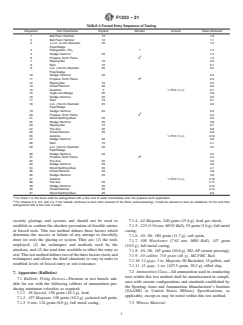
4.2 Forced Entry Class—See Table 2.
4.1.7 R2 Rifle - Heavy Soft Point—Ammunitionconforming
toSAAMIspecificationsforcaliber.30-’06,180grain(11.7g)
5. Summary of Test Method
soft point producing velocities of 2925 (675) ft/s (991 (615)
5.1 Forced entry shall be determined by resistance of the
m/s) at 15 ft (4.5 m) from the muzzle.
glazing material or system to the following:
4.1.8 R3 Rifle - Heavy Jacketed—Ammunition conforming
5.1.1 Ballistics attack only.
to SAAMI specifications for caliber .308 Winchester
5.1.2 Physical attack only to include blunt tool impacts,
(7.62mm), 147 grain (9.5 g), M80 Ball, full metal casing
sharp tool impacts, thermal stress, and chemical deterioration.
producing velocities of 2800 (650) ft/s (853 (615) m/s) at 15
5.1.3 Ballisticsattackfollowedby,andincombinationwith,
ft (4.5 m) from the muzzle.
physical attack.
4.1.9 R4-AP - Armor Piercing—Ammunition conforming to
U.S.Militaryspecificationsforcaliber.30–’06,M2APproduc-
6. Significance and Use
ing velocities of 2775 (650) ft/s (846 (615) m/s) at 15 ft
(4.5m) from the muzzle. 6.1 Thistestmethodisbasedonfieldexperienceratherthan
4.1.10 R5 - Ball Jacketed—AmmunitionconformingtoU.S. laboratory analysis. It provides a basis for the comparative
Military specifications for caliber .50 M2 Ball, full metal evaluation of ballistic/forced entry/containment resistance of
F1233 − 21
TABLE 2 Forced Entry Sequence of Testing
Sequence Test Implements Impacts Minutes Amount Class Achieved
1 Ball Peen Hammer 10 1.0
2 Ball Peen Hammer 10 1.1
31 ⁄2-in. (4-cm) Diameter 25 1.2
Pipe/Sledge
4 Extinguisher, CO 11.3
5 Sledge Hammer 25 1.4
A
6 Propane Torch Flame 5 1.5
7 Ripping Bar 10 2.0
8 Ram 10 2.1
9 4-in. (10-cm) Diameter 25 2.2
Pipe/Sledge
10 Sledge Hammer 25 2.3
B
11 Propane Torch Flame 5 2.4
12 Ripping Bar 10 2.5
13 Chisel/Hammer 25 2.6
1 1
14 Gasoline 4 ⁄2 Pint ( ⁄4 L) 2.7
15 Angle Iron/Sledge 25 2.8
16 Sledge Hammer 25 3.0
17 Ram 10 3.1
18 4-in. (10-cm) Diameter 25 3.2
Pipe/Sledge
19 Sledge Hammer 25 3.3
B
20 Propane Torch Flame 5 3.4
21 Wood Splitting Maul 25 3.5
22 Sledge Hammer 25 3.6
23 Ripping Bar 10 3.7
24 Fire Axe 25 3.8
25 Chisel/Hammer 25 3.9
1 1
26 Acetone ⁄2 Pint ( ⁄4 L) 3.10
27 Sledge Hammer 25 4.0
28 Ram 10 4.1
29 4-in. (10-cm) Diameter 25 4.2
Pipe/Sledge
30 Sledge Hammer 25 4.3
B
31 Propane Torch Flame 5 4.4
32 Fire Axe 25 4.5
33 Sledge Hammer 25 4.6
34 Wood Splitting Maul 25 4.7
35 Chisel/Hammer 25 4.8
36 Sledge Hammer 25 4.9
1 1
37 Acetone ⁄2 Pint ( ⁄4 L) 4.10
38 Fire Axe 25 4.11
39 Sledge Hammer 25 4.12
40 Chisel/Hammer 25 4.13
41 Wood Splitting Maul 25 5.0
A
For Class 1.5, the flame shall be extinguished with a fine mist of water immediately after the propane torch application.
B
For Classes 2.4, 3.4, and 4.4, if the sample continues to burn after removal of the flame (self-sustaining), it shall be allowed to burn an additional 10 min and then
extinguished with a fine mist of water.
security glazings and systems and should not be used to 7.1.4 .44 Magnum, 240 grain (15.6g), lead gas check,
establish or confirm the absolute prevention of forcible entries
7.1.5 .223 (5.56 mm, M193 Ball),55grain(3.6g),fullmetal
or forced exits. This test method defines three factors which casing,
determine the success or failure of any attempt to forcefully
7.1.6 .30–’06, 180 grain (11.7g), soft point,
enter (or exit) the glazing or system. They are: (1) the tools
7.1.7 .308 Winchester (7.62 mm, M80 Ball), 147 grain
employed, (2) the techniques and methods used by the
(10.5g), full metal casing,
attackers, and (3) the total time available to effect the entry or
7.1.8 .30–’06, 165 grain (10.6g), M2-AP (armor piercing),
exit.Thistestmethoddefinestwoofthethreefactors(toolsand
7.1.9 .50 caliber, 710 grain (46 g), M2-FMC Ball,
techniques) and allows the third (duration) to vary in order to
7.1.10 12 gage, 3 in. Magnum, 00 Buckshot, 15 pellets, and
establish levels of forced entry or exit resistance.
7.1.11 12 gage, 1 oz. (437.5 grain, 28.3g), rifled slug.
7. Apparatus (Ballistics) 7.2 Ammunition Class—All ammunition used in conducting
tests within this test method shall be manufactured in compli-
7.1 Ballistic Firing Devices—Firearms or test barrels suit-
ance with current configurations and standards established by
able for use with the following calibers of ammunition pro-
the Sporting Arms and Ammunition Manufacturer’s Institute
ducing minimum velocities as required:
(SAAMI) or United States Military Specifications, as
7.1.1 .38 Special, 158 grain (10.2g), lead,
applicable, except as may be noted within this test method.
7.1.2 .357 Magnum, 158 grain (10.2g), jacketed soft point,
7.1.3 9 mm, 124 grain (8.0g), full metal casing, 7.3 Witness Material:
F1233 − 21
7.3.1 Aluminumfoil,kitchenfoil,orequivalent,0.00094in. partially through the thickness of the glazing to examine all
(0.024 mm) 610% thick. Alloy may be 8111 or 1100, “0” possible penetration paths. Not only shall the primary weapon/
temper. ammunition be used, but the 12-gage shotgun (as defined
within this test method as an adjunct to the primary test) as
7.4 Instrumentation:
9 well. The 12-gage ballistic threat is to be used as a confirma-
7.4.1 Photosensitive Triggering Screens,
torytestofassemblies.Glazingmaterialsarenottobetestedor
7.4.2 Chronograph,
rated against this threat.
7.4.3 Thermometer—Temperature ranges from +120 to
7.6.4.1 Due to chronograph/triggering screen accessibility,
−30°F (+49 to −34°C).
thetestdirectormayelectnottoelectronicallymeasuremuzzle
7.5 Test Frame and Stand:
velocities of certain oblique firings.
7.5.1 Samples of glazing submitted for testing shall be in
sizes that would be encountered during normal use, but in no
8. Apparatus (Physical Attack)
case smaller than 12 by 12 in. (30 by 30 cm) or larger than
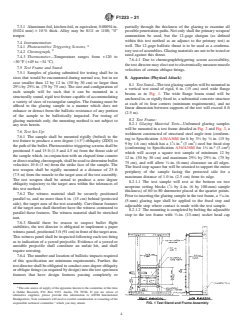
8.1 Test Stand—Thetestglazingsampleswillbemountedin
3 3
29 ⁄4by 29 ⁄4in. (75 by 75 cm). The size and configuration of
a vertical test stand of rigid, 6 in. (15 cm) steel wide flange
each sample will be such that it can be mounted in a
beams as in Fig. 1. The wide flange beam stand will be
structurally sound, rigid test fixture capable of accommodating
anchored in, or rigidly fixed to, a substantial concrete structure
a variety of sizes of rectangular samples. The framing must be
at each of its four corners (minimum requirements), and no
affixed to the glazing sample in a manner which does not
linear dimension between supports of the test will exceed 8 ft
enhance or detract from the ballistic resistance of any portion
(2.5 m).
of the sample to be ballistically impacted. For testing of
8.2 Test Frame:
glazing materials only, the mounting method is not subject to
8.2.1 Glazing Material Tests—Unframed glazing samples
any tests herein.
will be mounted in a test frame detailed in Fig. 2 and Fig. 3,a
7.6 Test Set-Up:
weldment constructed of structural steel angle iron (conform-
7.6.1 The sample shall be mounted rigidly (bolted) to the
1 5
ing to Specification A36/A36Mfor6by3 ⁄2 by ⁄8in. (15 by
test fixture to produce a zero degree (63°) obliquity (ZDO) to
2 2
9by 1.6 cm) which has a 1 ⁄4in. (3 cm ) steel bar fixed stop
thepathofthebullet.Photosensitivetriggeringscreensshallbe 2 2
(conforming to Specification A36/A36M for 1 ⁄4in. (3 cm )
positioned 5 and 15 ft (1.5 and 4.5 m) from the threat side of
which will accept a square test sample of minimum 12 by
the sample which, in conjunction with an elapsed time counter
3 3
12in. (30 by 30 cm) and maximum 29 ⁄4 by 29 ⁄4in. (75 by
ordirectreadingchronograph,shallbeusedtodeterminebullet
75cm), and will allow ⁄4-in. (6-mm) clearance on all edges.
velocities 10 ft (3 m) from the strike face of the sample. The
The fixed stop square bar will be oriented to support the entire
test weapon shall be rigidly mounted at a distance of 25 ft
periphery of the sample facing the protected side for a
(7.5m) from the muzzle to the target area of the test assembly.
maximum distance of 1.0 in. (2.5 cm) from its edge.
The test weapon shall be aimed to produce a zero degree
8.2.1.1 The test sample will rest at the bottom on two
obliquity trajectory to the target area within the tolerances of
neoprene setting blocks ( ⁄4 by 4-in. (6 by 100-mm) sample
this test method.
thickness) of 60 to 80 durometer placed at the quarter points.
7.6.2 The witness material shall be securely positioned
Prior to inserting the glazing sample in the test frame, a ⁄16-in.
parallel to, and no more than 6 in. (15 cm) behind (protected
(5-mm) glazing tape shall be applied to the fixed stop and
side), the target area of the test assembly. Curvilinear features
adjustable stop where contact is made with the test sample.
of the target area shall therefore have the witness contoured to
8.2.1.2 Themountingiscompletedbyboltingtheadjustable
parallel these features. The witness material shall be stretched
stop to the test frame with ⁄2-in. (13-mm) socket head cap
taut.
7.6.3 Should there be reason to suspect bullet flight
stabilities, the test director is obligated to implement a paper
witnesspanel,positioned3ft(91cm)infrontofthetargetarea.
This witness panel shall be inspected following each test firing
as to indication of a yawed projectile. Evidence of a yawed or
unstable projectile shall constitute an unfair hit, and shall
require retesting.
7.6.4 The number and location of ballistic impacts required
of this specification are minimum requirements. Further, the
testdirectorshallbeobligatedtoconductzerodegreeobliquity
orobliquefirings(asrequiredbydesign)intothetestspecimen
features that have design features passing completely or
The sole source of supply of the apparatus known to the committee at this time
is Oehler Research, P.O. Box 9135, Austin, TX 78766. If you are aware of
alternative suppliers, please provide this information to ASTM International
Headquarters.Your comments will receive careful consideration at a meeting of the
responsible technical committee, which you may attend. FIG. 1 Test Stand and Frame Assembly
F1233 − 21
8.2.2.2 Amount of “bite” within the frame.
8.2.2.3 Integrity of the frame.
8.2.2.4 Strength of base material.
8.2.2.5 Size of removable stop.
8.2.2.6 Removable stop fastener.
8.2.2.7 Interface between glazing and frame.
8.2.2.8 Integrity of anchorage of glazing system to adjoin-
ing architectural features.
8.3 Blunt Impacting Tools:
8.3.1 Sledge Hammer, 12-lb (5.5-kg), double-faced, drop-
forged steel head with 36-in. (91-cm) handle.
8.3.2 Pipe, Steel, 4-in. (10-cm), in accordance with Speci-
fication A53/A53M, 90° cut-off.
8.3.3 Ram, Two man, 120-lb (54-kg), steel with 4 by 4-in.
(10by10-cm)strikefaceandtwo1-in.(2.5-cm)roundhandles
mountedperpendiculartothelongitudinalcenterlineextending
12 in. (30.5 cm) beyond the extremity of two opposing sides.
FIG. 2 Glazing Material Test Frame
8.3.4 Ball Peen Hammer, 32-oz (0.5-kg), drop-forged, steel
head, with 16-in. (41-cm) handle.
8.4 Sharp Impacting Tools:
8.4.1 Ripping Bar—Slotted claw and chisel ends, forged
steel, 24 in. (61 cm).
8.4.2 Cold Chisel—Conforming to Federal Specification
GGG-313U, ⁄8-in. (22-mm) edge, 8 in. (20 cm) long, to be
struck with 16-oz. (0.25-kg) claw hammer.
8.4.3 Structural Steel Angle, 20 by 2 in. (51 by 5 cm), ⁄4in.
(6 mm) thick, AISI-M1020, 90° cut-off.
8.4.4 Pipe, Steel, 1 ⁄2in. (4 cm nominal) outside diameter,
Schedule80,inaccordancewithSpecificationA53/A53M,90°
cut-off.
8.4.5 Fireman’s Axe-Pick Head—Drop-forged steel, 6 lb
(3kg), 36 in. (91 cm) long.
8.4.6 Wood Splitting Maul, 8-lb (3.5-kg), heat-treated steel
head with 3-in. (7.5-cm) cutting edge with 36-in. (91-cm)
handle.
FIG. 3 Section of Glazing Material Test Frame
8.5 Thermal Stress Tools:
8.5.1 Fire Extinguisher CO —Steel cylinder, 20 lb (9 kg),
conforming to UL10BC, or equivalent.
screws (conforming to Specification A574) torqued to
8.5.2 Propane Torch,12to15-oz(5.5to7-kg)cylinderwith
120 610 ft·lbf (163 614 N·m) each. The center to center
general purpose Tip No. HT-880-2,9 or equivalent.
location of adjustable stop mounting bolts shall be no greater
than 6 in. (15 cm). When the test sample is mounted it will be 8.6 Chemically Deteriorating Materials:
centered in the test frame and positioned with neoprene shims
8.6.1 Gasoline—American Oil Company unleaded
to result in not more than 1.0-in. (2.5-cm) edge coverage (bite)
premium, 93 octane or equivalent.
of the test sample.
8.6.2 Solvent, Containing acetone (minimum of 95 %
8.2.1.3 Compressionoftheglazingtapewillbemadebythe
concentration-technical grade).
adjustable stop, but not to allow a test sample face to stop
8.6.3 Dispenser, Hand-operated, pump-type atomizing dis-
clearance of more than ⁄8in. (3 mm). When mounted, the
penser similar to that used for dispensing window cleaning
bottom edge of the exposed faces (protected and assaulted) of
solutions and other household products (polypropylene or
thesamplewillbenohigherthan24in.(61cm)norlowerthan
polyethylene).
21 in. (53 cm) from the horizontal surface supporting the test
8.7 Materials:
(attack) personnel.
8.2.2 Glazing System Tests—The glazing system will be
mounted in accordance with the manufacturer’s recommenda-
Thesolesourceofsupplyoftheapparatusknowntothecommitteeatthistime
tionsandshallbesecurelyanchoredsoasthemountingsystem
is Turner Companies, 821 Park Ave., Sycamore, IL 60178. If you are aware of
will not absorb any of the testing shock. Consideration should
alternative suppliers, please provide this information to ASTM International
be given to, but is not limited to:
Headquarters.Your comments will receive careful consideration at a meeting of the
8.2.2.1 Overall size of glazing system. responsible technical committee, which you may attend.
F1233 − 21
8.7.1 Forced Entry Shape—Arigid, rectangular shape mea- 9.2.1.4 Temperature Gradient Test (Summer)—Condition
suring 8 by 8 by 5 in. (6 ⁄8in.) (20 by 20 by 13 cm (63 mm)) strike face of sample for3hat +120 65°F (48 63°C) with
fabricated from 16 MSG steel. edges and rear face at ambient (+70 610°F or 21 65°C).
8.8 Test Personnel:
10. Procedures
8.8.1 Six males, muscular (180 to 250 lb (82 to 113 kg)), in
10.1 Ballistic Test—Twelve primary ballistic classes (see
good health, who carry out an enthusiastic assault.
4.2) establish varying degrees of protection. The shotgun is
8.8.2 No less than two members of the test team will be
used to further evaluate the ability of designed-through open-
left-handed, and no less than two shall be right-handed.
ings to resist fragmentary threats.
8.9 Test Specimens:
10.1.1 Procedure—Ammunition of the appropriate type and
8.9.1 Number of Samples—All testing is done on a single
caliber shall be single fired to obtain the required number of
sample with the exception of extreme temperature firings as
fair hits on each glazing sample according to Table 1. The
described in 9.2.1. Replicate testing is to be specified by the
separation between any two ballistic impacts on a single
purchaser.
contiguous area of glazing shall be no less than 4 in. (10 cm)
8.9.2 Size of Samples:
center-to-center.
8.9.2.1 Base Material Tests—The size of all transparent
10.1.1.1 Aftereachfiring,thewitnesspanelontheprotected
3 3
glazingmaterialsampleswillbenolargerthan29 ⁄4by29 ⁄4in. sideshallbeinspectedvisually.Onlyacompleteperforationof
(75 by 75 cm) or smaller than 12 by 12 in. (30 by 30 cm).
thewitnesspanel,whetherbybulletfragmentsormaterialfrom
Samplesizesubmittedfortestshallbetheinstalledsizeforthe the test sample (spall), shall be classified as a “penetration.”
intendeduse,butinnocaselargerorsmallerthantheaforesaid
Any perforation of the witness panel through which the light
dimensions. To facilitate fixturing, the sample thickness shall from a 40-W incandescent lamp can be detected shall be
1 1
not be less than ⁄4in. (6 mm) nor more than 2 ⁄2in. (6.4 cm).
termed a “penetration.” Impacts which produce any other
The sample shall be submitted without framing, gaskets, or results will be classified as “no penetration.” These definitions
edging except that which is essential to maintaining any
shall apply whether or not the test sample has been completely
laminar spacing (or sealing of that spacing). perforated. In the case of extreme temperature firings (9.2.1),
the visual inspection may be completed after the last of the
9. Preparation for Test required firings are completed
10.1.1.2 For purposes of this test method, a fair hit shall be
9.1 Forced Entry Test Environment—The location of the
a zero degree obliquity ballistic impact (63°) using the
forced entry fixturing shall be in a protected environment
specified weight and type of unyawed bullet (3° maximum)
whose ambient temperature is 72 65°F (22 63°C). All test
within the specified velocity range on the specified location of
materials will be in this environment for a minimum of 24 h
the test sample. All other firings shall be classified as unfair
immediately preceding initiation of the test. The area immedi-
except:
ately adjacent to the test sample extending 6 ft (1.8 m) to the
10.1.1.3 An impact at less than the minimum acceptable
left and right of either vertical edge of the sample, 10 ft (3 m)
velocity which results in penetration but which is otherwise a
from the assault face of the sample, and 8 ft (2.4 m) over the
fair hit shall be classified as a fair hit.
horizontal surface supporting the test (attack) personnel, shall
10.1.1.4 An impact at more than the maximum acceptable
be free of all obstructions and appurtenances.
velocity which does not produce penetration but which is
9.2 Ballistic Test Environment—The location of the ballistic
otherwise a fair hit shall be classified as a fair hit.
test apparatus shall be in a protected environment whose
10.1.1.5 Oblique shots required by the test director because
ambient temperature is essentially at room temperature condi-
of suspected weak points.
tions 72 65°F (22 63°C).
10.1.1.6 All firings shall be conducted after the sample has
9.2.1 Extreme Temperature Firings—Extreme temperature
been conditioned to the ambient temperature range for a
ballistictestingofglazingmaterialsintendedforuseinexterior
maximum of 4 h and shall continue until the required number
applicationsshallberequired.Onesampleshallberequiredfor
of non-penetrating fair hits or a single penetrating fair hit is
each of the following tests. The required temperature condi-
(are) obtained, whichever occurs first. (Warning—Personal
tionsmustbemaintainedatthespecimensurfacesuntilthefirst
safety during ballistic tests is paramount and shall be strictly
shotisfired.The3shotsmustbecompletedwithin2minfrom
enforcedbythetestdirectortoprecludeinjurytothosepersons
thetimeofthefirstshot.Glazingintendedforinterioruseonly
conducting or observing the tests, or both.)
shall have relief from these extreme temperature firings but
10.1.2 Data—Datarecordsofeachfiringwillbemaintained
must be permanently labeled FOR INTERIOR USE ONLY.
andsubmittedwiththetestreportbythetestinglaboratory,and
9.2.1.1 High-Temperature Test—Conditionsamplefor3hat shall include the following:
+120 65°F (+49 63°C).
10.1.2.1 Complete identification of the test sample.
9.2.1.2 Cold-Temperature Test—Conditionsamplefor3hat 10.1.2.2 Ballistic class of test sample (see Annex A2).
−20 65°F (−29 63°C).
10.1.2.3 Temperatureofthetestsample,ifdifferentfromthe
ambient temperatures.
9.2.1.3 Temperature Gradient Test (Winter)—Condition
10.1.2.4 Type and lot number of the test ammunition.
strike face of sample for3hat−20 65°F (−29 63°C) with
edges and rear face at ambient (+70 610°F or 21 65°C). 10.1.2.5 Velocity and impact location of each shot.
F1233 − 21
10.1.2.6 Fair/unfair,penetration/nopenetration,andspall/no constitutes a failure by forcible entry. Free passage is defined
spall determination of each shot. aspassingtheobjectthroughtheopeningwithanappliedforce
10.1.2.7 Date,location,andambienttemperatureofthetest. no greater than 10 lb (4.4 N).This criterion will apply whether
10.1.2.8 Photograph (test director’s and manufacturer’s op- the free passage of the shape is made through a hole through
tion) of sample before and after each shot or complete test, or the glazing or through the gap created by dissociation of the
both. glazing material from its frame.
10.1.3 Reporting—After completion of all testing, a com-
10.2.4.3 Flame Test—After removal of the flame of the
prehensive test report shall be prep
...
This document is not an ASTM standard and is intended only to provide the user of an ASTM standard an indication of what changes have been made to the previous version. Because
it may not be technically possible to adequately depict all changes accurately, ASTM recommends that users consult prior editions as appropriate. In all cases only the current version
of the standard as published by ASTM is to be considered the official document.
Designation: F1233 − 08 (Reapproved 2019) F1233 − 21
Standard Test Method for
Security Glazing Materials And Systems
This standard is issued under the fixed designation F1233; the number immediately following the designation indicates the year of
original adoption or, in the case of revision, the year of last revision. A number in parentheses indicates the year of last reapproval. A
superscript epsilon (´) indicates an editorial change since the last revision or reapproval.
1. Scope
1.1 This test method sets forth procedures whose purpose is limited to the evaluation of the resistance of security glazing materials
and systems against the following threats:
1.1.1 Ballistic Impact,
1.1.2 Blunt Tool Impacts,
1.1.3 Sharp Tool Impacts,
1.1.4 Thermal Stress, and
1.1.5 Chemical Deterioration.
NOTE 1—Specifically exempted from this test method are the use of power (motor or engine-driven) tools or devices, explosives, military ordinance
(excepting small arms) and tools, processes or devices requiring more than two persons to transport and operate.
1.2 The values stated in inch-pounds are to be regarded as the standard. The values given in parentheses are for information only.
1.3 This standard does not purport to address all of the safety concerns, if any, associated with its use. It is the responsibility
of the user of this standard to establish appropriate safety, health, and environmental practices and determine the applicability of
regulatory limitations prior to use. For a specific warning statement, see Warning in 10.1.1.6.
1.4 This international standard was developed in accordance with internationally recognized principles on standardization
established in the Decision on Principles for the Development of International Standards, Guides and Recommendations issued
by the World Trade Organization Technical Barriers to Trade (TBT) Committee.
2. Referenced Documents
2.1 ASTM Standards:
A36/A36M Specification for Carbon Structural Steel
A53/A53M Specification for Pipe, Steel, Black and Hot-Dipped, Zinc-Coated, Welded and Seamless
A574 Specification for Alloy Steel Socket-Head Cap Screws
This test method is under the jurisdiction of Committee F12 on Security Systems and Equipment and is the direct responsibility of Subcommittee F12.10 on Systems
Products and Services.
Current edition approved Aug. 1, 2019Oct. 15, 2021. Published August 2019November 2021. Originally approved in 1989. Last previous edition approved in 20132019
as F1233 – 08 (2013).(2019). DOI: 10.1520/F1233-08R19.10.1520/F1233-21.
For referenced ASTM standards, visit the ASTM website, www.astm.org, or contact ASTM Customer Service at service@astm.org. For Annual Book of ASTM Standards
volume information, refer to the standard’s Document Summary page on the ASTM website.
Copyright © ASTM International, 100 Barr Harbor Drive, PO Box C700, West Conshohocken, PA 19428-2959. United States
F1233 − 21
F1029 Guide for Selection of Physical Security Measures for a Facility (Withdrawn 2004)
2.2 Other Documents:
Sporting Arms and Ammunition Manufacturer’s Institute (SAAMI) Arms and Ammunition Manufacturer’s Institute (SAAMI)—
Ammunition— Ammunition
United States Military Ammunition Specifications States Military — Ammunition Specifications—Ammunition
Federal Specification GGG-313U Specification GGG-313U—Cold — Cold Chisel
American Iron and Steel Institute M-1020 Iron and Steel Institute M-1020—Structural Steel— Structural Steel
UL 10BC 10BC—Fire — Fire Extinguisher
3. Terminology
3.1 Definitions:
3.1.1 test director, n—individual identified by the independent testing laboratory as being responsible to complete the specified
tests as required and to document the results.
4. Class
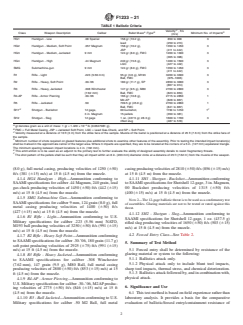
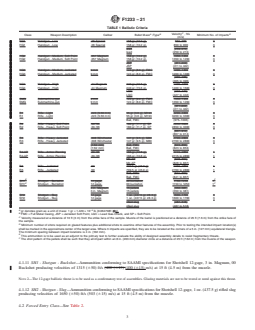
4.1 Ballistic Class—Ballistic tests and test results from this standard shall be classified by the following (see also Table 1):
4.1.1 HG1 Handgun - Low—Ammunition conforming to SAAMI specifications for caliber .38 Special, 158 grain (10.2 g),
(10.2 g), soft point, producing velocities of 875 (625) ft/s (266 (67) m/s) at 15 ft (4.5 m) from the muzzle.
4.1.2 HG2 Handgun - Medium Soft Point—Ammunition conforming to SAAMI specifications for caliber .357 Magnum, 158 grain
(10.2 g), jacketed soft point, producing velocities of 1400 (650) ft/s (427 (615) m/s) at 15 ft (4.5 m) from the muzzle.
4.1.3 HG3 Handgun - Medium Jacketed—Ammunition conforming to SAAMI specifications for caliber 9 mm, 124 grain (8.0 g),
full metal casing, producing velocities of 1250 (650) ft/s (381 (615) m/s) at 15 ft (4.5 m) from the muzzle.
4.1.4 HG4 Handgun - High—Ammunition conforming to SAAMI specifications for caliber .44 Magnum, 240 grain, lead gas
check producing velocities of 1450 (650) ft/s (442 (615) m/s) at 15 ft (4.5 m) from the muzzle.
4.1.5 SMG Submachine Gun—Ammunition conforming to SAAMI specifications for caliber 9 mm, 124 grain (8.0 g), full metal
casing producing velocities of 1400 (650) ft/s (427 (615) (427 (615) m/s) at 15 ft (4.5 m) from the muzzle.
4.1.6 R1 Rifle - Light—Ammunition conforming to U.S. Military specifications for caliber .223 (5.56 mm) NATO, M193 ball
producing velocities of 3250 (650) ft/s (991 (615) m/s) at 15 ft (4.5 m) from the muzzle.
4.1.7 R2 Rifle - Heavy Soft Point—Ammunition conforming to SAAMI specifications for caliber .30-’06, 180 grain (11.7 g) soft
point producing velocities of 2925 (675) ft/s (991 (615) m/s) at 15 ft (4.5 m) from the muzzle.
4.1.8 R3 Rifle - Heavy Jacketed—Ammunition conforming to SAAMI specifications for caliber .308 Winchester (7.62 mm),
(7.62 mm), 147 grain (9.5 g), M80 Ball, full metal casing producing velocities of 2800 (650) ft/s (853 (615) m/s) at 15 ft (4.5
m) from the muzzle.
4.1.9 R4-AP - Armor Piercing—Ammunition conforming to U.S. Military specifications for caliber .30–’06, M2AP producing
velocities of 2775 (650) ft/s (846 (615) m/s) at 15 ft (4.5 m) (4.5 m) from the muzzle.
4.1.10 R5 - Ball Jacketed—Ammunition conforming to U.S. Military specifications for caliber .50 M2 Ball, full metal casing
producing velocities of 2810 (650) ft/s (856 (615) m/s) at 15 ft (4.5 m) from the muzzle.
The last approved version of this historical standard is referenced on www.astm.org.
Available from Sporting Arms and Ammunition Manufacturers’ Association (SAAMI), Box 1075, Riverside, CT 06878. http://www.saami.org.
Available from Standardization Documents Order Desk, Bldg. 4, Section D, DLA Document Services, Building 4/D, 700 Robbins Ave., Philadelphia, PA 19111-5094,
Attn: NPODS. http://quicksearch.dla.mil.
Available from General Services Adm., 7th and D Sts. SW, Washington, DC 20407. https://www.gsa.gov.
Available from American Iron and Steel Institute, 1000 16th St. NW, Washington, DC 20036.(AISI), 25 Massachusetts Avenue, NW, Suite 800, Washington, DC 20001,
https://www.steel.org.
Available from Underwriters Laboratories, Inc., Laboratories (UL), UL Headquarters, 333 Pfingsten Rd., Northbrook, IL 60062.Road, Northbrook, IL, 60062,
http://www.ul.com.
F1233 − 21
TABLE 1 Ballistic Criteria
C
Velocity , ft/s
A B D
Class Weapon Description Caliber Bullet Mass /Type Minimum No. of Impacts
(m/s)
HG1 Handgun - Low .38 Special 158 gr (10.2 g), 850–900 3
HG1 Handgun - Low .38 Special 158 gr (10.2 g), 850 to 900 3
lead (259–274)
lead (259 to 274)
HG2 Handgun - Medium, Soft Point .357 Magnum 158 gr (10.2 g), 1350–1450 3
HG2 Handgun - Medium, Soft Point .357 Magnum 158 gr (10.2 g), 1350 to 1450 3
JSP (411–442)
JSP (411 to 442)
HG3 Handgun - Medium, Jacketed 9 mm 124 gr (8.0 g), FMC 1200–1300 3
HG3 Handgun - Medium, Jacketed 9 mm 124 gr (8.0 g), FMC 1200 to 1300 3
(365–396)
(365 to 396)
HG4 Handgun - High .44 Magnum 240 gr (15.6 g), 1400–1500 3
HG4 Handgun - High .44 Magnum 240 gr (15.6 g), 1400 to 1500 3
LGC (427–442)
LGC (427 to 442)
SMG Submachine-gun 9 mm 124 gr (8.0 g), FMC 1350–1450 3
SMG Submachine-gun 9 mm 124 gr (8.0 g), FMC 1350 to 1450 3
(411–442)
(411 to 442)
R1 Rifle - Light .223 (5.56 mm) 55 gr (3.6 g), M193 3200–3300 3
R1 Rifle - Light .223 (5.56 mm) 55 gr (3.6 g), M193 3200 to 3300 3
Ball, FMC (975–1006)
R2 Rifle - Heavy, Soft Point .30-’06 180 gr (11.7 g), SP 2850–3000 3
R2 Rifle - Heavy, Soft Point .30-’06 180 gr (11.7 g), SP 2850 to 3000 3
(867–914)
(867 to 914)
R3 Rifle - Heavy, Jacketed .308 Winchester 147 gr (9.5 g), M80 2700–2800 3
R3 Rifle - Heavy, Jacketed .308 Winchester 147 gr (9.5 g), M80 2700 to 2800 3
(7.62 mm) Ball, FMC (823–853)
(7.62 mm) Ball, FMC (823 to 853)
R4-AP Rifle - Armor Piercing .30-’06 166 gr (10.8 g), 2715–2850 1
R4-AP Rifle - Armor Piercing .30-’06 166 gr (10.8 g), 2715 to 2850 1
M2-AP (828–867)
M2-AP (828 to 867)
R5 Rifle - Jacketed .50 709.5 gr (45.9 g) 2760–2860 1
R5 Rifle - Jacketed .50 709.5 gr (45.9 g) 2760 to 2860 1
Ball, FMC (841–867)
Ball, FMC (841 to 867)
E F
SH1 Shotgun - Buckshot 12 gage, 00 buckshot, 1150–1250 1
E F
SH1 Shotgun - Buckshot 12 gage, 00 buckshot, 1150 to 1250 1
3 in. Magnum 15 pellets (350–381)
3 in. Magnum 15 pellets (350 to 381)
SH2 Shotgun - Slug 12 gage 1 oz. (437.5 gr, 28.3 g) 1600–1700 3
SH2 Shotgun - Slug 12 gage 1 oz. (437.5 gr, 28.3 g) 1600 to 1700 3
rifled slug (487–518)
rifled slug (487 to 518)
A −4
gr denotes grain as a unit of mass: 1 gr = 1.429 × 10 lb (0.0647981 g)g).
B
FMC = Full Metal Casing, JSP = Jacketed Soft Point, LGC = Lead Gas-Check, and SP = Soft Point.
C
Velocity measured at a distance of 10 ft (3 m) from the strike face of the sample. Muzzle of the barrel is positioned at a distance of 25 ft (7.6 m) from the strike face of
the sample.
D
Minimum number of shots required on glazed features plus additional shots to examine other features of the assembly. Prior to testing the intended impact location(s)
shall be marked in the approximate center of the target area. Where 3 impacts are specified, they are to be located at the corners of a 5 in. (127 mm) equilateral triangle.
The minimum spacing between impact locations is 4 in. (102 mm).
E
This ammunition is to be used as an adjunct to the primary test to further evaluate the ability of designed assembly details to resist fragmentary threats.
F
The shot pattern of the pellets shall be such that they all impact within an 8 in. (203 mm) diameter circle at a distance of 25 ft (7.62 m) from the muzzle of the weapon.
4.1.11 SH1 - Shotgun - Buckshot—Ammunition conforming to SAAMI specifications for Shotshell 12-gage, 3 in. Magnum, 00
Buckshot producing velocities of 1315 (650) ft/s (400 (615) (400 (615) m/s) at 15 ft (4.5 m) from the muzzle.
NOTE 2—The 12-gage ballistic threat is to be used as a confirmatory test of assemblies. Glazing materials are not to be tested or rated against this threat.
4.1.12 SH2 - Shotgun - Slug—Ammunition conforming to SAAMI specifications for Shotshell 12-gage, 1 oz. (437.5 g) rifled slug
producing velocities of 1650 (650) ft/s (503 (615) m/s) at 15 ft (4.5 m) from the muzzle.
4.2 Forced Entry Class—See Table 2.
F1233 − 21
TABLE 2 Forced Entry Sequence of Testing
Sequence Test Implements Impacts Minutes Amount Class Achieved
1 Ball Peen Hammer 10 1.0
2 Ball Peen Hammer 10 1.1
3 1 ⁄2-in. (4-cm) Diameter 25 1.2
Pipe/Sledge
4 Extinguisher, CO 1 1.3
5 Sledge Hammer 25 1.4
A
6 Propane Torch Flame 5 1.5
7 Ripping Bar 10 2.0
8 Ram 10 2.1
9 4-in. (10-cm) Diameter 25 2.2
Pipe/Sledge
10 Sledge Hammer 25 2.3
B
11 Propane Torch Flame 5 2.4
12 Ripping Bar 10 2.5
13 Chisel/Hammer 25 2.6
1 1
14 Gasoline 4 ⁄2 Pint ( ⁄4 L) 2.7
15 Angle Iron/Sledge 25 2.8
16 Sledge Hammer 25 3.0
17 Ram 10 3.1
18 4-in. (10-cm) Diameter 25 3.2
Pipe/Sledge
19 Sledge Hammer 25 3.3
B
20 Propane Torch Flame 5 3.4
21 Wood Splitting Maul 25 3.5
22 Sledge Hammer 25 3.6
23 Ripping Bar 10 3.7
24 Fire Axe 25 3.8
25 Chisel/Hammer 25 3.9
1 1
26 Acetone ⁄2 Pint ( ⁄4 L) 3.10
27 Sledge Hammer 25 4.0
28 Ram 10 4.1
29 4-in. (10-cm) Diameter 25 4.2
Pipe/Sledge
30 Sledge Hammer 25 4.3
B
31 Propane Torch Flame 5 4.4
32 Fire Axe 25 4.5
33 Sledge Hammer 25 4.6
34 Wood Splitting Maul 25 4.7
35 Chisel/Hammer 25 4.8
36 Sledge Hammer 25 4.9
1 1
37 Acetone ⁄2 Pint ( ⁄4 L) 4.10
38 Fire Axe 25 4.11
39 Sledge Hammer 25 4.12
40 Chisel/Hammer 25 4.13
41 Wood Splitting Maul 25 5.0
A
For Class 1.5, the flame shall be extinguished with a fine mist of water immediately after the propane torch application.
B
For Classes 2.4, 3.4, and 4.4, if the sample continues to burn after removal of the flame (self-sustaining), it shall be allowed to burn an additional 10 min and then
extinguished with a fine mist of water.
5. Summary of Test Method
5.1 Forced entry shall be determined by resistance of the glazing material or system to the following:
5.1.1 Ballistics attack only.
5.1.2 Physical attack only to include blunt tool impacts, sharp tool impacts, thermal stress, and chemical deterioration.
5.1.3 Ballistics attack followed by, and in combination with, physical attack.
6. Significance and Use
6.1 This test method is based on field experience rather than laboratory analysis. It provides a basis for the comparative evaluation
of ballistic/forced entry/containment resistance of security glazings and systems and should not be used to establish or confirm the
absolute prevention of forcible entries or forced exits. This test method defines three factors which determine the success or failure
of any attempt to forcefully enter (or exit) the glazing or system. They are: (1) the tools employed, (2) the techniques and methods
used by the attackers, and (3) the total time available to effect the entry or exit. This test method defines two of the three factors
(tools and techniques) and allows the third (duration) to vary in order to establish levels of forced entry or exit resistance.
F1233 − 21
7. Apparatus (Ballistics)
7.1 Ballistic Firing Devices—Firearms or test barrels suitable for use with the following calibers of ammunition producing
minimum velocities as required:
7.1.1 .38 Special, 158 grain (10.2 g), lead,
7.1.2 .357 Magnum, 158 grain (10.2 g), jacketed soft point,
7.1.3 9 mm, 124 grain (8.0 g), full metal casing,
7.1.4 .44 Magnum, 240 grain (15.6 g), lead gas check,
7.1.5 .223 (5.56 mm, M193 Ball), 55 grain (3.6 g), full metal casing,
7.1.6 .30–’06, 180 grain (11.7 g), soft point,
7.1.7 .308 Winchester (7.62 mm, M80 Ball), 147 grain (10.5 g), full metal casing,
7.1.8 .30–’06, 165 grain (10.6 g), M2-AP (armor piercing),
7.1.9 .50 caliber, 710 grain (46 g), M2-FMC Ball,
7.1.10 12 gage, 3 in. Magnum, 00 Buckshot, 15 pellets, and
7.1.11 12 gage, 1 oz. (437.5 grain, 28.3 g), rifled slug.
7.2 Ammunition Class—All ammunition used in conducting tests within this test method shall be manufactured in compliance with
current configurations and standards established by the Sporting Arms and Ammunition Manufacturer’s Institute (SAAMI) or
United States Military Specifications, as applicable, except as may be noted within this test method.
7.3 Witness Material:
7.3.1 Aluminum foil, kitchen foil, or equivalent, 0.00094 in. (0.024 mm) 6 10 % thick. Alloy may be 8111 or 1100, “0” temper.
7.4 Instrumentation:
7.4.1 Photosensitive Triggering Screens,
7.4.2 Chronograph,
7.4.3 Thermometer—Temperature ranges from +120 to −30°F−30 °F (+49 to −34°C).−34 °C).
7.5 Test Frame and Stand:
7.5.1 Samples of glazing submitted for testing shall be in sizes that would be encountered during normal use, but in no case smaller
3 3
than 12 by 12 in. (30 by 30 cm) or larger than 29 ⁄4 by by 29 ⁄4 in. (75 by 75 cm). The size and configuration of each sample will
be such that it can be mounted in a structurally sound, rigid test fixture capable of accommodating a variety of sizes of rectangular
samples. The framing must be affixed to the glazing sample in a manner which does not enhance or detract from the ballistic
resistance of any portion of the sample to be ballistically impacted. For testing of glazing materials only, the mounting method is
not subject to any tests herein.
7.6 Test Set-Up:
The sole source of supply of the apparatus known to the committee at this time is Oehler Research, P.O. Box 9135, Austin, TX 78766. If you are aware of alternative
suppliers, please provide this information to ASTM International Headquarters. Your comments will receive careful consideration at a meeting of the responsible technical
committee, which you may attend.
F1233 − 21
7.6.1 The sample shall be mounted rigidly (bolted) to the test fixture to produce a zero degree (63°) obliquity (ZDO) to the path
of the bullet. Photosensitive triggering screens shall be positioned 5 and 15 ft (1.5 and 4.5 m) from the threat side of the sample
which, in conjunction with an elapsed time counter or direct reading chronograph, shall be used to determine bullet velocities 10
ft (3 m) from the strike face of the sample. The test weapon shall be rigidly mounted at a distance of 25 ft (7.5 m) (7.5 m) from
the muzzle to the target area of the test assembly. The test weapon shall be aimed to produce a zero degree obliquity trajectory
to the target area within the tolerances of this test method.
7.6.2 The witness material shall be securely positioned parallel to, and no more than 6 in. (15 cm) behind (protected side), the
target area of the test assembly. Curvilinear features of the target area shall therefore have the witness contoured to parallel these
features. The witness material shall be stretched taut.
7.6.3 Should there be reason to suspect bullet flight stabilities, the test director is obligated to implement a paper witness panel,
positioned 3 ft (91 cm) in front of the target area. This witness panel shall be inspected following each test firing as to indication
of a yawed projectile. Evidence of a yawed or unstable projectile shall constitute an unfair hit, and shall require retesting.
7.6.4 The number and location of ballistic impacts required of this specification are minimum requirements. Further, the test
director shall be obligated to conduct zero degree obliquity or oblique firings (as required by design) into the test specimen features
that have design features passing completely or partially through the thickness of the glazing to examine all possible penetration
paths. Not only shall the primary weapon/ammunition be used, but the 12-gage shotgun (as defined within this test method as an
adjunct to the primary test) as well. The 12-gage ballistic threat is to be used as a confirmatory test of assemblies. Glazing materials
are not to be tested or rated against this threat.
7.6.4.1 Due to chronograph/triggering screen accessibility, the test director may elect not to electronically measure muzzle
velocities of certain oblique firings.
8. Apparatus (Physical Attack)
8.1 Test Stand—The test glazing samples will be mounted in a vertical test stand of rigid, 6 in. (15 cm) steel wide flange beams
as in Fig. 1. The wide flange beam stand will be anchored in, or rigidly fixed to, a substantial concrete structure at each of its four
corners (minimum requirements), and no linear dimension between supports of the test will exceed 8 ft (2.5 m).
8.2 Test Frame:
8.2.1 Glazing Material Tests—Unframed glazing samples will be mounted in a test frame detailed in Fig. 2 and Fig. 3, a weldment
1 5
constructed of structural steel angle iron (conforming to Specification A36/A36M for 6 by 3 ⁄2 by ⁄8 in. (15 by 9 by 9 by 1.6 cm)
2 2 2 2
1 1
which has a 1 ⁄4 in. (3 cm ) steel bar fixed stop (conforming to Specification A36/A36M for 1 ⁄4 in. (3 cm ) which will accept
3 3
a square test sample of minimum 12 by 12 in. 12 in. (30 by 30 cm) and maximum 29 ⁄4 by 29 ⁄4 in. (75 by 75 cm), 75 cm), and
will allow ⁄4-in. (6-mm) clearance on all edges. The fixed stop square bar will be oriented to support the entire periphery of the
sample facing the protected side for a maximum distance of 1.0 in. (2.5 cm) from its edge.
FIG. 1 Test Stand and Frame Assembly
F1233 − 21
FIG. 2 Glazing Material Test Frame
FIG. 3 Section of Glazing Material Test Frame
8.2.1.1 The test sample will rest at the bottom on two neoprene setting blocks ( ⁄4 by 4-in. (6 by 100-mm) sample thickness) of
60 to 80 durometer placed at the quarter points. Prior to inserting the glazing sample in the test frame, a ⁄16-in. (5-mm) glazing
tape shall be applied to the fixed stop and adjustable stop where contact is made with the test sample.
8.2.1.2 The mounting is completed by bolting the adjustable stop to the test frame with ⁄2-in. (13-mm) socket head cap screws
(conforming to Specification A574) torqued to 120 6 10 ft·lbf (163 6 14 N·m) each. The center to center location of adjustable
stop mounting bolts shall be no greater than 6 in. (15 cm). When the test sample is mounted it will be centered in the test frame
and positioned with neoprene shims to result in not more than 1.0-in. (2.5-cm) edge coverage (bite) of the test sample.
8.2.1.3 Compression of the glazing tape will be made by the adjustable stop, but not to allow a test sample face to stop clearance
of more than ⁄8 in. (3 mm). When mounted, the bottom edge of the exposed faces (protected and assaulted) of the sample will be
no higher than 24 in. (61 cm) nor lower than 21 in. (53 cm) from the horizontal surface supporting the test (attack) personnel.
8.2.2 Glazing System Tests—The glazing system will be mounted in accordance with the manufacturer’s recommendations and
shall be securely anchored so as the mounting system will not absorb any of the testing shock. Consideration should be given to,
but is not limited to:
8.2.2.1 Overall size of glazing system.
F1233 − 21
8.2.2.2 Amount of “bite” within the frame.
8.2.2.3 Integrity of the frame.
8.2.2.4 Strength of base material.
8.2.2.5 Size of removable stop.
8.2.2.6 Removable stop fastener.
8.2.2.7 Interface between glazing and frame.
8.2.2.8 Integrity of anchorage of glazing system to adjoining architectural features.
8.3 Blunt Impacting Tools:
8.3.1 Sledge Hammer, 12-lb (5.5-kg), double-faced, drop-forged steel head with 36-in. (91-cm) handle.
8.3.2 Pipe, Steel, 4-in. (10-cm), in accordance with Specification A53/A53M, 90° cut-off.
8.3.3 Ram, Two man, 120-lb (54-kg), steel with 4 by 4-in. (10 by 10-cm) strike face and two 1-in. (2.5-cm) round handles mounted
perpendicular to the longitudinal centerline extending 12 in. (30.5 cm) beyond the extremity of two opposing sides.
8.3.4 Ball Peen Hammer, 32-oz (0.5-kg), drop-forged, steel head, with 16-in. (41-cm) handle.
8.4 Sharp Impacting Tools:
8.4.1 Ripping Bar—Slotted claw and chisel ends, forged steel, 24 in. (61 cm).
8.4.2 Cold Chisel—Conforming to Federal Specification GGG-313U, ⁄8-in. (22-mm) edge, 8 in. (20 cm) long, to be struck with
16-oz. (0.25-kg) claw hammer.
8.4.3 Structural Steel Angle, 20 by 2 in. (51 by 5 cm), ⁄4 in. (6 mm) thick, AISI-M1020, 90° cut-off.
8.4.4 Pipe, Steel, 1 ⁄2 in. (4 cm nominal) outside diameter, Schedule 80, in accordance with Specification A53/A53M, 90° cut-off.
8.4.5 Fireman’s Axe-Pick Head—Drop-forged steel, 6 lb (3 kg), (3 kg), 36 in. (91 cm) long.
8.4.6 Wood Splitting Maul, 8-lb (3.5-kg), heat-treated steel head with 3-in. (7.5-cm) cutting edge with 36-in. (91-cm) handle.
8.5 Thermal Stress Tools:
8.5.1 Fire Extinguisher CO —Steel cylinder, 20 lb (9 kg), conforming to UL 10BC, or equivalent.
8.5.2 Propane Torch, 12 to 15-oz (5.5 to 7-kg) cylinder with general purpose Tip No. HT-880-2,9 or equivalent.
8.6 Chemically Deteriorating Materials:
8.6.1 Gasoline—American Oil Company unleaded premium, 93 octane or equivalent.
8.6.2 Solvent, Containing acetone (minimum of 95 % concentration-technical grade).
The sole source of supply of the apparatus known to the committee at this time is Turner Companies, 821 Park Ave., Sycamore, IL 60178. If you are aware of alternative
suppliers, please provide this information to ASTM International Headquarters. Your comments will receive careful consideration at a meeting of the responsible technical
committee, which you may attend.
F1233 − 21
8.6.3 Dispenser, Hand-operated, pump-type atomizing dispenser similar to that used for dispensing window cleaning solutions and
other household products (polypropylene or polyethylene).
8.7 Materials:
8.7.1 Forced Entry Shape—A rigid, rectangular shape measuring 8 by 8 by 5 in. (6 ⁄8 in.) (20 by 20 by 13 cm (63 mm)) fabricated
from 16 MSG steel.
8.8 Test Personnel:
8.8.1 Six males, muscular (180 to 250 lb (82 to 113 kg)), in good health, who carry out an enthusiastic assault.
8.8.2 No less than two members of the test team will be left-handed, and no less than two shall be right-handed.
8.9 Test Specimens:
8.9.1 Number of Samples—All testing is done on a single sample with the exception of extreme temperature firings as described
in 9.2.1. Replicate testing is to be specified by the purchaser.
8.9.2 Size of Samples:
3 3
8.9.2.1 Base Material Tests—The size of all transparent glazing material samples will be no larger than 29 ⁄4 by 29 ⁄4 in. (75 by
75 cm) or smaller than 12 by 12 in. (30 by 30 cm). Sample size submitted for test shall be the installed size for the intended use,
but in no case larger or smaller than the aforesaid dimensions. To facilitate fixturing, the sample thickness shall not be less than
1 1
⁄4 in. (6 mm) nor more than 2 ⁄2 in. (6.4 cm). The sample shall be submitted without framing, gaskets, or edging except that which
is essential to maintaining any laminar spacing (or sealing of that spacing).
9. Preparation for Test
9.1 Forced Entry Test Environment—The location of the forced entry fixturing shall be in a protected environment whose ambient
temperature is 72 6 5°F (22 6 3°C).72 6 5 °F (22 6 3 °C). All test materials will be in this environment for a minimum of 24 h
immediately preceding initiation of the test. The area immediately adjacent to the test sample extending 6 ft (1.8 m) to the left and
right of either vertical edge of the sample, 10 ft (3 m) from the assault face of the sample, and 8 ft (2.4 m) over the horizontal
surface supporting the test (attack) personnel, shall be free of all obstructions and appurtenances.
9.2 Ballistic Test Environment—The location of the ballistic test apparatus shall be in a protected environment whose ambient
temperature is essentially at room temperature conditions 72 6 5°F (22 6 3°C).72 6 5 °F (22 6 3 °C).
9.2.1 Extreme Temperature Firings—Extreme temperature ballistic testing of glazing materials intended for use in exterior
applications shall be required. One sample shall be required for each of the following tests. The required temperature conditions
must be maintained at the specimen surfaces until the first shot is fired. The 3 shots must be completed within 2 min from the time
of the first shot. Glazing intended for interior use only shall have relief from these extreme temperature firings but must be
permanently labeled FOR INTERIOR USE ONLY.
9.2.1.1 High-Temperature Test—Condition sample for 3 h at +120 6 5°F (+49 6 3°C).+120 6 5 °F (+49 6 3 °C).
9.2.1.2 Cold-Temperature Test—Condition sample for 3 h at −20 6 5°F (−29 6 3°C).−20 6 5 °F (−29 6 3 °C).
9.2.1.3 Temperature Gradient Test (Winter)—Condition strike face of sample for 3 h at −20 6 5°F (−29 6 3°C)−20 6 5 °F
(−29 6 3 °C) with edges and rear face at ambient (+70 6 10°F(+70 6 10 °F or 21 6 5°C).21 6 5 °C).
9.2.1.4 Temperature Gradient Test (Summer)—Condition strike face of sample for 3 h at +120 6 5°F (48 6 3°C)+120 6 5 °F
(48 6 3 °C) with edges and rear face at ambient (+70 6 10°F(+70 6 10 °F or 21 6 5°C).21 6 5 °C).
F1233 − 21
10. Procedures
10.1 Ballistic Test—Twelve primary ballistic classes (see 4.2) establish varying degrees of protection. The shotgun is used to
further evaluate the ability of designed-through openings to resist fragmentary threats.
10.1.1 Procedure—Ammunition of the appropriate type and caliber shall be single fired to obtain the required number of fair hits
on each glazing sample according to Table 1. The separation between any two ballistic impacts on a single contiguous area of
glazing shall be no less than 4 in. (10 cm) center-to-center.
10.1.1.1 After each firing, the witness panel on the protected side shall be inspected visually. Only a complete perforation of the
witness panel, whether by bullet fragments or material from the test sample (spall), shall be classified as a “penetration.” Any
perforation of the witness panel through which the light from a 40-W incandescent lamp can be detected shall be termed a
“penetration.” Impacts which produce any other results will be classified as “no penetration.” These definitions shall apply whether
or not the test sample has been completely perforated. In the case of extreme temperature firings (9.2.1), the visual inspection may
be completed after the last of the required firings are completed
10.1.1.2 For purposes of this test method, a fair hit shall be a zero degree obliquity ballistic impact (63°) using the specified
weight and type of unyawed bullet (3° maximum) within the specified velocity range on the specified location of the test sample.
All other firings shall be classified as unfair except:
10.1.1.3 An impact at less than the minimum acceptable velocity which results in penetration but which is otherwise a fair hit shall
be classified as a fair hit.
10.1.1.4 An impact at more than the maximum acceptable velocity which does not produce penetration but which is otherwise a
fair hit shall be classified as a fair hit.
10.1.1.5 Oblique shots required by the test director because of suspected weak points.
10.1.1.6 All firings shall be conducted after the sample has been conditioned to the ambient temperature range for a maximum
of 4 h and shall continue until the required number of non-penetrating fair hits or a single penetrating fair hit is (are) obtained,
whichever occurs first. (Warning—Personal safety during ballistic tests is paramount and shall be strictly enforced by the test
director to preclude injury to those persons conducting or observing the tests, or both.)
10.1.2 Data—Data records of each firing will be maintained and submitted with the test report by the testing laboratory, and shall
include the following:
10.1.2.1 Complete identification of the test sample.
10.1.2.2 Ballistic class of test sample (see Annex A2).
10.1.2.3 Temperature of the test sample, if different from the ambient temperatures.
10.1.2.4 Type and lot number of the test ammunition.
10.1.2.5 Velocity and impact location of each shot.
10.1.2.6 Fair/unfair, penetration/no penetration, and spall/no spall determination of each shot.
10.1.2.7 Date, location, and ambient temperature of the test.
10.1.2.8 Photograph (test director’s and manufacturer’s option) of sample before and after each shot or complete test, or both.
10.1.3 Reporting—After completion of all testing, a comprehensive test report shall be prepared by the test laboratory which will
specify the date, location, and results of the test and shall include, as appendices thereto, all data and photographs (see 10.1.2).
10.1.4 Acceptance Criteria—Where samples are submitted for ballistic classification, any fair hit which produces a “penetration”
shall be cause to reject the sample and prohibit the labeling and use of that design of that glazing type as a bull
...