

ASTM E2358-24
(Specification)Standard Specification for Performance of Glazing in Permanent Railing Systems, Guards, and Balustrades
General Information
- Abstract
ABSTRACT
This specification covers the classification, design and performance requirements, and test methods for glass in permanent railing systems, guards, and balustrades installed in agricultural, assembly, commercial, educational, industrial, institutional, recreational, and residential buildings. This specification considers that the overall outlook is based on the health and safety of all potential users of buildings, and establishes the basic minimum requirements and criteria that lead to satisfactory products under normal and anticipated building uses, and not for abuses for which the building and its components are not designed. Also, this specification does not give consideration to design criteria for specific field conditions, the establishment of which is the prerogative and responsibility of the designer, specification writer, and regulatory agencies.
SIGNIFICANCE AND USE
11.1 The significance and use of the test methods is contained in Test Methods E2353.
SCOPE
1.1 This specification covers glass in permanent railing systems, guards, and balustrades, including components such as rails and swing gates or other forms of required guardrail opening protection installed in agricultural, assembly, comme-
rcial, educational, industrial, institutional, recreational, and residential buildings, and other structures such as towers or elevated platforms.
1.2 This specification is intended to be applied to permanent glass or other glazing railing systems for buildings and to such railing systems, rails, guards, and balustrades having major structural components made of glass or other glazing material, or the secondary components such as infill or balusters made of glass or other glazing material.
1.3 This specification considers that the overall outlook is based on the health and safety of all potential users of buildings. The criteria incorporated in this specification provide for normal and anticipated building uses, but not for abuses for which the building and its components are not designed.
1.4 This specification establishes basic minimum requirements and criteria that lead to satisfactory products under normal use conditions and does not give consideration to design criteria for specific field conditions, the establishment of which is the prerogative and responsibility of the designer, specification writer, and regulatory agencies.
1.5 This standard does not purport to address all of the safety concerns, if any, associated with its use. It is the responsibility of the user of this standard to establish appropriate safety, health, and environmental practices and to determine the applicability of regulatory limitations prior to use.
1.6 This international standard was developed in accordance with internationally recognized principles on standardization established in the Decision on Principles for the Development of International Standards, Guides and Recommendations issued by the World Trade Organization Technical Barriers to Trade (TBT) Committee.
- Status
- Published
- Publication Date
- 29-Feb-2024
- Technical Committee
- E06 - Performance of Buildings
- Drafting Committee
- E06.56 - Performance of Railing Systems and Glass for Floors and Stairs
Buy Documents
ASTM E2358-24 - Standard Specification for Performance of Glazing in Permanent Railing Systems, Guards, and Balustrades

REDLINE ASTM E2358-24 - Standard Specification for Performance of Glazing in Permanent Railing Systems, Guards, and Balustrades
Overview
ASTM E2358-24: Standard Specification for Performance of Glazing in Permanent Railing Systems, Guards, and Balustrades outlines classification, design, performance requirements, and test methods for glass glazing used in railing systems, guards, and balustrades. This international specification is vital for ensuring health and safety in a broad range of building types, including agricultural, commercial, residential, educational, institutional, and recreational structures. The standard sets the minimum criteria needed for satisfactory safety and performance in normal and anticipated building use, while recognizing that specific field conditions are the responsibility of designers and regulatory authorities.
Key Topics
Scope and Applicability
- Covers glazing materials and assemblies used in permanent railing systems, including all major or secondary structural glass components in applications such as rails, swing gates, balusters, and infill panels.
- Applies to newly constructed or renovated buildings as well as elevated platforms or towers.
Health and Safety Focus
- Prioritizes safe use for all potential building occupants.
- Establishes basic minimum safety and performance benchmarks, especially for fall prevention and impact resistance.
Design Requirements
- Specifies minimum guardrail and handrail heights based on building use, occupancy, and jurisdictional code requirements.
- Details handrail and transfer rail design, including diameter, clearance, sliding continuity, and avoidance of sharp edges or hazardous protrusions.
- Sets criteria for opening limitations to prevent passage of objects that may cause harm.
Performance and Classification
- Identifies system types and performance levels based on structural and impact loading tests.
- Outlines deflection and retention criteria for glazing subjected to lateral and vertical loads.
- Establishes substitution protocols for glazing materials, such as when using laminated instead of tempered glass.
Testing and Evaluation
- References ASTM E2353 for test methods, including concentrated load, pendulum impact, and shot bag impact performance.
- Lists requirements for post-impact classification and marking based on performance under test conditions.
Applications
ASTM E2358-24 is essential for architects, engineers, builders, and regulatory officials concerned with the safe specification and installation of permanent glass railing systems, guards, and balustrades. Key practical applications include:
- Commercial and Institutional Buildings
- Ensuring compliance with safety codes for railings in high-traffic areas such as shopping centers, office buildings, healthcare, and educational facilities.
- Residential Construction
- Guiding design and installation of balcony railings, stair guards, and other glazing applications in multifamily developments and private homes.
- Assembly and Recreation Spaces
- Applying robust standards for protective barriers in arenas, stadiums, auditoriums, and gyms where occupant density or activity could increase risk.
- Industrial and Agricultural Settings
- Providing reliable impact-resistance criteria for safety barriers in locations such as plants, warehouses, and agricultural buildings.
- Retrofit and Renovation Projects
- Adapting existing structures to meet current glazing safety standards.
Related Standards
For comprehensive compliance and best practices, consider these related ASTM and ANSI standards:
- ASTM E631: Terminology of Building Constructions
- ASTM E935: Test Methods for Performance of Permanent Metal Railing Systems and Rails for Buildings
- ASTM E1481: Terminology of Railing Systems and Rails for Buildings
- ASTM E2353: Test Methods for Performance of Glazing in Permanent Railing Systems, Guards, and Balustrades
- ASTM E1886 & ASTM E1996: Performance of exterior windows, curtain walls, and impact protective systems impacted by debris and wind pressures
- ANSI Z97.1: Safety Performance Specifications and Methods of Test for Glazing Materials Used in Buildings
Conclusion
ASTM E2358-24 is central to achieving reliable safety and performance when designing or specifying glass for railing systems, guards, or balustrades. Proper application ensures compliance with international norms, enhances public safety, and supports the functional, aesthetic, and structural integrity of glazed architectural barriers across diverse building types. For the most up-to-date practices and interpretations, users should consult the official ASTM publication and companion standards.
Relations
- Effective Date
- 01-Mar-2024
- Effective Date
- 01-Mar-2024
Buy Documents
ASTM E2358-24 - Standard Specification for Performance of Glazing in Permanent Railing Systems, Guards, and Balustrades
REDLINE ASTM E2358-24 - Standard Specification for Performance of Glazing in Permanent Railing Systems, Guards, and Balustrades
Frequently Asked Questions
ASTM E2358-24 is a technical specification published by ASTM International. Its full title is "Standard Specification for Performance of Glazing in Permanent Railing Systems, Guards, and Balustrades". This standard covers: ABSTRACT This specification covers the classification, design and performance requirements, and test methods for glass in permanent railing systems, guards, and balustrades installed in agricultural, assembly, commercial, educational, industrial, institutional, recreational, and residential buildings. This specification considers that the overall outlook is based on the health and safety of all potential users of buildings, and establishes the basic minimum requirements and criteria that lead to satisfactory products under normal and anticipated building uses, and not for abuses for which the building and its components are not designed. Also, this specification does not give consideration to design criteria for specific field conditions, the establishment of which is the prerogative and responsibility of the designer, specification writer, and regulatory agencies. SIGNIFICANCE AND USE 11.1 The significance and use of the test methods is contained in Test Methods E2353. SCOPE 1.1 This specification covers glass in permanent railing systems, guards, and balustrades, including components such as rails and swing gates or other forms of required guardrail opening protection installed in agricultural, assembly, comme- rcial, educational, industrial, institutional, recreational, and residential buildings, and other structures such as towers or elevated platforms. 1.2 This specification is intended to be applied to permanent glass or other glazing railing systems for buildings and to such railing systems, rails, guards, and balustrades having major structural components made of glass or other glazing material, or the secondary components such as infill or balusters made of glass or other glazing material. 1.3 This specification considers that the overall outlook is based on the health and safety of all potential users of buildings. The criteria incorporated in this specification provide for normal and anticipated building uses, but not for abuses for which the building and its components are not designed. 1.4 This specification establishes basic minimum requirements and criteria that lead to satisfactory products under normal use conditions and does not give consideration to design criteria for specific field conditions, the establishment of which is the prerogative and responsibility of the designer, specification writer, and regulatory agencies. 1.5 This standard does not purport to address all of the safety concerns, if any, associated with its use. It is the responsibility of the user of this standard to establish appropriate safety, health, and environmental practices and to determine the applicability of regulatory limitations prior to use. 1.6 This international standard was developed in accordance with internationally recognized principles on standardization established in the Decision on Principles for the Development of International Standards, Guides and Recommendations issued by the World Trade Organization Technical Barriers to Trade (TBT) Committee.
ABSTRACT This specification covers the classification, design and performance requirements, and test methods for glass in permanent railing systems, guards, and balustrades installed in agricultural, assembly, commercial, educational, industrial, institutional, recreational, and residential buildings. This specification considers that the overall outlook is based on the health and safety of all potential users of buildings, and establishes the basic minimum requirements and criteria that lead to satisfactory products under normal and anticipated building uses, and not for abuses for which the building and its components are not designed. Also, this specification does not give consideration to design criteria for specific field conditions, the establishment of which is the prerogative and responsibility of the designer, specification writer, and regulatory agencies. SIGNIFICANCE AND USE 11.1 The significance and use of the test methods is contained in Test Methods E2353. SCOPE 1.1 This specification covers glass in permanent railing systems, guards, and balustrades, including components such as rails and swing gates or other forms of required guardrail opening protection installed in agricultural, assembly, comme- rcial, educational, industrial, institutional, recreational, and residential buildings, and other structures such as towers or elevated platforms. 1.2 This specification is intended to be applied to permanent glass or other glazing railing systems for buildings and to such railing systems, rails, guards, and balustrades having major structural components made of glass or other glazing material, or the secondary components such as infill or balusters made of glass or other glazing material. 1.3 This specification considers that the overall outlook is based on the health and safety of all potential users of buildings. The criteria incorporated in this specification provide for normal and anticipated building uses, but not for abuses for which the building and its components are not designed. 1.4 This specification establishes basic minimum requirements and criteria that lead to satisfactory products under normal use conditions and does not give consideration to design criteria for specific field conditions, the establishment of which is the prerogative and responsibility of the designer, specification writer, and regulatory agencies. 1.5 This standard does not purport to address all of the safety concerns, if any, associated with its use. It is the responsibility of the user of this standard to establish appropriate safety, health, and environmental practices and to determine the applicability of regulatory limitations prior to use. 1.6 This international standard was developed in accordance with internationally recognized principles on standardization established in the Decision on Principles for the Development of International Standards, Guides and Recommendations issued by the World Trade Organization Technical Barriers to Trade (TBT) Committee.
ASTM E2358-24 is classified under the following ICS (International Classification for Standards) categories: 81.040.20 - Glass in building. The ICS classification helps identify the subject area and facilitates finding related standards.
ASTM E2358-24 has the following relationships with other standards: It is inter standard links to ASTM E2358-17, ASTM E2353-21. Understanding these relationships helps ensure you are using the most current and applicable version of the standard.
ASTM E2358-24 is available in PDF format for immediate download after purchase. The document can be added to your cart and obtained through the secure checkout process. Digital delivery ensures instant access to the complete standard document.
Standards Content (Sample)
This international standard was developed in accordance with internationally recognized principles on standardization established in the Decision on Principles for the
Development of International Standards, Guides and Recommendations issued by the World Trade Organization Technical Barriers to Trade (TBT) Committee.
Designation: E2358 − 24
Standard Specification for
Performance of Glazing in Permanent Railing Systems,
Guards, and Balustrades
This standard is issued under the fixed designation E2358; the number immediately following the designation indicates the year of
original adoption or, in the case of revision, the year of last revision. A number in parentheses indicates the year of last reapproval. A
superscript epsilon (´) indicates an editorial change since the last revision or reapproval.
1. Scope responsibility of the user of this standard to establish appro-
priate safety, health, and environmental practices and to
1.1 This specification covers glass in permanent railing
determine the applicability of regulatory limitations prior to
systems, guards, and balustrades, including components such
use.
as rails and swing gates or other forms of required guardrail
1.6 This international standard was developed in accor-
opening protection installed in agricultural, assembly, comme-
dance with internationally recognized principles on standard-
rcial, educational, industrial, institutional, recreational, and
ization established in the Decision on Principles for the
residential buildings, and other structures such as towers or
Development of International Standards, Guides and Recom-
elevated platforms.
mendations issued by the World Trade Organization Technical
1.2 This specification is intended to be applied to permanent
Barriers to Trade (TBT) Committee.
glass or other glazing railing systems for buildings and to such
railing systems, rails, guards, and balustrades having major
2. Referenced Documents
structural components made of glass or other glazing material,
2.1 ASTM Standards:
or the secondary components such as infill or balusters made of
E631 Terminology of Building Constructions
glass or other glazing material.
E1481 Terminology of Railing Systems and Rails for Build-
1.3 This specification considers that the overall outlook is
ings
based on the health and safety of all potential users of
E1886 Test Method for Performance of Exterior Windows,
buildings. The criteria incorporated in this specification pro-
Curtain Walls, Doors, and Impact Protective Systems
vide for normal and anticipated building uses, but not for
Impacted by Missile(s) and Exposed to Cyclic Pressure
abuses for which the building and its components are not
Differentials
designed.
E1996 Specification for Performance of Exterior Windows,
1.4 This specification establishes basic minimum require- Curtain Walls, Doors, and Impact Protective Systems
Impacted by Windborne Debris in Hurricanes
ments and criteria that lead to satisfactory products under
normal use conditions and does not give consideration to E2353 Test Methods for Performance of Glazing in Perma-
nent Railing Systems, Guards, and Balustrades
design criteria for specific field conditions, the establishment of
which is the prerogative and responsibility of the designer,
2.2 ANSI Standard:
specification writer, and regulatory agencies.
ANSI Z97.1 Glazing Materials Used in Buildings, Safety
1.5 This standard does not purport to address all of the Performance Specifications and Methods of Test
safety concerns, if any, associated with its use. It is the
This specification is under the jurisdiction of ASTM Committee E06 on For referenced ASTM standards, visit the ASTM website, www.astm.org, or
Performance of Buildings and is the direct responsibility of Subcommittee E06.56 contact ASTM Customer Service at service@astm.org. For Annual Book of ASTM
on Performance of Railing Systems and Glass for Floors and Stairs. Standards volume information, refer to the standard’s Document Summary page on
Current edition approved March 1, 2024. Published March 2024. Originally the ASTM website.
approved in 2004. Last previous edition approved in 2017 as E2358 – 17. DOI: Available from American National Standards Institute (ANSI), 25 W. 43rd St.,
10.1520/E2358-24. 4th Floor, New York, NY 10036, http://www.ansi.org.
Copyright © ASTM International, 100 Barr Harbor Drive, PO Box C700, West Conshohocken, PA 19428-2959. United States
E2358 − 24
3. Terminology having jurisdiction; however, it shall be a minimum of 910 mm
(36 in.) at aisle ends and a minimum of 1070 mm (42 in.)
3.1 Definitions—General terms used in this standard test
where aisle steps are perpendicular to the railing system.
method are defined in Terminologies E631 and E1481. Terms
4.1.2 Handrails and Stair-rail Systems:
common to this standard test method and referenced test
4.1.2.1 In corridors, ramp, walkways, and enclosed stair-
methods are defined in the respective documents unless defined
ways having a slope of at least 1 in 20, the height of the
herein.
handrail of the stair-rail system, measured from its top surface
4. Design Requirements
to the finished floor level or tread-nose line, shall be not less
than 860 mm (34 in.) nor more than 970 mm (38 in.). When a
4.1 Railing Height:
stair-rail system is higher than 970 mm (38 in.), a separate
4.1.1 Guardrail Systems:
handrail shall be installed at a height of not less than 860 mm
4.1.1.1 The fabricated height of a guardrail system, mea-
(34 in.) nor more than 970 mm (38 in.).
sured from its top surface to the finished floor level, shall be in
4.1.2.2 Where required and in childcare and educational
accordance with the authority having jurisdiction. When varia-
facilities serving children under the age of 12 years, a second
tion in the evenness of the finished floor will result in any
separate handrail shall be permitted to be installed at a
individual height measurement of the installed guardrail sys-
mounting height of 610 mm to 710 mm (24 in. to 28 in.). The
tem to be less than minimum height designated by the authority
vertical clearance between the handrails shall be at least
having jurisdiction, the fabricated height of the entire guardrail
230 mm (9 in.).
system shall be increased accordingly.
4.1.3 Transfer Rails Systems—where transfer rail systems
4.1.1.2 Within an individual dwelling unit, the required
are to be installed, such as in toilets and bathrooms, the
railing height shall be permitted to be reduced as allowed by
required height, measured from its top surface to the finished
the governing jurisdiction.
floor level, shall not be less than 760 mm (30 in.) nor more than
(1) Where the vertical distance between adjacent finished
860 mm (34 in.).
floor levels is less than 762 mm (30 in.), the height of the
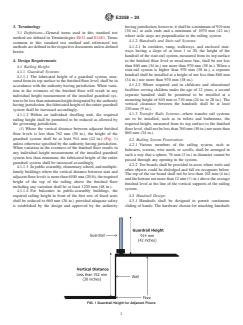
guardrail system shall be at least 914 mm (42 in.) (Fig. 1)
4.2 Railing System Penetration:
unless otherwise specified by the authority having jurisdiction.
4.2.1 Various members of the railing system, such as
When variation in the evenness of the finished floor results in
balusters, screens, wire mesh, or scrolls, shall be arranged in
any individual height measurement of the installed guardrail
such a way that a sphere, 76 mm (3 in.) in diameter cannot be
system less than minimum, the fabricated height of the entire
passed through any opening in the system.
guardrail system shall be increased accordingly.
4.2.2 Toe boards shall be provided in areas where tools and
4.1.1.3 In public assembly, elementary school, and multiple-
other objects could be dislodged and fall on occupants below.
family buildings where the vertical distance between stair and
The top of the toe board shall not be less than 102 mm (4 in.)
adjacent floor levels is more than 6100 mm (20 ft), the required
and the bottom not more than 12 mm ( ⁄2 in.) above the average
height of the top of the railing above the finished floor
finished level at the line of the vertical supports of the railing
including any variation shall be at least 1220 mm (48 in.).
system.
4.1.1.4 For balconies in public-assembly buildings, the
4.3 Handrail Design:
required railing height in front of the first row of fixed seats
shall be reduced to 660 mm (26 in.) provided adequate safety 4.3.1 Handrails shall be designed to permit continuous
is established by the design and approved by the authority sliding of hands. The hardware chosen for attaching handrails
FIG. 1 Guardrail Height for Adjacent Floors
E2358 − 24
to balusters or walls shall be such that projecting lugs, devices,
or other construction elements shall have no sharp edges or
dangerous protrusions.
4.3.2 Handrail ends shall be returned to supporting walls or
otherwise arranged to avoid projecting rail ends. Wall handrails
at stairs and ramps and other handrails that are not continuous
shall be extended horizontally for a distance of at least 305 mm
(12 in.) beyond the intersection of the finish line (plane of tread
nose lines) of the stair or ramp and the landings, unless
interference limits such an extension.
4.3.3 The clearance between the handrail and the mounting
surface or any protrusions from this surface shall be 38 mm
(1 ⁄2 in.). The handrail shall project no more than 89 mm
(3 ⁄2 in.) into the required egress width. The vertical clearance
in a recess shall be in accordance with the provision in 4.4.5.
4.3.4 The hand-grip portion of the handrail shall not be less
than 32 mm (1 ⁄4 in.) or more than 51 mm (2 in.) in outside
FIG. 2 Recessed Transfer Rail
diameter.
4.4 Transfer Rail Design:
4.4.1 Transfer rails shall be designed to permit continuous
5. Classification
sliding of the arm and hand supporting the body weight during
transfer. The hardware chosen for attaching the transfer rails
5.1 Classifications of systems passing the performance re-
shall be such that projecting lugs, devices, or other construction
quirements are outlined in Section 6 of this specification. Basic
elements shall not interrupt the continuous sliding of the arm or
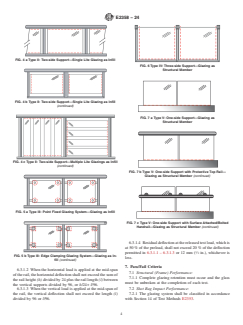
classification shall indicate type of system (Type I through VI
hand or catch loose clothing. The transfer rails, including their
see Figs. 3-8) and level of performance (1, 2, 3, or 4) as defined
fasteners, shall not have sharp edges or dangerous protrusions.
in Test Methods E2353. Each supported edge is indicated by a
The transfer rail top surface shall not be abrasive.
dashed line (---).
4.4.2 Transfer rails shall be returned to supporting walls or
otherwise arranged to avoid projecting rail ends that could
6. Performance Requirements
catch clothing or objects during normal activity around the rail
6.1 The performance requirements are outlined in Table 1
ends.
and 6.3.
4.4.3 The clearance between the face of the transfer rail and
6.2 Exterior glazing in balcony rails in windborne d
...
This document is not an ASTM standard and is intended only to provide the user of an ASTM standard an indication of what changes have been made to the previous version. Because
it may not be technically possible to adequately depict all changes accurately, ASTM recommends that users consult prior editions as appropriate. In all cases only the current version
of the standard as published by ASTM is to be considered the official document.
Designation: E2358 − 17 E2358 − 24
Standard Specification for
Performance of Glazing in Permanent Railing Systems,
Guards, and Balustrades
This standard is issued under the fixed designation E2358; the number immediately following the designation indicates the year of
original adoption or, in the case of revision, the year of last revision. A number in parentheses indicates the year of last reapproval. A
superscript epsilon (´) indicates an editorial change since the last revision or reapproval.
1. Scope
1.1 This specification covers glass in permanent railing systems, guards, and balustrades, including components such as rails and
swing gates or other forms of required guardrail opening protection installed in agricultural, assembly, commercial,comme-
rcial, educational, industrial, institutional, recreational, and residential buildings, and other structures such as towers or elevated
platforms.
1.2 This specification is intended to be applied to permanent glass or other glazing railing systems for buildings and to such railing
systems, rails, guards, and balustrades having major structural components made of glass or other glazing material, or the
secondary components such as infill or balusters made of glass or other glazing material.
1.3 This specification considers that the overall outlook is based on the health and safety of all potential users of buildings. The
criteria incorporated in this specification provide for normal and anticipated building uses, but not for abuses for which the building
and its components are not designed.
1.4 This specification establishes basic minimum requirements and criteria that lead to satisfactory products under normal use
conditions and does not give consideration to design criteria for specific field conditions, the establishment of which is the
prerogative and responsibility of the designer, specification writer, and regulatory agencies.
1.5 This standard does not purport to address all of the safety concerns, if any, associated with its use. It is the responsibility
of the user of this standard to establish appropriate safety, health, and environmental practices and to determine the applicability
of regulatory limitations prior to use.
1.6 This international standard was developed in accordance with internationally recognized principles on standardization
established in the Decision on Principles for the Development of International Standards, Guides and Recommendations issued
by the World Trade Organization Technical Barriers to Trade (TBT) Committee.
2. Referenced Documents
2.1 ASTM Standards:
E631 Terminology of Building Constructions
E935 Test Methods for Performance of Permanent Metal Railing Systems and Rails for Buildings
E1481 Terminology of Railing Systems and Rails for Buildings
This specification is under the jurisdiction of ASTM Committee E06 on Performance of Buildings and is the direct responsibility of Subcommittee E06.56 on Performance
of Railing Systems and Glass for Floors and Stairs.
Current edition approved Aug. 1, 2017March 1, 2024. Published September 2017March 2024. Originally approved in 2004. Last previous edition approved in 20102017
as E2358 – 04E2358 – 17.(2010). DOI: 10.1520/E2358-17.10.1520/E2358-24.
For referenced ASTM standards, visit the ASTM website, www.astm.org, or contact ASTM Customer Service at service@astm.org. For Annual Book of ASTM Standards
volume information, refer to the standard’s Document Summary page on the ASTM website.
Copyright © ASTM International, 100 Barr Harbor Drive, PO Box C700, West Conshohocken, PA 19428-2959. United States
E2358 − 24
E1886 Test Method for Performance of Exterior Windows, Curtain Walls, Doors, and Impact Protective Systems Impacted by
Missile(s) and Exposed to Cyclic Pressure Differentials
E1996 Specification for Performance of Exterior Windows, Curtain Walls, Doors, and Impact Protective Systems Impacted by
Windborne Debris in Hurricanes
E2025 Test Method for Evaluating Fenestration Components and Assemblies for Resistance to Impact Energies (Withdrawn
2015)
E2353 Test Methods for Performance of Glazing in Permanent Railing Systems, Guards, and Balustrades
2.2 ANSI Standard:
ANSI Z97.1 Glazing Materials Used in Buildings, Safety Performance Specifications and Methods of Test
Available from American National Standards Institute (ANSI), 25 W. 43rd St., 4th Floor, New York, NY 10036, http://www.ansi.org.
E2358 − 24
3. Terminology
3.1 Definitions—General terms used in this standard test method are defined in Terminologies E631 and E1481. Terms common
to this standard test method and referenced test methods are defined in the respective documents unless defined herein.
4. Design Requirements
4.1 Railing Height:
4.1.1 Guardrail Systems:
4.1.1.1 The fabricated height of a guardrail system, measured from its top surface to the finished floor level, shall be in accordance
with the authority having jurisdiction. When variation in the evenness of the finished floor will result in any individual height
measurement of the installed guardrail system to be less than minimum height designated by the authority having jurisdiction, the
fabricated height of the entire guardrail system shall be increased accordingly.
4.1.1.2 Within an individual dwelling unit, the required railing height shall be permitted to be reduced as allowed by the governing
jurisdiction.
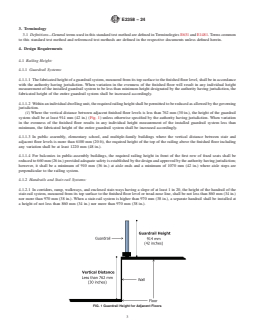
(1) Where the vertical distance between adjacent finished floor levels is less than 762 mm (30 in.), the height of the guardrail
system shall be at least 914 mm (42 in.) (Fig. 1) unless otherwise specified by the authority having jurisdiction. When variation
in the evenness of the finished floor results in any individual height measurement of the installed guardrail system less than
minimum, the fabricated height of the entire guardrail system shall be increased accordingly.
4.1.1.3 In public assembly, elementary school, and multiple-family buildings where the vertical distance between stair and
adjacent floor levels is more than 6100 mm (20 ft), the required height of the top of the railing above the finished floor including
any variation shall be at least 1220 mm (48 in.).
4.1.1.4 For balconies in public-assembly buildings, the required railing height in front of the first row of fixed seats shall be
reduced to 660 mm (26 in.) provided adequate safety is established by the design and approved by the authority having jurisdiction;
however, it shall be a minimum of 910 mm (36 in.) at aisle ends and a minimum of 1070 mm (42 in.) where aisle steps are
perpendicular to the railing system.
4.1.2 Handrails and Stair-rail Systems:
4.1.2.1 In corridors, ramp, walkways, and enclosed stair-ways having a slope of at least 1 in 20, the height of the handrail of the
stair-rail system, measured from its top surface to the finished floor level or tread-nose line, shall be not less than 860 mm (34 in.)
nor more than 970 mm (38 in.). When a stair-rail system is higher than 970 mm (38 in.), a separate handrail shall be installed at
a height of not less than 860 mm (34 in.) nor more than 970 mm (38 in.).
FIG. 1 Guardrail Height for Adjacent Floors
E2358 − 24
4.1.2.2 Where required and in childcare and educational facilities serving children under the age of 12 years, a second separate
handrail shall be permitted to be installed at a mounting height of 610 mm to 710 mm (24 in. to 28 in.). The vertical clearance
between the handrails shall be at least 230 mm (9 in.).
4.1.3 Transfer Rails Systems—where transfer rail systems are to be installed, such as in toilets and bathrooms, the required height,
measured from its top surface to the finished floor level, shall not be less than 760 mm (30 in.) nor more than 860 mm (34 in.).
4.2 Railing System Penetration:
4.2.1 Various members of the railing system, such as balusters, screens, wire mesh, or scrolls, shall be arranged in such a way that
a sphere, 76 mm (3 in.) in diameter cannot be passed through any opening in the system.
4.2.2 Toe boards shall be provided in areas where tools and other objects could be dislodged and fall on occupants below. The
top of the toe board shall not be less than 102 mm (4 in.) and the bottom not more than 12 mm ( ⁄2 in.) above the average finished
level at the line of the vertical supports of the railing system.
4.3 Handrail Design:
4.3.1 Handrails shall be designed to permit continuous sliding of hands. The hardware chosen for attaching handrails to balusters
or walls shall be such that projecting lugs, devices, or other construction elements shall have no sharp edges or dangerous
protrusions.
4.3.2 Handrail ends shall be returned to supporting walls or otherwise arranged to avoid projecting rail ends. Wall handrails at
stairs and ramps and other handrails that are not continuous shall be extended horizontally for a distance of at least 305 mm (12
in.) beyond the intersection of the finish line (plane of tread nose lines) of the stair or ramp and the landings, unless interference
limits such an extension.
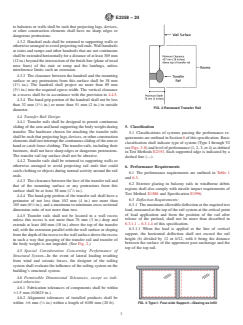
4.3.3 The clearance between the handrail and the mounting surface or any protrusions from this surface shall be 38 mm (1 ⁄2 in.).
The handrail shall project no more than 89 mm (3 ⁄2 in.) into the required egress width. The vertical clearance in a recess shall be
in accordance with the provision in 4.4.5.
4.3.4 The hand-grip portion of the handrail shall not be less than 32 mm (1 ⁄4 in.) or more than 51 mm (2 in.) in outside diameter.
4.4 Transfer Rail Design:
4.4.1 Transfer rails shall be designed to permit continuous sliding of the arm and hand supporting the body weight during transfer.
The hardware chosen for attaching the transfer rails shall be such that projecting lugs, devices, or other construction elements shall
not interrupt the continuous sliding of the arm or hand or catchescatch loose clothing. The transfer rails, including their fasteners,
shall not have sharp edges or dangerous protrusions. The transfer rail top surface shall not be abrasive.
4.4.2 Transfer rails shall be returned to supporting walls or otherwise arranged to avoid projecting rail ends that could catch
clothing or objects during normal activity around the rail ends.
4.4.3 The clearance between the face of the transfer rail and that of the mounting surface or any protrusions from this surface shall
be at least 38 mm (1 ⁄2 in.).
4.4.4 The hand-grip portion of the transfer rail shall have a perimeter of not less than 102 mm (4 in.) nor more than 165 mm (6 ⁄2
in.), and a maximum to minimum cross-sectional dimension ratio of not more than two.
4.4.5 Transfer rails shall not be located in a wall recess unless this recess is not more than 76 mm (3 in.) deep and extends at least
460 mm (18 in.) above the top of the transfer rail, with the extension parallel with the wall surface or sloping from the depth
...