


ASTM D7897-15
(Practice)Standard Practice for Laboratory Soiling and Weathering of Roofing Materials to Simulate Effects of Natural Exposure on Solar Reflectance and Thermal Emittance
Standard Practice for Laboratory Soiling and Weathering of Roofing Materials to Simulate Effects of Natural Exposure on Solar Reflectance and Thermal Emittance
SIGNIFICANCE AND USE
5.1 The solar reflectance of a building envelope surface affects surface temperature and near-surface ambient air temperature. Surfaces with low solar reflectance absorb a high fraction of the incoming solar energy. Sunlight absorbed by a roof or by other building envelope surfaces can be conducted into the building, increasing cooling load and decreasing heating load in a conditioned building, or raising indoor temperature in an unconditioned building. It can also warm the outside air by convection. Determination of solar reflectance can help designers and consumers choose appropriate materials for their buildings and communities.
5.1.1 The solar reflectance of a new building envelope surface often changes within one to two years through deposition and retention of soot and dust; microbiological growth; exposure to sunlight, precipitation, and dew; and other processes of soiling and weathering. For example, light-colored “cool” envelope surfaces with high initial reflectance can experience substantial reflectance loss as they are covered with dark soiling agents. Current product rating programs require roofing manufacturers to report values of solar reflectance and thermal emittance measured after three years of natural exposure (2, 3). A rapid laboratory process for soiling and weathering that simulates the three-year-aged radiative properties of roof and other building envelope surface materials expedites the development, testing, and introduction to market of such products.
5.2 Thermal emittance describes the efficiency with which a surface exchanges thermal radiation with its environment. High thermal emittance enhances the ability of a surface to stay cool in the sun. The thermal emittance of a bare metal surface is initially low, and often increases as it is soiled or oxidized (4). The thermal emittance of a typical non-metal surface is initially high, and remains high after soiling (5).
5.3 This practice allows measurement of the solar reflectance a...
SCOPE
1.1 Practice D7897 applies to simulation of the effects of field exposure on the solar reflectance and thermal emittance of roof surface materials including but not limited to field-applied coatings, factory-applied coatings, single-ply membranes, modified bitumen products, shingles, tiles, and metal products. The solar reflectance and thermal emittance of roof surface materials can be changed by exposure to the outdoor environment. These changes are caused by three factors: deposition and retention of airborne pollutants; microbiological growth; and changes in physical or chemical properties. This practice applies to simulation of changes in solar reflectance and thermal emittance induced by deposition and retention of airborne pollutants and, to a limited extent, changes caused by microbiological growth.
1.2 This standard does not purport to address all of the safety concerns, if any, associated with its use. It is the responsibility of the user of this standard to establish appropriate safety and health practices and determine the applicability of regulatory limitations prior to use.
General Information
Relations
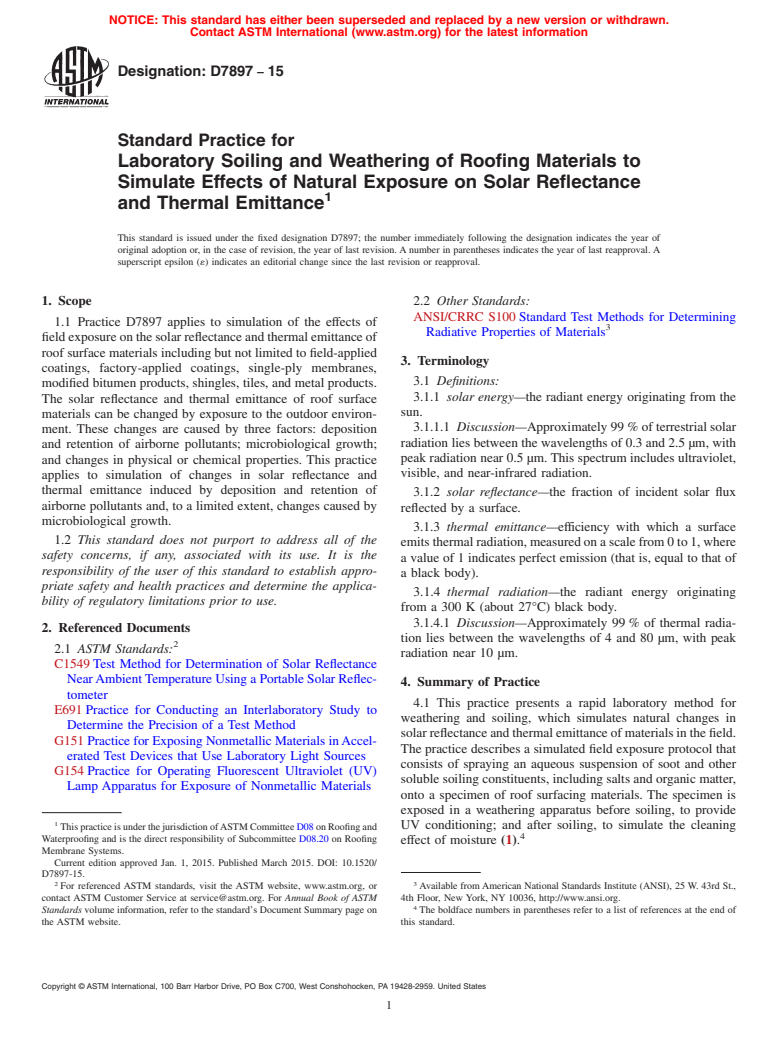

Standards Content (Sample)
NOTICE: This standard has either been superseded and replaced by a new version or withdrawn.
Contact ASTM International (www.astm.org) for the latest information
Designation:D7897 −15
Standard Practice for
Laboratory Soiling and Weathering of Roofing Materials to
Simulate Effects of Natural Exposure on Solar Reflectance
1
and Thermal Emittance
This standard is issued under the fixed designation D7897; the number immediately following the designation indicates the year of
original adoption or, in the case of revision, the year of last revision. A number in parentheses indicates the year of last reapproval. A
superscript epsilon (´) indicates an editorial change since the last revision or reapproval.
1. Scope 2.2 Other Standards:
ANSI/CRRC S100 Standard Test Methods for Determining
1.1 Practice D7897 applies to simulation of the effects of
3
Radiative Properties of Materials
fieldexposureonthesolarreflectanceandthermalemittanceof
roof surface materials including but not limited to field-applied
3. Terminology
coatings, factory-applied coatings, single-ply membranes,
3.1 Definitions:
modified bitumen products, shingles, tiles, and metal products.
3.1.1 solar energy—the radiant energy originating from the
The solar reflectance and thermal emittance of roof surface
sun.
materials can be changed by exposure to the outdoor environ-
3.1.1.1 Discussion—Approximately 99 % of terrestrial solar
ment. These changes are caused by three factors: deposition
radiation lies between the wavelengths of 0.3 and 2.5 µm, with
and retention of airborne pollutants; microbiological growth;
peak radiation near 0.5 µm. This spectrum includes ultraviolet,
and changes in physical or chemical properties. This practice
visible, and near-infrared radiation.
applies to simulation of changes in solar reflectance and
thermal emittance induced by deposition and retention of
3.1.2 solar reflectance—the fraction of incident solar flux
airborne pollutants and, to a limited extent, changes caused by
reflected by a surface.
microbiological growth.
3.1.3 thermal emittance—efficiency with which a surface
1.2 This standard does not purport to address all of the
emitsthermalradiation,measuredonascalefrom0to1,where
safety concerns, if any, associated with its use. It is the
a value of 1 indicates perfect emission (that is, equal to that of
responsibility of the user of this standard to establish appro-
a black body).
priate safety and health practices and determine the applica-
3.1.4 thermal radiation—the radiant energy originating
bility of regulatory limitations prior to use.
from a 300 K (about 27°C) black body.
3.1.4.1 Discussion—Approximately 99 % of thermal radia-
2. Referenced Documents
tion lies between the wavelengths of 4 and 80 µm, with peak
2
2.1 ASTM Standards:
radiation near 10 µm.
C1549 Test Method for Determination of Solar Reflectance
NearAmbientTemperature Using a Portable Solar Reflec-
4. Summary of Practice
tometer
4.1 This practice presents a rapid laboratory method for
E691 Practice for Conducting an Interlaboratory Study to
weathering and soiling, which simulates natural changes in
Determine the Precision of a Test Method
solarreflectanceandthermalemittanceofmaterialsinthefield.
G151 Practice for Exposing Nonmetallic Materials inAccel-
The practice describes a simulated field exposure protocol that
erated Test Devices that Use Laboratory Light Sources
consists of spraying an aqueous suspension of soot and other
G154 Practice for Operating Fluorescent Ultraviolet (UV)
soluble soiling constituents, including salts and organic matter,
Lamp Apparatus for Exposure of Nonmetallic Materials
onto a specimen of roof surfacing materials. The specimen is
exposed in a weathering apparatus before soiling, to provide
1
ThispracticeisunderthejurisdictionofASTMCommitteeD08onRoofingand UV conditioning; and after soiling, to simulate the cleaning
4
Waterproofing and is the direct responsibility of Subcommittee D08.20 on Roofing
effect of moisture (1).
Membrane Systems.
Current edition approved Jan. 1, 2015. Published March 2015. DOI: 10.1520/
D7897-15.
2 3
For referenced ASTM standards, visit the ASTM website, www.astm.org, or Available fromAmerican National Standards Institute (ANSI), 25 W. 43rd St.,
contact ASTM Customer Service at service@astm.org. For Annual Book of ASTM 4th Floor, New York, NY 10036, http://www.ansi.org.
4
Standards volume information, refer to the standard’s Document Summary page on The boldface numbers in parentheses refer to a list of references at the end of
the ASTM website. this standard.
Copyright © ASTM International, 100 Barr Harbor Drive, PO Box C700, West Conshohocken, PA 19428-2959. United States
1
---------------------- Page: 1 ----------------------
D7897−15
5. Significance and Use 6.1.1 Soot—A commercially available self-dispersible car-
5
bon black (Aqua-Black 001: Tokai Carbon Co., Ltd ), is used
5.1 The solar reflectance of a building envelope surface
as surrogate for soot. 1.37 6 0.05 g of Aqua-Black 001
affects surface tempe
...
Questions, Comments and Discussion
Ask us and Technical Secretary will try to provide an answer. You can facilitate discussion about the standard in here.