


ASTM B893-98(2018)
(Specification)Standard Specification for Hard-Coat Anodizing of Magnesium for Engineering Applications
Standard Specification for Hard-Coat Anodizing of Magnesium for Engineering Applications
SCOPE
1.1 This specification covers requirements for electrolytically formed oxide coatings on magnesium and magnesium alloy parts where appearance, abrasion resistance, and protection against corrosion are important.
1.2 This standard does not purport to address all of the safety concerns, if any, associated with its use. It is the responsibility of the user of this standard to establish appropriate safety, health, and environmental practices and determine the applicability of regulatory limitations prior to use.
1.3 This international standard was developed in accordance with internationally recognized principles on standardization established in the Decision on Principles for the Development of International Standards, Guides and Recommendations issued by the World Trade Organization Technical Barriers to Trade (TBT) Committee.
General Information
Buy Standard
Standards Content (Sample)
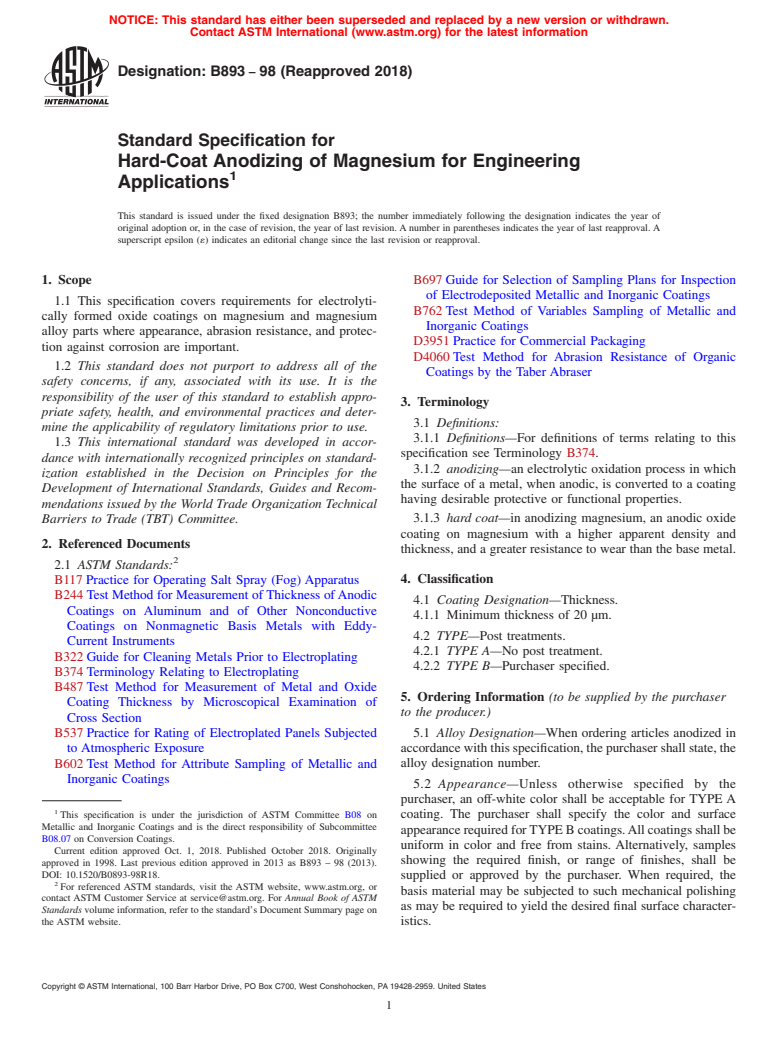
NOTICE: This standard has either been superseded and replaced by a new version or withdrawn.
Contact ASTM International (www.astm.org) for the latest information
Designation: B893 − 98 (Reapproved 2018)
Standard Specification for
Hard-Coat Anodizing of Magnesium for Engineering
Applications
This standard is issued under the fixed designation B893; the number immediately following the designation indicates the year of
original adoption or, in the case of revision, the year of last revision. A number in parentheses indicates the year of last reapproval. A
superscript epsilon (´) indicates an editorial change since the last revision or reapproval.
1. Scope B697 Guide for Selection of Sampling Plans for Inspection
of Electrodeposited Metallic and Inorganic Coatings
1.1 This specification covers requirements for electrolyti-
B762 Test Method of Variables Sampling of Metallic and
cally formed oxide coatings on magnesium and magnesium
Inorganic Coatings
alloy parts where appearance, abrasion resistance, and protec-
D3951 Practice for Commercial Packaging
tion against corrosion are important.
D4060 Test Method for Abrasion Resistance of Organic
1.2 This standard does not purport to address all of the
Coatings by the Taber Abraser
safety concerns, if any, associated with its use. It is the
responsibility of the user of this standard to establish appro-
3. Terminology
priate safety, health, and environmental practices and deter-
3.1 Definitions:
mine the applicability of regulatory limitations prior to use.
3.1.1 Definitions—For definitions of terms relating to this
1.3 This international standard was developed in accor-
specification see Terminology B374.
dance with internationally recognized principles on standard-
3.1.2 anodizing—an electrolytic oxidation process in which
ization established in the Decision on Principles for the
the surface of a metal, when anodic, is converted to a coating
Development of International Standards, Guides and Recom-
having desirable protective or functional properties.
mendations issued by the World Trade Organization Technical
3.1.3 hard coat—in anodizing magnesium, an anodic oxide
Barriers to Trade (TBT) Committee.
coating on magnesium with a higher apparent density and
2. Referenced Documents
thickness, and a greater resistance to wear than the base metal.
2.1 ASTM Standards:
4. Classification
B117 Practice for Operating Salt Spray (Fog) Apparatus
B244 Test Method for Measurement of Thickness of Anodic
4.1 Coating Designation—Thickness.
Coatings on Aluminum and of Other Nonconductive
4.1.1 Minimum thickness of 20 µm.
Coatings on Nonmagnetic Basis Metals with Eddy-
4.2 TYPE—Post treatments.
Current Instruments
4.2.1 TYPE A—No post treatment.
B322 Guide for Cleaning Metals Prior to Electroplating
4.2.2 TYPE B—Purchaser specified.
B374 Terminology Relating to Electroplating
B487 Test Method for Measurement of Metal and Oxide
5. Ordering Information (to be supplied by the purchaser
Coating Thickness by Microscopical Examination of
to the producer.)
Cross Section
B537 Practice for Rating of Electroplated Panels Subjected 5.1 Alloy Designation—When ordering articles anodized in
accordance with this specification, the purchaser shall state, the
to Atmospheric Exposure
B602 Test Method for Attribute Sampling of Metallic and alloy designation number.
Inorganic Coatings
5.2 Appearance—Unless otherwise specified by the
purchaser, an off-white color shall be acceptable for TYPE A
This specification is under the jurisdiction of ASTM Committee B08 on coating. The purchaser shall specify the color and surface
Metallic and Inorganic Coatings and is the direct responsibility of Subcommittee
appearance required for TYPE B coatings. All coatings shall be
B08.07 on Conversion Coatings.
uniform in color and free from stains. Alternatively, samples
Current edition approved Oct. 1, 2018. Published October 2018. Originally
showing the required finish, or range of finishes, shall be
approved in 1998. Last previous edition approved in 2013 as B893 – 98 (2013).
DOI: 10.1520/B0893-98R18.
supplied or approved by the purchaser. When required, the
For referenced ASTM standards, visit the ASTM website, www.astm.org, or
basis material may be subjected to such mechanical polishing
contact ASTM Customer Service at service@astm.org. For Annual Book of ASTM
as may be required to yield the desired final surface character-
Standards volume information, refer to the standard’s Document Summary page on
the ASTM website. istics.
Copyright © ASTM International, 100 Barr Harbor Drive, PO Box C700, West Conshohocken, PA 19428-2959. United States
B893 − 98 (2018)
NOTE 3—Defects in the surface of the basis material such as scratches,
5.3 Significant Surface—The areas of the article covered by
porosity, inclusions, etc., may adversely affect the appearance and
the coating, for which the coating is essential for service or
performance of the article.
appearance or both.
5.3.1 Contact Marks—Contact marks will occur. The pur- 7.1.2 Thickness:
chaser shall specify where contact marks are unacceptable.
7.1.2.1 Coating Thickness for SC20—The anodic film thick-
ness shall be a minimum of 20 µm and not exceed 30 µm on the
5.4 Tolerances—Dimensional build-up is approximately
significant surface.
one-half of anodic film thickness. The order document shall
7.1.2.2 Test—Hard-coating thickness shall be evaluated by
include any coating thickness tolerances and shall not exceed
one or more of the following test methods in Section 8.
any applicable drawing dimensions.
5.5 The purchaser shall provide the number for this standard
7.2 Qualification Tests—The process shall be evaluated
TYPE. monthly or more frequently if required by the purchaser using
the following test methods on panels that are of the same alloy
5.6 The purchaser shall state any special post treatments
of the parts coated with TYPE A hard coat.
(see 4.2 and 5.2).
7.2.1 Corrosion Test—Use method described in 8.1.
5.7 Test Methods—The purchaser shall state the test meth-
7.2.2 Abrasion Resistance Test—Use the Taber Abraser test
od(s) by which the coated article will be evaluated (see Section
method in Annex A1 of this specification.
8).
5.8 Sampling Plan—see Section 9.
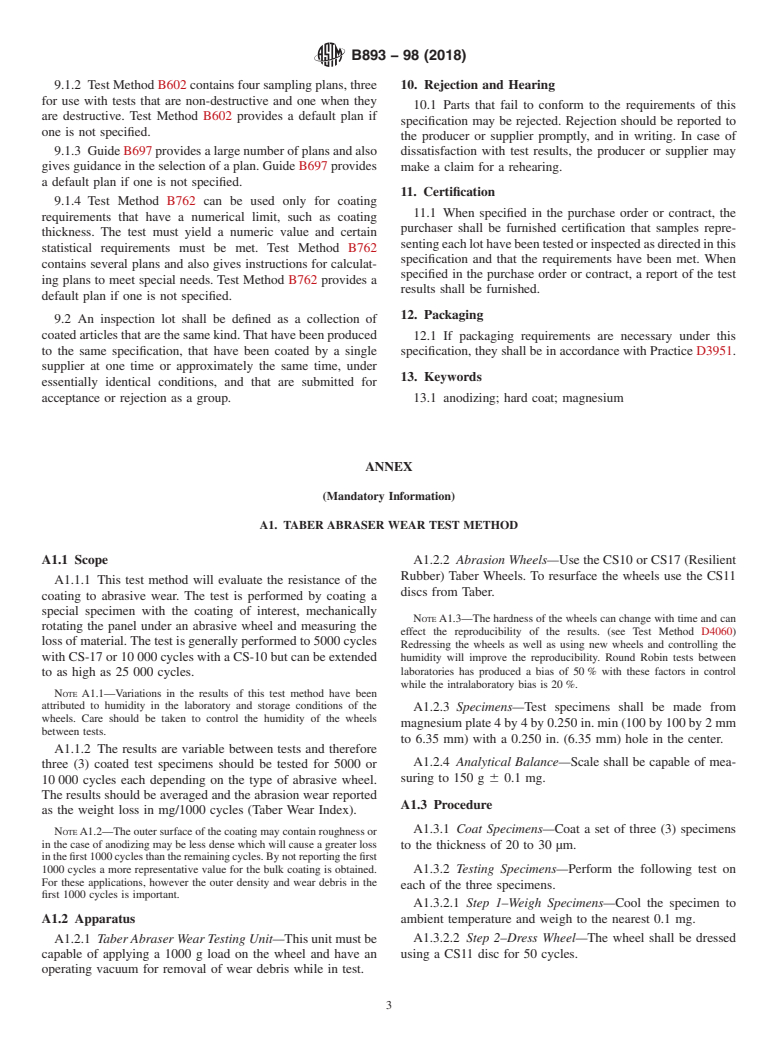
8. Test Methods
5.9 Any requirement for certification (see Section 11).
8.1 Corrosion Test—Panel(s) shall be subjected to a 5 % salt
5.10 Any requirement for packaging (see Section 12).
spray (fog) test in accordance with Practice B117 for 336 h.
The panel(s) shall be prepared and evaluated in accordance
6. Materials and Process
with Practice B537. A protective rating of 6 or less is
considered a failure.
6.1 Process:
6.1.1 Basis Metal—This specification does not specify re-
8.2 Abrasion Resistance Test—Test panels in accordance
quirements for the surface condition of the basis metal before
with Annex A1. The acceptance criteria shall be as follows.
anodizing, but agreement should preferably be reached be-
8.2.1 Abrasive Wheel No. CS-10—A wear index of more
tween the purchaser and the producer that the surface condition
than 7 mg/1000 cycles or less than 10 000 wear cycles shall be
of the basis metal is satisfactory.
considered a failure.
6.1.2 Surface Preparation—Preparatory procedures and
8.2.2 Abrasive Wheel No. CS-17—A wear index of more
cleaning of the basis material may be necessary, see Practice
than 20 mg/1000 cycles or less than 5 000 wear cycles shall be
B322.
considered a failure.
6.1.3 Hard-Coating—Following the preparatory operations,
the articles are introduced into the solution for a period of time
8.3 Thickness Tests:
at the current density and temperature required to produce the
8.3.1 Eddy-Current Method (Test Method B244).
hard-coated surface.
8.3.2 Microscopical Cross Section Method (Test Method
NOTE 1—Hard-coating solutions and operating conditions are commer- B487).
cially available. The appropriate operating instructions should be fol-
lowed.
9. Sampling
NOTE 2—Intricately shaped articles may not receive the same thickness
of coating in recessed areas due to lower current densities. Auxiliary
9.1 The purchaser and producer are urged to employ statis-
cathodes, may be used to improve anodize thickness in these areas.
tical process control in the coating process. P
...
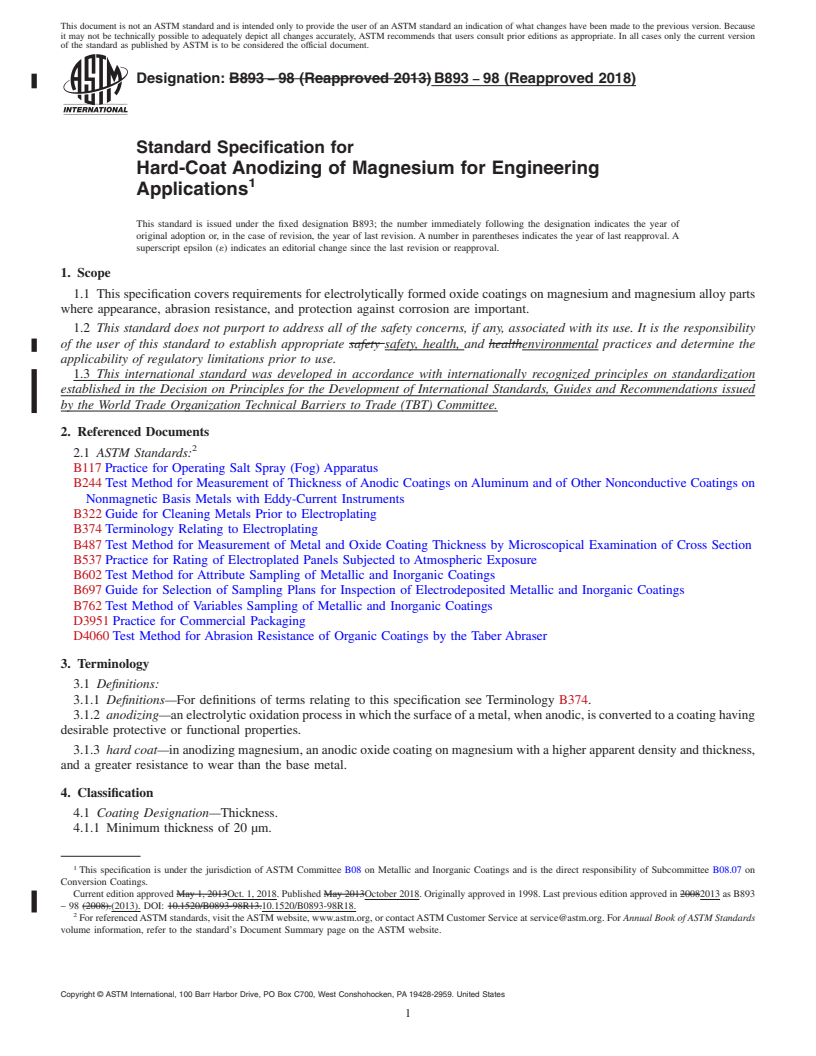
This document is not an ASTM standard and is intended only to provide the user of an ASTM standard an indication of what changes have been made to the previous version. Because
it may not be technically possible to adequately depict all changes accurately, ASTM recommends that users consult prior editions as appropriate. In all cases only the current version
of the standard as published by ASTM is to be considered the official document.
Designation: B893 − 98 (Reapproved 2013) B893 − 98 (Reapproved 2018)
Standard Specification for
Hard-Coat Anodizing of Magnesium for Engineering
Applications
This standard is issued under the fixed designation B893; the number immediately following the designation indicates the year of
original adoption or, in the case of revision, the year of last revision. A number in parentheses indicates the year of last reapproval. A
superscript epsilon (´) indicates an editorial change since the last revision or reapproval.
1. Scope
1.1 This specification covers requirements for electrolytically formed oxide coatings on magnesium and magnesium alloy parts
where appearance, abrasion resistance, and protection against corrosion are important.
1.2 This standard does not purport to address all of the safety concerns, if any, associated with its use. It is the responsibility
of the user of this standard to establish appropriate safety safety, health, and healthenvironmental practices and determine the
applicability of regulatory limitations prior to use.
1.3 This international standard was developed in accordance with internationally recognized principles on standardization
established in the Decision on Principles for the Development of International Standards, Guides and Recommendations issued
by the World Trade Organization Technical Barriers to Trade (TBT) Committee.
2. Referenced Documents
2.1 ASTM Standards:
B117 Practice for Operating Salt Spray (Fog) Apparatus
B244 Test Method for Measurement of Thickness of Anodic Coatings on Aluminum and of Other Nonconductive Coatings on
Nonmagnetic Basis Metals with Eddy-Current Instruments
B322 Guide for Cleaning Metals Prior to Electroplating
B374 Terminology Relating to Electroplating
B487 Test Method for Measurement of Metal and Oxide Coating Thickness by Microscopical Examination of Cross Section
B537 Practice for Rating of Electroplated Panels Subjected to Atmospheric Exposure
B602 Test Method for Attribute Sampling of Metallic and Inorganic Coatings
B697 Guide for Selection of Sampling Plans for Inspection of Electrodeposited Metallic and Inorganic Coatings
B762 Test Method of Variables Sampling of Metallic and Inorganic Coatings
D3951 Practice for Commercial Packaging
D4060 Test Method for Abrasion Resistance of Organic Coatings by the Taber Abraser
3. Terminology
3.1 Definitions:
3.1.1 Definitions—For definitions of terms relating to this specification see Terminology B374.
3.1.2 anodizing—an electrolytic oxidation process in which the surface of a metal, when anodic, is converted to a coating having
desirable protective or functional properties.
3.1.3 hard coat—in anodizing magnesium, an anodic oxide coating on magnesium with a higher apparent density and thickness,
and a greater resistance to wear than the base metal.
4. Classification
4.1 Coating Designation—Thickness.
4.1.1 Minimum thickness of 20 μm.
This specification is under the jurisdiction of ASTM Committee B08 on Metallic and Inorganic Coatings and is the direct responsibility of Subcommittee B08.07 on
Conversion Coatings.
Current edition approved May 1, 2013Oct. 1, 2018. Published May 2013October 2018. Originally approved in 1998. Last previous edition approved in 20082013 as B893
– 98 (2008).(2013). DOI: 10.1520/B0893-98R13.10.1520/B0893-98R18.
For referenced ASTM standards, visit the ASTM website, www.astm.org, or contact ASTM Customer Service at service@astm.org. For Annual Book of ASTM Standards
volume information, refer to the standard’s Document Summary page on the ASTM website.
Copyright © ASTM International, 100 Barr Harbor Drive, PO Box C700, West Conshohocken, PA 19428-2959. United States
B893 − 98 (2018)
4.2 TYPE—Post treatments.
4.2.1 TYPE A—No post treatment.
4.2.2 TYPE B—Purchaser specified.
5. Ordering Information (to be supplied by the purchaser to the producer.)
5.1 Alloy Designation—When ordering articles anodized in accordance with this specification, the purchaser shall state, the
alloy designation number.
5.2 Appearance—Unless otherwise specified by the purchaser, an off-white color shall be acceptable for TYPE A coating. The
purchaser shall specify the color and surface appearance required for TYPE B coatings. All coatings shall be uniform in color and
free from stains. Alternatively, samples showing the required finish, or range of finishes, shall be supplied or approved by the
purchaser. When required, the basis material may be subjected to such mechanical polishing as may be required to yield the desired
final surface characteristics.
5.3 Significant Surface—The areas of the article covered by the coating, for which the coating is essential for service or
appearance or both.
5.3.1 Contact Marks—Contact marks will occur. The purchaser shall specify where contact marks are unacceptable.
5.4 Tolerances—Dimensional build-up is approximately one-half of anodic film thickness. The order document shall include
any coating thickness tolerances and shall not exceed any applicable drawing dimensions.
5.5 The purchaser shall provide the number for this standard TYPE.
5.6 The purchaser shall state any special post treatments (see 4.2 and 5.2).
5.7 Test Methods—The purchaser shall state the test method(s) by which the coated article will be evaluated (see Section 8).
5.8 Sampling Plan—see Section 9.
5.9 Any requirement for certification (see Section 11).
5.10 Any requirement for packaging (see Section 12).
6. Materials and Process
6.1 Process:
6.1.1 Basis Metal—This specification does not specify requirements for the surface condition of the basis metal before
anodizing, but agreement should preferably be reached between the purchaser and the producer that the surface condition of the
basis metal is satisfactory.
6.1.2 Surface Preparation—Preparatory procedures and cleaning of the basis material may be necessary, see Practice B322.
6.1.3 Hard-Coating—Following the preparatory operations, the articles are introduced into the solution for a period of time at
the current density and temperature required to produce the hard-coated surface.
NOTE 1—Hard-coating solutions and operating conditions are commercially available. The appropriate operating instructions should be followed.
NOTE 2—Intricately shaped articles may not receive the same thickness of coating in recessed areas due to lower current densities. Auxiliary cathodes,
may be used to improve anodize thickness in these areas.
6.2 Post Treatments:
6.2.1 Final Rinsing—Rinsing subsequent to anodizing is necessary to remove all traces of the electrolyte that may affect the
appearance and performance of the part. Deionized or distilled water may be used to avoid water spots.
6.2.2 Post Treatment—Surface sealers or topcoats may be specified to reduce friction, add color, or further increase
performance.
7. Requirements
7.1 Acceptance:
7.1.1 Visual Defects—The significant surfaces of the article to be hardcoated shall be free of clearly visible defects such as pits,
roughness, striations, or discoloration when examined with normal or corrected to 20/20 eyesight at a distance of approximately
0.5 m.
NOTE 3—Defects in the surface of the basis material such as scratches, porosity, inclusions, etc., may adversely affect the appearance and performance
of the article.
7.1.2 Thickness:
7.1.2.1 Coating Thickness for SC20—The anodic film thickness shall be a minimum of 20 μm and not exceed 30 μm on the
significant surface.
7.1.2.2 Test—Hard-coating thickness shall be evaluated by one or more of the following test methods in Section 8.
7.2 Qualification Tests—The process shall be evaluated monthly or more frequently if required by the purchaser using the
following test methods on panels that are of the same alloy of the parts coated with TYPE A hard coat.
B893 − 98 (2018)
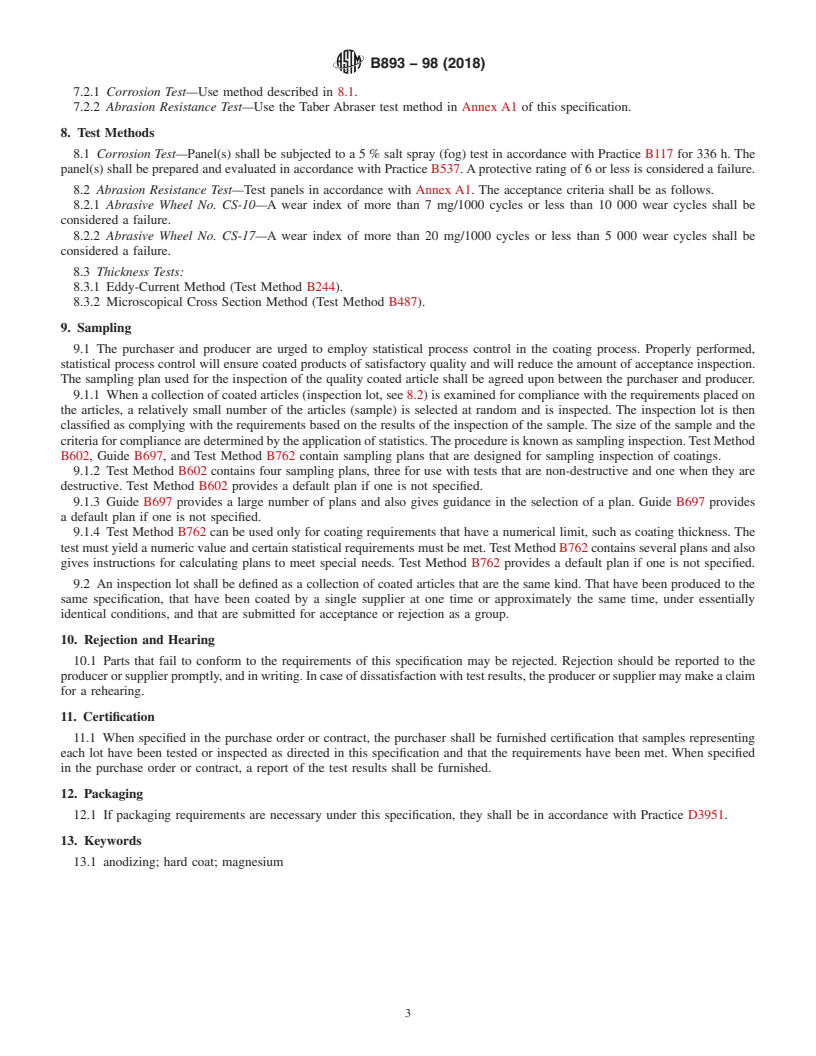
7.2.1 Corrosion Test—Use method described in 8.1.
7.2.2 Abrasion Resistance Test—Use the Taber Abraser test method in Annex A1 of this specification.
8. Test Methods
8.1 Corrosion
...
Questions, Comments and Discussion
Ask us and Technical Secretary will try to provide an answer. You can facilitate discussion about the standard in here.