

ASTM B729-20
(Specification)Standard Specification for Seamless Nickel-Iron-Chromium-Molybdenum-Copper Nickel Alloy Pipe and Tube
General Information
- Abstract
ABSTRACT
This specification covers UNS N08020, UNS N08026 and UNS N08024 nickel-alloy seamless, cold-worked or hot-finished pipe and tube intended for general corrosive service. The product of UNS N08020 alloy, UNS N08026 alloy, and UNS N08024 alloy shall be furnished in the stabilized-annealed condition, solution-annealed condition, and annealed condition, respectively. The tensile strength, yield strength, and elongation requirements are specified. Hydrostatic and nondestructive electric tests shall be conducted on the each pipe or tube.
SCOPE
1.1 This specification covers UNS N08020, UNS N08026, and UNS N08024 seamless, cold-worked or hot finished pipe and tube intended for general corrosive service.
1.2 The values stated in inch-pound units are to be regarded as standard. The values given in parentheses are mathematical conversions to SI units that are provided for information only and are not considered standard.
1.3 The following safety hazards caveat pertains only to the test methods portion, Section 10, of this specification: This standard does not purport to address all of the safety concerns, if any, associated with its use. It is the responsibility of the user of this standard to become familiar with all hazards including those identified in the appropriate Material Safety data Sheet (MSDS) for this product/material as provided by the manufacturer, to establish appropriate safety, health, and environmental practices, and determine the applicability of regulatory limitations prior to use.
1.4 This international standard was developed in accordance with internationally recognized principles on standardization established in the Decision on Principles for the Development of International Standards, Guides and Recommendations issued by the World Trade Organization Technical Barriers to Trade (TBT) Committee.
- Status
- Published
- Publication Date
- 30-Sep-2020
- Technical Committee
- B02 - Nonferrous Metals and Alloys
- Drafting Committee
- B02.07 - Refined Nickel and Cobalt and Their Alloys
Buy Documents
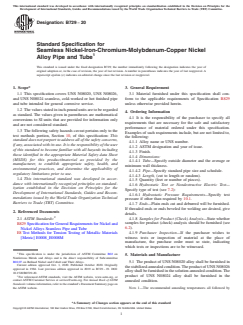
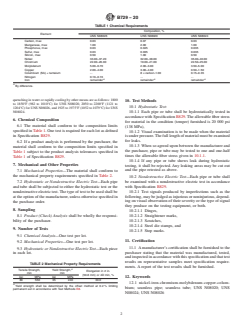


ASTM B729-20 - Standard Specification for Seamless Nickel-Iron-Chromium-Molybdenum-Copper Nickel Alloy Pipe and Tube
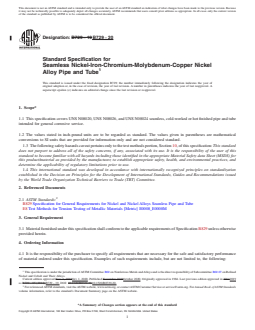
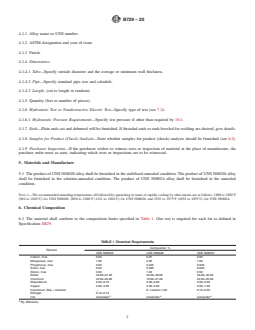

REDLINE ASTM B729-20 - Standard Specification for Seamless Nickel-Iron-Chromium-Molybdenum-Copper Nickel Alloy Pipe and Tube
Overview
ASTM B729-20 is the standard specification for seamless nickel-iron-chromium-molybdenum-copper nickel alloy pipe and tube, intended for general corrosive service. This specification covers three primary alloys: UNS N08020, UNS N08026, and UNS N08024, each supplied in a specific annealed condition to optimize material performance. The standard sets requirements for material composition, mechanical properties, testing, and certification to ensure that seamless pipes and tubes meet the rigorous demands of corrosive processing environments. ASTM B729-20 is developed and maintained by ASTM International and is widely referenced in industries requiring reliable corrosion resistance and mechanical strength.
Key Topics
Material Coverage
- Applies to seamless, cold-worked, or hot-finished nickel alloy pipes and tubes.
- Includes alloys UNS N08020, UNS N08026, and UNS N08024.
- Supplied in stabilized-annealed, solution-annealed, or annealed condition, as needed.
Dimensions and Ordering Requirements
- Specifies dimensions such as outside diameter, wall thickness, length, and finish.
- Ordering information must include alloy designation, ASTM standard, finish, testing, and inspection requirements.
Mechanical Properties
- Outlines minimum tensile strength, yield strength, and elongation values for each alloy.
- Ensures mechanical reliability for applications exposed to corrosives.
Testing and Inspection
- Requires each pipe or tube to undergo hydrostatic testing or nondestructive electric testing for leak-tightness and material integrity.
- Test requirements determined by the manufacturer unless otherwise specified by the purchaser.
Certification
- Mandatory manufacturer’s certification with test results verifying compliance to ASTM B729-20.
Safety and Compliance
- Includes a caveat regarding the responsibility of users to identify and address safety hazards as found in relevant Material Safety Data Sheets (MSDS) and regulatory limitations.
Applications
ASTM B729-20 seamless nickel alloy pipes and tubes are designed for demanding corrosive environments. Typical application areas include:
Chemical Processing
Used for piping and tubing in production plants handling acids, chlorides, and other aggressive chemicals.Petrochemical Industry
Installed in refineries and processing plants where resistance to sulfur compounds, seawater, and high-temperature corrosion is critical.Power Generation
Utilized in heat exchangers, condensers, and recirculation lines where both mechanical strength and corrosion resistance are required.Oil & Gas
Deployed in offshore platforms and pipelines facing harsh environmental exposure.Pharmaceutical & Food Processing
Suitable for equipment needing superior resistance to cleaning agents and process chemicals.
Related Standards
Several additional ASTM standards are relevant for those specifying or working with nickel alloy piping and tubing:
- ASTM B829 - General requirements for nickel and nickel alloys seamless pipe and tube.
- ASTM E8/E8M - Test methods for tension testing of metallic materials.
- Other alloy-specific or application-specific ASTM standards as referenced in related documentation.
Practical Value
Implementing ASTM B729-20 helps organizations and engineers:
- Assure high-quality, leak-tight nickel alloy pipe and tube for corrosive service.
- Meet regulatory and safety requirements for critical infrastructure.
- Specify robust materials that help maximize asset lifecycle and minimize downtime due to corrosion failures.
- Simplify procurement and qualification processes by relying on an internationally recognized, comprehensive standard.
For complete technical details or to ensure compliance, always consult the current official version of ASTM B729-20 and related standards through ASTM International.
Relations
- Effective Date
- 01-Apr-2019
- Effective Date
- 01-Nov-2018
- Effective Date
- 01-Apr-2017
- Effective Date
- 15-Apr-2009
- Effective Date
- 01-Oct-2004
- Effective Date
- 01-Apr-2004
- Effective Date
- 01-Feb-2004
- Effective Date
- 10-Jul-2003
- Effective Date
- 10-Oct-2001
- Effective Date
- 10-Oct-2001
- Effective Date
- 10-Oct-2001
- Effective Date
- 10-Oct-2001
- Effective Date
- 10-May-1999
Buy Documents
ASTM B729-20 - Standard Specification for Seamless Nickel-Iron-Chromium-Molybdenum-Copper Nickel Alloy Pipe and Tube
REDLINE ASTM B729-20 - Standard Specification for Seamless Nickel-Iron-Chromium-Molybdenum-Copper Nickel Alloy Pipe and Tube
Get Certified
Connect with accredited certification bodies for this standard

Element Materials Technology
Materials testing and product certification.

Inštitut za kovinske materiale in tehnologije
Institute of Metals and Technology. Materials testing, metallurgical analysis, NDT.
Sponsored listings
Frequently Asked Questions
ASTM B729-20 is a technical specification published by ASTM International. Its full title is "Standard Specification for Seamless Nickel-Iron-Chromium-Molybdenum-Copper Nickel Alloy Pipe and Tube". This standard covers: ABSTRACT This specification covers UNS N08020, UNS N08026 and UNS N08024 nickel-alloy seamless, cold-worked or hot-finished pipe and tube intended for general corrosive service. The product of UNS N08020 alloy, UNS N08026 alloy, and UNS N08024 alloy shall be furnished in the stabilized-annealed condition, solution-annealed condition, and annealed condition, respectively. The tensile strength, yield strength, and elongation requirements are specified. Hydrostatic and nondestructive electric tests shall be conducted on the each pipe or tube. SCOPE 1.1 This specification covers UNS N08020, UNS N08026, and UNS N08024 seamless, cold-worked or hot finished pipe and tube intended for general corrosive service. 1.2 The values stated in inch-pound units are to be regarded as standard. The values given in parentheses are mathematical conversions to SI units that are provided for information only and are not considered standard. 1.3 The following safety hazards caveat pertains only to the test methods portion, Section 10, of this specification: This standard does not purport to address all of the safety concerns, if any, associated with its use. It is the responsibility of the user of this standard to become familiar with all hazards including those identified in the appropriate Material Safety data Sheet (MSDS) for this product/material as provided by the manufacturer, to establish appropriate safety, health, and environmental practices, and determine the applicability of regulatory limitations prior to use. 1.4 This international standard was developed in accordance with internationally recognized principles on standardization established in the Decision on Principles for the Development of International Standards, Guides and Recommendations issued by the World Trade Organization Technical Barriers to Trade (TBT) Committee.
ABSTRACT This specification covers UNS N08020, UNS N08026 and UNS N08024 nickel-alloy seamless, cold-worked or hot-finished pipe and tube intended for general corrosive service. The product of UNS N08020 alloy, UNS N08026 alloy, and UNS N08024 alloy shall be furnished in the stabilized-annealed condition, solution-annealed condition, and annealed condition, respectively. The tensile strength, yield strength, and elongation requirements are specified. Hydrostatic and nondestructive electric tests shall be conducted on the each pipe or tube. SCOPE 1.1 This specification covers UNS N08020, UNS N08026, and UNS N08024 seamless, cold-worked or hot finished pipe and tube intended for general corrosive service. 1.2 The values stated in inch-pound units are to be regarded as standard. The values given in parentheses are mathematical conversions to SI units that are provided for information only and are not considered standard. 1.3 The following safety hazards caveat pertains only to the test methods portion, Section 10, of this specification: This standard does not purport to address all of the safety concerns, if any, associated with its use. It is the responsibility of the user of this standard to become familiar with all hazards including those identified in the appropriate Material Safety data Sheet (MSDS) for this product/material as provided by the manufacturer, to establish appropriate safety, health, and environmental practices, and determine the applicability of regulatory limitations prior to use. 1.4 This international standard was developed in accordance with internationally recognized principles on standardization established in the Decision on Principles for the Development of International Standards, Guides and Recommendations issued by the World Trade Organization Technical Barriers to Trade (TBT) Committee.
ASTM B729-20 is classified under the following ICS (International Classification for Standards) categories: 77.120.40 - Nickel, chromium and their alloys. The ICS classification helps identify the subject area and facilitates finding related standards.
ASTM B729-20 has the following relationships with other standards: It is inter standard links to ASTM B829-19, ASTM B829-18, ASTM B829-04a(2017), ASTM B829-04a(2009), ASTM B829-04a, ASTM E8-04, ASTM B829-04, ASTM E8-03, ASTM E8-01, ASTM E8-01e2, ASTM E8-01e1, ASTM E8-00b, ASTM B829-99. Understanding these relationships helps ensure you are using the most current and applicable version of the standard.
ASTM B729-20 is available in PDF format for immediate download after purchase. The document can be added to your cart and obtained through the secure checkout process. Digital delivery ensures instant access to the complete standard document.
Standards Content (Sample)
This international standard was developed in accordance with internationally recognized principles on standardization established in the Decision on Principles for the
Development of International Standards, Guides and Recommendations issued by the World Trade Organization Technical Barriers to Trade (TBT) Committee.
Designation:B729 −20
Standard Specification for
Seamless Nickel-Iron-Chromium-Molybdenum-Copper Nickel
Alloy Pipe and Tube
This standard is issued under the fixed designation B729; the number immediately following the designation indicates the year of
original adoption or, in the case of revision, the year of last revision. A number in parentheses indicates the year of last reapproval. A
superscript epsilon (´) indicates an editorial change since the last revision or reapproval.
1. Scope* 3. General Requirement
3.1 Material furnished under this specification shall con-
1.1 This specification covers UNS N08020, UNS N08026,
and UNS N08024 seamless, cold-worked or hot finished pipe form to the applicable requirements of Specification B829
unless otherwise provided herein.
and tube intended for general corrosive service.
1.2 The values stated in inch-pound units are to be regarded
4. Ordering Information
as standard. The values given in parentheses are mathematical
4.1 It is the responsibility of the purchaser to specify all
conversions to SI units that are provided for information only
requirements that are necessary for the safe and satisfactory
and are not considered standard.
performance of material ordered under this specification.
1.3 The following safety hazards caveat pertains only to the
Examples of such requirements include, but are not limited to,
test methods portion, Section 10, of this specification: This
the following:
standard does not purport to address all of the safety concerns,
4.1.1 Alloy name or UNS number.
if any, associated with its use. It is the responsibility of the user
4.1.2 ASTM designation and year of issue.
of this standard to become familiar with all hazards including
4.1.3 Finish.
those identified in the appropriate Material Safety data Sheet
4.1.4 Dimensions:
(MSDS) for this product/material as provided by the
4.1.4.1 Tube—Specify outside diameter and the average or
manufacturer, to establish appropriate safety, health, and
minimum wall thickness.
environmental practices, and determine the applicability of
4.1.4.2 Pipe—Specify standard pipe size and schedule.
regulatory limitations prior to use.
4.1.4.3 Length, (cut to length or random).
1.4 This international standard was developed in accor-
4.1.5 Quantity (feet or number of pieces).
dance with internationally recognized principles on standard-
4.1.6 Hydrostatic Test or Nondestructive Electric Test—
ization established in the Decision on Principles for the
Specify type of test (see 7.2):
Development of International Standards, Guides and Recom-
4.1.6.1 Hydrostatic Pressure Requirements—Specify test
mendations issued by the World Trade Organization Technical
pressure if other than required by 10.1.
Barriers to Trade (TBT) Committee.
4.1.7 Ends—Plain ends cut and deburred will be furnished.
If threaded ends or ends beveled for welding are desired, give
2. Referenced Documents
details.
4.1.8 Samples for Product (Check) Analysis—State whether
2.1 ASTM Standards:
samples for product (check) analysis should be furnished (see
B829 Specification for General Requirements for Nickel and
6.2).
Nickel Alloys Seamless Pipe and Tube
4.1.9 Purchaser Inspection—If the purchaser wishes to
E8 Test Methods for Tension Testing of Metallic Materials
[Metric] E0008_E0008M witness tests or inspection of material at the place of
manufacture, the purchase order must so state, indicating
which tests or inspections are to be witnessed.
This specification is under the jurisdiction of ASTM Committee B02 on
5. Materials and Manufacture
Nonferrous Metals and Alloys and is the direct responsibility of Subcommittee
B02.07 on Refined Nickel and Cobalt and Their Alloys.
5.1 The product of UNS N08020 alloy shall be furnished in
Current edition approved Oct. 1, 2020. Published October 2020. Originally
thestabilized-annealedcondition.TheproductofUNSN08026
approved in 1984. Last previous edition approved in 2019 as B729 – 19. DOI:
alloy shall be furnished in the solution-annealed condition.The
10.1520/B0729-20.
product of UNS N08024 alloy shall be furnished in the
For referenced ASTM standards, visit the ASTM website, www.astm.org, or
contact ASTM Customer Service at service@astm.org. For Annual Book of ASTM
annealed condition.
Standards volume information, refer to the standard’s Document Summary page on
the ASTM website. NOTE 1—The recommended annealing temperatures all followed by
*A Summary of Changes section appears at the end of this standard
Copyright © ASTM International, 100 Barr Harbor Drive, PO Box C700, West Conshohocken, PA 19428-2959. United States
B729−20
TABLE 1 Chemical Requirements
Composition, %
Element
UNS N08026 UNS N08020 UNS N08024
Carbon, max 0.03 0.07 0.03
Manganese, max 1.00 2.00 1.00
Phosphorus, max 0.03 0.045 0.035
Sulfur, max 0.03 0.035 0.035
Silicon, max 0.50 1.00 0.50
Nickel 33.00–37.20 32.00–38.00 35.00–40.00
Chromium 22.00–26.00 19.00–21.00 22.50–25.00
Molybdenum 5.00–6.70 2.00–3.00 3.50–5.00
Copper 2.00–4.00 3.00–4.00 0.50–1.50
Columbium (Nb) + tantalum . 8 × carbon-1.00 0.15–0.35
Nitrogen 0.10–0.16 . .
A A A
Iron re
...
This document is not an ASTM standard and is intended only to provide the user of an ASTM standard an indication of what changes have been made to the previous version. Because
it may not be technically possible to adequately depict all changes accurately, ASTM recommends that users consult prior editions as appropriate. In all cases only the current version
of the standard as published by ASTM is to be considered the official document.
Designation: B729 − 19 B729 − 20
Standard Specification for
Seamless Nickel-Iron-Chromium-Molybdenum-Copper Nickel
Alloy Pipe and Tube
This standard is issued under the fixed designation B729; the number immediately following the designation indicates the year of
original adoption or, in the case of revision, the year of last revision. A number in parentheses indicates the year of last reapproval. A
superscript epsilon (´) indicates an editorial change since the last revision or reapproval.
1. Scope*
1.1 This specification covers UNS N08020, UNS N08026, and UNS N08024 seamless, cold-worked or hot finished pipe and tube
intended for general corrosive service.
1.2 The values stated in inch-pound units are to be regarded as standard. The values given in parentheses are mathematical
conversions to SI units that are provided for information only and are not considered standard.
1.3 The following safety hazards caveat pertains only to the test methods portion, Section 10, of this specification: This standard
does not purport to address all of the safety concerns, if any, associated with its use. It is the responsibility of the user of this
standard to become familiar with all hazards including those identified in the appropriate Material Safety data Sheet (MSDS) for
this product/material as provided by the manufacturer, to establish appropriate safety, health, and environmental practices, and
determine the applicability of regulatory limitations prior to use.
1.4 This international standard was developed in accordance with internationally recognized principles on standardization
established in the Decision on Principles for the Development of International Standards, Guides and Recommendations issued
by the World Trade Organization Technical Barriers to Trade (TBT) Committee.
2. Referenced Documents
2.1 ASTM Standards:
B829 Specification for General Requirements for Nickel and Nickel Alloys Seamless Pipe and Tube
E8 Test Methods for Tension Testing of Metallic Materials [Metric] E0008_E0008M
3. General Requirement
3.1 Material furnished under this specification shall conform to the applicable requirements of Specification B829 unless otherwise
provided herein.
4. Ordering Information
4.1 It is the responsibility of the purchaser to specify all requirements that are necessary for the safe and satisfactory performance
of material ordered under this specification. Examples of such requirements include, but are not limited to, the following:
This specification is under the jurisdiction of ASTM Committee B02 on Nonferrous Metals and Alloys and is the direct responsibility of Subcommittee B02.07 on Refined
Nickel and Cobalt and Their Alloys.
Current edition approved Nov. 1, 2019Oct. 1, 2020. Published November 2019October 2020. Originally approved in 1984. Last previous edition approved in 20142019
as B729 – 05 (2014).B729 – 19. DOI: 10.1520/B0729-19.10.1520/B0729-20.
For referenced ASTM standards, visit the ASTM website, www.astm.org, or contact ASTM Customer Service at service@astm.org. For Annual Book of ASTM Standards
volume information, refer to the standard’s Document Summary page on the ASTM website.
*A Summary of Changes section appears at the end of this standard
Copyright © ASTM International, 100 Barr Harbor Drive, PO Box C700, West Conshohocken, PA 19428-2959. United States
B729 − 20
4.1.1 Alloy name or UNS number.
4.1.2 ASTM designation and year of issue.
4.1.3 Finish.
4.1.4 Dimensions:
4.1.4.1 Tube—Specify outside diameter and the average or minimum wall thickness.
4.1.4.2 Pipe—Specify standard pipe size and schedule.
4.1.4.3 Length, (cut to length or random).
4.1.5 Quantity (feet or number of pieces).
4.1.6 Hydrostatic Test or Nondestructive Electric Test—Specify type of test (see 7.2):
4.1.6.1 Hydrostatic Pressure Requirements—Specify test pressure if other than required by 10.1.
4.1.7 Ends—Plain ends cut and deburred will be furnished. If threaded ends or ends beveled for welding are desired, give details.
4.1.8 Samples for Product (Check) Analysis—State whether samples for product (check) analysis should be furnished (see 6.2).
4.1.9 Purchaser Inspection—If the purchaser wishes to witness tests or inspection of material at the place of manufacture, the
purchase order must so state, indicating which tests or inspections are to be witnessed.
5. Materials and Manufacture
5.1 The product of UNS N08020 alloy shall be furnished in the stabilized-annealed condition. The product of UNS N08026 alloy
shall be furnished in the solution-annealed condition. The product of UNS N08024 alloy shall be furnished in the annealed
condition.
NOTE 1—The recommended annealing temperatures all followed by quenching in water or rapidly cooling by other means are as follows: 1800 to 1850°F
(982 to 1010°C) for UNS N08020, 2050 to 2200°F (1121 to 1204°C) for UNS N08026, and 1925 to 1975°F (1052 to 1079°C) for UNS N08024.
6. Chemical Composition
6.1 The material shall conform to the composition limits specified in Table 1. One test is required for each lot as defined in
Specification B829.
TABLE 1 Chemical Requirements
Composition, %
Element
UNS N08026 UNS N08020 UNS N08024
Carbon, max 0.03 0.07 0.03
Manganese, max 1.00 2.00 1.00
Phosphorus, m
...