

ASTM C1297-18
(Guide)Standard Guide for Qualification of Laboratory Analysts for the Analysis of Nuclear Fuel Cycle Materials
General Information
- Abstract
SIGNIFICANCE AND USE
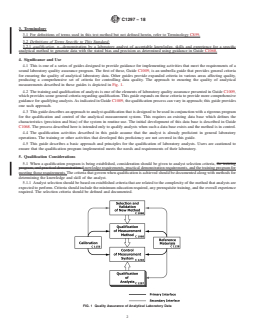
4.1 This is one of a series of guides designed to provide guidance for implementing activities that meet the requirements of a sound laboratory quality assurance program. The first of these, Guide C1009, is an umbrella guide that provides general criteria for ensuring the quality of analytical laboratory data. Other guides provide expanded criteria in various areas affecting quality, producing a comprehensive set of criteria for controlling data quality. The approach to ensuring the quality of analytical measurements described in these guides is depicted in Fig. 1.
FIG. 1 Quality Assurance of Analytical Laboratory Data
4.2 The training and qualification of analysts is one of the elements of laboratory quality assurance presented in Guide C1009, which provides some general criteria regarding qualification. This guide expands on those criteria to provide more comprehensive guidance for qualifying analysts. As indicated in Guide C1009, the qualification process can vary in approach; this guide provides one such approach.
4.3 This guide describes an approach to analyst qualification that is designed to be used in conjunction with a rigorous program for the qualification and control of the analytical measurement system. This requires an existing data base which defines the characteristics (precision and bias) of the system in routine use. The initial development of this data base is described in Guide C1068. The process described here is intended only to qualify analysts when such a data base exists and the method is in control.
4.4 The qualification activities described in this guide assume that the analyst is already proficient in general laboratory operations. The training or other activities that developed this proficiency are not covered in this guide.
4.5 This guide describes a basic approach and principles for the qualification of laboratory analysts. Users are cautioned to ensure that the qualification program implemented meets the needs and requi...
SCOPE
1.1 This guide covers the qualification of analysts to perform chemical analysis or physical measurements of nuclear fuel cycle materials. The guidance is general in that it is applicable to all analytical methods, but must be applied method by method. Also, the guidance is general in that it may be applied to initial qualification or requalification.
1.2 The guidance is provided in the following sections:
Section
Qualification Considerations
5
Demonstration Process
6
Statistical Tests
7
1.3 This standard does not apply to maintaining qualification during routine use of a method. Maintaining qualification is included in Guide C1210.
1.4 This standard does not purport to address all of the safety concerns, if any, associated with its use. It is the responsibility of the user of this standard to establish appropriate safety, health, and environmental practices and determine the applicability of regulatory limitations prior to use.
1.5 This international standard was developed in accordance with internationally recognized principles on standardization established in the Decision on Principles for the Development of International Standards, Guides and Recommendations issued by the World Trade Organization Technical Barriers to Trade (TBT) Committee.
- Status
- Published
- Publication Date
- 30-Jun-2018
- Technical Committee
- C26 - Nuclear Fuel Cycle
Buy Documents
ASTM C1297-18 - Standard Guide for Qualification of Laboratory Analysts for the Analysis of Nuclear Fuel Cycle Materials
REDLINE ASTM C1297-18 - Standard Guide for Qualification of Laboratory Analysts for the Analysis of Nuclear Fuel Cycle Materials
Overview
ASTM C1297-18 is the Standard Guide for Qualification of Laboratory Analysts for the Analysis of Nuclear Fuel Cycle Materials, published by ASTM International. This guide offers essential principles for qualifying laboratory analysts who are responsible for chemical analyses or physical measurements of nuclear fuel cycle materials. Proper analyst qualification is a critical component of laboratory quality assurance, ensuring that analytical data meets required standards for precision and bias.
This guide is widely used in nuclear industry laboratories to standardize the process for analyst qualification, supporting compliance with internationally recognized quality management systems.
Key Topics
ASTM C1297-18 addresses the following key areas in the qualification of laboratory analysts for nuclear fuel cycle analysis:
- Analyst Selection and Training
- Selection criteria should be based on method complexity, education, training, and experience.
- Documentation of minimum qualifications and prerequisites is essential.
- Method-Specific Training Programs
- Training programs must be established and include oral or written assessments to evaluate knowledge of chemical, physical, and instrumental concepts relevant to the method.
- Progress monitoring during training helps identify readiness for qualification.
- Demonstration of Competence
- Analysts perform analysis on reference materials after training.
- Multiple test samples are used across different sessions to emulate routine laboratory conditions.
- Demonstration results are statistically compared to an established data base of routine method performance.
- Statistical Tests for Qualification
- Tests for statistical normality, precision, and bias are applied to demonstration data.
- The use of statistical significance levels helps control errors in qualification decisions.
- Results must fall within established acceptance ranges to achieve qualification.
- Quality Assurance Integration
- The analyst qualification process is designed to operate alongside robust quality assurance programs for measurement systems and methods, as described in related ASTM guides.
Applications
The practical value of ASTM C1297-18 is realized in laboratories engaged in the analysis and processing of nuclear fuel cycle materials. Key applications include:
- Nuclear Power Plant Laboratories
- Ensuring only qualified analysts produce chemistry and physical measurement data related to nuclear fuel or waste.
- Regulatory Compliance and Auditing
- Establishing defensible records for regulatory bodies and inspections by documenting analyst qualifications.
- Interlaboratory Comparisons
- Facilitating comparability of results by ensuring consistent analyst competencies across organizations.
- Accreditation Support
- Providing a framework for meeting internal and external laboratory accreditation requirements, especially those emphasizing staff competence.
By following ASTM C1297-18, laboratories can minimize the risk of analyst error, support data defensibility, and maintain high standards of laboratory performance in handling sensitive nuclear materials.
Related Standards
ASTM C1297-18 is part of a larger series of quality assurance and laboratory standards relevant to nuclear industry laboratories. Important related standards include:
- ASTM C1009 - Guide for Establishing and Maintaining a Quality Assurance Program for Analytical Laboratories Within the Nuclear Industry
- ASTM C1068 - Guide for Qualification of Measurement Methods by a Laboratory Within the Nuclear Industry
- ASTM C1128 - Guide for Preparation of Working Reference Materials for Use in Analysis of Nuclear Fuel Cycle Materials
- ASTM C1156 - Guide for Establishing Calibration for a Measurement Method Used to Analyze Nuclear Fuel Cycle Materials
- ASTM C1210 - Guide for Establishing a Measurement System Quality Control Program for Analytical Chemistry Laboratories Within the Nuclear Industry
- ASTM C1215 - Guide for Preparing and Interpreting Precision and Bias Statements in Test Method Standards Used in the Nuclear Industry
- ISO Guide 30 - Terms and Definitions Used in Connection with Reference Materials
- ISO Guide 33 - Reference Materials – Good Practice in Using Reference Materials
Adhering to these interrelated standards ensures a comprehensive approach to laboratory data quality, analyst competence, and overall laboratory accreditation in the nuclear sector.
Relations
- Effective Date
- 01-Jul-2018
- Effective Date
- 01-Jan-2024
- Effective Date
- 01-Jul-2018
- Effective Date
- 01-Feb-2015
- Effective Date
- 15-Jun-2014
- Effective Date
- 15-Jan-2014
- Effective Date
- 01-Jun-2013
- Effective Date
- 01-May-2013
- Effective Date
- 01-Jan-2013
- Effective Date
- 01-Jun-2012
- Effective Date
- 01-Jun-2012
- Effective Date
- 01-Jun-2011
- Effective Date
- 01-Jun-2011
- Effective Date
- 01-Nov-2010
- Effective Date
- 01-Aug-2010
Buy Documents
ASTM C1297-18 - Standard Guide for Qualification of Laboratory Analysts for the Analysis of Nuclear Fuel Cycle Materials
REDLINE ASTM C1297-18 - Standard Guide for Qualification of Laboratory Analysts for the Analysis of Nuclear Fuel Cycle Materials
Get Certified
Connect with accredited certification bodies for this standard

DNV
DNV is an independent assurance and risk management provider.

Lloyd's Register
Lloyd's Register is a global professional services organisation specialising in engineering and technology.
DNV Energy Systems
Energy and renewable energy certification.
Sponsored listings
Frequently Asked Questions
ASTM C1297-18 is a guide published by ASTM International. Its full title is "Standard Guide for Qualification of Laboratory Analysts for the Analysis of Nuclear Fuel Cycle Materials". This standard covers: SIGNIFICANCE AND USE 4.1 This is one of a series of guides designed to provide guidance for implementing activities that meet the requirements of a sound laboratory quality assurance program. The first of these, Guide C1009, is an umbrella guide that provides general criteria for ensuring the quality of analytical laboratory data. Other guides provide expanded criteria in various areas affecting quality, producing a comprehensive set of criteria for controlling data quality. The approach to ensuring the quality of analytical measurements described in these guides is depicted in Fig. 1. FIG. 1 Quality Assurance of Analytical Laboratory Data 4.2 The training and qualification of analysts is one of the elements of laboratory quality assurance presented in Guide C1009, which provides some general criteria regarding qualification. This guide expands on those criteria to provide more comprehensive guidance for qualifying analysts. As indicated in Guide C1009, the qualification process can vary in approach; this guide provides one such approach. 4.3 This guide describes an approach to analyst qualification that is designed to be used in conjunction with a rigorous program for the qualification and control of the analytical measurement system. This requires an existing data base which defines the characteristics (precision and bias) of the system in routine use. The initial development of this data base is described in Guide C1068. The process described here is intended only to qualify analysts when such a data base exists and the method is in control. 4.4 The qualification activities described in this guide assume that the analyst is already proficient in general laboratory operations. The training or other activities that developed this proficiency are not covered in this guide. 4.5 This guide describes a basic approach and principles for the qualification of laboratory analysts. Users are cautioned to ensure that the qualification program implemented meets the needs and requi... SCOPE 1.1 This guide covers the qualification of analysts to perform chemical analysis or physical measurements of nuclear fuel cycle materials. The guidance is general in that it is applicable to all analytical methods, but must be applied method by method. Also, the guidance is general in that it may be applied to initial qualification or requalification. 1.2 The guidance is provided in the following sections: Section Qualification Considerations 5 Demonstration Process 6 Statistical Tests 7 1.3 This standard does not apply to maintaining qualification during routine use of a method. Maintaining qualification is included in Guide C1210. 1.4 This standard does not purport to address all of the safety concerns, if any, associated with its use. It is the responsibility of the user of this standard to establish appropriate safety, health, and environmental practices and determine the applicability of regulatory limitations prior to use. 1.5 This international standard was developed in accordance with internationally recognized principles on standardization established in the Decision on Principles for the Development of International Standards, Guides and Recommendations issued by the World Trade Organization Technical Barriers to Trade (TBT) Committee.
SIGNIFICANCE AND USE 4.1 This is one of a series of guides designed to provide guidance for implementing activities that meet the requirements of a sound laboratory quality assurance program. The first of these, Guide C1009, is an umbrella guide that provides general criteria for ensuring the quality of analytical laboratory data. Other guides provide expanded criteria in various areas affecting quality, producing a comprehensive set of criteria for controlling data quality. The approach to ensuring the quality of analytical measurements described in these guides is depicted in Fig. 1. FIG. 1 Quality Assurance of Analytical Laboratory Data 4.2 The training and qualification of analysts is one of the elements of laboratory quality assurance presented in Guide C1009, which provides some general criteria regarding qualification. This guide expands on those criteria to provide more comprehensive guidance for qualifying analysts. As indicated in Guide C1009, the qualification process can vary in approach; this guide provides one such approach. 4.3 This guide describes an approach to analyst qualification that is designed to be used in conjunction with a rigorous program for the qualification and control of the analytical measurement system. This requires an existing data base which defines the characteristics (precision and bias) of the system in routine use. The initial development of this data base is described in Guide C1068. The process described here is intended only to qualify analysts when such a data base exists and the method is in control. 4.4 The qualification activities described in this guide assume that the analyst is already proficient in general laboratory operations. The training or other activities that developed this proficiency are not covered in this guide. 4.5 This guide describes a basic approach and principles for the qualification of laboratory analysts. Users are cautioned to ensure that the qualification program implemented meets the needs and requi... SCOPE 1.1 This guide covers the qualification of analysts to perform chemical analysis or physical measurements of nuclear fuel cycle materials. The guidance is general in that it is applicable to all analytical methods, but must be applied method by method. Also, the guidance is general in that it may be applied to initial qualification or requalification. 1.2 The guidance is provided in the following sections: Section Qualification Considerations 5 Demonstration Process 6 Statistical Tests 7 1.3 This standard does not apply to maintaining qualification during routine use of a method. Maintaining qualification is included in Guide C1210. 1.4 This standard does not purport to address all of the safety concerns, if any, associated with its use. It is the responsibility of the user of this standard to establish appropriate safety, health, and environmental practices and determine the applicability of regulatory limitations prior to use. 1.5 This international standard was developed in accordance with internationally recognized principles on standardization established in the Decision on Principles for the Development of International Standards, Guides and Recommendations issued by the World Trade Organization Technical Barriers to Trade (TBT) Committee.
ASTM C1297-18 is classified under the following ICS (International Classification for Standards) categories: 27.120.30 - Fissile materials and nuclear fuel technology. The ICS classification helps identify the subject area and facilitates finding related standards.
ASTM C1297-18 has the following relationships with other standards: It is inter standard links to ASTM C1297-03(2011), ASTM C859-24, ASTM C1215-18, ASTM C1128-15, ASTM C859-14a, ASTM C859-14, ASTM C859-13a, ASTM C859-13, ASTM C1009-13, ASTM C1215-92(2012)e1, ASTM C1210-12, ASTM C1068-03(2011), ASTM C1156-03(2011), ASTM C859-10b, ASTM C859-10a. Understanding these relationships helps ensure you are using the most current and applicable version of the standard.
ASTM C1297-18 is available in PDF format for immediate download after purchase. The document can be added to your cart and obtained through the secure checkout process. Digital delivery ensures instant access to the complete standard document.
Standards Content (Sample)
This international standard was developed in accordance with internationally recognized principles on standardization established in the Decision on Principles for the
Development of International Standards, Guides and Recommendations issued by the World Trade Organization Technical Barriers to Trade (TBT) Committee.
Designation:C1297 −18
Standard Guide for
Qualification of Laboratory Analysts for the Analysis of
Nuclear Fuel Cycle Materials
This standard is issued under the fixed designation C1297; the number immediately following the designation indicates the year of
original adoption or, in the case of revision, the year of last revision.Anumber in parentheses indicates the year of last reapproval.A
superscript epsilon (´) indicates an editorial change since the last revision or reapproval.
1. Scope C1068Guide for Qualification of Measurement Methods by
a Laboratory Within the Nuclear Industry
1.1 This guide covers the qualification of analysts to per-
C1128Guide for Preparation of Working Reference Materi-
form chemical analysis or physical measurements of nuclear
als for Use in Analysis of Nuclear Fuel Cycle Materials
fuel cycle materials. The guidance is general in that it is
C1156Guide for Establishing Calibration for a Measure-
applicable to all analytical methods, but must be applied
ment Method Used toAnalyze Nuclear Fuel Cycle Mate-
method by method.Also, the guidance is general in that it may
rials
be applied to initial qualification or requalification.
C1210Guide for Establishing a Measurement System Qual-
1.2 The guidance is provided in the following sections:
ity Control Program for Analytical Chemistry Laborato-
Section
ries Within the Nuclear Industry
Qualification Considerations 5
C1215Guide for Preparing and Interpreting Precision and
Demonstration Process 6
Bias Statements in Test Method Standards Used in the
Statistical Tests 7
Nuclear Industry
1.3 This standard does not apply to maintaining qualifica-
2.2 ISO Standards:
tion during routine use of a method. Maintaining qualification
ISO Guide 30Reference materials – Selected terms and
is included in Guide C1210.
definitions
1.4 This standard does not purport to address all of the
ISO Guide 33Reference materials – Good practice in using
safety concerns, if any, associated with its use. It is the
reference materials
responsibility of the user of this standard to establish appro-
priate safety, health, and environmental practices and deter-
3. Terminology
mine the applicability of regulatory limitations prior to use.
3.1 For definitions of terms used in this test method but not
1.5 This international standard was developed in accor-
defined herein, refer to Terminology C859.
dance with internationally recognized principles on standard-
3.2 Definitions of Terms Specific to This Standard:
ization established in the Decision on Principles for the
Development of International Standards, Guides and Recom- 3.2.1 qualification, n—demonstration by a laboratory ana-
lyst of acceptable knowledge, skills and experience for a
mendations issued by the World Trade Organization Technical
Barriers to Trade (TBT) Committee. specific analytical method to generate data with the stated bias
and precision as determined using guidance in Guide C1068.
2. Referenced Documents
2 4. Significance and Use
2.1 ASTM Standards:
C859Terminology Relating to Nuclear Materials 4.1 This is one of a series of guides designed to provide
C1009Guide for Establishing and Maintaining a Quality guidance for implementing activities that meet the require-
AssuranceProgramforAnalyticalLaboratoriesWithinthe ments of a sound laboratory quality assurance program. The
Nuclear Industry first of these, Guide C1009, is an umbrella guide that provides
generalcriteriaforensuringthequalityofanalyticallaboratory
data. Other guides provide expanded criteria in various areas
This guide is under the jurisdiction ofASTM Committee C26 on Nuclear Fuel
CycleandisthedirectresponsibilityofSubcommitteeC26.08onQualityAssurance, affecting quality, producing a comprehensive set of criteria for
Statistical Applications, and Reference Materials.
controlling data quality. The approach to ensuring the quality
CurrenteditionapprovedJuly1,2018.PublishedJuly2018.Originallyapproved
of analytical measurements described in these guides is de-
in 1995. Last previous edition approved in 2011 as C1297–03 (2011). DOI:
picted in Fig. 1.
10.1520/C1297-18.
For referenced ASTM standards, visit the ASTM website, www.astm.org, or
contact ASTM Customer Service at service@astm.org. For Annual Book of ASTM
Standards volume information, refer to the standard’s Document Summary page on Available fromAmerican National Standards Institute (ANSI), 25 W. 43rd St.,
the ASTM website. 4th Floor, New York, NY 10036, http://www.ansi.org.
Copyright ©ASTM International, 100 Barr Harbor Drive, PO Box C700, West Conshohocken, PA19428-2959. United States
C1297−18
5.1.1 Analyst selection should be based on established
criteria that are related to the complexity of the method that
analysts are expected to perform. Criteria should include the
minimumeducationrequired,anyprerequisitetraining,andthe
overall experience required. The selection criteria should be
defined and documented.
5.1.2 The method-specific analyst training program should
be an established program with a prescribed training proce-
dure.Somemechanismsuchasanoralorwrittentestshouldbe
used to allow an analyst to demonstrate knowledge and
understanding of the chemical, physical, instrumental, and
mathematical concepts used to execute the method. It is
advisabletomonitorprogressduringtrainingtoensurethatthe
analyst has a reasonable chance of passing the qualification
test.
5.1.3 The practical demonstration of the analyst’s ability to
generateresultswiththeanalyticalmethodshouldbecompared
to established criteria. The comparison criteria should be
defined and documented.
NOTE 1—The qualification of analysts, like many other laboratory
processes, has the potential for undetected errors. There are two types of
errors that occur. One is to fail an individual who should have been
FIG. 1 Quality Assurance of Analytical Laboratory Data
determined to be qualified. The other error is to pass an individual who
should not have been determined to be qualified. The potential for these
errors to occur and the potential consequences to the laboratory should be
carefully considered when determining the laboratory’s qualification
4.2 The training and qualification of analysts is one of the
methodology. A statistical approach includes choosing the significance
elements of laboratory quality assurance presented in Guide
level at which the determination of qualification will be made. This
C1009, which provides some general criteria regarding quali-
produces a quantitative value of the two possible risks. This is described
fication. This guide expands on those criteria to provide more
further in Appendix X1.
comprehensive guidance for qualifying analysts. As indicated
in Guide C1009, the qualification process can vary in ap-
6. Demonstration Process
proach; this guide provides one such approach.
6.1 The suggested approach to practical demonstration for
4.3 Thisguidedescribesanapproachtoanalystqualification
analyst qualification that is described in the remainder of this
that is designed to be used in conjunction with a rigorous
guide involves a comparison of the performance of the analyst
program for the qualification and control of the analytical
with the performance of all qualified analysts on a particular
measurementsystem.Thisrequiresanexistingdatabasewhich
analytical method. The performance is measured by the analy-
defines the characteristics (precision and bias) of the system in
sis of reference materials (see ISO Guide 30) and comparison
routine use. The initial development of this data base is
of the results to the data base for the analytical method. This
described in Guide C1068. The process described here is
approach requires a data base that describes method perfor-
intended only to qualify analysts when such a data base exists
mance. The comparison described in this guide is statistical in
and the method is in control.
natureandthereforestatisticiansshouldbeinvolvedearlyonin
the process of defining qualification. Other types of compari-
4.4 The qualification activities described in this guide as-
sons may serve to qualify equally well; however, such com-
sumethattheanalystisalreadyproficientingenerallaboratory
parisonsarenotaddressedinthisguide.Ifused,theyshouldbe
operations. The training or other activities that developed this
defined and documented.
proficiency are not covered in this guide.
6.2 Thedatabaseforagivenanalyticalmethodisgenerated
4.5 Thisguidedescribesabasicapproachandprinciplesfor
byallqualifiedanalystswhorunreferencematerialsampleson
the qualification of laboratory analysts. Users are cautioned to
an established schedule or frequency. The data base is used to
ensure that the qualification program implemented meets the
establishthebiasandprecisionofthemethodasroutinelyused
needs and requirements of their laboratory.
in the laboratory. The data base is established through a
measurement control program as presented in Guide C1210.
5. Qualification Considerations
Foranewmethod,adatabaseshouldbeestablishedaccording
5.1 When a qualification program is being established,
toGuideC1068andtheanalystshouldbequalifiedagainstthat
consideration should be given to analyst selection criteria,
data base.
knowledge requirements, practical demonstration
requirements, and the training program for meeting those 6.3 Ifchangesinamethodoccurorchangesintheexecution
requirements. The criteria that govern when qualification is of a method occur that render the existing data base represen-
achieved should be documented along with methods for tation of
...
This document is not an ASTM standard and is intended only to provide the user of an ASTM standard an indication of what changes have been made to the previous version. Because
it may not be technically possible to adequately depict all changes accurately, ASTM recommends that users consult prior editions as appropriate. In all cases only the current version
of the standard as published by ASTM is to be considered the official document.
Designation: C1297 − 03 (Reapproved 2011) C1297 − 18
Standard Guide for
Qualification of Laboratory Analysts for the Analysis of
Nuclear Fuel Cycle Materials
This standard is issued under the fixed designation C1297; the number immediately following the designation indicates the year of
original adoption or, in the case of revision, the year of last revision. A number in parentheses indicates the year of last reapproval. A
superscript epsilon (´) indicates an editorial change since the last revision or reapproval.
1. Scope
1.1 This guide covers the qualification of analysts to perform chemical analysis or physical measurements of nuclear fuel cycle
materials. The guidance is general in that it is applicable to all analytical methods, but must be applied method by method. Also,
the guidance is general in that it may be applied to initial qualification or requalification.
1.2 The guidance is provided in the following sections:
Section
Qualification Considerations 4
Qualification Considerations 5
Demonstration Process 5
Demonstration Process 6
Statistical Tests 6
Statistical Tests 7
1.3 This standard does not apply to maintaining qualification during routine use of a method. Maintaining qualification is
included in Guide C1210.
1.4 This standard does not purport to address all of the safety concerns, if any, associated with its use. It is the responsibility
of the user of this standard to establish appropriate safety safety, health, and healthenvironmental practices and determine the
applicability of regulatory limitations prior to use.
1.5 This international standard was developed in accordance with internationally recognized principles on standardization
established in the Decision on Principles for the Development of International Standards, Guides and Recommendations issued
by the World Trade Organization Technical Barriers to Trade (TBT) Committee.
2. Referenced Documents
2.1 ASTM Standards:
C859 Terminology Relating to Nuclear Materials
C1009 Guide for Establishing and Maintaining a Quality Assurance Program for Analytical Laboratories Within the Nuclear
Industry
C1068 Guide for Qualification of Measurement Methods by a Laboratory Within the Nuclear Industry
C1128 Guide for Preparation of Working Reference Materials for Use in Analysis of Nuclear Fuel Cycle Materials
C1156 Guide for Establishing Calibration for a Measurement Method Used to Analyze Nuclear Fuel Cycle Materials
C1210 Guide for Establishing a Measurement System Quality Control Program for Analytical Chemistry Laboratories Within
the Nuclear Industry
C1215 Guide for Preparing and Interpreting Precision and Bias Statements in Test Method Standards Used in the Nuclear
Industry
2.2 ISO Standard:Standards:
ISO Guide 30 Terms and Definitions Used in Connection with Reference MaterialsReference materials – Selected terms and
definitions
ISO Guide 33 Reference materials – Good practice in using reference materials
This guide is under the jurisdiction of ASTM Committee C26 on Nuclear Fuel Cycleand is the direct responsibility of Subcommittee C26.08 on Quality Assurance,
Statistical Applications, and Reference Materials.
Current edition approved June 1, 2011July 1, 2018. Published June 2011July 2018. Originally approved in 1995. Last previous edition approved in 20032011 as
C1297 - 03.C1297 – 03 (2011). DOI: 10.1520/C1297-03R11.10.1520/C1297-18.
For referenced ASTM standards, visit the ASTM website, www.astm.org, or contact ASTM Customer Service at service@astm.org. For Annual Book of ASTM Standards
volume information, refer to the standard’s Document Summary page on the ASTM website.
Available from American National Standards Institute (ANSI), 25 W. 43rd St., 4th Floor, New York, NY 10036, http://www.ansi.org.
Copyright © ASTM International, 100 Barr Harbor Drive, PO Box C700, West Conshohocken, PA 19428-2959. United States
C1297 − 18
3. Terminology
3.1 For definitions of terms used in this test method but not defined herein, refer to Terminology C859.
3.2 Definitions of Terms Specific to This Standard:
3.2.1 qualification, n—demonstration by a laboratory analyst of acceptable knowledge, skills and experience for a specific
analytical method to generate data with the stated bias and precision as determined using guidance in Guide C1068.
4. Significance and Use
4.1 This is one of a series of guides designed to provide guidance for implementing activities that meet the requirements of a
sound laboratory quality assurance program. The first of these, Guide C1009, is an umbrella guide that provides general criteria
for ensuring the quality of analytical laboratory data. Other guides provide expanded criteria in various areas affecting quality,
producing a comprehensive set of criteria for controlling data quality. The approach to ensuring the quality of analytical
measurements described in these guides is depicted in Fig. 1.
4.2 The training and qualification of analysts is one of the elements of laboratory quality assurance presented in Guide C1009,
which provides some general criteria regarding qualification. This guide expands on those criteria to provide more comprehensive
guidance for qualifying analysts. As indicated in Guide C1009, the qualification process can vary in approach; this guide provides
one such approach.
4.3 This guide describes an approach to analyst qualification that is designed to be used in conjunction with a rigorous program
for the qualification and control of the analytical measurement system. This requires an existing data base which defines the
characteristics (precision and bias) of the system in routine use. The initial development of this data base is described in Guide
C1068. The process described here is intended only to qualify analysts when such a data base exists and the method is in control.
4.4 The qualification activities described in this guide assume that the analyst is already proficient in general laboratory
operations. The training or other activities that developed this proficiency are not covered in this guide.
4.5 This guide describes a basic approach and principles for the qualification of laboratory analysts. Users are cautioned to
ensure that the qualification program implemented meets the needs and requirements of their laboratory.
5. Qualification Considerations
5.1 When a qualification program is being established, consideration should be given to analyst selection criteria, the training
program, and practical demonstration. knowledge requirements, practical demonstration requirements, and the training program for
meeting those requirements. The criteria that govern when qualification is achieved should be documented along with methods for
determining the knowledge and skill of the analyst.
5.1.1 Analyst selection should be based on established criteria that are related to the complexity of the method that analysts are
expected to perform. Criteria should include the minimum education required, any prerequisite training, and the overall experience
required. The selection criteria should be defined and documented.
FIG. 1 Quality Assurance of Analytical Laboratory Data
C1297 − 18
5.1.2 The method-specific analyst training program should be an established program with a prescribed training procedure.
Some mechanism such as an oral or written test should be used to allow an analyst to demonstrate knowledge and understanding
of the chemical, physical, instrumental, and mathematical concepts used to execute the method. It is advisable to monitor progress
during training to ensure that the analyst has a reasonable chance of passing the qualification test.
5.1.3 The practical demonstration of the analyst’s ability to generate results with the analytical method should be compared to
established criteria. The comparison criteria should be defined and documented.
NOTE 1—The qualification of analysts, like many other laboratory processes, has the potential for undetected errors. There are two types of errors that
occur. One is to fail an individual who should have been determined to be qualified. The other error is to pass an individual who should not have been
determined to be qualified. The potential for these errors to occur and the potential consequences to the laboratory should be carefully considered when
determining the laboratory’s qualification methodology. A statistical approach includes choosing the significance level at which the determination of
qualification will be made. This produces a quantitative value of the two possible risks. This is described further in Appendix X1.
6. Demonstration Process
6.1 The suggested approach to practical demonstration for analyst qualification that is described in the remainder of this guide
involves a comparison of the performance of the analyst with the performance of all qualified analysts on a particular analytical
method. The performance is measured by the analysis of reference materials (see ISO Guide 30) and comparison of the results to
the data base for the analytical method. This approach requires a data base that describes method performance. The comparison
described in this guide is statistical in nature and therefore statisticians should be involved early on in the process of defining
qualification. Other types of comparisons may serve to qualify equally well; however, such comparisons are not addressed in this
guide. If used, they should be defined and documented.
6.2 The data base for a given analytical method is generated by all qualified analysts who run reference material samples on
an established schedule or frequency. The data base is used to establish the bias and precision of the method as routinely used in
the laboratory. The data base is established through a measurement control program as presented in Guide C1210. Fo
...