

ASTM F3199-16a
(Guide)Standard Guide for Wing Interface Documentation for Weight Shift Control Aircraft
General Information
- Abstract
SCOPE
1.1 This guide covers the manufacture of Weight Shift aircraft and their qualification for certification.
1.2 This guide applies to Weight Shift Control aircraft seeking civil aviation authority approval, in the form of flight certificates, flight permits, or other like documentation.
1.3 This standard does not purport to address all of the safety concerns, if any, associated with its use. It is the responsibility of the user of this standard to establish appropriate safety and health practices and determine the applicability of regulatory limitations prior to use.
- Status
- Published
- Publication Date
- 31-Oct-2016
- Technical Committee
- F37 - Light Sport Aircraft
- Drafting Committee
- F37.40 - Weight Shift
Buy Documents


ASTM F3199-16a - Standard Guide for Wing Interface Documentation for Weight Shift Control Aircraft


REDLINE ASTM F3199-16a - Standard Guide for Wing Interface Documentation for Weight Shift Control Aircraft
Overview
ASTM F3199-16a is a standard guide developed by ASTM International for wing interface documentation specific to weight shift control aircraft. This document supports manufacturers and subcontractors in creating and maintaining comprehensive documentation required for successful certification and compliance with relevant civil aviation authorities. Weight shift control aircraft are a category of light sport aircraft (LSA) where flight control is accomplished by shifting the aircraft’s center of gravity, primarily using a pivoting wing. This standard is instrumental in streamlining the data transfer and quality assurance procedures that underpin the manufacturing and certification process in this segment of the aviation industry.
Key Topics
- Documentation Requirements: Outlines types of interface data, including wing specifications, quality assurance manuals, production acceptance testing procedures, and airworthiness records necessary for certification.
- Product Identification: Specifies details to be provided for each wing interface, such as make, model, serial number, and document reference dates.
- Data Management: Recommends formats for documenting product data, ensuring traceability and up-to-date records for each aircraft produced.
- Quality Assurance Coordination: Mandates that manufacturers retain current subcontractor documentation for quality assurance, ongoing airworthiness, and maintenance.
- Compliance Support: Provides a data sheet template to aid the systematic supply and review of information needed by manufacturers to demonstrate compliance.
Applications
The practical applications of ASTM F3199-16a are significant for organizations engaged in the design, manufacture, and certification of weight shift control aircraft, including:
- Manufacturer Certification: Ensures complete and consistent documentation to support applications for flight certificates, flight permits, or similar regulatory approvals from civil aviation authorities.
- Supply Chain Coordination: Improves communication and coordination between subcontractors and manufacturers through clearly defined documentation and traceability requirements.
- Product Delivery: Details the specific data to be delivered with each aircraft, aiding in quality control, regulatory compliance, and after-sales support.
- Continued Airworthiness: Supports the maintenance and updating of aircraft by requiring proper documentation of airworthiness and maintenance practices.
Related Standards
ASTM F3199-16a references several key standards essential for the lifecycle management of weight shift control aircraft:
- ASTM F2241 / F2425: Specifications for continued airworthiness systems for weight shift aircraft.
- ASTM F2972: Specification for manufacturer’s quality assurance systems for light sport aircraft.
- ASTM F2447: Practice for production acceptance test procedures for weight shift control aircraft.
- ASTM F2457: Specification for required product information accompanying weight shift control aircraft.
- ASTM F2483: Practice for maintenance and the creation of maintenance manuals for light sport aircraft.
- ASTM F2317 / F2317M: Specification for the design of weight shift control aircraft and statements of compliance.
These references ensure that ASTM F3199-16a is firmly integrated into a broader framework of standards for light sport and weight shift control aircraft, targeting enhanced safety, reliability, and regulatory compliance in the aviation industry.
Keywords: ASTM F3199, wing interface documentation, weight shift control aircraft, light sport aircraft, aviation certification, quality assurance, continued airworthiness, aircraft manufacturing, regulatory compliance, flight certificates, aviation documentation standards.
Relations
- Replaces
ASTM F3199-16 - Standard Guide for Wing Interface Documentation for Weight Shift Control Aircraft - Effective Date
- 01-Nov-2016
- Effective Date
- 01-Mar-2018
- Effective Date
- 01-Mar-2018
- Effective Date
- 01-Jan-2018
- Effective Date
- 01-Jan-2018
- Effective Date
- 01-Jan-2018
- Effective Date
- 01-Nov-2016
- Effective Date
- 01-Jun-2016
- Effective Date
- 01-Dec-2015
- Effective Date
- 01-Nov-2014
- Effective Date
- 01-Nov-2014
- Effective Date
- 01-Dec-2012
- Effective Date
- 01-Nov-2012
- Effective Date
- 01-Jan-2010
- Effective Date
- 01-Jul-2009
Buy Documents
ASTM F3199-16a - Standard Guide for Wing Interface Documentation for Weight Shift Control Aircraft
REDLINE ASTM F3199-16a - Standard Guide for Wing Interface Documentation for Weight Shift Control Aircraft
Get Certified
Connect with accredited certification bodies for this standard

BSI Group
BSI (British Standards Institution) is the business standards company that helps organizations make excellence a habit.

Bureau Veritas
Bureau Veritas is a world leader in laboratory testing, inspection and certification services.

DNV
DNV is an independent assurance and risk management provider.
Sponsored listings
Frequently Asked Questions
ASTM F3199-16a is a guide published by ASTM International. Its full title is "Standard Guide for Wing Interface Documentation for Weight Shift Control Aircraft". This standard covers: SCOPE 1.1 This guide covers the manufacture of Weight Shift aircraft and their qualification for certification. 1.2 This guide applies to Weight Shift Control aircraft seeking civil aviation authority approval, in the form of flight certificates, flight permits, or other like documentation. 1.3 This standard does not purport to address all of the safety concerns, if any, associated with its use. It is the responsibility of the user of this standard to establish appropriate safety and health practices and determine the applicability of regulatory limitations prior to use.
SCOPE 1.1 This guide covers the manufacture of Weight Shift aircraft and their qualification for certification. 1.2 This guide applies to Weight Shift Control aircraft seeking civil aviation authority approval, in the form of flight certificates, flight permits, or other like documentation. 1.3 This standard does not purport to address all of the safety concerns, if any, associated with its use. It is the responsibility of the user of this standard to establish appropriate safety and health practices and determine the applicability of regulatory limitations prior to use.
ASTM F3199-16a is classified under the following ICS (International Classification for Standards) categories: 49.020 - Aircraft and space vehicles in general. The ICS classification helps identify the subject area and facilitates finding related standards.
ASTM F3199-16a has the following relationships with other standards: It is inter standard links to ASTM F3199-16, ASTM F2483-18, ASTM F2483-18e1, ASTM F2457-05(2018), ASTM F2425-05a(2018), ASTM F2447-05(2018), ASTM F2317/F2317M-16a, ASTM F2317/F2317M-16, ASTM F2972-15, ASTM F2972-14, ASTM F2972-14e1, ASTM F2972-12, ASTM F2483-12, ASTM F2317/F2317M-10, ASTM F2425-05a(2009). Understanding these relationships helps ensure you are using the most current and applicable version of the standard.
ASTM F3199-16a is available in PDF format for immediate download after purchase. The document can be added to your cart and obtained through the secure checkout process. Digital delivery ensures instant access to the complete standard document.
Standards Content (Sample)
This international standard was developed in accordance with internationally recognized principles on standardization established in the Decision on Principles for the
Development of International Standards, Guides and Recommendations issued by the World Trade Organization Technical Barriers to Trade (TBT) Committee.
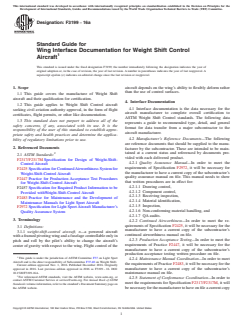
Designation: F3199 − 16a
Standard Guide for
Wing Interface Documentation for Weight Shift Control
Aircraft
This standard is issued under the fixed designation F3199; the number immediately following the designation indicates the year of
original adoption or, in the case of revision, the year of last revision. A number in parentheses indicates the year of last reapproval. A
superscript epsilon (´) indicates an editorial change since the last revision or reapproval.
1. Scope aircraft depends on the wing’s ability to flexibly deform rather
than the use of control surfaces.
1.1 This guide covers the manufacture of Weight Shift
aircraft and their qualification for certification.
4. Interface Documentation
1.2 This guide applies to Weight Shift Control aircraft
4.1 Interface documentation is the data necessary for the
seeking civil aviation authority approval, in the form of flight
aircraft manufacturer to complete overall certification to
certificates, flight permits, or other like documentation.
ASTM Weight Shift Control standards. The following data
1.3 This standard does not purport to address all of the
represents a guide to recommended type, detail, and general
safety concerns, if any, associated with its use. It is the
format for data transfer from a major subcontractor to the
responsibility of the user of this standard to establish appro-
aircraft manufacturer.
priate safety and health practices and determine the applica-
4.2 Manufacturer’s Reference Documents—The following
bility of regulatory limitations prior to use.
are reference documents that should be supplied to the manu-
2. Referenced Documents facturer by the subcontractor. These are intended to be main-
tained at a current status and referenced by documents pro-
2.1 ASTM Standards:
vided with each delivered product.
F2317/F2317M Specification for Design of Weight-Shift-
4.2.1 Quality Assurance Manual—In order to meet the
Control Aircraft
requirements of Specification F2972, it will be necessary for
F2425 Specification for ContinuedAirworthiness System for
the manufacturer to have a current copy of the subcontractor’s
Weight-Shift-Control Aircraft
quality assurance manual on file. This manual needs to show
F2447 Practice for Production Acceptance Test Procedures
that written procedures are in effect for:
for Weight-Shift-Control Aircraft
4.2.1.1 Drawing control,
F2457 Specification for Required Product Information to be
4.2.1.2 Component control,
Provided withWeight-Shift-Control Aircraft
4.2.1.3 Receiving inspection,
F2483 Practice for Maintenance and the Development of
4.2.1.4 Material identification,
Maintenance Manuals for Light Sport Aircraft
4.2.1.5 Inspection,
F2972 Specification for Light Sport Aircraft Manufacturer’s
4.2.1.6 Non-conforming material handling, and
Quality Assurance System
4.2.1.7 QA audits.
3. Terminology
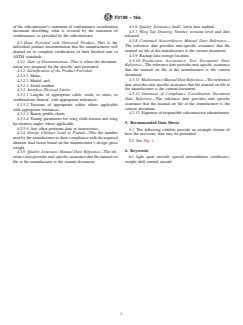
4.2.2 Continued Airworthiness—In order to meet the re-
quirements of Specification F2425, it will be necessary for the
3.1 Definitions:
manufacturer to have a current copy of the subcontractor’s
3.1.1 weight-shift-control aircraft, n—a powered aircraft
continued airworthiness manual on file.
withaframedpivotingwingandafuselagecontrollableonlyin
4.2.3 Production Acceptance Testing—In order to meet the
pitch and roll by the pilot’s ability to change the aircraft’s
requirements of Practice F2447, it will be necessary for the
center of gravity with respect to the wing. Flight control of the
manufacturer to have a current copy of the subcontractor’s
production acceptance testing written procedure on file.
This guide is under the jurisdiction of ASTM Committee F37 on Light Sport
4.2.4 Maintenance Manual Coordination—In order to meet
Aircraft and is the direct responsibility of Subcommittee F37.40 on Weight Shift.
the requirements of Practice F2483, it will be necessary for the
Current edition approved Nov. 1, 2016. Published December 2016. Originally
manufacturer to have a current copy of the subcontractor’s
approved in 2016. Last previous edition approved in 2016 as F3199 – 16. DOI:
10.1520/F3199-16A.
maintenance manual on file.
For referenced ASTM standards, visit the ASTM website, www.astm.org, or
4.2.5 Statement of Conformance Coordination—In order to
contact ASTM Customer Service at s
...
This document is not an ASTM standard and is intended only to provide the user of an ASTM standard an indication of what changes have been made to the previous version. Because
it may not be technically possible to adequately depict all changes accurately, ASTM recommends that users consult prior editions as appropriate. In all cases only the current version
of the standard as published by ASTM is to be considered the official document.
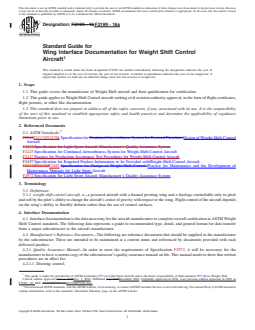
Designation: F3199 − 16 F3199 − 16a
Standard Guide for
Wing Interface Documentation for Weight Shift Control
Aircraft
This standard is issued under the fixed designation F3199; the number immediately following the designation indicates the year of
original adoption or, in the case of revision, the year of last revision. A number in parentheses indicates the year of last reapproval. A
superscript epsilon (´) indicates an editorial change since the last revision or reapproval.
1. Scope
1.1 This guide covers the manufacture of Weight Shift aircraft and their qualification for certification.
1.2 This guide applies to Weight Shift Control aircraft seeking civil aviation authority approval, in the form of flight certificates,
flight permits, or other like documentation.
1.3 This standard does not purport to address all of the safety concerns, if any, associated with its use. It is the responsibility
of the user of this standard to establish appropriate safety and health practices and determine the applicability of regulatory
limitations prior to use.
2. Referenced Documents
2.1 ASTM Standards:
F2241F2317/F2317M Specification for Continued Airworthiness System for Powered Parachute Design of Weight-Shift-Control
Aircraft
F2972 Specification for Light Sport Aircraft Manufacturer’s Quality Assurance System
F2425 Specification for Continued Airworthiness System for Weight-Shift-Control Aircraft
F2447 Practice for Production Acceptance Test Procedures for Weight-Shift-Control Aircraft
F2457 Specification for Required Product Information to be Provided withWeight-Shift-Control Aircraft
F2317/F2317MF2483 Specification for Design of Weight-Shift-Control Practice for Maintenance and the Development of
Maintenance Manuals for Light Sport Aircraft
F2972 Specification for Light Sport Aircraft Manufacturer’s Quality Assurance System
3. Terminology
3.1 Definitions:
3.1.1 weight-shift-control aircraft, n—a powered aircraft with a framed pivoting wing and a fuselage controllable only in pitch
and roll by the pilot’s ability to change the aircraft’s center of gravity with respect to the wing. Flight control of the aircraft depends
on the wing’s ability to flexibly deform rather than the use of control surfaces.
4. Interface Documentation
4.1 Interface documentation is the data necessary for the aircraft manufacturer to complete overall certification to ASTM Weight
Shift Control standards. The following data represents a guide to recommended type, detail, and general format for data transfer
from a major subcontractor to the aircraft manufacturer.
4.2 Manufacturer’s Reference Documents—The following are reference documents that should be supplied to the manufacturer
by the subcontractor. These are intended to be maintained at a current status and referenced by documents provided with each
delivered product.
4.2.1 Quality Assurance Manual—In order to meet the requirements of Specification F2972, it will be necessary for the
manufacturer to have a current copy of the subcontractor’s quality assurance manual on file. This manual needs to show that written
procedures are in effect for:
4.2.1.1 Drawing control,
This guide is under the jurisdiction of ASTM Committee F37 on Light Sport Aircraft and is the direct responsibility of Subcommittee F37.40 on Weight Shift.
Current edition approved June 1, 2016Nov. 1, 2016. Published July 2016December 2016. Originally approved in 2016. Last previous edition approved in 2016 as
F3199 – 16. DOI: 10.1520/F3199-16.10.1520/F3199-16A.
For referenced ASTM standards, visit the ASTM website, www.astm.org, or contact ASTM Customer Service at service@astm.org. For Annual Book of ASTM Standards
volume information, refer to the standard’s Document Summary page on the ASTM website.
Copyright © ASTM International, 100 Barr Harbor Drive, PO Box C700, West Conshohocken, PA 19428-2959. United States
F3199 − 16a
4.2.1.2 Component control,
4.2.1.3 Receiving inspection,
4.2.1.4 Material identification,
4.2.1.5 Inspection,
4.2.1.6 Non-conforming material handling, and
4.2.1.7 QA audits.
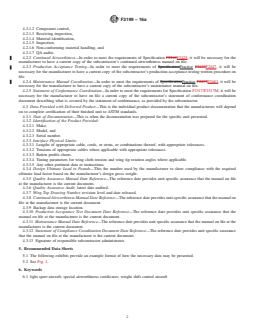
4.2.2 Continued Airworthiness—In order to meet the requirements of Specification F2241F2425, it will be necessary for the
manufacturer to have a current copy of the subcontractor’s continued airworthiness manual on file.
4.2.3 Production
...