

ASTM E2248-18
(Test Method)Standard Test Method for Impact Testing of Miniaturized Charpy V-notch Specimens
General Information
- Abstract
SIGNIFICANCE AND USE
5.1 There are cases where it is impractical or impossible to prepare standard CVN specimens. MCVN specimens are an alternative approach for characterizing notched specimen impact behavior. Typical applications include MCVN specimens prepared from the broken halves of previously tested specimens, from thin product form material, or from material cut from in-service components.
5.2 This test method establishes the requirements for performing impact tests on MCVN specimens fabricated from metallic materials. Minimum requirements are given for measurement and recording equipment such that similar sensitivity and comparable measurements, as compared to standard CVN tests, are achieved. The user should be aware that the transition region temperature dependence data obtained from MCVN specimens are not directly comparable to those obtained from full-size standard Charpy V-notch specimens and suitable correlation procedures have to be employed to obtain ductile-to-brittle transition temperature (DBTT) data equivalent to those obtained using CVN specimens. In all instances, correlations will have to be developed to relate upper shelf energy (USE) data from MCVN test to CVN comparable energy levels. Application of MCVN test data to the evaluation of ferritic material behavior is the responsibility of the user of this test method. MCVN test data should not be used directly to determine the lowest allowable operating temperature for an in-service material. The data must be interpreted within the framework of a fracture mechanics assessment.
5.3 While this test method treats the use of an instrumented striker as an option, the use of instrumentation in the impact test is recommended and is fully described in Test Method E2298. In order to establish the force-displacement diagram, it is necessary to measure the impact force as a function of time during contact of the striker with the specimen. The area under the force-displacement curve is a measure of instrumented absorbed...
SCOPE
1.1 This test method describes notched-bar impact testing of metallic materials using Miniaturized Charpy V-notch (MCVN) specimens and test apparatus. It provides: (a) a description of the apparatus, (b) requirements for inspection and calibration, (c) safety precautions, (d) sampling, (e) dimensions and preparation of specimens, (f) testing procedures, and (g) precision and bias.
1.2 This test method concerns Miniaturized Charpy V-notch specimens, for which all linear dimensions, including length and notch depth, are reduced with respect to a standard Charpy V-notch impact test specimen in accordance with Test Methods E23. These are not the same as sub-size specimens, described in Annex A3 of Test Methods E23, for which length, notch angle and notch depth are the same as for the standard Charpy V-notch specimen. See also 1.5 below.
1.3 Comparison of the MCVN data with standard Charpy V-notch (CVN) data or application of the MCVN data, or both, to the evaluation of ferritic material behavior is the responsibility of the user of this test method and is not explicitly covered by this test method.
1.4 The values stated in SI units are to be regarded as standard. No other units of measurement are included in this standard.
1.5 This test method does not address testing of sub-size specimens as discussed in Test Methods E23. The reader should understand the distinction between miniature and subsize. Miniature specimens are shorter that sub-size specimens so that more tests can be conducted per unit volume of material. Moreover, miniature specimens are designed so that the stress fields which control fracture are similar to those of standard Test Methods E23 specimens.
1.6 The MCVN test may be performed using a typical Test Methods E23 test machine with suitably modified anvils and striker or using a smaller capacity machine.
1.7 This standard does not purport to address all of the safety concerns, if any, ass...
- Status
- Published
- Publication Date
- 31-May-2018
- Technical Committee
- E28 - Mechanical Testing
- Drafting Committee
- E28.07 - Impact Testing
Buy Documents
ASTM E2248-18 - Standard Test Method for Impact Testing of Miniaturized Charpy V-notch Specimens
REDLINE ASTM E2248-18 - Standard Test Method for Impact Testing of Miniaturized Charpy V-notch Specimens
Overview
ASTM E2248-18: Standard Test Method for Impact Testing of Miniaturized Charpy V-notch Specimens provides a comprehensive methodology for conducting notched-bar impact tests on metallic materials using miniaturized Charpy V-notch (MCVN) specimens. This standard addresses scenarios where preparing full-size Charpy V-notch (CVN) specimens is impractical or impossible. MCVN specimens enable reliable characterization of impact behavior, especially valuable when only limited material is available, such as in thin sections, broken test pieces, or in-service components.
This standard establishes key requirements for the apparatus, specimen design, calibration, testing procedures, and reporting, ensuring that impact data from miniaturized specimens approximates that of standard CVN tests where possible. It emphasizes the need for careful correlation and interpretation of results, particularly when evaluating critical material properties such as ductile-to-brittle transition temperature (DBTT) and upper shelf energy (USE).
Key Topics
Miniaturized Charpy V-notch Specimen Design
MCVN specimens have all linear dimensions, including length and notch depth, reduced in proportion to standard CVN specimens. They are designed to generate comparable stress fields and fracture behavior.Testing Apparatus and Calibration
The standard outlines the use of pendulum-type impact testing machines, which can be standard machines with modified anvils and strikers or smaller capacity machines. Equipment calibration and verification are critical to ensure test validity.Test Procedures
Includes specimen preparation, in-situ or external heating/cooling methods, placement, and detailed instructions for recording absorbed energy using dials or optical encoders. Instrumented impact testing (measuring force over time) is recommended for detailed analysis.Interpretation and Correlation
Results from MCVN specimens are not directly interchangeable with those from full-size CVN specimens. Users must apply appropriate correlation procedures for data such as DBTT or USE, and interpret results within a fracture mechanics framework.Safety and Reporting
The standard addresses safety precautions, including protection from moving pendulums and handling of heated or cooled specimens. Comprehensive reporting requirements ensure clarity and traceability of test results.
Applications
ASTM E2248-18 offers significant practical value for materials testing across various industries, particularly when only small volumes of metallic material are available or sampling is constrained by geometry or previous testing. Examples include:
Failure Analysis
Assessing the impact toughness of fragments removed from in-service components or failed structures.Limited Sample Quantities
Testing thin product forms or remnants from prior mechanical tests, allowing for efficient use of scarce materials.Comparative Materials Research
Enabling more extensive testing within a single sample volume due to the reduced size of MCVN specimens.Assessment of Ferritic Materials
Providing alternative testing for ferritic steels where standard CVN specimen preparation isn’t feasible, while emphasizing correct correlation and analysis.
It is crucial to note that MCVN impact data should not be used directly to define service temperatures or critical performance thresholds without correlation through validated procedures.
Related Standards
ASTM E2248-18 references several important related standards and international documents for impact testing of metallic materials:
- ASTM E23: Test Methods for Notched Bar Impact Testing of Metallic Materials (standard reference for Charpy testing)
- ASTM E2298: Test Method for Instrumented Impact Testing of Metallic Materials
- ISO 148: Metallic materials - Charpy pendulum impact test - Part 1: Test method
- ISO 14556: Steel - Charpy V-notch pendulum impact test - Instrumented test method
- ASTM A370: Test Methods and Definitions for Mechanical Testing of Steel Products
For further precision, users should refer to these standards for details on specimen configuration, test equipment, data interpretation, and safety practices.
Keywords: ASTM E2248-18, impact testing, miniaturized Charpy, MCVN, notched-bar test, metallic materials, fracture toughness, instrumented impact, DBTT, upper shelf energy, pendulum machine, specimen calibration, material behavior assessment.
Relations
- Replaces
ASTM E2248-15 - Standard Test Method for Impact Testing of Miniaturized Charpy V-Notch Specimens - Effective Date
- 01-Jun-2018
- Effective Date
- 01-Apr-2024
- Effective Date
- 01-Apr-2016
- Effective Date
- 01-Jan-2016
- Effective Date
- 01-Oct-2015
- Effective Date
- 01-May-2014
- Effective Date
- 01-May-2013
- Effective Date
- 01-May-2013
- Effective Date
- 01-Apr-2013
- Effective Date
- 15-Nov-2012
- Effective Date
- 01-Jul-2012
- Effective Date
- 01-Jun-2012
- Effective Date
- 15-May-2012
- Effective Date
- 01-Nov-2011
- Effective Date
- 01-Oct-2010
Buy Documents
ASTM E2248-18 - Standard Test Method for Impact Testing of Miniaturized Charpy V-notch Specimens
REDLINE ASTM E2248-18 - Standard Test Method for Impact Testing of Miniaturized Charpy V-notch Specimens
Get Certified
Connect with accredited certification bodies for this standard

Element Materials Technology
Materials testing and product certification.

Inštitut za kovinske materiale in tehnologije
Institute of Metals and Technology. Materials testing, metallurgical analysis, NDT.
Sponsored listings
Frequently Asked Questions
ASTM E2248-18 is a standard published by ASTM International. Its full title is "Standard Test Method for Impact Testing of Miniaturized Charpy V-notch Specimens". This standard covers: SIGNIFICANCE AND USE 5.1 There are cases where it is impractical or impossible to prepare standard CVN specimens. MCVN specimens are an alternative approach for characterizing notched specimen impact behavior. Typical applications include MCVN specimens prepared from the broken halves of previously tested specimens, from thin product form material, or from material cut from in-service components. 5.2 This test method establishes the requirements for performing impact tests on MCVN specimens fabricated from metallic materials. Minimum requirements are given for measurement and recording equipment such that similar sensitivity and comparable measurements, as compared to standard CVN tests, are achieved. The user should be aware that the transition region temperature dependence data obtained from MCVN specimens are not directly comparable to those obtained from full-size standard Charpy V-notch specimens and suitable correlation procedures have to be employed to obtain ductile-to-brittle transition temperature (DBTT) data equivalent to those obtained using CVN specimens. In all instances, correlations will have to be developed to relate upper shelf energy (USE) data from MCVN test to CVN comparable energy levels. Application of MCVN test data to the evaluation of ferritic material behavior is the responsibility of the user of this test method. MCVN test data should not be used directly to determine the lowest allowable operating temperature for an in-service material. The data must be interpreted within the framework of a fracture mechanics assessment. 5.3 While this test method treats the use of an instrumented striker as an option, the use of instrumentation in the impact test is recommended and is fully described in Test Method E2298. In order to establish the force-displacement diagram, it is necessary to measure the impact force as a function of time during contact of the striker with the specimen. The area under the force-displacement curve is a measure of instrumented absorbed... SCOPE 1.1 This test method describes notched-bar impact testing of metallic materials using Miniaturized Charpy V-notch (MCVN) specimens and test apparatus. It provides: (a) a description of the apparatus, (b) requirements for inspection and calibration, (c) safety precautions, (d) sampling, (e) dimensions and preparation of specimens, (f) testing procedures, and (g) precision and bias. 1.2 This test method concerns Miniaturized Charpy V-notch specimens, for which all linear dimensions, including length and notch depth, are reduced with respect to a standard Charpy V-notch impact test specimen in accordance with Test Methods E23. These are not the same as sub-size specimens, described in Annex A3 of Test Methods E23, for which length, notch angle and notch depth are the same as for the standard Charpy V-notch specimen. See also 1.5 below. 1.3 Comparison of the MCVN data with standard Charpy V-notch (CVN) data or application of the MCVN data, or both, to the evaluation of ferritic material behavior is the responsibility of the user of this test method and is not explicitly covered by this test method. 1.4 The values stated in SI units are to be regarded as standard. No other units of measurement are included in this standard. 1.5 This test method does not address testing of sub-size specimens as discussed in Test Methods E23. The reader should understand the distinction between miniature and subsize. Miniature specimens are shorter that sub-size specimens so that more tests can be conducted per unit volume of material. Moreover, miniature specimens are designed so that the stress fields which control fracture are similar to those of standard Test Methods E23 specimens. 1.6 The MCVN test may be performed using a typical Test Methods E23 test machine with suitably modified anvils and striker or using a smaller capacity machine. 1.7 This standard does not purport to address all of the safety concerns, if any, ass...
SIGNIFICANCE AND USE 5.1 There are cases where it is impractical or impossible to prepare standard CVN specimens. MCVN specimens are an alternative approach for characterizing notched specimen impact behavior. Typical applications include MCVN specimens prepared from the broken halves of previously tested specimens, from thin product form material, or from material cut from in-service components. 5.2 This test method establishes the requirements for performing impact tests on MCVN specimens fabricated from metallic materials. Minimum requirements are given for measurement and recording equipment such that similar sensitivity and comparable measurements, as compared to standard CVN tests, are achieved. The user should be aware that the transition region temperature dependence data obtained from MCVN specimens are not directly comparable to those obtained from full-size standard Charpy V-notch specimens and suitable correlation procedures have to be employed to obtain ductile-to-brittle transition temperature (DBTT) data equivalent to those obtained using CVN specimens. In all instances, correlations will have to be developed to relate upper shelf energy (USE) data from MCVN test to CVN comparable energy levels. Application of MCVN test data to the evaluation of ferritic material behavior is the responsibility of the user of this test method. MCVN test data should not be used directly to determine the lowest allowable operating temperature for an in-service material. The data must be interpreted within the framework of a fracture mechanics assessment. 5.3 While this test method treats the use of an instrumented striker as an option, the use of instrumentation in the impact test is recommended and is fully described in Test Method E2298. In order to establish the force-displacement diagram, it is necessary to measure the impact force as a function of time during contact of the striker with the specimen. The area under the force-displacement curve is a measure of instrumented absorbed... SCOPE 1.1 This test method describes notched-bar impact testing of metallic materials using Miniaturized Charpy V-notch (MCVN) specimens and test apparatus. It provides: (a) a description of the apparatus, (b) requirements for inspection and calibration, (c) safety precautions, (d) sampling, (e) dimensions and preparation of specimens, (f) testing procedures, and (g) precision and bias. 1.2 This test method concerns Miniaturized Charpy V-notch specimens, for which all linear dimensions, including length and notch depth, are reduced with respect to a standard Charpy V-notch impact test specimen in accordance with Test Methods E23. These are not the same as sub-size specimens, described in Annex A3 of Test Methods E23, for which length, notch angle and notch depth are the same as for the standard Charpy V-notch specimen. See also 1.5 below. 1.3 Comparison of the MCVN data with standard Charpy V-notch (CVN) data or application of the MCVN data, or both, to the evaluation of ferritic material behavior is the responsibility of the user of this test method and is not explicitly covered by this test method. 1.4 The values stated in SI units are to be regarded as standard. No other units of measurement are included in this standard. 1.5 This test method does not address testing of sub-size specimens as discussed in Test Methods E23. The reader should understand the distinction between miniature and subsize. Miniature specimens are shorter that sub-size specimens so that more tests can be conducted per unit volume of material. Moreover, miniature specimens are designed so that the stress fields which control fracture are similar to those of standard Test Methods E23 specimens. 1.6 The MCVN test may be performed using a typical Test Methods E23 test machine with suitably modified anvils and striker or using a smaller capacity machine. 1.7 This standard does not purport to address all of the safety concerns, if any, ass...
ASTM E2248-18 is classified under the following ICS (International Classification for Standards) categories: 77.040.10 - Mechanical testing of metals. The ICS classification helps identify the subject area and facilitates finding related standards.
ASTM E2248-18 has the following relationships with other standards: It is inter standard links to ASTM E2248-15, ASTM E23-24, ASTM E23-16a, ASTM E23-16, ASTM E2298-15, ASTM E177-14, ASTM E177-13, ASTM E691-13, ASTM E2298-13, ASTM E23-12c, ASTM E23-12b, ASTM E23-12a, ASTM E23-12, ASTM E691-11, ASTM E177-10. Understanding these relationships helps ensure you are using the most current and applicable version of the standard.
ASTM E2248-18 is available in PDF format for immediate download after purchase. The document can be added to your cart and obtained through the secure checkout process. Digital delivery ensures instant access to the complete standard document.
Standards Content (Sample)
This international standard was developed in accordance with internationally recognized principles on standardization established in the Decision on Principles for the
Development of International Standards, Guides and Recommendations issued by the World Trade Organization Technical Barriers to Trade (TBT) Committee.
Designation: E2248 − 18
Standard Test Method for
Impact Testing of Miniaturized Charpy V-notch Specimens
This standard is issued under the fixed designation E2248; the number immediately following the designation indicates the year of
original adoption or, in the case of revision, the year of last revision.Anumber in parentheses indicates the year of last reapproval.A
superscript epsilon (´) indicates an editorial change since the last revision or reapproval.
1. Scope* 1.7 This standard does not purport to address all of the
safety concerns, if any, associated with its use. It is the
1.1 Thistestmethoddescribesnotched-barimpacttestingof
responsibility of the user of this standard to establish appro-
metallic materials using Miniaturized Charpy V-notch
priate safety, health, and environmental practices and deter-
(MCVN) specimens and test apparatus. It provides: (a)a
mine the applicability of regulatory limitations prior to use.
description of the apparatus, (b) requirements for inspection
1.8 This international standard was developed in accor-
andcalibration,(c)safetyprecautions,(d)sampling,(e)dimen-
dance with internationally recognized principles on standard-
sions and preparation of specimens, (f) testing procedures, and
ization established in the Decision on Principles for the
(g) precision and bias.
Development of International Standards, Guides and Recom-
1.2 ThistestmethodconcernsMiniaturizedCharpyV-notch
mendations issued by the World Trade Organization Technical
specimens, for which all linear dimensions, including length
Barriers to Trade (TBT) Committee.
andnotchdepth,arereducedwithrespecttoastandardCharpy
2. Referenced Documents
V-notchimpacttestspecimeninaccordancewithTestMethods
E23. These are not the same as sub-size specimens, described
2.1 ASTM Standards:
in Annex A3 of Test Methods E23, for which length, notch
E23Test Methods for Notched Bar Impact Testing of Me-
angle and notch depth are the same as for the standard Charpy
tallic Materials
V-notch specimen. See also 1.5 below.
E177Practice for Use of the Terms Precision and Bias in
ASTM Test Methods
1.3 Comparison of the MCVN data with standard Charpy
E691Practice for Conducting an Interlaboratory Study to
V-notch(CVN)dataorapplicationoftheMCVNdata,orboth,
Determine the Precision of a Test Method
to the evaluation of ferritic material behavior is the responsi-
E2298Test Method for Instrumented Impact Testing of
bility of the user of this test method and is not explicitly
Metallic Materials
covered by this test method.
2.2 ISO Standards:
1.4 The values stated in SI units are to be regarded as
ISO 14556Steel -- Charpy V-notch pendulum impact test --
standard. No other units of measurement are included in this
Instrumented test method
standard.
3. Terminology
1.5 This test method does not address testing of sub-size
specimens as discussed in Test Methods E23. The reader
3.1 Definitions of terms Common to Mechanical Testing:
should understand the distinction between miniature and sub-
3.1.1 absorbed energy [FL], n—work spent to fracture a
size. Miniature specimens are shorter that sub-size specimens
specimen in a single pendulum swing, as measured by a
so that more tests can be conducted per unit volume of
compensated indicating device
material. Moreover, miniature specimens are designed so that
3.1.2 instrumented absorbed energy, W[FL], n—workspent
t
the stress fields which control fracture are similar to those of
to fracture a specimen in a single pendulum swing, as calcu-
standard Test Methods E23 specimens.
lated by integrating the force-displacement curve.
1.6 The MCVN test may be performed using a typical Test
3.1.3 lateral expansion [L], n—the maximum increase in
Methods E23 test machine with suitably modified anvils and
thickness of the specimen as a result of the impact test,
striker or using a smaller capacity machine.
expressed in mm.
For referenced ASTM standards, visit the ASTM website, www.astm.org, or
This test method is under the jurisdiction of ASTM Committee E28 on contact ASTM Customer Service at service@astm.org. For Annual Book of ASTM
Mechanical Testing and is the direct responsibility of Subcommittee E28.07 on Standards volume information, refer to the standard’s Document Summary page on
Impact Testing. the ASTM website.
Current edition approved June 1, 2018. Published September 2018. Originally Available from International Organization for Standardization (ISO), 1, ch. de
approved in 2009. Last previous edition approved in 2015 as E2248–15. DOI: la Voie-Creuse, Case postale 56, CH-1211, Geneva 20, Switzerland, http://
10.1520/E2248-18. www.iso.org.
*A Summary of Changes section appears at the end of this standard
Copyright © ASTM International, 100 Barr Harbor Drive, PO Box C700, West Conshohocken, PA 19428-2959. United States
E2248 − 18
3.1.3.1 Discussion—lateral expansion is used as a measure absorbed energy. Absorbed energy may be evaluated directly
of ductility. from machine dial reading. Whenever possible, an optical
encoder shall be used in place of the machine dial because an
3.1.4 shear fracture appearance, SFA, n—the amount of
encoder has better resolution than a dial.
fracture surface in the specimen that failed in a shear (stable)
mode, expressed in percent.
6. Test Machine
4. Summary of Test Method
6.1 The test shall be carried out with a pendulum-type
impact testing machine which is (optionally) instrumented to
4.1 The essential features of the MCVN impact test are: (a)
determine force-time curves. The test machine shall have
a suitable miniature three point bend specimen, (b) anvils and
sufficient capacity to break the specimen in one blow while
supports on which the test specimen is placed to receive the
losing not more than 80 % of the initial potential energy.
blow of the moving mass, (c) a moving mass (striker) that has
Provided absorbed energy measurements can be obtained with
been released from a sufficient height to cause the mass to
aresolutionbetterthanorequalto0.1J,thesametestmachine
break the specimen placed in its path, (d) an indicating device
used for CVN testing may be used to test MCVN specimens.
for determining the absorbed energy of the broken specimen,
and optionally (e) instrumentation for measuring applied force
6.2 The MCVN specimen has to be suitably supported so
as a function of time during specimen loading (refer to Test
that the centerline of the specimen coincides with the center of
Method E2298).
strike of the pendulum. If the same machine used for CVN
4.2 Thetestconsistsofbreakingtheminiaturizedspecimen, testing is used for MCVN specimens, refer toAppendix X3 of
E23 for changing the specimen support height by manufactur-
notched in the middle, and supported at each end, with one
blow from a swinging pendulum under conditions defined ing new supports or adding shims.
hereafter.
6.3 The impact velocity (tangential velocity) of the pendu-
lum at the center of the strike shall not be less than 1 nor more
5. Significance and Use
than 6 m/s.
5.1 There are cases where it is impractical or impossible to
NOTE 1—Impact velocities above 4 m/s are not advisable for instru-
prepare standard CVN specimens. MCVN specimens are an
mented MCVN tests, since excessive oscillations are then superimposed
alternative approach for characterizing notched specimen im-
ontheinitialportionofthetestdiagramanderrorsintheevaluationofthe
pact behavior. Typical applications include MCVN specimens force-displacement trace may occur. For the same reason (ease of
interpretation of the instrumented curve), lower velocities are allowed for
prepared from the broken halves of previously tested
MCVN tests than required by E23 (not less than 3 m/s).
specimens, from thin product form material, or from material
cut from in-service components. 6.4 Itisrecommendedthatthescalabilityofthestressfields
is maintained. This is accomplished by scaling the striker
5.2 This test method establishes the requirements for per-
radius, anvil radii, and the span of the anvils with respect to a
forming impact tests on MCVN specimens fabricated from
specimensizethatisproportionaltotheCVNspecimen.Fig.1
metallic materials. Minimum requirements are given for mea-
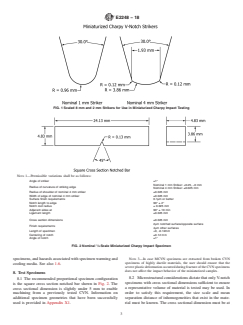
shows the dimensions of 8 and 2 mm strikers (3.86 mm and
surementandrecordingequipmentsuchthatsimilarsensitivity
0.96 mm) scaled for use with the nominal ⁄2-scale MCVN
and comparable measurements, as compared to standard CVN
(4.83 by 4.83 by 24.13 mm) specimen shown in Fig. 2. For
tests,areachieved.Theusershouldbeawarethatthetransition
both of these scaled strikers, the anvil radius is scaled to 0.48
region temperature dependence data obtained from MCVN
mm 6 0.025 mm, and the span is 19.3 mm 6 0.025 mm.
specimens are not directly comparable to those obtained from
full-size standard Charpy V-notch specimens and suitable 6.5 A non-scaled 2 mm striker can be used to test the 4 by
correlation procedures have to be employed to obtain ductile-
3 by 27 mm MCVN specimen described in Annex D of ISO
+0.50
to-brittle transition temperature (DBTT) data equivalent to
14556.The anvil radius and span, in this case are 1 mm
–0
+0.10
those obtained using CVN specimens. In all instances, corre-
and 22 mm respectively.
–0
lations will have to be developed to relate upper shelf energy
NOTE2—Thisparticulartestisallowedbecauseasubstantialamountof
(USE) data from MCVN test to CVN comparable energy
data exists for this specimen and test geometry. This MCVN specimen is
levels. Application of MCVN test data to the evaluation of
not proportional to the CVN specimen, so scaling is not appropriate.
ferriticmaterialbehavioristheresponsibilityoftheuserofthis
6.6 The testing machine shall be a pendulum type of rigid
test method. MCVN test data should not be used directly to
construction. All general requirements for apparatus and cali-
determine the lowest allowable operating temperature for an
bration specified in Test Methods E23 shall be satisfied.
in-service material. The data must be interpreted within the
6.7 For instrumented force measurements using optional
framework of a fracture mechanics assessment.
force measuring instrumentation, the requirements given in
5.3 While this test method treats the use of an instrumented
Test Method E2298 regarding striker instrumentation, data
striker as an option, the use of instrumentation in the impact
acquisition, and data analysis shall be satisfied.
test is recommended and is fully described in Test Method
E2298. In order to establish the force-displacement diagram, it
7. Hazards
is necessary to measure the impact force as a function of time
duringcontactofthestrikerwiththespecimen.Theareaunder 7.1 Safety precautions should be taken to protect personnel
the force-displacement curve is a measure of instrumented from electric shock, the swinging pendulum, flying broken
E2248 − 18
FIG. 1 Scaled 8 mm and 2 mm Strikers for Use in Miniaturized Charpy Impact Testing
NOTE 1—Permissible variations shall be as follows:
Angle of striker ±1°
Nominal 1 mm Striker: +0.25, –0 mm
Radius of curvature of striking edge
Nominal 4 mm Striker: ±0.025 mm
Radius of shoulder of nominal 4 mm striker ±0.025 mm
Width of edge of nominal 4 mm striker ±0.025 mm
Surface finish requirements 0.1µm or better
Notch length to edge 90° ± 2°
Notch root radius ± 0.025 mm
Adjacent sides at 90° ±10min
Ligament length ±0.025 mm
Cross section dimensions ±0.025 mm
2µm notched surface/opposite surface
Finish requirements
4µm other surfaces
Length of specimen +0, -0.12mm
Centering of notch ±0.12 mm
Angle of notch ±1°
FIG. 2 Nominal ⁄2-Scale Miniaturized Charpy Impact Specimen
NOTE 3—In case MCVN specimens are extracted from broken CVN
specimens,andhazardsassociatedwithspecimenwarmingand
specimens of highly ductile materials, the user should ensure that the
cooling media. See also 1.6.
severeplasticdeformationoccurredduringfractureoftheCVNspecimens
does not affect the impact behavior of the miniaturized samples.
8. Test Specimens
8.2 MicrostructuralconsiderationsdictatethatonlyV-notch
8.1 The recommended proportional specimen configuration
specimens with cross sectional dimensions sufficient to ensure
is the square cross section notched bar shown in Fig. 2. The
a representative volume of material is tested may be used. In
cross sectional dimension is slightly under 5 mm to enable
order to satisfy this requirement, the size scale and mean
machining from a previously tested CVN. Information on
separation distance of inhomogeneities that exist in the mate-
additional specimen geometries that have been successfully
used is provided in Appendix X1. rial must be known. The cross sectional dimension must be at
E2248 − 18
least five times greater than the largest inhomogeneity. Post- time (~1sor less). If a thermal bath transfer system is not
test metallography may be performed in order to confirm that used, dummy specimens (with internal thermocouples) or test
the requirement has been met. specimens (with surface thermocouples) shall be used to
demonstratethatthe 62°Crequirementhasbeenmet.Ifin-situ
8.3 Stress field similitude dictates that if the miniaturized
heating/cooling is used, dummy specimens (with internal
specimens (such as the one shown in Fig. 2) do not satisfy the
thermocouples)ortestspecimens(withsurfacethermocouples)
microstructural considerations, specimens with a larger cross
shallbeusedtocalibratethesystemandtodemonstratethatthe
section may be used. For the square cross section specimen in
62°C requirement has been met.
Fig. 2, all the remaining specimen dimensions (length, notch
depth, etc.) shall be scaled by appropriate ratio with the 9.3 Thespecimenshallbeplacedonthesupportsagainstthe
standardCVNdimensi
...
This document is not an ASTM standard and is intended only to provide the user of an ASTM standard an indication of what changes have been made to the previous version. Because
it may not be technically possible to adequately depict all changes accurately, ASTM recommends that users consult prior editions as appropriate. In all cases only the current version
of the standard as published by ASTM is to be considered the official document.
Designation: E2248 − 15 E2248 − 18
Standard Test Method for
Impact Testing of Miniaturized Charpy V-NotchV-notch
Specimens
This standard is issued under the fixed designation E2248; the number immediately following the designation indicates the year of
original adoption or, in the case of revision, the year of last revision. A number in parentheses indicates the year of last reapproval. A
superscript epsilon (´) indicates an editorial change since the last revision or reapproval.
1. Scope*
1.1 This test method describes notched-bar impact testing of metallic materials using Miniaturized Charpy V-NotchV-notch
(MCVN) specimens and test apparatus. It provides: (a) a description of the apparatus, (b) requirements for inspection and
calibration, (c) safety precautions, (d) sampling, (e) dimensions and preparation of specimens, (f) testing procedures, and (g)
precision and bias.
1.2 This standard test method concerns Miniaturized Charpy V-NotchV-notch specimens, for which all linear dimensions,
including length and notch depth, are reduced with respect to a type A standardstandard Charpy V-notch impact test specimen in
accordance with Test Methods E23. These are not the same as sub-size specimens, described in Annex A3 of Test Methods E23,
for which length, notch angle and notch depth are the same as for the standard type A Charpy V-notch specimen. See also 1.5 below.
1.3 Comparison of the MCVN data with conventionalstandard Charpy V-NotchV-notch (CVN) data or application of the
MCVN data, or both, to the evaluation of ferritic material behavior is the responsibility of the user of this test method and is not
explicitly covered by this test method.
1.4 The values stated in SI units are to be regarded as standard. No other units of measurement are included in this standard.
1.5 This standard test method does not address testing of sub-size specimens as discussed in Test Methods E23. The reader
should understand the distinction between miniature and subsize. Miniature specimens are shorter that sub-size specimens so that
more tests can be conducted per unit volume of material. Moreover, miniature specimens are designed so that the stress fields
which control fracture are similar to those of conventionalstandard Test Methods E23 specimens.
1.6 The MCVN test may be performed using a typical Test Methods E23 test machine with suitably modified anvils and striker
or using a smaller capacity machine.
1.7 This standard does not purport to address all of the safety concerns, if any, associated with its use. It is the responsibility
of the user of this standard to establish appropriate safety safety, health, and healthenvironmental practices and determine the
applicability of regulatory limitations prior to use.
1.8 This international standard was developed in accordance with internationally recognized principles on standardization
established in the Decision on Principles for the Development of International Standards, Guides and Recommendations issued
by the World Trade Organization Technical Barriers to Trade (TBT) Committee.
2. Referenced Documents
2.1 ASTM Standards:
A370 Test Methods and Definitions for Mechanical Testing of Steel Products
E23 Test Methods for Notched Bar Impact Testing of Metallic Materials
E177 Practice for Use of the Terms Precision and Bias in ASTM Test Methods
E691 Practice for Conducting an Interlaboratory Study to Determine the Precision of a Test Method
E2298 Test Method for Instrumented Impact Testing of Metallic Materials
2.2 ISO Standards:
ISO 148 Metallic materials -- Charpy pendulum impact test -- Part 1: Test method
ISO 14556 Steel -- Charpy V-notch pendulum impact test -- Instrumented test method
This test method is under the jurisdiction of ASTM Committee E28 on Mechanical Testing and is the direct responsibility of Subcommittee E28.07 on Impact Testing.
Current edition approved Oct. 1, 2015June 1, 2018. Published December 2015September 2018. Originally approved in 2009. Last previous edition approved in 20132015
as E2248–13.–15. DOI: 10.1520/E2248-15.10.1520/E2248-18.
For referenced ASTM standards, visit the ASTM website, www.astm.org, or contact ASTM Customer Service at service@astm.org. For Annual Book of ASTM Standards
volume information, refer to the standard’s Document Summary page on the ASTM website.
Available from International Organization for Standardization (ISO), 1, ch. de la Voie-Creuse, Case postale 56, CH-1211, Geneva 20, Switzerland, http://www.iso.org.
*A Summary of Changes section appears at the end of this standard
Copyright © ASTM International, 100 Barr Harbor Drive, PO Box C700, West Conshohocken, PA 19428-2959. United States
E2248 − 18
3. Terminology
3.1 Definitions of terms Common to Mechanical Testing:
3.1.1 absorbed energy [FL], n—work spent to fracture a specimen in a single pendulum swing, as measured by a compensated
indicating device
3.1.2 instrumented absorbed energy, W [FL], n—work spent to fracture a specimen in a single pendulum swing, as calculated
t
by integrating the force-displacement curve.
3.1.3 lateral expansion [L], n—the maximum increase in thickness of the specimen as a result of the impact test, expressed in
mm.
3.1.3.1 Discussion—
lateral expansion is used as a measure of ductility.
3.1.4 shear fracture appearance, SFA, n—the amount of fracture surface in the specimen that failed in a shear (stable) mode,
expressed in percent.
4. Summary of Test Method
4.1 The essential features of the MCVN impact test are: (a) a suitable miniature three point bend specimen, (b) anvils and
supports on which the test specimen is placed to receive the blow of the moving mass, (c) a moving mass (striker) that has been
released from a sufficient height to cause the mass to break the specimen placed in its path, (d) a an indicating device for
determining the energy absorbed by energy of the broken specimen, and optionally (e) instrumentation for measuring applied force
as a function of time during specimen loading (refer to Test Method E2298).
4.2 The test consists of breaking the miniaturized specimen, notched in the middle, and supported at each end, with one blow
from a swinging pendulum under conditions defined hereafter.
5. Significance and Use
5.1 There are cases where it is impractical or impossible to prepare conventionalstandard CVN specimens. MCVN specimens
are an alternative approach for characterizing notched specimen impact behavior. Typical applications include MCVN specimens
prepared from the broken halves of previously tested specimens, from thin product form material, or from material cut from
in-service components.
5.2 This standard test method establishes the requirements for performing impact tests on MCVN specimens fabricated from
metallic materials. Minimum requirements are given for measurement and recording equipment such that similar sensitivity and
comparable measurements, as compared to conventionalstandard CVN tests, are achieved. The user should be aware that the
transition region temperature dependence data obtained from MCVN specimens are not directly comparable to those obtained from
full-size standard Charpy-V Charpy V-notch specimens and suitable correlation procedures have to be employed to obtain
ductile-to-brittle transition temperature (DBTT) data equivalent to those obtained using CVN specimens. In all instances,
correlations will have to be developed to relate upper shelf energy (USE) data from MCVN test to CVN comparable energy levels.
Application of MCVN test data to the evaluation of ferritic material behavior is the responsibility of the user of this test method.
MCVN test data should not be used directly to determine the lowest allowable operating temperature for an in-service material.
The data must be interpreted within the framework of a fracture mechanics assessment.
5.3 While this test method treats the use of an instrumented striker as an option, the use of instrumentation in the impact test
is recommended and is fully described in Test Method E2298. In order to establish the force-displacement diagram, it is necessary
to measure the impact force as a function of time during contact of the striker with the specimen. The area under the
force-displacement curve is a measure of instrumented absorbed energy. As an alternative, absorbed Absorbed energy may be
evaluated directly from machine dial reading. Whenever possible, an optical encoder shall be used in place of the machine dial
because an encoder has better resolution than a dial.
6. Test Machine
6.1 The test shall be carried out with a pendulum-type impact testing machine which is (optionally) instrumented to determine
force-time curves. The test machine shall have sufficient capacity to break the specimen in one blow while losing not more than
80 % of the initial potential energy. Provided absorbed energy measurements can be obtained with a resolution better than or equal
to 0.1 J, the same test machine used for CVN testing may be used to test MCVN specimens.
6.2 The MCVN specimen has to be suitably supported so that the centerline of the specimen coincides with the center of strike
of the pendulum. If the same machine used for CVN testing is used for MCVN specimens, refer to Appendix X3 of E23 for
changing the specimen support height by manufacturing new supports or adding shims.
6.3 The impact velocity (tangential velocity) of the pendulum at the center of the strike shall not be less than 1 nor more than
6 m/s.
E2248 − 18
NOTE 1—Impact velocities above 4 m/s are not advisable for instrumented MCVN tests, since excessive oscillations are then superimposed on the initial
portion of the test diagram and errors in the evaluation of the force-displacement trace may occur. For the same reason (ease of interpretation of the
instrumented curve), lower velocities are allowed for MCVN tests than required by E23 (not less than 3 m/s).
6.4 It is recommended that the scalability of the stress fields is maintained. This is accomplished by scaling the striker radius,
anvil radii, and the span of the anvils with respect to a specimen size that is proportional to the CVN specimen. Fig. 1 shows the
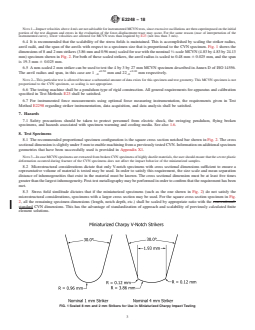
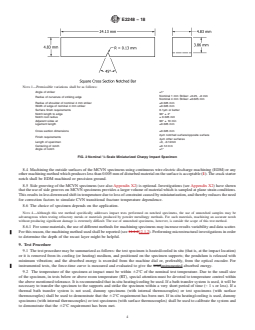
dimensions of 8 and 2 mm strikers (3.86 mm and 0.96 mm) scaled for use with the nominal ⁄2-scale MCVN (4.83 by 4.83 by 24.13
mm) specimen shown in Fig. 2. For both of these scaled strikers, the anvil radius is scaled to 0.48 mm 6 0.025 mm, and the span
is 19.3 mm 6 0.025 mm.
6.5 A non-scaled 2 mm striker can be used to test the 4 by 3 by 27 mm MCVN specimen described in Annex D of ISO 14556.
+0.50 +0.10
The anvil radius and span, in this case are 1 mm and 22 mm respectively.
–0 –0
NOTE 2—This particular test is allowed because a substantial amount of data exists for this specimen and test geometry. This MCVN specimen is not
proportional to the CVN specimen, so scaling is not appropriate.
6.6 The testing machine shall be a pendulum type of rigid construction. All general requirements for apparatus and calibration
specified in Test Methods E23 shall be satisfied.
6.7 For instrumented force measurements using optional force measuring instrumentation, the requirements given in Test
Method E2298 regarding striker instrumentation, data acquisition, and data analysis shall be satisfied.
7. Hazards
7.1 Safety precautions should be taken to protect personnel from electric shock, the swinging pendulum, flying broken
specimens, and hazards associated with specimen warming and cooling media. See also 1.6.
8. Test Specimens
8.1 The recommended proportional specimen configuration is the square cross section notched bar shown in Fig. 2. The cross
sectional dimension is slightly under 5 mm to enable machining from a previously tested CVN. Information on additional specimen
geometries that have been successfully used is provided in Appendix X1.
NOTE 3—In case MCVN specimens are extracted from broken CVN specimens of highly ductile materials, the user should ensure that the severe plastic
deformation occurred during fracture of the CVN specimens does not affect the impact behavior of the miniaturized samples.
8.2 Microstructural considerations dictate that only V-notch specimens with cross sectional dimensions sufficient to ensure a
representative volume of material is tested may be used. In order to satisfy this requirement, the size scale and mean separation
distance of inhomogeneities that exist in the material must be known. The cross sectional dimension must be at least five times
greater than the largest inhomogeneity. Post-test metallography may be performed in order to confirm that the requirement has been
met.
8.3 Stress field similitude dictates that if the miniaturized specimens (such as the one shown in Fig. 2) do not satisfy the
microstructural considerations, specimens with a larger cross section may be used. For the square cross section specimen in Fig.
2, all the remaining specimen dimensions (length, notch depth, etc.) shall be scaled by appropriate ratio with the conventional-
standard CVN dimensions. This has the advantage of standardization of approach and scalability of previously calculated finite
element solutions.
FIG. 1 Scaled 8 mm and 2 mm Strikers for Use in Miniaturized Charpy Impact Testing
E2248 − 18
NOTE 1—Permissible variations shall be as follows:
Angle of striker ±1°
Nominal 1 mm Striker: +0.25, –0 mm
Radius of curvature of striking edge
Nominal 4 mm Striker: ±0.025 mm
Radius of shoulder of nominal 4 mm striker ±0.025 mm
Width of edge of nominal 4 mm striker ±0.025 mm
Surface finish requirements 0.1μm or better
Notch length to edge 90° ± 2°
Notch root radius ± 0.025 mm
Adjacent sides at 90° ± 10 min
Ligament length ±0.025 mm
Cross section dimensions ±0.025 mm
2μm notched surface/opposite surface
Finish requirements
4μm other surfaces
Length of specimen +0, -0.12mm
Centering of notch ±0.12 mm
Angle of notch ±1°
FIG. 2 Nominal ⁄2-Scale Miniaturized Charpy Impact Specimen
8.4 Machining the outside surfaces of the MCVN specimens using continuous wire electric discharge machining (EDM) or any
other machining method which produces less than 0.005 mm of disturbed material on the surface is acceptable (1). The crack starter
notch shall be EDM machined or precision ground.
8.5 Side grooving of th
...