

ASTM E290-22
(Test Method)Standard Test Methods for Bend Testing of Material for Ductility
General Information
- Abstract
SIGNIFICANCE AND USE
5.1 Bend tests for ductility provide a simple way to evaluate the quality of materials by their ability to resist cracking or other surface irregularities during one continuous bend. No reversal of the bend force shall be employed when conducting these tests.
5.2 The type of bend test used determines the location of the forces and constraints on the bent portion of the specimen, ranging from no direct contact to continuous contact.
5.3 The test can terminate at a given angle of bend over a specified radius of bend or continue until the specimen legs are in contact. The angle of bend can be measured while the specimen is under the bending force (usually when the semi-guided bend test is employed), or after removal of the force as when performing a free-bend test. Product requirements for the material being tested determine the method used.
5.4 Materials with an as-fabricated cross section of rectangular, round, hexagonal, or similar defined shape can be tested in full section to evaluate their bend properties by using the procedures outlined in these test methods, in which case relative width and thickness requirements do not apply.
SCOPE
1.1 These test methods cover bend testing for ductility of materials. Included in the procedures are four conditions of constraint on the bent portion of the specimen; a guided-bend test using a mandrel or plunger of defined dimensions to force the mid-length of the specimen between two supports separated by a defined space; a semi-guided bend test in which the specimen is bent, while in contact with a mandrel, through a specified angle of bend or to a specified inside radius of bend (r) measured while under the bending force; a free-bend test in which the ends of the specimen are brought toward each other, but in which no transverse force is applied to the bend itself and there is no contact of the concave inside surface of the bend with other material; a bend-and-flatten test, in which a transverse force is applied to the bend such that the legs make contact with each other over the length of the specimen.
1.2 After bending, the convex surface of the bend is examined for evidence of a crack or surface irregularities. If the specimen fractures, the material has failed the test. When complete fracture does not occur, the criterion for failure is the number and size of cracks or surface irregularities visible to the unaided eye occurring on the convex surface of the specimen after bending, as specified by the product specification. Any cracks within one thickness of the edge of the specimen are not considered a bend test failure. Cracks occurring in the corners of the bent portion shall not be considered significant unless they exceed the size specified for corner cracks in the product specification.
1.3 The values stated in SI units are to be regarded as standard. Inch-pound values given in parentheses were used in establishing test parameters and are for information only.
1.4 This standard does not purport to address all of the safety concerns, if any, associated with its use. It is the responsibility of the user of this standard to establish appropriate safety, health, and environmental practices and determine the applicability of regulatory limitations prior to use.
1.5 This international standard was developed in accordance with internationally recognized principles on standardization established in the Decision on Principles for the Development of International Standards, Guides and Recommendations issued by the World Trade Organization Technical Barriers to Trade (TBT) Committee.
- Status
- Published
- Publication Date
- 14-Jun-2022
- Technical Committee
- E28 - Mechanical Testing
- Drafting Committee
- E28.02 - Ductility and Formability
Overview
ASTM E290-22: Standard Test Methods for Bend Testing of Material for Ductility provides comprehensive procedures for evaluating the ductility and quality of various materials by subjecting them to bend tests. Developed by ASTM International, this standard is widely referenced across multiple industries to assess materials’ ability to resist cracking, fracture, or other surface irregularities during controlled bending.
Bend tests are essential in quality control and materials engineering as they offer a straightforward approach to determine a material's ductility and performance under deformation. ASTM E290-22 covers specimens of various shapes, including rectangular, round, hexagonal, or similar cross-sections, and outlines specific methodologies for examining the effects of bending on material integrity.
Key Topics
Bend Test Methods
ASTM E290-22 categorizes four primary bend test techniques:- Guided-Bend Test: Utilizes a mandrel or plunger and two supports; can include specific subtypes such as U-bend and V-bend for sheet materials.
- Semi-Guided Bend Test: The specimen is bent over a mandrel through a defined angle or radius, with arrangements suitable for one-end-held or thin materials.
- Free-Bend Test: Ends of the specimen are brought together without direct force at the bend, focusing solely on the material's own ductility.
- Bend-and-Flatten Test: The specimen is bent to 180°, then flattened between platens to evaluate extreme ductility and cracking potential.
Specimen Evaluation
After bending, the standard specifies examination of the convex (outer) surface for cracks or surface irregularities visible to the naked eye. The presence, number, and size of cracks determine if the material passes or fails, according to product specification.Test Directions and Specimen Preparation
- Testing can be performed in both longitudinal and transverse directions relative to the primary processing axis of the material.
- Guidelines are provided for specimen dimensions, preparation of edges, and marking for identification.
Apparatus and Safety
- Detailed requirements for test fixtures-plungers, mandrels, supports-are included to ensure accuracy and repeatability.
- The standard highlights user responsibility for safety, health, and environmental practices.
Applications
ASTM E290-22 is vital for industries where material ductility is a critical property, including:
Metallurgy and Metalworking
Used extensively in quality assurance for sheet metal, pipe, wire, and structural profiles to ensure compliance with ductility requirements and resistance to cracking during manufacturing.Welding
Assessment of weld ductility in fabricated components by subjecting welded joints to guided-bend or bend-and-flatten tests.Product Specification and Verification
Essential for manufacturers and suppliers to validate that materials meet contractual or regulatory specifications, enhancing product performance and safety.Research and Development
Provides a reference framework for investigating the effects of processing parameters, composition, or heat treatment on the ductility and formability of new or existing materials.
Related Standards
For a comprehensive approach to material mechanical testing, ASTM E290-22 should be considered alongside other industry standards, including:
- ASTM E8/E8M: Test Methods for Tension Testing of Metallic Materials
- ASTM E18: Test Methods for Rockwell Hardness of Metallic Materials
- ASTM E190: Test Method for Guided Bend Test for Ductility of Welds
- ASTM E6: Terminology Relating to Methods of Mechanical Testing
Conclusion
By following ASTM E290-22, organizations can efficiently assess the ductility and bending performance of materials, supporting the delivery of high-quality, safe, and reliable products. These standardized bend test procedures enable consistent material evaluation across the supply chain, aiding compliance with both industry and international quality requirements.
Relations
- Effective Date
- 01-Jan-2024
- Effective Date
- 15-Jul-2016
- Effective Date
- 01-Feb-2015
- Effective Date
- 01-Jun-2013
- Effective Date
- 01-Dec-2011
- Effective Date
- 15-May-2009
- Effective Date
- 15-May-2009
- Effective Date
- 01-Apr-2009
- Effective Date
- 01-Jan-2009
- Effective Date
- 01-Oct-2008
- Effective Date
- 01-Sep-2008
- Effective Date
- 01-Feb-2008
- Effective Date
- 01-Nov-2007
- Effective Date
- 01-Jun-2007
- Effective Date
- 01-Mar-2007
Get Certified
Connect with accredited certification bodies for this standard

Element Materials Technology
Materials testing and product certification.

Inštitut za kovinske materiale in tehnologije
Institute of Metals and Technology. Materials testing, metallurgical analysis, NDT.
Sponsored listings
Frequently Asked Questions
ASTM E290-22 is a standard published by ASTM International. Its full title is "Standard Test Methods for Bend Testing of Material for Ductility". This standard covers: SIGNIFICANCE AND USE 5.1 Bend tests for ductility provide a simple way to evaluate the quality of materials by their ability to resist cracking or other surface irregularities during one continuous bend. No reversal of the bend force shall be employed when conducting these tests. 5.2 The type of bend test used determines the location of the forces and constraints on the bent portion of the specimen, ranging from no direct contact to continuous contact. 5.3 The test can terminate at a given angle of bend over a specified radius of bend or continue until the specimen legs are in contact. The angle of bend can be measured while the specimen is under the bending force (usually when the semi-guided bend test is employed), or after removal of the force as when performing a free-bend test. Product requirements for the material being tested determine the method used. 5.4 Materials with an as-fabricated cross section of rectangular, round, hexagonal, or similar defined shape can be tested in full section to evaluate their bend properties by using the procedures outlined in these test methods, in which case relative width and thickness requirements do not apply. SCOPE 1.1 These test methods cover bend testing for ductility of materials. Included in the procedures are four conditions of constraint on the bent portion of the specimen; a guided-bend test using a mandrel or plunger of defined dimensions to force the mid-length of the specimen between two supports separated by a defined space; a semi-guided bend test in which the specimen is bent, while in contact with a mandrel, through a specified angle of bend or to a specified inside radius of bend (r) measured while under the bending force; a free-bend test in which the ends of the specimen are brought toward each other, but in which no transverse force is applied to the bend itself and there is no contact of the concave inside surface of the bend with other material; a bend-and-flatten test, in which a transverse force is applied to the bend such that the legs make contact with each other over the length of the specimen. 1.2 After bending, the convex surface of the bend is examined for evidence of a crack or surface irregularities. If the specimen fractures, the material has failed the test. When complete fracture does not occur, the criterion for failure is the number and size of cracks or surface irregularities visible to the unaided eye occurring on the convex surface of the specimen after bending, as specified by the product specification. Any cracks within one thickness of the edge of the specimen are not considered a bend test failure. Cracks occurring in the corners of the bent portion shall not be considered significant unless they exceed the size specified for corner cracks in the product specification. 1.3 The values stated in SI units are to be regarded as standard. Inch-pound values given in parentheses were used in establishing test parameters and are for information only. 1.4 This standard does not purport to address all of the safety concerns, if any, associated with its use. It is the responsibility of the user of this standard to establish appropriate safety, health, and environmental practices and determine the applicability of regulatory limitations prior to use. 1.5 This international standard was developed in accordance with internationally recognized principles on standardization established in the Decision on Principles for the Development of International Standards, Guides and Recommendations issued by the World Trade Organization Technical Barriers to Trade (TBT) Committee.
SIGNIFICANCE AND USE 5.1 Bend tests for ductility provide a simple way to evaluate the quality of materials by their ability to resist cracking or other surface irregularities during one continuous bend. No reversal of the bend force shall be employed when conducting these tests. 5.2 The type of bend test used determines the location of the forces and constraints on the bent portion of the specimen, ranging from no direct contact to continuous contact. 5.3 The test can terminate at a given angle of bend over a specified radius of bend or continue until the specimen legs are in contact. The angle of bend can be measured while the specimen is under the bending force (usually when the semi-guided bend test is employed), or after removal of the force as when performing a free-bend test. Product requirements for the material being tested determine the method used. 5.4 Materials with an as-fabricated cross section of rectangular, round, hexagonal, or similar defined shape can be tested in full section to evaluate their bend properties by using the procedures outlined in these test methods, in which case relative width and thickness requirements do not apply. SCOPE 1.1 These test methods cover bend testing for ductility of materials. Included in the procedures are four conditions of constraint on the bent portion of the specimen; a guided-bend test using a mandrel or plunger of defined dimensions to force the mid-length of the specimen between two supports separated by a defined space; a semi-guided bend test in which the specimen is bent, while in contact with a mandrel, through a specified angle of bend or to a specified inside radius of bend (r) measured while under the bending force; a free-bend test in which the ends of the specimen are brought toward each other, but in which no transverse force is applied to the bend itself and there is no contact of the concave inside surface of the bend with other material; a bend-and-flatten test, in which a transverse force is applied to the bend such that the legs make contact with each other over the length of the specimen. 1.2 After bending, the convex surface of the bend is examined for evidence of a crack or surface irregularities. If the specimen fractures, the material has failed the test. When complete fracture does not occur, the criterion for failure is the number and size of cracks or surface irregularities visible to the unaided eye occurring on the convex surface of the specimen after bending, as specified by the product specification. Any cracks within one thickness of the edge of the specimen are not considered a bend test failure. Cracks occurring in the corners of the bent portion shall not be considered significant unless they exceed the size specified for corner cracks in the product specification. 1.3 The values stated in SI units are to be regarded as standard. Inch-pound values given in parentheses were used in establishing test parameters and are for information only. 1.4 This standard does not purport to address all of the safety concerns, if any, associated with its use. It is the responsibility of the user of this standard to establish appropriate safety, health, and environmental practices and determine the applicability of regulatory limitations prior to use. 1.5 This international standard was developed in accordance with internationally recognized principles on standardization established in the Decision on Principles for the Development of International Standards, Guides and Recommendations issued by the World Trade Organization Technical Barriers to Trade (TBT) Committee.
ASTM E290-22 is classified under the following ICS (International Classification for Standards) categories: 77.040.10 - Mechanical testing of metals. The ICS classification helps identify the subject area and facilitates finding related standards.
ASTM E290-22 has the following relationships with other standards: It is inter standard links to ASTM E8/E8M-24, ASTM E8/E8M-16, ASTM E8/E8M-15, ASTM E8/E8M-13, ASTM E8/E8M-11, ASTM E6-09b, ASTM E6-09be1, ASTM E6-09a, ASTM E6-09, ASTM E6-08a, ASTM E190-92(2008), ASTM E6-08, ASTM E6-07b, ASTM E6-07a, ASTM E6-07. Understanding these relationships helps ensure you are using the most current and applicable version of the standard.
ASTM E290-22 is available in PDF format for immediate download after purchase. The document can be added to your cart and obtained through the secure checkout process. Digital delivery ensures instant access to the complete standard document.
Standards Content (Sample)
This international standard was developed in accordance with internationally recognized principles on standardization established in the Decision on Principles for the
Development of International Standards, Guides and Recommendations issued by the World Trade Organization Technical Barriers to Trade (TBT) Committee.
Designation: E290 − 22
Standard Test Methods for
Bend Testing of Material for Ductility
This standard is issued under the fixed designation E290; the number immediately following the designation indicates the year of
original adoption or, in the case of revision, the year of last revision. A number in parentheses indicates the year of last reapproval. A
superscript epsilon (´) indicates an editorial change since the last revision or reapproval.
This standard has been approved for use by agencies of the U.S. Department of Defense.
1. Scope* priate safety, health, and environmental practices and deter-
mine the applicability of regulatory limitations prior to use.
1.1 These test methods cover bend testing for ductility of
1.5 This international standard was developed in accor-
materials. Included in the procedures are four conditions of
dance with internationally recognized principles on standard-
constraint on the bent portion of the specimen; a guided-bend
ization established in the Decision on Principles for the
test using a mandrel or plunger of defined dimensions to force
Development of International Standards, Guides and Recom-
themid-lengthofthespecimenbetweentwosupportsseparated
mendations issued by the World Trade Organization Technical
by a defined space; a semi-guided bend test in which the
Barriers to Trade (TBT) Committee.
specimen is bent, while in contact with a mandrel, through a
specified angle of bend or to a specified inside radius of bend
2. Referenced Documents
(r) measured while under the bending force; a free-bend test in
2.1 ASTM Standards:
which the ends of the specimen are brought toward each other,
E6 Terminology Relating to Methods of Mechanical Testing
but in which no transverse force is applied to the bend itself
E8/E8M Test Methods for Tension Testing of Metallic Ma-
and there is no contact of the concave inside surface of the
terials
bend with other material; a bend-and-flatten test, in which a
E190 Test Method for Guided Bend Test for Ductility of
transverse force is applied to the bend such that the legs make
Welds
contact with each other over the length of the specimen.
1.2 After bending, the convex surface of the bend is 3. Terminology
examined for evidence of a crack or surface irregularities. If
3.1 Definitions—RefertoTerminologyE6forthedefinitions
the specimen fractures, the material has failed the test. When
of bend test, ductility and springback.
complete fracture does not occur, the criterion for failure is the
3.1.1 guided bend, n—the bend obtained by using a mandrel
numberandsizeofcracksorsurfaceirregularitiesvisibletothe
to guide and force the portion of the specimen being bent
unaided eye occurring on the convex surface of the specimen
between two faces of a die.
after bending, as specified by the product specification. Any
3.2 Definitions of Terms Specific to This Standard:
cracks within one thickness of the edge of the specimen are not
3.2.1 angle of bend, n—the change in the angle between the
considered a bend test failure. Cracks occurring in the corners
two legs of the specimen during a bend test, measured before
of the bent portion shall not be considered significant unless
release of the bending forces, unless otherwise specified.
they exceed the size specified for corner cracks in the product
3.2.2 bend-and-flatten bend, n—the bend obtained by com-
specification.
pressing the legs of a 180° bend between platens until the legs
1.3 The values stated in SI units are to be regarded as
of the bend contact.
standard. Inch-pound values given in parentheses were used in
3.2.3 crack, n—a nominally two-dimensional defect caused
establishing test parameters and are for information only.
by the bend test that extends primarily from the surface of the
1.4 This standard does not purport to address all of the
test specimen to its interior.
safety concerns, if any, associated with its use. It is the
3.2.3.1 Discussion—Different disciplines characterize and
responsibility of the user of this standard to establish appro-
describe cracks using different, specific terminology. The
terminology of a specification that cites E290 shall always be
followed instead of any crack terminology defined here.
This test method is under the jurisdiction of ASTM Committee E28 on
Mechanical Testing and is the direct responsibility of Subcommittee E28.02 on
Ductility and Formability. For referenced ASTM standards, visit the ASTM website, www.astm.org, or
Current edition approved June 15, 2022. Published September 2022. Originally contact ASTM Customer Service at service@astm.org. For Annual Book of ASTM
approved in 1966. Last previous edition approved in 2014 as E290 – 14. DOI: Standards volume information, refer to the standard’s Document Summary page on
10.1520/E0290-22. the ASTM website.
*A Summary of Changes section appears at the end of this standard
Copyright © ASTM International, 100 Barr Harbor Drive, PO Box C700, West Conshohocken, PA 19428-2959. United States
E290 − 22
3.2.4 free bend—thebendobtainedbyapplyingforcestothe 3.2.8.1 Discussion—Surface disturbances such as loss of
ends of a specimen without the application of force at the point coating adherence or surface roughening such as orange peel
of maximum bending. are examples of surface irregularity.
3.2.4.1 Discussion—In making a free bend, lateral forces 3.2.8.2 Discussion—Different codes and product specifica-
first are applied to produce a small amount of bending at two tions characterize surface irregularities using different, specific
points.The two bends, each a suitable distance from the center, terminology. The terminology of a code or product specifica-
are both in the same direction. tion that cites E290 shall always be followed instead of any
terminology defined or used here.
3.2.5 mandrel, n—In bend testing, the tool used to control
the strain on the concave side of a bend in a wrap-around bend
4. Summary of Test Methods
test and also to apply the bending force in a semi-guided or
guided-bend test.
4.1 Four methods for ductility testing employing bending
3.2.5.1 Discussion—The terms pin, plunger, and male die
are included in these test methods. Three methods have
have been used in place of mandrel.
subgroups with specific procedures.
3.2.5.2 Discussion—In free bends or semi-guided bends to 4.1.1 Guided-bend Tests:
an angle of 180° a shim or block of the proper thickness is
4.1.1.1 Guided-bend, No-die Test,
sometimes placed between the legs of the specimen as bending
4.1.1.2 Guided-bend, U-bend Test,
is completed. This shim or block is also referred to as a pin or
4.1.1.3 Guided-Bend, V-bend Test,
mandrel.
4.1.1.4 Guided-Bend, V-bend test for cold-rolled sheet,
4.1.2 Semi-guided Bend Tests:
3.2.6 radius of bend [L],n—the radius of the cylindrical
4.1.2.1 Arrangement A, one-end-held semi-guided bend
surfaceofthepin,mandrel,plunger,roller,support,ormaledie
test.
that comes in contact with the inside surface of the bend during
4.1.2.2 Arrangement B, thin-material semi-guided bend test.
a guided or semi-guided bend test.
4.1.2.3 Arrangement C, mandrel-guided semi-guided bend
3.2.6.1 Discussion—In the case of free or semi-guided
test.
bends to 180° in which a shim or block is used, the radius of
4.1.3 Free-bend Tests:
bend is one half the thickness of the shim or block.
4.1.3.1 Type 1, 180° free-bend test.
3.2.6.2 Discussion—radius of bend is typically not mea-
4.1.3.2 Type 2, flat-on-itself free-bend test.
sured in free-bend tests and bend-and-flatten bend tests.
4.1.4 Bend-and-flatten Test
3.2.7 semi-guided bend, n—the bend obtained by applying a
4.2 Aguided-bend test for ductility of welds is described in
force directly to the specimen in the portion that is to be bent.
Method E190 and may be used for flat-rolled materials when
3.2.7.1 Discussion—The specimen is either held at one end
specified by the product specification. The essential features of
or forced around a pin, mandrel, roller, or support, or is
this bending method are employed in 4.1.1.2, guided-bend,
supported near the ends and bent by a force applied on the side
U-bend test.
of the specimen opposite the supports and midway between
them. In some instances, the bend is started in this manner and
4.3 Bend tests are made in one of two directions relative to
finished in the manner of the free bend.
the principal working direction employed in production pro-
3.2.8 surface irregularity, n—a nominally two-dimensional cessing of the material.
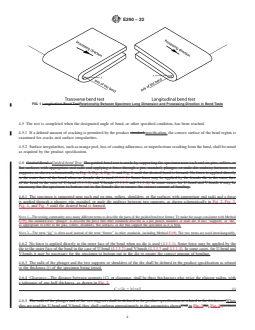
type of damage caused by the bend test that encompasses an 4.3.1 Longitudinal tests use a specimen with its long dimen-
area of the surface of a test specimen, but does not extend into sion aligned with the processing direction such that the bend is
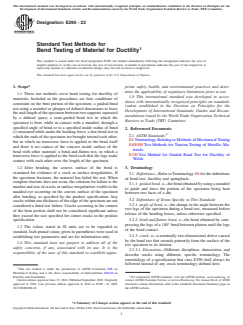
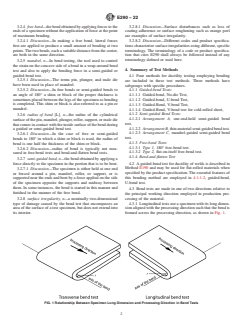
its interior. formed across the processing direction, as shown in Fig. 1.
FIG. 1 Relationship Between Specimen Long Dimension and Processing Direction in Bend Tests
E290 − 22
standardsdescribeasapin,punch,mandrel,ormaledie.Ituses“supports”
4.3.2 Transverse tests use a specimen with the long dimen-
or “die” as appropriate to refer to the pins, rollers, shoulders, flat surfaces,
sion perpendicular to the processing direction so that the axis
or die that support the specimen as it is bent.
of the bend is aligned with the processing direction, as shown
NOTE 2—The term “jig” is often used instead of the term “fixture” in
in Fig. 1. The axis of bend is the center of the radius of bend.
other standards, including Method E190. The two terms are used inter-
4.3.3 Thin sheet products are generally produced by reduc-
changeably.
ingthethicknessofstockinrollingmillsandfromthistheterm
4.6.2 No force is applied directly to the outer face of the
rolling direction is used to identify the principal processing
bend when no die is used (4.1.1.1). Some force may be applied
direction. Similarly, a product produced in coil form may have
by the die to the outer face of the bend in the case of U-bend
the processing direction referred to as the coiling direction.
(4.1.1.2) and V-bends (4.1.1.3 and 4.1.1.4). In some cases, for
U-bend and V-bends it may be necessary for the specimen to
4.4 The location of the force application to the specimen
relative to the bend itself and the amount of bending differen- bottom out in the die to ensure the correct amount of bending.
4.6.3 The radii of the plunger and the two supports or
tiate the four methods of bending covered in these test
methods. The three semi-guided bend test procedures provide shouldersofthedieshallbedefinedintheproductspecification
as related to the thickness (t) of the specimen being tested.
radiused surfaces over which the bend is formed. The results
4.6.4 Clearance—The distance between supports (C), or
obtained by different test procedures may not be the same,
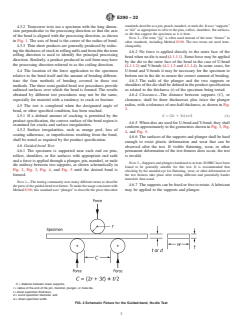
especially for material with a tendency to crack or fracture. clearance, shall be three thicknesses plus twice the plunger
radius, with a tolerance of one-half thickness, as shown in Fig.
4.5 The test is completed when the designated angle of
2.
bend, or other specified condition, has been reached.
C 5 2r 1 3t 6t⁄2 (1)
4.5.1 If a defined amount of cracking is permitted by the ~ !
product specification, the convex surface of the bend region is
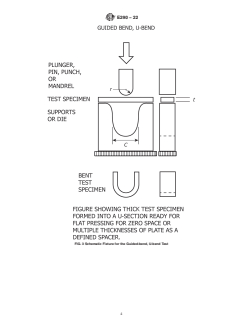
4.6.5 When dies are used for U-bend and V-bend, they shall
examined for cracks and surface irregularities.
conform approximately to the geometries shown in Fig. 3, Fig.
4.5.2 Surface irregularities, such as orange peel, loss of
4, and Fig. 5.
coating adherence, or imperfections resulting from the bend,
4.6.6 The surfaces of the supports and plunger shall be hard
shall be noted as required by the product specification.
enough to resist plastic deformation and wear that can be
4.6 Guided-bend Test: observed after the test. If visible flattening, wear, or other
4.6.1 The specimen is supported near each end on pins,
permanent deformation of the test fixtures does occur, the test
rollers, shoulders, or flat surfaces with appropriate end radii is invalid.
and a force is applied through a plunger, pin, mandrel, or male
NOTE 3—Supports and plungers hardened to at least 20 HRC have been
die midway between two supports, as shown schematically in
found to be generally suitable for this test. It is recommended that
Fig. 2, Fig. 3, Fig. 4, and Fig. 5 until the desired bend is
checking by the unaided eye for flattening, wear, or other deformation of
the test fixtures take place after testing different and potentially harder
formed.
materials than usual.
NOTE 1—The testing community uses many different terms to describe
4.6.7 The supports can be fixed or free to rotate.Alubricant
thepartsoftheguided-bendtestfixture.Tomaketheusageconsistentwith
Method E190, this standard uses “plunger” to describe the piece that other may be applied to the supports and plunger.
C = distance between lower supports,
r = radius of the end of the pin, mandrel, plunger, or male die,
t = sheet specimen thickness,
d = round specimen diameter, and
w = sheet specimen width.
FIG. 2 Schematic Fixture for the Guided-bend, No-die Test
E290 − 22
FIG. 3 Schematic Fixture for the Guided-bend, U-bend Test
E290 − 22
FIG. 4 Schematic Fixture for the Guided-bend, V-bend Test
E290 − 22
FIG. 5 Schematic Fixture for the Guided-bend, V-bend Test for Cold-rolled Sheet
E290 − 22
4.6.8 The width of the guided-bend test fixture, including
the supports and plunger, shall be such that the bend region of
the specimen is subject to the bending force across its width
(w) during bending.
4.6.9 When the thickness or strength of the specimen, or
capacity of the guided-bend test fixture (shown in Fig. 2) does
not produce the required amount of bending, the specimen can
be removed from the fixture and the bend completed by
applying force against the ends of the specimen, as shown
schematically in Fig. 6. A spacer with a thickness equal to
FIG. 7 Schematic Fixture for Arrangement A, One-end-held Semi-
guided Bend Test
twice the required radius of bend is inserted at the location of
the bend. The edges at the ends shall be constrained so the
specimencannotejectfromthefixtureunderthebendingforce.
4.6.10 Surface cracks and surface irregularities resulting
from the bend shall be evaluated and reported.
4.7 Semi-guided Bend Test—Aconstraining force is applied
on the inside of the bend during the initiation of the bending
and continues until the final bend condition is achieved.
4.7.1 Thesemi-guidedbendtestismadebyapplyingaforce
transversely to the specimen’s long axis in the portion that is
being bent.
4.7.2 The angle of bend in the semi-guided bend test is
measured while the specimen is held stationary under the force
forming the bend.
4.7.3 The location of the bend along the length of the
specimen is unimportant. The specimen is clamped or sup-
FIG. 8 Schematic Fixture for Arrangement B, Thin-material Semi-
ported by one of the arrangements shown schematically in
guided Bend Test
Figs. 7-9. It is possible that different results will be obtained
with the use of different arrangements. The arrangement used
shall be described in the test report on the ductility of the
material being evaluated.
4.7.4 Arrangement A, One End-held Semi-guided Bend
Test—Arrangement A involves holding one end of the semi-
guided bend test specimen and applying a force transversely
near the free end as in Fig. 7. The bend is formed around a
stationary pin, mandrel, or roller of a specified radius of bend.
Bending is continued until failure occurs or the specified angle
FIG. 9 Schematic Fixture for Arrangement C, Mandrel-guided
of bend has been achieved.
Semi-guided Bend Test
4.7.5 Arrangement B, Thin-material Semi-guided Bend
Test—Arrangement B is for semi-guided bend tests of thin
specimens, and includes a support between the clamp and the
forceisappliedtothespecimenduringthebending.Theresults
radius of bend, as shown schematically in Fig. 8. No tension
should be the same for tests using either Arrangement A, or
Arrangement B.
4.7.6 Arrangement C, Mandrel-guided Semi-guided Bend
Test—Arrangement C employs a stationary pin, or mandrel,
over which the semi-guided bend test specimen is bent by the
force of a roller, or mandrel, in contact with the outer surface
of the bend (as shown schematically in Fig. 9). This may exert
asmalltensionforceinthebend.Thetestissometimesreferred
to as a wrap, but it is distinct from the wrap-around wire test.
4.7.7 Cracks and surface irregularities resulting from the
bend shall be evaluated and reported.
4.8 Free-bend Test—No external force is applied to the
specimen in the immediate area of the bend.
4.8.1 The force to initiate bending for a free-bend test shall
beappliedat,orwithinonewidthdistancefrom,theendsofthe
specimen. This may be done by gripping the specimen. If the
FIG. 6 Schematic Fixture for Completing the Guided-bend Test
Started as Shown in Fig. 2 material is too stiff to respond to such force, it shall be
E290 − 22
supported at the mid-length (as shown schematically in Fig.
10) over a span of at least the specimen width while the initial
force is applied near the two ends of the specimen.
4.8.2 The angle of bend in a free-bend test is measured once
the specimen has been removed from the test fixture and is
under no constraining force. There is no radius of bend
measurement required for a free-bend test.
4.8.3 Type 1, 180°-Free-bend Test—The bending is initiated
as described in 4.8.1 and is then continued until a 180° bend is
developed by applying force to bring the legs of the specimen
FIG. 11 Type 1, 180° Free-bend Test
to a parallel position (as shown schematically in Fig. 11).
4.8.4 Type 2, Flat-on-itself Free-bend Test—The legs of the
specimen are placed under flat platens and compressed to
contact no closer than one width of specimen distance from the
outer extension of the bend (as shown schematically in Fig.
12).
4.8.5 The bending force is more severe in a Type 2-free-
bend test than in a Type 1, free-bend test. For this reason, the
type of bending used shall be described in the report.
4.8.6 Materials that age harden at room temperature shall be
tested within the allowed period of time, as defined in the
product specification.
4.8.7 After completing the free-bend test, the surface is
NOTE1—Thedistancefromtheclampingplatenstotheouterbendshall
examined for cracks and surface irregularities.
not be less than the width (w) of the bend specimen.
FIG. 12 Type 2, Flat-on-itself Free-bend Test
4.9 Bend-and-flatten Test—An initial 180° bend is made as
described in 4.8.1 and 4.8.3. The specimen is then placed
betweentwoparallelplatensextendingbeyondthebentportion
of the specimen and wider than the specimen width.
4.9.1 Force is exerted to clamp the specimen and cause the
two legs to contact at the bend, exclusive of the eye of the bend
(as shown schematically in Fig. 13).
4.9.2 Examinationforcracksintheoutersurfaceofthebend
is done after removing the specimen from the bending force
and allowing springback. The allowed number and size of
cracks on the outer surface of the bend shall be as specified in
the product specification. FIG. 13 Bend-and-flatten Test
4.9.3 Any surface irregularities resulting from the bend test
shall be noted and reported.
5.2 The type of bend test used determines the location of the
forces and constraints on the bent portion of the specimen,
5. Significance and Use
ranging from no direct contact to continuous contact.
5.1 Bend tests for ductility provide a simple way to evaluate
5.3 The test can terminate at a given angle of bend over a
the quality of materials by their ability to resist cracking or
specified radius of bend or continue until the specimen legs are
other surface irregularities during one continuous bend. No
in contact. The angle of bend can be measured while the
reversal of the bend force shall be employed when conducting
specimen is under the bending force (usually when the semi-
these tests.
g
...
This document is not an ASTM standard and is intended only to provide the user of an ASTM standard an indication of what changes have been made to the previous version. Because
it may not be technically possible to adequately depict all changes accurately, ASTM recommends that users consult prior editions as appropriate. In all cases only the current version
of the standard as published by ASTM is to be considered the official document.
Designation: E290 − 14 E290 − 22
Standard Test Methods for
Bend Testing of Material for Ductility
This standard is issued under the fixed designation E290; the number immediately following the designation indicates the year of
original adoption or, in the case of revision, the year of last revision. A number in parentheses indicates the year of last reapproval. A
superscript epsilon (´) indicates an editorial change since the last revision or reapproval.
This standard has been approved for use by agencies of the U.S. Department of Defense.
1. Scope*
1.1 These test methods cover bend testing for ductility of materials. Included in the procedures are four conditions of constraint
on the bent portion of the specimen; a guided-bend test using a mandrel or plunger of defined dimensions to force the mid-length
of the specimen between two supports separated by a defined space; a semi-guided bend test in which the specimen is bent, while
in contact with a mandrel, through a specified angle of bend or to a specified inside radius (r) of curvature, bend (r) measured while
under the bending force; a free-bend test in which the ends of the specimen are brought toward each other, but in which no
transverse force is applied to the bend itself and there is no contact of the concave inside surface of the bend with other material;
a bend and flatten bend-and-flatten test, in which a transverse force is applied to the bend such that the legs make contact with each
other over the length of the specimen.
1.2 After bending, the convex surface of the bend is examined for evidence of a crack or surface irregularities. If the specimen
fractures, the material has failed the test. When complete fracture does not occur, the criterion for failure is the number and size
of cracks or surface irregularities visible to the unaided eye occurring on the convex surface of the specimen after bending, as
specified by the product standard.specification. Any cracks within one thickness of the edge of the specimen are not considered
a bend test failure. Cracks occurring in the corners of the bent portion shall not be considered significant unless they exceed the
size specified for corner cracks in the product standard.specification.
1.3 The values stated in SI units are to be regarded as standard. Inch-pound values given in parentheses were used in establishing
test parameters and are for information only.
1.4 This standard does not purport to address all of the safety concerns, if any, associated with its use. It is the responsibility
of the user of this standard to establish appropriate safety safety, health, and healthenvironmental practices and determine the
applicability of regulatory limitations prior to use.
1.5 This international standard was developed in accordance with internationally recognized principles on standardization
established in the Decision on Principles for the Development of International Standards, Guides and Recommendations issued
by the World Trade Organization Technical Barriers to Trade (TBT) Committee.
2. Referenced Documents
2.1 ASTM Standards:
E6 Terminology Relating to Methods of Mechanical Testing
This test method is under the jurisdiction of ASTM Committee E28 on Mechanical Testing and is the direct responsibility of Subcommittee E28.02 on Ductility and
Formability.
Current edition approved May 1, 2014June 15, 2022. Published September 2014September 2022. Originally approved in 1966. Last previous edition approved in 20132014
as E290 – 13.E290 – 14. DOI: 10.1520/E0290-14.10.1520/E0290-22.
For referenced ASTM standards, visit the ASTM website, www.astm.org, or contact ASTM Customer Service at service@astm.org. For Annual Book of ASTM Standards
volume information, refer to the standard’s Document Summary page on the ASTM website.
*A Summary of Changes section appears at the end of this standard
Copyright © ASTM International, 100 Barr Harbor Drive, PO Box C700, West Conshohocken, PA 19428-2959. United States
E290 − 22
E8/E8M Test Methods for Tension Testing of Metallic Materials
E18 Test Methods for Rockwell Hardness of Metallic Materials
E190 Test Method for Guided Bend Test for Ductility of Welds
3. Terminology
3.1 Definitions—Refer to Terminology E6 for the definitions of bend test, ductility and springback.
3.1.1 guided bend, n—the bend obtained by using a mandrel to guide and force the portion of the specimen being bent between
two faces of a die.
3.2 Definitions of Terms Specific to This Standard:
3.2.1 angle of bend, n—the change in the angle between the two legs of the specimen during a bend test, measured before release
of the bending forces, unless otherwise specified.
3.2.2 bend-and-flatten bend, n—the bend obtained by compressing the legs of a 180° bend between platens until the legs of the
bend contact.
3.2.3 crack, n—a nominally two-dimensional defect caused by the bend test that extends primarily from the surface of the test
specimen to its interior.
3.2.3.1 Discussion—
Different disciplines characterize and describe cracks using different, specific terminology. The terminology of a specification that
cites E290 shall always be followed instead of any crack terminology defined here.
3.2.4 free bend—the bend obtained by applying forces to the ends of a specimen without the application of force at the point of
maximum bending.
3.2.4.1 Discussion—
In making a free bend, lateral forces first are applied to produce a small amount of bending at two points. The two bends, each
a suitable distance from the center, are both in the same direction.
3.2.5 mandrel, n—In bend testing, the tool used to control the strain on the concave side of a bend in a wrap-around bend test and
also to apply the bending force in a semi-guided or guided-bend test.
3.2.5.1 Discussion—
The terms pin, plunger, and male die have been used in place of mandrel.
3.2.5.2 Discussion—
In free bends or semi-guided bends to an angle of 180° a shim or block of the proper thickness is sometimes placed between the
legs of the specimen as bending is completed. This shim or block is also referred to as a pin or mandrel.
3.2.6 radius of bend [L],n—the radius of the cylindrical surface of the pin, mandrel, plunger, roller, support, or male die that comes
in contact with the inside surface of the bend during a guided or semi-guided bend test.
3.2.6.1 Discussion—
In the case of free or semi-guided bends to 180° in which a shim or block is used, the radius of bend is one half the thickness of
the shim or block.
3.2.6.2 Discussion—
radius of bend is typically not measured in free-bend tests and bend-and-flatten bend tests.
3.2.7 semi-guided bend, n—the bend obtained by applying a force directly to the specimen in the portion that is to be bent.
3.2.7.1 Discussion—
The specimen is either held at one end or forced around a pin, mandrel, roller, or support, or is supported near the ends and bent
by a force applied on the side of the specimen opposite the supports and midway between them. In some instances, the bend is
started in this manner and finished in the manner of the free bend.
3.2.8 surface irregularity, n—a nominally two-dimensional type of damage caused by the bend test that encompasses an area of
the surface of a test specimen, but does not extend into its interior.
3.2.8.1 Discussion—
Surface disturbances such as loss of coating adherence or surface roughening such as orange peel are examples of surface
irregularity.
E290 − 22
3.2.8.2 Discussion—
Different codes and product specifications characterize surface irregularities using different, specific terminology. The terminology
of a code or product specification that cites E290 shall always be followed instead of any terminology defined or used here.
4. Summary of Test Methods
4.1 Four methods for ductility testing employing bending are included in these test methods. Three methods have subgroups with
specific procedures.
4.1.1 Guided Bend:Guided-bend Tests:
4.1.1.1 Guided Bend, No Die,Guided-bend, No-die Test,
4.1.1.2 Guided Bend, U-Bend,Guided-bend, U-bend Test,
4.1.1.3 Guided Bend, V-Bend,Guided-Bend, V-bend Test,
4.1.1.4 Guided Bend, V-Bend for cold rolled Guided-Bend, V-bend test for cold-rolled sheet,
4.1.2 Semi-guided Bend: Bend Tests:
4.1.2.1 Arrangement A, specimen held at one end.one-end-held semi-guided bend test.
4.1.2.2 Arrangement B, for thin material.thin-material semi-guided bend test.
4.1.2.3 Arrangement C, mandrel contact force in the bend.mandrel-guided semi-guided bend test.
4.1.3 Free-Bend: Free-bend Tests:
4.1.3.1 Type 1, 180° bend.free-bend test.
4.1.3.2 Type 2, bend flat on itself.flat-on-itself free-bend test.
4.1.4 Bend and Flatten: Bend-and-flatten Test
4.2 A guided-bend test for ductility of welds is described in Method E190 and may be used for flat-rolled materials when specified
by the product standard.specification. The essential features of this bending method are employed in 3.1.1.24.1.1.2, Guided Bend,
U-Bend. guided-bend, U-bend test.
4.3 Bend tests are made in one of two directions relative to the principal working direction employed in production processing
of the material.
4.3.1 Longitudinal tests use a specimen with its long dimension aligned with the processing direction such that the bend is formed
across the processing direction, as shown in Fig. 1.
4.3.2 Transverse tests use a specimen with the long dimension perpendicular to the processing direction so that the bend axis axis
of the bend is aligned with the processing direction, as shown in Fig. 21. The axis of bend is the center of the bend radius.radius
of bend.
4.3.3 Thin sheet products are generally produced by reducing the thickness of stock in rolling mills and from this the term rolling
direction is used to identify the principal processing direction. Similarly, a product produced in coil form may have the processing
direction referred to as the coiling direction.
4.4 The location of the force application to the specimen relative to the bend itself and the amount of bending differentiate the
four methods of bending covered in these test methods. The twothree semi-guided bend test procedures provide radiused surfaces
over which the bend is formed. The results obtained by different test procedures may not be the same, especially for material with
a tendency to crack or fracture.
E290 − 22
FIG. 1 Longitudinal Bend TestRelationship Between Specimen Long Dimension and Processing Direction in Bend Tests
4.5 The test is completed when the designated angle of bend, or other specified condition, has been reached.
4.5.1 If a defined amount of cracking is permitted by the product standard,specification, the convex surface of the bend region is
examined for cracks and surface irregularities.
4.5.2 Surface irregularities, such as orange peel, loss of coating adherence, or imperfections resulting from the bend, shall be noted
as required by the product specification.
4.6 Guided Bend—Guided-bend Test: The guided-bend test is made by supporting the specimen near each end on pins, rollers, or
flat surfaces with appropriate end radii and applying a force through a pin, mandrel, plunger, or male die midway between two
supports, as shown schematically in Fig. 3, Fig. 4, Fig. 5, and Fig. 6 until the desired bend is formed. No force is applied directly
to the outer face of the bend when no female die is used (3.1.1.1). Some force may be applied by the female die to the outer face
of the bend in the case of U-bend (3.1.1.2) and V-bends (3.1.1.3 and 3.1.1.4). In some cases, for U-bend and V-bends it may be
necessary for the specimen to bottom out in the female die to ensure the correct amount of bending.
4.6.1 The specimen is supported near each end on pins, rollers, shoulders, or flat surfaces with appropriate end radii and a force
is applied through a plunger, pin, mandrel, or male die midway between two supports, as shown schematically in Fig. 2, Fig. 3,
Fig. 4, and Fig. 5 until the desired bend is formed.
NOTE 1—The testing community uses many different terms to describe the parts of the guided-bend test fixture. To make the usage consistent with Method
E190, this standard uses “plunger” to describe the piece that other standards describe as a pin, punch, mandrel, or male die. It uses “supports” or “die”
as appropriate to refer to the pins, rollers, shoulders, flat surfaces, or die that support the specimen as it is bent.
NOTE 2—The term “jig” is often used instead of the term “fixture” in other standards, including Method E190. The two terms are used interchangeably.
4.6.2 No force is applied directly to the outer face of the bend when no die is used (4.1.1.1). Some force may be applied by the
die to the outer face of the bend in the case of U-bend (4.1.1.2) and V-bends (4.1.1.3 and 4.1.1.4). In some cases, for U-bend and
V-bends it may be necessary for the specimen to bottom out in the die to ensure the correct amount of bending.
4.6.3 The radii of the plunger and the two supports or shoulders of the die shall be defined in the product specification as related
to the thickness (t) of the specimen being tested.
4.6.4 Clearance—The distance between supports (C), or clearance, shall be three thicknesses plus twice the plunger radius, with
a tolerance of one-half thickness, as shown in Fig. 2.
C 5 2r 1 3t 6t⁄2 (1)
~ !
4.6.5 The radii of the plunger and of the two supports shall be defined in the product specification as related to the thickness (When
dies are used for U-bend and V-bend, they shall conform approximately to the geometries shownt) of in Fig. 3the, Fig. 4specimen
E290 − 22
NOTE 1—Arrow indicates direction of processing.
C = distance between lower supports,
r = radius of the end of the pin, mandrel, plunger, or male die,
t = sheet specimen thickness,
d = round specimen diameter, and
w = sheet specimen width.
FIG. 2 Transverse Bend Test
NOTE 1—C = distance between lower supports,
r = radius of the end of the mandrel or plunger,
t = sheet specimen thickness,
d = round specimen diameter, and
w = sheet specimen width.
FIG. 32 Schematic Fixture for the Guided Bend, No Die Guided-bend, No-die Test
being tested. A clearance of three thickness with a tolerance of one half thickness shall be provided between the pins, plunger, ,
and Fig. 5specimen in the initial bend fixture.
3.6.1.1 The distance between supports (C) shall be three thicknesses plus twice the plunger radius, with a tolerance of one-half
thickness, as shown in Fig. 3.
3.6.1.2 When female dies are used for U-bend and V-bend, they shall conform approximately to the geometries shown in Fig. 4,
Fig. 5, and Fig. 6.
4.6.6 The surfaces of the supports and plunger shall be hard enough to resist plastic deformation and wear that can be observed
after the test. If visible flattening, wear, or other permanent deformation of the test fixtures does occur, the test is invalid.
NOTE 3—Supports and plungers hardened to at least 20 HRC have been found to be generally suitable for this test. It is recommended that checking by
the unaided eye for flattening, wear, or other deformation of the test fixtures take place after testing different and potentially harder materials than usual.
4.6.7 The supports can be fixed or free to rotate. A lubricant may be applied to the supports and plunger.
4.6.8 The width of the guided-bend test fixture, including the supports and plunger, shall be such that the bend region of the
specimen is subject to the bending force across its width (w) during bending.
4.6.9 When the thickness or strength of the specimen, or capacity of the guided-bend test fixture (shown in Fig. 32) does not
produce the required amount of bending, the specimen can be removed from the fixture and the bend completed by applying force
against the ends of the specimen, as shown schematically in Fig. 76. A spacer with a thickness equal to twice the required bend
radius of bend is inserted at the location of the bend. The edges at the ends shall be constrained so the specimen cannot eject from
the fixture under the bending force.
4.6.10 Surface cracks and imperfections surface irregularities resulting from the bend shall be evaluated and reported.
E290 − 22
FIG. 43 Schematic Fixture for the Guided Bend, Guided-bend, U-bend Test
E290 − 22
FIG. 54 Schematic Fixture for the Guided Bend, V- Bend Guided-bend, V-bend Test
E290 − 22
FIG. 65 Schematic Fixture for the Guided Bend, V- Bend Guided-bend, V-bend Test for Cold Rolled Cold-rolled Sheet
E290 − 22
FIG. 76 Schematic Fixture for Completing the Guided-BendGuided-bend Test Started as Shown in Fig.Fig. 2 3
4.7 Semi-guided Bend—Bend Test—The semi-guided bend test employs a constraining force A constraining force is applied on the
inside of the bend during the initiation of the bending and continuingcontinues until the final bend condition is achieved.
4.7.1 The semi-guided bend test is made by applying a force transversely to the specimen’s long axis in the portion that is being
bent.
4.7.2 The angle of bend in the semi-guided bend test is measured while the specimen is held stationary under the force forming
the bend.
4.7.3 The location of the bend along the length of the specimen is unimportant. The specimen is clamped or supported by one of
the methodsarrangements shown schematically in Figs. 8-7-109. It is possible that different results will be obtained with the use
of different devices.arrangements. The methodarrangement used shall be described in the test report on the ductility of the material
being evaluated.
4.7.4 Arrangement A—One End Held—A, One End-held Semi-guided Bend Test—Arrangement A involves holding one end of the
semi-guided bend test specimen and applying a force transversely near the free end as in Fig. 87. The bend is formed around a
stationary pin, mandrel, or roller of a specified radius. radius of bend. Bending is continued until failure occurs or the specified
angle of bend has been achieved.
4.7.5 Arrangement B—Thin Materials—B, Thin-material Semi-guided Bend Test—Arrangement B is for semi-guided bend tests
of thin specimens, and includes a support between the clamp and the bend radius, radius of bend, as shown schematically in Fig.
98. No tension force is applied to the specimen during the bending. The results should be the same for tests using either
Arrangement A, or Arrangement B.
4.7.6 Arrangement C—Mandrel Contact on Outer Surface—C, Mandrel-guided Semi-guided Bend Test—Arrangement C employs
a stationary pin, or mandrel, over which the semi-guided bend test specimen is bent by the force of a roller, or mandrel, in contact
with the outer surface of the bend (as shown schematically in Fig. 109). This may exert a small tension force in the bend. The test
is sometimes referred to as a wrap, but it is distinct from the wrap aroundwrap-around wire test described in Method test.E6.
4.7.7 Surface cracks Cracks and surface irregularities resulting from the bend shall be evaluated and reported.
FIG. 87 Schematic Fixture for Semi-Guided Bend Test Arrangement A—One End Held—Force Applied Near Free EndArrangement A,
One-end-held Semi-guided Bend Test
E290 − 22
FIG. 98 Arrangement B for Semi-Guided Bend Test of Thin Specimens—One End HeldSchematic Fixture for Arrangement B, Thin-
material Semi-guided Bend Test
FIG. 109 Schematic Fixture for Semi-Guided Bend Test Arrangement C—One End Held—Force Applied Near MandrelArrangement C,
Mandrel-guided Semi-guided Bend Test
4.8 Free-Bend—Free-bend Test—The free-bend test is made with no external force No external force is applied to the specimen
in the immediate area of the bend.
4.8.1 The force to initiate bending for a free-bend test shall be applied at, or within one width distance from, the ends of the
specimen. This may be done by gripping the specimen. If the material is too stiff to respond to such force, it shall be supported
at the mid-length (as shown schematically in Fig. 1110) over a span of at least the specimen width while the initial force is applied
near the two ends of the specimen.
4.8.2 The angle of bend in a free-bend test is measured once the specimen has been removed from the bendingtest fixture and is
under no constraining force. There is no radius of bend measurement required for a free-bend test.
4.8.3 Type 1-Free-Bend–180° Bend—1, 180°-Free-bend Test—The bending is initiated as described in 3.8.14.8.1 and is then
continued until a 180° bend is developed by applying force to bring the legs of the specimen to a parallel position (as shown
schematically in Fig. 1211).
4.8.4 Type 2-Free Bend (Flat on Itself Bend)—2, Flat-on-itself Free-bend Test—The legs of the specimen are placed under flat
platens and compressed to contact no closer than one width of specimen distance from the outer extension of the bend (as shown
schematically in Fig. 1312).
FIG. 1110 Free Bend Free-bend Support and Force
E290 − 22
FIG. 1211 Type 1, 180° Free BendFree-bend Test
NOTE 1—The distance from the clamping platens to the outer bend shall not be less than the width (w) of the bend specimen.
FIG. 1312 Type 2 Flat-on-Itself Free Bend2, Flat-on-itself Free-bend Test
4.8.5 The bending force is more severe in a Type 2-Free-Bend2-free-bend test than in a Type 1-Free-Bend 1, free-bend test. For
this reason, the type of bending used shall be described in the report.
4.8.6 Materials that age harden at room temperature shall be tested within the allowed period of time, as defined in the product
standard.specification.
4.8.7 After completing the free-bend, free-bend test, the surface is examined for cracks and imperfections.surface irregularities.
4.9 Bend and Flatten—Bend-and-flatten Test—For the bend and flatten test for ductility, an An initial 180° bend is made as
described in 3.8.14.8.1 and 3.8.34.8.3. The specimen is then placed between two parallel platens extending beyond the bent portion
of the specimen and wider than the specimen width.
4.9.1 Force is exerted to clamp the specimen and cause the two legs to contact at the bend, exclusive of the eye of the bend (as
shown schematically in Fig. 1413).
4.9.2 Examination for cracks in the outer surface of the bend is done after removing the specimen from the
...