

ASTM A1021/A1021M-20
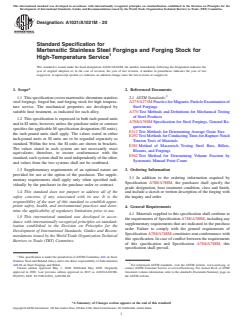
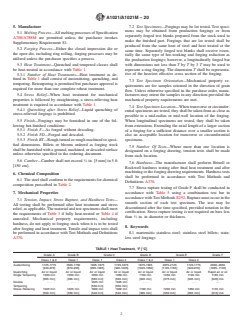
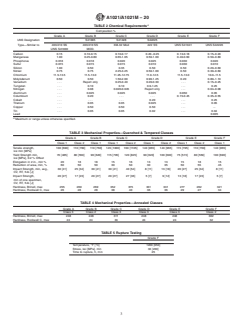
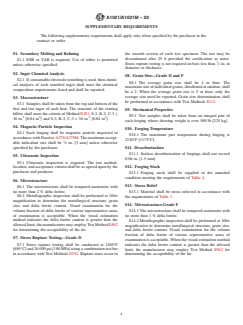
(Specification)Standard Specification for Martensitic Stainless Steel Forgings and Forging Stock for High-Temperature Service
General Information
- Abstract
ABSTRACT
This specification covers martensitic chromium stainless steel forgings, forged bars, and forging stock for high-temperature service. The mechanical properties are developed by suitable heat treatment, as indicated for each alloy. Steel materials shall be manufactured by melting and forging processes, and heat treatments, that shall consist of austenizing, quenching, tempering, and stress relieving. Stainless steels may then be furnished in one of the following hot-finished conditions: as forged without descaling; forged and descaled; rough turned or rough machined. Specimens shall conform to required chemical compositions. Forgings shall undergo tension, impact, stress rapture, and hardness tests, and should conform to mechanical properties prescribed for individual grades and classes. These mechanical properties are: tensile strength, yield strength, elongation, reduction of area, impact strength, and Brinell and Rockwell hardness.
SCOPE
1.1 This specification covers martensitic chromium stainless steel forgings, forged bar, and forging stock for high temperature service. The mechanical properties are developed by suitable heat treatment, as indicated for each alloy.
1.2 This specification is expressed in both inch-pound units and in SI units; however, unless the purchase order or contract specifies the applicable M specification designation (SI units), the inch-pound units shall apply. The values stated in either inch-pound units or SI units are to be regarded separately as standard. Within the text, the SI units are shown in brackets. The values stated in each system are not necessarily exact equivalents; therefore, to ensure conformance with the standard, each system shall be used independently of the other, and values from the two systems shall not be combined.
1.3 Supplementary requirements of an optional nature are provided for use at the option of the purchaser. The supplementary requirements shall apply only when specified individually by the purchaser in the purchase order or contract.
1.4 This standard does not purport to address all of the safety concerns, if any, associated with its use. It is the responsibility of the user of this standard to establish appropriate safety, health, and environmental practices and determine the applicability of regulatory limitations prior to use.
1.5 This international standard was developed in accordance with internationally recognized principles on standardization established in the Decision on Principles for the Development of International Standards, Guides and Recommendations issued by the World Trade Organization Technical Barriers to Trade (TBT) Committee.
- Status
- Published
- Publication Date
- 30-Apr-2020
- Technical Committee
- A01 - Steel, Stainless Steel and Related Alloys
- Drafting Committee
- A01.06 - Steel Forgings and Billets
Buy Documents
ASTM A1021/A1021M-20 - Standard Specification for Martensitic Stainless Steel Forgings and Forging Stock for High-Temperature Service
REDLINE ASTM A1021/A1021M-20 - Standard Specification for Martensitic Stainless Steel Forgings and Forging Stock for High-Temperature Service
Overview
ASTM A1021/A1021M-20 is the international standard specification for martensitic chromium stainless steel forgings, forged bars, and forging stock intended for high-temperature service applications. Issued by ASTM International, this standard defines the requirements for manufacturing processes, chemical composition, heat treatment, mechanical properties, testing, and finishing of martensitic stainless steels used in demanding environments. The specification is applicable to products fabricated via both inch-pound and SI units, ensuring global relevance for manufacturers and end-users in steel forging.
Key Topics
Material Scope
Covers martensitic chromium stainless steel forgings, forged bar, and forging stock designed to withstand elevated temperatures.Production Processes
Specifies permitted melting (including ESR and VAR if required), closed or open die forging, and finishing conditions such as as-forged, descaled, or rough-machined.Heat Treatment
Requires austenitizing, quenching, tempering, and stress relieving to achieve desired mechanical properties according to grade and class.Chemical Composition
Each grade must meet strict chemical analysis requirements for elements such as carbon, chromium, nickel, molybdenum, and others as detailed in the standard.Mechanical Properties and Testing
Outlines the minimum requirements for tensile strength, yield strength, elongation, reduction of area, impact strength, and hardness (Brinell and Rockwell). Mandates tension, impact, stress rupture, and hardness tests after suitable heat treatment.Inspection and Supplementary Requirements
Includes optional magnetic particle and ultrasonic testing, grain size, microstructure evaluations, macroetch test, and decarburization limits.Dual Units
Specifies use of either inch-pound or SI units but prohibits mixing values from the different systems, ensuring clarity and compliance.
Applications
ASTM A1021/A1021M-20 martensitic stainless steel forgings are critical for industries where mechanical strength and resistance to high temperatures are required. Common applications include:
- Power generation equipment: Turbine blades, shafts, and high-pressure valve components exposed to thermal and mechanical stress.
- Petrochemical and chemical processing: Components such as pump shafts, valves, and fittings for refineries and process plants.
- Aerospace and aviation: Parts subjected to high temperature and stress, including engine components and fasteners.
- Heavy machinery: Forged parts for compressors, gearboxes, and other high-demand mechanical systems.
Forgings produced to this standard ensure consistent performance, reliability, and durability under high-temperature operating conditions, meeting the stringent requirements of these advanced applications.
Related Standards
Several other ASTM standards are referenced or complement ASTM A1021/A1021M-20, providing additional requirements and testing methods for steel forgings:
- ASTM A788/A788M: General requirements for steel forgings, referenced for overall conformity.
- ASTM A370: Methods for mechanical testing of steel products, including tension and hardness testing.
- ASTM A275/A275M: Practice for magnetic particle examination of steel forgings.
- ASTM E112: Determining average grain size.
- ASTM E292: Stress rupture testing methods.
- ASTM E381: Macroetch testing procedures.
- ASTM E562: Volume fraction measurement by systematic manual point count.
These related standards ensure comprehensive control over quality, safety, mechanical properties, and reliability for high-temperature stainless steel forgings.
Keywords: ASTM A1021, martensitic stainless steel, stainless steel forgings, high-temperature forgings, forging stock, mechanical properties, heat treatment, steel standards, ASTM International, high-temperature service
Relations
- Effective Date
- 01-May-2020
- Effective Date
- 01-Mar-2024
- Effective Date
- 01-Nov-2023
- Effective Date
- 15-Aug-2019
- Effective Date
- 01-Jul-2019
- Effective Date
- 01-May-2019
- Effective Date
- 01-Nov-2018
- Effective Date
- 01-Sep-2018
- Effective Date
- 01-Mar-2018
- Refers
ASTM A370-17a - Standard Test Methods and Definitions for Mechanical Testing of Steel Products - Effective Date
- 15-Nov-2017
- Effective Date
- 01-Nov-2017
- Effective Date
- 01-May-2017
- Effective Date
- 01-Jan-2017
- Effective Date
- 01-Dec-2016
- Effective Date
- 01-Nov-2015
Buy Documents
ASTM A1021/A1021M-20 - Standard Specification for Martensitic Stainless Steel Forgings and Forging Stock for High-Temperature Service
REDLINE ASTM A1021/A1021M-20 - Standard Specification for Martensitic Stainless Steel Forgings and Forging Stock for High-Temperature Service
Get Certified
Connect with accredited certification bodies for this standard

Element Materials Technology
Materials testing and product certification.

Inštitut za kovinske materiale in tehnologije
Institute of Metals and Technology. Materials testing, metallurgical analysis, NDT.
Sponsored listings
Frequently Asked Questions
ASTM A1021/A1021M-20 is a technical specification published by ASTM International. Its full title is "Standard Specification for Martensitic Stainless Steel Forgings and Forging Stock for High-Temperature Service". This standard covers: ABSTRACT This specification covers martensitic chromium stainless steel forgings, forged bars, and forging stock for high-temperature service. The mechanical properties are developed by suitable heat treatment, as indicated for each alloy. Steel materials shall be manufactured by melting and forging processes, and heat treatments, that shall consist of austenizing, quenching, tempering, and stress relieving. Stainless steels may then be furnished in one of the following hot-finished conditions: as forged without descaling; forged and descaled; rough turned or rough machined. Specimens shall conform to required chemical compositions. Forgings shall undergo tension, impact, stress rapture, and hardness tests, and should conform to mechanical properties prescribed for individual grades and classes. These mechanical properties are: tensile strength, yield strength, elongation, reduction of area, impact strength, and Brinell and Rockwell hardness. SCOPE 1.1 This specification covers martensitic chromium stainless steel forgings, forged bar, and forging stock for high temperature service. The mechanical properties are developed by suitable heat treatment, as indicated for each alloy. 1.2 This specification is expressed in both inch-pound units and in SI units; however, unless the purchase order or contract specifies the applicable M specification designation (SI units), the inch-pound units shall apply. The values stated in either inch-pound units or SI units are to be regarded separately as standard. Within the text, the SI units are shown in brackets. The values stated in each system are not necessarily exact equivalents; therefore, to ensure conformance with the standard, each system shall be used independently of the other, and values from the two systems shall not be combined. 1.3 Supplementary requirements of an optional nature are provided for use at the option of the purchaser. The supplementary requirements shall apply only when specified individually by the purchaser in the purchase order or contract. 1.4 This standard does not purport to address all of the safety concerns, if any, associated with its use. It is the responsibility of the user of this standard to establish appropriate safety, health, and environmental practices and determine the applicability of regulatory limitations prior to use. 1.5 This international standard was developed in accordance with internationally recognized principles on standardization established in the Decision on Principles for the Development of International Standards, Guides and Recommendations issued by the World Trade Organization Technical Barriers to Trade (TBT) Committee.
ABSTRACT This specification covers martensitic chromium stainless steel forgings, forged bars, and forging stock for high-temperature service. The mechanical properties are developed by suitable heat treatment, as indicated for each alloy. Steel materials shall be manufactured by melting and forging processes, and heat treatments, that shall consist of austenizing, quenching, tempering, and stress relieving. Stainless steels may then be furnished in one of the following hot-finished conditions: as forged without descaling; forged and descaled; rough turned or rough machined. Specimens shall conform to required chemical compositions. Forgings shall undergo tension, impact, stress rapture, and hardness tests, and should conform to mechanical properties prescribed for individual grades and classes. These mechanical properties are: tensile strength, yield strength, elongation, reduction of area, impact strength, and Brinell and Rockwell hardness. SCOPE 1.1 This specification covers martensitic chromium stainless steel forgings, forged bar, and forging stock for high temperature service. The mechanical properties are developed by suitable heat treatment, as indicated for each alloy. 1.2 This specification is expressed in both inch-pound units and in SI units; however, unless the purchase order or contract specifies the applicable M specification designation (SI units), the inch-pound units shall apply. The values stated in either inch-pound units or SI units are to be regarded separately as standard. Within the text, the SI units are shown in brackets. The values stated in each system are not necessarily exact equivalents; therefore, to ensure conformance with the standard, each system shall be used independently of the other, and values from the two systems shall not be combined. 1.3 Supplementary requirements of an optional nature are provided for use at the option of the purchaser. The supplementary requirements shall apply only when specified individually by the purchaser in the purchase order or contract. 1.4 This standard does not purport to address all of the safety concerns, if any, associated with its use. It is the responsibility of the user of this standard to establish appropriate safety, health, and environmental practices and determine the applicability of regulatory limitations prior to use. 1.5 This international standard was developed in accordance with internationally recognized principles on standardization established in the Decision on Principles for the Development of International Standards, Guides and Recommendations issued by the World Trade Organization Technical Barriers to Trade (TBT) Committee.
ASTM A1021/A1021M-20 is classified under the following ICS (International Classification for Standards) categories: 77.140.85 - Iron and steel forgings. The ICS classification helps identify the subject area and facilitates finding related standards.
ASTM A1021/A1021M-20 has the following relationships with other standards: It is inter standard links to ASTM A1021/A1021M-05(2015), ASTM A370-24, ASTM A275/A275M-23, ASTM E562-19e1, ASTM A370-19, ASTM A788/A788M-19, ASTM A788/A788M-18b, ASTM A788/A788M-18a, ASTM A788/A788M-18, ASTM A370-17a, ASTM A788/A788M-17a, ASTM A788/A788M-17, ASTM A370-17, ASTM A788/A788M-16a, ASTM A370-15. Understanding these relationships helps ensure you are using the most current and applicable version of the standard.
ASTM A1021/A1021M-20 is available in PDF format for immediate download after purchase. The document can be added to your cart and obtained through the secure checkout process. Digital delivery ensures instant access to the complete standard document.
Standards Content (Sample)
This international standard was developed in accordance with internationally recognized principles on standardization established in the Decision on Principles for the
Development of International Standards, Guides and Recommendations issued by the World Trade Organization Technical Barriers to Trade (TBT) Committee.
Designation:A1021/A1021M −20
Standard Specification for
Martensitic Stainless Steel Forgings and Forging Stock for
High-Temperature Service
This standard is issued under the fixed designation A1021/A1021M; the number immediately following the designation indicates the
year of original adoption or, in the case of revision, the year of last revision. A number in parentheses indicates the year of last
reapproval. A superscript epsilon (´) indicates an editorial change since the last revision or reapproval.
1. Scope* 2. Referenced Documents
1.1 Thisspecificationcoversmartensiticchromiumstainless 2.1 ASTM Standards:
steel forgings, forged bar, and forging stock for high tempera- A275/A275MPracticeforMagneticParticleExaminationof
ture service. The mechanical properties are developed by Steel Forgings
suitable heat treatment, as indicated for each alloy. A370Test Methods and Definitions for Mechanical Testing
of Steel Products
1.2 This specification is expressed in both inch-pound units
A788/A788MSpecification for Steel Forgings, General Re-
and in SI units; however, unless the purchase order or contract
quirements
specifies the applicable M specification designation (SI units),
E112Test Methods for Determining Average Grain Size
the inch-pound units shall apply. The values stated in either
E292Test Methods for Conducting Time-for-Rupture Notch
inch-pound units or SI units are to be regarded separately as
Tension Tests of Materials
standard. Within the text, the SI units are shown in brackets.
E381Method of Macroetch Testing Steel Bars, Billets,
The values stated in each system are not necessarily exact
Blooms, and Forgings
equivalents; therefore, to ensure conformance with the
E562Test Method for Determining Volume Fraction by
standard, each system shall be used independently of the other,
Systematic Manual Point Count
and values from the two systems shall not be combined.
1.3 Supplementary requirements of an optional nature are 3. Ordering Information
provided for use at the option of the purchaser. The supple-
3.1 In addition to the ordering information required by
mentary requirements shall apply only when specified indi-
Specification A788/A788M, the purchaser shall specify the
vidually by the purchaser in the purchase order or contract.
grade designation, heat treatment condition, class and finish,
1.4 This standard does not purport to address all of the
and include a sketch or written description of the forging with
safety concerns, if any, associated with its use. It is the
the inquiry and order.
responsibility of the user of this standard to establish appro-
priate safety, health, and environmental practices and deter-
4. General Requirements
mine the applicability of regulatory limitations prior to use.
4.1 Materials supplied to this specification shall conform to
1.5 This international standard was developed in accor-
the requirements of Specification A788/A788M, including any
dance with internationally recognized principles on standard-
supplementary requirements that are indicated in the purchase
ization established in the Decision on Principles for the
order. Failure to comply with the general requirements of
Development of International Standards, Guides and Recom-
Specification A788/A788M constitutes non-conformance with
mendations issued by the World Trade Organization Technical
this specification. In case of conflict between the requirements
Barriers to Trade (TBT) Committee.
of this specification and Specification A788/A788M, this
specification shall prevail.
This specification is under the jurisdiction ofASTM Committee A01 on Steel,
Stainless Steel and RelatedAlloys and is the direct responsibility of Subcommittee
A01.06 on Steel Forgings and Billets. For referenced ASTM standards, visit the ASTM website, www.astm.org, or
Current edition approved May 1, 2020. Published May 2020. Originally contact ASTM Customer Service at service@astm.org. For Annual Book of ASTM
approved in 2001. Last previous edition approved in 2015 as A1021/A1021M- Standards volume information, refer to the standard’s Document Summary page on
05(2015). DOI: 10.1520/A1021_A1021M-20. the ASTM website.
*A Summary of Changes section appears at the end of this standard
Copyright © ASTM International, 100 Barr Harbor Drive, PO Box C700, West Conshohocken, PA 19428-2959. United States
A1021/A1021M−20
5. Manufacture 7.2 Test Specimens—Forgings may be lot tested. Test speci-
mens may be obtained from production forgings or from
5.1 MeltingProcess—AllmeltingprocessesofSpecification
separately forged test blanks prepared from the stock used to
A788/A788M are permitted unless the purchaser invokes
make the finished part. Forgings that are lot tested shall be
Supplementary Requirement S1.
produced from the same heat of steel and heat treated at the
5.2 Forging Process—Either the closed impression die or
same time. Separately forged test blanks shall receive essen-
the open die, including ring rolling, forging processes may be
tially the same type of hot-working and forging reduction as
utilized unless the purchaser specifies a process.
the production forgings; however, a longitudinally forged bar
with dimensions not less than T by T by 3 T may be used to
5.3 Heat Treatment—Quenched and tempered classes shall
be heat-treated in accordance with Table 1. represent a ring forging. The dimension T shall be representa-
tive of the heaviest effective cross section of the forging.
5.3.1 Number of Heat Treatments—Heat treatment as de-
fined in Table 1 shall consist of austenitizing, quenching, and
7.3 Test Specimen Orientation—Mechanical property re-
tempering. Retempering is permitted but purchaser approval is
quirements are for samples oriented in the direction of grain
required for more than one complete reheat treatment.
flow. Unless otherwise specified in the purchase order, manu-
5.4 Stress Relief—When heat treatment for mechanical facturers may orient the samples in any direction provided the
properties is followed by straightening, a stress-relieving heat mechanical property requirements are met.
treatment is required in accordance with Table 1.
7.4 TestSpecimenLocation—Whentransverseorcircumfer-
5.4.1 Quenching after Stress Relief—Liquid quenching of
entialspecimensaretested,theyshallbetakenfromascloseas
stress-relieved forgings is prohibited.
possible to a mid-radius or mid-wall location of the forging.
5.5 Finish—Forgings may be furnished in one of the fol- When longitudinal specimens are tested, they shall be taken
lowing hot-finished conditions: from extensions. Extending the axial length of a larger section
5.5.1 Finish F—As forged without descaling. of a forging for a sufficient distance over a smaller section is
5.5.2 Finish FD—Forged and descaled. also an acceptable location for transverse or circumferential
5.5.3 FinishRT—Roughturnedorroughmachinedtospeci- specimens.
fied dimensions. Billets or blooms ordered as forging stock
7.5 Number Of Tests—Where more than one location is
shallbefurnishedwithaground,machined,ordescaledsurface
designated on a forging drawing, tension tests shall be made
unless otherwise specified in the ordering document.
from each location.
5.6 Camber—Camber shall not exceed ⁄4 in. [5 mm] in 5 ft
7.6 Hardness—The manufacturer shall perform Brinell or
[150 cm].
Rockwell hardness testing after final heat treatment and after
machining to the forging drawing requirements. Hardness tests
6. Chemical Composition
shall be performed in accordance with Test Methods and
6.1 Thesteelshallconformtotherequirementsforchemical
Definitions A370.
composition prescribed in Table 2.
7.7 Stress rupture testing of Grade F shall be conducted in
7. Mechanical Properties accordance with Table 5 using a combination test bar in
accordancewithTestMethodsE292.Rupturemustoccurinthe
7.1 Tension, Impact, Stress Rupture, and Hardness Tests—
smooth section of each test specimen. The test may be
All testing shall be performed after heat treatment and stress
discontinued after the time specified, provided notation in the
relief,asapplicable.Thematerialandtestspecimensshallmeet
certification. Stress rupture testing is not required on bars less
the requirements of Table 3 if fully heat-treated or Table 4 if
than ⁄2 in. in diameter or thickness.
annealed. Mechanical property requirements, including
hardness, do not apply to forging stock when it is to be tested
8. Keywords
after forging and heat treatment. Tensile and impact tests shall
beperformedinaccordancewithTestMethodsandDefinitions 8.1 martensitic stainless steel; stainless steel billets; stain-
less steel forgings
A370.
T
...
This document is not an ASTM standard and is intended only to provide the user of an ASTM standard an indication of what changes have been made to the previous version. Because
it may not be technically possible to adequately depict all changes accurately, ASTM recommends that users consult prior editions as appropriate. In all cases only the current version
of the standard as published by ASTM is to be considered the official document.
Designation: A1021/A1021M − 05 (Reapproved 2015) A1021/A1021M − 20
Standard Specification for
Martensitic Stainless Steel Forgings and Forging Stock for
High-Temperature Service
This standard is issued under the fixed designation A1021/A1021M; the number immediately following the designation indicates the
year of original adoption or, in the case of revision, the year of last revision. A number in parentheses indicates the year of last
reapproval. A superscript epsilon (´) indicates an editorial change since the last revision or reapproval.
1. Scope Scope*
1.1 This specification covers martensitic chromium stainless steel forgings, forged bar, and forging stock for high temperature
service. The mechanical properties are developed by suitable heat treatment, as indicated for each alloy.
1.2 This specification is expressed in both inch-pound units and in SI units; however, unless the purchase order or contract
specifies the applicable M specification designation (SI units), the inch-pound units shall apply. The values stated in either
inch-pound units or SI units are to be regarded separately as standard. Within the text, the SI units are shown in brackets. The
values stated in each system mayare not benecessarily exact equivalents; therefore, to ensure conformance with the standard, each
system shall be used independently of the other. Combiningother, and values from the two systems may result in nonconformance
with the standard.shall not be combined.
1.3 Supplementary requirements of an optional nature are provided for use at the option of the purchaser. The supplementary
requirements shall apply only when specified individually by the purchaser in the purchase order or contract.
1.4 This standard does not purport to address all of the safety concerns, if any, associated with its use. It is the responsibility
of the user of this standard to establish appropriate safety safety, health, and healthenvironmental practices and determine the
applicability of regulatory limitations prior to use.
1.5 This international standard was developed in accordance with internationally recognized principles on standardization
established in the Decision on Principles for the Development of International Standards, Guides and Recommendations issued
by the World Trade Organization Technical Barriers to Trade (TBT) Committee.
2. Referenced Documents
2.1 ASTM Standards:
A275/A275M Practice for Magnetic Particle Examination of Steel Forgings
A370 Test Methods and Definitions for Mechanical Testing of Steel Products
A788/A788M Specification for Steel Forgings, General Requirements
E112 Test Methods for Determining Average Grain Size
E292 Test Methods for Conducting Time-for-Rupture Notch Tension Tests of Materials
E381 Method of Macroetch Testing Steel Bars, Billets, Blooms, and Forgings
E562 Test Method for Determining Volume Fraction by Systematic Manual Point Count
3. Ordering Information
3.1 In addition to the ordering information required by Specification A788/A788M, the purchaser shall specify the grade
designation, heat treatment condition, class and finish, and include a sketch or written description of the forging with the inquiry
and order.
4. General Requirements
4.1 Materials supplied to this specification shall conform to the requirements of Specification A788/A788M, including any
supplementary requirements that are indicated in the purchase order. Failure to comply with the general requirements of
This specification is under the jurisdiction of ASTM Committee A01 on Steel, Stainless Steel and Related Alloys and is the direct responsibility of Subcommittee A01.06
on Steel Forgings and Billets.
Current edition approved March 1, 2015May 1, 2020. Published March 2015May 2020. Originally approved in 2001. Last previous edition approved in 20102015 as
A1021/A1021MA1021/A1021M-05(2015). – 05 (2010). DOI: 10.1520/A1021_A1021M-05R15.DOI: 10.1520/A1021_A1021M-20.
For referenced ASTM standards, visit the ASTM website, www.astm.org, or contact ASTM Customer Service at service@astm.org. For Annual Book of ASTM Standards
volume information, refer to the standard’sstandard’s Document Summary page on the ASTM website.
*A Summary of Changes section appears at the end of this standard
Copyright © ASTM International, 100 Barr Harbor Drive, PO Box C700, West Conshohocken, PA 19428-2959. United States
A1021/A1021M − 20
Specification A788/A788M constitutes non-conformance with this specification. In case of conflict between the requirements of
this specification and Specification A788/A788M, this specification shall prevail.
5. Manufacture
5.1 Melting Process—All melting processes of Specification A788/A788M are permitted unless the purchaser invokes
Supplementary Requirement S1.
5.2 Forging Process—Either the closed impression die or the open die, including ring rolling, forging processes may be utilized
unless the purchaser specifies a process.
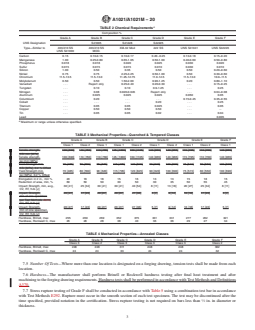
5.3 Heat Treatment—Quenched and tempered classes shall be heat-treated in accordance with Table 1.
5.3.1 Number of Heat Treatments—Heat treatment as defined in Table 1 shall consist of austenitizing, quenching, and tempering.
Retempering is permitted but purchaser approval is required for more than one complete reheat treatment.
5.4 Stress Relief—When heat treatment for mechanical properties is followed by straightening, a stress-relieving heat treatment
is required in accordance with Table 1.
5.4.1 Quenching after Stress Relief—Liquid quenching of stress-relieved forgings is prohibited.
5.5 Finish—Forgings may be furnished in one of the following hot-finished conditions:
5.5.1 Finish F—As forged without descaling.
5.5.2 Finish FD—Forged and descaled.
5.5.3 Finish RT—Rough turned or rough machined to specified dimensions. Billets or blooms ordered as forging stock shall be
furnished with a ground, machined, or descaled surface unless otherwise specified in the ordering document.
5.6 Camber—Camber shall not exceed ⁄4 in. [5 mm] in 5 ft [150 cm].
6. Chemical Composition
6.1 The steel shall conform to the requirements for chemical composition prescribed in Table 2.
7. Mechanical Properties
7.1 Tension, Impact, Stress Rupture, and Hardness Tests—All testing shall be performed after heat treatment and stress relief,
as applicable. The material and test specimens shall meet the requirements of Table 3 if fully heat-treated or Table 4 if annealed.
Mechanical property requirements, including hardness, do not apply to forging stock when it is to be tested after forging and heat
treatment. Tensile and impact tests shall be performed in accordance with Test Methods and Definitions A370.
7.2 Test Specimens—Forgings may be lot tested. Test specimens may be obtained from production forgings or from separately
forged test blanks prepared from the stock used to make the finished part. Forgings that are lot tested shall be produced from the
same heat of steel and heat treated at the same time. Separately forged test blanks shall receive essentially the same type of
hot-working and forging reduction as the production forgings; however, a longitudinally forged bar with dimensions not less than
T by T by 3 T may be used to represent a ring forging. The dimension T shall be representative of the heaviest effective cross section
of the forging.
7.3 Test Specimen Orientation—Mechanical property requirements are for samples oriented in the direction of grain flow.
Unless otherwise specified in the purchase order, manufacturers may orient the samples in any direction provided the mechanical
property requirements are met.
7.4 Test Specimen Location—When transverse or circumferential specimens are tested, they shall be taken from as close as
possible to a mid-radius or mid-wall location of the forging. When longitudinal specimens are tested, they shall be taken from
extensions. Extending the axial length of a larger section of a forging for a sufficient distance over a smaller section is also an
acceptable location for transverse or circumferential specimens.
TABLE 1 Heat Treatment, °F [°C]
Grade A Grade B Grade C Grade D Grade E Grade F
Class 1 & 2 Class 1 Class 1 Class 2 Class 1 & 2 Class 1 Class 2
Austenitizing 1725-1775 1600-1750 1825-1875 1725-1875 1875-1925 2075-2125 1725-1775 2000–2050
[940-970] [870-955] [995-1025] [940-1025] [1025-1050] [1135-1165] [940-970] [1095–1120]
Quenching Air or liquid Air or liquid Air or liquid Air or liquid Air or liquid Air or liquid Air or liquid Rapid air or oil
Single Tempering 1050 min 1050 min 1050 min 1050 min 1150 min 1250 min 1100 min 1185 min
[565 min] [565 min] [565 min] [565 min] [620 min] [675 min] [595 min] [640] min
Double . . . . . . 1025 min 1025 min . . . . . . . . . .
Tempering [550 min] [550 min]
Stress Relieving 1025 min 1025 min 1000 min 1000 min 1100 min 1200 min 1050 min 1135 min
[550 min] [550 min] [540 min] [540 min] [595 min] [650 min] [565 min] [610] min
A1021/A1
...