


ASTM F2391-05(2016)
(Test Method)Standard Test Method for Measuring Package and Seal Integrity Using Helium as the Tracer Gas
Standard Test Method for Measuring Package and Seal Integrity Using Helium as the Tracer Gas
SIGNIFICANCE AND USE
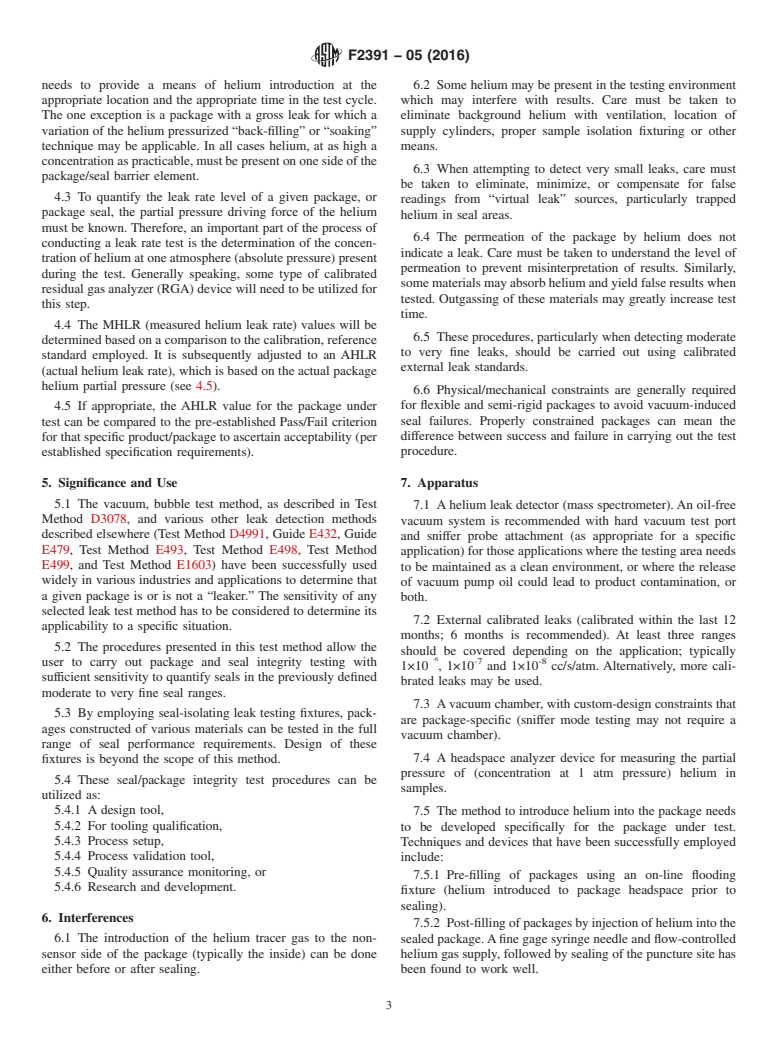
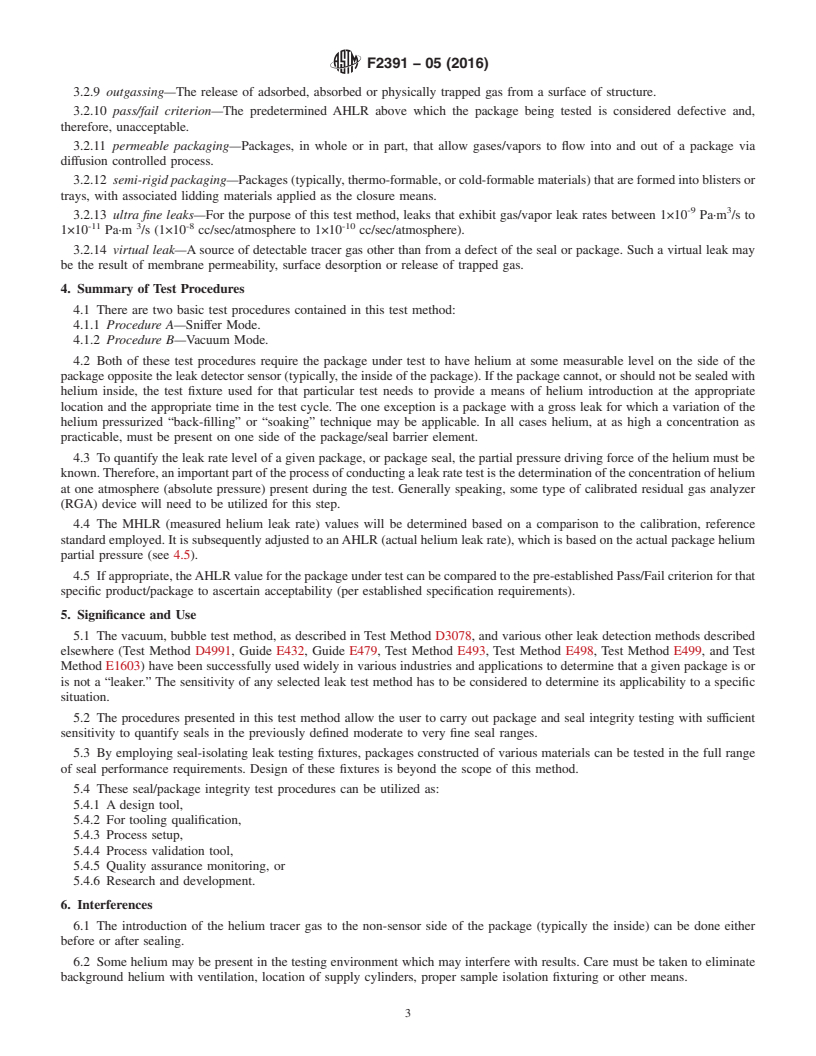
5.1 The vacuum, bubble test method, as described in Test Method D3078, and various other leak detection methods described elsewhere (Test Method D4991, Guide E432, Guide E479, Test Method E493, Test Method E498, Test Method E499, and Test Method E1603) have been successfully used widely in various industries and applications to determine that a given package is or is not a “leaker.” The sensitivity of any selected leak test method has to be considered to determine its applicability to a specific situation.
5.2 The procedures presented in this test method allow the user to carry out package and seal integrity testing with sufficient sensitivity to quantify seals in the previously defined moderate to very fine seal ranges.
5.3 By employing seal-isolating leak testing fixtures, packages constructed of various materials can be tested in the full range of seal performance requirements. Design of these fixtures is beyond the scope of this method.
5.4 These seal/package integrity test procedures can be utilized as:
5.4.1 A design tool,
5.4.2 For tooling qualification,
5.4.3 Process setup,
5.4.4 Process validation tool,
5.4.5 Quality assurance monitoring, or
5.4.6 Research and development.
SCOPE
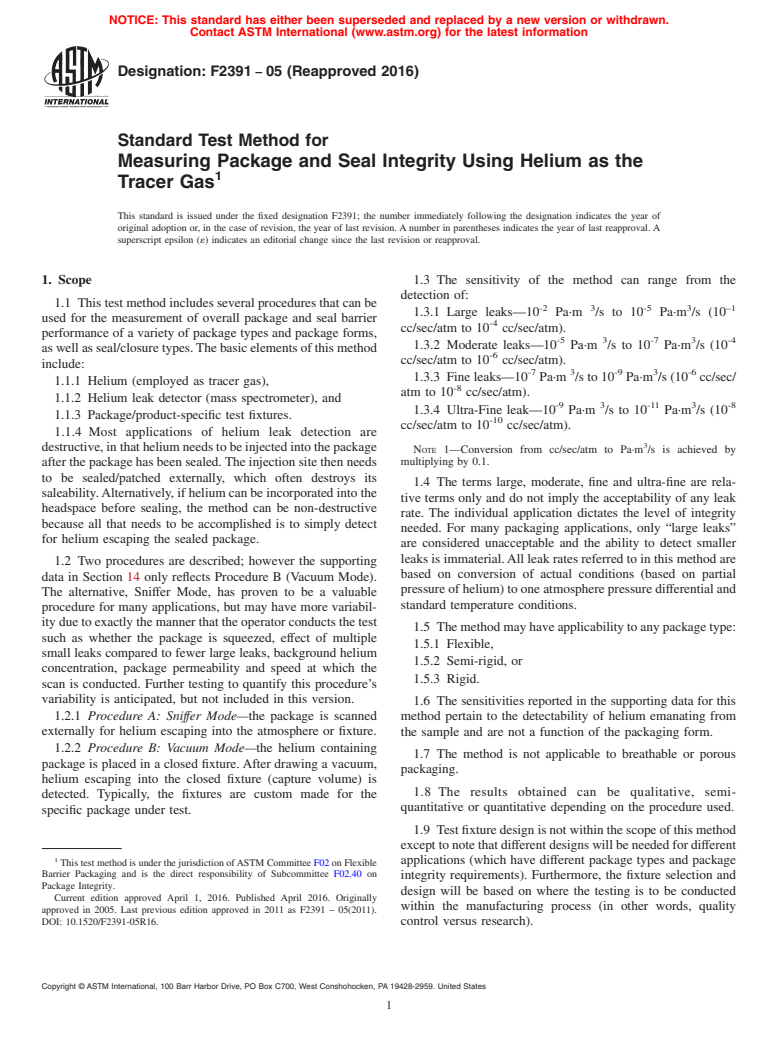
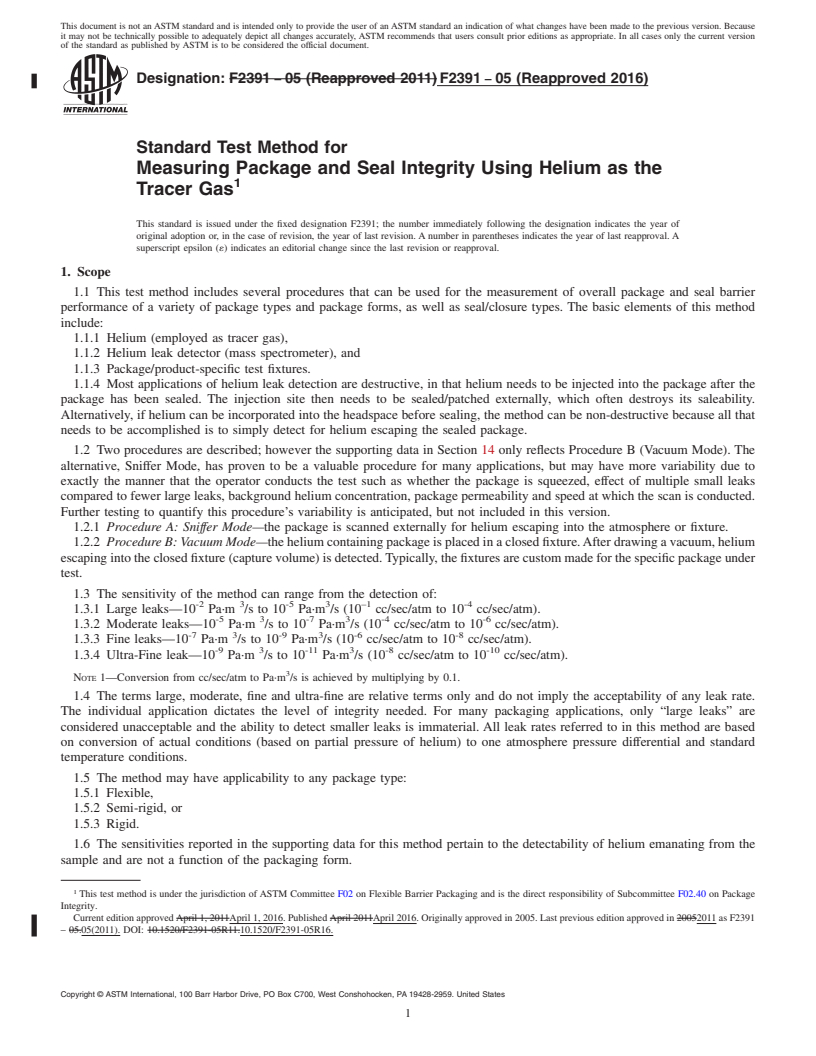
1.1 This test method includes several procedures that can be used for the measurement of overall package and seal barrier performance of a variety of package types and package forms, as well as seal/closure types. The basic elements of this method include:
1.1.1 Helium (employed as tracer gas),
1.1.2 Helium leak detector (mass spectrometer), and
1.1.3 Package/product-specific test fixtures.
1.1.4 Most applications of helium leak detection are destructive, in that helium needs to be injected into the package after the package has been sealed. The injection site then needs to be sealed/patched externally, which often destroys its saleability. Alternatively, if helium can be incorporated into the headspace before sealing, the method can be non-destructive because all that needs to be accomplished is to simply detect for helium escaping the sealed package.
1.2 Two procedures are described; however the supporting data in Section 14 only reflects Procedure B (Vacuum Mode). The alternative, Sniffer Mode, has proven to be a valuable procedure for many applications, but may have more variability due to exactly the manner that the operator conducts the test such as whether the package is squeezed, effect of multiple small leaks compared to fewer large leaks, background helium concentration, package permeability and speed at which the scan is conducted. Further testing to quantify this procedure’s variability is anticipated, but not included in this version.
1.2.1 Procedure A: Sniffer Mode—the package is scanned externally for helium escaping into the atmosphere or fixture.
1.2.2 Procedure B: Vacuum Mode—the helium containing package is placed in a closed fixture. After drawing a vacuum, helium escaping into the closed fixture (capture volume) is detected. Typically, the fixtures are custom made for the specific package under test.
1.3 The sensitivity of the method can range from the detection of:
1.3.1 Large leaks—10-2 Pa·m 3/s to 10-5 Pa·m3/s (10–1 cc/sec/atm to 10-4 cc/sec/atm).
1.3.2 Moderate leaks—10-5 Pa·m 3/s to 10-7 Pa·m3/s (10-4 cc/sec/atm to 10-6 cc/sec/atm).
1.3.3 Fine leaks—10-7 Pa·m 3/s to 10-9 Pa·m3/s (10-6 cc/sec/atm to 10-8 cc/sec/atm).
1.3.4 Ultra-Fine leak—10-9 Pa·m 3/s to 10-11 Pa·m3/s (10-8 cc/sec/atm to 10-10 cc/sec/atm).
Note 1: Conversion from cc/sec/atm to Pa·m3/s is achieved by multiplying by 0.1.
1.4 The terms large, moderate, fine and ultra-fine are relative terms only and do not imply the acceptability of any leak rate. The individual application dictates the level of integrity needed. For many packaging applications, only “large leaks” are considered unacceptable and the ability to detect smaller leaks is immaterial. All le...
General Information
Buy Standard
Standards Content (Sample)
NOTICE: This standard has either been superseded and replaced by a new version or withdrawn.
Contact ASTM International (www.astm.org) for the latest information
Designation: F2391 − 05 (Reapproved 2016)
Standard Test Method for
Measuring Package and Seal Integrity Using Helium as the
Tracer Gas
This standard is issued under the fixed designation F2391; the number immediately following the designation indicates the year of
original adoption or, in the case of revision, the year of last revision.Anumber in parentheses indicates the year of last reapproval.A
superscript epsilon (´) indicates an editorial change since the last revision or reapproval.
1. Scope 1.3 The sensitivity of the method can range from the
detection of:
1.1 Thistestmethodincludesseveralproceduresthatcanbe
-2 3 -5 3 –1
1.3.1 Large leaks—10 Pa·m /s to 10 Pa·m /s (10
used for the measurement of overall package and seal barrier
-4
cc/sec/atm to 10 cc/sec/atm).
performance of a variety of package types and package forms,
-5 3 -7 3 -4
1.3.2 Moderate leaks—10 Pa·m /s to 10 Pa·m /s (10
aswellasseal/closuretypes.Thebasicelementsofthismethod
-6
cc/sec/atm to 10 cc/sec/atm).
include:
-7 3 -9 3 -6
1.3.3 Fineleaks—10 Pa·m /sto10 Pa·m /s(10 cc/sec/
1.1.1 Helium (employed as tracer gas),
-8
atm to 10 cc/sec/atm).
1.1.2 Helium leak detector (mass spectrometer), and
-9 3 -11 3 -8
1.3.4 Ultra-Fine leak—10 Pa·m /s to 10 Pa·m /s (10
1.1.3 Package/product-specific test fixtures.
-10
cc/sec/atm to 10 cc/sec/atm).
1.1.4 Most applications of helium leak detection are
destructive,inthatheliumneedstobeinjectedintothepackage
NOTE 1—Conversion from cc/sec/atm to Pa·m /s is achieved by
multiplying by 0.1.
afterthepackagehasbeensealed.Theinjectionsitethenneeds
to be sealed/patched externally, which often destroys its
1.4 The terms large, moderate, fine and ultra-fine are rela-
saleability.Alternatively,ifheliumcanbeincorporatedintothe
tive terms only and do not imply the acceptability of any leak
headspace before sealing, the method can be non-destructive
rate. The individual application dictates the level of integrity
because all that needs to be accomplished is to simply detect
needed. For many packaging applications, only “large leaks”
for helium escaping the sealed package.
are considered unacceptable and the ability to detect smaller
leaksisimmaterial.Allleakratesreferredtointhismethodare
1.2 Two procedures are described; however the supporting
based on conversion of actual conditions (based on partial
data in Section 14 only reflects Procedure B (Vacuum Mode).
pressureofhelium)tooneatmospherepressuredifferentialand
The alternative, Sniffer Mode, has proven to be a valuable
standard temperature conditions.
procedure for many applications, but may have more variabil-
ityduetoexactlythemannerthattheoperatorconductsthetest
1.5 Themethodmayhaveapplicabilitytoanypackagetype:
such as whether the package is squeezed, effect of multiple
1.5.1 Flexible,
small leaks compared to fewer large leaks, background helium
1.5.2 Semi-rigid, or
concentration, package permeability and speed at which the
1.5.3 Rigid.
scan is conducted. Further testing to quantify this procedure’s
variability is anticipated, but not included in this version.
1.6 The sensitivities reported in the supporting data for this
1.2.1 Procedure A: Sniffer Mode—the package is scanned method pertain to the detectability of helium emanating from
externally for helium escaping into the atmosphere or fixture. the sample and are not a function of the packaging form.
1.2.2 Procedure B: Vacuum Mode—the helium containing
1.7 The method is not applicable to breathable or porous
package is placed in a closed fixture.After drawing a vacuum,
packaging.
helium escaping into the closed fixture (capture volume) is
1.8 The results obtained can be qualitative, semi-
detected. Typically, the fixtures are custom made for the
quantitative or quantitative depending on the procedure used.
specific package under test.
1.9 Testfixturedesignisnotwithinthescopeofthismethod
excepttonotethatdifferentdesignswillbeneededfordifferent
applications (which have different package types and package
ThistestmethodisunderthejurisdictionofASTMCommitteeF02onFlexible
Barrier Packaging and is the direct responsibility of Subcommittee F02.40 on
integrity requirements). Furthermore, the fixture selection and
Package Integrity.
design will be based on where the testing is to be conducted
Current edition approved April 1, 2016. Published April 2016. Originally
within the manufacturing process (in other words, quality
approved in 2005. Last previous edition approved in 2011 as F2391 – 05(2011).
DOI: 10.1520/F2391-05R16. control versus research).
Copyright © ASTM International, 100 Barr Harbor Drive, PO Box C700, West Conshohocken, PA 19428-2959. United States
F2391 − 05 (2016)
1.10 This standard does not purport to address all of the 3.2.2 breathable/porous packaging—Packages, in whole or
safety concerns, if any, associated with its use. It is the inpart,thatintentionallyallowgases/vaporstoflowfreelyinto
responsibility of the user of this standard to establish appro- and out of the package. (See also Terminology F1327)
priate safety and health practices and determine the applica-
3.2.3 fine leaks—For the purpose of this test method, leaks
-7 3
bility of regulatory limitations prior to use.
that exhibit gas/vapor leak rates between 1×10 Pa·m /s to
-9 3 -6 -8
10 Pa·m /s (1×10 cc/sec/atmosphere to 1×10 cc/sec/
2. Referenced Documents
atmosphere).
2.1 ASTM Standards:
3.2.4 flexible packaging—Packages (typically, pouches,
D996Terminology of Packaging and Distribution Environ-
sachets, and bags) constructed of materials that are readily
ments
bendable. (See also Terminology Method F17)
D3078Test Method for Determination of Leaks in Flexible
3.2.5 impermeable packaging—Packages constructed of
Packaging by Bubble Emission
materials (typically metal or glass) that prevent gases/vapors
D4991Test Method for Leakage Testing of Empty Rigid
from flowing into or out of the package.
Containers by Vacuum Method
3.2.6 large leaks—Forthepurposeofthistestmethod,leaks
E432Guide for Selection of a Leak Testing Method
-2 3
that exhibit gas/vapor leak rates between 1×10 Pa·m /s to
E479Guide for Preparation of a Leak Testing Specification
-5 3 –1 -4
3 1×10 Pa·m /s (1×10 cc/sec/atm to 1×10 cc/sec/
(Withdrawn 2014)
atmosphere).
E493Test Methods for Leaks Using the Mass Spectrometer
3.2.7 measured helium leak rate (MHLR)—Helium signal
Leak Detector in the Inside-Out Testing Mode
level obtained based on the actual helium concentration in the
E498Test Methods for Leaks Using the Mass Spectrometer
package.
Leak Detector or Residual Gas Analyzer in the Tracer
Probe Mode
3.2.8 moderate leaks—For the purpose of this test method,
-5 3
E499Test Methods for Leaks Using the Mass Spectrometer
leaks that exhibit gas/vapor leak rates between 1×10 Pa·m /s
-7 3 -4 -6
Leak Detector in the Detector Probe Mode
to 10 Pa·m /s (1×10 cc/sec/atmosphere to 1×10 cc/sec/
E691Practice for Conducting an Interlaboratory Study to
atmosphere).
Determine the Precision of a Test Method
3.2.9 outgassing—The release of adsorbed, absorbed or
E1603Test Methods for Leakage Measurement Using the
physically trapped gas from a surface of structure.
Mass Spectrometer Leak Detector or Residual Gas Ana-
3.2.10 pass/fail criterion—The predeterminedAHLR above
lyzer in the Hood Mode
which the package being tested is considered defective and,
F17Terminology Relating to Flexible Barrier Packaging
therefore, unacceptable.
F1327Terminology Relating to Barrier Materials for Medi-
3.2.11 permeable packaging—Packages,inwholeorinpart,
cal Packaging (Withdrawn 2007)
that allow gases/vapors to flow into and out of a package via
2.2 Other Documents:
diffusion controlled process.
Principal author L. Kirsch, et al - (shown in reference
3.2.12 semi-rigid packaging—Packages (typically, thermo-
Appendix X1 as literature references 1, 2, 3 and 5)
formable, or cold-formable materials) that are formed into
Principalauthor L. Nguyen, et al - (shown in reference
blisters or trays, with associated lidding materials applied as
appendix I at literature reference 4)
the closure means.
Co-authorsinclude C. Moeckly, L. Nguyen, R. Gerth, W.
Muangsiri, R. Scheire, D. M. Guazzo, L. Kirsch, G.
3.2.13 ultra fine leaks—For the purpose of this test method,
-9 3
Schmitt,A.Kirsch,M.Koch,T.Wertli,M.LehmanandG.
leaks that exhibit gas/vapor leak rates between 1×10 Pa·m /s
-11 3 -8 -10
Schramm.
to 1×10 Pa·m /s (1×10 cc/sec/atmosphere to 1×10
cc/sec/atmosphere).
3. Terminology
3.2.14 virtual leak—Asource of detectable tracer gas other
3.1 General Term Definitions—For definitions used in this than from a defect of the seal or package. Such a virtual leak
may be the result of membrane permeability, surface desorp-
standard see Terminology D996, Terminology F17 and Termi-
nology F1327. tion or release of trapped gas.
3.2 Specific Term Definitions:
4. Summary of Test Procedures
3.2.1 actual helium leak rate (AHLR)—Measured helium
4.1 Therearetwobasictestprocedurescontainedinthistest
leak rate (MHLR) signal level adjusted to a driving force of
100% concentration at 101 KPa (1.0 atmosphere), absolute. method:
4.1.1 Procedure A—Sniffer Mode.
4.1.2 Procedure B—Vacuum Mode.
4.2 Both of these test procedures require the package under
For referenced ASTM standards, visit the ASTM website, www.astm.org, or
contact ASTM Customer Service at service@astm.org. For Annual Book of ASTM
test to have helium at some measurable level on the side of the
Standards volume information, refer to the standard’s Document Summary page on
package opposite the leak detector sensor (typically, the inside
the ASTM website.
of the package). If the package cannot, or should not be sealed
The last approved version of this historical standard is referenced on
www.astm.org. with helium inside, the test fixture used for that particular test
F2391 − 05 (2016)
needs to provide a means of helium introduction at the 6.2 Some helium may be present in the testing environment
appropriate location and the appropriate time in the test cycle. which may interfere with results. Care must be taken to
The one exception is a package with a gross leak for which a eliminate background helium with ventilation, location of
variation of the helium pressurized “back-filling” or “soaking” supply cylinders, proper sample isolation fixturing or other
technique may be applicable. In all cases helium, at as high a means.
concentrationaspracticable,mustbepresentononesideofthe
6.3 When attempting to detect very small leaks, care must
package/seal barrier element.
be taken to eliminate, minimize, or compensate for false
4.3 To quantify the leak rate level of a given package, or
readings from “virtual leak” sources, particularly trapped
package seal, the partial pressure driving force of the helium
helium in seal areas.
must be known. Therefore, an important part of the process of
6.4 The permeation of the package by helium does not
conducting a leak rate test is the determination of the concen-
indicate a leak. Care must be taken to understand the level of
trationofheliumatoneatmosphere(absolutepressure)present
permeation to prevent misinterpretation of results. Similarly,
during the test. Generally speaking, some type of calibrated
somematerialsmayabsorbheliumandyieldfalseresultswhen
residualgasanalyzer(RGA)devicewillneedtobeutilizedfor
tested. Outgassing of these materials may greatly increase test
this step.
time.
4.4 The MHLR (measured helium leak rate) values will be
6.5 These procedures, particularly when detecting moderate
determinedbasedonacomparisontothecalibration,reference
to very fine leaks, should be carried out using calibrated
standard employed. It is subsequently adjusted to an AHLR
external leak standards.
(actual helium leak rate), which is based on the actual package
helium partial pressure (see 4.5).
6.6 Physical/mechanical constraints are generally required
for flexible and semi-rigid packages to avoid vacuum-induced
4.5 If appropriate, the AHLR value for the package under
test can be compared to the pre-established Pass/Fail criterion seal failures. Properly constrained packages can mean the
difference between success and failure in carrying out the test
forthatspecificproduct/packagetoascertainacceptability(per
procedure.
established specification requirements).
5. Significance and Use 7. Apparatus
5.1 The vacuum, bubble test method, as described in Test
7.1 Ahelium leak detector (mass spectrometer).An oil-free
Method D3078, and various other leak detection methods
vacuum system is recommended with hard vacuum test port
described elsewhere (Test Method D4991, Guide E432, Guide
and sniffer probe attachment (as appropriate for a specific
E479, Test Method E493, Test Method E498, Test Method
application)forthoseapplicationswherethetestingareaneeds
E499, and Test Method E1603) have been successfully used
to be maintained as a clean environment, or where the release
widely in various industries and applications to determine that
of vacuum pump oil could lead to product contamination, or
a given package is or is not a “leaker.” The sensitivity of any
both.
selected leak test method has to be considered to determine its
7.2 External calibrated leaks (calibrated within the last 12
applicability to a specific situation.
months; 6 months is recommended). At least three ranges
5.2 The procedures presented in this test method allow the
should be covered depending on the application; typically
-6
-7 -8
user to carry out package and seal integrity testing with
1×10 , 1×10 and 1×10 cc/s/atm. Alternatively, more cali-
sufficient sensitivity to quantify seals in the previously defined
brated leaks may be used.
moderate to very fine seal ranges.
7.3 Avacuumchamber,withcustom-designconstraintsthat
5.3 By employing seal-isolating leak testing fixtures, pack-
are package-specific (sniffer mode testing may not require a
ages constructed of various materials can be tested in the full
vacuum chamber).
range of seal performance requirements. Design of these
fixtures is beyond the scope of this method. 7.4 A headspace analyzer device for measuring the partial
pressure of (concentration at 1 atm pressure) helium in
5.4 These seal/package integrity test procedures can be
samples.
utilized as:
5.4.1 A design tool,
7.5 The method to introduce helium into the package needs
5.4.2 For tooling qualification,
to be developed specifically for the package under test.
5.4.3 Process setup,
Techniques and devices that have been successfully employed
5.4.4 Process validation tool,
include:
5.4.5 Quality assurance monitoring, or
7.5.1 Pre-filling of packages using an on-line flooding
5.4.6 Research and development.
fixture (helium introduced to package headspace prior to
sealing).
6. Interferences
7.5.2 Post-fillingofpackagesbyinjectionofheliumintothe
6.1 The introduction o
...
This document is not an ASTM standard and is intended only to provide the user of an ASTM standard an indication of what changes have been made to the previous version. Because
it may not be technically possible to adequately depict all changes accurately, ASTM recommends that users consult prior editions as appropriate. In all cases only the current version
of the standard as published by ASTM is to be considered the official document.
Designation: F2391 − 05 (Reapproved 2011) F2391 − 05 (Reapproved 2016)
Standard Test Method for
Measuring Package and Seal Integrity Using Helium as the
Tracer Gas
This standard is issued under the fixed designation F2391; the number immediately following the designation indicates the year of
original adoption or, in the case of revision, the year of last revision. A number in parentheses indicates the year of last reapproval. A
superscript epsilon (´) indicates an editorial change since the last revision or reapproval.
1. Scope
1.1 This test method includes several procedures that can be used for the measurement of overall package and seal barrier
performance of a variety of package types and package forms, as well as seal/closure types. The basic elements of this method
include:
1.1.1 Helium (employed as tracer gas),
1.1.2 Helium leak detector (mass spectrometer), and
1.1.3 Package/product-specific test fixtures.
1.1.4 Most applications of helium leak detection are destructive, in that helium needs to be injected into the package after the
package has been sealed. The injection site then needs to be sealed/patched externally, which often destroys its saleability.
Alternatively, if helium can be incorporated into the headspace before sealing, the method can be non-destructive because all that
needs to be accomplished is to simply detect for helium escaping the sealed package.
1.2 Two procedures are described; however the supporting data in Section 14 only reflects Procedure B (Vacuum Mode). The
alternative, Sniffer Mode, has proven to be a valuable procedure for many applications, but may have more variability due to
exactly the manner that the operator conducts the test such as whether the package is squeezed, effect of multiple small leaks
compared to fewer large leaks, background helium concentration, package permeability and speed at which the scan is conducted.
Further testing to quantify this procedure’s variability is anticipated, but not included in this version.
1.2.1 Procedure A: Sniffer Mode—the package is scanned externally for helium escaping into the atmosphere or fixture.
1.2.2 Procedure B: Vacuum Mode—the helium containing package is placed in a closed fixture. After drawing a vacuum, helium
escaping into the closed fixture (capture volume) is detected. Typically, the fixtures are custom made for the specific package under
test.
1.3 The sensitivity of the method can range from the detection of:
-2 3 -5 3 –1 -4
1.3.1 Large leaks—10 Pa·m /s to 10 Pa·m /s (10 cc/sec/atm to 10 cc/sec/atm).
-5 3 -7 3 -4 -6
1.3.2 Moderate leaks—10 Pa·m /s to 10 Pa·m /s (10 cc/sec/atm to 10 cc/sec/atm).
-7 3 -9 3 -6 -8
1.3.3 Fine leaks—10 Pa·m /s to 10 Pa·m /s (10 cc/sec/atm to 10 cc/sec/atm).
-9 3 -11 3 -8 -10
1.3.4 Ultra-Fine leak—10 Pa·m /s to 10 Pa·m /s (10 cc/sec/atm to 10 cc/sec/atm).
NOTE 1—Conversion from cc/sec/atm to Pa·m /s is achieved by multiplying by 0.1.
1.4 The terms large, moderate, fine and ultra-fine are relative terms only and do not imply the acceptability of any leak rate.
The individual application dictates the level of integrity needed. For many packaging applications, only “large leaks” are
considered unacceptable and the ability to detect smaller leaks is immaterial. All leak rates referred to in this method are based
on conversion of actual conditions (based on partial pressure of helium) to one atmosphere pressure differential and standard
temperature conditions.
1.5 The method may have applicability to any package type:
1.5.1 Flexible,
1.5.2 Semi-rigid, or
1.5.3 Rigid.
1.6 The sensitivities reported in the supporting data for this method pertain to the detectability of helium emanating from the
sample and are not a function of the packaging form.
This test method is under the jurisdiction of ASTM Committee F02 on Flexible Barrier Packaging and is the direct responsibility of Subcommittee F02.40 on Package
Integrity.
Current edition approved April 1, 2011April 1, 2016. Published April 2011April 2016. Originally approved in 2005. Last previous edition approved in 20052011 as F2391
– 05.05(2011). DOI: 10.1520/F2391-05R11.10.1520/F2391-05R16.
Copyright © ASTM International, 100 Barr Harbor Drive, PO Box C700, West Conshohocken, PA 19428-2959. United States
F2391 − 05 (2016)
1.7 The method is not applicable to breathable or porous packaging.
1.8 The results obtained can be qualitative, semi-quantitative or quantitative depending on the procedure used.
1.9 Test fixture design is not within the scope of this method except to note that different designs will be needed for different
applications (which have different package types and package integrity requirements). Furthermore, the fixture selection and design
will be based on where the testing is to be conducted within the manufacturing process (in other words, quality control versus
research).
1.10 This standard does not purport to address all of the safety concerns, if any, associated with its use. It is the responsibility
of the user of this standard to establish appropriate safety and health practices and determine the applicability of regulatory
limitations prior to use.
2. Referenced Documents
2.1 ASTM Standards:
D996 Terminology of Packaging and Distribution Environments
D3078 Test Method for Determination of Leaks in Flexible Packaging by Bubble Emission
D4991 Test Method for Leakage Testing of Empty Rigid Containers by Vacuum Method
E432 Guide for Selection of a Leak Testing Method
E479 Guide for Preparation of a Leak Testing Specification (Withdrawn 2014)
E493 Test Methods for Leaks Using the Mass Spectrometer Leak Detector in the Inside-Out Testing Mode
E498 Test Methods for Leaks Using the Mass Spectrometer Leak Detector or Residual Gas Analyzer in the Tracer Probe Mode
E499 Test Methods for Leaks Using the Mass Spectrometer Leak Detector in the Detector Probe Mode
E691 Practice for Conducting an Interlaboratory Study to Determine the Precision of a Test Method
E1603 Test Methods for Leakage Measurement Using the Mass Spectrometer Leak Detector or Residual Gas Analyzer in the
Hood Mode
F17 Terminology Relating to Flexible Barrier Packaging
F1327 Terminology Relating to Barrier Materials for Medical Packaging (Withdrawn 2007)
2.2 Other Documents:
Principal author L. Kirsch, et al - (shown in reference Appendix X1 as literature references 1, 2, 3 and 5)
Principal author L. Nguyen, et al - (shown in reference appendix I at literature reference 4)
Co-authors include C. Moeckly, L. Nguyen, R. Gerth, W. Muangsiri, R. Scheire, D. M. Guazzo, L. Kirsch, G. Schmitt, A. Kirsch,
M. Koch, T. Wertli, M. Lehman and G. Schramm.
3. Terminology
3.1 General Term Definitions—For definitions used in this standard see Terminology D996, Terminology F17 and Terminology
F1327.
3.2 Specific Term Definitions:
3.2.1 actual helium leak rate (AHLR)—Measured helium leak rate (MHLR) signal level adjusted to a driving force of 100 %
concentration at 101 KPa (1.0 atmosphere), absolute.
3.2.2 breathable/porous packaging—Packages, in whole or in part, that intentionally allow gases/vapors to flow freely into and
out of the package. (See also Terminology F1327)
-7 3 -9
3.2.3 fine leaks—For the purpose of this test method, leaks that exhibit gas/vapor leak rates between 1×10 Pa·m /s to 10
3 -6 -8
Pa·m /s (1×10 cc/sec/atmosphere to 1×10 cc/sec/atmosphere).
3.2.4 flexible packaging—Packages (typically, pouches, sachets, and bags) constructed of materials that are readily bendable.
(See also Terminology Method F17)
3.2.5 impermeable packaging—Packages constructed of materials (typically metal or glass) that prevent gases/vapors from
flowing into or out of the package.
-2 3 -5
3.2.6 large leaks—For the purpose of this test method, leaks that exhibit gas/vapor leak rates between 1×10 Pa·m /s to 1×10
3 –1 -4
Pa·m /s (1×10 cc/sec/atm to 1×10 cc/sec/atmosphere).
3.2.7 measured helium leak rate (MHLR)—Helium signal level obtained based on the actual helium concentration in the
package.
-5 3 -7
3.2.8 moderate leaks—For the purpose of this test method, leaks that exhibit gas/vapor leak rates between 1×10 Pa·m /s to 10
3 -4 -6
Pa·m /s (1×10 cc/sec/atmosphere to 1×10 cc/sec/atmosphere).
For referenced ASTM standards, visit the ASTM website, www.astm.org, or contact ASTM Customer Service at service@astm.org. For Annual Book of ASTM Standards
volume information, refer to the standard’s Document Summary page on the ASTM website.
The last approved version of this historical standard is referenced on www.astm.org.
F2391 − 05 (2016)
3.2.9 outgassing—The release of adsorbed, absorbed or physically trapped gas from a surface of structure.
3.2.10 pass/fail criterion—The predetermined AHLR above which the package being tested is considered defective and,
therefore, unacceptable.
3.2.11 permeable packaging—Packages, in whole or in part, that allow gases/vapors to flow into and out of a package via
diffusion controlled process.
3.2.12 semi-rigid packaging—Packages (typically, thermo-formable, or cold-formable materials) that are formed into blisters or
trays, with associated lidding materials applied as the closure means.
-9 3
3.2.13 ultra fine leaks—For the purpose of this test method, leaks that exhibit gas/vapor leak rates between 1×10 Pa·m /s to
-11 3 -8 -10
1×10 Pa·m /s (1×10 cc/sec/atmosphere to 1×10 cc/sec/atmosphere).
3.2.14 virtual leak—A source of detectable tracer gas other than from a defect of the seal or package. Such a virtual leak may
be the result of membrane permeability, surface desorption or release of trapped gas.
4. Summary of Test Procedures
4.1 There are two basic test procedures contained in this test method:
4.1.1 Procedure A—Sniffer Mode.
4.1.2 Procedure B—Vacuum Mode.
4.2 Both of these test procedures require the package under test to have helium at some measurable level on the side of the
package opposite the leak detector sensor (typically, the inside of the package). If the package cannot, or should not be sealed with
helium inside, the test fixture used for that particular test needs to provide a means of helium introduction at the appropriate
location and the appropriate time in the test cycle. The one exception is a package with a gross leak for which a variation of the
helium pressurized “back-filling” or “soaking” technique may be applicable. In all cases helium, at as high a concentration as
practicable, must be present on one side of the package/seal barrier element.
4.3 To quantify the leak rate level of a given package, or package seal, the partial pressure driving force of the helium must be
known. Therefore, an important part of the process of conducting a leak rate test is the determination of the concentration of helium
at one atmosphere (absolute pressure) present during the test. Generally speaking, some type of calibrated residual gas analyzer
(RGA) device will need to be utilized for this step.
4.4 The MHLR (measured helium leak rate) values will be determined based on a comparison to the calibration, reference
standard employed. It is subsequently adjusted to an AHLR (actual helium leak rate), which is based on the actual package helium
partial pressure (see 4.5).
4.5 If appropriate, the AHLR value for the package under test can be compared to the pre-established Pass/Fail criterion for that
specific product/package to ascertain acceptability (per established specification requirements).
5. Significance and Use
5.1 The vacuum, bubble test method, as described in Test Method D3078, and various other leak detection methods described
elsewhere (Test Method D4991, Guide E432, Guide E479, Test Method E493, Test Method E498, Test Method E499, and Test
Method E1603) have been successfully used widely in various industries and applications to determine that a given package is or
is not a “leaker.” The sensitivity of any selected leak test method has to be considered to determine its applicability to a specific
situation.
5.2 The procedures presented in this test method allow the user to carry out package and seal integrity testing with sufficient
sensitivity to quantify seals in the previously defined moderate to very fine seal ranges.
5.3 By employing seal-isolating leak testing fixtures, packages constructed of various materials can be tested in the full range
of seal performance requirements. Design of these fixtures is beyond the scope of this method.
5.4 These seal/package integrity test procedures can be utilized as:
5.4.1 A design tool,
5.4.2 For tooling qualification,
5.4.3 Process setup,
5.4.4 Process validation tool,
5.4.5 Quality assurance monitoring, or
5.4.6 Research and development.
6. Interferences
6.1 The introduction of the helium tracer gas to the non-sensor side of the package (typically the inside) can be done either
before or after sealing.
6.2 Some helium may be present in the testing environment which may interfere with results. Care must be taken to eliminate
background helium with ventilation, location of supply cylinders, proper sample isolation fixturing or other means.
F2391 − 05 (2016)
6.3 When attempting to detect very small leaks, care must be taken to eliminate, minimize, or compensate for false readings
from “virtual leak” sources, particularly trapped helium in seal areas.
6.4 The permeation of the package by helium does not indicate a leak. Care must be taken to understand the level of permeation
to prevent misinterpretation of results. Similarly, some materials may absorb helium and yield false results when tested. Outgassing
of these materials may greatly increase test time.
6.5 These procedures, particularly when detecting moderate to very fine leaks, should be carried out using calibrated external
leak standards.
6.6 Physical/mechanical constraints are generally required for flexible and semi-rigid packages to avoid vacuum-induced seal
failures. Properly constrained packages can mean the difference between success and failure in carrying out the test procedure.
7. Apparatus
7.1 A helium leak detector (mass spectrometer). An oil-free vacuum system is recommended with hard vacuum test port and
sniffer probe attachment (as appropriate for a specific application) for those applications where the testing area needs to be
maintained as a clean environment, or where the release of vacuum pump oil could lead to product contamination, or both.
7.2 External calibrated leaks (calibrated within the last 12 months; 6 months is recommended). A
...
Questions, Comments and Discussion
Ask us and Technical Secretary will try to provide an answer. You can facilitate discussion about the standard in here.