

ASTM C1392-20
(Guide)Standard Guide for Evaluating Failure of Structural Sealant Glazing
General Information
- Abstract
SIGNIFICANCE AND USE
5.1 This guide suggests a simple means of evaluating the extent of any failure of a structural sealant in an installed structural sealant glazing system.
5.2 A qualified authority should specify the criteria described in Sections 8 and 9 and should interpret the results and judge their significance for the structural sealant glazing system.
5.3 The evaluation program measures deflection of loaded lites and does not measure directly any structural sealant failure. Consequently, the qualified authority interpreting the data should also evaluate the source of any increased deflection that is measured. Increased deflection may be due to structural sealant adhesive or cohesive failure, but may also be due to a decrease in sealant modulus, a change in sealant joint dimensions, or other nonfailure mechanisms. Selective destructive sampling of areas with increased deflections can assist in this evaluation.
SCOPE
1.1 This guide covers a screening approach to detect failure (adhesive or cohesive) of a structural sealant in a structural sealant-glazed window, curtain wall, or other similar system. Presently, only a silicone-sealant that is specifically formulated, tested, and marketed as a structural glazing sealant is allowed for structural sealant glazing.
1.2 The values stated in either acceptable metric units or in other units shall be regarded separately as the standard. The values stated in each system may not be exact equivalents; therefore, each system must be used independently of the other, without combining values in any way.
1.3 There are no ISO standards similar or equivalent to this ASTM standard.
1.4 This standard does not purport to address all of the safety concerns, if any, associated with its use. It is the responsibility of the user of this standard to establish appropriate safety, health, and environmental practices and determine the applicability of regulatory limitations prior to use.
1.5 This international standard was developed in accordance with internationally recognized principles on standardization established in the Decision on Principles for the Development of International Standards, Guides and Recommendations issued by the World Trade Organization Technical Barriers to Trade (TBT) Committee.
- Status
- Published
- Publication Date
- 31-Dec-2019
- Technical Committee
- C24 - Building Seals and Sealants
- Drafting Committee
- C24.10 - Specifications, Guides and Practices
Overview
ASTM C1392-20: Standard Guide for Evaluating Failure of Structural Sealant Glazing provides a comprehensive screening approach for detecting adhesive or cohesive failure of structural sealants in glazing systems, such as windows and curtain walls. Developed by ASTM International, this guide equips industry professionals with essential procedures to evaluate the performance and reliability of silicone-based structural sealant glazing-supporting effective maintenance, repair, and assurance of building envelope integrity.
As structural sealant glazing is critical to the safety and durability of modern facades, detecting failure-whether due to loss of adhesion, cohesion, or other changes-is vital for both new construction and in-service evaluation.
Key Topics
- Screening Methodology: Outlines deflection measurements on glass lites subjected to localized loads as a means to assess the integrity of installed structural sealant joints.
- Types of Failure: Focuses on both adhesive and cohesive failure modes in structural silicone glazing sealants as well as other non-failure causes of increased deflection.
- Qualified Authority: Stresses that a knowledgeable professional must specify evaluation criteria, interpret data, and judge significance for each situation.
- Apparatus and Testing: Recommends specific apparatus such as field loading devices and deflection measurement tools, calibrated for accuracy.
- Sampling and Inspection: Provides guidance on the selection of test locations and repetition of measurements to ensure comprehensive assessment.
- Reporting Requirements: Details the essential data and documentation necessary for credible evaluation and record-keeping.
- Safety and Responsibility: Emphasizes user responsibility for implementing proper safety, health, and regulatory practices in all evaluation activities.
Applications
ASTM C1392-20 is widely applicable across the building and construction industry for individuals and organizations concerned with the performance, longevity, and safety of structural sealant glazing systems:
- In-service Evaluation: Used for ongoing assessments of existing facades to detect potential failures and plan maintenance or repairs, thus minimizing risks and costly repairs.
- Quality Assurance: Supports initial acceptance testing of newly installed glass in curtain walls and window systems to validate workmanship and material integrity.
- Remediation Planning: Provides a framework for evaluating the scope and urgency of repairs when sealant failure is suspected or documented.
- Building Renovation: Offers valuable guidance during facade upgrades, retrofits, or window replacements where the integrity of existing structural sealants must be verified.
- Insurance and Risk Assessment: Supplies standardized methods for those responsible for asset management or insurability of commercial buildings.
Professionals involved may include façade consultants, building envelope specialists, glaziers, quality assurance personnel, and facility managers.
Related Standards
While ASTM C1392-20 stands unique with no direct ISO equivalents, it relates closely to several other ASTM standards and documents:
- ASTM C717: Terminology of Building Seals and Sealants – for detailed definitions and essential terms used throughout ASTM C1392-20.
- ASTM STP 1286: Science and Technology of Building Seals, Sealants, Glazing and Waterproofing – for additional context on reliability and evaluation practices of sealant systems.
- Building Safety Codes: Compliance with local or international building safety regulations often requires evaluation and documentation in line with recognized ASTM procedures.
Practical Value
Implementing ASTM C1392-20 helps ensure the structural and weatherproof performance of glazing systems over their service life. Using this guide, construction and maintenance teams can:
- Effectively identify and document problem areas
- Make informed decisions about repair or replacement
- Enhance façade safety and durability
- Optimize maintenance schedules and minimize unplanned costs
This standard is an essential resource for safeguarding the long-term functionality of structural sealant glazing in buildings worldwide.
Relations
- Effective Date
- 01-Jan-2020
- Effective Date
- 01-Mar-2019
- Effective Date
- 01-Mar-2018
- Effective Date
- 01-Nov-2017
- Effective Date
- 01-Jan-2017
- Effective Date
- 15-Nov-2016
- Effective Date
- 01-Sep-2016
- Effective Date
- 01-May-2014
- Effective Date
- 01-Feb-2014
- Effective Date
- 01-Nov-2013
- Effective Date
- 01-Dec-2012
- Effective Date
- 01-May-2012
- Effective Date
- 15-Jan-2012
- Effective Date
- 01-Mar-2011
- Effective Date
- 15-Jan-2011
Get Certified
Connect with accredited certification bodies for this standard

DIBt (Deutsches Institut für Bautechnik)
German Institute for Building Technology.
DIN CERTCO
DIN Group product certification.

Aboma Certification B.V.
Specialized in construction, metal, and transport sectors.
Sponsored listings
Frequently Asked Questions
ASTM C1392-20 is a guide published by ASTM International. Its full title is "Standard Guide for Evaluating Failure of Structural Sealant Glazing". This standard covers: SIGNIFICANCE AND USE 5.1 This guide suggests a simple means of evaluating the extent of any failure of a structural sealant in an installed structural sealant glazing system. 5.2 A qualified authority should specify the criteria described in Sections 8 and 9 and should interpret the results and judge their significance for the structural sealant glazing system. 5.3 The evaluation program measures deflection of loaded lites and does not measure directly any structural sealant failure. Consequently, the qualified authority interpreting the data should also evaluate the source of any increased deflection that is measured. Increased deflection may be due to structural sealant adhesive or cohesive failure, but may also be due to a decrease in sealant modulus, a change in sealant joint dimensions, or other nonfailure mechanisms. Selective destructive sampling of areas with increased deflections can assist in this evaluation. SCOPE 1.1 This guide covers a screening approach to detect failure (adhesive or cohesive) of a structural sealant in a structural sealant-glazed window, curtain wall, or other similar system. Presently, only a silicone-sealant that is specifically formulated, tested, and marketed as a structural glazing sealant is allowed for structural sealant glazing. 1.2 The values stated in either acceptable metric units or in other units shall be regarded separately as the standard. The values stated in each system may not be exact equivalents; therefore, each system must be used independently of the other, without combining values in any way. 1.3 There are no ISO standards similar or equivalent to this ASTM standard. 1.4 This standard does not purport to address all of the safety concerns, if any, associated with its use. It is the responsibility of the user of this standard to establish appropriate safety, health, and environmental practices and determine the applicability of regulatory limitations prior to use. 1.5 This international standard was developed in accordance with internationally recognized principles on standardization established in the Decision on Principles for the Development of International Standards, Guides and Recommendations issued by the World Trade Organization Technical Barriers to Trade (TBT) Committee.
SIGNIFICANCE AND USE 5.1 This guide suggests a simple means of evaluating the extent of any failure of a structural sealant in an installed structural sealant glazing system. 5.2 A qualified authority should specify the criteria described in Sections 8 and 9 and should interpret the results and judge their significance for the structural sealant glazing system. 5.3 The evaluation program measures deflection of loaded lites and does not measure directly any structural sealant failure. Consequently, the qualified authority interpreting the data should also evaluate the source of any increased deflection that is measured. Increased deflection may be due to structural sealant adhesive or cohesive failure, but may also be due to a decrease in sealant modulus, a change in sealant joint dimensions, or other nonfailure mechanisms. Selective destructive sampling of areas with increased deflections can assist in this evaluation. SCOPE 1.1 This guide covers a screening approach to detect failure (adhesive or cohesive) of a structural sealant in a structural sealant-glazed window, curtain wall, or other similar system. Presently, only a silicone-sealant that is specifically formulated, tested, and marketed as a structural glazing sealant is allowed for structural sealant glazing. 1.2 The values stated in either acceptable metric units or in other units shall be regarded separately as the standard. The values stated in each system may not be exact equivalents; therefore, each system must be used independently of the other, without combining values in any way. 1.3 There are no ISO standards similar or equivalent to this ASTM standard. 1.4 This standard does not purport to address all of the safety concerns, if any, associated with its use. It is the responsibility of the user of this standard to establish appropriate safety, health, and environmental practices and determine the applicability of regulatory limitations prior to use. 1.5 This international standard was developed in accordance with internationally recognized principles on standardization established in the Decision on Principles for the Development of International Standards, Guides and Recommendations issued by the World Trade Organization Technical Barriers to Trade (TBT) Committee.
ASTM C1392-20 is classified under the following ICS (International Classification for Standards) categories: 91.100.50 - Binders. Sealing materials. The ICS classification helps identify the subject area and facilitates finding related standards.
ASTM C1392-20 has the following relationships with other standards: It is inter standard links to ASTM C1392-00(2014), ASTM C717-19, ASTM C717-18, ASTM C717-17a, ASTM C717-17, ASTM C717-16a, ASTM C717-16, ASTM C717-14a, ASTM C717-14, ASTM C717-13, ASTM C717-12b, ASTM C717-12a, ASTM C717-12, ASTM C717-11a, ASTM C717-11. Understanding these relationships helps ensure you are using the most current and applicable version of the standard.
ASTM C1392-20 is available in PDF format for immediate download after purchase. The document can be added to your cart and obtained through the secure checkout process. Digital delivery ensures instant access to the complete standard document.
Standards Content (Sample)
This international standard was developed in accordance with internationally recognized principles on standardization established in the Decision on Principles for the
Development of International Standards, Guides and Recommendations issued by the World Trade Organization Technical Barriers to Trade (TBT) Committee.
Designation: C1392 − 20
Standard Guide for
Evaluating Failure of Structural Sealant Glazing
This standard is issued under the fixed designation C1392; the number immediately following the designation indicates the year of
original adoption or, in the case of revision, the year of last revision. A number in parentheses indicates the year of last reapproval. A
superscript epsilon (´) indicates an editorial change since the last revision or reapproval.
1. Scope adhesive failure; cohesive failure; deflection; glazing; joint;
lite; modulus; silicone sealant; structural sealant; structural
1.1 This guide covers a screening approach to detect failure
sealant glazing; and substrate.
(adhesive or cohesive) of a structural sealant in a structural
3.1.1 qualified authority, n—a person with a recognized
sealant-glazed window, curtain wall, or other similar system.
degree or professional certificate and extensive knowledge and
Presently, only a silicone-sealant that is specifically
formulated, tested, and marketed as a structural glazing sealant experience in the particular fields necessary for the evaluation
is allowed for structural sealant glazing. program.The authority’s qualification level that is necessary to
specify the evaluation criteria and interpret the significance of
1.2 The values stated in either acceptable metric units or in
the results depends upon the level of sophistication of the
other units shall be regarded separately as the standard. The
evaluation program. For example, if statistical and finite
values stated in each system may not be exact equivalents;
element analyses are being incorporated into the evaluation
therefore,eachsystemmustbeusedindependentlyoftheother,
program, then the authority should be knowledgeable and
without combining values in any way.
experienced in these areas.
1.3 There are no ISO standards similar or equivalent to this
3.1.2 competent person, n—a person experienced in the
ASTM standard.
operation of the testing equipment and with an understanding
1.4 This standard does not purport to address all of the
of the construction of the wall system. This person may carry
safety concerns, if any, associated with its use. It is the
out the field testing under the supervision of the qualified
responsibility of the user of this standard to establish appro-
authority.
priate safety, health, and environmental practices and deter-
mine the applicability of regulatory limitations prior to use.
4. Summary of Guide
1.5 This international standard was developed in accor-
dance with internationally recognized principles on standard-
4.1 This guide uses deflection measurements obtained from
ization established in the Decision on Principles for the
localized applied loads to determine locations of sealant failure
Development of International Standards, Guides and Recom-
in an installed structural sealant glazing system.
mendations issued by the World Trade Organization Technical
4.2 Initially, the deflection of an existing lite that is fully
Barriers to Trade (TBT) Committee.
adhered by a structural sealant is measured when a discrete
edge of the lite is loaded laterally. Subsequently, at a few
2. Referenced Documents
2 selected lites, the structural sealant is cut intentionally to
2.1 ASTM Standards:
simulate failure, and the deflection of the lite is measured at the
C717 Terminology of Building Seals and Sealants
same lateral load. This provides the basis for determining
during subsequent tests of other lites in the system whether the
3. Terminology
sealant has failed.
3.1 Definitions: Refer to Terminology C717 for the follow-
ing definitions and description of terms used in this guide: 4.3 Additional lites are evaluated and their deflections
measured to determine the extent of any structural sealant
failure. Structural sealant failure is determined by comparing
ThisguideisunderthejurisdictionofASTMCommitteeC24onBuildingSeals
the measured deflections with the initial measurements of
and Sealants and is the direct responsibility of Subcommittee C24.10 on
deflection with and without failed (intentionally cut) sealant.
Specifications, Guides and Practices.
Current edition approved Jan. 1, 2020. Published January 2020. Originally
approved in 1998. Last previous edition approved in 2009 as C1392 – 09(2014).
5. Significance and Use
DOI: 10.1520/C1392-20.
For referenced ASTM standards, visit the ASTM website, www.astm.org, or
5.1 This guide suggests a simple means of evaluating the
contact ASTM Customer Service at service@astm.org. For Annual Book of ASTM
extent of any failure of a structural sealant in an installed
Standards volume information, refer to the standard’s Document Summary page on
the ASTM website. structural sealant glazing system.
Copyright © ASTM International, 100 Barr Harbor Drive, PO Box C700, West Conshohocken, PA 19428-2959. United States
C1392 − 20
5.2 A qualified authority should specify the criteria de- 7. Sampling
scribed in Sections 8 and 9 and should interpret the results and
7.1 The qualified authority should specify the locations,
judge their significance for the structural sealant glazing
distribution, and number of applied loads for the structural
system.
sealant glazing system. Sections 8 and 9 discuss various
5.3 The evaluation program measures deflection of loaded
approaches to this selection process.
lites and does not measure directly any structural sealant
failure. Consequently, the qualified authority interpreting the
8. Establishing Deflection and Sealant Failure
datashouldalsoevaluatethesourceofanyincreaseddeflection
Relationship
that is measured. Increased deflection may be due to structural
8.1 Summary of Procedure—Establishing the deflection/
sealant adhesive or cohesive failure, but may also be due to a
failure relationship requires the specifying authority to select
decrease in sealant modulus, a change in sealant joint
the applied load magnitude, the locations of the applied loads
dimensions,orothernonfailuremechanisms.Selectivedestruc-
on the lite, and the criteria for failure length. The following
tive sampling of areas with increased deflections can assist in
describes various approaches that can be used to select these
this evaluation.
parameters, depending upon the sophistication of the evalua-
tion program and the desired results. Depending upon the
6. Suggested Apparatus
parameters selected the procedure can be used as a crude
6.1 Field Loading Device, provides a frame that can span
screening tool or can be correlated to the actual stresses within
beyond the edges of the loaded lite, while supported by suction
the structural sealant joint under an applied load and used as a
cups on the face of adjacent lites or by other means that do not
rational means of assessing areas of failure that require repair.
adversely affect the stresses in the tested structural sealant and
Using the deflection magnitudes and locations, the initial
lite (Fig. 1 and Fig. 2). To permit application of a force
evaluation establishes the relationship between loaded lite
perpendicular to the surface of the lite, mount a loading piston
deflections with intact structural sealant and those with failed
on the lite, with a suction cup or other means near the edge of
structural sealant.
thelite.Placealoadcellbetweenthesuctioncupandtheframe
to monitor the applied load. Calibrate the field loading device 8.2 Applied Load Magnitude—The qualified authority
and the load cell prior to use on a project and immediately after specifies the magnitude of the applied load.The load should be
any changes or damage to the device. large enough to produce significant differences in deflection
between intact and failed sealant areas, that is, the failure
6.2 Deflection Measurement Device, either an extensometer
length criteria. The applied load can be derived from the
with a dial gage mounted on an adjacent lite or a straight edge
glazing system’s lateral design loads through computer mod-
with feeler gages, of length equal to the length of the edge of
eling (finite element analysis), if it is necessary to relate the
the lite. The device should be accurate to within 10 % of the
testing to a design load and stress.
measured deflection.
8.2.1 An initial evaluation will determine whether the ap-
plied load is large enough to produce significant differences in
deflectionbetweenareaswithintactstructuralsealantandthose
with failed structural sealant. Excessive loads may crack, kink
or otherwise damage the glazing material.
8.3 Applied Load Locations on a Lite—The evaluation
procedure involves application of a local load to a discrete
portion of the edge of a lite. Therefore, a single application
doesnotnecessarilyevaluateastructuralsealantjointalongthe
entire edge of a lite. The stress distribution in the structural
sealant from the applied load is a function of many variables,
including the relative stiffness of the sealant and glazing
material, the location of
...
This document is not an ASTM standard and is intended only to provide the user of an ASTM standard an indication of what changes have been made to the previous version. Because
it may not be technically possible to adequately depict all changes accurately, ASTM recommends that users consult prior editions as appropriate. In all cases only the current version
of the standard as published by ASTM is to be considered the official document.
Designation: C1392 − 00 (Reapproved 2014) C1392 − 20
Standard Guide for
Evaluating Failure of Structural Sealant Glazing
This standard is issued under the fixed designation C1392; the number immediately following the designation indicates the year of
original adoption or, in the case of revision, the year of last revision. A number in parentheses indicates the year of last reapproval. A
superscript epsilon (´) indicates an editorial change since the last revision or reapproval.
1. Scope
1.1 This guide covers a screening approach to detect failure (adhesive or cohesive) of a structural sealant in a structural
sealant-glazed window, curtain wall, or other similar system. Presently, only a silicone-sealant that is specifically formulated,
tested, and marketed as a structural glazing sealant is allowed for structural sealant glazing.
1.2 The values stated in either acceptable metric units or in other units shall be regarded separately as the standard. The values
stated in each system may not be exact equivalents; therefore, each system must be used independently of the other, without
combining values in any way.
1.3 There are no ISO standards similar or equivalent to this ASTM standard.
1.4 This standard does not purport to address all of the safety concerns, if any, associated with its use. It is the responsibility
of the user of this standard to establish appropriate safety safety, health, and healthenvironmental practices and determine the
applicability of regulatory limitations prior to use.
1.5 This international standard was developed in accordance with internationally recognized principles on standardization
established in the Decision on Principles for the Development of International Standards, Guides and Recommendations issued
by the World Trade Organization Technical Barriers to Trade (TBT) Committee.
2. Referenced Documents
2.1 ASTM Standards:
C717 Terminology of Building Seals and Sealants
3. Terminology
3.1 Definitions: Refer to Terminology C717 for the following definitions and description of terms used in this guide: adhesive
failure; cohesive failure; deflection; glazing; joint; lite; modulus; silicone sealant; structural sealant; structural sealant glazing; and
substrate.
3.1.1 qualified authority, n—a person with a recognized degree or professional certificate and extensive knowledge and
experience in the particular fields necessary for the evaluation program. The authority’s qualification level that is necessary to
specify the evaluation criteria and interpret the significance of the results depends upon the level of sophistication of the evaluation
program. For example, if statistical and finite element analyses are being incorporated into the evaluation program, then the
authority should be knowledgeable and experienced in these areas.
3.1.2 competent person, n—a person experienced in the operation of the testing equipment and with an understanding of the
construction of the wall system. This person may carry out the field testing under the supervision of the qualified authority.
4. Summary of Guide
4.1 This guide uses deflection measurements obtained from localized applied loads to determine locations of sealant failure in
an installed structural sealant glazing system.
4.2 Initially, the deflection of an existing lite that is fully adhered by a structural sealant is measured when a discrete edge of
the lite is loaded laterally. Subsequently, at a few selected lites, the structural sealant is cut intentionally to simulate failure, and
This guide is under the jurisdiction of ASTM Committee C24 on Building Seals and Sealants and is the direct responsibility of Subcommittee C24.10 on Specifications,
Guides and Practices.
Current edition approved Jan. 1, 2014Jan. 1, 2020. Published December 2009January 2020. Originally approved in 1998. Last previous edition approved in 2009 as
C1392 – 00C1392 – 09(2009).(2014). DOI: 10.1520/C1392-00R14.10.1520/C1392-20.
For referenced ASTM standards, visit the ASTM website, www.astm.org, or contact ASTM Customer Service at service@astm.org. For Annual Book of ASTM Standards
volume information, refer to the standard’s Document Summary page on the ASTM website.
Copyright © ASTM International, 100 Barr Harbor Drive, PO Box C700, West Conshohocken, PA 19428-2959. United States
C1392 − 20
the deflection of the lite is measured at the same lateral load. This provides the basis for determining during subsequent tests of
other lites in the system whether the sealant has failed.
4.3 Additional lites are evaluated and their deflections measured to determine the extent of any structural sealant failure.
Structural sealant failure is determined by comparing the measured deflections with the initial measurements of deflection with and
without failed (intentionally cut) sealant.
5. Significance and Use
5.1 This guide suggests a simple means of evaluating the extent of any failure of a structural sealant in an installed structural
sealant glazing system.
5.2 A qualified authority should specify the criteria described in Sections 8 and 9 and should interpret the results and judge their
significance for the structural sealant glazing system.
5.3 The evaluation program measures deflection of loaded lites and does not measure directly any structural sealant failure.
Consequently, the qualified authority interpreting the data should also evaluate the source of any increased deflection that is
measured. Increased deflection may be due to structural sealant adhesive or cohesive failure, but may also be due to a decrease
in sealant modulus, a change in sealant joint dimensions, or other nonfailure mechanisms. Selective destructive sampling of areas
with increased deflections can assist in this evaluation.
6. Suggested Apparatus
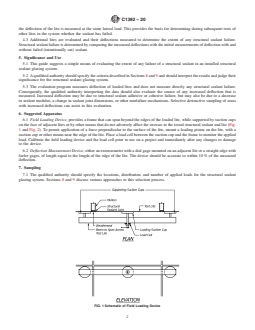
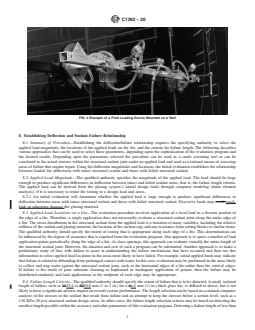
6.1 Field Loading Device, provides a frame that can span beyond the edges of the loaded lite, while supported by suction cups
on the face of adjacent lites or by other means that do not adversely affect the stresses in the tested structural sealant and lite (Fig.
1 and Fig. 2). To permit application of a force perpendicular to the surface of the lite, mount a loading piston on the lite, with a
suction cup or other means near the edge of the lite. Place a load cell between the suction cup and the frame to monitor the applied
load. Calibrate the field loading device and the load cell prior to use on a project and immediately after any changes or damage
to the device.
6.2 Deflection Measurement Device, either an extensometer with a dial gage mounted on an adjacent lite or a straight edge with
feeler gages, of length equal to the length of the edge of the lite. The device should be accurate to within 10 % of the measured
deflection.
7. Sampling
7.1 The qualified authority should specify the locations, distribution, and number of applied loads for the structural sealant
glazing system. Sections 8 and 9 discuss various approaches to this selection process.
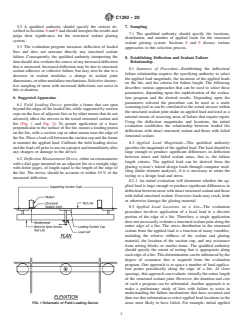
FIG. 1 Schematic of Field Loading Device
C1392 − 20
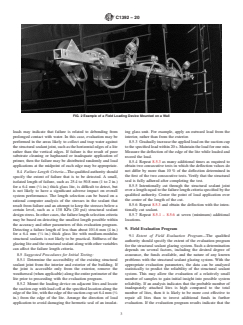
FIG. 2 Example of a Field Loading Device Mounted on a Wall
8. Establishing Deflection and Sealant Failure Relationship
8.1 Summary of Procedure—Establishing the deflection/failure relationship requires the specifying authority to select the
applied load magnitude, the locations of the applied loads on the lite, and the criteria for failure length. The following describes
various approaches that can be used to select these parameters, depending upon the sophistication of the evaluation program and
the desired results. Depending upon the parameters selected the procedure can be used as a crude screening tool or can be
correlated to the actual stresses within the structural sealant joint under an applied load and used as a rational means of assessing
areas of failure that require repair. Using the deflection magnitudes and locations, the initial evaluation establishes the relationship
between loaded lite deflections with intact structural sealant and those with failed structural sealant.
8.2 Applied Load Magnitude—The qualified authority specifies the magnitude of the applied load. The load should be large
enough to produce significant differences in deflection between intact and failed sealant areas, that is, the failure length criteria.
The applied load can be derived from the glazing system’s lateral design loads through computer modeling (finite element
analysis), if it is necessary to relate the testing to a design load and stress.
8.2.1 An initial evaluation will determine whether the applied load is large enough to produce significant differences in
deflection between areas with intact structural sealant and those with failed structural sealant. Excessive loads may crack crack,
kink or otherwise damage the glazing material.
8.3 Applied Load Locations on a Lite—The evaluation procedure involves application of a local load to a discrete portion of
the edge of a lite. Therefore, a single application does n
...