


ASTM D4427-18
(Classification)Standard Classification of Peat Samples by Laboratory Testing
Standard Classification of Peat Samples by Laboratory Testing
SIGNIFICANCE AND USE
4.1 The purpose of this classification is to standardize the naming of peat materials so that the peat-producer can better identify the product and the peat-consumer can better select peat materials to meet requirements. This system may also be used for peat resource evaluations, environmental impact reports, and preliminary engineering studies. The parameters selected for use in this classification are ones which have been determined to relate to the agricultural/horticultural, geotechnical, and energy uses of peats.
Note 1: The quality of the result produced by this standard is dependent on the competence of the personnel performing it, and the suitability of the equipment and facilities used. Agencies that meet the criteria of Practice D3740 are generally considered capable of competent and objective testing. Users of this standard are cautioned that compliance with Practice D3740 does not in itself assure reliable results. Reliable results depend on many factors; Practice D3740 provides a means of evaluating some of those factors.
SCOPE
1.1 This classification is a system for subdividing and assigning nomenclature to peat samples through laboratory tests.
1.2 Peat is considered to be a naturally occurring organic soil primarily derived from decomposing plant material that has sedentarily accumulated in water-saturated, anaerobic environments. It is found in peatlands, bogs, mangroves, mires, moors, and muskegs and is generally composed of mosses, grasses, leaves, sedges, and shrubs. Changes in depositional environment can create subsurface peat deposits underlying inorganic soils. Typically, peat has a low density, high water content, and is quite compressible when compared to other types of soil
1.3 This standard does not purport to address all of the safety concerns, if any, associated with its use. It is the responsibility of the user of this standard to establish appropriate safety, health, and environmental practices and determine the applicability of regulatory limitations prior to use.
1.4 This international standard was developed in accordance with internationally recognized principles on standardization established in the Decision on Principles for the Development of International Standards, Guides and Recommendations issued by the World Trade Organization Technical Barriers to Trade (TBT) Committee.
General Information
Buy Standard

Standards Content (Sample)
NOTICE: This standard has either been superseded and replaced by a new version or withdrawn.
Contact ASTM International (www.astm.org) for the latest information
Designation: D4427 − 18
Standard Classification of
1
Peat Samples by Laboratory Testing
This standard is issued under the fixed designation D4427; the number immediately following the designation indicates the year of
original adoption or, in the case of revision, the year of last revision. A number in parentheses indicates the year of last reapproval. A
superscript epsilon (´) indicates an editorial change since the last revision or reapproval.
This standard has been approved for use by agencies of the U.S. Department of Defense.
1. Scope* D2974 Test Methods for Moisture, Ash, and Organic Matter
of Peat and Other Organic Soils
1.1 This classification is a system for subdividing and
D2976 Test Method for pH of Peat Materials
assigning nomenclature to peat samples through laboratory
D2980 Test Method for Saturated Density, Moisture-
tests.
Holding Capacity, and Porosity of Saturated Peat Materi-
1.2 Peat is considered to be a naturally occurring organic
als
soil primarily derived from decomposing plant material that
D3740 Practice for Minimum Requirements for Agencies
has sedentarily accumulated in water-saturated, anaerobic en-
Engaged in Testing and/or Inspection of Soil and Rock as
vironments. It is found in peatlands, bogs, mangroves, mires,
Used in Engineering Design and Construction
moors, and muskegs and is generally composed of mosses,
grasses, leaves, sedges, and shrubs. Changes in depositional
3. Terminology
environment can create subsurface peat deposits underlying
3.1 Definitions:
inorganic soils. Typically, peat has a low density, high water
3.1.1 For definitions of common technical terms in this
content, and is quite compressible when compared to other
standard, refer to Terminology D653.
types of soil
3.2 Definitions of Terms Specific to This Standard:
1.3 This standard does not purport to address all of the
3.2.1 absorbency—the amount of water by mass that can be
safety concerns, if any, associated with its use. It is the
held by the peat. This amount is expressed in terms of the
responsibility of the user of this standard to establish appro-
water-holding capacity as measured using Test Method D2980.
priate safety, health, and environmental practices and deter-
mine the applicability of regulatory limitations prior to use. 3.2.2 acidity—expressed as the pH of the peat in water as
measured using Test Method D2976.
1.4 This international standard was developed in accor-
dance with internationally recognized principles on standard-
3.2.3 ash content—the percentage by dry mass of material
ization established in the Decision on Principles for the
remaining after the oven dry peat is burned, using the methods
Development of International Standards, Guides and Recom-
described in Test Methods D2974.
mendations issued by the World Trade Organization Technical
3.2.4 botanical composition—the dominant plant genus,
Barriers to Trade (TBT) Committee.
genera, or informal plant group identified by visual observation
as comprising a portion of the fiber in the peat.
2. Referenced Documents
3.2.5 fiber content—the dry mass of fibers remaining after
2
2.1 ASTM Standards:
wet sieving over a No. 100 (150-µm) sieve. Fiber content is
D653 Terminology Relating to Soil, Rock, and Contained
expressed as a percentage of the original dry mass, using the
Fluids
method described in Test Method D1997.
D1997 Test Method for Laboratory Determination of the
Fiber Content of Peat Samples by Dry Mass
4. Significance and Use
4.1 The purpose of this classification is to standardize the
1
This classification is under the jurisdiction of ASTM Committee D18 on Soil naming of peat materials so that the peat-producer can better
and Rock and is the direct responsibility of Subcommittee D18.07 on Identification
identify the product and the peat-consumer can better select
and Classification of Soils.
peat materials to meet requirements. This system may also be
Current edition approved Jan. 1, 2018. Published February 2018. Originally
used for peat resource evaluations, environmental impact
approved in 1984. Last previous edition approved in 2017 as D4427 – 13(2017).
DOI: 10.1520/D4427-13R17.
reports, and preliminary engineering studies. The parameters
2
For referenced ASTM standards, visit the ASTM website, www.astm.org, or
selected for use in this classification are ones which have been
contact ASTM Customer Service at service@astm.org. For Annual Book of ASTM
determined to relate to the agricultural/horticultural,
Standards volume information, refer to the standard’s Document Summary page on
the ASTM website. geotechnical, and energy uses of peats.
*A Summary of Changes section appears at the end of this standard
Copyright © ASTM International, 100 Barr Harbor Drive, PO Box C700, West Conshohocken, PA 19428-2959. United States
1
---------------------- Page: 1 ----------
...
This document is not an ASTM standard and is intended only to provide the user of an ASTM standard an indication of what changes have been made to the previous version. Because
it may not be technically possible to adequately depict all changes accurately, ASTM recommends that users consult prior editions as appropriate. In all cases only the current version
of the standard as published by ASTM is to be considered the official document.
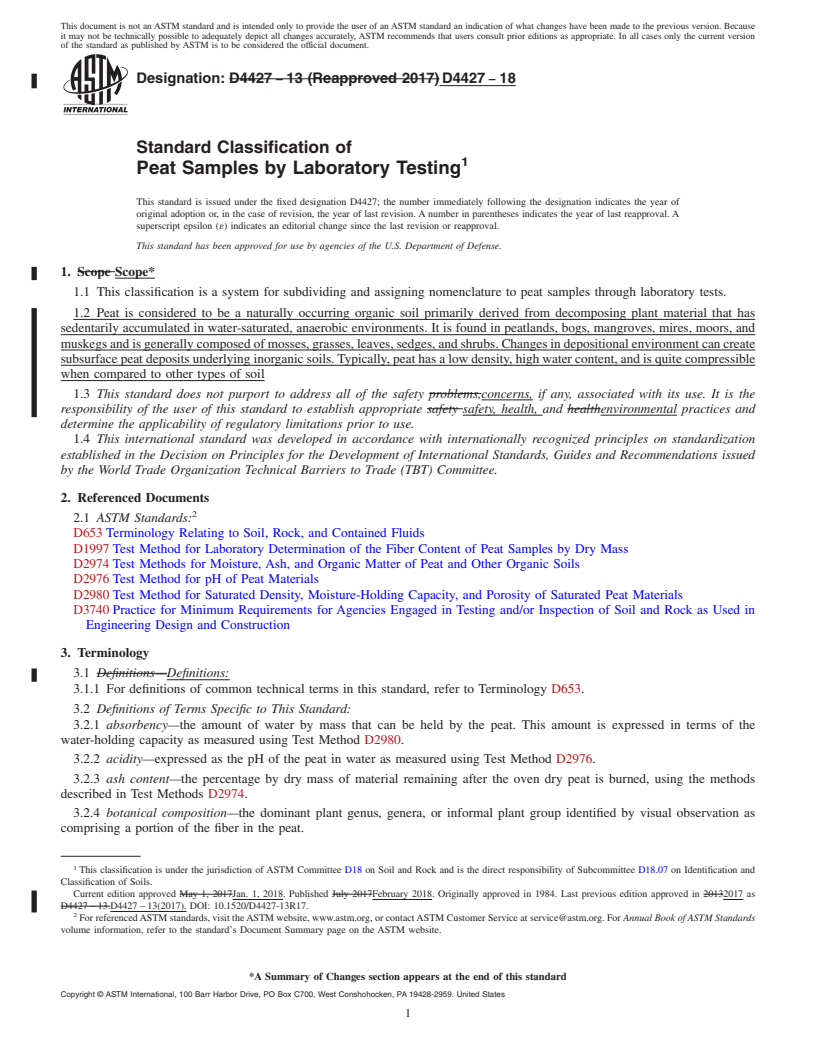
Designation: D4427 − 13 (Reapproved 2017) D4427 − 18
Standard Classification of
1
Peat Samples by Laboratory Testing
This standard is issued under the fixed designation D4427; the number immediately following the designation indicates the year of
original adoption or, in the case of revision, the year of last revision. A number in parentheses indicates the year of last reapproval. A
superscript epsilon (´) indicates an editorial change since the last revision or reapproval.
This standard has been approved for use by agencies of the U.S. Department of Defense.
1. Scope Scope*
1.1 This classification is a system for subdividing and assigning nomenclature to peat samples through laboratory tests.
1.2 Peat is considered to be a naturally occurring organic soil primarily derived from decomposing plant material that has
sedentarily accumulated in water-saturated, anaerobic environments. It is found in peatlands, bogs, mangroves, mires, moors, and
muskegs and is generally composed of mosses, grasses, leaves, sedges, and shrubs. Changes in depositional environment can create
subsurface peat deposits underlying inorganic soils. Typically, peat has a low density, high water content, and is quite compressible
when compared to other types of soil
1.3 This standard does not purport to address all of the safety problems,concerns, if any, associated with its use. It is the
responsibility of the user of this standard to establish appropriate safety safety, health, and healthenvironmental practices and
determine the applicability of regulatory limitations prior to use.
1.4 This international standard was developed in accordance with internationally recognized principles on standardization
established in the Decision on Principles for the Development of International Standards, Guides and Recommendations issued
by the World Trade Organization Technical Barriers to Trade (TBT) Committee.
2. Referenced Documents
2
2.1 ASTM Standards:
D653 Terminology Relating to Soil, Rock, and Contained Fluids
D1997 Test Method for Laboratory Determination of the Fiber Content of Peat Samples by Dry Mass
D2974 Test Methods for Moisture, Ash, and Organic Matter of Peat and Other Organic Soils
D2976 Test Method for pH of Peat Materials
D2980 Test Method for Saturated Density, Moisture-Holding Capacity, and Porosity of Saturated Peat Materials
D3740 Practice for Minimum Requirements for Agencies Engaged in Testing and/or Inspection of Soil and Rock as Used in
Engineering Design and Construction
3. Terminology
3.1 Definitions—Definitions:
3.1.1 For definitions of common technical terms in this standard, refer to Terminology D653.
3.2 Definitions of Terms Specific to This Standard:
3.2.1 absorbency—the amount of water by mass that can be held by the peat. This amount is expressed in terms of the
water-holding capacity as measured using Test Method D2980.
3.2.2 acidity—expressed as the pH of the peat in water as measured using Test Method D2976.
3.2.3 ash content—the percentage by dry mass of material remaining after the oven dry peat is burned, using the methods
described in Test Methods D2974.
3.2.4 botanical composition—the dominant plant genus, genera, or informal plant group identified by visual observation as
comprising a portion of the fiber in the peat.
1
This classification is under the jurisdiction of ASTM Committee D18 on Soil and Rock and is the direct responsibility of Subcommittee D18.07 on Identification and
Classification of Soils.
Current edition approved May 1, 2017Jan. 1, 2018. Published July 2017February 2018. Originally approved in 1984. Last previous edition approved in 20132017 as
D4427 – 13.D4427 – 13(2017). DOI: 10.1520/D4427-13R17.
2
For referenced ASTM standards, visit the ASTM website, www.astm.org, or contact ASTM Customer Service at service@astm.org. For Annual Book of ASTM Standards
volume information, refer to the standard’s Document Summary page on the ASTM website.
*A Summary of Changes section appears at the end of this standard
Copyright © ASTM International, 100 Barr Harbor Drive, PO Box C700, West Conshohocken, PA 19428-2959. United States
1
---------------------- Page: 1 ----------------------
D4427 − 18
3.2.5 fiber content—the dry mass of fibers remaining after wet sieving over a No. 100 (150-μm) sieve. Fiber content is expressed
as a percentage of the original dry mass, using the method described in Test Method D1997.
4. Significance and Use
4.1 The purpose of this classification is to standardize the naming of peat materials so that the peat-producer can better identify
the product and
...
Questions, Comments and Discussion
Ask us and Technical Secretary will try to provide an answer. You can facilitate discussion about the standard in here.