


ASTM E1399/E1399M-97(2022)
(Test Method)Standard Test Method for Cyclic Movement and Measuring the Minimum and Maximum Joint Widths of Architectural Joint Systems
Standard Test Method for Cyclic Movement and Measuring the Minimum and Maximum Joint Widths of Architectural Joint Systems
SIGNIFICANCE AND USE
4.1 Types of architectural joint systems included in this test method are the following:
4.1.1 Metallic systems;
4.1.2 Compression seals:
4.1.2.1 With frames, and
4.1.2.2 Without frames,
4.1.3 Strip seals;
4.1.4 Preformed sealant systems (see Appendix X1):
4.1.4.1 With frames, and
4.1.4.2 Without frames,
4.1.5 Preformed foams and sponges:
4.1.5.1 Self-Expanding, and
4.1.5.2 Nonexpanding,
4.1.6 Fire barriers:
4.1.6.1 Used as joint systems, and
4.1.6.2 Used as a part of the joint system, and
4.1.7 Elastomeric membrane systems:
4.1.7.1 With nosing material(s), and
4.1.7.2 Without nosing material(s).
4.2 This test method will assist users, producers, building officials, code authorities, and others in verifying some performance characteristics of representative specimens of architectural joint systems under common test conditions. The following performance characteristics are verifiable:
4.2.1 The maximum joint width,
4.2.2 The minimum joint width, and
4.2.3 The movement capability.
4.3 This test compares similar architectural joint systems by cycling but does not accurately reflect the system's application. Similar refers to the same type of architectural system within the same subsection under 4.1.
4.4 This test method does not provide information on:
4.4.1 Durability of the architectural joint system under actual service conditions, including the effects of cycled temperature on the joint system,
4.4.2 Loading capability of the system and the effects of a load on the functional parameters established by this test method,
4.4.3 Rotational, vertical, and horizontal shear capabilities of the specimen,
4.4.4 Any other attributes of the specimen, such as fire resistance, wear resistance, chemical resistance, air infiltration, watertightness, and so forth, and
4.4.5 Testing or compatibility of substrates.
4.5 This test method is only to be used as one element in the selection of an architectural j...
SCOPE
1.1 This test method covers testing procedures for architectural joint systems. This test method is intended for the following uses for architectural joint systems:
1.1.1 To verify movement capability information supplied to the user by the producer,
1.1.2 To standardize comparison of movement capability by relating it to specified nominal joint widths,
1.1.3 To determine the cyclic movement capability between specified minimum and maximum joint widths without visual deleterious effects, and
1.1.4 To provide the user with graphic information, drawings or pictures in the test report, depicting them at minimum, maximum, and nominal joint widths during cycling.
1.2 This test method is intended to be used only as part of a specification or acceptance criterion due to the limited movements tested.
1.3 The values stated in either SI units or inch-pound units are to be regarded separately as standard. The values stated in each system are not necessarily exact equivalents; therefore, to ensure conformance with the standard, each system shall be used independently of the other, and values from the two systems shall not be combined.
1.4 This standard does not purport to address all of the safety concerns, if any, associated with its use. It is the responsibility of the user of this standard to establish appropriate safety, health, and environmental practices and determine the applicability of regulatory limitations prior to use.
1.5 This international standard was developed in accordance with internationally recognized principles on standardization established in the Decision on Principles for the Development of International Standards, Guides and Recommendations issued by the World Trade Organization Technical Barriers to Trade (TBT) Committee.
General Information
Relations
Standards Content (Sample)
This international standard was developed in accordance with internationally recognized principles on standardization established in the Decision on Principles for the
Development of International Standards, Guides and Recommendations issued by the World Trade Organization Technical Barriers to Trade (TBT) Committee.
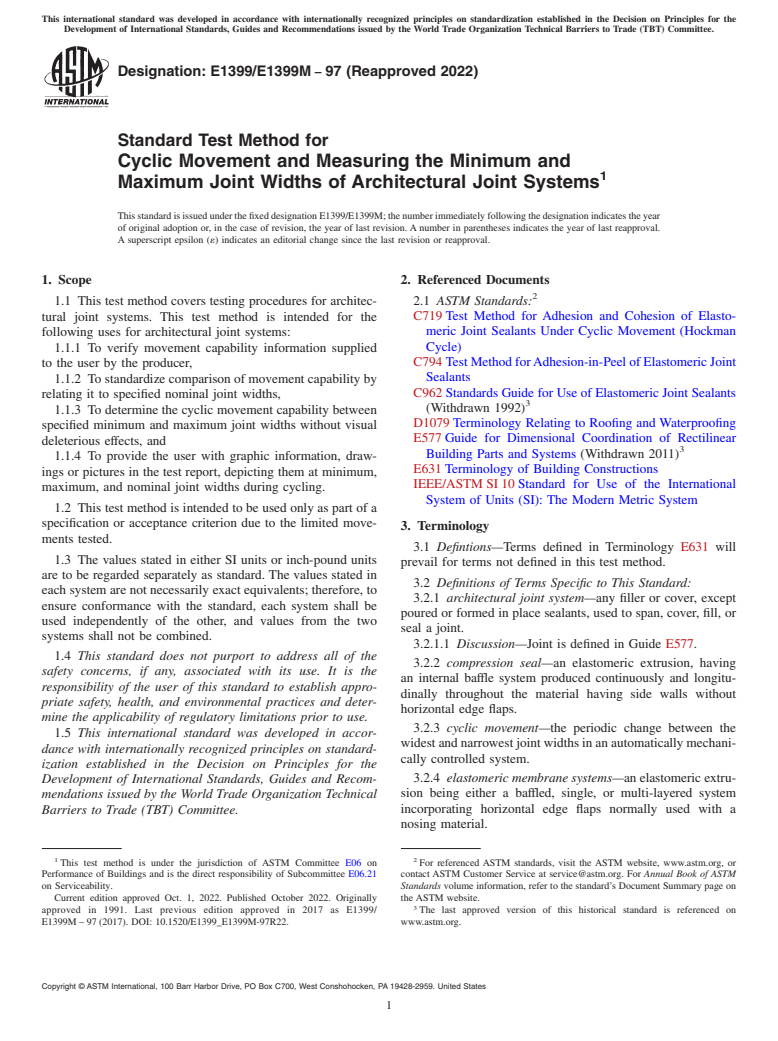
Designation: E1399/E1399M − 97 (Reapproved 2022)
Standard Test Method for
Cyclic Movement and Measuring the Minimum and
1
Maximum Joint Widths of Architectural Joint Systems
ThisstandardisissuedunderthefixeddesignationE1399/E1399M;thenumberimmediatelyfollowingthedesignationindicatestheyear
of original adoption or, in the case of revision, the year of last revision. A number in parentheses indicates the year of last reapproval.
A superscript epsilon (´) indicates an editorial change since the last revision or reapproval.
1. Scope 2. Referenced Documents
2
2.1 ASTM Standards:
1.1 This test method covers testing procedures for architec-
tural joint systems. This test method is intended for the C719 Test Method for Adhesion and Cohesion of Elasto-
meric Joint Sealants Under Cyclic Movement (Hockman
following uses for architectural joint systems:
Cycle)
1.1.1 To verify movement capability information supplied
C794 TestMethodforAdhesion-in-PeelofElastomericJoint
to the user by the producer,
Sealants
1.1.2 To standardize comparison of movement capability by
C962 Standards Guide for Use of Elastomeric Joint Sealants
relating it to specified nominal joint widths,
3
(Withdrawn 1992)
1.1.3 To determine the cyclic movement capability between
D1079 Terminology Relating to Roofing and Waterproofing
specified minimum and maximum joint widths without visual
E577 Guide for Dimensional Coordination of Rectilinear
deleterious effects, and
3
Building Parts and Systems (Withdrawn 2011)
1.1.4 To provide the user with graphic information, draw-
E631 Terminology of Building Constructions
ings or pictures in the test report, depicting them at minimum,
IEEE/ASTM SI 10 Standard for Use of the International
maximum, and nominal joint widths during cycling.
System of Units (SI): The Modern Metric System
1.2 This test method is intended to be used only as part of a
specification or acceptance criterion due to the limited move-
3. Terminology
ments tested.
3.1 Defintions—Terms defined in Terminology E631 will
1.3 The values stated in either SI units or inch-pound units
prevail for terms not defined in this test method.
are to be regarded separately as standard. The values stated in
3.2 Definitions of Terms Specific to This Standard:
each system are not necessarily exact equivalents; therefore, to
3.2.1 architectural joint system—any filler or cover, except
ensure conformance with the standard, each system shall be
poured or formed in place sealants, used to span, cover, fill, or
used independently of the other, and values from the two
seal a joint.
systems shall not be combined.
3.2.1.1 Discussion—Joint is defined in Guide E577.
1.4 This standard does not purport to address all of the
3.2.2 compression seal—an elastomeric extrusion, having
safety concerns, if any, associated with its use. It is the
an internal baffle system produced continuously and longitu-
responsibility of the user of this standard to establish appro-
dinally throughout the material having side walls without
priate safety, health, and environmental practices and deter-
horizontal edge flaps.
mine the applicability of regulatory limitations prior to use.
3.2.3 cyclic movement—the periodic change between the
1.5 This international standard was developed in accor-
widestandnarrowestjointwidthsinanautomaticallymechani-
dance with internationally recognized principles on standard-
cally controlled system.
ization established in the Decision on Principles for the
Development of International Standards, Guides and Recom- 3.2.4 elastomeric membrane systems—an elastomeric extru-
sion being either a baffled, single, or multi-layered system
mendations issued by the World Trade Organization Technical
Barriers to Trade (TBT) Committee. incorporating horizontal edge flaps normally used with a
nosing material.
1 2
This test method is under the jurisdiction of ASTM Committee E06 on For referenced ASTM standards, visit the ASTM website, www.astm.org, or
Performance of Buildings and is the direct responsibility of Subcommittee E06.21 contact ASTM Customer Service at service@astm.org. For Annual Book of ASTM
on Serviceability. Standards volume information, refer to the standard’s Document Summary page on
Current edition approved Oct. 1, 2022. Published October 2022. Originally the ASTM website.
3
approved in 1991. Last previous edition approved in 2017 as E1399/ The last approved version of this historical standard is referenced on
E1399M – 97 (2017). DOI: 10.1520/E1399_E1399M-97R22. www.astm.org.
Copyright © ASTM International, 100 Barr Harbor Drive, PO Box C700, West Conshohocken, PA 19428-2959. United States
1
---------------------- Page: 1 ----------------------
E1399/E1399M − 97
...
Questions, Comments and Discussion
Ask us and Technical Secretary will try to provide an answer. You can facilitate discussion about the standard in here.