

ASTM E900-21
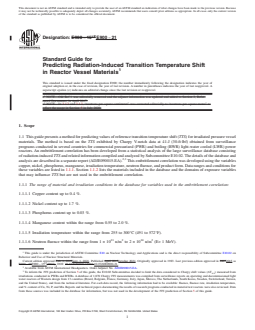
(Guide)Standard Guide for Predicting Radiation-Induced Transition Temperature Shift in Reactor Vessel Materials
General Information
- Abstract
SIGNIFICANCE AND USE
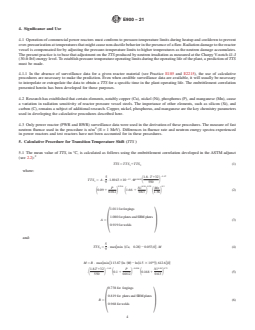
4.1 Operation of commercial power reactors must conform to pressure-temperature limits during heatup and cooldown to prevent over-pressurization at temperatures that might cause non-ductile behavior in the presence of a flaw. Radiation damage to the reactor vessel is compensated for by adjusting the pressure-temperature limits to higher temperatures as the neutron damage accumulates. The present practice is to base that adjustment on the TTS produced by neutron irradiation as measured at the Charpy V-notch 41-J (30-ft·lbf) energy level. To establish pressure temperature operating limits during the operating life of the plant, a prediction of TTS must be made.
4.1.1 In the absence of surveillance data for a given reactor material (see Practice E185 and E2215), the use of calculative procedures are necessary to make the prediction. Even when credible surveillance data are available, it will usually be necessary to interpolate or extrapolate the data to obtain a TTS for a specific time in the plant operating life. The embrittlement correlation presented herein has been developed for those purposes.
4.2 Research has established that certain elements, notably copper (Cu), nickel (Ni), phosphorus (P), and manganese (Mn), cause a variation in radiation sensitivity of reactor pressure vessel steels. The importance of other elements, such as silicon (Si), and carbon (C), remains a subject of additional research. Copper, nickel, phosphorus, and manganese are the key chemistry parameters used in developing the calculative procedures described here.
4.3 Only power reactor (PWR and BWR) surveillance data were used in the derivation of these procedures. The measure of fast neutron fluence used in the procedure is n/m2 (E > 1 MeV). Differences in fluence rate and neutron energy spectra experienced in power reactors and test reactors have not been accounted for in these procedures.
SCOPE
1.1 This guide presents a method for predicting values of reference transition temperature shift (TTS) for irradiated pressure vessel materials. The method is based on the TTS exhibited by Charpy V-notch data at 41-J (30-ft·lbf) obtained from surveillance programs conducted in several countries for commercial pressurized (PWR) and boiling (BWR) light-water cooled (LWR) power reactors. An embrittlement correlation has been developed from a statistical analysis of the large surveillance database consisting of radiation-induced TTS and related information compiled and analyzed by Subcommittee E10.02. The details of the database and analysis are described in a separate report (ADJE090015-EA).2,3 This embrittlement correlation was developed using the variables copper, nickel, phosphorus, manganese, irradiation temperature, neutron fluence, and product form. Data ranges and conditions for these variables are listed in 1.1.1. Section 1.1.2 lists the materials included in the database and the domains of exposure variables that may influence TTS but are not used in the embrittlement correlation.
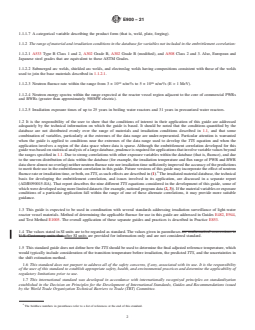
1.1.1 The range of material and irradiation conditions in the database for variables used in the embrittlement correlation:
1.1.1.1 Copper content up to 0.4 %.
1.1.1.2 Nickel content up to 1.7 %.
1.1.1.3 Phosphorus content up to 0.03 %.
1.1.1.4 Manganese content within the range from 0.55 to 2.0 %.
1.1.1.5 Irradiation temperature within the range from 255 to 300°C (491 to 572°F).
1.1.1.6 Neutron fluence within the range from 1 × 10²¹ n/m2 to 2 × 1024 n/m2 (E> 1 MeV).
1.1.1.7 A categorical variable describing the product form (that is, weld, plate, forging).
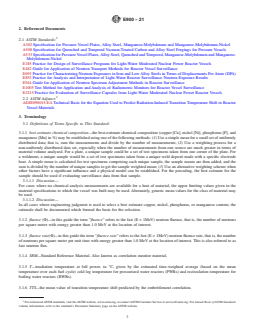
1.1.2 The range of material and irradiation conditions in the database for variables not included in the embrittlement correlation:
1.1.2.1 A533 Type B Class 1 and 2, A302 Grade B, A302 Grade B (modified), and A508 Class 2 and 3. Also, European and Japanese steel grades that are equivalent to these ASTM Grades.
1.1.2.2 Submerged arc welds, shielded a...
- Status
- Published
- Publication Date
- 31-Aug-2021
- Technical Committee
- E10 - Nuclear Technology and Applications
- Drafting Committee
- E10.02 - Behavior and Use of Nuclear Structural Materials
Buy Documents
ASTM E900-21 - Standard Guide for Predicting Radiation-Induced Transition Temperature Shift in Reactor Vessel Materials
REDLINE ASTM E900-21 - Standard Guide for Predicting Radiation-Induced Transition Temperature Shift in Reactor Vessel Materials
Overview
ASTM E900-21: Standard Guide for Predicting Radiation-Induced Transition Temperature Shift in Reactor Vessel Materials provides comprehensive guidance for estimating the reference transition temperature shift (TTS) in reactor pressure vessel steels caused by neutron irradiation. This standard is crucial for ensuring the structural integrity and safety of reactor vessels in pressurized water reactors (PWRs) and boiling water reactors (BWRs) throughout their operational life.
By utilizing predictive models based on a large international surveillance database, ASTM E900-21 enables plant operators, engineers, and regulators to make informed adjustments to pressure-temperature limits, accommodating the effects of radiation-induced embrittlement. The guide details embrittlement correlations that account for key chemical and irradiation variables impacting TTS, making it an essential resource for nuclear plant operation and materials engineering.
Key Topics
- Transition Temperature Shift (TTS): Defines methods to predict the increase in the reference transition temperature of reactor vessel materials due to neutron irradiation.
- Embrittlement Correlation: Developed through a statistical analysis of surveillance data, incorporating variables such as copper, nickel, phosphorus, manganese content, irradiation temperature, neutron fluence, and product form.
- Material and Irradiation Conditions: The guide specifies applicable ranges for material composition and irradiation conditions, ensuring predictions remain within validated boundaries.
- Data Use and Interpolation: Addresses prediction methods for cases with limited or absent surveillance data and guidance on interpolation/extrapolation for specific plant scenarios.
- Uncertainty Evaluation: Outlines procedures to estimate and handle uncertainties in the prediction of TTS, taking into account input parameter variability.
- Fluence Attenuation: Discusses considerations for neutron flux and damage attenuation through the reactor vessel wall, including recommended calculation methods.
Applications
ASTM E900-21 is widely adopted in the nuclear energy sector for supporting:
- Reactor Safety Management: Used to establish and adjust safe pressure-temperature operating limits during reactor heatup and cooldown, minimizing the risk of non-ductile failure.
- Life Extension and Aging Management: Enables predictive assessment of the vessel’s material condition over time, supporting lifetime extension strategies and decision-making.
- Surveillance Program Support: Assists in evaluating data from reactor surveillance capsules and provides calculative alternatives when surveillance data is lacking or incomplete.
- Regulatory Compliance: Helps nuclear utilities and regulators meet requirements for vessel integrity and operating safety as prescribed by local and international regulations.
- Materials Specification and Selection: Guides material engineers in understanding radiation sensitivity factors and the importance of controlling alloy composition.
Related Standards
ASTM E900-21 should be implemented alongside the following related ASTM standards and guides to achieve a comprehensive approach to reactor vessel surveillance and irradiation assessment:
- ASTM E185: Practice for Design of Surveillance Programs for Light-Water Moderated Nuclear Power Reactor Vessels.
- ASTM E2215: Practice for Evaluation of Surveillance Capsules from Light-Water Moderated Nuclear Power Reactor Vessels.
- ASTM E482: Guide for Application of Neutron Transport Methods for Reactor Vessel Surveillance.
- ASTM E944: Guide for Application of Neutron Spectrum Adjustment Methods in Reactor Surveillance.
- ASTM E853: Practice for Analysis and Interpretation of Light-Water Reactor Surveillance Neutron Exposure Results.
- ASTM E1005: Test Method for Application and Analysis of Radiometric Monitors for Reactor Vessel Surveillance.
- ASTM E693: Practice for Characterizing Neutron Exposures in Iron and Low Alloy Steels in Terms of Displacements Per Atom (DPA).
These standards collectively provide a robust framework for monitoring, analyzing, and managing irradiation effects in pressure vessel steels, contributing to the continued safety and performance of nuclear power plants.
Keywords: ASTM E900-21, reactor vessel materials, transition temperature shift, radiation embrittlement, neutron irradiation, nuclear power reactor, pressure vessel surveillance, PWR, BWR, nuclear safety, surveillance data, pressure-temperature limits.
Relations
- Effective Date
- 01-Oct-2019
- Effective Date
- 01-Jun-2019
- Effective Date
- 01-Aug-2018
- Effective Date
- 01-Dec-2016
- Effective Date
- 01-Jul-2015
- Effective Date
- 01-Jun-2015
- Effective Date
- 01-Jun-2015
- Effective Date
- 01-Jun-2015
- Effective Date
- 01-Jun-2013
- Effective Date
- 01-Jan-2013
- Effective Date
- 01-Jan-2013
- Effective Date
- 01-Jun-2012
- Effective Date
- 01-Jun-2012
- Effective Date
- 01-Jun-2011
- Effective Date
- 01-Jun-2011
Buy Documents
ASTM E900-21 - Standard Guide for Predicting Radiation-Induced Transition Temperature Shift in Reactor Vessel Materials
REDLINE ASTM E900-21 - Standard Guide for Predicting Radiation-Induced Transition Temperature Shift in Reactor Vessel Materials
Get Certified
Connect with accredited certification bodies for this standard

DNV
DNV is an independent assurance and risk management provider.

Lloyd's Register
Lloyd's Register is a global professional services organisation specialising in engineering and technology.
DNV Energy Systems
Energy and renewable energy certification.
Sponsored listings
Frequently Asked Questions
ASTM E900-21 is a guide published by ASTM International. Its full title is "Standard Guide for Predicting Radiation-Induced Transition Temperature Shift in Reactor Vessel Materials". This standard covers: SIGNIFICANCE AND USE 4.1 Operation of commercial power reactors must conform to pressure-temperature limits during heatup and cooldown to prevent over-pressurization at temperatures that might cause non-ductile behavior in the presence of a flaw. Radiation damage to the reactor vessel is compensated for by adjusting the pressure-temperature limits to higher temperatures as the neutron damage accumulates. The present practice is to base that adjustment on the TTS produced by neutron irradiation as measured at the Charpy V-notch 41-J (30-ft·lbf) energy level. To establish pressure temperature operating limits during the operating life of the plant, a prediction of TTS must be made. 4.1.1 In the absence of surveillance data for a given reactor material (see Practice E185 and E2215), the use of calculative procedures are necessary to make the prediction. Even when credible surveillance data are available, it will usually be necessary to interpolate or extrapolate the data to obtain a TTS for a specific time in the plant operating life. The embrittlement correlation presented herein has been developed for those purposes. 4.2 Research has established that certain elements, notably copper (Cu), nickel (Ni), phosphorus (P), and manganese (Mn), cause a variation in radiation sensitivity of reactor pressure vessel steels. The importance of other elements, such as silicon (Si), and carbon (C), remains a subject of additional research. Copper, nickel, phosphorus, and manganese are the key chemistry parameters used in developing the calculative procedures described here. 4.3 Only power reactor (PWR and BWR) surveillance data were used in the derivation of these procedures. The measure of fast neutron fluence used in the procedure is n/m2 (E > 1 MeV). Differences in fluence rate and neutron energy spectra experienced in power reactors and test reactors have not been accounted for in these procedures. SCOPE 1.1 This guide presents a method for predicting values of reference transition temperature shift (TTS) for irradiated pressure vessel materials. The method is based on the TTS exhibited by Charpy V-notch data at 41-J (30-ft·lbf) obtained from surveillance programs conducted in several countries for commercial pressurized (PWR) and boiling (BWR) light-water cooled (LWR) power reactors. An embrittlement correlation has been developed from a statistical analysis of the large surveillance database consisting of radiation-induced TTS and related information compiled and analyzed by Subcommittee E10.02. The details of the database and analysis are described in a separate report (ADJE090015-EA).2,3 This embrittlement correlation was developed using the variables copper, nickel, phosphorus, manganese, irradiation temperature, neutron fluence, and product form. Data ranges and conditions for these variables are listed in 1.1.1. Section 1.1.2 lists the materials included in the database and the domains of exposure variables that may influence TTS but are not used in the embrittlement correlation. 1.1.1 The range of material and irradiation conditions in the database for variables used in the embrittlement correlation: 1.1.1.1 Copper content up to 0.4 %. 1.1.1.2 Nickel content up to 1.7 %. 1.1.1.3 Phosphorus content up to 0.03 %. 1.1.1.4 Manganese content within the range from 0.55 to 2.0 %. 1.1.1.5 Irradiation temperature within the range from 255 to 300°C (491 to 572°F). 1.1.1.6 Neutron fluence within the range from 1 × 10²¹ n/m2 to 2 × 1024 n/m2 (E> 1 MeV). 1.1.1.7 A categorical variable describing the product form (that is, weld, plate, forging). 1.1.2 The range of material and irradiation conditions in the database for variables not included in the embrittlement correlation: 1.1.2.1 A533 Type B Class 1 and 2, A302 Grade B, A302 Grade B (modified), and A508 Class 2 and 3. Also, European and Japanese steel grades that are equivalent to these ASTM Grades. 1.1.2.2 Submerged arc welds, shielded a...
SIGNIFICANCE AND USE 4.1 Operation of commercial power reactors must conform to pressure-temperature limits during heatup and cooldown to prevent over-pressurization at temperatures that might cause non-ductile behavior in the presence of a flaw. Radiation damage to the reactor vessel is compensated for by adjusting the pressure-temperature limits to higher temperatures as the neutron damage accumulates. The present practice is to base that adjustment on the TTS produced by neutron irradiation as measured at the Charpy V-notch 41-J (30-ft·lbf) energy level. To establish pressure temperature operating limits during the operating life of the plant, a prediction of TTS must be made. 4.1.1 In the absence of surveillance data for a given reactor material (see Practice E185 and E2215), the use of calculative procedures are necessary to make the prediction. Even when credible surveillance data are available, it will usually be necessary to interpolate or extrapolate the data to obtain a TTS for a specific time in the plant operating life. The embrittlement correlation presented herein has been developed for those purposes. 4.2 Research has established that certain elements, notably copper (Cu), nickel (Ni), phosphorus (P), and manganese (Mn), cause a variation in radiation sensitivity of reactor pressure vessel steels. The importance of other elements, such as silicon (Si), and carbon (C), remains a subject of additional research. Copper, nickel, phosphorus, and manganese are the key chemistry parameters used in developing the calculative procedures described here. 4.3 Only power reactor (PWR and BWR) surveillance data were used in the derivation of these procedures. The measure of fast neutron fluence used in the procedure is n/m2 (E > 1 MeV). Differences in fluence rate and neutron energy spectra experienced in power reactors and test reactors have not been accounted for in these procedures. SCOPE 1.1 This guide presents a method for predicting values of reference transition temperature shift (TTS) for irradiated pressure vessel materials. The method is based on the TTS exhibited by Charpy V-notch data at 41-J (30-ft·lbf) obtained from surveillance programs conducted in several countries for commercial pressurized (PWR) and boiling (BWR) light-water cooled (LWR) power reactors. An embrittlement correlation has been developed from a statistical analysis of the large surveillance database consisting of radiation-induced TTS and related information compiled and analyzed by Subcommittee E10.02. The details of the database and analysis are described in a separate report (ADJE090015-EA).2,3 This embrittlement correlation was developed using the variables copper, nickel, phosphorus, manganese, irradiation temperature, neutron fluence, and product form. Data ranges and conditions for these variables are listed in 1.1.1. Section 1.1.2 lists the materials included in the database and the domains of exposure variables that may influence TTS but are not used in the embrittlement correlation. 1.1.1 The range of material and irradiation conditions in the database for variables used in the embrittlement correlation: 1.1.1.1 Copper content up to 0.4 %. 1.1.1.2 Nickel content up to 1.7 %. 1.1.1.3 Phosphorus content up to 0.03 %. 1.1.1.4 Manganese content within the range from 0.55 to 2.0 %. 1.1.1.5 Irradiation temperature within the range from 255 to 300°C (491 to 572°F). 1.1.1.6 Neutron fluence within the range from 1 × 10²¹ n/m2 to 2 × 1024 n/m2 (E> 1 MeV). 1.1.1.7 A categorical variable describing the product form (that is, weld, plate, forging). 1.1.2 The range of material and irradiation conditions in the database for variables not included in the embrittlement correlation: 1.1.2.1 A533 Type B Class 1 and 2, A302 Grade B, A302 Grade B (modified), and A508 Class 2 and 3. Also, European and Japanese steel grades that are equivalent to these ASTM Grades. 1.1.2.2 Submerged arc welds, shielded a...
ASTM E900-21 is classified under the following ICS (International Classification for Standards) categories: 27.120.10 - Reactor engineering. The ICS classification helps identify the subject area and facilitates finding related standards.
ASTM E900-21 has the following relationships with other standards: It is inter standard links to ASTM E944-19, ASTM E2215-19, ASTM E2215-18, ASTM E2215-16, ASTM E1005-15, ASTM E2215-15, ASTM E185-15, ASTM E185-15e1, ASTM E853-13, ASTM E944-13e1, ASTM E944-13, ASTM E693-12, ASTM E693-12e1, ASTM E482-11e1, ASTM E482-11. Understanding these relationships helps ensure you are using the most current and applicable version of the standard.
ASTM E900-21 is available in PDF format for immediate download after purchase. The document can be added to your cart and obtained through the secure checkout process. Digital delivery ensures instant access to the complete standard document.
Standards Content (Sample)
This international standard was developed in accordance with internationally recognized principles on standardization established in the Decision on Principles for the
Development of International Standards, Guides and Recommendations issued by the World Trade Organization Technical Barriers to Trade (TBT) Committee.
Designation: E900 − 21
Standard Guide for
Predicting Radiation-Induced Transition Temperature Shift
in Reactor Vessel Materials
This standard is issued under the fixed designation E900; the number immediately following the designation indicates the year of
original adoption or, in the case of revision, the year of last revision.Anumber in parentheses indicates the year of last reapproval.A
superscript epsilon (´) indicates an editorial change since the last revision or reapproval.
1. Scope 1.1.1.2 Nickel content up to 1.7 %.
1.1.1.3 Phosphorus content up to 0.03 %.
1.1 This guide presents a method for predicting values of
1.1.1.4 Manganesecontentwithintherangefrom0.55to2.0
reference transition temperature shift (TTS) for irradiated
%.
pressure vessel materials. The method is based on the TTS
1.1.1.5 Irradiationtemperaturewithintherangefrom255to
exhibited by Charpy V-notch data at 41-J (30-ft·lbf) obtained
300°C (491 to 572°F).
from surveillance programs conducted in several countries for
21 2
1.1.1.6 Neutronfluencewithintherangefrom1×10 n/m
commercialpressurized(PWR)andboiling(BWR)light-water
24 2
to2×10 n/m (E> 1 MeV).
cooled (LWR) power reactors. An embrittlement correlation
1.1.1.7 A categorical variable describing the product form
has been developed from a statistical analysis of the large
(that is, weld, plate, forging).
surveillance database consisting of radiation-induced TTS and
1.1.2 The range of material and irradiation conditions in
related information compiled and analyzed by Subcommittee
the database for variables not included in the embrittlement
E10.02. The details of the database and analysis are described
2,3
correlation:
in a separate report (ADJE090015-EA). This embrittlement
correlation was developed using the variables copper, nickel, 1.1.2.1 A533 Type B Class 1 and 2, A302 Grade B, A302
Grade B (modified), and A508 Class 2 and 3. Also, European
phosphorus, manganese, irradiation temperature, neutron
fluence,andproductform.Datarangesandconditionsforthese and Japanese steel grades that are equivalent to these ASTM
Grades.
variables are listed in 1.1.1. Section 1.1.2 lists the materials
includedinthedatabaseandthedomainsofexposurevariables 1.1.2.2 Submerged arc welds, shielded arc welds, and elec-
that may influence TTS but are not used in the embrittlement troslag welds having compositions consistent with those of the
correlation. welds used to join the base materials described in 1.1.2.1.
1.1.1 The range of material and irradiation conditions in
1.1.2.3 Neutron fluence rate within the range from3×10
2 16 2
the database for variables used in the embrittlement correla-
n/m/sto5×10 n/m /s (E > 1 MeV).
tion:
1.1.2.4 Neutron energy spectra within the range expected at
1.1.1.1 Copper content up to 0.4 %.
the reactor vessel region adjacent to the core of commercial
PWRs and BWRs (greater than approximately 500MW elec-
tric).
This guide is under the jurisdiction of ASTM Committee E10 on Nuclear
1.1.2.5 Irradiation exposure times of up to 25 years in
Technology and Applications and is the direct responsibility of Subcommittee
boiling water reactors and 31 years in pressurized water
E10.02 on Behavior and Use of Nuclear Structural Materials.
reactors.
Current edition approved Sept. 1, 2021. Published October 2021. Originally
ɛ2
approved in 1983. Last previous edition approved in 2015 as E900–15 . DOI:
1.2 It is the responsibility of the user to show that the
10.1520/E0900-21.
Available from ASTM International Headquarters. Order Adjunct No. conditions of interest in their application of this guide are
ADJE090015-EA.
addressed adequately by the technical information on which
To inform the TTS prediction of Section 5 of this guide, the E10.02
the guide is based. It should be noted that the conditions
Subcommittee decided to limit the data considered to Charpy shift values (∆T )
41J
quantified by the database are not distributed evenly over the
measured from irradiations conducted in PWRs and BWRs. A database of 1,878
Charpy TTSmeasurementswascompiledfromsurveillancereportsonoperatingand
range of materials and irradiation conditions described in 1.1,
decommissioned light water reactors of Western design from 13 countries (Brazil,
and that some combination of variables, particularly at the
Belgium, France, Germany, Italy, Japan, Mexico, The Netherlands, South Korea,
extremes of the data range are under-represented. Particular
Sweden, Switzlerland, Taiwan, and the United States), and from the technical
attention is warranted when the guide is applied to conditions
literature. For each data record, the following information had to be available:
fluence, fluence rate, irradiation temperature, and % content of Cu, Ni, P, and Mn.
near the extremes of the data range used to develop the TTS
Reports and technical papers documenting the results of research programs
equationandwhentheapplicationinvolvesaregionofthedata
conductedinmaterialtestreactorswerealsoreviewed.Datafromthesesourceswas
space where data is sparse. Although the embrittlement corre-
includedinthedatabaseforinformation,butwasnotusedinthedevelopmentofthe
TTS prediction of Section 5 of this guide. lationdevelopedforthisguidewasbasedonstatisticalanalysis
Copyright © ASTM International, 100 Barr Harbor Drive, PO Box C700, West Conshohocken, PA 19428-2959. United States
E900 − 21
of a large database, prudence is required for applications that A302Specification for Pressure Vessel Plates, Alloy Steel,
involvevariablevaluesbeyondtherangesspecifiedin1.1.Due Manganese-Molybdenum and Manganese-Molybdenum-
to strong correlations with other exposure variables within the Nickel
database(thatis,fluence),andduetotheunevendistributionof A508Specification for Quenched and Tempered Vacuum-
data within the database (for example, the irradiation tempera- Treated Carbon and Alloy Steel Forgings for Pressure
ture and flux range of PWR and BWR data show almost no Vessels
overlap) neither neutron fluence rate nor irradiation time A533Specification for Pressure Vessel Plates, Alloy Steel,
sufficiently improved the accuracy of the predictions to merit Quenched and Tempered, Manganese-Molybdenum and
their use in the embrittlement correlation in this guide. Future Manganese-Molybdenum-Nickel
versions of this guide may incorporate the effect of neutron E185Practice for Design of Surveillance Programs for
fluencerateorirradiationtime,orboth,on TTS,assucheffects Light-Water Moderated Nuclear Power Reactor Vessels
are described in (1). The irradiated material database, the E482Guide for Application of Neutron Transport Methods
technical basis for developing the embrittlement correlation, for Reactor Vessel Surveillance
and issues involved in its application, are discussed in a E693Practice for Characterizing Neutron Exposures in Iron
separate report (ADJE090015-EA). That report describes the and Low Alloy Steels in Terms of Displacements Per
nine different TTS equations considered in the development of Atom (DPA)
this guide, some of which were developed using more limited E853PracticeforAnalysisandInterpretationofLight-Water
datasets (for example, national program data (2, 3)). If the Reactor Surveillance Neutron Exposure Results
material variables or exposure conditions of a particular E944Guide for Application of Neutron Spectrum Adjust-
application fall within the range of one of these alternate ment Methods in Reactor Surveillance
correlations, it may provide more suitable guidance. E1005Test Method for Application and Analysis of Radio-
metric Monitors for Reactor Vessel Surveillance
1.3 This guide is expected to be used in coordination with
E2215Practice for Evaluation of Surveillance Capsules
several standards addressing irradiation surveillance of light-
from Light-Water Moderated Nuclear Power ReactorVes-
water reactor vessel materials. Method of determining the
sels
applicablefluenceforuseinthisguideareaddressedinGuides
E482, E944, and Test Method E1005. The overall application 2.2 ASTM Adjunct:
of these separate guides and practices is described in Practice ADJE090015-EATechnical Basis for the Equation Used to
E853. PredictRadiation-InducedTransitionTemperatureShiftin
Reactor Vessel Materials
1.4 The values stated in SI units are to be regarded as
standard. The values given in parentheses after SI units are
3. Terminology
providedforinformationonlyandarenotconsideredstandard.
3.1 Definitions of Terms Specific to This Standard:
1.5 This standard guide does not define how the TTS should
3.1.1 best-estimate chemical composition—the best-
be used to determine the final adjusted reference temperature,
estimate chemical composition (copper [Cu], nickel [Ni],
which would typically include consideration of the transition
phosphorus[P],andmanganese[Mn]in%)maybeestablished
temperature before irradiation, the predicted TTS, and the
usingoneofthefollowingmethods:(1)Useasimplemeanfor
uncertainties in the shift estimation method.
a small set of uniformly distributed data; that is, sum the
1.6 This standard does not purport to address all of the
measurements and divide by the number of measurements; (2)
safety concerns, if any, associated with its use. It is the
Use a weighting process for a non-uniformly distributed data
responsibility of the user of this standard to establish appro-
set, especially when the number of measurements from one
priate safety, health, and environmental practices and deter-
source are much greater in terms of material volume analyzed.
mine the applicability of regulatory limitations prior to use.
For a plate, a unique sample could be a set of test specimens
1.7 This international standard was developed in accor-
taken from one corner of the plate. For a weldment, a unique
dance with internationally recognized principles on standard-
sample would be a set of test specimens taken from a unique
ization established in the Decision on Principles for the
weld deposit made with a specific electrode heat. A simple
Development of International Standards, Guides and Recom-
mean is calculated for test specimens comprising each unique
mendations issued by the World Trade Organization Technical
sample, the sample means are then added, and the sum is
Barriers to Trade (TBT) Committee.
divided by the number of unique samples to get the sample
weightedmean;(3)Useanalternativeweightingschemewhen
2. Referenced Documents
other factors have a significant influence and a physical model
2.1 ASTM Standards:
can be established. For the preceding, the best estimate for the
sampleshouldbeusedifevaluatingsurveillancedatafromthat
sample.
3.1.1.1 Discussion—For cases where no chemical analysis
The boldface numbers in parentheses refer to a list of references at the end of
this standard.
measurements are available for a heat of material, the upper
For referenced ASTM standards, visit the ASTM website, www.astm.org, or
limitingvaluesgiveninthematerialspecificationstowhichthe
contact ASTM Customer Service at service@astm.org. For Annual Book of ASTM
vesselwasbuiltmaybeused.Alternately,genericmeanvalues
Standards volume information, refer to the standard’s Document Summary page on
the ASTM website. for the class of material may be used.
E900 − 21
3.1.1.2 Discussion—In all cases where engineering judg- experienced in power reactors and test reactors have not been
ment is used to select a best estimate copper, nickel, accounted for in these procedures.
phosphorus, or manganese content, the rationale shall be
...
This document is not an ASTM standard and is intended only to provide the user of an ASTM standard an indication of what changes have been made to the previous version. Because
it may not be technically possible to adequately depict all changes accurately, ASTM recommends that users consult prior editions as appropriate. In all cases only the current version
of the standard as published by ASTM is to be considered the official document.
´2
Designation: E900 − 15 E900 − 21
Standard Guide for
Predicting Radiation-Induced Transition Temperature Shift
in Reactor Vessel Materials
This standard is issued under the fixed designation E900; the number immediately following the designation indicates the year of
original adoption or, in the case of revision, the year of last revision. A number in parentheses indicates the year of last reapproval. A
superscript epsilon (´) indicates an editorial change since the last revision or reapproval.
ε NOTE—Old Ref 1 was editorially removed and the adjunct information was updated and added to Section 2, Refer-
enced Documents, in April 2017.
ε NOTE—In 3.1.2 and 3.1.3, “neutrons per square centimeter” was corrected editorially to “neutrons per square meter” to
reflect the usage in Section 5 in July 2020.
1. Scope
1.1 This guide presents a method for predicting values of reference transition temperature shift (TTS) for irradiated pressure vessel
materials. The method is based on the TTS exhibited by Charpy V-notch data at 41-J (30-ft·lbf) obtained from surveillance
programs conducted in several countries for commercial pressurized (PWR) and boiling (BWR) light-water cooled (LWR) power
reactors. An embrittlement correlation has been developed from a statistical analysis of the large surveillance database consisting
of radiation-induced TTS and related information compiled and analyzed by Subcommittee E10.02. The details of the database and
2,3
analysis are described in a separate report (ADJE090015-EA). This embrittlement correlation was developed using the variables
copper, nickel, phosphorus, manganese, irradiation temperature, neutron fluence, and product form. Data ranges and conditions for
these variables are listed in 1.1.1. Section 1.1.2 lists the materials included in the database and the domains of exposure variables
that may influence TTS but are not used in the embrittlement correlation.
1.1.1 The range of material and irradiation conditions in the database for variables used in the embrittlement correlation:
1.1.1.1 Copper content up to 0.4 %.
1.1.1.2 Nickel content up to 1.7 %.
1.1.1.3 Phosphorus content up to 0.03 %.
1.1.1.4 Manganese content within the range from 0.55 to 2.0 %.
1.1.1.5 Irradiation temperature within the range from 255 to 300°C (491 to 572°F).
21 2 24 2
1.1.1.6 Neutron fluence within the range from 1 × 10 n/m to 2 × 10 n/m (E> 1 MeV).
This guide is under the jurisdiction of ASTM Committee E10 on Nuclear Technology and Applications and is the direct responsibility of Subcommittee E10.02 on
Behavior and Use of Nuclear Structural Materials.
Current edition approved Feb. 1, 2015Sept. 1, 2021. Published April 2015October 2021. Originally approved in 1983. Last previous edition approved in 20072015 as
ɛ2
E900 – 02E900 – 15 (2007). DOI: 10.1520/E0900-15E02.10.1520/E0900-21.
Available from ASTM International Headquarters. Order Adjunct No. ADJE090015-EA.
To inform the TTS prediction of Section 5 of this guide, the E10.02 Subcommittee decided to limit the data considered to Charpy shift values (ΔT ) measured from
41J
irradiations conducted in PWRs and BWRs. A database of 1,878 Charpy TTS measurements was compiled from surveillance reports on operating and decommissioned light
water reactors of Western design from 13 countries (Brazil, Belgium, France, Germany, Italy, Japan, Mexico, The Netherlands, South Korea, Sweden, Switzlerland, Taiwan,
and the United States), and from the technical literature. For each data record, the following information had to be available: fluence, fluence rate, irradiation temperature,
and % content of Cu, Ni, P, and Mn. Reports and technical papers documenting the results of research programs conducted in material test reactors were also reviewed. Data
from these sources was included in the database for information, but was not used in the development of the TTS prediction of Section 5 of this guide.
Copyright © ASTM International, 100 Barr Harbor Drive, PO Box C700, West Conshohocken, PA 19428-2959. United States
E900 − 21
1.1.1.7 A categorical variable describing the product form (that is, weld, plate, forging).
1.1.2 The range of material and irradiation conditions in the database for variables not included in the embrittlement correlation:
1.1.2.1 A533 Type B Class 1 and 2, A302 Grade B, A302 Grade B (modified), and A508 Class 2 and 3. Also, European and
Japanese steel grades that are equivalent to these ASTM Grades.
1.1.2.2 Submerged arc welds, shielded arc welds, and electroslag welds having compositions consistent with those of the welds
used to join the base materials described in 1.1.2.1.
12 2 16 2
1.1.2.3 Neutron fluence rate within the range from 3 × 10 n/m /s to 5 × 10 n/m /s (E > 1 MeV).
1.1.2.4 Neutron energy spectra within the range expected at the reactor vessel region adjacent to the core of commercial PWRs
and BWRs (greater than approximately 500MW electric).
1.1.2.5 Irradiation exposure times of up to 25 years in boiling water reactors and 31 years in pressurized water reactors.
1.2 It is the responsibility of the user to show that the conditions of interest in their application of this guide are addressed
adequately by the technical information on which the guide is based. It should be noted that the conditions quantified by the
database are not distributed evenly over the range of materials and irradiation conditions described in 1.1, and that some
combination of variables, particularly at the extremes of the data range are under-represented. Particular attention is warranted
when the guide is applied to conditions near the extremes of the data range used to develop the TTS equation and when the
application involves a region of the data space where data is sparse. Although the embrittlement correlation developed for this
guide was based on statistical analysis of a large database, prudence is required for applications that involve variable values beyond
the ranges specified in 1.1. Due to strong correlations with other exposure variables within the database (that is, fluence), and due
to the uneven distribution of data within the database (for example, the irradiation temperature and flux range of PWR and BWR
data show almost no overlap) neither neutron fluence rate nor irradiation time sufficiently improved the accuracy of the predictions
to merit their use in the embrittlement correlation in this guide. Future versions of this guide may incorporate the effect of neutron
fluence rate or irradiation time, or both, on TTS, as such effects are described in (1). The irradiated material database, the technical
basis for developing the embrittlement correlation, and issues involved in its application, are discussed in a separate report
(ADJE090015-EA). That report describes the nine different TTS equations considered in the development of this guide, some of
which were developed using more limited datasets (for example, national program data (2, 3)). If the material variables or exposure
conditions of a particular application fall within the range of one of these alternate correlations, it may provide more suitable
guidance.
1.3 This guide is expected to be used in coordination with several standards addressing irradiation surveillance of light-water
reactor vessel materials. Method of determining the applicable fluence for use in this guide are addressed in Guides E482, E944,
and Test Method E1005. The overall application of these separate guides and practices is described in Practice E853.
1.4 The values stated in SI units are to be regarded as standard. The values given in parentheses are mathematical conversions to
U.S. Customary units that after SI units are provided for information only and are not considered standard.
1.5 This standard guide does not define how the TTS should be used to determine the final adjusted reference temperature, which
would typically include consideration of the transition temperature before irradiation, the predicted TTS, and the uncertainties in
the shift estimation method.
1.6 This standard does not purport to address all of the safety concerns, if any, associated with its use. It is the responsibility
of the user of this standard to establish appropriate safety, health, and environmental practices and determine the applicability of
regulatory limitations prior to use.
1.7 This international standard was developed in accordance with internationally recognized principles on standardization
established in the Decision on Principles for the Development of International Standards, Guides and Recommendations issued
by the World Trade Organization Technical Barriers to Trade (TBT) Committee.
The boldface numbers in parentheses refer to a list of references at the end of this standard.
E900 − 21
2. Referenced Documents
2.1 ASTM Standards:
A302 Specification for Pressure Vessel Plates, Alloy Steel, Manganese-Molybdenum and Manganese-Molybdenum-Nickel
A508 Specification for Quenched and Tempered Vacuum-Treated Carbon and Alloy Steel Forgings for Pressure Vessels
A533 Specification for Pressure Vessel Plates, Alloy Steel, Quenched and Tempered, Manganese-Molybdenum and Manganese-
Molybdenum-Nickel
E185 Practice for Design of Surveillance Programs for Light-Water Moderated Nuclear Power Reactor Vessels
E482 Guide for Application of Neutron Transport Methods for Reactor Vessel Surveillance
E693 Practice for Characterizing Neutron Exposures in Iron and Low Alloy Steels in Terms of Displacements Per Atom (DPA)
E853 Practice for Analysis and Interpretation of Light-Water Reactor Surveillance Neutron Exposure Results
E944 Guide for Application of Neutron Spectrum Adjustment Methods in Reactor Surveillance
E1005 Test Method for Application and Analysis of Radiometric Monitors for Reactor Vessel Surveillance
E2215 Practice for Evaluation of Surveillance Capsules from Light-Water Moderated Nuclear Power Reactor Vessels
2.2 ASTM Adjunct:
ADJE090015-EA Technical Basis for the Equation Used to Predict Radiation-Induced Transition Temperature Shift in Reactor
Vessel Materials
3. Terminology
3.1 Definitions of Terms Specific to This Standard:
3.1.1 best-estimate chemical composition—the best-estimate chemical composition (copper [Cu], nickel [Ni], phosphorus [P], and
manganese [Mn] in %) may be established using one of the following methods: (1) Use a simple mean for a small set of uniformly
distributed data; that is, sum the measurements and divide by the number of measurements; (2) Use a weighting process for a
non-uniformly distributed data set, especially when the number of measurements from one source are much greater in terms of
material volume analyzed. For a plate, a unique sample could be a set of test specimens taken from one corner of the plate. For
a weldment, a unique sample would be a set of test specimens taken from a unique weld deposit made with a specific electrode
heat. A simple mean is calculated for test specimens comprising each unique sample, the sample means are then added, and the
sum is divided by the number of unique samples to get the sample weighted mean; (3) Use an alternative weighting scheme when
other factors have a significant influence and a physical model can be established. For the preceding, the best estimate for the
sample should be used if evaluating surveillance data from that sample.
3.1.1.1 Discussion—
For cases where no chemical analysis measurements are available for a heat of material, the upper limiting values given in the
material specifications to which the vessel was built may be used. Alternately, generic mean values for the class of material may
be used.
3.1.1.2 Discussion—
In all cases where engineering judgment is used to select a best estimate copper, nickel, phosphorus, or manganese content, the
rationale shall be documented which formed the basis for the selection.
3.1.2 fluence (Φ)—in this guide the term “fluence” refers to the fast (E > 1MeV) neutron fluence, that is, the number of neutrons
per square meter with energy greater than 1.0 MeV at the location of interest.
3.1.3 fluence rate(Φ)—in this guide the term “fluence rate” refers to the fast (E > 1MeV) neutron fluence rate, that is, the number
of neutrons per square meter per unit time with energy greater than 1.0 MeV at the locat
...