

ASTM A769/A769M-17(2023)
(Specification)Standard Specification for Carbon and High-Strength Electric Resistance Forge-Welded Steel Structural Shapes
General Information
- Abstract
ABSTRACT
This specification covers carbon and high-strength steel shapes of structural quality manufactured by the electric resistance forge-welding process from coils. The specimens shall be established by the steel supplier, shape manufacturer, and shape purchaser of the materials. Specimens shall conform to the required chemical compositions of carbon, manganese, phosphorus, sulfur and silicon. Specimens shall undergo tension tests, peel tests and tee tension tests and shall conform to the required values of tensile strength, yield point, and elongation.
SCOPE
1.1 This specification covers carbon and high-strength steel shapes of structural quality manufactured by the electric-resistance forge-welding process from coils.
1.2 The size range covered is described in nominal dimensions for columns, beams, and tees.
Size Range, in. (mm)
Web thickness
0.060 to 0.500 [1.5 to 12.7]
Flange thickness
0.060 to 0.500 [1.5 to 12.7]
Overall depth
2.00 to 24.00 [50 to 600]
Flange width
0.50 to 12.00 [12.7 to 300]
1.3 These shapes are intended for two classes of application:
1.3.1 Class 1—General structural use where static loading predominates.
1.3.2 Class 2—Structural use where fatigue loading occurs and is a principal design consideration.
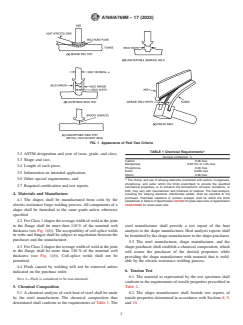
Note 1: Caution—Because of the absence of smooth, integral, large radius fillets at the junctions of the webs and the flanges (see Fig. 1), fatigue limits of resistance forge-welded shapes in torsion, lateral loading, and flexure are usually lower than those for hot-rolled shapes of similar size and material. Users should consult shape manufacturers for recommended values of fatigue limits for each specific use, material, and size in cases where dynamic loading is a principal design consideration.
FIG. 1 Appearance of Peel Test Criteria
1.4 When the steel is to be welded, it is presupposed that a welding procedure suitable for the grade of steel and intended use or service will be utilized. See Appendix X3 of Specification A6/A6M for information on weldability.
1.5 The values stated in either SI units or inch-pound units are to be regarded separately as standard. The values stated in each system may not be exact equivalents; therefore, each system shall be used independently of the other. Combining values from the two systems may result in non-conformance with the standard.
1.6 The following safety hazards caveat pertains only to the test methods portion, Section 10, of this specification: This standard does not purport to address all of the safety concerns, if any, associated with its use. It is the responsibility of the user of this standard to establish appropriate safety, health, and environmental practices and determine the applicability of regulatory limitations prior to use.
1.7 This international standard was developed in accordance with internationally recognized principles on standardization established in the Decision on Principles for the Development of International Standards, Guides and Recommendations issued by the World Trade Organization Technical Barriers to Trade (TBT) Committee.
- Status
- Published
- Publication Date
- 30-Apr-2023
- Technical Committee
- A01 - Steel, Stainless Steel and Related Alloys
Overview
ASTM A769/A769M-17(2023) is the standard specification issued by ASTM International for carbon and high-strength electric resistance forge-welded steel structural shapes. This specification is designed for structural quality shapes manufactured from steel coils using the electric resistance forge-welding process. The standard covers specific chemical compositions and mechanical property requirements for columns, beams, and tees, making it fundamental in the field of structural steel engineering and fabrication.
The standard applies to two principal classes of applications:
- Class 1: General structural use with predominantly static loading
- Class 2: Structural use where fatigue loading is a primary design consideration
Key Topics
Scope and Coverage
- Applies to carbon and high-strength steel structural shapes produced from coils
- Covered shapes include columns, beams, and tees
- Nominal size ranges:
- Web & Flange Thickness: 0.060 to 0.500 in. [1.5 to 12.7 mm]
- Overall Depth: 2.00 to 24.00 in. [50 to 600 mm]
- Flange Width: 0.50 to 12.00 in. [12.7 to 300 mm]
- Both SI and inch-pound units are recognized, but must not be intermixed
Manufacturing and Material Requirements
- Requires production from coils by an electric-resistance forge-welding process
- All shape components are furnished to the same grade unless otherwise specified
- Chemical composition must meet requirements for carbon, manganese, phosphorus, sulfur, and silicon
- Mechanical properties are defined for different grades, including tensile strength, yield point, and elongation
Testing and Inspection
- Mandatory tension tests, peel tests, and tee tension tests
- All shapes must comply with mechanical property requirements per grade and class
- Manufactured sections are inspected and marked according to ASTM and purchaser requirements
- Proper test reporting and certification are necessary for each batch
Weldability and Safety
- Welding procedures should be appropriate for the specific steel grade and application
- Users should review fatigue limits and weld quality criteria carefully-especially for dynamic loading scenarios
- The standard emphasizes that all safety, health, and environmental practices must be considered when utilizing these sections
Applications
Structural Steel Use
- Primarily used for fabricating structural frames, supports, and load-bearing assemblies in bridges, buildings, rolling stock, and ship construction
- Suited for both static and fatigue-sensitive applications, allowing engineers to select the right class for each project
Design Flexibility
- Broad range of available sizes and grades enables versatile design for various load requirements
- Applicable where electric resistance forge-welded shapes are preferred due to production efficiency or desired weld properties
Purchasing and Specification
- Used by steel suppliers, manufacturers, and purchasers to ensure material traceability, consistent quality, and compliance with design codes
- Essential for procurement contracts, detailed project specifications, and quality assurance processes
Related Standards
- ASTM A6/A6M: General Requirements for Rolled Structural Steel Bars, Plates, Shapes, and Sheet Piling
- ASTM A370: Test Methods and Definitions for Mechanical Testing of Steel Products
- ASTM A568/A568M: Steel, Sheet, Carbon, Structural, and High-Strength, Low-Alloy, Hot-Rolled and Cold-Rolled
- ASTM A635/A635M: Steel, Sheet and Strip, Heavy-Thickness Coils, Hot-Rolled, Alloy, Carbon, Structural, High-Strength Low-Alloy
- ASTM A700: Packaging, Marking, and Loading Methods for Steel Products
- AWS D1.1: Structural Welding Code (American Welding Society)
This standard is recognized internationally and aligns with World Trade Organization (WTO) principles, supporting global trade and compliance in steel construction projects.
Keywords: ASTM A769, structural steel, forge-welded steel shapes, electric resistance welding, high-strength steel, carbon steel shapes, ASTM standards, fatigue loading, static loading, steel manufacturing, mechanical properties, steel specification, structural engineering.
Relations
- Effective Date
- 01-Mar-2024
- Effective Date
- 01-Mar-2024
- Effective Date
- 01-Nov-2023
- Effective Date
- 01-Nov-2019
- Effective Date
- 01-Nov-2019
- Effective Date
- 01-Jul-2019
- Refers
ASTM A370-17a - Standard Test Methods and Definitions for Mechanical Testing of Steel Products - Effective Date
- 15-Nov-2017
- Effective Date
- 01-Nov-2017
- Effective Date
- 01-Nov-2017
- Effective Date
- 01-Sep-2017
- Effective Date
- 01-Jan-2017
- Effective Date
- 15-Nov-2016
- Effective Date
- 01-May-2016
- Effective Date
- 01-Nov-2015
- Effective Date
- 01-Nov-2015
Get Certified
Connect with accredited certification bodies for this standard

Element Materials Technology
Materials testing and product certification.

Inštitut za kovinske materiale in tehnologije
Institute of Metals and Technology. Materials testing, metallurgical analysis, NDT.
Sponsored listings
Frequently Asked Questions
ASTM A769/A769M-17(2023) is a technical specification published by ASTM International. Its full title is "Standard Specification for Carbon and High-Strength Electric Resistance Forge-Welded Steel Structural Shapes". This standard covers: ABSTRACT This specification covers carbon and high-strength steel shapes of structural quality manufactured by the electric resistance forge-welding process from coils. The specimens shall be established by the steel supplier, shape manufacturer, and shape purchaser of the materials. Specimens shall conform to the required chemical compositions of carbon, manganese, phosphorus, sulfur and silicon. Specimens shall undergo tension tests, peel tests and tee tension tests and shall conform to the required values of tensile strength, yield point, and elongation. SCOPE 1.1 This specification covers carbon and high-strength steel shapes of structural quality manufactured by the electric-resistance forge-welding process from coils. 1.2 The size range covered is described in nominal dimensions for columns, beams, and tees. Size Range, in. (mm) Web thickness 0.060 to 0.500 [1.5 to 12.7] Flange thickness 0.060 to 0.500 [1.5 to 12.7] Overall depth 2.00 to 24.00 [50 to 600] Flange width 0.50 to 12.00 [12.7 to 300] 1.3 These shapes are intended for two classes of application: 1.3.1 Class 1—General structural use where static loading predominates. 1.3.2 Class 2—Structural use where fatigue loading occurs and is a principal design consideration. Note 1: Caution—Because of the absence of smooth, integral, large radius fillets at the junctions of the webs and the flanges (see Fig. 1), fatigue limits of resistance forge-welded shapes in torsion, lateral loading, and flexure are usually lower than those for hot-rolled shapes of similar size and material. Users should consult shape manufacturers for recommended values of fatigue limits for each specific use, material, and size in cases where dynamic loading is a principal design consideration. FIG. 1 Appearance of Peel Test Criteria 1.4 When the steel is to be welded, it is presupposed that a welding procedure suitable for the grade of steel and intended use or service will be utilized. See Appendix X3 of Specification A6/A6M for information on weldability. 1.5 The values stated in either SI units or inch-pound units are to be regarded separately as standard. The values stated in each system may not be exact equivalents; therefore, each system shall be used independently of the other. Combining values from the two systems may result in non-conformance with the standard. 1.6 The following safety hazards caveat pertains only to the test methods portion, Section 10, of this specification: This standard does not purport to address all of the safety concerns, if any, associated with its use. It is the responsibility of the user of this standard to establish appropriate safety, health, and environmental practices and determine the applicability of regulatory limitations prior to use. 1.7 This international standard was developed in accordance with internationally recognized principles on standardization established in the Decision on Principles for the Development of International Standards, Guides and Recommendations issued by the World Trade Organization Technical Barriers to Trade (TBT) Committee.
ABSTRACT This specification covers carbon and high-strength steel shapes of structural quality manufactured by the electric resistance forge-welding process from coils. The specimens shall be established by the steel supplier, shape manufacturer, and shape purchaser of the materials. Specimens shall conform to the required chemical compositions of carbon, manganese, phosphorus, sulfur and silicon. Specimens shall undergo tension tests, peel tests and tee tension tests and shall conform to the required values of tensile strength, yield point, and elongation. SCOPE 1.1 This specification covers carbon and high-strength steel shapes of structural quality manufactured by the electric-resistance forge-welding process from coils. 1.2 The size range covered is described in nominal dimensions for columns, beams, and tees. Size Range, in. (mm) Web thickness 0.060 to 0.500 [1.5 to 12.7] Flange thickness 0.060 to 0.500 [1.5 to 12.7] Overall depth 2.00 to 24.00 [50 to 600] Flange width 0.50 to 12.00 [12.7 to 300] 1.3 These shapes are intended for two classes of application: 1.3.1 Class 1—General structural use where static loading predominates. 1.3.2 Class 2—Structural use where fatigue loading occurs and is a principal design consideration. Note 1: Caution—Because of the absence of smooth, integral, large radius fillets at the junctions of the webs and the flanges (see Fig. 1), fatigue limits of resistance forge-welded shapes in torsion, lateral loading, and flexure are usually lower than those for hot-rolled shapes of similar size and material. Users should consult shape manufacturers for recommended values of fatigue limits for each specific use, material, and size in cases where dynamic loading is a principal design consideration. FIG. 1 Appearance of Peel Test Criteria 1.4 When the steel is to be welded, it is presupposed that a welding procedure suitable for the grade of steel and intended use or service will be utilized. See Appendix X3 of Specification A6/A6M for information on weldability. 1.5 The values stated in either SI units or inch-pound units are to be regarded separately as standard. The values stated in each system may not be exact equivalents; therefore, each system shall be used independently of the other. Combining values from the two systems may result in non-conformance with the standard. 1.6 The following safety hazards caveat pertains only to the test methods portion, Section 10, of this specification: This standard does not purport to address all of the safety concerns, if any, associated with its use. It is the responsibility of the user of this standard to establish appropriate safety, health, and environmental practices and determine the applicability of regulatory limitations prior to use. 1.7 This international standard was developed in accordance with internationally recognized principles on standardization established in the Decision on Principles for the Development of International Standards, Guides and Recommendations issued by the World Trade Organization Technical Barriers to Trade (TBT) Committee.
ASTM A769/A769M-17(2023) is classified under the following ICS (International Classification for Standards) categories: 77.140.70 - Steel profiles. The ICS classification helps identify the subject area and facilitates finding related standards.
ASTM A769/A769M-17(2023) has the following relationships with other standards: It is inter standard links to ASTM A370-24, ASTM A6/A6M-24, ASTM A6/A6M-23, ASTM A700-14(2019), ASTM A568/A568M-19a, ASTM A370-19, ASTM A370-17a, ASTM A568/A568M-17a, ASTM A6/A6M-17a, ASTM A568/A568M-17, ASTM A370-17, ASTM A6/A6M-16a, ASTM A6/A6M-16, ASTM A568/A568M-15, ASTM A370-15. Understanding these relationships helps ensure you are using the most current and applicable version of the standard.
ASTM A769/A769M-17(2023) is available in PDF format for immediate download after purchase. The document can be added to your cart and obtained through the secure checkout process. Digital delivery ensures instant access to the complete standard document.
Standards Content (Sample)
This international standard was developed in accordance with internationally recognized principles on standardization established in the Decision on Principles for the
Development of International Standards, Guides and Recommendations issued by the World Trade Organization Technical Barriers to Trade (TBT) Committee.
Designation: A769/A769M − 17 (Reapproved 2023)
Standard Specification for
Carbon and High-Strength Electric Resistance Forge-
Welded Steel Structural Shapes
This standard is issued under the fixed designation A769/A769M; the number immediately following the designation indicates the year
of original adoption or, in the case of revision, the year of last revision. A number in parentheses indicates the year of last reapproval.
A superscript epsilon (´) indicates an editorial change since the last revision or reapproval.
1. Scope standard does not purport to address all of the safety concerns,
if any, associated with its use. It is the responsibility of the user
1.1 This specification covers carbon and high-strength steel
of this standard to establish appropriate safety, health, and
shapes of structural quality manufactured by the electric-
environmental practices and determine the applicability of
resistance forge-welding process from coils.
regulatory limitations prior to use.
1.2 The size range covered is described in nominal dimen-
1.7 This international standard was developed in accor-
sions for columns, beams, and tees.
dance with internationally recognized principles on standard-
Size Range, in. (mm)
ization established in the Decision on Principles for the
Web thickness 0.060 to 0.500 [1.5 to 12.7]
Development of International Standards, Guides and Recom-
Flange thickness 0.060 to 0.500 [1.5 to 12.7]
mendations issued by the World Trade Organization Technical
Overall depth 2.00 to 24.00 [50 to 600]
Flange width 0.50 to 12.00 [12.7 to 300]
Barriers to Trade (TBT) Committee.
1.3 These shapes are intended for two classes of application:
2. Referenced Documents
1.3.1 Class 1—General structural use where static loading
predominates.
2.1 ASTM Standards:
1.3.2 Class 2—Structural use where fatigue loading occurs
A6/A6M Specification for General Requirements for Rolled
and is a principal design consideration.
Structural Steel Bars, Plates, Shapes, and Sheet Piling
A370 Test Methods and Definitions for Mechanical Testing
of Steel Products
NOTE 1—Caution—Because of the absence of smooth, integral, large
A568/A568M Specification for Steel, Sheet, Carbon,
radius fillets at the junctions of the webs and the flanges (see Fig. 1),
fatigue limits of resistance forge-welded shapes in torsion, lateral loading, Structural, and High-Strength, Low-Alloy, Hot-Rolled and
and flexure are usually lower than those for hot-rolled shapes of similar
Cold-Rolled, General Requirements for
size and material. Users should consult shape manufacturers for recom-
A635/A635M Specification for Steel, Sheet and Strip,
mended values of fatigue limits for each specific use, material, and size in
Heavy-Thickness Coils, Hot-Rolled, Alloy, Carbon,
cases where dynamic loading is a principal design consideration.
Structural, High-Strength Low-Alloy, and High-Strength
1.4 When the steel is to be welded, it is presupposed that a
Low-Alloy with Improved Formability, General Require-
welding procedure suitable for the grade of steel and intended
ments for
use or service will be utilized. See Appendix X3 of Specifica-
A700 Guide for Packaging, Marking, and Loading Methods
tion A6/A6M for information on weldability.
for Steel Products for Shipment
1.5 The values stated in either SI units or inch-pound units
2.2 American Welding Society Standard:
are to be regarded separately as standard. The values stated in
AWS Specification D 1.1 Structural Welding Code
each system may not be exact equivalents; therefore, each
system shall be used independently of the other. Combining 3. Ordering Information
values from the two systems may result in non-conformance
3.1 Orders for material under this specification should
with the standard.
include the following, as required, to describe the desired
1.6 The following safety hazards caveat pertains only to the material adequately:
test methods portion, Section 10, of this specification: This
3.1.1 Quantity (total number of feet (metres) or lengths),
1 2
This specification is under the jurisdiction of ASTM Committee A01 on Steel, For referenced ASTM standards, visit the ASTM website, www.astm.org, or
Stainless Steel and Related Alloys and is the direct responsibility of Subcommittee contact ASTM Customer Service at service@astm.org. For Annual Book of ASTM
A01.02 on Structural Steel for Bridges, Buildings, Rolling Stock and Ships. Standards volume information, refer to the standard’s Document Summary page on
Current edition approved May 1, 2023. Published June 2023. Originally the ASTM website.
approved in 1979. Last previous edition approved in 2017 as A769/A769M – 17. Available from American Welding Society (AWS), 8669 NW 36 St., #130,
DOI: 10.1520/A0769_A0769M-17R23. Miami, FL 33166-6672, http://www.aws.org.
Copyright © ASTM International, 100 Barr Harbor Drive, PO Box C700, West Conshohocken, PA 19428-2959. United States
A769/A769M − 17 (2023)
FIG. 1 Appearance of Peel Test Criteria
A
TABLE 1 Chemical Requirements
3.2 ASTM designation and year of issue, grade, and class,
General Limitations, %
3.3 Shape and size,
Carbon 0.26 max
Manganese 0.30 min to 1.65 max
3.4 Length of each piece,
Phosphorus 0.03 max
Sulfur 0.035 max
3.5 Information on intended application,
Silicon 0.60 max
A
3.6 Other special requirements, and
The choice and use of alloying elements (combined with carbon, manganese,
phosphorus, and sulfur within the limits prescribed) to provide the specified
3.7 Required certification and test reports.
mechanical properties, or to enhance the atmospheric corrosion resistance, or
both, may vary with manufacturer and thickness of material. The heat analysis,
4. Materials and Manufacture
including the alloying elements intentionally added, shall be reported to the
purchaser. Permitted variations in product analysis shall be within the limits
4.1 The shapes shall be manufactured from coils by the
established in Table A of Specification A6/A6M for plate steel coils or Specification
A568/A568M for sheet steel coils.
electric-resistance forge-welding process. All components of a
shape shall be furnished to the same grade unless otherwise
specified.
4.2 For Class 1 shapes the average width of weld at the joint
to the flange shall be more than 110 % of the nominal web
steel manufacturer shall provide a test report of the heat
thickness (see Fig. 1(b)). The acceptability of coil-splice welds
analysis to the shape manufacturer. Heat analysis reports shall
in webs and flanges shall be subject to negotiation between the
be furnished by the shape manufacturer to the shape purchaser.
purchaser and the manufacturer.
5.2 The steel manufacturer, shape manufacturer, and the
4.3 For Class 2 shapes the average width of weld at the joint
shape purchaser shall establish a chemical composition, which
to the flange shall be more than 130 % of the nominal web
will assure the purchaser of the desired properties while
thickness (see Fig. 1(b)). Coil-splice welds shall not be
providing the shape manufacturer with material that is weld-
permitted.
able by the electric-resistance welding process.
4.4 Flash caused by welding will not be removed unless
6. Tension Test
indicated on the purchase order.
6.1 The material as represented by the test specimen shall
NOTE 2—Flash is considered to be non-structural.
conform to the requirements of tensile properties prescribed in
5. Chemical Composition Table 2.
5.1 A chemical analysis of each heat of steel shall be made 6.2 The shape manufacturer shall furnish test reports of
by the steel manufacturer. The chemical composition thus tensile properties determined in accordance with Sections 8, 9,
determined shall conform to the requirements of Table 1. The and 10.
A769/A769M − 17 (2023)
TABLE 2 Mechanical Properties
A A
Grade 36 45 45W 50 50W 60 80
Tensile strength, min, psi [MPa] 53 000 60 000 65 000 65 000 70 000 75 000 90 000
[365] [415] [450] [450] [485] [520] [620]
Yield point, min, psi [MPa] 36 000 45 000 45 000 50 000 50 000 60 000 80 000
[250] [310] [310] [345] [345] [415] [550]
Elongation, min, %
in 2 in. [50 mm] 22 19 19 17 17 17 17
B
in 8 in. [200 mm] 15 14 14 12 12 12 12
A
The suffix “W” indicates steel grades having atmospheric corrosion resistance approximately two times that of carbon structural steel with copper.
B
See elongation requirement adjustments under the Tension Tests section of Specification A6/A6M. See specimen orientation in the Tension Tests section of Specification
A6/A6M.
TABLE 3 Common Sizes of Electric Resistance Forge-Welded Sections
Designation Area Weight Depth Web Thickness Flange Width Flange Thickness
2 2
Depth × lb/ft in. mm lb/ft kg/m in. mm in. mm in. mm in. mm
3.50 × 3.57 1.028 663 3.57 5.31 3.50 89 0.105 2.7 3.25 83 0.105 2.7
3.63 × 5.54 1.599 1032 5.54 8.24 3.625 92 0.155 3.9 3.50 89 0.155 3.9
3.63 × 7.59 2.200 1419 7.59 11.30 3.625 92 0.155 3.9 3.50 89 0.245 6.2
3.63 × 10.28 2.973 1918 10.28 15.30 3.625 92 0.245 6.2 4.500 114 0.245 6.2
4.00 × 3.75 1.080 697 3.75 5.58 4.00 102 0.105 2.7 3.25 83 0.105 2.7
4.00 × 5.61 1.627 1050 5.61 8.35 4.00 102 1.105 2.7 4.00 102 0.155 3.9
4.00 × 8.62 2.504 1615 8.62 12.83 4.00 102 1.155 3.9 4.00 102 0.245 6.2
5.25 × 3.63 1.051 687 3.64 5.42 5.25 133 0.090 2.3 2.50 64 0.120 3.0
5.50 × 4.28 1.238 799 4.28 6.37 5.50 140 0.105 2.7 3.25 83 0.105 2.7
5.50 × 9.42 2.737 1766 9.42 14.02 5.50 140 0.155 3.9 4.00 102 0.245 6.2
6.00 × 4.46 1.290 832 4.46 6.64 6.00 152 0.105 2.7 3.25 83 0.105 2.7
6.00 × 6.80 1.967 1269 6.80 10.12 6.00 152 0.155 3.9 3.50 89 0.155 3.9
6.00 × 7.75 2.253 1454 7.75 11.53 6.00 152 0.120 3.0 4.50 114 0.175 4.4
6.00 × 9.68 2.814 1815 9.68 14.41 6.00 152 0.155 3.9 4.00 102 0.245 6.2
6.00 × 10.48 3.047 1966 10.48 15.60 6.00 152 0.175 4.4 4.25 108 0.245 6.2
6.00 × 12.41 3.610 2329 12.41 18.47 6.00 152 0.210 5.3 5.00 127 0.245 6.2
6.00 × 14.76 4.290 2768 14.76 21.97 6.00 152 0.245 6.2 6.00 152 0.245 6.2
6.50 × 4.02 1.181 762 4.02 5.98 6.50 165 0.090 2.3 2.50 64 0.120 3.0
8.00 × 6.38 1.853 1195 6.39 9.51 8.00 203 0.120 3.0 3.00 76 0.155 3.9
8.00 × 11.34 3.290 2123 11.34 16.88 8.00 203 0.210 5.3 3.50 89 0.245 6.2
8.00 × 21.52 6.276 4049 21.52 32.03 8.00 203 0.245 6.2 6.00 152 0.375 9.5
8.25 × 5.65 1.662 1072 5.65 8.41 8.25 210 0.090 2.3 3.00 76 0.155 3.9
10.00 × 7.59 2.208 1425 7.59 11.30 10.00 254 0.120 3.0 3.00 76 0.175 4.4
10.00 × 11.62 3.380 2181 11.62 17.29 10.00 254 0.175 4.4 3.50 89 0.245 6.2
10.25 × 7.69 2.238 1444 7.70 11.46 10.25 260 0.120 3.0 3.50 89 0.175 4.4
10.25 × 7.60 2.235 1442 7.60 11.31 10.25 260 0.100 2.5 3.50 89 0.175 4.4
10.25 × 8.28 2.437 1572 8.28 12.33 10.25 260 0.120 3.0 3.50 89 0.175 4.4
12.00 × 10.62 3.120 2013 10.62 15.80 12.00 305 0.120 3.0 3.50 89 0.245 6.2
12.25 × 9.90 2.911 1878 9.90 14.73 12.25 311 0.100 2.5 3.50 89 0.245 6.2
12.25 × 9.91 2.890 1865 9.91 14.75 12.25 311 0.120 3.0 3.50 89 0.210 5.3
12.25 × 10.71 3.150 2032 10.71 15.94 12.25 311 0.120 3.0 3.50 89 0.245 6.2
12.25 × 10.74 3.136 2023 10.74 15.98 12.25 311 0.100 2.5 4.00 102 0.245 6.2
12.25 × 11.54 3.371 2175 11.55 17.19 12.25 311 0.120 3.0 4.00 102 0.245 6.2
13.00 × 21.86 6.376 4114 21.86 32.53 13.00 330 0.245 6.2 4.50 114 0.375 9.5
13.00 × 24.41 7.1126 4597 24.41 36.33 13.00 330 0.245 6.2 5.50 140 0.375 9.5
14.00 × 11.43 3.336 2152 11.43 17
...