


ASTM C1442-14(2021)
(Practice)Standard Practice for Conducting Tests on Sealants Using Artificial Weathering Apparatus
Standard Practice for Conducting Tests on Sealants Using Artificial Weathering Apparatus
SIGNIFICANCE AND USE
5.1 This practice determines the effects of actinic radiation, elevated temperature, and moisture on sealants and their constituents under controlled laboratory artificial weather test conditions.
5.2 When conducting exposures in devices which use laboratory light sources, it is important to consider (1) how well the artificial test conditions will reproduce property changes and failure modes caused by end-use environments on the sealant being tested and (2) the stability ranking of sealants. Refer to Practice G151 for full cautionary guidance regarding laboratory weathering.
5.3 Because of differences in the spectral power distributions of the exposure sources (xenon arc, fluorescent UV lamps, and open flame carbon arc), as well as other conditions used in the three types of laboratory weathering tests, including temperature, type and amount of moisture, and test cycles, these three procedures may not result in the same performance ranking or types of failure modes of sealants. Further, different exposure durations may be required for testing the weathering performance of sealants by the three types of exposures. Comparisons should not be made of the relative stability of sealants exposed in the different types of apparatus.
5.4 Variations in results may be expected when operating conditions are varied within the accepted limits of this practice. Therefore, all test results using this practice must be accompanied by a report of the specific operating conditions as required in Section 10. Refer to Practice G151 for detailed information on the caveats applicable to use of results obtained according to this practice.
5.5 No laboratory exposure test can be specified as a total simulation of actual use conditions in outdoor environments. The relative durability of materials in actual use conditions can vary in different locations because of differences in UV radiation, time of wetness, relative humidity, temperature, pollutants, and other factors. Results ob...
SCOPE
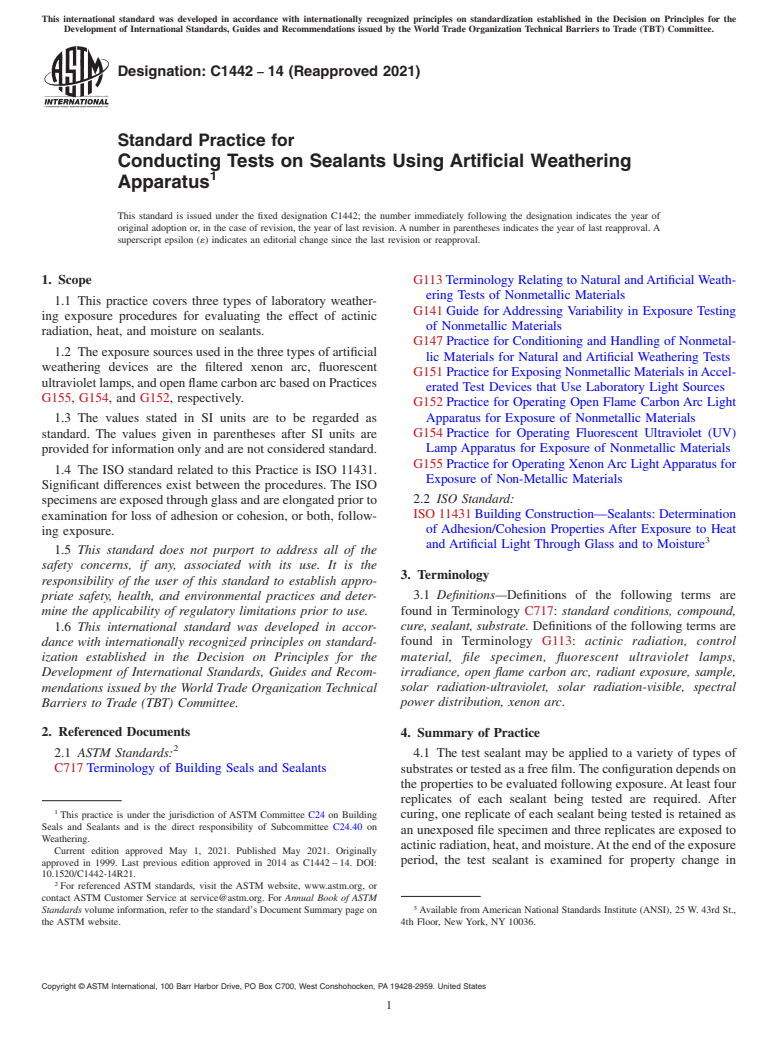
1.1 This practice covers three types of laboratory weathering exposure procedures for evaluating the effect of actinic radiation, heat, and moisture on sealants.
1.2 The exposure sources used in the three types of artificial weathering devices are the filtered xenon arc, fluorescent ultraviolet lamps, and open flame carbon arc based on Practices G155, G154, and G152, respectively.
1.3 The values stated in SI units are to be regarded as standard. The values given in parentheses after SI units are provided for information only and are not considered standard.
1.4 The ISO standard related to this Practice is ISO 11431. Significant differences exist between the procedures. The ISO specimens are exposed through glass and are elongated prior to examination for loss of adhesion or cohesion, or both, following exposure.
1.5 This standard does not purport to address all of the safety concerns, if any, associated with its use. It is the responsibility of the user of this standard to establish appropriate safety, health, and environmental practices and determine the applicability of regulatory limitations prior to use.
1.6 This international standard was developed in accordance with internationally recognized principles on standardization established in the Decision on Principles for the Development of International Standards, Guides and Recommendations issued by the World Trade Organization Technical Barriers to Trade (TBT) Committee.
General Information
Standards Content (Sample)
This international standard was developed in accordance with internationally recognized principles on standardization established in the Decision on Principles for the
Development of International Standards, Guides and Recommendations issued by the World Trade Organization Technical Barriers to Trade (TBT) Committee.
Designation: C1442 −14 (Reapproved 2021)
Standard Practice for
Conducting Tests on Sealants Using Artificial Weathering
1
Apparatus
This standard is issued under the fixed designation C1442; the number immediately following the designation indicates the year of
original adoption or, in the case of revision, the year of last revision. A number in parentheses indicates the year of last reapproval. A
superscript epsilon (´) indicates an editorial change since the last revision or reapproval.
1. Scope G113 Terminology Relating to Natural andArtificial Weath-
ering Tests of Nonmetallic Materials
1.1 This practice covers three types of laboratory weather-
G141 Guide for Addressing Variability in Exposure Testing
ing exposure procedures for evaluating the effect of actinic
of Nonmetallic Materials
radiation, heat, and moisture on sealants.
G147 Practice for Conditioning and Handling of Nonmetal-
1.2 The exposure sources used in the three types of artificial
lic Materials for Natural and Artificial Weathering Tests
weathering devices are the filtered xenon arc, fluorescent
G151 Practice for Exposing Nonmetallic Materials inAccel-
ultravioletlamps,andopenflamecarbonarcbasedonPractices
erated Test Devices that Use Laboratory Light Sources
G155, G154, and G152, respectively.
G152 Practice for Operating Open Flame Carbon Arc Light
Apparatus for Exposure of Nonmetallic Materials
1.3 The values stated in SI units are to be regarded as
standard. The values given in parentheses after SI units are G154 Practice for Operating Fluorescent Ultraviolet (UV)
Lamp Apparatus for Exposure of Nonmetallic Materials
provided for information only and are not considered standard.
G155 Practice for Operating XenonArc LightApparatus for
1.4 The ISO standard related to this Practice is ISO 11431.
Exposure of Non-Metallic Materials
Significant differences exist between the procedures. The ISO
2.2 ISO Standard:
specimensareexposedthroughglassandareelongatedpriorto
ISO 11431 Building Construction—Sealants: Determination
examination for loss of adhesion or cohesion, or both, follow-
of Adhesion/Cohesion Properties After Exposure to Heat
ing exposure.
3
and Artificial Light Through Glass and to Moisture
1.5 This standard does not purport to address all of the
safety concerns, if any, associated with its use. It is the
3. Terminology
responsibility of the user of this standard to establish appro-
priate safety, health, and environmental practices and deter- 3.1 Definitions—Definitions of the following terms are
mine the applicability of regulatory limitations prior to use. found in Terminology C717: standard conditions, compound,
1.6 This international standard was developed in accor- cure, sealant, substrate. Definitions of the following terms are
dance with internationally recognized principles on standard- found in Terminology G113: actinic radiation, control
material, file specimen, fluorescent ultraviolet lamps,
ization established in the Decision on Principles for the
Development of International Standards, Guides and Recom- irradiance, open flame carbon arc, radiant exposure, sample,
solar radiation-ultraviolet, solar radiation-visible, spectral
mendations issued by the World Trade Organization Technical
Barriers to Trade (TBT) Committee. power distribution, xenon arc.
2. Referenced Documents
4. Summary of Practice
2
2.1 ASTM Standards: 4.1 The test sealant may be applied to a variety of types of
C717 Terminology of Building Seals and Sealants
substratesortestedasafreefilm.Theconfigurationdependson
the properties to be evaluated following exposure.At least four
replicates of each sealant being tested are required. After
1
This practice is under the jurisdiction of ASTM Committee C24 on Building
curing, one replicate of each sealant being tested is retained as
Seals and Sealants and is the direct responsibility of Subcommittee C24.40 on
an unexposed file specimen and three replicates are exposed to
Weathering.
actinicradiation,heat,andmoisture.Attheendoftheexposure
Current edition approved May 1, 2021. Published May 2021. Originally
period, the test sealant is examined for property change in
approved in 1999. Last previous edition approved in 2014 as C1442 – 14. DOI:
10.1520/C1442-14R21.
2
For referenced ASTM standards, visit the ASTM website, www.astm.org, or
contact ASTM Customer Service at service@astm.org. For Annual Book of ASTM
3
Standards volume information, refer to the standard’s Document Summary page on Available fromAmerican National Standards Institute (ANSI), 25 W. 43rd St.,
the ASTM website. 4th Floor, New York, NY 10036.
Copyright © ASTM International, 100 Barr Harbor Drive, PO Box C700, West Conshohocken, PA 19428-2959. United S
...
Questions, Comments and Discussion
Ask us and Technical Secretary will try to provide an answer. You can facilitate discussion about the standard in here.