

ASTM B775/B775M-22
(Specification)Standard Specification for General Requirements for Nickel and Nickel Alloy Welded Pipe
General Information
- Abstract
ABSTRACT
This general specification contains the mandatory requirements to the ASTM standards listed herein for longitudinally welded piping made from nickel and nickel alloys. In case of conflict, the requirements listed in the particular product specification takes precedence over those listed here.
SCOPE
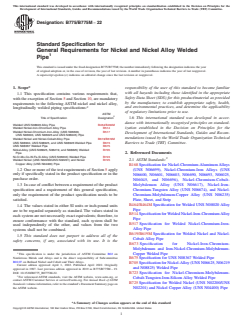
1.1 This specification contains various requirements that, with the exception of Section 5 and Section 10, are mandatory requirements to the following ASTM nickel and nickel alloy, longitudinally welded piping specifications:2
Title of Specification
ASTM
Designation2
Welded UNS N08020 Alloy Pipe
B464/B464M
Welded Nickel-Iron-Chromium Alloy Pipe
B514
Welded Nickel-Chromium-Iron-Alloy (UNS N06600,
UNS N06603, UNS N06025 and UNS N06045) Pipe
B517
Welded Nickel and Nickel-Cobalt Alloy Pipe
B619/B619M
UNS N08904, UNS N08925, and UNS N08926 Welded Pipe
B673
UNS N08367 Welded Pipe
B675
Nickel-Alloy (UNS N06625, N06219, and N08825) Welded Pipe
B705
Ni-Cr-Mo-Co-W-Fe-Si Alloy (UNS N06333) Welded Pipe
B723
Welded Nickel (UNS N02200/UNS N02201) and Nickel
Copper Alloy (UNS N04400) Pipe
B725
1.2 One or more of the test requirements of Section 5 apply only if specifically stated in the product specification or in the purchase order.
1.3 In case of conflict between a requirement of the product specification and a requirement of this general specification, only the requirement of the product specification needs to be satisfied.
1.4 The values stated in either SI units or inch-pound units are to be regarded separately as standard. The values stated in each system are not necessarily exact equivalents; therefore, to ensure conformance with the standard, each system shall be used independently of the other, and values from the two systems shall not be combined.
1.5 This standard does not purport to address all of the safety concerns, if any, associated with its use. It is the responsibility of the user of this standard to become familiar with all hazards including those identified in the appropriate Safety Data Sheet (SDS) for this product/material as provided by the manufacturer, to establish appropriate safety, health, and environmental practices, and determine the applicability of regulatory limitations prior to use.
1.6 This international standard was developed in accordance with internationally recognized principles on standardization established in the Decision on Principles for the Development of International Standards, Guides and Recommendations issued by the World Trade Organization Technical Barriers to Trade (TBT) Committee.
- Status
- Published
- Publication Date
- 31-Mar-2022
- Technical Committee
- B02 - Nonferrous Metals and Alloys
- Drafting Committee
- B02.07 - Refined Nickel and Cobalt and Their Alloys
Buy Documents
ASTM B775/B775M-22 - Standard Specification for General Requirements for Nickel and Nickel Alloy Welded Pipe
REDLINE ASTM B775/B775M-22 - Standard Specification for General Requirements for Nickel and Nickel Alloy Welded Pipe
Overview
ASTM B775/B775M-22: Standard Specification for General Requirements for Nickel and Nickel Alloy Welded Pipe outlines the mandatory requirements for longitudinally welded piping manufactured from nickel and nickel alloys. This standard serves as a comprehensive reference for welded nickel pipe used across a range of industries, ensuring consistent material quality, testing methods, dimensional accuracy, and markings. ASTM B775/B775M is a general specification applicable to various product specifications including, but not limited to, pipes produced according to ASTM B464/B464M, B514, B517, B619/B619M, B673, B675, B705, B723, and B725.
Key Topics
- Scope and Applicability: Covers welded piping made from a wide range of nickel and nickel alloy types, specifying when additional requirements apply as per individual product specifications.
- Test and Inspection Requirements:
- Chemical composition analysis, using prescribed ASTM test methods and tolerances.
- Mechanical testing procedures such as tension tests, flattening tests, bend tests, and hardness tests performed according to ASTM and ASME standards.
- Nondestructive testing, including ultrasonic and eddy current examinations, to identify imperfections or discontinuities in pipe welds.
- Hydrostatic and pneumatic leak testing to ensure pressure integrity.
- Dimensional Criteria: Specifies allowable tolerances for outside diameter, wall thickness, length, straightness, and end finish for welded nickel pipes. Permissible deviations ensure reliable fit and performance.
- Workmanship and Appearance: Requires pipes to have uniform quality, smoothness, and to be free from surface imperfections or defects affecting usability.
- Marking and Certification: Sets rules for product marking, lot identification, and documentation to ensure traceability and compliance with ASTM requirements.
- Repair by Welding: Allows for repair of weld seams under specified conditions using qualified procedures and mandatory post-repair inspection and testing.
Applications
Nickel and nickel alloy welded pipes fabricated under ASTM B775/B775M-22 are essential in industries demanding high resistance to corrosion, heat, and pressure. Typical applications include:
- Chemical Processing: Used in piping systems transporting reactive or corrosive chemicals due to superior corrosion resistance of nickel alloys.
- Petrochemical and Oil & Gas: Supports high-pressure and high-temperature service, commonly employed in refineries, offshore platforms, and pipelines.
- Power Generation: Integral in heat exchangers, condensers, and boiler components where mechanical strength and corrosion resistance are vital.
- Pharmaceutical and Food Processing: Utilized in process piping where cleanliness, durability, and resistance to contamination are critical.
- Desalination and Marine Engineering: Ensures long-lasting performance when exposed to seawater and other aggressive environments.
ASTM B775/B775M-22 ensures that welded nickel pipes meet the stringent requirements necessary for reliable performance in demanding settings, emphasizing both structural integrity and safety.
Related Standards
ASTM B775/B775M-22 is closely related to, and designed to support, the following ASTM specifications for nickel and nickel alloy welded pipe:
- ASTM B464/B464M: Welded UNS N08020 Alloy Pipe
- ASTM B514: Welded Nickel-Iron-Chromium Alloy Pipe
- ASTM B517: Welded Nickel-Chromium-Iron-Alloy Pipe
- ASTM B619/B619M: Welded Nickel and Nickel-Cobalt Alloy Pipe
- ASTM B673, B675, B705, B723, B725: Various nickel alloy and nickel-copper welded pipes
It also references additional testing and terminology standards such as ASTM E8/E8M (tension testing), E18 (hardness testing), E213 (ultrasonic testing), and B899 (terminology for nonferrous metals), aligning with ANSI and ASME codes for threads, pipe sizing, and welding procedures.
Practical Value
Compliance with ASTM B775/B775M-22 ensures pipe manufacturers, suppliers, and end-users benefit from:
- Consistent product quality
- Clear documentation and traceability
- Reliable testing and inspection protocols
- Compatibility across a broad range of nickel alloy grades
- Globally recognized compliance for international trade and specification
This standard is an essential resource for engineers, buyers, and quality control professionals involved in specifying, procuring, and validating welded nickel and nickel alloy piping for mission-critical applications.
Relations
- Effective Date
- 01-Apr-2024
- Effective Date
- 01-Jan-2024
- Refers
ASTM B619/B619M-19(2023) - Standard Specification for Welded Nickel and Nickel-Cobalt Alloy Pipe - Effective Date
- 01-Nov-2023
- Effective Date
- 01-Apr-2020
- Effective Date
- 01-Apr-2020
- Effective Date
- 01-Nov-2019
- Effective Date
- 01-Jul-2019
- Effective Date
- 01-Apr-2019
- Effective Date
- 01-Nov-2018
- Effective Date
- 01-Jul-2018
- Effective Date
- 01-Jul-2017
- Effective Date
- 01-Oct-2016
- Effective Date
- 15-Jul-2016
- Effective Date
- 01-Jun-2016
- Effective Date
- 01-Oct-2015
Buy Documents
ASTM B775/B775M-22 - Standard Specification for General Requirements for Nickel and Nickel Alloy Welded Pipe
REDLINE ASTM B775/B775M-22 - Standard Specification for General Requirements for Nickel and Nickel Alloy Welded Pipe
Get Certified
Connect with accredited certification bodies for this standard

Element Materials Technology
Materials testing and product certification.

Inštitut za kovinske materiale in tehnologije
Institute of Metals and Technology. Materials testing, metallurgical analysis, NDT.
Sponsored listings
Frequently Asked Questions
ASTM B775/B775M-22 is a technical specification published by ASTM International. Its full title is "Standard Specification for General Requirements for Nickel and Nickel Alloy Welded Pipe". This standard covers: ABSTRACT This general specification contains the mandatory requirements to the ASTM standards listed herein for longitudinally welded piping made from nickel and nickel alloys. In case of conflict, the requirements listed in the particular product specification takes precedence over those listed here. SCOPE 1.1 This specification contains various requirements that, with the exception of Section 5 and Section 10, are mandatory requirements to the following ASTM nickel and nickel alloy, longitudinally welded piping specifications:2 Title of Specification ASTM Designation2 Welded UNS N08020 Alloy Pipe B464/B464M Welded Nickel-Iron-Chromium Alloy Pipe B514 Welded Nickel-Chromium-Iron-Alloy (UNS N06600, UNS N06603, UNS N06025 and UNS N06045) Pipe B517 Welded Nickel and Nickel-Cobalt Alloy Pipe B619/B619M UNS N08904, UNS N08925, and UNS N08926 Welded Pipe B673 UNS N08367 Welded Pipe B675 Nickel-Alloy (UNS N06625, N06219, and N08825) Welded Pipe B705 Ni-Cr-Mo-Co-W-Fe-Si Alloy (UNS N06333) Welded Pipe B723 Welded Nickel (UNS N02200/UNS N02201) and Nickel Copper Alloy (UNS N04400) Pipe B725 1.2 One or more of the test requirements of Section 5 apply only if specifically stated in the product specification or in the purchase order. 1.3 In case of conflict between a requirement of the product specification and a requirement of this general specification, only the requirement of the product specification needs to be satisfied. 1.4 The values stated in either SI units or inch-pound units are to be regarded separately as standard. The values stated in each system are not necessarily exact equivalents; therefore, to ensure conformance with the standard, each system shall be used independently of the other, and values from the two systems shall not be combined. 1.5 This standard does not purport to address all of the safety concerns, if any, associated with its use. It is the responsibility of the user of this standard to become familiar with all hazards including those identified in the appropriate Safety Data Sheet (SDS) for this product/material as provided by the manufacturer, to establish appropriate safety, health, and environmental practices, and determine the applicability of regulatory limitations prior to use. 1.6 This international standard was developed in accordance with internationally recognized principles on standardization established in the Decision on Principles for the Development of International Standards, Guides and Recommendations issued by the World Trade Organization Technical Barriers to Trade (TBT) Committee.
ABSTRACT This general specification contains the mandatory requirements to the ASTM standards listed herein for longitudinally welded piping made from nickel and nickel alloys. In case of conflict, the requirements listed in the particular product specification takes precedence over those listed here. SCOPE 1.1 This specification contains various requirements that, with the exception of Section 5 and Section 10, are mandatory requirements to the following ASTM nickel and nickel alloy, longitudinally welded piping specifications:2 Title of Specification ASTM Designation2 Welded UNS N08020 Alloy Pipe B464/B464M Welded Nickel-Iron-Chromium Alloy Pipe B514 Welded Nickel-Chromium-Iron-Alloy (UNS N06600, UNS N06603, UNS N06025 and UNS N06045) Pipe B517 Welded Nickel and Nickel-Cobalt Alloy Pipe B619/B619M UNS N08904, UNS N08925, and UNS N08926 Welded Pipe B673 UNS N08367 Welded Pipe B675 Nickel-Alloy (UNS N06625, N06219, and N08825) Welded Pipe B705 Ni-Cr-Mo-Co-W-Fe-Si Alloy (UNS N06333) Welded Pipe B723 Welded Nickel (UNS N02200/UNS N02201) and Nickel Copper Alloy (UNS N04400) Pipe B725 1.2 One or more of the test requirements of Section 5 apply only if specifically stated in the product specification or in the purchase order. 1.3 In case of conflict between a requirement of the product specification and a requirement of this general specification, only the requirement of the product specification needs to be satisfied. 1.4 The values stated in either SI units or inch-pound units are to be regarded separately as standard. The values stated in each system are not necessarily exact equivalents; therefore, to ensure conformance with the standard, each system shall be used independently of the other, and values from the two systems shall not be combined. 1.5 This standard does not purport to address all of the safety concerns, if any, associated with its use. It is the responsibility of the user of this standard to become familiar with all hazards including those identified in the appropriate Safety Data Sheet (SDS) for this product/material as provided by the manufacturer, to establish appropriate safety, health, and environmental practices, and determine the applicability of regulatory limitations prior to use. 1.6 This international standard was developed in accordance with internationally recognized principles on standardization established in the Decision on Principles for the Development of International Standards, Guides and Recommendations issued by the World Trade Organization Technical Barriers to Trade (TBT) Committee.
ASTM B775/B775M-22 is classified under the following ICS (International Classification for Standards) categories: 77.150.40 - Nickel and chromium products. The ICS classification helps identify the subject area and facilitates finding related standards.
ASTM B775/B775M-22 has the following relationships with other standards: It is inter standard links to ASTM B705-24, ASTM E8/E8M-24, ASTM B619/B619M-19(2023), ASTM B723-20, ASTM B464/B464M-15(2020), ASTM B517-19, ASTM E571-19, ASTM B514-05(2019), ASTM B168-18, ASTM E18-18, ASTM E18-17, ASTM B899-16, ASTM E8/E8M-16, ASTM B168-11(2016), ASTM B464/B464M-15. Understanding these relationships helps ensure you are using the most current and applicable version of the standard.
ASTM B775/B775M-22 is available in PDF format for immediate download after purchase. The document can be added to your cart and obtained through the secure checkout process. Digital delivery ensures instant access to the complete standard document.
Standards Content (Sample)
This international standard was developed in accordance with internationally recognized principles on standardization established in the Decision on Principles for the
Development of International Standards, Guides and Recommendations issued by the World Trade Organization Technical Barriers to Trade (TBT) Committee.
Designation:B775/B775M −22
Standard Specification for
General Requirements for Nickel and Nickel Alloy Welded
Pipe
This standard is issued under the fixed designation B775/B775M; the number immediately following the designation indicates the year
of original adoption or, in the case of revision, the year of last revision. A number in parentheses indicates the year of last reapproval.
A superscript epsilon (´) indicates an editorial change since the last revision or reapproval.
1. Scope* responsibility of the user of this standard to become familiar
with all hazards including those identified in the appropriate
1.1 This specification contains various requirements that,
Safety Data Sheet (SDS) for this product/material as provided
with the exception of Section 5 and Section 10, are mandatory
by the manufacturer, to establish appropriate safety, health,
requirements to the following ASTM nickel and nickel alloy,
and environmental practices, and determine the applicability
longitudinally welded piping specifications:
of regulatory limitations prior to use.
ASTM
Title of Specification Designation
1.6 This international standard was developed in accor-
dance with internationally recognized principles on standard-
Welded UNS N08020 Alloy Pipe B464/B464M
ization established in the Decision on Principles for the
Welded Nickel-Iron-Chromium Alloy Pipe B514
Welded Nickel-Chromium-Iron-Alloy (UNS N06600, B517
Development of International Standards, Guides and Recom-
UNS N06603, UNS N06025 and UNS N06045) Pipe
mendations issued by the World Trade Organization Technical
Welded Nickel and Nickel-Cobalt Alloy Pipe B619/B619M
UNS N08904, UNS N08925, and UNS N08926 Welded Pipe B673
Barriers to Trade (TBT) Committee.
UNS N08367 Welded Pipe B675
Nickel-Alloy (UNS N06625, N06219, and N08825) Welded B705
2. Referenced Documents
Pipe
Ni-Cr-Mo-Co-W-Fe-Si Alloy (UNS N06333) Welded Pipe B723
Welded Nickel (UNS N02200/UNS N02201) and Nickel B725 2.1 ASTM Standards:
Copper Alloy (UNS N04400) Pipe
B168 Specification for Nickel-Chromium-AluminumAlloys
1.2 One or more of the test requirements of Section 5 apply
(UNS N06699), Nickel-Chromium-Iron Alloys (UNS
only if specifically stated in the product specification or in the
N06600, N06601, N06603, N06690, N06693, N06025,
purchase order.
N06045, and N06696), Nickel-Chromium-Cobalt-
Molybdenum Alloy (UNS N06617), Nickel-Iron-
1.3 In case of conflict between a requirement of the product
Chromium-Tungsten Alloy (UNS N06674), and Nickel-
specification and a requirement of this general specification,
Chromium-Molybdenum-Copper Alloy (UNS N06235)
only the requirement of the product specification needs to be
satisfied. Plate, Sheet, and Strip
B464/B464M Specification for Welded UNS N08020 Alloy
1.4 The values stated in either SI units or inch-pound units
Pipe
are to be regarded separately as standard. The values stated in
B514 SpecificationforWeldedNickel-Iron-ChromiumAlloy
each system are not necessarily exact equivalents; therefore, to
Pipe
ensure conformance with the standard, each system shall be
B517 Specification for Welded Nickel-Chromium-Iron-
used independently of the other, and values from the two
Alloy Pipe
systems shall not be combined.
B619/B619M Specification for Welded Nickel and Nickel-
1.5 This standard does not purport to address all of the
Cobalt Alloy Pipe
safety concerns, if any, associated with its use. It is the
B673 Specification for Nickel-Iron-Chromium-
Molybdenum and Iron-Nickel-Chromium-Molybdenum-
Copper Welded Pipe
This specification is under the jurisdiction of ASTM Committee B02 on
Nonferrous Metals and Alloys and is the direct responsibility of Subcommittee
B675 Specification for UNS N08367 Welded Pipe
B02.07 on Refined Nickel and Cobalt and Their Alloys.
B705 SpecificationforNickel-Alloy(UNSN06625,N06219
Current edition approved April 1, 2022. Published April 2022. Originally
and N08825) Welded Pipe
approved in 1987. Last previous edition approved in 2019 as B775/B775M – 19.
DOI: 10.1520/B0775_B0775M-22.
B723 Specification for Nickel-Chromium-Molybdenum-
For referenced ASTM standards, visit the ASTM website, www.astm.org, or
Cobalt-Tungsten-Iron-Silicon Alloy Welded Pipe
contact ASTM Customer Service at service@astm.org. For Annual Book of ASTM
B725 Specification for Welded Nickel (UNS N02200/UNS
Standards volume information, refer to the standard’s Document Summary page on
the ASTM website. N02201) and Nickel Copper Alloy (UNS N04400) Pipe
*A Summary of Changes section appears at the end of this standard
Copyright © ASTM International, 100 Barr Harbor Drive, PO Box C700, West Conshohocken, PA 19428-2959. United States
B775/B775M−22
B880 Specification for General Requirements for Chemical and produced to the particular dimensions commercially
Check Analysis Limits for Nickel, Nickel Alloys and known as pipe sizes (NPS).
Cobalt Alloys
4. Chemical Composition
B899 Terminology Relating to Non-ferrous Metals and Al-
loys
4.1 In case of disagreement, the chemical composition shall
E8/E8M Test Methods for Tension Testing of Metallic Ma-
be determined in accordance with the following methods:
terials
UNS No. Prefixes ASTM Method
E18 Test Methods for Rockwell Hardness of Metallic Ma- N02 E39
N04 E76
terials
N06, N08 E1473
E29 Practice for Using Significant Digits in Test Data to
4.2 The ladle analysis of the material shall conform to the
Determine Conformance with Specifications
chemical requirements prescribed by the individual product
E39 Methods for Chemical Analysis of Nickel (Withdrawn
specification.
1995)
E76 Test Methods for Chemical Analysis of Nickel-Copper 4.3 The product (check) analysis of the material shall meet
Alloys (Withdrawn 2003)
the requirements for the ladle analysis within the tolerance
E112 Test Methods for Determining Average Grain Size
limits prescribed in Specification B880.
E213 Practice for Ultrasonic Testing of Metal Pipe and
5. Test Requirements
Tubing
E426 Practice for Electromagnetic (Eddy Current) Examina-
5.1 Flattening Test:
tion of Seamless and Welded Tubular Products, Titanium,
5.1.1 Alength of pipe not less than 4 in. [102 mm], shall be
Austenitic Stainless Steel and Similar Alloys
flattened under a load applied gradually at room temperature
E527 Practice for Numbering Metals and Alloys in the
until the distance between the platens is five times the wall
Unified Numbering System (UNS)
thickness. The weld shall be positioned 90° from the direction
E571 PracticeforElectromagnetic(Eddy-Current)Examina-
of the applied flattening force.
tion of Nickel and Nickel Alloy Tubular Products
5.1.2 The flattened specimen shall not exhibit cracks.
E1473 Test Methods for Chemical Analysis of Nickel, Co-
5.1.3 Superficial ruptures resulting from surface imperfec-
balt and High-Temperature Alloys
tions shall not be a cause for rejection.
2.2 ANSI Standards:
5.2 Transverse Guided-Bend Weld Test:
B1.20.1 Pipe Threads
5.2.1 For welded pipe made either with or without the
B36.10 Welded and Seamless Wrought Steel Pipe
addition of filler and at the option of the manufacturer, the
B36.19 Stainless Steel Pipe
transverse guided bend weld test may be substituted in lieu of
2.3 SAE Standards:
the flattening test. Two bend test specimens shall be taken
SAE J 1086 Practice for Numbering Metals and Alloys
transverselyfrompipeorthetestspecimensmaybetakenfrom
(UNS)
a test plate of the same material and heat as the pipe, which is
2.4 Other Documents:
attached to the end of the cylinder and welded as a prolonga-
ASME Boiler and Pressure Vessel Code Section IX – Weld-
tion of the pipe longitudinal seam. Except as provided in 5.2.2,
ing and Brazing Qualifications
one shall be subject to a face guided bend test and a second to
a root guided bend test. One specimen shall be bent with the
3. Terminology
insidesurfaceofthepipeagainsttheplungerandtheotherwith
3.1 Definitions—Definitions for terms defined in Terminol-
theoutsidesurfaceofthepipeagainsttheplunger.Guidedbend
ogy B899 shall apply unless otherwise defined by the require-
test specimens shall be prepared and tested in accordance with
ments of this document. Section IX, Part QW, Paragraph QW 160 of the ASME Boiler
3.1.1 averagediameter,n—theaverageofthemaximumand
and Pressure Vessel Code and shall be one of the types shown
minimum outside diameters, as determined at any one cross in QW 463.1 of that code.
section of the pipe.
5.2.2 For wall thicknesses over ⁄8 in. [10 mm] but less than
⁄4 in. [19 mm] side bend tests may be made instead of the face
3.1.2 nominalwall,n—aspecifiedwallthicknesswithaplus
and root bend tests. For specified wall thicknesses ⁄4 in.
or minus tolerance from the specified thickness.
[19 mm] and over, both specimens shall be subjected to the
3.1.3 welded pipe, n—a round hollow produced by forming
side bend tests. Side bend specimens shall be bent so that one
flat stock and joining the single longitudinal seam by welding,
of the side surfaces becomes the convex surface of the bend
specimen.
5.2.3 The bend test shall be acceptable if no cracks or other
The last approved version of this historical standard is referenced on
www.astm.org.
defects exceeding ⁄8 in. [3 mm] in any direction be present in
Available fromAmerican National Standards Institute (ANSI), 25 W. 43rd St.,
the weld metal or between the weld and the pipe or plate metal
4th Floor, New York, NY 10036, http://www.ansi.org.
after bending. Cracks which originate along the edges of the
Available from SAE International (SAE), 400 Commonwealth Dr.,Warrendale,
PA 15096, http://www.sae.org. specimen during testing, and that are less than ⁄4 in. [6 mm]
Available from American Society of Mechanical Engineers (ASME), ASME
measured in any direction shall not be considered.
International Headquarters, Three Park Ave., New York, NY 10016-5990, http://
www.asme.org. 5.3 Pressure (Leak Test):
B775/B775M−22
5.3.1 Hydrostatic—Each pipe shall be tested by the manu- the specified wall thickness or 0.004 in. [0.10 mm], whichever
facturer to a minimum internal hydrostatic pressure of 1000 psi is greater. The notch shall be placed in the weld, if visible.
[7 MPa] provided that the fiber stress, calculated from the
5.4.3 Calibration Frequency—The frequency of calibration
following equation, does not exceed the allowable fiber stress checks shall be as follows:
for the material:
5.4.3.1 At the beginning of each production run.
5.4.3.2 At least every four hours during testing.
P 5 2St/D (1)
5.4.3.3 At the end of each production run.
where:
5.4.3.4 After any suspected equipment malfunction or work
P = hydrostatic test pressure, psi [MPa],
stoppage.
S = allowable fiber stress, for material in the condition
5.4.3.5 If, during any check, the equipment fails to detect
(temper) furnished as specified in the product specifi-
the calibration defects, the instrument must be recalibrated and
cation (S is calculated as the lower of ⁄3 of the specified
all material tested since the last satisfactory check shall be
minimum 0.2 % offset yield strength or ⁄4 of the
retested.
specified minimum ultimate strength for the material),
5.4.4 Acceptance and Rejection—Material producing a sig-
t = minimum wall thickness permitted, in. [mm], including
nal equal to or greater than the calibration defect shall be
minus tolerance, if any, and
subject to rejection.
D = nominal outside diameter of the pipe, in. [mm].
5.4.4.1 Test signals that are produced by imperfections that
5.3.1.1 Thetestpressureshallbeheldforasufficienttimeto
cannot be identified or that are produced by cracks or crack-
permit the entire length of the welded seam to be inspected.
like imperfections shall result in rejection of the pipe, subject
5.3.2 Pneumatic (Air Underwater Test)—Each pipe shall be to rework and retest.
tested at a pressure of 150 psi [1 MPa]. The test pressure shall
5.4.4.2 If the imperfection is judged as not fit for use, the
beheldforaminimumof5s.Visualexaminationistobemade
tube shall be rejected, but may be reconditioned and retested
when the material is submerged and under pressure. The full
providing the wall thickness requirements are met. To be
length of pipe must be examined for leaks.
accepted, retested material shall meet the original electric test
5.3.3 If any pipe shows leaks during hydrostatic or pneu- requirements.
matic testing, it shall be rejected.
5.4.4.3 If the imperfection is explored to the extent that it
can be identified, and the pipe is determined to be fit for use,
5.4 Nondestructive Electric Test:
the material may be accepted without further testing providing
5.4.1 Eddy Current Testing—Testing shall be conducted in
theimperfectiondoesnotencroachonminimumwallthickness
accordance with Practices E426 or E571. The eddy current
requirements.
examination reference in this specification has the capability of
detecting significant discontinuities, especially of the short,
5.5 Tension Test—Tension testing shall be conducted in
abrupt type. accordance with Test Methods E8/E8M.
5.4.1.1 Unless otherwise specified by the purchaser, the 5.5.1 The material shall conform to the tensile properties
calibration standard shall contain, at the option of the
prescribed in the individual product specification.
manufacturer, any one of the following discontinuities to
5.6 Hardness Test—Hardness testing shall be conducted in
establish a minimum sensitivity level for rejection. The dis-
accordance with Test Methods E18.
continuity shall be placed in the weld if visible.
5.7 Grain Size—The measurement of average grain size
5.4.1.2 Drill Hole—A hole not larger than 0.031 in.
may be carried out by the planimetric method, the comparison
[0.8 mm] diameter shall be drilled radially and completely
method, or the intercept method described in Test Methods
through the wall, care being taken to avoid distortion of the
E112. In case of dispute, the “referee” method for determining
material while drilling.
average grain size shall be the intercept method.
5.4.1.3 Transverse Tangential Notch—Using a round file or
tool with a ⁄4 in. [6 mm] diameter, a notch shall be filed or
5.8 For purposes of determining compliance with the speci-
milled on the pipe outside diameter tangential to the surface
fied limits for requirements of the properties listed in the
and transverse to the longitudinal axis of the material. Said
following table, an observed value or a calculated value shall
notch shall have a depth not exceeding 12.5 % of the specified
beroundedinaccordancewiththeroundingmethodofPractice
wall thickness of the material, or 0.004 in. [0.10 mm],
E29:
whichever is greater.
Rounded Unit for Observed
Requirements
5.4.2 Ultrasonic Testing—Testing shall be conducted in or Calculated Value
accordance with Practice E213. The ultrasonic examination
Chemical composition and tolerances nearest unit in the last right-hand
referred to in this specification is intended to detect longitudi-
place of figures of the specified limit
nal discontinuities having a reflective area similar to or larger Tensile strength and yield strength nearest 1000 psi [7 MPa]
Elongation nearest 1 %
than the calibration reference notches specified in 5.4.2.1. The
examination may not detect circumferentially oriented imper-
6. Dimensions and Permissible Variations
fections or short, deep defects.
5.4.2.1 For ultrasonic testing, longitudinal calibration 6.1 Dimensions of pipe are shown in Table 1.
notches shall be machined on the outside and inside diameter 6.1.1 Permissible variations in outside diameter and wall
surfaces. The depth of the notches shall not exceed 12.5 % of thickness are shown in Table 2.
B775/B775M−22
TABLE 1 Dimensions of Pipe
NOTE 1—The following table is a reprint of Table 1 of ANSI B36.19.
NOTE 2—The decimal thicknesses listed for the respective pipe sizes represent their nominal wall dimensions.
Outside Diameter Nominal Wall Thickness
NPS
A A
Designator Schedule 5S Schedule 10S Schedule 40S Schedule 80S
in. mm
[mm]
in. mm in. mm in. mm in. mm
⁄8 [10.29] 0.405 10.29 . . 0.049 1.24 0.068 1.73 0.095 2.41
⁄4 [13.72] 0.540 13.72 . . 0.065 1.65 0.088 2.24 0.119 3.02
⁄8 [17.15] 0.675 17.15 . . 0.065 1.65 0.091 2.31 0.126 3.20
⁄2 [21.34] 0.840 21.3
...
This document is not an ASTM standard and is intended only to provide the user of an ASTM standard an indication of what changes have been made to the previous version. Because
it may not be technically possible to adequately depict all changes accurately, ASTM recommends that users consult prior editions as appropriate. In all cases only the current version
of the standard as published by ASTM is to be considered the official document.
Designation: B775/B775M − 19 B775/B775M − 22
Standard Specification for
General Requirements for Nickel and Nickel Alloy Welded
Pipe
This standard is issued under the fixed designation B775/B775M; the number immediately following the designation indicates the year
of original adoption or, in the case of revision, the year of last revision. A number in parentheses indicates the year of last reapproval.
A superscript epsilon (´) indicates an editorial change since the last revision or reapproval.
1. Scope*
1.1 This specification contains various requirements that, with the exception of Section 5 and Section 10, are mandatory
requirements to the following ASTM nickel and nickel alloy, longitudinally welded piping specifications:
ASTM
Title of Specification Designation
Welded UNS N08020 Alloy Pipe B464/B464M
Welded Nickel-Iron-Chromium Alloy Pipe B514
Welded Nickel-Chromium-Iron-Alloy (UNS N06600, B517
UNS N06603, UNS N06025 and UNS N06045) Pipe
Welded Nickel and Nickel-Cobalt Alloy Pipe B619/B619M
UNS N08904, UNS N08925, and UNS N08926 Welded Pipe B673
UNS N08367 Welded Pipe B675
Nickel-Alloy (UNS N06625, N06219, and N08825) Welded B705
Pipe
Ni-Cr-Mo-Co-W-Fe-Si Alloy (UNS N06333) Welded Pipe B723
Welded Nickel (UNS N02200/UNS N02201) and Nickel B725
Copper Alloy (UNS N04400) Pipe
1.2 One or more of the test requirements of Section 5 apply only if specifically stated in the product specification or in the purchase
order.
1.3 In case of conflict between a requirement of the product specification and a requirement of this general specification, only the
requirement of the product specification needs to be satisfied.
1.4 The values stated in either SI units or inch-pound units are to be regarded separately as standard. The values stated in each
system are not necessarily exact equivalents; therefore, to ensure conformance with the standard, each system shall be used
independently of the other, and values from the two systems shall not be combined.
1.5 This standard does not purport to address all of the safety concerns, if any, associated with its use. It is the responsibility
of the user of this standard to become familiar with all hazards including those identified in the appropriate Safety Data Sheet
(SDS) for this product/material as provided by the manufacturer, to establish appropriate safety, health, and environmental
practices, and determine the applicability of regulatory limitations prior to use.
This specification is under the jurisdiction of ASTM Committee B02 on Nonferrous Metals and Alloys and is the direct responsibility of Subcommittee B02.07 on Refined
Nickel and Cobalt and Their Alloys.
Current edition approved April 1, 2019April 1, 2022. Published April 2019April 2022. Originally approved in 1987. Last previous edition approved in 20162019 as
B775/B775M – 16.B775/B775M – 19. DOI: 10.1520/B0775_B0775M-19.10.1520/B0775_B0775M-22.
For referenced ASTM standards, visit the ASTM website, www.astm.org, or contact ASTM Customer Service at service@astm.org. For Annual Book of ASTM Standards
volume information, refer to the standard’s Document Summary page on the ASTM website.
*A Summary of Changes section appears at the end of this standard
Copyright © ASTM International, 100 Barr Harbor Drive, PO Box C700, West Conshohocken, PA 19428-2959. United States
B775/B775M − 22
1.6 This international standard was developed in accordance with internationally recognized principles on standardization
established in the Decision on Principles for the Development of International Standards, Guides and Recommendations issued
by the World Trade Organization Technical Barriers to Trade (TBT) Committee.
2. Referenced Documents
2.1 ASTM Standards:
B168 Specification for Nickel-Chromium-Aluminum Alloys (UNS N06699), Nickel-Chromium-Iron Alloys (UNS N06600,
N06601, N06603, N06690, N06693, N06025, N06045, and N06696), Nickel-Chromium-Cobalt-Molybdenum Alloy (UNS
N06617), Nickel-Iron-Chromium-Tungsten Alloy (UNS N06674), and Nickel-Chromium-Molybdenum-Copper Alloy (UNS
N06235) Plate, Sheet, and Strip
B464/B464M Specification for Welded UNS N08020 Alloy Pipe
B514 Specification for Welded Nickel-Iron-Chromium Alloy Pipe
B517 Specification for Welded Nickel-Chromium-Iron-Alloy Pipe
B619/B619M Specification for Welded Nickel and Nickel-Cobalt Alloy Pipe
B673 Specification for Nickel-Iron-Chromium-Molybdenum and Iron-Nickel-Chromium-Molybdenum-Copper Welded Pipe
B675 Specification for UNS N08367 Welded Pipe
B705 Specification for Nickel-Alloy (UNS N06625, N06219 and N08825) Welded Pipe
B723 Specification for Nickel-Chromium-Molybdenum-Cobalt-Tungsten-Iron-Silicon Alloy Welded Pipe
B725 Specification for Welded Nickel (UNS N02200/UNS N02201) and Nickel Copper Alloy (UNS N04400) Pipe
B880 Specification for General Requirements for Chemical Check Analysis Limits for Nickel, Nickel Alloys and Cobalt Alloys
B899 Terminology Relating to Non-ferrous Metals and Alloys
E8/E8M Test Methods for Tension Testing of Metallic Materials
E18 Test Methods for Rockwell Hardness of Metallic Materials
E29 Practice for Using Significant Digits in Test Data to Determine Conformance with Specifications
E39 Methods for Chemical Analysis of Nickel (Withdrawn 1995)
E76 Test Methods for Chemical Analysis of Nickel-Copper Alloys (Withdrawn 2003)
E112 Test Methods for Determining Average Grain Size
E213 Practice for Ultrasonic Testing of Metal Pipe and Tubing
E426 Practice for Electromagnetic (Eddy Current) Examination of Seamless and Welded Tubular Products, Titanium, Austenitic
Stainless Steel and Similar Alloys
E527 Practice for Numbering Metals and Alloys in the Unified Numbering System (UNS)
E571 Practice for Electromagnetic (Eddy-Current) Examination of Nickel and Nickel Alloy Tubular Products
E1473 Test Methods for Chemical Analysis of Nickel, Cobalt and High-Temperature Alloys
2.2 ANSI Standards:
B1.20.1 Pipe Threads
B36.10 Welded and Seamless Wrought Steel Pipe
B36.19 Stainless Steel Pipe
2.3 SAE Standards:
SAE J 1086 Practice for Numbering Metals and Alloys (UNS)
2.4 Other Documents:
ASME Boiler and Pressure Vessel Code Section IX – Welding and Brazing Qualifications
2.4 SAE:
SAE J 1086 Practice for Numbering Metals and Alloys (UNS)
3. Terminology
3.1 Definitions — Definitions —Definitions for terms defined in Terminology B899 shall apply unless otherwise defined by the
requirements of this document.
3.1.1 average diameter, n—the average of the maximum and minimum outside diameters, as determined at any one cross section
of the pipe.
3.1.2 nominal wall, n—a specified wall thickness with a plus or minus tolerance from the specified thickness.
The last approved version of this historical standard is referenced on www.astm.org.
Available from American National Standards Institute (ANSI), 25 W. 43rd St., 4th Floor, New York, NY 10036, http://www.ansi.org.
Available from SAE International (SAE), 400 Commonwealth Dr., Warrendale, PA 15096, http://www.sae.org.
Available from American Society of Mechanical Engineers (ASME), ASME International Headquarters, Three Park Ave., New York, NY 10016-5990, http://
www.asme.org.
B775/B775M − 22
3.1.3 welded pipe, n—a round hollow produced by forming flat stock and joining the single longitudinal seam by welding, and
produced to the particular dimensions commercially known as pipe sizes (NPS).
4. Chemical Composition
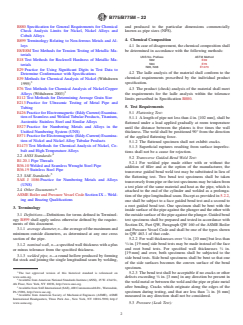
4.1 In case of disagreement, the chemical composition shall be determined in accordance with the following methods:
UNS No. Prefixes ASTM Method
N02 E39
N04 E76
N06, N08 E1473
4.2 The ladle analysis of the material shall conform to the chemical requirements prescribed by the individual product
specification.
4.3 The product (check) analysis of the material shall meet the requirements for the ladle analysis within the tolerance limits
prescribed in Specification B880.
5. Test Requirements
5.1 Flattening Test:
5.1.1 A length of pipe not less than 4 in. [102 mm], shall be flattened under a load applied gradually at room temperature until
the distance between the platens is five times the wall thickness. The weld shall be positioned 90° from the direction of the applied
flattening force.
5.1.2 The flattened specimen shall not exhibit cracks.
5.1.3 Superficial ruptures resulting from surface imperfections shall not be a cause for rejection.
5.2 Transverse Guided-Bend Weld Test:
5.2.1 For welded pipe made either with or without the addition of filler and at the option of the manufacturer, the transverse guided
bend weld test may be substituted in lieu of the flattening test. Two bend test specimens shall be taken transversely from pipe or
the test specimens may be taken from a test plate of the same material and heat as the pipe, which is attached to the end of the
cylinder and welded as a prolongation of the pipe longitudinal seam. Except as provided in 5.2.2, one shall be subject to a face
guided bend test and a second to a root guided bend test. One specimen shall be bent with the inside surface of the pipe against
the plunger and the other with the outside surface of the pipe against the plunger. Guided bend test specimens shall be prepared
and tested in accordance with Section IX, Part QW, Paragraph QW 160 of the ASME Boiler and Pressure Vessel Code and shall
be one of the types shown in QW 463.1 of that code.
3 3
5.2.2 For wall thicknesses over ⁄8 in. [10 mm] but less than ⁄4 in. [19 mm] [19 mm] side bend tests may be made instead of the
face and root bend tests. For specified wall thicknesses ⁄4 in. [19 mm] [19 mm] and over, both specimens shall be subjected to
the side bend tests. Side bend specimens shall be bent so that one of the side surfaces becomes the convex surface of the bend
specimen.
5.2.3 The bend test shall be acceptable if no cracks or other defects exceeding ⁄8 in. [3 mm] in any direction be present in the
weld metal or between the weld and the pipe or plate metal after bending. Cracks which originate along the edges of the specimen
during testing, and that are less than ⁄4 in. [6 mm] measured in any direction shall not be considered.
5.3 Pressure (Leak Test):
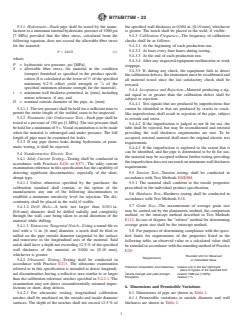
5.3.1 Hydrostatic—Each pipe shall be tested by the manufacturer to a minimum internal hydrostatic pressure of 1000 psi [7 MPa]
provided that the fiber stress, calculated from the following equation, does not exceed the allowable fiber stress for the material:
P 5 2St/D (1)
B775/B775M − 22
where:
P = hydrostatic test pressure, psi [MPa)],
P = hydrostatic test pressure, psi [MPa],
S = allowable fiber stress, for material in the condition (temper) furnished as specified in the product specification (S is
2 1
calculated as the lower of ⁄3 of the specified minimum 0.2 % offset yield strength or ⁄4 of the specified minimum ultimate
strength for the material),
t = minimum wall thickness permitted, in. [mm], including minus tolerance, if any, and
D = nominal outside diameter of the pipe, in. [mm].
5.3.1.1 The test pressure shall be held for a sufficient time to permit the entire length of the welded seam to be inspected.
5.3.2 Pneumatic (Air Underwater Test)—Each pipe shall be tested at a pressure of 150 psi [1 MPa]. The test pressure shall be held
for a minimum of 5 s. Visual examination is to be made when the material is submerged and under pressure. The full length of
pipe must be examined for leaks.
5.3.3 If any pipe shows leaks during hydrostatic or pneumatic testing, it shall be rejected.
5.4 Nondestructive Electric Test:
5.4.1 Eddy Current Testing—Testing shall be conducted in accordance with Practices E426 or E571. The eddy current examination
reference in this specification has the capability of detecting significant discontinuities, especially of the short, abrupt type.
5.4.1.1 Unless otherwise specified by the purchaser, the calibration standard shall contain, at the option of the manufacturer, any
one of the following discontinuities to establish a minimum sensitivity level for rejection. The discontinuity shall be placed in the
weld if visible.
5.4.1.2 Drill Hole—A hole not larger than 0.031 in. [0.8 mm] 0.031 in. [0.8 mm] diameter shall be drilled radially and completely
through the wall, care being taken to avoid distortion of the material while drilling.
5.4.1.3 Transverse Tangential Notch—Using a round file or tool with a ⁄4 in. [6 mm] diameter, a notch shall be filed or milled on
the pipe outside diameter tangential to the surface and transverse to the longitudinal axis of the material. Said notch shall have a
depth not exceeding 12.5 % of the specified wall thickness of the material, or 0.004 in. [0.10 mm], whichever is greater.
5.4.2 Ultrasonic Testing—Testing shall be conducted in accordance with Practice E213. The ultrasonic examination referred to in
this specification is intended to detect longitudinal discontinuities having a reflective area similar to or larger than the calibration
reference notches specified in 5.4.2.1. The examination may not detect circumferentially oriented imperfections or short, deep
defects.
5.4.2.1 For ultrasonic testing, longitudinal calibration notches shall be machined on the outside and inside diameter surfaces. The
depth of the notches shall not exceed 12.5 % of the specified wall thickness or 0.004 in. [0.10 mm], whichever is greater. The notch
shall be placed in the weld, if visible.
5.4.3 Calibration Frequency—The frequency of calibration checks shall be as follows:
5.4.3.1 At the beginning of each production run.
5.4.3.2 At least every four hours during testing.
5.4.3.3 At the end of each production run.
5.4.3.4 After any suspected equipment malfunction or work stoppage.
5.4.3.5 If, during any check, the equipment fails to detect the calibration defects, the instrument must be recalibrated and all
material tested since the last satisfactory check shall be retested.
5.4.4 Acceptance and Rejection—Material producing a signal equal to or greater than the calibration defect shall be subject to
rejection.
B775/B775M − 22
5.4.4.1 Test signals that are produced by imperfections that cannot be identified or that are produced by cracks or crack-like
imperfections shall result in rejection of the pipe, subject to rework and retest.
5.4.4.2 If the imperfection is judged as not fit for use, the tube shall be rejected, but may be reconditioned and retested providing
the wall thickness requirements are met. To be accepted, retested material shall meet the original electric test requirements.
5.4.4.3 If the imperfection is explored to the extent that it can be identified, and the pipe is determined to be fit for use, the material
may be accepted without further testing providing the imperfection does not encroach on minimum wall thickness requirements.
5.5 Tension Test—Tension testing shall be conducted in accordance with Test Methods E8/E8M.
5.5.1 The material shall conform to the tensile properties prescribed in the individual product specification.
5.6 Hardness Test—Hardness testing shall be conducted in accordance with Test Methods E18.
5.7 Grain Size—The measurement of average grain size may be carried out by the planimetric method, the comparison method,
or the intercept method described in Test Methods E112. In case of dispute, the “referee” method for determining average grain
size shall be the intercept method.
5.8 For purposes of determining compliance with the specified limits for requirements of the properties listed in the following
table, an observed value or a calculated value shall be rounded in accordance with the rounding method of Practice E29:
Rounded Unit for Observed
Requirements
or Calculated Value
Chemical composition and tolerances nearest unit in the last right-hand
place of figures of the specified limit
Tensile strength and yield strength nearest 1000 psi [7 MPa]
Elongation nearest 1 %
6. Dimensions and Permissible Variations
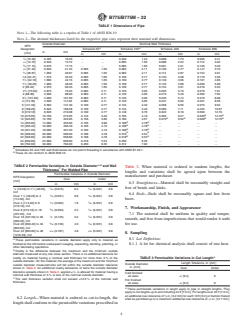
6.1 Dimensions of pipe are shown in Table 1.
6.1.1 Permissible variations in outside diameter and wall thickness are shown in Table 2.
6.2 Length—When material is ordered as cut-to-length, the length shall conform to the permissible variations prescribed in Table
3. When material is ordered to random lengths, the lengths and variations shall be agreed upon between the manufacturer and
purchaser.
6.3 Straightness—Material shall be reasonably straight and free of bends and kinks.
6.4 Ends—Ends shall be reasonably square and free from burrs.
7. Workmanship, Finish, and Appearance
7.1 The material shall be uniform in quality and temper, smooth, and free from imperfections that would render it unfit for use.
8. Sampling
8.1 Lot Definition:
8.1.1 A lot for chemical analysis shall consist o
...