

ASTM B574-23
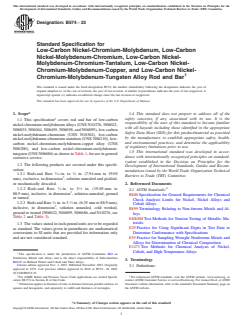
(Specification)Standard Specification for Low-Carbon Nickel-Chromium-Molybdenum, Low-Carbon Nickel-Molybdenum-Chromium, Low-Carbon Nickel-Molybdenum-Chromium-Tantalum, Low-Carbon Nickel-Chromium-Molybdenum-Copper, and Low-Carbon Nickel-Chromium-Molybdenum-Tungsten Alloy Rod and Bar
General Information
- Abstract
ABSTRACT
This specification2 covers rod of low-carbon nickel-chromium- molybdenum alloys (UNS N10276, N06022, N06035, N06455, N06058, and N06059), low-carbon nickel-molybdenum- chromium-tantalum (UNS N06210), low-carbon nickel-chromium-molybdenum-copper alloy (UNS N06200), and low-carbon nickel-chromium-molybdenum-tungsten (UNS N06686), for use in general corrosive service. Product and chemical analyses shall be performed on the materials and shall conform to the required chemical composition in molybdenum, chromium, iron, tungsten, cobalt, carbon, silicon, manganese, vanadium, phosphorus, sulfur, titanium, nickel, aluminum, copper, and tantalum. Tension test shall be performed and shall comply to required mechanical properties for hot or cold finished, solution annealed rods such as tensile strength, yield strength, and elongation.
SCOPE
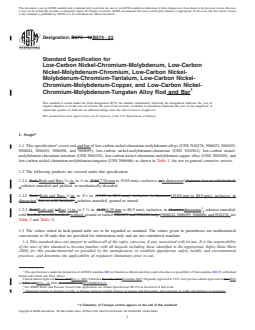
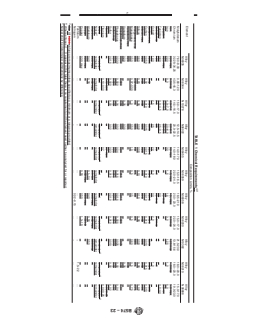
1.1 This specification2 covers rod and bar of low-carbon nickel-chromium-molybdenum alloys (UNS N10276, N06022, N06035, N06044, N06455, N06058, and N06059), low-carbon nickel-molybdenum-chromium (USN N10362), low-carbon nickel-molybdenum-chromium-tantalum (UNS N06210), low-carbon nickel-chromium-molybdenum-copper alloy (UNS N06200), and low-carbon nickel-chromium-molybdenum-tungsten (UNS N06686) as shown in Table 1, for use in general corrosive service.
1.2 The following products are covered under this specification:
1.2.1 Rods and Bars 5/16 in. to 3/4 in. (7.94 mm to 19.05 mm), exclusive, in dimension3, solution annealed and pickled, or mechanically descaled.
1.2.2 Rods and Bars 3/4 in. to 31/2 in. (19.05 mm to 88.9 mm), inclusive, in dimension3, solution annealed, ground or turned.
1.2.3 Rods and Bars 1/4 in. to 3 1/2 in. (6.35 mm to 88.9 mm), inclusive, in dimension3, solution annealed, cold worked, ground or turned (N06022, N06059, N06686, and N10276, see Table 2 and Table 3).
1.3 The values stated in inch-pound units are to be regarded as standard. The values given in parentheses are mathematical conversions to SI units that are provided for information only and are not considered standard.
1.4 This standard does not purport to address all of the safety concerns, if any, associated with its use. It is the responsibility of the user of this standard to become familiar with all hazards including those identified in the appropriate Safety Data Sheet (SDS) for this product/material as provided by the manufacturer, to establish appropriate safety, health, and environmental practices, and determine the applicability of regulatory limitations prior to use.
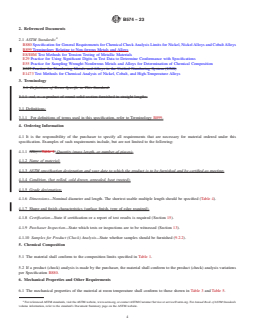
1.5 This international standard was developed in accordance with internationally recognized principles on standardization established in the Decision on Principles for the Development of International Standards, Guides and Recommendations issued by the World Trade Organization Technical Barriers to Trade (TBT) Committee.
- Status
- Published
- Publication Date
- 31-Oct-2023
- Technical Committee
- B02 - Nonferrous Metals and Alloys
- Drafting Committee
- B02.07 - Refined Nickel and Cobalt and Their Alloys
Buy Documents
ASTM B574-23 - Standard Specification for Low-Carbon Nickel-Chromium-Molybdenum, Low-Carbon Nickel-Molybdenum-Chromium, Low-Carbon Nickel-Molybdenum-Chromium-Tantalum, Low-Carbon Nickel-Chromium-Molybdenum-Copper, and Low-Carbon Nickel-Chromium-Molybdenum-Tungsten Alloy Rod and Bar
REDLINE ASTM B574-23 - Standard Specification for Low-Carbon Nickel-Chromium-Molybdenum, Low-Carbon Nickel-Molybdenum-Chromium, Low-Carbon Nickel-Molybdenum-Chromium-Tantalum, Low-Carbon Nickel-Chromium-Molybdenum-Copper, and Low-Carbon Nickel-Chromium-Molybdenum-Tungsten Alloy Rod and Bar
Overview
ASTM B574-23 is the Standard Specification developed by ASTM International for rod and bar products composed of low-carbon nickel-based alloys. This specification covers various alloy groups including nickel-chromium-molybdenum, nickel-molybdenum-chromium, nickel-molybdenum-chromium-tantalum, nickel-chromium-molybdenum-copper, and nickel-chromium-molybdenum-tungsten alloys. The standard provides requirements for chemical composition, mechanical properties, dimensions, workmanship, and testing for rods and bars intended for general corrosive service.
Primarily designed for use in environments with demanding corrosion resistance needs, ASTM B574-23 ensures the consistency, reliability, and quality of nickel alloy rods and bars within sizes ranging from 6.35 mm to 88.9 mm in diameter or dimension, as solution annealed, pickled, mechanically descaled, ground, or turned products.
Key Topics
Alloy Types Covered:
The standard applies to a range of UNS designations including N10276, N06022, N06035, N06044, N06455, N06058, N06059, N06200, N06210, N06686, and N10362.Product Forms:
- Rods and bars 5/16 in. to 3/4 in. (7.94 mm to 19.05 mm): solution annealed and pickled or mechanically descaled
- Rods and bars 3/4 in. to 3-1/2 in. (19.05 mm to 88.9 mm): solution annealed, ground, or turned
- Rods and bars 1/4 in. to 3-1/2 in. (6.35 mm to 88.9 mm): solution annealed, cold worked, ground or turned (select alloys)
Chemical Composition:
Specifies strict requirements for total content of molybdenum, chromium, iron, tungsten, cobalt, carbon, and other relevant elements to ensure corrosion resistance and mechanical strength.Mechanical Properties:
- Minimum tensile and yield strength
- Minimum elongation
- Room temperature performance is the basis for all mechanical requirements
Dimensional Tolerances:
Clearly defines permissible variations in dimension and out-of-roundness for cold-worked and solution-annealed products.Workmanship and Marking:
Requirements ensure defect-free surfaces, uniformity in quality, proper marking of material, and traceable labeling for each order.Testing and Certification:
Mandates specific procedures for chemical and mechanical testing, with detailed guidance on sampling, number of tests, specimen preparation, and retests.
Applications
ASTM B574-23 alloy rods and bars are vital in general corrosive service across industries where superior resistance to chemicals, oxidizing environments, and reducing media is essential. Typical applications include:
- Chemical Processing Plants: Components such as process piping, reaction vessels, and fittings exposed to harsh chemical environments
- Petrochemical and Oil & Gas Industries: Equipment and piping systems susceptible to sour gas, chlorides, and high temperature corrosive exposure
- Pharmaceutical and Biotechnology: Fabrication of clean-in-place equipment, reactors, and parts requiring minimal contamination and high corrosion resistance
- Pollution Control, Flue Gas Desulfurization: Ducting, scrubbers, and absorbers operating with acidic gases and condensates
- Power Generation, Marine, and Aerospace: High integrity fasteners, shafts, and structural components exposed to aggressive marine or industrial atmospheres
These nickel-based alloy rods and bars are selected for their durability, long service life, and compliance with stringent quality standards outlined in ASTM B574-23, ensuring safe operation in critical environments.
Related Standards
For those involved in procurement, fabrication, or inspection of nickel alloy rods and bars, several related ASTM documents and external standards provide complementary guidelines:
- ASTM B880: General Requirements for Chemical Check Analysis Limits for Nickel, Nickel Alloys and Cobalt Alloys
- ASTM B899: Terminology Relating to Non-ferrous Metals and Alloys
- ASTM E8/E8M: Test Methods for Tension Testing of Metallic Materials
- ASTM E1473: Test Methods for Chemical Analysis of Nickel, Cobalt, and High-Temperature Alloys
- ASTM E55: Practice for Sampling Wrought Nonferrous Metals and Alloys for Determination of Chemical Composition
Additionally, for code applications:
- ASME SB-574: Referenced for Boiler and Pressure Vessel Code compliance requirements.
Keywords: ASTM B574-23, nickel alloy rod, nickel alloy bar, corrosion resistant alloys, UNS N10276, UNS N06022, UNS N06686, mechanical properties, chemical composition, industrial nickel alloys, ASTM standards.
Relations
- Effective Date
- 01-Nov-2023
- Effective Date
- 01-Jan-2024
- Effective Date
- 01-May-2022
- Effective Date
- 01-Nov-2023
- Effective Date
- 01-Nov-2023
- Effective Date
- 01-Nov-2023
- Effective Date
- 01-Nov-2023
- Referred By
ASTM F467M-06a(2018) - Standard Specification for Nonferrous Nuts for General Use (Metric) - Effective Date
- 01-Nov-2023
- Effective Date
- 01-Nov-2023
Buy Documents
ASTM B574-23 - Standard Specification for Low-Carbon Nickel-Chromium-Molybdenum, Low-Carbon Nickel-Molybdenum-Chromium, Low-Carbon Nickel-Molybdenum-Chromium-Tantalum, Low-Carbon Nickel-Chromium-Molybdenum-Copper, and Low-Carbon Nickel-Chromium-Molybdenum-Tungsten Alloy Rod and Bar
REDLINE ASTM B574-23 - Standard Specification for Low-Carbon Nickel-Chromium-Molybdenum, Low-Carbon Nickel-Molybdenum-Chromium, Low-Carbon Nickel-Molybdenum-Chromium-Tantalum, Low-Carbon Nickel-Chromium-Molybdenum-Copper, and Low-Carbon Nickel-Chromium-Molybdenum-Tungsten Alloy Rod and Bar
Get Certified
Connect with accredited certification bodies for this standard

Element Materials Technology
Materials testing and product certification.

Inštitut za kovinske materiale in tehnologije
Institute of Metals and Technology. Materials testing, metallurgical analysis, NDT.
Sponsored listings
Frequently Asked Questions
ASTM B574-23 is a technical specification published by ASTM International. Its full title is "Standard Specification for Low-Carbon Nickel-Chromium-Molybdenum, Low-Carbon Nickel-Molybdenum-Chromium, Low-Carbon Nickel-Molybdenum-Chromium-Tantalum, Low-Carbon Nickel-Chromium-Molybdenum-Copper, and Low-Carbon Nickel-Chromium-Molybdenum-Tungsten Alloy Rod and Bar". This standard covers: ABSTRACT This specification2 covers rod of low-carbon nickel-chromium- molybdenum alloys (UNS N10276, N06022, N06035, N06455, N06058, and N06059), low-carbon nickel-molybdenum- chromium-tantalum (UNS N06210), low-carbon nickel-chromium-molybdenum-copper alloy (UNS N06200), and low-carbon nickel-chromium-molybdenum-tungsten (UNS N06686), for use in general corrosive service. Product and chemical analyses shall be performed on the materials and shall conform to the required chemical composition in molybdenum, chromium, iron, tungsten, cobalt, carbon, silicon, manganese, vanadium, phosphorus, sulfur, titanium, nickel, aluminum, copper, and tantalum. Tension test shall be performed and shall comply to required mechanical properties for hot or cold finished, solution annealed rods such as tensile strength, yield strength, and elongation. SCOPE 1.1 This specification2 covers rod and bar of low-carbon nickel-chromium-molybdenum alloys (UNS N10276, N06022, N06035, N06044, N06455, N06058, and N06059), low-carbon nickel-molybdenum-chromium (USN N10362), low-carbon nickel-molybdenum-chromium-tantalum (UNS N06210), low-carbon nickel-chromium-molybdenum-copper alloy (UNS N06200), and low-carbon nickel-chromium-molybdenum-tungsten (UNS N06686) as shown in Table 1, for use in general corrosive service. 1.2 The following products are covered under this specification: 1.2.1 Rods and Bars 5/16 in. to 3/4 in. (7.94 mm to 19.05 mm), exclusive, in dimension3, solution annealed and pickled, or mechanically descaled. 1.2.2 Rods and Bars 3/4 in. to 31/2 in. (19.05 mm to 88.9 mm), inclusive, in dimension3, solution annealed, ground or turned. 1.2.3 Rods and Bars 1/4 in. to 3 1/2 in. (6.35 mm to 88.9 mm), inclusive, in dimension3, solution annealed, cold worked, ground or turned (N06022, N06059, N06686, and N10276, see Table 2 and Table 3). 1.3 The values stated in inch-pound units are to be regarded as standard. The values given in parentheses are mathematical conversions to SI units that are provided for information only and are not considered standard. 1.4 This standard does not purport to address all of the safety concerns, if any, associated with its use. It is the responsibility of the user of this standard to become familiar with all hazards including those identified in the appropriate Safety Data Sheet (SDS) for this product/material as provided by the manufacturer, to establish appropriate safety, health, and environmental practices, and determine the applicability of regulatory limitations prior to use. 1.5 This international standard was developed in accordance with internationally recognized principles on standardization established in the Decision on Principles for the Development of International Standards, Guides and Recommendations issued by the World Trade Organization Technical Barriers to Trade (TBT) Committee.
ABSTRACT This specification2 covers rod of low-carbon nickel-chromium- molybdenum alloys (UNS N10276, N06022, N06035, N06455, N06058, and N06059), low-carbon nickel-molybdenum- chromium-tantalum (UNS N06210), low-carbon nickel-chromium-molybdenum-copper alloy (UNS N06200), and low-carbon nickel-chromium-molybdenum-tungsten (UNS N06686), for use in general corrosive service. Product and chemical analyses shall be performed on the materials and shall conform to the required chemical composition in molybdenum, chromium, iron, tungsten, cobalt, carbon, silicon, manganese, vanadium, phosphorus, sulfur, titanium, nickel, aluminum, copper, and tantalum. Tension test shall be performed and shall comply to required mechanical properties for hot or cold finished, solution annealed rods such as tensile strength, yield strength, and elongation. SCOPE 1.1 This specification2 covers rod and bar of low-carbon nickel-chromium-molybdenum alloys (UNS N10276, N06022, N06035, N06044, N06455, N06058, and N06059), low-carbon nickel-molybdenum-chromium (USN N10362), low-carbon nickel-molybdenum-chromium-tantalum (UNS N06210), low-carbon nickel-chromium-molybdenum-copper alloy (UNS N06200), and low-carbon nickel-chromium-molybdenum-tungsten (UNS N06686) as shown in Table 1, for use in general corrosive service. 1.2 The following products are covered under this specification: 1.2.1 Rods and Bars 5/16 in. to 3/4 in. (7.94 mm to 19.05 mm), exclusive, in dimension3, solution annealed and pickled, or mechanically descaled. 1.2.2 Rods and Bars 3/4 in. to 31/2 in. (19.05 mm to 88.9 mm), inclusive, in dimension3, solution annealed, ground or turned. 1.2.3 Rods and Bars 1/4 in. to 3 1/2 in. (6.35 mm to 88.9 mm), inclusive, in dimension3, solution annealed, cold worked, ground or turned (N06022, N06059, N06686, and N10276, see Table 2 and Table 3). 1.3 The values stated in inch-pound units are to be regarded as standard. The values given in parentheses are mathematical conversions to SI units that are provided for information only and are not considered standard. 1.4 This standard does not purport to address all of the safety concerns, if any, associated with its use. It is the responsibility of the user of this standard to become familiar with all hazards including those identified in the appropriate Safety Data Sheet (SDS) for this product/material as provided by the manufacturer, to establish appropriate safety, health, and environmental practices, and determine the applicability of regulatory limitations prior to use. 1.5 This international standard was developed in accordance with internationally recognized principles on standardization established in the Decision on Principles for the Development of International Standards, Guides and Recommendations issued by the World Trade Organization Technical Barriers to Trade (TBT) Committee.
ASTM B574-23 is classified under the following ICS (International Classification for Standards) categories: 77.150.40 - Nickel and chromium products. The ICS classification helps identify the subject area and facilitates finding related standards.
ASTM B574-23 has the following relationships with other standards: It is inter standard links to ASTM B574-18, ASTM E8/E8M-24, ASTM E8/E8M-22, ASTM B366/B366M-23, ASTM F468M-06(2018), ASTM F467-13(2018), ASTM B462-18e1, ASTM F467M-06a(2018), ASTM F468-23. Understanding these relationships helps ensure you are using the most current and applicable version of the standard.
ASTM B574-23 is available in PDF format for immediate download after purchase. The document can be added to your cart and obtained through the secure checkout process. Digital delivery ensures instant access to the complete standard document.
Standards Content (Sample)
This international standard was developed in accordance with internationally recognized principles on standardization established in the Decision on Principles for the
Development of International Standards, Guides and Recommendations issued by the World Trade Organization Technical Barriers to Trade (TBT) Committee.
Designation: B574 − 23
Standard Specification for
Low-Carbon Nickel-Chromium-Molybdenum, Low-Carbon
Nickel-Molybdenum-Chromium, Low-Carbon Nickel-
Molybdenum-Chromium-Tantalum, Low-Carbon Nickel-
Chromium-Molybdenum-Copper, and Low-Carbon Nickel-
Chromium-Molybdenum-Tungsten Alloy Rod and Bar
This standard is issued under the fixed designation B574; the number immediately following the designation indicates the year of
original adoption or, in the case of revision, the year of last revision. A number in parentheses indicates the year of last reapproval. A
superscript epsilon (´) indicates an editorial change since the last revision or reapproval.
This standard has been approved for use by agencies of the U.S. Department of Defense.
1. Scope* 1.4 This standard does not purport to address all of the
2 safety concerns, if any, associated with its use. It is the
1.1 This specification covers rod and bar of low-carbon
responsibility of the user of this standard to become familiar
nickel-chromium-molybdenum alloys (UNS N10276, N06022,
with all hazards including those identified in the appropriate
N06035, N06044, N06455, N06058, and N06059), low-carbon
Safety Data Sheet (SDS) for this product/material as provided
nickel-molybdenum-chromium (USN N10362), low-carbon
by the manufacturer, to establish appropriate safety, health,
nickel-molybdenum-chromium-tantalum (UNS N06210), low-
and environmental practices, and determine the applicability
carbon nickel-chromium-molybdenum-copper alloy (UNS
of regulatory limitations prior to use.
N06200), and low-carbon nickel-chromium-molybdenum-
1.5 This international standard was developed in accor-
tungsten (UNS N06686) as shown in Table 1, for use in general
dance with internationally recognized principles on standard-
corrosive service.
ization established in the Decision on Principles for the
1.2 The following products are covered under this specifi-
Development of International Standards, Guides and Recom-
cation:
mendations issued by the World Trade Organization Technical
5 3
1.2.1 Rods and Bars ⁄16 in. to ⁄4 in. (7.94 mm to 19.05
Barriers to Trade (TBT) Committee.
mm), exclusive, in dimension , solution annealed and pickled,
2. Referenced Documents
or mechanically descaled.
3 1
1.2.2 Rods and Bars ⁄4 in. to 3 ⁄2 in. (19.05 mm to
2.1 ASTM Standards:
88.9 mm), inclusive, in dimension , solution annealed, ground
B880 Specification for General Requirements for Chemical
or turned.
Check Analysis Limits for Nickel, Nickel Alloys and
1 1
1.2.3 Rods and Bars ⁄4 in. to 3 ⁄2 in. (6.35 mm to 88.9 mm),
Cobalt Alloys
inclusive, in dimension , solution annealed, cold worked,
B899 Terminology Relating to Non-ferrous Metals and Al-
ground or turned (N06022, N06059, N06686, and N10276, see
loys
Table 2 and Table 3).
E8/E8M Test Methods for Tension Testing of Metallic Ma-
terials
1.3 The values stated in inch-pound units are to be regarded
E29 Practice for Using Significant Digits in Test Data to
as standard. The values given in parentheses are mathematical
Determine Conformance with Specifications
conversions to SI units that are provided for information only
E55 Practice for Sampling Wrought Nonferrous Metals and
and are not considered standard.
Alloys for Determination of Chemical Composition
E1473 Test Methods for Chemical Analysis of Nickel,
Cobalt, and High-Temperature Alloys
This specification is under the jurisdiction of ASTM Committee B02 on
Nonferrous Metals and Alloys and is the direct responsibility of Subcommittee
3. Terminology
B02.07 on Refined Nickel and Cobalt and Their Alloys.
Current edition approved Nov. 1, 2023. Published November 2023. Originally
3.1 Definitions:
approved in 1972. Last previous edition approved in 2018 as B574 – 18. DOI:
10.1520/B0574-23.
2 4
For ASME Boiler and Pressure Vessel Code applications see related Specifi- For referenced ASTM standards, visit the ASTM website, www.astm.org, or
cation SB-574 in Section II of that Code. contact ASTM Customer Service at service@astm.org. For Annual Book of ASTM
Dimension applies to diameter of rods, to distance between parallel surfaces of Standards volume information, refer to the standard’s Document Summary page on
squares and hexagonals, and separately to width and thickness of rectangles. the ASTM website.
*A Summary of Changes section appears at the end of this standard
Copyright © ASTM International, 100 Barr Harbor Drive, PO Box C700, West Conshohocken, PA 19428-2959. United States
B574 − 23
A,B
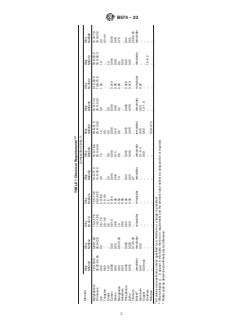
TABLE 1 Chemical Requirements
Composition Limits, %
Element
Alloy Alloy Alloy Alloy Alloy Alloy Alloy Alloy Alloy Alloy Alloy
N06035 N06044 N10276 N06022 N06455 N06059 N06058 N06200 N10362 N06210 N06686
Molybdenum 7.60–9.00 0.80-1.20 15.0–17.0 12.5–14.5 14.0–17.0 15.0–16.5 18.5–21.0 15.0–17.0 21.5-23.0 18.0–20.0 15.0-17.0
Chromium 32.25–34.25 43.5-45.3 14.5–16.5 20.0–22.5 14.0–18.0 22.0–24.0 20.0- 23.0 22.0–24.0 13.8-15.6 18.0–20.0 19.0-23.0
Iron 2.00 0.3 4.0–7.0 2.0–6.0 3.0 1.5 1.5 3.0 1.25 1.0 5.0
Tungsten 0.60 . 3.0–4.5 2.5–3.5 . . 0.3 . . . 3.0-4.4
Cobalt 1.00 . 2.5 2.5 2.0 0.3 0.3 2.0 . 1.0 .
Carbon 0.050 0.02 0.010 0.015 0.015 0.010 0.010 0.010 0.010 0.015 0.010
Silicon 0.60 0.20 0.08 0.08 0.08 0.10 0.10 0.08 0.08 0.08 0.08
Manganese 0.50 0.07-0.30 1.0 0.50 1.0 0.5 0.5 0.5 0.60 0.5 0.75
Vanadium 0.20 . 0.35 0.35 . . . . . 0.35 .
Phosphorus 0.030 0.020 0.04 0.02 0.04 0.015 0.015 0.025 0.025 0.02 0.04
Sulfur 0.015 0.020 0.03 0.02 0.03 0.010 0.010 0.010 0.010 0.02 0.02
Titanium . 0.10-0.30 . . 0.7 . . . . . 0.02-0.25
C
Nickel remainder remainder remainder remainder remainder remainder remainder remainder remainder remainder remainder
Aluminum 0.40 0.30 . . . 0.1–0.4 0.40 0.50 0.50 . .
Copper 0.30 max . . . . 0.50 0.50 1.3–1.9 . . .
Tantalum . . . . . . . . . 1.5–2.2 .
Nitrogen . . . . . . 0.02–0.15 . . . .
A
All values are maximums unless specified as a minimum or a range is provided.
B
Where ellipses ([. . .]) appear in this table there is no requirement and the element need neither be analyzed for or reported.
C
Nickel shall be determined arithmetically by difference.
B574 − 23
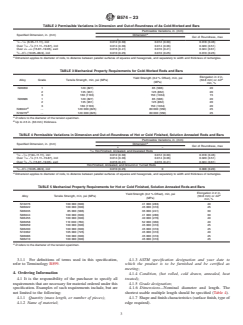
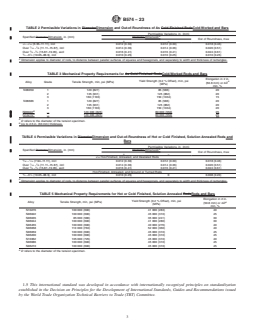
TABLE 2 Permissible Variations in Dimension and Out-of-Roundness of As Cold-Worked and Bars
Permissible Variations, in. (mm)
A
Specified Dimension, in. (mm) Dimension
Out of Roundness, max
+ −
1 7
⁄4 – ⁄16 (6.35–11.11), incl 0.012 (0.30) 0.012 (0.30) 0.018 (0.46)
7 5
Over ⁄16 – ⁄8 (11.11–15.87), incl 0.014 (0.36) 0.014 (0.36) 0.020 (0.51)
5 3
Over ⁄8 – ⁄4 (15.87–19.05), excl 0.016 (0.41) 0.016 (0.41) 0.024 (0.61)
3 1
⁄4 –3 ⁄2 (19.05–88.9), incl 0.010 (0.25) 0.010 (0.25) 0.010 (0.25)
A
Dimension applies to diameter of rods, to distance between parallel surfaces of squares and hexagonals, and separately to width and thickness of rectangles.
TABLE 3 Mechanical Property Requirements for Cold-Worked Rods and Bars
Elongation in 2 in.
Yield Strength (0.2 % Offset), min, psi
A
Alloy Grade Tensile Strength, min, psi (MPa)
(50.8 mm) or 4D
(MPa)
min, %
N06059 1 120 (827) 85 (586) 20
2 135 (931) 125 (862) 20
3 160 (1103) 150 (1034) 15
N06686 1 120 (827) 85 (586) 20
2 135 (931) 125 (862) 20
3 160 (1103) 150 (1034) 20
B
N06022 . 120 000 (825) 80 000 (550) 25
B
N10276 . 120 000 (825) 80 000 (550) 25
A
D refers to the diameter of the tension specimen.
B
Up to 2.5 in. (63 mm) thickness.
TABLE 4 Permissible Variations in Dimension and Out-of-Roundness of Hot or Cold Finished, Solution Annealed Rods and Bars
Permissible Variations, in. (mm)
A
Specified Dimension, in. (mm) Dimension
Out of Roundness, max
+ −
⁄16 Hot-Finished, Annealed, and Descaled Rods
5 7
⁄16 – ⁄16 (7.94–11.11), incl 0.012 (0.30) 0.012 (0.30) 0.018 (0.46)
7 5
Over ⁄16 – ⁄8 (11.11–15.87), incl 0.014 (0.36) 0.014 (0.36) 0.020 (0.51)
5 3
Over ⁄8 – ⁄4 (15.87–19.05), excl 0.016 (0.41) 0.016 (0.41) 0.024 (0.61)
Hot-Finished, Annealed, and Ground or Turned Rods
3 1
⁄4 –3 ⁄2 (19.05–88.9), incl 0.010 (0.25) 0 0.008 (0.20)
A
Dimension applies to diameter of rods, to distance between parallel surfaces of squares and hexagonals, and separately to width and thickness of rectangles.
TABLE 5 Mechanical Property Requirements for Hot or Cold Finished, Solution Annealed Rods and Bars
Elongation in 2 in.
Yield Strength (0.2 % Offset), min, psi
A
Alloy Tensile Strength, min, psi (MPa)
(50.8 mm) or 4D
(MPa)
min, %
N10276 100 000 (690) 41 000 (283) 40
N06022 100 000 (690) 45 000 (310) 45
N06035 85 000 (586) 35 000 (241) 30
N06044 100 000 (690) 41 000 (280) 30
N06455 100 000 (690) 40 000 (276) 40
N06058 110 000 (760) 52 000 (360) 40
N06059 100 000 (690) 45 000 (310) 45
N06200 100 000 (690) 45 000 (310) 45
N10362 105 000 (725) 45 000 (310) 40
N06686 100 000 (690) 45 000 (310) 45
N06210 100 000 (690) 45 000 (310) 45
A
D refers to the diameter of the tension specimen.
3.1.1 For definitions of terms used in this specification, 4.1.3 ASTM specification designation and year date to
refer to Terminology B899. which the product is to be furnished and be certified as
meeting;
4. Ordering Information
4.1.4 Condition, (hot rolled, cold drawn, annealed, heat
treated);
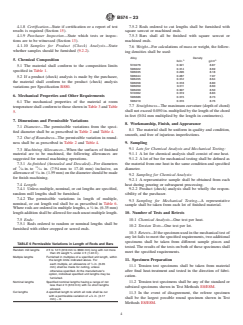
4.1 It is the responsibility of the purchaser to specify all
requirements that are necessary for material ordered under this 4.1.5 Grade designation;
4.1.6 Dimensions—Nominal diameter and length. The
specification. Examples of such requirements include, but are
not limited to the following: shortest usable multiple length should be specified (Table 4).
4.1.1 Quantity (mass length, or number of pieces); 4.1.7 Shape and finish characteristics (surface finish, type of
4.1.2 Name of material; edge required).
B574 − 23
4.1.8 Certification—State if certification or a report of test 7.5.2 Rods ordered to cut lengths shall be furnished with
results is required (Section 15). square sawcut or machined ends.
4.1.9 Purchaser Inspection—State which tests or inspec- 7.5.3 Bars shall all be finished with square sawcut or
tions are to be witnessed (Section 13). machined ends.
4.1.10 Samples for Product (Check) Analysis—State
7.6 Weight—For calculations of mass or weight, the follow-
whether samples should be furnished (9.2.2).
ing densities shall be used:
Alloy Density
5. Chemical Composition
...
This document is not an ASTM standard and is intended only to provide the user of an ASTM standard an indication of what changes have been made to the previous version. Because
it may not be technically possible to adequately depict all changes accurately, ASTM recommends that users consult prior editions as appropriate. In all cases only the current version
of the standard as published by ASTM is to be considered the official document.
Designation: B574 − 18 B574 − 23
Standard Specification for
Low-Carbon Nickel-Chromium-Molybdenum, Low-Carbon
Nickel-Molybdenum-Chromium, Low-Carbon Nickel-
Molybdenum-Chromium-Tantalum, Low-Carbon Nickel-
Chromium-Molybdenum-Copper, and Low-Carbon Nickel-
Chromium-Molybdenum-Tungsten Alloy Rod and Bar
This standard is issued under the fixed designation B574; the number immediately following the designation indicates the year of
original adoption or, in the case of revision, the year of last revision. A number in parentheses indicates the year of last reapproval. A
superscript epsilon (´) indicates an editorial change since the last revision or reapproval.
This standard has been approved for use by agencies of the U.S. Department of Defense.
1. Scope*
1.1 This specification covers rod and bar of low-carbon nickel-chromium-molybdenum alloys (UNS N10276, N06022, N06035,
N06044, N06455, N06058, and N06059), low-carbon nickel-molybdenum-chromium (USN N10362), low-carbon nickel-
molybdenum-chromium-tantalum (UNS N06210), low-carbon nickel-chromium-molybdenum-copper alloy (UNS N06200), and
low-carbon nickel-chromium-molybdenum-tungsten (UNS N06686) as shown in Table 1, for use in general corrosive service.
1.2 The following products are covered under this specification:
5 3
1.2.1 Rods Rods and Bars ⁄16 in. to ⁄4 in. (7.94(7.94 mm to 19.05 mm), exclusive, inin dimension diameter, hot or cold finished,
, solution annealed and pickled, or mechanically descaled.
3 1
1.2.2 Rods Rods and Bars ⁄4 in. to 3 ⁄2 in. (19.05 to 88.9 mm), inclusive, in diameter,(19.05 mm to 88.9 mm), inclusive, in
dimension hot or cold finished, , solution annealed, ground or turned.
1 1 1
1.2.3 RodsRods and ⁄4Bars ⁄4 in. to 3 ⁄2 in. (6.35(6.35 mm to 88.9 mm), inclusive, in diameter,dimension , solution annealed,
cold finished, as cold finished, worked, ground or turned (N06059 and N06686 only, (N06022, N06059, N06686, and N10276, see
Table 2 and Table 3).
1.3 The values stated in inch-pound units are to be regarded as standard. The values given in parentheses are mathematical
conversions to SI units that are provided for information only and are not considered standard.
1.4 This standard does not purport to address all of the safety concerns, if any, associated with its use. It is the responsibility
of the user of this standard to become familiar with all hazards including those identified in the appropriate Safety Data Sheet
(SDS) for this product/material as provided by the manufacturer, to establish appropriate safety, health, and environmental
practices, and determine the applicability of regulatory limitations prior to use.
This specification is under the jurisdiction of ASTM Committee B02 on Nonferrous Metals and Alloys and is the direct responsibility of Subcommittee B02.07 on Refined
Nickel and Cobalt and Their Alloys.
Current edition approved Nov. 1, 2018Nov. 1, 2023. Published December 2018November 2023. Originally approved in 1972. Last previous edition approved in 20172018
as B574 – 17.B574 – 18. DOI: 10.1520/B0574-18.10.1520/B0574-23.
For ASME Boiler and Pressure Vessel Code applications see related Specification SB-574 in Section II of that Code.
Dimension applies to diameter of rods, to distance between parallel surfaces of squares and hexagonals, and separately to width and thickness of rectangles.
*A Summary of Changes section appears at the end of this standard
Copyright © ASTM International, 100 Barr Harbor Drive, PO Box C700, West Conshohocken, PA 19428-2959. United States
B574 − 23
A,B
TABLE 1 Chemical Requirements
Composition Limits, %
Element
Alloy Alloy Alloy Alloy Alloy Alloy Alloy Alloy Alloy Alloy Alloy
N06035 N06044 N10276 N06022 N06455 N06059 N06058 N06200 N10362 N06210 N06686
Molybdenum 7.60–9.00 0.80-1.20 15.0–17.0 12.5–14.5 14.0–17.0 15.0–16.5 18.5–21.0 15.0–17.0 21.5-23.0 18.0–20.0 15.0-17.0
Chromium 32.25–34.25 43.5-45.3 14.5–16.5 20.0–22.5 14.0–18.0 22.0–24.0 20.0- 23.0 22.0–24.0 13.8-15.6 18.0–20.0 19.0-23.0
Iron 2.00 max 0.3 max 4.0–7.0 2.0–6.0 3.0 max 1.5, max 1.5, max 3.0 max 1.25 max 1.0 max 5.0 max
Iron 2.00 0.3 4.0–7.0 2.0–6.0 3.0 1.5 1.5 3.0 1.25 1.0 5.0
Tungsten 0.60 max . 3.0–4.5 2.5–3.5 . . 0.3 max . . . 3.0-4.4
Tungsten 0.60 . 3.0–4.5 2.5–3.5 . . 0.3 . . . 3.0-4.4
Cobalt, max 1.00 . 2.5 2.5 2.0 0.3 0.3 max 2.0 max . 1.0 .
Cobalt 1.00 . 2.5 2.5 2.0 0.3 0.3 2.0 . 1.0 .
Carbon, max 0.050 0.02 0.010 0.015 0.015 0.010 0.010 0.010 0.010 0.015 0.010
Carbon 0.050 0.02 0.010 0.015 0.015 0.010 0.010 0.010 0.010 0.015 0.010
Silicon, max 0.60 0.20 0.08 0.08 0.08 0.10 0.10 0.08 0.08 0.08 0.08
Silicon 0.60 0.20 0.08 0.08 0.08 0.10 0.10 0.08 0.08 0.08 0.08
Manganese, max 0.50 0.07-0.30 1.0 0.50 1.0 0.5 0.5 0.5 0.60 0.5 0.75
Manganese 0.50 0.07-0.30 1.0 0.50 1.0 0.5 0.5 0.5 0.60 0.5 0.75
Vanadium, max 0.20 . 0.35 0.35 . . . . . 0.35 .
Vanadium 0.20 . 0.35 0.35 . . . . . 0.35 .
Phosphorus, max 0.030 0.020 0.04 0.02 0.04 0.015 0.015 0.025 0.025 0.02 0.04
Phosphorus 0.030 0.020 0.04 0.02 0.04 0.015 0.015 0.025 0.025 0.02 0.04
Sulfur, max 0.015 0.020 0.03 0.02 0.03 0.010 0.010 0.010 0.010 0.02 0.02
Sulfur 0.015 0.020 0.03 0.02 0.03 0.010 0.010 0.010 0.010 0.02 0.02
Titanium . 0.10-0.30 . . 0.7 max . . . . . 0.02-0.25
Titanium . 0.10-0.30 . . 0.7 . . . . . 0.02-0.25
A A A A A A A A
Nickel remainder Bal remainder remainder remainder Bal Bal remainder remainder remainder remainder
C
Nickel remainder remainder remainder remainder remainder remainder remainder remainder remainder remainder remainder
Aluminum 0.40 max 0.30 max . . . 0.1–0.4 0.40 max 0.50 max 0.50 max . .
Aluminum 0.40 0.30 . . . 0.1–0.4 0.40 0.50 0.50 . .
Copper 0.30 max . . . . 0.50 max 0.50 max 1.3–1.9 . . .
Copper 0.30 max . . . . 0.50 0.50 1.3–1.9 . . .
Tantalum . . . . . . . . . 1.5–2.2 .
Nitrogen . . . . . . 0.02–0.15 . . . .
A
See All 12.1.1.values are maximums unless specified as a minimum or a range is provided.
B
Where ellipses ([. . .]) appear in this table there is no requirement and the element need neither be analyzed for or reported.
C
Nickel shall be determined arithmetically by difference.
B574 − 23
TABLE 2 Permissible Variations in DiameterDimension and Out-of-Roundness of As Cold Finished RodsCold-Worked and Bars
Permissible Variations, in. (mm)
A
Specified Diameter,Dimension, in. (mm) Diameter Dimension
Out of Roundness, max
+ −
1 7
⁄4 – ⁄16 (6.35–11.11), incl 0.012 (0.30) 0.012 (0.30) 0.018 (0.46)
7 5
Over ⁄16 – ⁄8 (11.11–15.87), incl 0.014 (0.36) 0.014 (0.36) 0.020 (0.51)
5 3
Over ⁄8 – ⁄4 (15.87–19.05), excl 0.016 (0.41) 0.016 (0.41) 0.024 (0.61)
3 1
⁄4 –3 ⁄2 (19.05–88.9), incl 0.010 (0.25) 0.010 (0.25) 0.010 (0.25)
A
Dimension applies to diameter of rods, to distance between parallel surfaces of squares and hexagonals, and separately to width and thickness of rectangles.
TABLE 3 Mechanical Property Requirements for As Cold Finished RodsCold-Worked Rods and Bars
Elongation in 2 in.
Yield Strength (0.2 % Offset), min, psi
A
Alloy Grade Tensile Strength, min, psi (MPa)
(50.8 mm) or 4D
(MPa)
min, %
N06059 1 120 (827) 85 (586) 20
2 135 (931) 125 (862) 20
3 160 (1103) 150 (1034) 15
N06686 1 120 (827) 85 (586) 20
2 135 (931) 125 (862) 20
3 160 (1103) 150 (1034) 20
B
N06022 . 120 000 (825) 80 000 (550) 25
B
N10276 . 120 000 (825) 80 000 (550) 25
A
D refers to the diameter of the tension specimen.
B
Up to 2.5 in. (63 mm) thickness.
TABLE 4 Permissible Variations in DiameterDimension and Out-of-Roundness of Hot or Cold Finished, Solution Annealed Rods and
Bars
Permissible Variations, in. (mm)
A
Specified Diameter,Dimension, in. (mm) Diameter Dimension
Out of Roundness, max
+ −
⁄16 Hot-Finished, Annealed, and Descaled Rods
5 7
⁄16 – ⁄16 (7.94–11.11), incl 0.012 (0.30) 0.012 (0.30) 0.018 (0.46)
7 5
Over ⁄16 – ⁄8 (11.11–15.87), incl 0.014 (0.36) 0.014 (0.36) 0.020 (0.51)
5 3
Over ⁄8 – ⁄4 (15.87–19.05), excl 0.016 (0.41) 0.016 (0.41) 0.024 (0.61)
Hot-Finished, Annealed, and Ground or Turned Rods
3 1
⁄4 –3 ⁄2 (19.05–88.9), incl 0.010 (0.25) 0 0.008 (0.20)
A
Dimension applies to diameter of rods, to distance between parallel surfaces of squares and hexagonals, and separately to width and thickness of rectangles.
TABLE 5 Mechanical Property Requirements for Hot or Cold Finished, Solution Annealed RodsRods and Bars
Elongation in 2 in.
Yield Strength (0.2 % Offset), min, psi
A
Alloy Tensile Strength, min, psi (MPa) (50.8 mm) or 4D
(MPa)
min, %
N10276 100 000 (690) 41 000 (283) 40
N06022 100 000 (690) 45 000 (310) 45
N06035 85 000 (586) 35 000 (241) 30
N06044 100 000 (690) 41 000 (280) 30
N06455 100 000 (690) 40 000 (276) 40
N06058 110 000 (760) 52 000 (360) 40
N06059 100 000 (690) 45 000 (310) 45
N06200 100 000 (690) 45 000 (310) 45
N10362 105 000 (725) 45 000 (310) 40
N06686 100 000 (690) 45 000 (310) 45
N06210 100 000 (690) 45 000 (310) 45
A
D refers to the diameter of the tension specimen.
1.5 This international standard was developed in accordance with internationally recognized principles on standardization
established in the Decision on Principles for the Development of International Standards, Guides and Recommendations issued
by the World Trade Organization Technical Barriers to Trade (TBT) Committee.
B574 − 23
2. Referenced Documents
2.1 ASTM Standards:
B880 Specification for General Requirements for Chemical Check Analysis Limits for Nickel, Nickel Alloys and Cobalt Alloys
B899 Terminology Relating to Non-ferrous Metals and Alloys
E8/E8M Test Methods for Tension Testing of Metallic Materials
E29 Practice for Using Significant Digits in Test Data to Determine Conformance with Specifications
E55 Practice for Sampling Wrought Nonferrous Metals and Alloys for Determination of Chemical Composition
E527 Practice for Numbering Metals and Alloys in the Unified Numbering System (UNS)
E1473 Test Methods for Chemical Analysis of Nickel, Cobalt, and High-Temperature Alloys
3. Terminology
3.1 Definitions of Terms Specific to This Standard:
3.1.1 rod, n—a product of round solid section furnished in straight lengths.
3.1 Definitions:
3.1.1 For definitions of terms used in this specification, refer to Terminology B899.
4. Ordering Information
4.1 It is the responsibility of the purchaser to specify all requirements that are necessary for material ordered under this
specification. Examples of such requirements include, but are not limited to the following:
4.1.1 Alloy—Table 1. Quantity (mass length, or number of pieces);
4.1.2 Name of material;
4.1.3 ASTM specification designation and year date to which the product is to be furnished and be certified as meeting;
4.1.4 Condition, (hot rolled, cold drawn, annealed, heat treated);
4.1.5 Grade designation;
4.1.6 Dimensions—Nominal diameter and length. The shortest usable multiple length should be specified (Table 4).
4.1.7 Shape and finish characteristics (surface finish, type of edge required).
4.1.8 Certification—State if certification or a report of test results is required (Section 15).
4.1.9 Purchaser Inspection—State which tests or inspections ar
...