

ASTM C1063-23
(Specification)Standard Specification for Installation of Lathing and Furring to Receive Interior and Exterior Portland Cement-Based Plaster
General Information
- Abstract
ABSTRACT
This specification covers the installation of lathing and furring to receive interior and exterior Portland cement-based plaster. The following materials shall be used: metal plaster bases—expanded metal lath and wire laths; accessories—steel, PVC plastic, zinc alloy, and cornerite; channels—external corner reinforcement and foundation weep screed; wire; rod and strap hangers; clips; fasteners—nails and screws. Hangers and cold-rolled channel main runner shall conform to the allowable spacing and spans, respectively. The following methods are discussed: installation of hangers for suspended ceilings under wood constructions, attachment of hangers to main runners, installation of main runners, installation of cross furring, metal furring for walls, lapping of metal plaster bases, spacing of attachments for metal plaster bases, application of metal plaster bases, and application of accessories.
SCOPE
1.1 This specification covers the minimum technical requirements for the installation of lathing and furring for the application of exterior and interior portland cement-based plaster, as in Specification C926. These requirements do not by default define a unit of work or assign responsibility for contractual purposes, which is the purview of a contract or contracts made between contracting entities.
1.2 Table of Contents:
Scope
1
Referenced Documents
2
Terminology
3
Delivery and Storage of Materials
4
Materials
5
Requirements for Substrates to Receive Metal Lathing & Furring
6
Installation
7
Workmanship
7.1
Installation of Metal Furring for Walls
7.2
Installation of Metal Plaster Bases
7.3
Installation of Lathing Accessories
7.4
Keywords
8
Installation of Metal Furring for Suspended Ceilings
Annex A1
1.3 Where a fire resistance rating is required for plastered assemblies and constructions, details of construction shall be in accordance with reports of fire tests of assemblies that have met the requirements of the fire rating imposed.
1.4 Where a specific degree of sound control is required for plastered assemblies and constructions, details of construction shall be in accordance with official reports of tests conducted in recognized testing laboratories in accordance with the applicable requirements of Test Method E90.
1.5 The values stated in inch-pound units are to be regarded as standard. The values given in parentheses are mathematical conversions to SI units that are provided for information only and are not considered standard.
1.6 The text of this specification references notes and footnotes that provide explanatory material. These notes and footnotes (excluding those in tables and figures) shall not be considered as requirements of the specification.
1.7 This international standard was developed in accordance with internationally recognized principles on standardization established in the Decision on Principles for the Development of International Standards, Guides and Recommendations issued by the World Trade Organization Technical Barriers to Trade (TBT) Committee.
- Status
- Published
- Publication Date
- 30-Jun-2023
- Technical Committee
- C11 - Gypsum and Related Building Materials and Systems
Buy Documents
ASTM C1063-23 - Standard Specification for Installation of Lathing and Furring to Receive Interior and Exterior Portland Cement-Based Plaster
REDLINE ASTM C1063-23 - Standard Specification for Installation of Lathing and Furring to Receive Interior and Exterior Portland Cement-Based Plaster
Overview
ASTM C1063-23, published by ASTM International, sets forth the minimum technical requirements and best practices for the installation of lathing and furring systems to support Portland cement-based plaster in both interior and exterior applications. These systems are crucial in ensuring the stability, durability, and performance of plaster finishes on a variety of substrates in residential, commercial, and institutional construction. The standard covers specifications for the use of metal plaster bases, accessories, channels, hangers, fasteners, and installation methods to ensure the integrity and longevity of the finished assembly.
Key Topics
- Material Requirements: The standard outlines acceptable materials for lathing and furring systems, such as galvanized expanded metal lath, welded and woven wire lath, steel and PVC accessories, rods, channel runners, hangers, nails, screws, and clips.
- Material Handling: Clear guidance is provided on the delivery, storage, and protection of lathing and furring materials to prevent corrosion, damage, or contamination before and during installation.
- Substrate Preparation: Criteria for substrate flatness, stability, moisture content, and marking requirements are included to ensure optimal adhesion and performance of the plaster finish.
- Installation Practices: The document covers procedures for installing furring on walls and suspended ceilings, attachment of plaster bases and accessories, proper lapping and securing of metal lath, spacing and positioning of fasteners, and the use of control and expansion joints.
- Accessory Application: Detailed requirements for installing essential lathing accessories include weep screeds for drainage, casing beads, internal and external corner reinforcements, control joints, and expansion joints.
- Fire and Sound Performance: Directions for compliance with applicable fire resistance and sound control requirements, referring to established test methods and standards.
Applications
The practical value of ASTM C1063-23 lies in its wide range of applications for modern building construction:
- Residential and Commercial Buildings: Ensures uniform quality and safety in the installation of cement-based plaster systems on walls and ceilings, both inside and outside buildings.
- New Construction and Renovation: Provides guidelines useful for both new projects and the repair or retrofit of existing structures to ensure compliance and long-term durability.
- Moisture and Drainage Management: Offers best practices for water-resistive barriers and the integration of accessories that facilitate drainage, reducing the risk of water intrusion and structural damage.
- Structural Movement Accommodation: Recommends the use and placement of control and expansion joints to manage building movement and prevent unintended plaster cracking.
- Specialty Environments: Applicable for buildings in environments exposed to salt air, industrial pollution, high humidity, or moisture, where material selection and installation details are critical for lasting performance.
- Compliance and Inspection: The specification enables architects, contractors, builders, and inspectors to standardize the quality and approach for cement plaster lath installations, reducing errors and improving inspection efficiency.
Related Standards
Several other ASTM and industry standards are referenced or closely related to ASTM C1063-23, including:
- ASTM C926: Specification for the application of Portland cement-based plaster, frequently used alongside C1063 for comprehensive system performance.
- ASTM C847: Specification for metal lath, governing the manufacturing and properties of metal plaster bases.
- ASTM C933 and C1032: Specifications for welded and woven wire plaster bases.
- ASTM C1280: Requirements for exterior gypsum panel products used as sheathing.
- ASTM C1861: Specification for lathing and furring accessories and fasteners.
- ASTM E90: Standard test method for sound transmission loss, pertinent for sound-rated assemblies.
- PS 1 and PS 2: DOC Voluntary Product Standards for structural plywood and wood-based panels.
- ANSI/AWC NDS: National Design Specification for Wood Construction, relevant for wood framing systems.
By following the requirements in ASTM C1063-23, construction professionals enable high-quality, durable, and code-compliant installations of Portland cement plaster systems, ensuring reliable building envelope performance.
Relations
- Effective Date
- 01-Dec-2023
- Effective Date
- 15-Nov-2023
- Effective Date
- 01-Oct-2023
- Effective Date
- 01-Oct-2023
- Effective Date
- 01-Oct-2023
- Effective Date
- 01-Sep-2023
- Effective Date
- 01-Sep-2023
- Effective Date
- 01-Jan-2020
- Effective Date
- 01-Jun-2019
- Effective Date
- 01-Jun-2019
- Effective Date
- 01-May-2019
- Effective Date
- 15-Nov-2018
- Effective Date
- 01-Nov-2018
- Refers
ASTM C11-18a - Standard Terminology Relating to Gypsum and Related Building Materials and Systems - Effective Date
- 01-Oct-2018
- Effective Date
- 01-Oct-2018
Buy Documents
ASTM C1063-23 - Standard Specification for Installation of Lathing and Furring to Receive Interior and Exterior Portland Cement-Based Plaster
REDLINE ASTM C1063-23 - Standard Specification for Installation of Lathing and Furring to Receive Interior and Exterior Portland Cement-Based Plaster
Get Certified
Connect with accredited certification bodies for this standard

DIBt (Deutsches Institut für Bautechnik)
German Institute for Building Technology.
DIN CERTCO
DIN Group product certification.

Aboma Certification B.V.
Specialized in construction, metal, and transport sectors.
Sponsored listings
Frequently Asked Questions
ASTM C1063-23 is a technical specification published by ASTM International. Its full title is "Standard Specification for Installation of Lathing and Furring to Receive Interior and Exterior Portland Cement-Based Plaster". This standard covers: ABSTRACT This specification covers the installation of lathing and furring to receive interior and exterior Portland cement-based plaster. The following materials shall be used: metal plaster bases—expanded metal lath and wire laths; accessories—steel, PVC plastic, zinc alloy, and cornerite; channels—external corner reinforcement and foundation weep screed; wire; rod and strap hangers; clips; fasteners—nails and screws. Hangers and cold-rolled channel main runner shall conform to the allowable spacing and spans, respectively. The following methods are discussed: installation of hangers for suspended ceilings under wood constructions, attachment of hangers to main runners, installation of main runners, installation of cross furring, metal furring for walls, lapping of metal plaster bases, spacing of attachments for metal plaster bases, application of metal plaster bases, and application of accessories. SCOPE 1.1 This specification covers the minimum technical requirements for the installation of lathing and furring for the application of exterior and interior portland cement-based plaster, as in Specification C926. These requirements do not by default define a unit of work or assign responsibility for contractual purposes, which is the purview of a contract or contracts made between contracting entities. 1.2 Table of Contents: Scope 1 Referenced Documents 2 Terminology 3 Delivery and Storage of Materials 4 Materials 5 Requirements for Substrates to Receive Metal Lathing & Furring 6 Installation 7 Workmanship 7.1 Installation of Metal Furring for Walls 7.2 Installation of Metal Plaster Bases 7.3 Installation of Lathing Accessories 7.4 Keywords 8 Installation of Metal Furring for Suspended Ceilings Annex A1 1.3 Where a fire resistance rating is required for plastered assemblies and constructions, details of construction shall be in accordance with reports of fire tests of assemblies that have met the requirements of the fire rating imposed. 1.4 Where a specific degree of sound control is required for plastered assemblies and constructions, details of construction shall be in accordance with official reports of tests conducted in recognized testing laboratories in accordance with the applicable requirements of Test Method E90. 1.5 The values stated in inch-pound units are to be regarded as standard. The values given in parentheses are mathematical conversions to SI units that are provided for information only and are not considered standard. 1.6 The text of this specification references notes and footnotes that provide explanatory material. These notes and footnotes (excluding those in tables and figures) shall not be considered as requirements of the specification. 1.7 This international standard was developed in accordance with internationally recognized principles on standardization established in the Decision on Principles for the Development of International Standards, Guides and Recommendations issued by the World Trade Organization Technical Barriers to Trade (TBT) Committee.
ABSTRACT This specification covers the installation of lathing and furring to receive interior and exterior Portland cement-based plaster. The following materials shall be used: metal plaster bases—expanded metal lath and wire laths; accessories—steel, PVC plastic, zinc alloy, and cornerite; channels—external corner reinforcement and foundation weep screed; wire; rod and strap hangers; clips; fasteners—nails and screws. Hangers and cold-rolled channel main runner shall conform to the allowable spacing and spans, respectively. The following methods are discussed: installation of hangers for suspended ceilings under wood constructions, attachment of hangers to main runners, installation of main runners, installation of cross furring, metal furring for walls, lapping of metal plaster bases, spacing of attachments for metal plaster bases, application of metal plaster bases, and application of accessories. SCOPE 1.1 This specification covers the minimum technical requirements for the installation of lathing and furring for the application of exterior and interior portland cement-based plaster, as in Specification C926. These requirements do not by default define a unit of work or assign responsibility for contractual purposes, which is the purview of a contract or contracts made between contracting entities. 1.2 Table of Contents: Scope 1 Referenced Documents 2 Terminology 3 Delivery and Storage of Materials 4 Materials 5 Requirements for Substrates to Receive Metal Lathing & Furring 6 Installation 7 Workmanship 7.1 Installation of Metal Furring for Walls 7.2 Installation of Metal Plaster Bases 7.3 Installation of Lathing Accessories 7.4 Keywords 8 Installation of Metal Furring for Suspended Ceilings Annex A1 1.3 Where a fire resistance rating is required for plastered assemblies and constructions, details of construction shall be in accordance with reports of fire tests of assemblies that have met the requirements of the fire rating imposed. 1.4 Where a specific degree of sound control is required for plastered assemblies and constructions, details of construction shall be in accordance with official reports of tests conducted in recognized testing laboratories in accordance with the applicable requirements of Test Method E90. 1.5 The values stated in inch-pound units are to be regarded as standard. The values given in parentheses are mathematical conversions to SI units that are provided for information only and are not considered standard. 1.6 The text of this specification references notes and footnotes that provide explanatory material. These notes and footnotes (excluding those in tables and figures) shall not be considered as requirements of the specification. 1.7 This international standard was developed in accordance with internationally recognized principles on standardization established in the Decision on Principles for the Development of International Standards, Guides and Recommendations issued by the World Trade Organization Technical Barriers to Trade (TBT) Committee.
ASTM C1063-23 is classified under the following ICS (International Classification for Standards) categories: 91.100.10 - Cement. Gypsum. Lime. Mortar. The ICS classification helps identify the subject area and facilitates finding related standards.
ASTM C1063-23 has the following relationships with other standards: It is inter standard links to ASTM E90-23, ASTM C926-23a, ASTM C1861-23a, ASTM C1280-18(2023), ASTM C933-23, ASTM C578-23, ASTM C1289-23a, ASTM C926-20, ASTM C926-19ae1, ASTM C926-19a, ASTM C926-19, ASTM C1289-18a, ASTM C1280-18, ASTM C11-18a, ASTM C1032-18. Understanding these relationships helps ensure you are using the most current and applicable version of the standard.
ASTM C1063-23 is available in PDF format for immediate download after purchase. The document can be added to your cart and obtained through the secure checkout process. Digital delivery ensures instant access to the complete standard document.
Standards Content (Sample)
This international standard was developed in accordance with internationally recognized principles on standardization established in the Decision on Principles for the
Development of International Standards, Guides and Recommendations issued by the World Trade Organization Technical Barriers to Trade (TBT) Committee.
Designation: C1063 − 23
Standard Specification for
Installation of Lathing and Furring to Receive Interior and
Exterior Portland Cement-Based Plaster
This standard is issued under the fixed designation C1063; the number immediately following the designation indicates the year of
original adoption or, in the case of revision, the year of last revision. A number in parentheses indicates the year of last reapproval. A
superscript epsilon (´) indicates an editorial change since the last revision or reapproval.
This standard has been approved for use by agencies of the U.S. Department of Defense.
1. Scope* 1.6 The text of this specification references notes and
footnotes that provide explanatory material. These notes and
1.1 This specification covers the minimum technical re-
footnotes (excluding those in tables and figures) shall not be
quirements for the installation of lathing and furring for the
considered as requirements of the specification.
application of exterior and interior portland cement-based
1.7 This international standard was developed in accor-
plaster, as in Specification C926. These requirements do not by
dance with internationally recognized principles on standard-
default define a unit of work or assign responsibility for
ization established in the Decision on Principles for the
contractual purposes, which is the purview of a contract or
Development of International Standards, Guides and Recom-
contracts made between contracting entities.
mendations issued by the World Trade Organization Technical
1.2 Table of Contents:
Barriers to Trade (TBT) Committee.
Scope 1
Referenced Documents 2
2. Referenced Documents
Terminology 3
Delivery and Storage of Materials 4 2
2.1 ASTM Standards:
Materials 5
C11 Terminology Relating to Gypsum and Related Building
Requirements for Substrates to Receive Metal Lathing & Furring 6
Installation 7
Materials and Systems
Workmanship 7.1
C578 Specification for Rigid, Cellular Polystyrene Thermal
Installation of Metal Furring for Walls 7.2
Insulation
Installation of Metal Plaster Bases 7.3
Installation of Lathing Accessories 7.4
C847 Specification for Metal Lath
Keywords 8
C926 Specification for Application of Portland Cement-
Installation of Metal Furring for Suspended Ceilings Annex A1
Based Plaster
1.3 Where a fire resistance rating is required for plastered
C933 Specification for Welded Wire Lath
assemblies and constructions, details of construction shall be in
C1032 Specification for Woven Wire Plaster Base
accordance with reports of fire tests of assemblies that have
C1280 Specification for Application of Exterior Gypsum
met the requirements of the fire rating imposed.
Panel Products for Use as Sheathing
1.4 Where a specific degree of sound control is required for C1289 Specification for Faced Rigid Cellular Polyisocyanu-
plastered assemblies and constructions, details of construction
rate Thermal Insulation Board
shall be in accordance with official reports of tests conducted in C1861 Specification for Lathing and Furring Accessories,
recognized testing laboratories in accordance with the appli-
and Fasteners, for Interior and Exterior Portland Cement-
cable requirements of Test Method E90.
Based Plaster
E90 Test Method for Laboratory Measurement of Airborne
1.5 The values stated in inch-pound units are to be regarded
Sound Transmission Loss of Building Partitions and
as standard. The values given in parentheses are mathematical
Elements
conversions to SI units that are provided for information only
2.2 US Department of Commerce (DOC) Standards:
and are not considered standard.
PS 1 Voluntary Product Standard PS 1, Structural Plywood
1 2
This specification is under the jurisdiction of ASTM Committee C11 on For referenced ASTM standards, visit the ASTM website, www.astm.org, or
Gypsum and Related Building Materials and Systems and is the direct responsibility contact ASTM Customer Service at service@astm.org. For Annual Book of ASTM
of Subcommittee C11.03 on Specifications for the Application of Gypsum and Other Standards volume information, refer to the standard’s Document Summary page on
Products in Assemblies. the ASTM website.
Current edition approved July 1, 2023. Published July 2023. Originally approved Available from U.S. Government Printing Office, Superintendent of
in 1986. Last previous edition approved in 2022 as C1063 – 22a. DOI: 10.1520/ Documents, 732 N. Capitol St., NW, Washington, DC 20401-0001, http://
C1063-23. www.access.gpo.gov.
*A Summary of Changes section appears at the end of this standard
Copyright © ASTM International, 100 Barr Harbor Drive, PO Box C700, West Conshohocken, PA 19428-2959. United States
C1063 − 23
PS 2 Voluntary Product Standard PS 2, Performance Stan- 4. Delivery and Storage of Materials
dard for Wood-Based Structural Use Panels
4.1 Delivery of Materials:
2.3 ANSI/AWC Standards:
4.1.1 Materials shall be delivered in the original packages,
NDS National Design Specification for Wood Construction
containers, or bundles bearing the brand-name and manufac-
turer’s (or supplier’s) identification.
3. Terminology
4.2 Storage of Materials:
3.1 Definitions:
4.2.1 Materials shall be kept dry. Materials shall be stacked
3.1.1 For definitions relating to ceilings and walls, see
off the ground, supported on a level platform, and protected
Terminology C11.
from the weather and surface contamination.
3.1.2 For definitions relating to lathing accessories, furring
4.2.2 Materials shall be neatly stacked with care taken to
accessories, and fasteners, see Specification C1861.
avoid damage to edges, ends, or surfaces.
3.2 Definitions of Terms Specific to This Standard:
4.2.3 Metal plaster bases with a factory-attached water-
3.2.1 building enclosure, n—system of building assemblies
resistive barrier shall be handled carefully in delivery, storage,
and materials designed and installed in such a manner as to
and erection to prevent puncturing or removal of the factory-
provide a barrier between different environments.
attached water-resistive barrier.
3.2.2 control joint, n—a joint that accommodates movement
5. Materials
of plaster shrinkage and curing along predetermined, usually
straight, lines.
5.1 Metallic materials including lathing, lathing accessories,
furring, furring accessories, and fasteners shall be selected for
3.2.3 expansion joint, n—a joint that accommodates move-
compatibility to minimize galvanic corrosion between adjacent
ment beyond plaster shrinkage and curing.
metallic materials installed in the cement plaster cladding
NOTE 1—For design consideration of control and expansion joints, see
assembly.
A2.3.1.2 of Specification C926.
5.2 Metal Plaster Bases:
3.2.4 framing member, n—studs, joist, runners (track),
5.2.1 Expanded Metal Lath—Specification C847, galva-
bridging, bracing, and related accessories manufactured or
nized.
supplied in wood or light gauge steel.
5.2.2 Wire Laths:
3.2.5 hangers, n—wires or steel rods or straps used to
5.2.2.1 Welded Wire Lath—Specification C933.
support main runners for suspended ceilings beneath floor or
5.2.2.2 Woven Wire Lath—Specification C1032.
roof constructions.
5.3 Lathing Accessories, Furring Accessories, and Fasten-
3.2.6 inserts, n—devices embedded in concrete framing
ers:
members to provide a loop or opening for attachment of
5.3.1 Lathing Accessories, Furring Accessories, and
hangers.
Fasteners—Specification C1861.
3.2.7 reentrant corner, n—a wall opening corner forming an
5.3.2 The selection of an appropriate type of material for
angle of less than 180°.
lathing accessories shall be based upon applicable surrounding
3.2.8 saddle tie, n—see Figs. A1.6 and A1.7.
climatic and environmental conditions specific to the project
location, such as salt air, industrial pollution, high moisture, or
3.2.9 self-furring, adj—a metal plaster base manufactured
humidity.
with evenly-spaced indentations that hold the body of the lath
approximately ⁄4 in. (6 mm) away from solid surfaces to
6. Requirements for Substrates to Receive Metal Lathing
which it is installed.
and Furring
3.2.10 water-resistive barrier, n—a material that resists the
6.1 Framed, or Framed and Sheathed Substrates:
infiltration of liquid moisture through the building enclosure
6.1.1 Framing member deflection shall not exceed L/360
system.
(0.33 in. in 10 ft).
3.2.11 weather-exposed surface, n—surfaces of walls,
6.1.2 Substrates to receive lath shall be straight and true to
ceilings, floors, roofs, soffits, and similar surfaces exposed to
line within ⁄4 in. in 10 ft. to receive the specified plaster
the weather except the following: (1) ceilings and roof soffits
thickness.
enclosed by walls, fascia, bulkheads or beams that extend not
6.1.3 Plywood and oriented strand board sheathing panels
less than 12 in. (305 mm) below such ceiling or roof soffits; (2)
shall be marked in accordance with DOC PS1 or DOC PS 2.
walls or portions of walls beneath an unenclosed roof area,
6.1.4 Plywood and oriented strand board sheathing panels
where located a horizontal distance from an open exterior
shall be installed with ⁄8 in. (3 mm) minimum panel edge gaps,
opening equal to not less than twice the height of the opening;
and panel edges shall be offset 4 in. (10 cm) minimum from
and (3) ceiling and roof soffits located a minimum horizontal
wall opening reentrant corners. (See Fig. 1.)
distance of 10 ft (3048 mm) from the outer edges of the ceiling
NOTE 2—This ⁄8-in. (3 mm) gap is intended to accommodate expan-
or roof soffits.
sion. Linear expansion that is not accommodated by an expansion gap can
cause stress on the stucco membrane resulting in stucco cracks.
6.1.5 Moisture content for wood framing members shall not
Available from American Wood Council (AWC), 222 Catoctin Circle SE, Suite
201, Leesburg, VA 20175, https://www.awc.org. exceed 19 % and shall be less than 16 % for plywood and
C1063 − 23
7. Installation
7.1 Workmanship—Metal lathing, lathing accessories,
furring, and furring accessories shall be erected so that the
finished cement plaster surfaces are true to line (allowable
tolerance of ⁄4 in. (6 mm) in 10 ft (3 m)), level, plumb, square,
or curved as required to receive the specified cement plaster
thickness.
7.2 Installation of Metal Furring for Walls:
7.2.1 Attachments for furring accessories shall be concrete
nails driven securely into concrete or into masonry joints,
power-actuated fasteners, or other devices specifically de-
signed as spacer elements, spaced horizontally not more than
2 ft (610 mm) on centers. They shall be spaced vertically in
accordance with horizontal stiffener spacing so that they
project from the face of the wall in order for ties to be made.
7.2.2 Horizontal stiffeners shall be not less than ⁄4 in.
(19 mm) cold-rolled channel furring, spaced not to exceed
54 in. (1372 mm) on centers vertically, with the lower and
upper cold-rolled channel furring not more than 6 in. (152 mm)
from the ends of vertical framing members and not less than
⁄4 in. (6 mm) clear from the wall face, securely tied to
FIG. 1 Wall Opening Reentrant Corner
attachments with three loops of wire, or equivalent devices.
(Isometric View Looking Up at Wall Opening Corner)
Approved furring is not prohibited from use in this application.
7.2.3 Vertical framing members shall be not less than ⁄4 in.
(19 mm) cold-rolled channel furring in accordance with the
oriented strand board sheathing panels before water-resistive requirements of Table 1. Vertical framing members shall be
barrier installation as specified in the ANSI/AWC NDS. saddle-tied to horizontal stiffeners with three loops of 0.0475-
6.1.6 Exterior gypsum sheathing panels shall be installed in in. 18 gauge (1.21 mm) wire, or equivalent devices, at each
compliance with Specification C1280. crossing, and securely anchored to the floor and ceiling
6.1.7 Rigid Foam Board-type Products: constructions. Where cold-rolled channel furring is not in
6.1.7.1 Expanded polystyrene insulation board substrate contact with the wall, cold-rolled channel furring braces shall
materials shall comply with Specification C578 Types II, IX, be installed between horizontal stiffeners and the wall, spaced
XIV, XV. horizontally not more than 2 ft (610 mm) on centers.
6.1.7.2 Extruded polystyrene insulation board substrate ma- 7.2.4 Where the water-resistive barrier has been damaged
terials shall comply with Specification C578 XII, X, XIII, IV, during installation of attachments, the water-resistive barrier
VI, VII, V.
shall be repaired with the same or an alternative material,
6.1.7.3 Polyisocyanurate insulation board substrate materi- compatible with the water-resistive barrier, before proceeding
als shall comply with Specification C1289. with the installation of the furring.
TABLE 1 Types and Weights of Metal Plaster Bases and Corresponding Maximum Permissible Spacing of Wall and Ceiling Framing
Members or Furring
Specific Installation Requirements and Maximum Permissible Spacing of Wall and Ceiling Framing Members or
Minimum Weight of
Type of Metal Furring, Center to Center, in. (mm)
Metal Plaster Base,
Plaster Base Walls Ceilings
2 2
lb/yd (kg/m )
24 (610) 16 (406) 24 (610) 16 (406) 12 (305)
Permitted only for
2.5 (1.4) Not Permitted Permitted
self-furred lath on
Expanded Sheet
sheathed wall Permitted
Metal
framing members or
3.4 (1.8)
Not Permitted
solid wall bases
Permitted only for
Flat Rib 2.75 (1.5) Not Permitted unsheathed wall
Permitted
framing members
3.4 (1.8)
⁄8 in. Rib Not Permitted Permitted
4.0 (2.1)
1.14 (0.618) Not Permitted Permitted Not Permitted
Welded Wire
1.95 (1.058) Permitted Permitted
Permitted only for
Permitted only for wood and concrete ceiling framing members
wood wall framing
Woven Wire 1.4 (0.76) Permitted
Permitted only for steel ceiling framing
members, wood
Not Permitted
members
furring
C1063 − 23
7.2.5 Z-furring used to support lathing and lathing accesso- 7.3.2.1 Side laps of metal plaster bases shall be secured to
ries and its fasteners for fastening to framing members or solid framing members. They shall be tied between framing mem-
bases, is a customized furring system which shall be engi- bers with 0.0475-in. 18 gauge (1.21 mm) wire at intervals not
neered. more than 9 in. (229 mm).
7.3.2.2 Side laps of expanded metal lath shall be lapped 2 in.
7.3 Installation of Metal Plaster Bases:
(50 mm) nominal and not less than ⁄2 in. (13 mm). Side laps of
7.3.1 General:
rib lath shall be lapped 2 in. (50 mm) nominal and not less than
7.3.1.1 Metal plaster bases shall be furred away from
⁄2 in. (13 mm), or nest the edge ribs. End laps of expanded
vertical framing members or solid surfaces at least ⁄4 in.
metal lath and rib metal lath shall be lapped 2 in. (50 mm)
(6 mm), except at furring points and fastener attachment
nominal and not less than 1 in. (25 mm). Wire lath shall be
locations. Self-furring lath meets furring requirements; except,
lapped minimum one mesh at the sides and ends. Where end
furring of expanded metal lath is not required on framing
laps occur between the framing members, the ends of the
members having a bearing surface of 1 ⁄8 in. (41 mm) or less.
sheets of all metal plaster bases shall be laced or wire tied with
7.3.1.2 The spacing of framing members for the type and
0.0475-in. (1.21 mm) wire.
weight of metal plaster base shall conform to the requirements
7.3.2.3 Where metal plaster base with a factory-attached
of Table 1. Metal plaster bases shall be attached to framing
water-resistive barrier is installed, the vertical and horizontal
members at not more than 7 in. (178 mm) on center, along
lap joints shall be water-resistive barrier on water-resistive
framing members except for ⁄8-in. (10 mm) rib metal lath that
barrier and metal plaster base on metal plaster base.
shall be attached at each rib. Attachment penetrations between
7.3.2.4 Where metal plaster base with a factory-attached
the framing members shall be avoided.
water-resistive barrier is installed, the water-resistive barrier
7.3.1.3 Lath shall be installed with the long dimension at
shall be lapped not less than 2 in. (51 mm). On walls, the
right angles to the framing members, unless otherwise speci-
water-resistive barrier shall be lapped so water will flow to the
fied.
exterior. Except for weep screeds, designated drainage screeds,
7.3.1.4 Ends of adjoining plaster bases shall be staggered.
and drainage flashings with solid attachment flanges, the
7.3.1.5 Lath shall not be continuous through control joints,
water-resistive barrier shall not be placed between metal
but shall be stopped and tied at each side.
plaster base and lathing accessory attachment flanges. Metal
7.3.1.6 Where furred or suspended ceilings butt into or are
plaster base to lathing accessory key attachment flange contact
penetrated by columns, walls, beams, or other elements, the
shall be required to ensure that the metal plaster base and
edges and ends of the ceiling lath shall be terminated at the
lathing accessory key attachment flanges are mechanically
horizontal internal corners with a casing bead lathing
locked together.
accessory, control joint lathing accessory, or similar device
7.3.3 Attachments for Metal Plaster Bases to Wood Framing
designed to keep the edges and ends of the ceiling lath and
Members:
plaster free of the adjoining vertically oriented, or penetrating
7.3.3.1 Diamond-mesh expanded metal lath, flat-rib ex-
elements. Internal corner reinforcement lathing accessories
panded metal lath, and wire lath shall be attached to horizontal
shall not be used at these locations. A clearance of not less than
3 wood framing members with 1 ⁄2-in. (38 mm) roofing nails
⁄8 in. (10 mm) shall be maintained between the casing bead
driven flush with the plaster base and attached to vertical wood
lathing accessory, control joint lathing accessory, or similar
framing members with 6d common nails, or 1-in. (25 mm)
device and penetrating elements.
roofing nails driven to a penetration of not less than ⁄4 in.
7.3.1.7 Where load bearing walls or partitions butt into
(19 mm), or 1-in. (25 mm) wire staples driven flush with the
structural walls, columns, or floor or roof slabs, the sides or
plaster base. Staples shall engage not less than three strands of
ends of the wall or partition lath shall be terminated at the
diamond mesh and flat rib expanded metal lath or not less than
internal corners with a casing bead lathing accessory, expan-
two strands of wire lath and penetrate the wood framing
sion joint lathing accessory, control joint lathing accessory, or
members not less than ⁄4 in. (19 mm). When metal lath is
similar device designed to keep the sides and ends of the wall
installed over sheathing, use fasteners that will penetrate the
or partition lath free of the adjoining elements. Internal corner
framing members not less than ⁄4 in. (19 mm).
reinforcement lathing accessories shall not be used at these
7.3.3.2 Expanded ⁄8 in. (10 mm) rib lath shall be attached to
internal corners. A clearance of not less than ⁄8 in. (10 mm)
horizontal wood framing members with nails or staples to
shall be maintained from abutting walls, columns, or other
provide not less than 1 ⁄4-in. (44 mm) penetration into hori-
vertical elements.
zontal wood framing members.
7.3.1.8 Where solid base materials interface with framed, or
7.3.3.3 Common nails shall be bent over to engage not less
framed and sheathed base materials and are to receive a
continuous coat of plaster, lathing accessories to reduce than three strands of diamond mesh and flat rib expanded metal
lath or not less than two strands of wire lath, or be bent over a
cracking, to facilitate drainage, or both, as categorized in
rib when rib lath is installed.
Specification C1861, shall be installed at the interface of these
base materials. Omission of these accessories shall be permit- 7.3.3.4 Screws used to attach metal plaster base to horizon-
ted provided the contract documents require provisions that are
tal and vertical wood framing members shall penetrate not less
equivalent in function and performance to control cracking and
than ⁄8 in. (16 mm) into the member when the lath is installed.
facilitate drainage, or both.
For expanded metal lath, the screw shall engage not less than
7.3.2 Lapping of Metal Plaster Bases: three strands of lath. For wire laths, screws shall engage not
C1063 − 23
less than two strands of diamond mesh and flat rib expanded 7.4.2.1 Attach lathing accessory attachment flanges to sub-
metal lath or not less than two strands of wire lath. When strate to ensure proper alignment during application of cement
installing expanded metal rib lath, the screw shall pass through, plaster. Secure lathing accessory attachment flanges at 7 in.
but not deform, the rib. When installing wire rib lath, the screw (178 mm) maximum intervals along framing members.
may deform the rib.
7.4.2.2 Install lathing accessories with key attachment
7.3.4 Attachments for Metal Plaster Bases to Metal Fram- flanges to completely embed the flanges in cement plaster.
i
...
This document is not an ASTM standard and is intended only to provide the user of an ASTM standard an indication of what changes have been made to the previous version. Because
it may not be technically possible to adequately depict all changes accurately, ASTM recommends that users consult prior editions as appropriate. In all cases only the current version
of the standard as published by ASTM is to be considered the official document.
Designation: C1063 − 22a C1063 − 23
Standard Specification for
Installation of Lathing and Furring to Receive Interior and
Exterior Portland Cement-Based Plaster
This standard is issued under the fixed designation C1063; the number immediately following the designation indicates the year of
original adoption or, in the case of revision, the year of last revision. A number in parentheses indicates the year of last reapproval. A
superscript epsilon (´) indicates an editorial change since the last revision or reapproval.
This standard has been approved for use by agencies of the U.S. Department of Defense.
1. Scope*
1.1 This specification covers the minimum technical requirements for the installation of lathing and furring for the application of
exterior and interior portland cement-based plaster, as in Specification C926. These requirements do not by default define a unit
of work or assign responsibility for contractual purposes, which is the purview of a contract or contracts made between contracting
entities.
1.2 Table of Contents:
Scope 1
Referenced Documents 2
Terminology 3
Delivery and Storage of Materials 4
Materials 5
Requirements for Substrates to Receive Metal Lathing & Furring 6
Installation 7
Workmanship 7.1
Installation of Metal Furring for Walls 7.2
Installation of Metal Plaster Bases 7.3
Installation of Lathing Accessories 7.4
Keywords 8
Installation of Metal Furring for Suspended Ceilings Annex A1
1.3 Where a fire resistance rating is required for plastered assemblies and constructions, details of construction shall be in
accordance with reports of fire tests of assemblies that have met the requirements of the fire rating imposed.
1.4 Where a specific degree of sound control is required for plastered assemblies and constructions, details of construction shall
be in accordance with official reports of tests conducted in recognized testing laboratories in accordance with the applicable
requirements of Test Method E90.
1.5 The values stated in inch-pound units are to be regarded as standard. The values given in parentheses are mathematical
conversions to SI units that are provided for information only and are not considered standard.
1.6 The text of this specification references notes and footnotes that provide explanatory material. These notes and footnotes
(excluding those in tables and figures) shall not be considered as requirements of the specification.
This specification is under the jurisdiction of ASTM Committee C11 on Gypsum and Related Building Materials and Systems and is the direct responsibility of
Subcommittee C11.03 on Specifications for the Application of Gypsum and Other Products in Assemblies.
Current edition approved Dec. 1, 2022July 1, 2023. Published December 2022July 2023. Originally approved in 1986. Last previous edition approved in 2022 as
C1063 – 22.C1063 – 22a. DOI: 10.1520/C1063-22A.10.1520/C1063-23.
*A Summary of Changes section appears at the end of this standard
Copyright © ASTM International, 100 Barr Harbor Drive, PO Box C700, West Conshohocken, PA 19428-2959. United States
C1063 − 23
1.7 This international standard was developed in accordance with internationally recognized principles on standardization
established in the Decision on Principles for the Development of International Standards, Guides and Recommendations issued
by the World Trade Organization Technical Barriers to Trade (TBT) Committee.
2. Referenced Documents
2.1 ASTM Standards:
C11 Terminology Relating to Gypsum and Related Building Materials and Systems
C578 Specification for Rigid, Cellular Polystyrene Thermal Insulation
C847 Specification for Metal Lath
C926 Specification for Application of Portland Cement-Based Plaster
C933 Specification for Welded Wire Lath
C1032 Specification for Woven Wire Plaster Base
C1280 Specification for Application of Exterior Gypsum Panel Products for Use as Sheathing
C1289 Specification for Faced Rigid Cellular Polyisocyanurate Thermal Insulation Board
C1861 Specification for Lathing and Furring Accessories, and Fasteners, for Interior and Exterior Portland Cement-Based
Plaster
E90 Test Method for Laboratory Measurement of Airborne Sound Transmission Loss of Building Partitions and Elements
2.2 US Department of Commerce (DOC) Standards:
PS 1 Voluntary Product Standard PS 1, Structural Plywood
PS 2 Voluntary Product Standard PS 2, Performance Standard for Wood-Based Structural Use Panels
2.3 ANSI/AWC Standards:
NDS National Design Specification for Wood Construction
3. Terminology
3.1 Definitions:
3.1.1 For definitions relating to ceilings and walls, see Terminology C11.
3.1.2 For definitions relating to lathing accessories, furring accessories, and fasteners, see Specification C1861.
3.2 Definitions of Terms Specific to This Standard:
3.2.1 building enclosure, n—system of building assemblies and materials designed and installed in such a manner as to provide
a barrier between different environments.
3.2.2 control joint, n—a joint that accommodates movement of plaster shrinkage and curing along predetermined, usually straight,
lines.
3.2.3 expansion joint, n—a joint that accommodates movement beyond plaster shrinkage and curing.
NOTE 1—For design consideration of control and expansion joints, see A2.3.1.2 of Specification C926.
3.2.4 framing member, n—studs, joist, runners (track), bridging, bracing, and related accessories manufactured or supplied in wood
or light gauge steel.
3.2.5 hangers, n—wires or steel rods or straps used to support main runners for suspended ceilings beneath floor or roof
constructions.
3.2.6 inserts, n—devices embedded in concrete framing members to provide a loop or opening for attachment of hangers.
3.2.7 reentrant corner, n—a wall opening corner forming an angle of less than 180°.
For referenced ASTM standards, visit the ASTM website, www.astm.org, or contact ASTM Customer Service at service@astm.org. For Annual Book of ASTM Standards
volume information, refer to the standard’s Document Summary page on the ASTM website.
Available from U.S. Government Printing Office, Superintendent of Documents, 732 N. Capitol St., NW, Washington, DC 20401-0001, http://www.access.gpo.gov.
Available from American Wood Council (AWC), 222 Catoctin Circle SE, Suite 201, Leesburg, VA 20175, https://www.awc.org.
C1063 − 23
3.2.8 saddle tie, n—see Figs. A1.6 and A1.7.
3.2.9 self-furring, adj—a metal plaster base manufactured with evenly-spaced indentations that hold the body of the lath
approximately ⁄4 in. (6 mm) away from solid surfaces to which it is installed.
3.2.10 water-resistive barrier, n—a material that resists the infiltration of liquid moisture through the building enclosure system.
3.2.11 weather-exposed surface, n—surfaces of walls, ceilings, floors, roofs, soffits, and similar surfaces exposed to the weather
except the following: (1) ceilings and roof soffits enclosed by walls, fascia, bulkheads or beams that extend not less than 12 in.
(305 mm) below such ceiling or roof soffits; (2) walls or portions of walls beneath an unenclosed roof area, where located a
horizontal distance from an open exterior opening equal to not less than twice the height of the opening; and (3) ceiling and roof
soffits located a minimum horizontal distance of 10 ft (3048 mm) from the outer edges of the ceiling or roof soffits.
4. Delivery and Storage of Materials
4.1 Delivery of Materials:
4.1.1 Materials shall be delivered in the original packages, containers, or bundles bearing the brand-name and manufacturer’s (or
supplier’s) identification.
4.2 Storage of Materials:
4.2.1 Materials shall be kept dry. Materials shall be stacked off the ground, supported on a level platform, and protected from the
weather and surface contamination.
4.2.2 Materials shall be neatly stacked with care taken to avoid damage to edges, ends, or surfaces.
4.2.3 Metal plaster bases with a factory-attached water-resistive barrier shall be handled carefully in delivery, storage, and erection
to prevent puncturing or removal of the factory-attached water-resistive barrier.
5. Materials
5.1 Metallic materials including lathing, lathing accessories, furring, furring accessories, and fasteners shall be selected for
compatibility to minimize galvanic corrosion between adjacent metallic materials installed in the cement plaster cladding assembly.
5.2 Metal Plaster Bases:
5.2.1 Expanded Metal Lath—Specification C847, galvanized.
5.2.2 Wire Laths:
5.2.2.1 Welded Wire Lath—Specification C933.
5.2.2.2 Woven Wire Lath—Specification C1032.
5.3 Lathing Accessories, Furring Accessories, and Fasteners:
5.3.1 Lathing Accessories, Furring Accessories, and Fasteners—Specification C1861.
5.3.2 The selection of an appropriate type of material for lathing accessories shall be based upon applicable surrounding climatic
and environmental conditions specific to the project location, such as salt air, industrial pollution, high moisture, or humidity.
6. Requirements for Substrates to Receive Metal Lathing and Furring
6.1 Framed, or Framed and Sheathed Substrates:
C1063 − 23
6.1.1 Framing member deflection shall not exceed L/360 (0.33 in. in 10 ft).
6.1.2 Substrates to receive lath shall be straight and true to line within ⁄4 in. in 10 ft. to receive the specified plaster thickness.
6.1.3 Plywood and oriented strand board sheathing panels shall be marked in accordance with DOC PS1 or DOC PS 2.
6.1.4 Plywood and oriented strand board sheathing panels shall be installed with ⁄8 in. (3 mm) minimum panel edge gaps, and
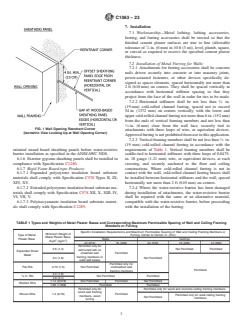
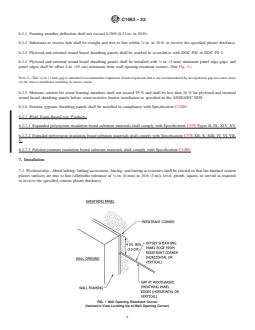
panel edges shall be offset 4 in. (10 cm) minimum from wall opening reentrant corners. (See Fig. 1.)
NOTE 2—This ⁄8-in. (3 mm) gap is intended to accommodate expansion. Linear expansion that is not accommodated by an expansion gap can cause stress
on the stucco membrane resulting in stucco cracks.
6.1.5 Moisture content for wood framing members shall not exceed 19 % and shall be less than 16 % for plywood and oriented
strand board sheathing panels before water-resistive barrier installation as specified in the ANSI/AWC NDS.
6.1.6 Exterior gypsum sheathing panels shall be installed in compliance with Specification C1280.
6.1.7 Rigid Foam Board-type Products:
6.1.7.1 Expanded polystyrene insulation board substrate materials shall comply with Specification C578 Types II, IX, XIV, XV.
6.1.7.2 Extruded polystyrene insulation board substrate materials shall comply with Specification C578 XII, X, XIII, IV, VI, VII,
V.
6.1.7.3 Polyisocyanurate insulation board substrate materials shall comply with Specification C1289.
7. Installation
7.1 Workmanship—Metal lathing, lathing accessories, furring, and furring accessories shall be erected so that the finished cement
plaster surfaces are true to line (allowable tolerance of ⁄4 in. (6 mm) in 10 ft (3 m)), level, plumb, square, or curved as required
to receive the specified cement plaster thickness.
FIG. 1 Wall Opening Reentrant Corner
(Isometric View Looking Up at Wall Opening Corner)
C1063 − 23
7.2 Installation of Metal Furring for Walls:
7.2.1 Attachments for furring accessories shall be concrete nails driven securely into concrete or into masonry joints,
power-actuated fasteners, or other devices specifically designed as spacer elements, spaced horizontally not more than 2 ft
(610 mm) on centers. They shall be spaced vertically in accordance with horizontal stiffener spacing so that they project from the
face of the wall in order for ties to be made.
7.2.2 Horizontal stiffeners shall be not less than ⁄4 in. (19 mm) cold-rolled channel furring, spaced not to exceed 54 in. (1372 mm)
on centers vertically, with the lower and upper cold-rolled channel furring not more than 6 in. (152 mm) from the ends of vertical
framing members and not less than ⁄4 in. (6 mm) clear from the wall face, securely tied to attachments with three loops of wire,
or equivalent devices. Approved furring is not prohibited from use in this application.
7.2.3 Vertical framing members shall be not less than ⁄4 in. (19 mm) cold-rolled channel furring in accordance with the
requirements of Table 1. Vertical framing members shall be saddle-tied to horizontal stiffeners with three loops of 0.0475-in. 18
gauge (1.21 mm) wire, or equivalent devices, at each crossing, and securely anchored to the floor and ceiling constructions. Where
cold-rolled channel furring is not in contact with the wall, cold-rolled channel furring braces shall be installed between horizontal
stiffeners and the wall, spaced horizontally not more than 2 ft (610 mm) on centers.
7.2.4 Where the water-resistive barrier has been damaged during installation of attachments, the water-resistive barrier shall be
repaired with the same or an alternative material, compatible with the water-resistive barrier, before proceeding with the
installation of the furring.
7.2.5 Z-furring used to support lathing and lathing accessories and its fasteners for fastening to framing members or solid bases,
is a customized furring system which shall be engineered.
7.3 Installation of Metal Plaster Bases:
7.3.1 General:
7.3.1.1 Metal plaster bases shall be furred away from vertical framing members or solid surfaces at least ⁄4 in. (6 mm), except
at furring points and fastener attachment locations. Self-furring lath meets furring requirements; except, furring of expanded metal
lath is not required on framing members having a bearing surface of 1 ⁄8 in. (41 mm) or less.
7.3.1.2 The spacing of framing members for the type and weight of metal plaster base shall conform to the requirements of Table
1. Metal plaster bases shall be attached to framing members at not more than 7 in. (178 mm) on center, along framing members
except for ⁄8-in. (10 mm) rib metal lath that shall be attached at each rib. Attachment penetrations between the framing members
shall be avoided.
TABLE 1 Types and Weights of Metal Plaster Bases and Corresponding Maximum Permissible Spacing of Wall and Ceiling Framing
Members or Furring
Specific Installation Requirements and Maximum Permissible Spacing of Wall and Ceiling Framing Members or
Minimum Weight of
Type of Metal Furring, Center to Center, in. (mm)
Metal Plaster Base,
Plaster Base Walls Ceilings
2 2
lb/yd (kg/m )
24 (610) 16 (406) 24 (610) 16 (406) 12 (305)
Permitted only for
2.5 (1.4) Not Permitted Permitted
self-furred lath on
Expanded Sheet
sheathed wall Permitted
Metal
framing members or
3.4 (1.8)
Not Permitted
solid wall bases
Permitted only for
Flat Rib 2.75 (1.5) Not Permitted unsheathed wall
Permitted
framing members
3.4 (1.8)
⁄8 in. Rib Not Permitted Permitted
4.0 (2.1)
1.14 (0.618) Not Permitted Permitted Not Permitted
Welded Wire
1.95 (1.058) Permitted Permitted
Permitted only for
Permitted only for wood and concrete ceiling framing members
wood wall framing
Woven Wire 1.4 (0.76) Permitted
Permitted only for steel ceiling framing
members, wood
Not Permitted
members
furring
C1063 − 23
7.3.1.3 Lath shall be installed with the long dimension at right angles to the framing members, unless otherwise specified.
7.3.1.4 Ends of adjoining plaster bases shall be staggered.
7.3.1.5 Lath shall not be continuous through control joints, but shall be stopped and tied at each side.
7.3.1.6 Where furred or suspended ceilings butt into or are penetrated by columns, walls, beams, or other elements, the edges and
ends of the ceiling lath shall be terminated at the horizontal internal corners with a casing bead lathing accessory, control joint
lathing accessory, or similar device designed to keep the edges and ends of the ceiling lath and plaster free of the adjoining
vertically oriented, or penetrating elements. Internal corner reinforcement lathing accessories shall not be used at these locations.
A clearance of not less than ⁄8 in. (10 mm) shall be maintained between the casing bead lathing accessory, control joint lathing
accessory, or similar device and penetrating elements.
7.3.1.7 Where load bearing walls or partitions butt into structural walls, columns, or floor or roof slabs, the sides or ends of the
wall or partition lath shall be terminated at the internal corners with a casing bead lathing accessory, expansion joint lathing
accessory, control joint lathing accessory, or similar device designed to keep the sides and ends of the wall or partition lath free
of the adjoining elements. Internal corner reinforcement lathing accessories shall not be used at these internal corners. A clearance
of not less than ⁄8 in. (10 mm) shall be maintained from abutting walls, columns, or other vertical elements.
7.3.1.8 Where solid base materials interface with framed, or framed and sheathed base materials and are to receive a continuous
coat of plaster, lathing accessories to reduce cracking, to facilitate drainage, or both, as categorized in Specification C1861, shall
be installed at the interface of these base materials. Omission of these accessories shall be permitted provided the contract
documents require provisions that are equivalent in function and performance to control cracking and facilitate drainage, or both.
7.3.2 Lapping of Metal Plaster Bases:
7.3.2.1 Side laps of metal plaster bases shall be secured to framing members. They shall be tied between framing members with
0.0475-in. 18 gauge (1.21 mm) wire at intervals not more than 9 in. (229 mm).
7.3.2.2 Side laps of expanded metal lath shall be lapped 2 in. (50 mm) nominal and not less than ⁄2 in. (13 mm). Side laps of rib
lath shall be lapped 2 in. (50 mm) nominal and not less than ⁄2 in. (13 mm), or nest the edge ribs. End laps of expanded metal
lath and rib metal lath shall be lapped 2 in. (50 mm) nominal and not less than 1 in. (25 mm). Wire lath shall be lapped minimum
one mesh at the sides and ends. Where end laps occur between the framing members, the ends of the sheets of all metal plaster
bases shall be laced or wire tied with 0.0475-in. (1.21 mm) wire.
7.3.2.3 Where metal plaster base with a factory-attached water-resistive barrier is installed, the vertical and horizontal lap joints
shall be water-resistive barrier on water-resistive barrier and metal plaster base on metal plaster base.
7.3.2.4 Where metal plaster base with a factory-attached water-resistive barrier is installed, the water-resistive barrier shall be
lapped not less than 2 in. (51 mm). On walls, the water-resistive barrier shall be lapped so water will flow to the exterior. Except
for weep screeds, designated drainage screeds, and drainage flashings with solid attachment flanges, the water-resistive barrier shall
not be placed between metal plaster base and lathing accessory attachment flanges. Metal plaster base to lathing accessory key
attachment flange contact shall be required to ensure that the metal plaster base and lathing accessory key attachment flanges are
mechanically locked together.
7.3.3 Attachments for Metal Plaster Bases to Wood Framing Members:
7.3.3.1 Diamond-mesh expanded metal lath, flat-rib expanded metal lath, and wire lath shall be attached to horizontal wood
framing members with 1 ⁄2-in. (38 mm) roofing nails driven flush with the plaster base and attached to vertical wood framing
members with 6d common nails, or 1-in. (25 mm) roofing nails driven to a penetration of not less than ⁄4 in. (19 mm), or 1-in.
(25 mm) wire staples driven flush with the plaster base. Staples shall engage not less than three strands of diamond mesh and flat
rib expanded metal lath or not less than two strands of wire lath and penetrate the wood framing members not less than ⁄4 in.
(19 mm). When metal lath is installed over sheathing, use fasteners that will penetrate the framing members not less than ⁄4 in.
(19 mm).
7.3.3.2 Expanded ⁄8 in. (10 mm) rib lath shall be attached to horizontal wood framing members with nails or staples to provide
not less than 1 ⁄4-in. (44 mm) penetration into horizontal wood framing members.
C1063 − 23
7.3.3.3 Common nails shall be bent over to engage not less than three strands of diamond mesh and flat rib expanded metal lath
or not less than two strands of wire lath, or be bent over a rib when rib lath is installed.
7.3.3.4 Screws used to attach metal plaster base to horizontal and vertical wood framing members shall penetrate not less than ⁄8
in. (16 mm) into the member when the lath is installed. For expanded metal lath, the screw shall engage not less than three strands
of lath. For wire laths, screws shall engage not less than two strands of diamond mesh and flat rib expanded metal lath or not less
than two strands of wire lath. When installing expanded metal rib lath, the screw shall pass through, but not deform, the rib. When
installing wire rib lath, the screw may deform the rib.
7.3.4 Attachments for Metal Plaster Bases to Metal Framing Members:
7.3.4.1 Except as described in 7.3.4.2, metal plaster bases shall be securely attached to metal framing members with 0.0475-in.
18 gauge (1.21 mm) wire ties, clips, or by other means of attachment which afford carrying strength and resistance to corrosion
equal to or superior to that of the wire.
7.3.4.2 Rib metal lath shall be attached to open-web steel joists by single ties o
...