


ASTM C843-23
(Specification)Standard Specification for Application of Gypsum Veneer Plaster
Standard Specification for Application of Gypsum Veneer Plaster
ABSTRACT
This specification covers the minimum requirements for gypsum veneer plaster and includes application methods on systems such as electric heat cable systems but not exceeding a specified temperature. Applicable building code regulations should be followed when a specific degree of fire resistance is required. Plaster and other cementitious materials should be kept dry until these are ready to be used and should be kept off the ground, under cover, and away from damp walls and surfaces.
SCOPE
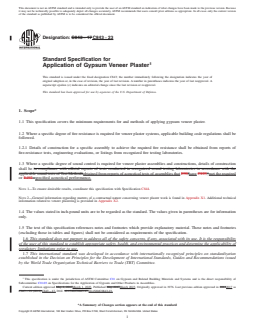
1.1 This specification covers the minimum requirements for and methods of applying gypsum veneer plaster.
1.2 Where a specific degree of fire resistance is required for veneer plaster systems, applicable building code regulations shall be followed.
1.2.1 Details of construction for a specific assembly to achieve the required fire resistance shall be obtained from reports of fire-resistance tests, engineering evaluations, or listings from recognized fire testing laboratories.
1.3 Where a specific degree of sound control is required for veneer plaster assemblies and constructions, details of construction shall be obtained from reports of acoustical tests of assemblies that have met the required or specified acoustical performance.
Note 1: To ensure desirable results, coordinate this specification with Specification C844.
Note 2: General information regarding matters of a contractual nature concerning veneer plaster work is found in Appendix X1. Additional technical information related to veneer plastering is provided in Appendix X2.
1.4 The values stated in inch-pound units are to be regarded as the standard. The values given in parentheses are for information only.
1.5 The text of this specification references notes and footnotes which provide explanatory material. These notes and footnotes (excluding those in tables and figures) shall not be considered as requirements of the specification.
1.6 This standard does not purport to address all of the safety concerns, if any, associated with its use. It is the responsibility of the user of this standard to establish appropriate safety, health, and environmental practices and determine the applicability of regulatory limitations prior to use.
1.7 This international standard was developed in accordance with internationally recognized principles on standardization established in the Decision on Principles for the Development of International Standards, Guides and Recommendations issued by the World Trade Organization Technical Barriers to Trade (TBT) Committee.
General Information
- Status
- Published
- Publication Date
- 28-Feb-2023
- Technical Committee
- C11 - Gypsum and Related Building Materials and Systems
Relations
- Refers
ASTM C631-09(2020) - Standard Specification for Bonding Compounds for Interior Gypsum Plastering - Effective Date
- 01-Apr-2020
- Refers
ASTM C1047-19 - Standard Specification for Accessories for Gypsum Wallboard and Gypsum Veneer Base - Effective Date
- 01-Nov-2019
- Effective Date
- 01-Oct-2019
- Refers
ASTM C11-18a - Standard Terminology Relating to Gypsum and Related Building Materials and Systems - Effective Date
- 01-Oct-2018
- Effective Date
- 01-Oct-2018
- Refers
ASTM C11-18 - Standard Terminology Relating to Gypsum and Related Building Materials and Systems - Effective Date
- 01-Jun-2018
- Refers
ASTM C11-17a - Standard Terminology Relating to Gypsum and Related Building Materials and Systems - Effective Date
- 01-Oct-2017
- Refers
ASTM C11-17 - Standard Terminology Relating to Gypsum and Related Building Materials and Systems - Effective Date
- 15-May-2017
- Refers
ASTM C11-16 - Standard Terminology Relating to Gypsum and Related Building Materials and Systems - Effective Date
- 15-May-2016
- Refers
ASTM C11-15a - Standard Terminology Relating to Gypsum and Related Building Materials and Systems - Effective Date
- 01-Oct-2015
- Refers
ASTM C11-15 - Standard Terminology Relating to Gypsum and Related Building Materials and Systems - Effective Date
- 01-Apr-2015
- Refers
ASTM C631-09(2014) - Standard Specification for Bonding Compounds for Interior Gypsum Plastering - Effective Date
- 01-Sep-2014
- Refers
ASTM C1047-14a - Standard Specification for Accessories for Gypsum Wallboard and Gypsum Veneer Base - Effective Date
- 01-Jun-2014
- Refers
ASTM C1047-14 - Standard Specification for Accessories for Gypsum Wallboard and Gypsum Veneer Base - Effective Date
- 15-Apr-2014
- Effective Date
- 01-Apr-2014
Overview
ASTM C843-23, published by ASTM International, is the standard specification for the application of gypsum veneer plaster. This document outlines the minimum requirements and recommended methods for applying gypsum veneer plaster to approved substrates such as gypsum bases, masonry, and monolithic concrete surfaces. It focuses on critical aspects like fire resistance, sound control, material handling, mixing, surface preparation, and environmental conditions to ensure a high-quality, durable veneer plaster finish in both residential and commercial construction.
Gypsum veneer plaster is widely valued for its smooth, durable surface and can contribute to effective fire resistance and sound attenuation depending on system design and installation. By adhering to ASTM C843-23, contractors, specifiers, and installers can achieve consistent, code-compliant results and minimize issues related to cracking, bonding, or performance failures.
Key Topics
- Scope and Application: Defines the minimum requirements for materials and methods used in applying gypsum veneer plaster, including on walls with electric radiative heat cable systems.
- Fire Resistance: Identifies the necessity of conforming to applicable building code regulations and using tested assemblies when a specific level of fire resistance is required.
- Sound Control: Encourages the use of assemblies tested for acoustical performance in applications requiring sound attenuation.
- Material Storage and Handling: Stresses that all plaster and cementitious materials must be kept dry, off the ground, and away from damp surfaces until ready for use to prevent material degradation.
- Environmental Conditions: Requires controlled temperature (between 55°F and 80°F) and proper ventilation during and after veneer plaster application to ensure optimal performance and prevent defects.
- Surface Preparation: Outlines procedures for examining and preparing surfaces, including cleaning, patching, and reinforcing joints, to receive veneer plaster and ensure proper adhesion.
- Mixing and Application: Requires use of fresh, lump-free materials, manufacturer-approved water ratios, and careful batch mixing without retempering. Also addresses applying single-coat (one-component) or base/finish (two-component) veneer plaster systems.
- Electric Radiant Heat Cable Systems: Details safe practices when applying plaster over electric heating cables, including adherence to maximum temperature limits and special construction methods.
Applications
ASTM C843-23 provides practical value in a variety of building scenarios:
- New Construction and Renovation: Essential for architects, contractors, and building owners seeking durable, high-quality interior wall finishes that meet performance requirements for fire and sound.
- Commercial and Residential Projects: Applicable in offices, schools, hospitals, multifamily housing, and other structures where aesthetics and performance are key considerations.
- Fire- and Sound-Rated Assemblies: Critical where code-mandated fire resistance or acoustic properties are required, supporting compliance and occupant comfort.
- Electric Radiant Heating: Offers guidance for safely integrating gypsum veneer plaster finishes with in-wall heating systems without compromising material integrity.
- Sustainable Building Practices: Promotes proper storage, mixing, and thermal management, reducing waste and enhancing the lifecycle of building materials.
Related Standards
ASTM C843-23 references and aligns with several related ASTM standards and test methods to ensure comprehensive coverage of plaster system requirements:
- ASTM C11 - Terminology Relating to Gypsum and Related Building Materials and Systems
- ASTM C587 - Specification for Gypsum Veneer Plaster
- ASTM C631 - Specification for Bonding Compounds for Interior Gypsum Plastering
- ASTM C844 - Specification for Application of Gypsum Base to Receive Gypsum Veneer Plaster
- ASTM C1047 - Specification for Accessories for Gypsum Wallboard and Gypsum Veneer Base
- ASTM C1396 - Specification for Gypsum Board
- ASTM E90, E492 and C423 - Test Methods for Sound Transmission and Absorption (as referenced for specific acoustical performance requirements)
Keywords: gypsum veneer plaster, ASTM C843, plaster application standard, fire resistance, sound control, construction standards, veneer plaster installation
Buy Documents
ASTM C843-23 - Standard Specification for Application of Gypsum Veneer Plaster
REDLINE ASTM C843-23 - Standard Specification for Application of Gypsum Veneer Plaster
Get Certified
Connect with accredited certification bodies for this standard

ICC Evaluation Service
Building products evaluation and certification.

QAI Laboratories
Building and construction product testing and certification.

Aboma Certification B.V.
Specialized in construction, metal, and transport sectors.
Sponsored listings
Frequently Asked Questions
ASTM C843-23 is a technical specification published by ASTM International. Its full title is "Standard Specification for Application of Gypsum Veneer Plaster". This standard covers: ABSTRACT This specification covers the minimum requirements for gypsum veneer plaster and includes application methods on systems such as electric heat cable systems but not exceeding a specified temperature. Applicable building code regulations should be followed when a specific degree of fire resistance is required. Plaster and other cementitious materials should be kept dry until these are ready to be used and should be kept off the ground, under cover, and away from damp walls and surfaces. SCOPE 1.1 This specification covers the minimum requirements for and methods of applying gypsum veneer plaster. 1.2 Where a specific degree of fire resistance is required for veneer plaster systems, applicable building code regulations shall be followed. 1.2.1 Details of construction for a specific assembly to achieve the required fire resistance shall be obtained from reports of fire-resistance tests, engineering evaluations, or listings from recognized fire testing laboratories. 1.3 Where a specific degree of sound control is required for veneer plaster assemblies and constructions, details of construction shall be obtained from reports of acoustical tests of assemblies that have met the required or specified acoustical performance. Note 1: To ensure desirable results, coordinate this specification with Specification C844. Note 2: General information regarding matters of a contractual nature concerning veneer plaster work is found in Appendix X1. Additional technical information related to veneer plastering is provided in Appendix X2. 1.4 The values stated in inch-pound units are to be regarded as the standard. The values given in parentheses are for information only. 1.5 The text of this specification references notes and footnotes which provide explanatory material. These notes and footnotes (excluding those in tables and figures) shall not be considered as requirements of the specification. 1.6 This standard does not purport to address all of the safety concerns, if any, associated with its use. It is the responsibility of the user of this standard to establish appropriate safety, health, and environmental practices and determine the applicability of regulatory limitations prior to use. 1.7 This international standard was developed in accordance with internationally recognized principles on standardization established in the Decision on Principles for the Development of International Standards, Guides and Recommendations issued by the World Trade Organization Technical Barriers to Trade (TBT) Committee.
ABSTRACT This specification covers the minimum requirements for gypsum veneer plaster and includes application methods on systems such as electric heat cable systems but not exceeding a specified temperature. Applicable building code regulations should be followed when a specific degree of fire resistance is required. Plaster and other cementitious materials should be kept dry until these are ready to be used and should be kept off the ground, under cover, and away from damp walls and surfaces. SCOPE 1.1 This specification covers the minimum requirements for and methods of applying gypsum veneer plaster. 1.2 Where a specific degree of fire resistance is required for veneer plaster systems, applicable building code regulations shall be followed. 1.2.1 Details of construction for a specific assembly to achieve the required fire resistance shall be obtained from reports of fire-resistance tests, engineering evaluations, or listings from recognized fire testing laboratories. 1.3 Where a specific degree of sound control is required for veneer plaster assemblies and constructions, details of construction shall be obtained from reports of acoustical tests of assemblies that have met the required or specified acoustical performance. Note 1: To ensure desirable results, coordinate this specification with Specification C844. Note 2: General information regarding matters of a contractual nature concerning veneer plaster work is found in Appendix X1. Additional technical information related to veneer plastering is provided in Appendix X2. 1.4 The values stated in inch-pound units are to be regarded as the standard. The values given in parentheses are for information only. 1.5 The text of this specification references notes and footnotes which provide explanatory material. These notes and footnotes (excluding those in tables and figures) shall not be considered as requirements of the specification. 1.6 This standard does not purport to address all of the safety concerns, if any, associated with its use. It is the responsibility of the user of this standard to establish appropriate safety, health, and environmental practices and determine the applicability of regulatory limitations prior to use. 1.7 This international standard was developed in accordance with internationally recognized principles on standardization established in the Decision on Principles for the Development of International Standards, Guides and Recommendations issued by the World Trade Organization Technical Barriers to Trade (TBT) Committee.
ASTM C843-23 is classified under the following ICS (International Classification for Standards) categories: 91.100.10 - Cement. Gypsum. Lime. Mortar. The ICS classification helps identify the subject area and facilitates finding related standards.
ASTM C843-23 has the following relationships with other standards: It is inter standard links to ASTM C631-09(2020), ASTM C1047-19, ASTM C1047-14a(2019), ASTM C11-18a, ASTM C587-04(2018), ASTM C11-18, ASTM C11-17a, ASTM C11-17, ASTM C11-16, ASTM C11-15a, ASTM C11-15, ASTM C631-09(2014), ASTM C1047-14a, ASTM C1047-14, ASTM C587-04(2014). Understanding these relationships helps ensure you are using the most current and applicable version of the standard.
ASTM C843-23 is available in PDF format for immediate download after purchase. The document can be added to your cart and obtained through the secure checkout process. Digital delivery ensures instant access to the complete standard document.
Standards Content (Sample)
This international standard was developed in accordance with internationally recognized principles on standardization established in the Decision on Principles for the
Development of International Standards, Guides and Recommendations issued by the World Trade Organization Technical Barriers to Trade (TBT) Committee.
Designation: C843 − 23
Standard Specification for
Application of Gypsum Veneer Plaster
This standard is issued under the fixed designation C843; the number immediately following the designation indicates the year of
original adoption or, in the case of revision, the year of last revision. A number in parentheses indicates the year of last reapproval. A
superscript epsilon (´) indicates an editorial change since the last revision or reapproval.
This standard has been approved for use by agencies of the U.S. Department of Defense.
1. Scope* 1.7 This international standard was developed in accor-
dance with internationally recognized principles on standard-
1.1 This specification covers the minimum requirements for
ization established in the Decision on Principles for the
and methods of applying gypsum veneer plaster.
Development of International Standards, Guides and Recom-
1.2 Where a specific degree of fire resistance is required for
mendations issued by the World Trade Organization Technical
veneer plaster systems, applicable building code regulations
Barriers to Trade (TBT) Committee.
shall be followed.
2. Referenced Documents
1.2.1 Details of construction for a specific assembly to
achieve the required fire resistance shall be obtained from
2.1 ASTM Standards:
reports of fire-resistance tests, engineering evaluations, or
C11 Terminology Relating to Gypsum and Related Building
listings from recognized fire testing laboratories.
Materials and Systems
C587 Specification for Gypsum Veneer Plaster
1.3 Where a specific degree of sound control is required for
C631 Specification for Bonding Compounds for Interior
veneer plaster assemblies and constructions, details of con-
Gypsum Plastering
struction shall be obtained from reports of acoustical tests of
C844 Specification for Application of Gypsum Base to
assemblies that have met the required or specified acoustical
Receive Gypsum Veneer Plaster
performance.
C1047 Specification for Accessories for Gypsum Wallboard
NOTE 1—To ensure desirable results, coordinate this specification with
and Gypsum Veneer Base
Specification C844.
C1396 Specification for Gypsum Board
NOTE 2—General information regarding matters of a contractual nature
concerning veneer plaster work is found in Appendix X1. Additional
3. Terminology
technical information related to veneer plastering is provided in Appendix
3.1 Definitions:
X2.
3.1.1 See Terminology C11.
1.4 The values stated in inch-pound units are to be regarded
3.2 Definitions of Terms Specific to This Standard:
as the standard. The values given in parentheses are for
3.2.1 base coat, n—veneer plaster trowel or machine ap-
information only.
plied as the first coat of a two-component system.
1.5 The text of this specification references notes and
3.2.2 finish coat, n—veneer finish plaster trowel or machine
footnotes which provide explanatory material. These notes and
applied as the second coat over the base coat plaster in a
footnotes (excluding those in tables and figures) shall not be
two-component system.
considered as requirements of the specification.
3.2.2.1 smooth-trowel finish, n—a finish resulting from steel
1.6 This standard does not purport to address all of the
troweling with a minimum of water after the plaster has
safety concerns, if any, associated with its use. It is the
become firm. A smooth finish free of trowel marks, blemishes,
responsibility of the user of this standard to establish appro-
or other imperfections.
priate safety, health, and environmental practices and deter-
3.2.2.2 texture finish, n—a finish resulting from (1) trowel
mine the applicability of regulatory limitations prior to use.
application followed by floating or texturing of the surface with
any of a variety of tools using a minimum of water or (2)
machine application, left as applied or followed by hand
This specification is under the jurisdiction of ASTM Committee C11 on
texturing.
Gypsum and Related Building Materials and Systems and is the direct responsibility
of Subcommittee C11.03 on Specifications for the Application of Gypsum and Other
Products in Assemblies. For referenced ASTM standards, visit the ASTM website, www.astm.org, or
Current edition approved March 1, 2023. Published March 2023. Originally contact ASTM Customer Service at service@astm.org. For Annual Book of ASTM
approved in 1976. Last previous edition approved in 2017 as C843 – 17. DOI: Standards volume information, refer to the standard’s Document Summary page on
10.1520/C0843-23. the ASTM website.
*A Summary of Changes section appears at the end of this standard
Copyright © ASTM International, 100 Barr Harbor Drive, PO Box C700, West Conshohocken, PA 19428-2959. United States
C843 − 23
3.2.3 joint-reinforcing embedment, n—the cementitious ma- 7.4 Liquid Bonding Compounds—Specification C631 (see
terial used to embed the strip material that is compatible with X2.3).
the veneer plaster used.
7.5 Water—Water shall be clean, fresh, and of potable water
3.2.4 one-component system, n—a veneer plaster system
quality.
designed for application directly over approved bases in a
7.6 Accessories—Specification C1047.
single plaster mix applied in a single coat or double-back
operation with the same material.
8. Surface Preparation
3.2.5 reinforced joint, n—a joint between gypsum base that
8.1 Examination—Carefully examine all surfaces, including
is reinforced with strip material embedded in a cementitious
but not limited to, unit masonry, monolithic concrete, gypsum
material.
bases of all types, and accessories to receive veneer plaster,
3.2.6 reinforcing, n—joint reinforcing tape or mesh (strip
before the veneer plaster is applied. Notify the proper authori-
material) that is applied over flat joints and interior angles.
ties promptly of all unsatisfactory conditions. The examination
3.2.7 two-component system, n—a veneer plaster system
shall determine whether the gypsum base has been exposed to
involving two separate materials mixed and applied separately
excessive sunlight. Do not apply veneer plaster until after such
for base coat and finish coat.
unsatisfactory conditions are rectified to the satisfaction of the
plastering contractor.
3.2.8 veneer plaster system, n—gypsum veneer plaster ap-
plied to (1) a gypsum base in accordance with 10.1 or (2)
NOTE 4—The bond of alkaline veneer plaster to gypsum base may be
properly prepared masonry or monolithic concrete surfaces,
impaired if the base is exposed to direct light or sunlight for extended
neither side of which is exposed to moisture. The plaster shall periods.
be applied with one or more components not exceeding ⁄4 in.
8.1.1 Do not apply veneer plaster over any surfaces of unit
(6.4 mm) in total thickness.
masonry or concrete that have been coated with any bitumi-
nous compound or other waterproofing or damproofing or form
4. Delivery of Materials
release agent.
4.1 All manufactured materials shall be delivered in the
8.2 Conditioning of Surfaces:
original packages, containers, or cartons bearing the brand
8.2.1 Immediately before the plaster is applied, wet down
name and manufacturer identification.
the masonry surfaces on which suction shall be reduced.
Visible water shall not remain on the surface.
5. Protection of Materials
8.2.2 Carefully examine accessories, such as corner beads,
control joints, casing beads, and so forth, to ensure that they are
5.1 Plasters and other cementitious materials shall be kept
straight, curved, plumb, level, square, or true to the required
dry until ready to be used; they shall be kept off the ground,
angles and have been applied in a manner to ensure full
under cover, and away from damp walls and surfaces.
coverage of flanges before the plaster is applied.
6. Environmental Conditions
8.3 Monolithic Concrete Surfaces—Clean monolithic con-
crete surfaces of all dust, loose particles, and other foreign
6.1 Temperature—When the ambient outside temperature at
matter. Completely remove all grease, oil, noncompatible
the building site is less than 55 °F (13 °C), maintain a
curing compounds, and form releasing agents. Remove all
temperature in the building of not less than 55 °F (13 °C) or not
ridges and protrusions greater that ⁄8 in. (3.2 mm) and fill all
more than 80 °F (27 °C) for not less than 24 h prior to the
depressions greater than ⁄4 in. (6.4 mm) level with portland
application of veneer plaster and for one week after the veneer
cement mortar and allow to set and dry. Any further prepara-
plaster has set or until the veneer plaster has dried. Distribute
tion shall be as recommended by the veneer plaster manufac-
heat evenly in all work areas, and use deflection or protective
turer.
screens to prevent concentrated or uneven heat or cold on the
veneer plaster.
8.4 Gypsum Base Joint Reinforcement—Reinforce all inte-
rior angles and flat joints prior to application of the veneer
NOTE 3—The requirements in 6.1 will minimize the cracking of veneer
plaster due to structural movements caused by thermal changes from plaster over the base.
temperature extremes; and dry-outs due to hot spots caused by concen-
8.4.1 Interior Angles—Position and secure reinforcement
trated heat.
with staples (on 12-in. (305 mm) centers, one side only),
6.2 Ventilation—Ventilation shall be provided to remove veneer plaster, or other cementitious material compatible with
excess water given off through the drying process.
the veneer plaster or by using self-adhering strip reinforce-
ment. When stapling, staple along the ceiling edge only for
7. Materials
wall-to-ceiling angles and along one edge for wall-to-wall
angles. When securing reinforcement with veneer plaster,
7.1 Gypsum Base for Veneer Plasters (hereinafter referred
reinforcement shall be thoroughly embedded so that embed-
to as “gypsum base”) Specification C1396.
ment material is both under and covering reinforcement.
7.2 Veneer Plasters—Specification C587.
8.4.2 Flat Joints—Center reinforcement over the joint line
7.3 Reinforcing—Noncorrosive strip providing the joint of the gypsum base and secure with staples or veneer plaster if
strength requirements of Specification C587. not using self-adhering reinforcement. Keep reinforcement
C843 − 23
tight and flat against the gypsum base, and when stapling, 9.2 Setting Time—Setting times are carefully controlled by
position the staples no farther than 24 in. (610 mm) apart, the manufacturer. Do not make adjustments to the setting time
staggered along each edge. Embed reinforcement and continue on the job. If problems with setting develop under unusual job
application of the veneer plaster over the field of the base. conditions, consult the manufacturer of the veneer plaster for
(Warning—This method provides minimum reinforcement of recommendations.
the joints. To minimize incidence and severity of joint ridging 9.2.1 Do not use gauging, molding, or casting plasters, l
...
This document is not an ASTM standard and is intended only to provide the user of an ASTM standard an indication of what changes have been made to the previous version. Because
it may not be technically possible to adequately depict all changes accurately, ASTM recommends that users consult prior editions as appropriate. In all cases only the current version
of the standard as published by ASTM is to be considered the official document.
Designation: C843 − 17 C843 − 23
Standard Specification for
Application of Gypsum Veneer Plaster
This standard is issued under the fixed designation C843; the number immediately following the designation indicates the year of
original adoption or, in the case of revision, the year of last revision. A number in parentheses indicates the year of last reapproval. A
superscript epsilon (´) indicates an editorial change since the last revision or reapproval.
This standard has been approved for use by agencies of the U.S. Department of Defense.
1. Scope*
1.1 This specification covers the minimum requirements for and methods of applying gypsum veneer plaster.
1.2 Where a specific degree of fire resistance is required for veneer plaster systems, applicable building code regulations shall be
followed.
1.2.1 Details of construction for a specific assembly to achieve the required fire resistance shall be obtained from reports of
fire-resistance tests, engineering evaluations, or listings from recognized fire testing laboratories.
1.3 Where a specific degree of sound control is required for veneer plaster assemblies and constructions, details of construction
shall be in compliance with official reports of tests conducted in recognized sound testing laboratories in accordance with the
applicable sound tests of Test Methodsobtained from reports of acoustical tests of assemblies that E90,have C423, met the required
or E492. specified acoustical performance.
NOTE 1—To ensure desirable results, coordinate this specification with Specification C844.
NOTE 2—General information regarding matters of a contractual nature concerning veneer plaster work is found in Appendix X1. Additional technical
information related to veneer plastering is provided in Appendix X2.
1.4 The values stated in inch-pound units are to be regarded as the standard. The values given in parentheses are for information
only.
1.5 The text of this specification references notes and footnotes which provide explanatory material. These notes and footnotes
(excluding those in tables and figures) shall not be considered as requirements of the specification.
1.6 This standard does not purport to address all of the safety concerns, if any, associated with its use. It is the responsibility
of the user of this standard to establish appropriate safety, health, and environmental practices and determine the applicability of
regulatory limitations prior to use.
1.7 This international standard was developed in accordance with internationally recognized principles on standardization
established in the Decision on Principles for the Development of International Standards, Guides and Recommendations issued
by the World Trade Organization Technical Barriers to Trade (TBT) Committee.
This specification is under the jurisdiction of ASTM Committee C11 on Gypsum and Related Building Materials and Systems and is the direct responsibility of
Subcommittee C11.03 on Specifications for the Application of Gypsum and Other Products in Assemblies.
Current edition approved May 1, 2017March 1, 2023. Published May 2017March 2023. Originally approved in 1976. Last previous edition approved in 20122017 as
C843 – 99 (2012).C843 – 17. DOI: 10.1520/C0843-17.10.1520/C0843-23.
*A Summary of Changes section appears at the end of this standard
Copyright © ASTM International, 100 Barr Harbor Drive, PO Box C700, West Conshohocken, PA 19428-2959. United States
C843 − 23
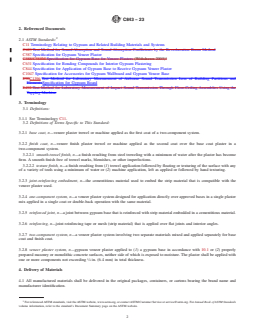
2. Referenced Documents
2.1 ASTM Standards:
C11 Terminology Relating to Gypsum and Related Building Materials and Systems
C423 Test Method for Sound Absorption and Sound Absorption Coefficients by the Reverberation Room Method
C587 Specification for Gypsum Veneer Plaster
C588/C588M Specification for Gypsum Base for Veneer Plasters (Withdrawn 2005)
C631 Specification for Bonding Compounds for Interior Gypsum Plastering
C844 Specification for Application of Gypsum Base to Receive Gypsum Veneer Plaster
C1047 Specification for Accessories for Gypsum Wallboard and Gypsum Veneer Base
E90C1396 Test Method for Laboratory Measurement of Airborne Sound Transmission Loss of Building Partitions and
ElementsSpecification for Gypsum Board
E492 Test Method for Laboratory Measurement of Impact Sound Transmission Through Floor-Ceiling Assemblies Using the
Tapping Machine
3. Terminology
3.1 Definitions:
3.1.1 See Terminology C11.
3.2 Definitions of Terms Specific to This Standard:
3.2.1 base coat, n—veneer plaster trowel or machine applied as the first coat of a two-component system.
3.2.2 finish coat, n—veneer finish plaster trowel or machine applied as the second coat over the base coat plaster in a
two-component system.
3.2.2.1 smooth-trowel finish, n—a finish resulting from steel troweling with a minimum of water after the plaster has become
firm. A smooth finish free of trowel marks, blemishes, or other imperfections.
3.2.2.2 texture finish, n—a finish resulting from (1) trowel application followed by floating or texturing of the surface with any
of a variety of tools using a minimum of water or (2) machine application, left as applied or followed by hand texturing.
3.2.3 joint-reinforcing embedment, n—the cementitious material used to embed the strip material that is compatible with the
veneer plaster used.
3.2.4 one-component system, n—a veneer plaster system designed for application directly over approved bases in a single plaster
mix applied in a single coat or double-back operation with the same material.
3.2.5 reinforced joint, n—a joint between gypsum base that is reinforced with strip material embedded in a cementitious material.
3.2.6 reinforcing, n—joint reinforcing tape or mesh (strip material) that is applied over flat joints and interior angles.
3.2.7 two-component system, n—a veneer plaster system involving two separate materials mixed and applied separately for base
coat and finish coat.
3.2.8 veneer plaster system, n—gypsum veneer plaster applied to (1) a gypsum base in accordance with 10.1 or (2) properly
prepared masonry or monolithic concrete surfaces, neither side of which is exposed to moisture. The plaster shall be applied with
one or more components not exceeding ⁄4 in. (6.4 mm) in total thickness.
4. Delivery of Materials
4.1 All manufactured materials shall be delivered in the original packages, containers, or cartons bearing the brand name and
manufacturer identification.
For referenced ASTM standards, visit the ASTM website, www.astm.org, or contact ASTM Customer Service at service@astm.org. For Annual Book of ASTM Standards
volume information, refer to the standard’s Document Summary page on the ASTM website.
C843 − 23
5. Protection of Materials
5.1 Plasters and other cementitious materials shall be kept dry until ready to be used; they shall be kept off the ground, under cover,
and away from damp walls and surfaces.
6. Environmental Conditions
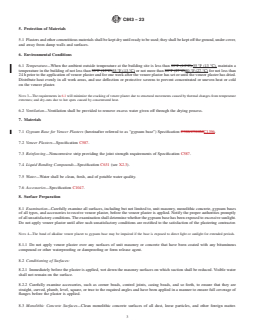
6.1 Temperature—When the ambient outside temperature at the building site is less than 55°F (13°C),55 °F (13 °C), maintain a
temperature in the building of not less than 55°F (13°C)55 °F (13 °C) or not more than 80°F (27°C)80 °F (27 °C) for not less than
24 h prior to the application of veneer plaster and for one week after the veneer plaster has set or until the veneer plaster has dried.
Distribute heat evenly in all work areas, and use deflection or protective screens to prevent concentrated or uneven heat or cold
on the veneer plaster.
NOTE 3—The requirements in 6.1 will minimize the cracking of veneer plaster due to structural movements caused by thermal changes from temperature
extremes; and dry-outs due to hot spots caused by concentrated heat.
6.2 Ventilation—Ventilation shall be provided to remove excess water given off through the drying process.
7. Materials
7.1 Gypsum Base for Veneer Plasters (hereinafter referred to as “gypsum base”) Specification C588/C588MC1396.
7.2 Veneer Plasters—Specification C587.
7.3 Reinforcing—Noncorrosive strip providing the joint strength requirements of Specification C587.
7.4 Liquid Bonding Compounds—Specification C631 (see X2.3).
7.5 Water—Water shall be clean, fresh, and of potable water quality.
7.6 Accessories—Specification C1047.
8. Surface Preparation
8.1 Examination—Carefully examine all surfaces, including but not limited to, unit masonry, monolithic concrete, gypsum bases
of all types, and accessories to receive veneer plaster, before the veneer plaster is applied. Notify the proper authorities promptly
of all unsatisfactory conditions. The examination shall determine whether the gypsum base has been exposed to excessive sunlight.
Do not apply veneer plaster until after such unsatisfactory conditions are rectified to the satisfaction of the plastering contractor.
NOTE 4—The bond of alkaline veneer plaster to gypsum base may be impaired if the base is exposed to direct light or sunlight for extended periods.
8.1.1 Do not apply veneer plaster over any surfaces of unit masonry or concrete that have been coated with any bituminous
compound or other waterproofing or damproofing or form release agent.
8.2 Conditioning of Surfaces:
8.2.1 Immediately before the plaster is applied, wet down the masonry surfaces on which suction shall be reduced. Visible water
shall not remain on the surface.
8.2.2 Carefully examine accessories, such as corner beads, control joints, casing beads, and so forth, to ensure that they are
straight, curved, plumb, level, square, or true to the required angles and have been applied in a manner to ensure full coverage of
flanges before the plaster is applied.
8.3 Monolithic Concrete Surfaces—Clean monolithic concrete surfaces of all dust, loose particles, and other foreign matter.
C843 − 23
Completely remove all grease, oil, noncompatible curing compounds, and form releasing agents. Remove all ridges and protrusions
1 1
greater that ⁄8 in. (3.2 mm) and fill all depressions greater than ⁄4 in. (6.4 mm) level with portland cement mortar and allow to set
and dry. Any further preparation shall be as recommended by the veneer plaster manufacturer.
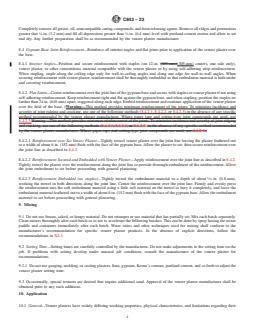
8.4 Gypsum Base Joint Reinforcement—Reinforce all interior angles and flat joints prior to application of the veneer plaster over
the base.
8.4.1 Interior Angles—Position and secure reinforcement with staples (on 12-in. (305-mm)(305 mm) centers, one side only),
veneer plaster, or other cementitious material compatible with the veneer plaster or by using self-adhering strip reinforcement.
When stapling, staple along the ceiling edge only for wall-to-ceiling angles and along one edge for wall-to-wall angles. When
securing reinforcement with veneer plaster, reinforcement shall be thoroughly embedded so that embedment material is both under
and covering reinforcement.
8.4.2 Flat Joints—Center reinforcement over the joint line of the gypsum base and secure with staples or veneer plaster if not using
self-adhering reinforcement. Keep reinforcement tight and flat against the gypsum base, and when stapling, position the staples no
farther than 24 in. (610 mm) apart, staggered along each edge. Embed reinforcement and continue application of the veneer plaster
over the field of the base. (Warning—This method provides minimum reinforcement of the joints. To minimize incidence and
severity of joint ridging and cracking, use one of the following methods (8.4.2.1, 8.4.2.2, or 8.4.2.3) in the absence of any specific
method recommended by the veneer plaster manufacturer
...
Questions, Comments and Discussion
Ask us and Technical Secretary will try to provide an answer. You can facilitate discussion about the standard in here.
Loading comments...