

ASTM B778-22
(Specification)Standard Specification for Shaped Wire Compact Concentric-Lay-Stranded Aluminum Conductors (AAC/TW)
General Information
- Abstract
ABSTRACT
This specification covers shaped wire compact concentric-lay-stranded aluminum conductor (AAC/TW) and its component wires for use as overhead electrical conductors. The trapezoidal aluminum wires shall meet the prescribed tensile strength and elongation requirements. Electric-butt welds, electric-butt cold-upset welds, or cold-pressure welds may be made in the individual aluminum wires during the stranding process. Requirements for the lay and construction of the conductor are detailed. The methods of determining the rated strength, breaking strength, mass, and electrical resistance are given. Tests for mechanical and electrical properties of aluminum wires shall be made before stranding. For the purpose of calculating mass per unit length, cross-sections, and the like, the density of aluminum to be taken is specified.
SCOPE
1.1 This specification covers shaped wire compact concentric-lay-stranded aluminum conductor (AAC/TW) and its component wires for use as overhead electrical conductors (Explanatory Note 1 and Note 2).
1.2 The values stated in inch-pound units are to be regarded as the standard with the exception of temperature and resistivity. The SI equivalents of inch-pound units may be approximate.
Note 1: AAC/TW is designed to increase the aluminum area for a given diameter of conductor by the use of trapezoidally shaped wires (TW). The conductors consist of a central core of one round aluminum wire or a seven-strand compact round core surrounded by two or more layers of trapezoidal aluminum 1350-H19 wires. For the purposes of this specification, the sizes listed are tabulated on the basis of the finished conductor having an area equal to that of specific sizes of standard AAC (Table 1) or in fixed diameter increments (Table 2) so as to facilitate conductor selection.
Note 2: The aluminum and temper designations conform to ANSI Standard H 35.1. Aluminum 1350 corresponds to Unified Numbering System (UNS) A91350 in accordance with Practice E527.
1.3 This international standard was developed in accordance with internationally recognized principles on standardization established in the Decision on Principles for the Development of International Standards, Guides and Recommendations issued by the World Trade Organization Technical Barriers to Trade (TBT) Committee.
- Status
- Published
- Publication Date
- 30-Nov-2022
- Technical Committee
- B01 - Electrical Conductors
- Drafting Committee
- B01.07 - Conductors of Light Metals
Buy Documents
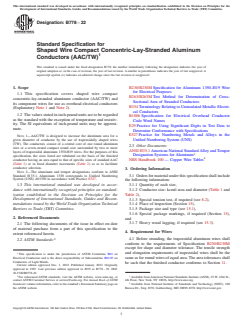
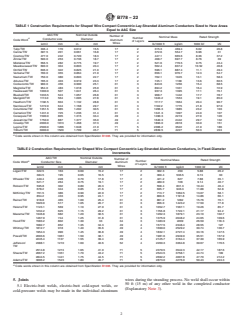
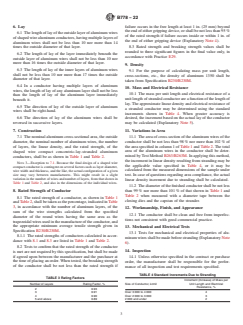

ASTM B778-22 - Standard Specification for Shaped Wire Compact Concentric-Lay-Stranded Aluminum Conductors (AAC/TW)
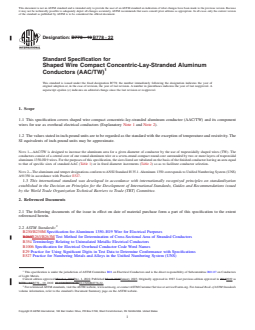
REDLINE ASTM B778-22 - Standard Specification for Shaped Wire Compact Concentric-Lay-Stranded Aluminum Conductors (AAC/TW)
Overview
ASTM B778-22 is the standard specification for shaped wire compact concentric-lay-stranded aluminum conductors (AAC/TW) and their component wires, intended for use as overhead electrical conductors. Developed by ASTM International, this standard provides essential criteria for the materials, construction, and performance of AAC/TW conductors, ensuring reliable supply, consistent quality, and suitability for electrical transmission and distribution systems.
These conductors utilize trapezoidal aluminum wires that increase the aluminum area for a given diameter, optimizing electrical efficiency while adhering to strength and durability requirements. ASTM B778-22 covers requirements for wire characteristics, allowable welds, conductor construction, lay and layering, mechanical and electrical properties, and marking and packaging.
Key Topics
- Material Specification: Prescribes the use of aluminum 1350-H19, conforming to ANSI Standard H35.1, with wires meeting tensile strength and elongation requirements.
- Conductor Construction: Details concentric-lay-stranded design, with shaped (trapezoidal) aluminum wires forming compact conductors.
- Welding and Joints: Permits electric-butt, electric-butt cold-upset, or cold-pressure welds within individual wires, with controls on weld spacing.
- Lay and Layering: Specifies preferred and permissible lengths of lay for each aluminum wire layer and requires alternating lay directions for structural integrity.
- Mechanical and Electrical Properties: Outlines procedures for calculating and verifying rated strength, mass per unit length, and electrical resistance, with pre-stranding testing for individual wires.
- Variations and Tolerances: Defines allowable tolerances for area and diameter of the finished conductor to ensure product consistency.
- Inspection and Packaging: Requires defined inspection practices and standardized packaging and marking for traceability during shipping and handling.
Applications
ASTM B778-22 is vital for applications requiring robust, efficient, and reliable overhead electrical conductors, particularly in:
- Electrical Power Transmission and Distribution: Used for high-voltage power lines and utility infrastructure, where reducing conductor size with maintained performance is critical.
- Utility Projects: Supports the selection and installation of conductors for municipal, industrial, and rural electrification.
- New Installations and Upgrades: Suited for both new line construction and retrofitting existing networks for greater capacity or efficiency.
- Environments Demanding Lightweight, High-Strength Materials: The aluminum construction offers corrosion resistance and ease of handling, beneficial in challenging installation conditions.
Selecting AAC/TW conductors as per ASTM B778-22 ensures compliance with industry best practices, reliable system performance, and optimal balance between current-carrying capacity and physical dimensions.
Related Standards
To properly specify and implement AAC/TW conductors, familiarity with related standards is important:
- ASTM B230/B230M: Specification for Aluminum 1350-H19 Wire for Electrical Purposes
- ASTM B263/B263M: Test Method for Determining Cross-Sectional Area of Stranded Conductors
- ASTM B354: Terminology Relating to Uninsulated Metallic Electrical Conductors
- ASTM B1006: Specification for Electrical Overhead Conductor Code Word Names
- ANSI H35.1: American National Standard Alloy and Temper Designation Systems for Aluminum
- ASTM E527: Practice for Numbering Metals and Alloys in the Unified Numbering System (UNS)
Adhering to ASTM B778-22, in conjunction with these referenced standards, supports effective procurement, specification, and quality assurance of concentric-lay-stranded aluminum conductors, facilitating safe and efficient overhead electrical power delivery.
Relations
- Refers
ASTM B1006-17(2023) - Standard Specification for Electrical Overhead Conductor Code Word Names - Effective Date
- 01-Oct-2023
- Effective Date
- 01-Jan-2020
- Effective Date
- 01-Apr-2017
- Effective Date
- 01-Sep-2016
- Effective Date
- 01-Apr-2014
- Effective Date
- 01-Dec-2012
- Effective Date
- 15-Oct-2012
- Effective Date
- 01-Oct-2010
- Effective Date
- 01-Oct-2008
- Refers
ASTM B230/B230M-07 - Standard Specification for Aluminum 1350-H19 Wire for Electrical Purposes - Effective Date
- 15-Mar-2007
- Effective Date
- 15-Nov-2006
- Effective Date
- 15-Sep-2006
- Effective Date
- 01-May-2006
- Effective Date
- 01-Mar-2005
- Effective Date
- 01-Dec-2004
Buy Documents
ASTM B778-22 - Standard Specification for Shaped Wire Compact Concentric-Lay-Stranded Aluminum Conductors (AAC/TW)
REDLINE ASTM B778-22 - Standard Specification for Shaped Wire Compact Concentric-Lay-Stranded Aluminum Conductors (AAC/TW)
Get Certified
Connect with accredited certification bodies for this standard

IMQ S.p.A. (Certification)
Italian electrical product certification.

SLG Prüf- und Zertifizierungs GmbH
German testing and certification body.

UL Solutions
Global safety science company with testing, inspection and certification.
Sponsored listings
Frequently Asked Questions
ASTM B778-22 is a technical specification published by ASTM International. Its full title is "Standard Specification for Shaped Wire Compact Concentric-Lay-Stranded Aluminum Conductors (AAC/TW)". This standard covers: ABSTRACT This specification covers shaped wire compact concentric-lay-stranded aluminum conductor (AAC/TW) and its component wires for use as overhead electrical conductors. The trapezoidal aluminum wires shall meet the prescribed tensile strength and elongation requirements. Electric-butt welds, electric-butt cold-upset welds, or cold-pressure welds may be made in the individual aluminum wires during the stranding process. Requirements for the lay and construction of the conductor are detailed. The methods of determining the rated strength, breaking strength, mass, and electrical resistance are given. Tests for mechanical and electrical properties of aluminum wires shall be made before stranding. For the purpose of calculating mass per unit length, cross-sections, and the like, the density of aluminum to be taken is specified. SCOPE 1.1 This specification covers shaped wire compact concentric-lay-stranded aluminum conductor (AAC/TW) and its component wires for use as overhead electrical conductors (Explanatory Note 1 and Note 2). 1.2 The values stated in inch-pound units are to be regarded as the standard with the exception of temperature and resistivity. The SI equivalents of inch-pound units may be approximate. Note 1: AAC/TW is designed to increase the aluminum area for a given diameter of conductor by the use of trapezoidally shaped wires (TW). The conductors consist of a central core of one round aluminum wire or a seven-strand compact round core surrounded by two or more layers of trapezoidal aluminum 1350-H19 wires. For the purposes of this specification, the sizes listed are tabulated on the basis of the finished conductor having an area equal to that of specific sizes of standard AAC (Table 1) or in fixed diameter increments (Table 2) so as to facilitate conductor selection. Note 2: The aluminum and temper designations conform to ANSI Standard H 35.1. Aluminum 1350 corresponds to Unified Numbering System (UNS) A91350 in accordance with Practice E527. 1.3 This international standard was developed in accordance with internationally recognized principles on standardization established in the Decision on Principles for the Development of International Standards, Guides and Recommendations issued by the World Trade Organization Technical Barriers to Trade (TBT) Committee.
ABSTRACT This specification covers shaped wire compact concentric-lay-stranded aluminum conductor (AAC/TW) and its component wires for use as overhead electrical conductors. The trapezoidal aluminum wires shall meet the prescribed tensile strength and elongation requirements. Electric-butt welds, electric-butt cold-upset welds, or cold-pressure welds may be made in the individual aluminum wires during the stranding process. Requirements for the lay and construction of the conductor are detailed. The methods of determining the rated strength, breaking strength, mass, and electrical resistance are given. Tests for mechanical and electrical properties of aluminum wires shall be made before stranding. For the purpose of calculating mass per unit length, cross-sections, and the like, the density of aluminum to be taken is specified. SCOPE 1.1 This specification covers shaped wire compact concentric-lay-stranded aluminum conductor (AAC/TW) and its component wires for use as overhead electrical conductors (Explanatory Note 1 and Note 2). 1.2 The values stated in inch-pound units are to be regarded as the standard with the exception of temperature and resistivity. The SI equivalents of inch-pound units may be approximate. Note 1: AAC/TW is designed to increase the aluminum area for a given diameter of conductor by the use of trapezoidally shaped wires (TW). The conductors consist of a central core of one round aluminum wire or a seven-strand compact round core surrounded by two or more layers of trapezoidal aluminum 1350-H19 wires. For the purposes of this specification, the sizes listed are tabulated on the basis of the finished conductor having an area equal to that of specific sizes of standard AAC (Table 1) or in fixed diameter increments (Table 2) so as to facilitate conductor selection. Note 2: The aluminum and temper designations conform to ANSI Standard H 35.1. Aluminum 1350 corresponds to Unified Numbering System (UNS) A91350 in accordance with Practice E527. 1.3 This international standard was developed in accordance with internationally recognized principles on standardization established in the Decision on Principles for the Development of International Standards, Guides and Recommendations issued by the World Trade Organization Technical Barriers to Trade (TBT) Committee.
ASTM B778-22 is classified under the following ICS (International Classification for Standards) categories: 29.240.20 - Power transmission and distribution lines. The ICS classification helps identify the subject area and facilitates finding related standards.
ASTM B778-22 has the following relationships with other standards: It is inter standard links to ASTM B1006-17(2023), ASTM B263/B263M-14(2020), ASTM B1006-17, ASTM B354-16, ASTM B263/B263M-14, ASTM B354-12, ASTM B230/B230M-07(2012), ASTM B263/B263M-04(2010)e1, ASTM E29-08, ASTM B230/B230M-07, ASTM E29-06b, ASTM E29-06a, ASTM E29-06, ASTM B354-05, ASTM E29-04. Understanding these relationships helps ensure you are using the most current and applicable version of the standard.
ASTM B778-22 is available in PDF format for immediate download after purchase. The document can be added to your cart and obtained through the secure checkout process. Digital delivery ensures instant access to the complete standard document.
Standards Content (Sample)
This international standard was developed in accordance with internationally recognized principles on standardization established in the Decision on Principles for the
Development of International Standards, Guides and Recommendations issued by the World Trade Organization Technical Barriers to Trade (TBT) Committee.
Designation: B778 −22
Standard Specification for
Shaped Wire Compact Concentric-Lay-Stranded Aluminum
Conductors (AAC/TW)
This standard is issued under the fixed designation B778; the number immediately following the designation indicates the year of
original adoption or, in the case of revision, the year of last revision. A number in parentheses indicates the year of last reapproval. A
superscript epsilon (´) indicates an editorial change since the last revision or reapproval.
1. Scope B230/B230M Specification for Aluminum 1350–H19 Wire
for Electrical Purposes
1.1 This specification covers shaped wire compact
B263/B263M Test Method for Determination of Cross-
concentric-lay-stranded aluminum conductor (AAC/TW) and
Sectional Area of Stranded Conductors
its component wires for use as overhead electrical conductors
B354 Terminology Relating to Uninsulated Metallic Electri-
(Explanatory Note 1 and Note 2).
cal Conductors
1.2 The values stated in inch-pound units are to be regarded
B1006 Specification for Electrical Overhead Conductor
as the standard with the exception of temperature and resistiv-
Code Word Names
ity. The SI equivalents of inch-pound units may be approxi-
E29 Practice for Using Significant Digits in Test Data to
mate.
Determine Conformance with Specifications
E527 Practice for Numbering Metals and Alloys in the
NOTE 1—AAC/TW is designed to increase the aluminum area for a
given diameter of conductor by the use of trapezoidally shaped wires Unified Numbering System (UNS)
(TW). The conductors consist of a central core of one round aluminum
2.3 Other Documents:
wire or a seven-strand compact round core surrounded by two or more
ANSI H35.1 American National StandardAlloy and Temper
layers of trapezoidal aluminum 1350-H19 wires. For the purposes of this
Designation Systems for Aluminum
specification, the sizes listed are tabulated on the basis of the finished
conductor having an area equal to that of specific sizes of standard AAC
NBS Handbook 100 — Copper Wire Tables
(Table 1) or in fixed diameter increments (Table 2) so as to facilitate
conductor selection.
3. Ordering Information
NOTE 2—The aluminum and temper designations conform to ANSI
Standard H 35.1. Aluminum 1350 corresponds to Unified Numbering 3.1 Orders for material under this specification shall include
System (UNS) A91350 in accordance with Practice E527.
the following information:
1.3 This international standard was developed in accor- 3.1.1 Quantity of each size,
dance with internationally recognized principles on standard-
3.1.2 Conductor size: kcmil area and diameter (Table 1 and
ization established in the Decision on Principles for the Table 2),
Development of International Standards, Guides and Recom-
3.1.3 Special tension test, if required (see 8.2),
mendations issued by the World Trade Organization Technical 3.1.4 Place of inspection (Section 15),
Barriers to Trade (TBT) Committee.
3.1.5 Package size and type (see 15.1),
3.1.6 Special package markings, if required (Section 15),
2. Referenced Documents
and
3.1.7 Heavy wood lagging, if required (see 15.3).
2.1 The following documents of the issue in effect on date
of material purchase form a part of this specification to the
4. Requirement for Wires
extent referenced herein.
2 4.1 Before stranding, the trapezoidal aluminum wires shall
2.2 ASTM Standards:
conform to the requirements of Specification B230/B230M
except for shape and diameter tolerance. The tensile strength
1 and elongation requirements of trapezoidal wires shall be the
This specification is under the jurisdiction of ASTM Committee B01 on
Electrical Conductors and is the direct responsibility of Subcommittee B01.07 on sameasforroundwiresofequalarea.Theareatolerancesshall
Conductors of Light Metals.
be such that the finished conductor conforms to Section 11.
Current edition approved Dec. 1, 2022. Published January 2023. Originally
approved in 1987. Last previous edition approved in 2019 as B778 – 19. DOI:
10.1520/B0778-22.
2 3
For referenced ASTM standards, visit the ASTM website, www.astm.org, or Available fromAmerican National Standards Institute (ANSI), 25 W. 43rd St.,
contact ASTM Customer Service at service@astm.org. For Annual Book of ASTM 4th Floor, New York, NY 10036, http://www.ansi.org.
Standards volume information, refer to the standard’s Document Summary page on Available from National Institute of Standards and Technology (NIST), 100
the ASTM website. Bureau Dr., Stop 1070, Gaithersburg, MD 20899-1070, http://www.nist.gov.
Copyright © ASTM International, 100 Barr Harbor Drive, PO Box C700, West Conshohocken, PA 19428-2959. United States
B778 − 22
TABLE 1 Construction Requirements for Shaped Wire Compact Concentric-Lay-Stranded Aluminum Conductors Sized to Have Areas
Equal to AAC Size
AAC/TW Nominal Outside
Number of
Nominal Mass Rated Strength
Number
A
Conductor size Diameter
Code Word Aluminum
of Layers
Wires
kcmil mm in. mm lb/1000 ft kg/km 1000 lbf kN
Tulip/TW 336.4 170 0.612 15.5 17 2 315.3 469.4 6.02 26.8
Canna/TW 397.5 201 0.661 16.8 17 2 372.6 554.7 6.96 31
Cosmos/TW 477.0 242 0.720 18.3 17 2 447.1 665.6 8.36 37.2
Zinnia/TW 500.0 253 0.736 18.7 17 2 468.7 697.7 8.76 39
Mistletoe/TW 556.5 282 0.775 19.7 17 2 521.6 776.5 9.75 43.4
Meadowsweet/TW 600.0 304 0.803 20.4 17 2 562.4 837.2 10.52 46.8
Orchid/TW 636.0 322 0.825 21.0 17 2 596.1 887.4 11.1 49.4
Verbena/TW 700.0 355 0.864 21.9 17 2 656.1 976.7 12.3 54.7
Nasturtium/TW 750.0 380 0.893 22.7 17 2 702.1 1045 13.1 58.3
Arbutus/TW 795.0 403 0.919 23.3 17 2 745.1 1109 13.6 60.5
Cockscomb/TW 900.0 456 0.990 25.1 31 3 843.6 1256 15.4 68.5
Magnolia/TW 954.0 483 1.018 25.9 31 3 894.2 1331 16.4 72.9
Hawkweed/TW 1000.0 507 1.041 26.4 31 3 937.3 1395 17.1 76.1
Bluebell/TW 1033.5 524 1.057 26.8 31 3 968.7 1442 17.7 78.7
Marigold/TW 1113.0 564 1.095 27.8 31 3 1043.2 1553 19.1 85.0
Hawthorn/TW 1192.5 604 1.132 28.8 31 3 1117.7 1664 20.4 90.7
Narcissus/TW 1272.0 644 1.168 29.7 31 3 1192.2 1775 21.8 97.0
Columbine/TW 1351.5 685 1.202 30.5 31 3 1266.3 1885 23.2 103
Carnation/TW 1431.0 725 1.236 31.4 31 3 1341.3 1997 24.0 107
Coreopsis/TW 1590.0 805 1.315 33.4 49 4 1490.3 2219 27.0 120
Jessamine/TW 1750.0 887 1.377 35.0 49 4 1640.3 2442 29.7 132
Cowslip/TW 2000.0 1013 1.468 37.3 49 4 1893.0 2818 33.9 151
Lupine/TW 2500.0 1266 1.648 41.9 71 5 2366.2 3522 41.9 186
Trillium/TW 3000.0 1520 1.799 45.7 71 5 2839.5 4227 50.3 224
A
Code words shown in this column are obtained from Specification B1006. They are provided for information only.
TABLE 2 Construction Requirements for Shaped Wire Compact Concentric-Lay-Stranded Aluminum Conductors, in Fixed-Diameter
Increments
AAC/TW Nominal Outside
Number of
Nominal Mass Rated Strength
Number
A
Conductor Size Diameter
Code Word Aluminum
of Layers
Wires
kcmil mm in. mm lb/1000 ft kg/km 1000 lbf kN
Logan/TW 322.5 163 0.60 15.2 17 2 302.3 450 5.88 26.2
384.5 195 0.65 16.5 17 2 360.4 536.5 6.74 30
Wheeler/TW 449.4 228 0.70 17.8 17 2 421.2 627 7.88 35.1
521.7 264 0.75 19.1 17 2 489.0 728 9.14 40.7
Robson/TW 595.8 302 0.80 20.3 17 2 558.4 831.3 10.44 46.4
678.2 344 0.85 21.6 17 2 635.7 946.3 11.88 52.8
McKinley/TW 761.5 386 0.90 22.9 17 2 713.7 1062.5 13.07 58.1
854.2 433 0.95 24.1 17 2 800.6 1191.8 14.86 66.1
Rainer/TW 918.8 465 1.00 25.4 31 3 861.2 1282 15.76 70.1
1020.0 517 1.05 26.7 31 3 956.0 1423.2 17.50 77.8
Helens/TW 1123.1 569 1.10 27.9 31 3 1052.7 1567.1 19.26 85.7
1234.2 625 1.15 29.2 31 3 1156.8 1722.1 21.17 94.2
Mazama/TW 1346.8 682 1.20 30.5 31 3 1262.3 1879.1 23.10 102.7
1467.9 744 1.25 31.8 31 3 1375.9 2048.2 24.65 109.6
Hood/TW 1583.2 802 1.30 33 34 3 1483.9 2209 26.59 118.3
1682.7 852 1.35 34.3 49 4 1577.5 2348.4 28.55 127
Whitney/TW 1812.7 918 1.40 35.6 49 4 1699.0 2529.2 30.74 136.7
1954.3 990 1.45 36.8 49 4 1832.1 2727.4 33.16 147.5
Powell/TW 2093.6 1061 1.50 38.1 49 4 1981.6 2949.9 35.51 157.9
2245.4 1137 1.55 39.4 49 4 2125.7 3164.4 37.30 165.9
Jefferson/ 2388.1 1210 1.60 40.6 52 4 2260.3 3364.8 39.67 176.5
TW
2514.8 1274 1.65 41.9 71 5 2379.5 3542.3 42.17 187.6
Shasta/TW 2667.2 1351 1.70 43.2 71 5 2524.5 3758.1 44.74 199
2844.5 1441 1.75 44.5 71 5 2692.2 4007.8 47.70 212.2
Adams/TW 3006.2 1523 1.80 45.7 71 5 2873.0 4276.9 50.43 224.3
A
Code words shown in this column are obtained from Specification B1006. They are provided for information only.
5. Joints wires during the stranding process. No weld shall occur within
50 ft (15 m) of any other weld in the completed conductor
5.1 Electric-butt welds, electric-butt cold-upset welds, or
(Explanatory Note 3).
cold-pressure welds may be made in the individual aluminum
B778 − 22
6. Lay failure occurs in the free length at least 1 in. (25 mm) beyond
the end of either gripping device, or shall be not less than 95 %
6.1 Thelengthoflayoftheoutsidelayerofaluminumwires
of the rated strength if failure occurs inside or within 1 in. of
ofshapedwirealuminumconductors,havingmultiplelayersof
the end of either gripping device (Explanatory Note 4).
aluminum wires shall not be less than 10 nor more than 14
times the outside diameter of that layer. 8.3 Rated strength and breaking strength values shall be
rounded to three significant figures in the final value only, in
6.2 The length of lay of the layer immediately beneath the
accordance with Practice E29.
outside layer of aluminum wires shall not be less than 10 nor
more than 16 times the outside diameter of that layer.
9. Density
6.3 The length of lay of the inner layers of aluminum wires
9.1 For the purpose of calculating mass per unit length,
shall not be less than 10 nor more than 17 times the outside
cross-sections, et
...
This document is not an ASTM standard and is intended only to provide the user of an ASTM standard an indication of what changes have been made to the previous version. Because
it may not be technically possible to adequately depict all changes accurately, ASTM recommends that users consult prior editions as appropriate. In all cases only the current version
of the standard as published by ASTM is to be considered the official document.
Designation: B778 − 19 B778 − 22
Standard Specification for
Shaped Wire Compact Concentric-Lay-Stranded Aluminum
Conductors (AAC/TW)
This standard is issued under the fixed designation B778; the number immediately following the designation indicates the year of
original adoption or, in the case of revision, the year of last revision. A number in parentheses indicates the year of last reapproval. A
superscript epsilon (´) indicates an editorial change since the last revision or reapproval.
1. Scope
1.1 This specification covers shaped wire compact concentric-lay-stranded aluminum conductor (AAC/TW) and its component
wires for use as overhead electrical conductors (Explanatory Note 1 and Note 2).
1.2 The values stated in inch-pound units are to be regarded as the standard with the exception of temperature and resistivity. The
SI equivalents of inch-pound units may be approximate.
NOTE 1—AAC/TW is designed to increase the aluminum area for a given diameter of conductor by the use of trapezoidally shaped wires (TW). The
conductors consist of a central core of one round aluminum wire or a seven-strand compact round core surrounded by two or more layers of trapezoidal
aluminum 1350-H19 wires. For the purposes of this specification, the sizes listed are tabulated on the basis of the finished conductor having an area equal
to that of specific sizes of standard AAC (Table 1) or in fixed diameter increments (Table 2) so as to facilitate conductor selection.
NOTE 2—The aluminum and temper designations conform to ANSI Standard H 35.1. Aluminum 1350 corresponds to Unified Numbering System (UNS)
A91350 in accordance with Practice E527.
1.3 This international standard was developed in accordance with internationally recognized principles on standardization
established in the Decision on Principles for the Development of International Standards, Guides and Recommendations issued
by the World Trade Organization Technical Barriers to Trade (TBT) Committee.
2. Referenced Documents
2.1 The following documents of the issue in effect on date of material purchase form a part of this specification to the extent
referenced herein.
2.2 ASTM Standards:
B230/B230M Specification for Aluminum 1350–H19 Wire for Electrical Purposes
B263B263/B263M Test Method for Determination of Cross-Sectional Area of Stranded Conductors
B354 Terminology Relating to Uninsulated Metallic Electrical Conductors
B1006 Specification for Electrical Overhead Conductor Code Word Names
E29 Practice for Using Significant Digits in Test Data to Determine Conformance with Specifications
E527 Practice for Numbering Metals and Alloys in the Unified Numbering System (UNS)
This specification is under the jurisdiction of ASTM Committee B01 on Electrical Conductors and is the direct responsibility of Subcommittee B01.07 on Conductors
of Light Metals.
Current edition approved March 1, 2019Dec. 1, 2022. Published March 2019January 2023. Originally approved in 1987. Last previous edition approved in 20142019 as
B778 – 14.B778 – 19. DOI: 10.1520/B0778-19.10.1520/B0778-22.
For referenced ASTM standards, visit the ASTM website, www.astm.org, or contact ASTM Customer Service at service@astm.org. For Annual Book of ASTM Standards
volume information, refer to the standard’s Document Summary page on the ASTM website.
Copyright © ASTM International, 100 Barr Harbor Drive, PO Box C700, West Conshohocken, PA 19428-2959. United States
B778 − 22
TABLE 1 Construction Requirements for Shaped Wire Compact Concentric-Lay-Stranded Aluminum Conductors Sized to Have Areas
Equal to AAC Size
AAC/TW Nominal Outside
Number of
Nominal Mass Rated Strength
Number
A
Conductor size Diameter
Code Word Aluminum
of Layers
Wires
kcmil mm in. mm lb/1000 ft kg/km 1000 lbf kN
Tulip/TW 336.4 170 0.612 15.5 17 2 315.3 469.4 6.02 26.8
Canna/TW 397.5 201 0.661 16.8 17 2 372.6 554.7 6.96 31
Cosmos/TW 477.0 242 0.720 18.3 17 2 447.1 665.6 8.36 37.2
Zinnia/TW 500.0 253 0.736 18.7 17 2 468.7 697.7 8.76 39
Mistletoe/TW 556.5 282 0.775 19.7 17 2 521.6 776.5 9.75 43.4
Meadowsweet/TW 600.0 304 0.803 20.4 17 2 562.4 837.2 10.52 46.8
Orchid/TW 636.0 322 0.825 21.0 17 2 596.1 887.4 11.1 49.4
Verbena/TW 700.0 355 0.864 21.9 17 2 656.1 976.7 12.3 54.7
Nasturtium/TW 750.0 380 0.893 22.7 17 2 702.1 1045 13.1 58.3
Arbutus/TW 795.0 403 0.919 23.3 17 2 745.1 1109 13.6 60.5
Cockscomb/TW 900.0 456 0.990 25.1 31 3 843.6 1256 15.4 68.5
Magnolia/TW 954.0 483 1.018 25.9 31 3 894.2 1331 16.4 72.9
Hawkweed/TW 1000.0 507 1.041 26.4 31 3 937.3 1395 17.1 76.1
Bluebell/TW 1033.5 524 1.057 26.8 31 3 968.7 1442 17.7 78.7
Marigold/TW 1113.0 564 1.095 27.8 31 3 1043.2 1553 19.1 85.0
Hawthorn/TW 1192.5 604 1.132 28.8 31 3 1117.7 1664 20.4 90.7
Narcissus/TW 1272.0 644 1.168 29.7 31 3 1192.2 1775 21.8 97.0
Columbine/TW 1351.5 685 1.202 30.5 31 3 1266.3 1885 23.2 103
Carnation/TW 1431.0 725 1.236 31.4 31 3 1341.3 1997 24.0 107
Coreopsis/TW 1590.0 805 1.315 33.4 49 4 1490.3 2219 27.0 120
Jessamine/TW 1750.0 887 1.377 35.0 49 4 1640.3 2442 29.7 132
Cowslip/TW 2000.0 1013 1.468 37.3 49 4 1893.0 2818 33.9 151
Lupine/TW 2500.0 1266 1.648 41.9 71 5 2366.2 3522 41.9 186
Trillium/TW 3000.0 1520 1.799 45.7 71 5 2839.5 4227 50.3 224
A
Code words shown in this column are obtained from Specification B1006. They are provided for information only.
TABLE 2 Construction Requirements for Shaped Wire Compact Concentric-Lay-Stranded Aluminum Conductors, in Fixed-Diameter
Increments
AAC/TW Nominal Outside
Number of
Nominal Mass Rated Strength
Number
A
Conductor Size Diameter
Code Word Aluminum
of Layers
Wires
kcmil mm in. mm lb/1000 ft kg/km 1000 lbf kN
Logan/TW 322.5 163 0.60 15.2 17 2 302.3 450 5.88 26.2
384.5 195 0.65 16.5 17 2 360.4 536.5 6.74 30
Wheeler/TW 449.4 228 0.70 17.8 17 2 421.2 627 7.88 35.1
521.7 264 0.75 19.1 17 2 489.0 728 9.14 40.7
Robson/TW 595.8 302 0.80 20.3 17 2 558.4 831.3 10.44 46.4
678.2 344 0.85 21.6 17 2 635.7 946.3 11.88 52.8
McKinley/TW 761.5 386 0.90 22.9 17 2 713.7 1062.5 13.07 58.1
854.2 433 0.95 24.1 17 2 800.6 1191.8 14.86 66.1
Rainer/TW 918.8 465 1.00 25.4 31 3 861.2 1282 15.76 70.1
1020.0 517 1.05 26.7 31 3 956.0 1423.2 17.50 77.8
Helens/TW 1123.1 569 1.10 27.9 31 3 1052.7 1567.1 19.26 85.7
1234.2 625 1.15 29.2 31 3 1156.8 1722.1 21.17 94.2
Mazama/TW 1346.8 682 1.20 30.5 31 3 1262.3 1879.1 23.10 102.7
1467.9 744 1.25 31.8 31 3 1375.9 2048.2 24.65 109.6
Hood/TW 1583.2 802 1.30 33 34 3 1483.9 2209 26.59 118.3
1682.7 852 1.35 34.3 49 4 1577.5 2348.4 28.55 127
Whitney/TW 1812.7 918 1.40 35.6 49 4 1699.0 2529.2 30.74 136.7
1954.3 990 1.45 36.8 49 4 1832.1 2727.4 33.16 147.5
Powell/TW 2093.6 1061 1.50 38.1 49 4 1981.6 2949.9 35.51 157.9
2245.4 1137 1.55 39.4 49 4 2125.7 3164.4 37.30 165.9
Jefferson/ 2388.1 1210 1.60 40.6 52 4 2260.3 3364.8 39.67 176.5
TW
2514.8 1274 1.65 41.9 71 5 2379.5 3542.3 42.17 187.6
Shasta/TW 2667.2 1351 1.70 43.2 71 5 2524.5 3758.1 44.74 199
2844.5 1441 1.75 44.5 71 5 2692.2 4007.8 47.70 212.2
Adams/TW 3006.2 1523 1.80 45.7 71 5 2873.0 4276.9 50.43 224.3
A
Code words shown in this column are obtained from Specification B1006. They are provided for information only.
B778 − 22
2.3 Other Documents:
ANSI H35.1 American National Standard Alloy and Temper Designation Systems for Aluminum
NBS Handbook 100 — Copper Wire Tables
3. Ordering Information
3.1 Orders for material under this specification shall include the following information:
3.1.1 Quantity of each size,
3.1.2 Conductor size: kcmil area and diameter (Table 1 and Table 2),
3.1.3 Special tension test, if required (see 8.2),
3.1.4 Place of inspection (Section 15),
3.1.5 Package size and type (see 15.1),
3.1.6 Special package markings, if required (Section 15), and
3.1.7 Heavy wood lagging, if required (see 15.3).
4. Requirement for Wires
4.1 Before stranding, the trapezoidal aluminum wires shall conform to the requirements of Specification B230/B230M except for
shape and diameter tolerance. The tensile strength and elongation requirements of trapezoidal wires shall be the same as for round
wires of equal area. The area tolerances shall be such that the finished conductor conforms to Section 11.
5. Joints
5.1 Electric-butt welds, electric-butt cold-upset welds, or cold-pressure welds may be made in the individual aluminum wires
during the stranding process. No weld shall occur within 50 ft (15 m) of any other weld in the completed conductor (Explanatory
Note 3).
6. Lay
6.1 The preferred length of lay of the outside layer of aluminum wires of shaped wire aluminum conductors, having multiple
layers of aluminum wires is 11 times the outside diameter of the conductor but the lay shall not be less than 10 nor more than 14
times that the outside diameter (Explanatoryof Note 1).that layer.
6.2 The preferred length of lay of the layer immediately beneath the outside layer of aluminum wires is 13 times the outside
diameter of such layer but the lay shall be not shall not be less than 10 nor more than 16 times that diameter.the outside diameter
of that layer.
6.3 The length of lay of the inner layers of aluminum wires shall be not be less than 10 nor more than 17 times the outside diameter
of suchthat layer.
6.4 In a conductor having multiple layers of aluminum wires, the length of lay of any aluminum layer shall not be less than the
length of lay of the aluminum layer immediately beneath it.
6.5 The direction of lay of the outside layer of aluminum wires shall be right-hand.
6.6 The direction of lay of the aluminum wires shall be reversed in successive layers.
Available from American National Standards Institute (ANSI), 25 W. 43rd St., 4th Floor, New York, NY 10036, http://www.ansi.org.
Available from National Institute of Standards and Technology (NIST), 100 Bureau Dr., Stop 1070, Gaithersburg, MD 20899-1070, http://www.nist.gov.
B778 − 22
6.6 For the purpose of this specification the lay factor is the length of lay of a given layer divided by its outside diameter.
6.7 In a conductor having multiple layers of aluminum wires, the lay ratio of any aluminum layer shall not be greater than the
lay ratio
...