

ASTM E2717-18
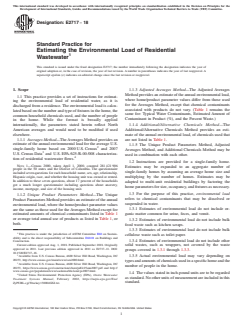
(Practice)Standard Practice for Estimating the Environmental Load of Residential Wastewater
General Information
- Abstract
SIGNIFICANCE AND USE
5.1 There is increasing concern regarding water quality. The first national-scale U.S. examination of these organic wastewater contaminants in streams, conducted by the Toxic Substances Hydrology Program of the U.S. Geological Survey (USGS), indicated that a broad range of chemicals found in residential, industrial, and agricultural wastewaters commonly occurs in mixtures at low concentrations downstream from areas of intense urbanization and animal production. The chemicals include pharmaceuticals, natural and synthetic hormones, detergent metabolites, plasticizers, insecticides, and fire retardants. One or more of these chemicals were found in 80 % of the streams sampled.6
5.2 This practice may be used by building owners and design professionals to assess water stewardship impacts of a residence. In particular, it is intended to inform design decisions and operation decisions regarding estimated wastewater quality impacts of a building.
5.3 This practice may be used by planners and water treatment professionals to assess water stewardship impacts of a residential area. In particular, it is intended to inform infrastructure decisions regarding estimated wastewater quality impacts of a residential service area.
5.3.1 This practice may be used to estimate the types and amounts of non-biological wastes entering a wastewater system. Such knowledge is becoming increasingly important in developing sustainable approaches to water stewardship.
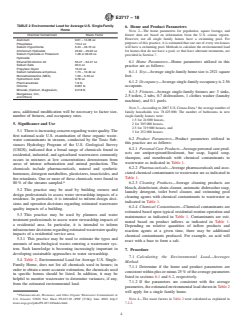
5.4 Table 2, Environmental Load for Average U.S. Single-Family Home, does not list all chemicals used in homes; in order to obtain a more accurate estimation, the chemicals used in specific homes should be listed. In addition, it may be helpful to monitor wastewater to determine variances, if any, from the estimated environmental load.
SCOPE
1.1 This practice provides a set of instructions for estimating the environmental load of residential water, as it is discharged from a residence. The environmental load is calculated based on the number and type of fixtures in the home, the common household chemicals used, and the number of people in the home. While the format is broadly applied internationally, the parameters stated herein reflect North American averages and would need to be modified if used elsewhere.
1.1.1 Averages Method—The Averages Method provides an estimate of the annual environmental load for the average U.S. single-family home based on 2000 U.S. Census2 and 2007 U.S. Census Data3 and U.S. EPA/625/R-00/008 characterization of residential wastewater flows.4
Note 1: Census 2000, taken April 1, 2000, counted 281 421 906 people in the 50 states and the District of Columbia. The questionnaire included seven questions for each household: name, sex, age, relationship, Hispanic origin, race, and whether the housing unit was owned or rented. In addition to these seven questions, about 17 percent of the households got a much longer questionnaire including questions about ancestry, income, mortgage, and size of the housing unit.
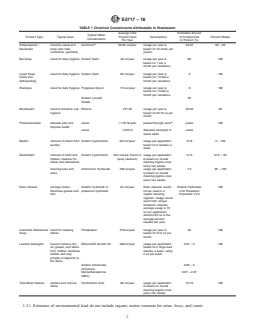
1.1.2 Unique Product Parameters Method—The Unique Product Parameters Method provides an estimate of the annual environmental load, where the home/product parameter values are the same as those used for the Averages Method except for estimated amounts of chemical contaminants listed in Table 1 or average total annual use of products as listed in Table 1, or both.
1.1.3 Adjusted Averages Method—The Adjusted Averages Method provides an estimate of the annual environmental load, where home/product parameter values differ from those used for the Averages Method, except that chemical contaminants associated with products do not vary. (Table 1 remains the same for: Typical Water Contaminants, Estimated Amount of Contaminant in Product (%), and the Percent Waste.)
1.1.4 Additional/Alternative Chemicals Method—The Additional/Alternative Chemicals Method provides an estimate of the annual environmental load, of che...
- Status
- Published
- Publication Date
- 31-Jul-2018
- Technical Committee
- E60 - Sustainability
- Drafting Committee
- E60.01 - Buildings and Construction
Buy Documents
ASTM E2717-18 - Standard Practice for Estimating the Environmental Load of Residential Wastewater
REDLINE ASTM E2717-18 - Standard Practice for Estimating the Environmental Load of Residential Wastewater
Overview
ASTM E2717-18: Standard Practice for Estimating the Environmental Load of Residential Wastewater provides a practical methodology for quantifying chemical contaminants discharged from residential properties into wastewater systems. Developed by ASTM Committee E60 on Sustainability, this standard addresses growing concerns about water stewardship and the impact of non-biological household chemicals-including pharmaceuticals, detergents, cleaners, and pool chemicals-on water quality.
ASTM E2717-18 outlines structured methods to estimate the annual environmental load based on typical or customized home and product parameters, supporting data-driven decisions for residential design, operation, and infrastructure planning.
Key Topics
- Definition of Environmental Load: The standard focuses on chemical contaminants dissolved or suspended in water from household use, excluding food waste and bulk solids.
- Estimation Methods: Several methods are provided for different scenarios:
- Averages Method uses national census and EPA data for a typical U.S. single-family home.
- Unique Product Parameters Method allows for specific quantities and product usage unique to a particular home.
- Adjusted Averages Method modifies average parameters (e.g., higher or lower occupancy, more fixtures).
- Additional/Alternative Chemicals Method incorporates chemicals or products particular to a household not covered in standard tables.
- Home and Product Parameters: Calculations consider average home size, occupancy, and fixtures, as well as annual product usage for personal care, cleaning, and pool maintenance.
- Types of Contaminants: Frequent household contributors include aluminum (from deodorants), sodium salts (soap), phosphates (dishwasher soap), hypochlorite (bleach), ethanol, hydrochloric acid (toilet cleaners), and pharmaceuticals passed through urine or disposed of in wastewater.
- Impact Awareness: Highlights that monitoring actual chemical use and variation helps refine environmental load estimates for more accurate water management.
- Water Stewardship: Promotes sustainable water use and pollution prevention in residential settings.
Applications
ASTM E2717-18 delivers practical value for a broad range of stakeholders engaged in water management and sustainability:
- Building Owners and Designers: Use the standard to assess the water quality impact of design choices, fixture selection, and product use, supporting greener decision-making and compliance with water stewardship goals.
- Urban Planners and Water Utilities: Estimate chemical loads from entire neighborhoods to inform infrastructure design, treatment plant sizing, and community-level sustainability initiatives.
- Facility Managers and Environmental Consultants: Report and monitor non-biological contaminant flows for regulatory compliance, sustainability benchmarking, and to design targeted reduction programs.
- Homeowners: Gain awareness of the environmental impacts of daily product choices, encouraging more responsible product use and disposal, especially of personal care and pharmaceutical products.
- Wastewater Treatment Operators: Anticipate contaminant trends in influent streams to optimize treatment strategies for emerging contaminants, such as pharmaceuticals and hormones.
Related Standards
- ASTM E2114: Terminology for Sustainability Relative to the Performance of Buildings - Defines key terms aiding in consistent interpretation.
- U.S. EPA Onsite Wastewater Treatment Systems Manual (EPA/625/R-00/008): Provides data on residential wastewater flow and characteristics.
- U.S. Census Data (2000, 2007): Supplies demographic and housing data used as baseline parameters in estimation methods.
Summary
Adhering to ASTM E2717-18 ensures a standardized, transparent approach to quantifying the environmental load of residential wastewater. By supporting informed design, planning, and operational decisions, it aligns with international best practices for sustainability, waste management, and water stewardship. Utilization of this standard ultimately contributes to more effective water quality management and the advancement of sustainable communities.
Relations
- Refers
ASTM E2114-17 - Standard Terminology for Sustainability Relative to the Performance of Buildings - Effective Date
- 01-Feb-2017
- Refers
ASTM E2114-08 - Standard Terminology for Sustainability Relative to the Performance of Buildings - Effective Date
- 01-Nov-2008
- Refers
ASTM E2114-06a - Standard Terminology for Sustainability Relative to the Performance of Buildings - Effective Date
- 01-Dec-2006
- Refers
ASTM E2114-06 - Standard Terminology for Sustainability Relative to the Performance of Buildings - Effective Date
- 15-Feb-2006
- Refers
ASTM E2114-05a - Standard Terminology for Sustainability Relative to the Performance of Buildings - Effective Date
- 01-Jun-2005
- Refers
ASTM E2114-05 - Standard Terminology for Sustainability Relative to the Performance of Buildings - Effective Date
- 01-Feb-2005
- Refers
ASTM E2114-04 - Standard Terminology for Sustainability Relative to the Performance of Buildings - Effective Date
- 01-Dec-2004
- Refers
ASTM E2114-00a - Standard Terminology for Sustainability Relative to the Performance of Buildings - Effective Date
- 10-Feb-2001
- Refers
ASTM E2114-01 - Standard Terminology for Sustainability Relative to the Performance of Buildings - Effective Date
- 10-Feb-2001
Buy Documents
ASTM E2717-18 - Standard Practice for Estimating the Environmental Load of Residential Wastewater
REDLINE ASTM E2717-18 - Standard Practice for Estimating the Environmental Load of Residential Wastewater
Get Certified
Connect with accredited certification bodies for this standard

CIS Institut d.o.o.
Personal Protective Equipment (PPE) certification body. Notified Body NB-2890 for EU Regulation 2016/425 PPE.

Kiwa BDA Testing
Building and construction product certification.
Kmetijski inštitut Slovenije
Agricultural Institute of Slovenia. Soil testing, plant health, agricultural product analysis.
Sponsored listings
Frequently Asked Questions
ASTM E2717-18 is a standard published by ASTM International. Its full title is "Standard Practice for Estimating the Environmental Load of Residential Wastewater". This standard covers: SIGNIFICANCE AND USE 5.1 There is increasing concern regarding water quality. The first national-scale U.S. examination of these organic wastewater contaminants in streams, conducted by the Toxic Substances Hydrology Program of the U.S. Geological Survey (USGS), indicated that a broad range of chemicals found in residential, industrial, and agricultural wastewaters commonly occurs in mixtures at low concentrations downstream from areas of intense urbanization and animal production. The chemicals include pharmaceuticals, natural and synthetic hormones, detergent metabolites, plasticizers, insecticides, and fire retardants. One or more of these chemicals were found in 80 % of the streams sampled.6 5.2 This practice may be used by building owners and design professionals to assess water stewardship impacts of a residence. In particular, it is intended to inform design decisions and operation decisions regarding estimated wastewater quality impacts of a building. 5.3 This practice may be used by planners and water treatment professionals to assess water stewardship impacts of a residential area. In particular, it is intended to inform infrastructure decisions regarding estimated wastewater quality impacts of a residential service area. 5.3.1 This practice may be used to estimate the types and amounts of non-biological wastes entering a wastewater system. Such knowledge is becoming increasingly important in developing sustainable approaches to water stewardship. 5.4 Table 2, Environmental Load for Average U.S. Single-Family Home, does not list all chemicals used in homes; in order to obtain a more accurate estimation, the chemicals used in specific homes should be listed. In addition, it may be helpful to monitor wastewater to determine variances, if any, from the estimated environmental load. SCOPE 1.1 This practice provides a set of instructions for estimating the environmental load of residential water, as it is discharged from a residence. The environmental load is calculated based on the number and type of fixtures in the home, the common household chemicals used, and the number of people in the home. While the format is broadly applied internationally, the parameters stated herein reflect North American averages and would need to be modified if used elsewhere. 1.1.1 Averages Method—The Averages Method provides an estimate of the annual environmental load for the average U.S. single-family home based on 2000 U.S. Census2 and 2007 U.S. Census Data3 and U.S. EPA/625/R-00/008 characterization of residential wastewater flows.4 Note 1: Census 2000, taken April 1, 2000, counted 281 421 906 people in the 50 states and the District of Columbia. The questionnaire included seven questions for each household: name, sex, age, relationship, Hispanic origin, race, and whether the housing unit was owned or rented. In addition to these seven questions, about 17 percent of the households got a much longer questionnaire including questions about ancestry, income, mortgage, and size of the housing unit. 1.1.2 Unique Product Parameters Method—The Unique Product Parameters Method provides an estimate of the annual environmental load, where the home/product parameter values are the same as those used for the Averages Method except for estimated amounts of chemical contaminants listed in Table 1 or average total annual use of products as listed in Table 1, or both. 1.1.3 Adjusted Averages Method—The Adjusted Averages Method provides an estimate of the annual environmental load, where home/product parameter values differ from those used for the Averages Method, except that chemical contaminants associated with products do not vary. (Table 1 remains the same for: Typical Water Contaminants, Estimated Amount of Contaminant in Product (%), and the Percent Waste.) 1.1.4 Additional/Alternative Chemicals Method—The Additional/Alternative Chemicals Method provides an estimate of the annual environmental load, of che...
SIGNIFICANCE AND USE 5.1 There is increasing concern regarding water quality. The first national-scale U.S. examination of these organic wastewater contaminants in streams, conducted by the Toxic Substances Hydrology Program of the U.S. Geological Survey (USGS), indicated that a broad range of chemicals found in residential, industrial, and agricultural wastewaters commonly occurs in mixtures at low concentrations downstream from areas of intense urbanization and animal production. The chemicals include pharmaceuticals, natural and synthetic hormones, detergent metabolites, plasticizers, insecticides, and fire retardants. One or more of these chemicals were found in 80 % of the streams sampled.6 5.2 This practice may be used by building owners and design professionals to assess water stewardship impacts of a residence. In particular, it is intended to inform design decisions and operation decisions regarding estimated wastewater quality impacts of a building. 5.3 This practice may be used by planners and water treatment professionals to assess water stewardship impacts of a residential area. In particular, it is intended to inform infrastructure decisions regarding estimated wastewater quality impacts of a residential service area. 5.3.1 This practice may be used to estimate the types and amounts of non-biological wastes entering a wastewater system. Such knowledge is becoming increasingly important in developing sustainable approaches to water stewardship. 5.4 Table 2, Environmental Load for Average U.S. Single-Family Home, does not list all chemicals used in homes; in order to obtain a more accurate estimation, the chemicals used in specific homes should be listed. In addition, it may be helpful to monitor wastewater to determine variances, if any, from the estimated environmental load. SCOPE 1.1 This practice provides a set of instructions for estimating the environmental load of residential water, as it is discharged from a residence. The environmental load is calculated based on the number and type of fixtures in the home, the common household chemicals used, and the number of people in the home. While the format is broadly applied internationally, the parameters stated herein reflect North American averages and would need to be modified if used elsewhere. 1.1.1 Averages Method—The Averages Method provides an estimate of the annual environmental load for the average U.S. single-family home based on 2000 U.S. Census2 and 2007 U.S. Census Data3 and U.S. EPA/625/R-00/008 characterization of residential wastewater flows.4 Note 1: Census 2000, taken April 1, 2000, counted 281 421 906 people in the 50 states and the District of Columbia. The questionnaire included seven questions for each household: name, sex, age, relationship, Hispanic origin, race, and whether the housing unit was owned or rented. In addition to these seven questions, about 17 percent of the households got a much longer questionnaire including questions about ancestry, income, mortgage, and size of the housing unit. 1.1.2 Unique Product Parameters Method—The Unique Product Parameters Method provides an estimate of the annual environmental load, where the home/product parameter values are the same as those used for the Averages Method except for estimated amounts of chemical contaminants listed in Table 1 or average total annual use of products as listed in Table 1, or both. 1.1.3 Adjusted Averages Method—The Adjusted Averages Method provides an estimate of the annual environmental load, where home/product parameter values differ from those used for the Averages Method, except that chemical contaminants associated with products do not vary. (Table 1 remains the same for: Typical Water Contaminants, Estimated Amount of Contaminant in Product (%), and the Percent Waste.) 1.1.4 Additional/Alternative Chemicals Method—The Additional/Alternative Chemicals Method provides an estimate of the annual environmental load, of che...
ASTM E2717-18 is classified under the following ICS (International Classification for Standards) categories: 13.060.30 - Sewage water. The ICS classification helps identify the subject area and facilitates finding related standards.
ASTM E2717-18 has the following relationships with other standards: It is inter standard links to ASTM E2114-17, ASTM E2114-08, ASTM E2114-06a, ASTM E2114-06, ASTM E2114-05a, ASTM E2114-05, ASTM E2114-04, ASTM E2114-00a, ASTM E2114-01. Understanding these relationships helps ensure you are using the most current and applicable version of the standard.
ASTM E2717-18 is available in PDF format for immediate download after purchase. The document can be added to your cart and obtained through the secure checkout process. Digital delivery ensures instant access to the complete standard document.
Standards Content (Sample)
This international standard was developed in accordance with internationally recognized principles on standardization established in the Decision on Principles for the
Development of International Standards, Guides and Recommendations issued by the World Trade Organization Technical Barriers to Trade (TBT) Committee.
Designation: E2717 − 18
Standard Practice for
Estimating the Environmental Load of Residential
Wastewater
This standard is issued under the fixed designation E2717; the number immediately following the designation indicates the year of
original adoption or, in the case of revision, the year of last revision. A number in parentheses indicates the year of last reapproval. A
superscript epsilon (´) indicates an editorial change since the last revision or reapproval.
1. Scope 1.1.3 Adjusted Averages Method—The Adjusted Averages
Method provides an estimate of the annual environmental load,
1.1 This practice provides a set of instructions for estimat-
where home/product parameter values differ from those used
ing the environmental load of residential water, as it is
for the Averages Method, except that chemical contaminants
discharged from a residence. The environmental load is calcu-
associated with products do not vary. (Table 1 remains the
lated based on the number and type of fixtures in the home, the
same for: Typical Water Contaminants, Estimated Amount of
common household chemicals used, and the number of people
Contaminant in Product (%), and the Percent Waste.)
in the home. While the format is broadly applied
internationally, the parameters stated herein reflect North 1.1.4 Additional/Alternative Chemicals Method—The
Additional/Alternative Chemicals Method provides an esti-
American averages and would need to be modified if used
elsewhere. mate of the annual environmental load, of chemicals used that
1.1.1 Averages Method—TheAverages Method provides an are not listed in Table 1.
estimate of the annual environmental load for the average U.S.
1.1.5 The Unique Product Parameters Method, Adjusted
single-family home based on 2000 U.S. Census and 2007
Averages Method, and Additional Chemicals Method may be
U.S. Census Data and U.S. EPA⁄625⁄R-00⁄008 characteriza-
used in combination with each other.
tion of residential wastewater flows.
1.2 Instructions are provided for a single-family home.
NOTE 1—Census 2000, taken April 1, 2000, counted 281 421 906
Estimates may be expanded to an aggregate number of
people in the 50 states and the District of Columbia. The questionnaire
single-family homes by assuming an average home size and
included seven questions for each household: name, sex, age, relationship,
multiplying by the number of homes. Estimates may be
Hispanic origin, race, and whether the housing unit was owned or rented.
In addition to these seven questions, about 17 percent of the households
adapted to multi-unit residential buildings by factoring the
got a much longer questionnaire including questions about ancestry,
homeparametersforsize,occupancy,andfixturesasnecessary.
income, mortgage, and size of the housing unit.
1.3 For the purpose of this practice, environmental load
1.1.2 Unique Product Parameters Method—The Unique
refers to chemical contaminants that may be dissolved or
Product Parameters Method provides an estimate of the annual
suspended in water.
environmental load, where the home/product parameter values
1.3.1 Estimates of environmental load do not include or-
are the same as those used for theAverages Method except for
estimated amounts of chemical contaminants listed in Table 1 ganic matter common for urine, feces, and vomit.
or average total annual use of products as listed in Table 1,or
1.3.2 Estimates of environmental load do not include bulk
both.
food waste such as kitchen scraps.
1.3.3 Estimates of environmental load do not include bulk
This practice is under the jurisdiction of ASTM Committee E60 on Sustain-
cellulose waste such as toilet paper.
ability and is the direct responsibility of Subcommittee E60.01 on Buildings and
1.3.4 Estimates of environmental load do not include other
Construction.
Current edition approved Aug. 1, 2018. Published September 2018. Originally
solid wastes, such as wrappers, not covered by the waste
approved in 2011. Last previous edition approved in 2011 as E2717–11. DOI:
groups covered in 1.3.1 through 1.3.3.
10.1520/E2717–18.
1.3.5 Actual environmental load may vary depending on
Available from U.S. Census Bureau, 4600 Silver Hill Road, Washington, DC
20233, http://www.census.gov/main/www/cen2000.html.
typesandamountsofchemicalsusedinaspecifichomeandthe
Available from U.S. Census Bureau, 4600 Silver Hill Road, Washington, DC
number of people in the home.
20233, https://www.census.gov/construction/chars/pdf/c25ann2007.pdf and http://
www.census.gov/population/www/socdemo/hh-fam/cps2007.html.
1.4 The values stated in inch-pound units are to be regarded
United States Environmental Protection Agency (EPA), Onsite Wastewater
as standard. No other units of measurement are included in this
Treatment Systems Manual, February 2002, https://nepis.epa.gov/Exe/
ZyPURL.cgi?Dockey=30004GXI.txt. standard.
Copyright © ASTM International, 100 Barr Harbor Drive, PO Box C700, West Conshohocken, PA 19428-2959. United States
E2717 − 18
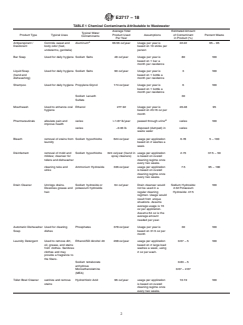
TABLE 1 Chemical Contaminants Attributable to Wastewater
Average Total Estimated Amount
Typical Water
Product Type Typical Uses Product Used Assumptions of Contaminant Percent Waste
Contaminants
Per Year in Product (%)
A
Antiperspirant / Controls sweat and Aluminum 66.56 oz/year Usage per year is 22.22 65 – 95
Deodorant body odor (feet, based on 10 sticks per
underarms, genitalia) person
Bar Soap Used for daily hygiene Sodium Salts 48 oz/year Usage per year is 80 100
based on 1 bar a
month per residence
Liquid Soap Used for daily hygiene Sodium Salts 90 oz/year Usage per year is 3 100
(hand and based on 1 bottle a
dishwashing) month per residence
Shampoo Used for daily hygiene Propylene Glycol 174 oz/year Usage per year is 6 100
based on 1 bottle a
month per residence
Sodium Larueth 30
Sulfate
Mouthwash Used to enhance oral Ethanol 277.92 Usage per year is 20.48 95
hygiene based on 23.16 oz per
month
B
Pharmaceuticals alleviate pain and varies #1.87 lb/year passed through urine varies 100
improve health
varies ~0.03 lb disposed (dumped) in varies
waste water
Bleach removal of stains from Sodium hypochlorite 624 oz/year usage per application 6.78 5 – 100
laundry based on 2 washes a
week.
Disinfectant removal of mold and Sodium hypochlorite 324 oz/year (found in usage per application 2.73 37.5 – 50
mildew; cleanser for spray cleaners) is based on overall
toilets and dishwasher cleaning regime once
every two weeks.
cleaning tubs and Ammonium Hydroxide 336 oz/year usage per application 7.5 95 – 100
sinks is based on overall
cleaning regime once
every two weeks.
Drain Cleaner Unclogs drains. Sodium hydroxide or 64 oz/year Drain cleanser would Sodium Hydroxide: 100
Dissolves grease and potassium hydroxide not be used in a 2.32 Potassium
hair. regular cleaning Hydroxide: 47.5
regimen. Usage would
result from unique
situations. Assume
average usage is 16
oz per application.
Assume 64 oz is the
average amount
needed per year.
Automatic Dishwasher Used for cleaning Phosphates 378 oz/year Usage per year is 30 100
Soap dishes based on 31.5 oz per
month
Laundry Detergent Used to remove dirt, Ethanol/SD Alcohol 40 208 oz/year usage per application 0.67 – 5 100
oil, grease, and stains based on 2 large load
from clothes. Sanitizes washes a week, using
clothes and may 2 oz per wash.
provide a fragrance to
the fibers.
Sodium tetraborate 0.83 – 5
anhydrous
Monoethanolamine 0.67 – 2.67
(MEA)
Toilet Bowl Cleaner sanitize and remove Hydrochloric Acid 96 oz/year usage per application 10.19 100
stains is based on overall
cleaning regime once
every two weeks.
E2717 − 18
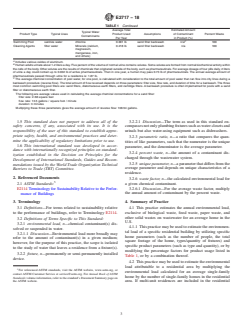
TABLE 1 Continued
Average Total Estimated Amount
Typical Water
Product Type Typical Uses Product Used Assumptions of Contaminant Percent Waste
Contaminants
Per Year in Product (%)
C
Swimming Pool sanitize water chlorine 0.001 lb sand filter backwash n/a 100
Cleaning Agents filter water Minerals (calcium, 0.218 lb sand filter backwash n/a 100
magnesium,
manganese, iron,
and others)
A
Includes various oxides of aluminum.
B
Human adults urinate about 1-2 liters a day. Five percent of the volume of normal urine contains solutes. Some solutes are formed from normal biochemical activity within
the cells of the body. Other solutes are the results of chemicals that originated outside of the body, such as pharmaceuticals. For average dosage of four pills daily, 2 liters
of urine a day could contain up to 0.002 lb of active pharmaceuticals. Then in one year, a human may pass 0.73 lb of pharmaceuticals. The annual average amount of
pharmaceuticals passed through urine for a residence is: 1.87 lb.
C
The average chemical concentration of pool water, for one pool, is calculated with consideration to the total amount of pool water that can flow into city lines during a
backwash procedure (reverse flow). The total amount of flow reversed depends on three parameters: filter size, flow rate, and duration of time for a backwash. The three
most common swimming pool filters are: sand filters, diatomaceous earth filters, and cartridge filters. A backwash procedure is often implemented for pools with a sand
filter or diatomaceous earth filter.
The following are average values used in calculating the average chemical concentrations for a sand filter:
filter size: 2.68 square feet
flow rate: 13.5 gallons / square foot / minute
duration: 3 minutes
Multiplying these three parameters gives the average amount of reverse flow: 108.54 gallons.
1.5 This standard does not purport to address all of the 3.2.2.1 Discussion—The term as used in this standard en-
safety concerns, if any, associated with its use. It is the compassesnotonlyplumbingfixturessuchaswaterclosetsand
responsibility of the user of this standard to establish appro- urinals but also water-using equipment such as dishwashers.
priate safety, health, and environmental practices and deter-
3.2.3 parametric ratio, n—a ratio that compares the quan-
mine the applicability of regulatory limitations prior to use.
tities of like parameters, such that the numerator is the unique
1.6 This international standard was developed in accor-
parameter, and the denominator is the average parameter.
dance with internationally recognized principles on standard-
3.2.4 percent waste, n—the amount of a contaminant dis-
ization established in the Decision on Principles for the
charged through the wastewater system.
Development of International Standards, Guides and Recom-
3.2.5 unique parameter, n—a parameter that differs from the
mendations issued by the World Trade Organization Technical
average parameter and depends on unique characteristics of a
Barriers to Trade (TBT) Committee.
residence.
2. Referenced Documents
3.2.6 waste factor, n—the calculated environmental load for
2.1 ASTM Standards: a given chemical contaminant.
E2114 Terminology for Sustainability Relative to the Perfor- 3.2.6.1 Discussion—For the average waste factor, multiply
mance of Buildings the annual amount of contaminant by the percent waste.
3. Terminology 4. Summary of Practice
3.1 Definitions—For terms related to sustainability relative 4.1 This practice estimates the annual environmental load,
to the performance of buildings, refer to Terminology E2114. exclusive of biological waste, food waste, paper waste, and
other solid wastes on wastewater for an average home in the
3.2 Definitions of Terms Specific to This Standard:
U.S.
3.2.1 environmental load, n—chemical contaminant(s) dis-
4.1.1 Thispracticemaybeusedtoestimatetheenvironmen-
solved or suspended in water.
tal load of a specific residential building by utilizing specific
3.2.1.1 Discussion—Environmental load more broadly may
home parameters (such as the number of people, the total
refer to the amount of contaminant(s) in a given medium;
square footage of the home, types/quantity of fixtures) and
however, for the purpose of this practice, the scope is isolated
specific product parameters (such as type and quantity), or by
to the study of water that leaves a residence from a fixture(s).
modifying the percentage factors for product usage listed in
3.2.2 fixture, n—permanently or semi-permanently installed
Table 1, or by a combination thereof.
device.
4.2 This practice may be used to estimate the environmental
load attributable to a residential area by multiplying the
For referenced ASTM standards, visit the ASTM website, www.astm.org, or
environmental load calculated for an average single-family
contact ASTM Customer Service at service@astm.org. For Annual Book of ASTM
home by the number of single-family homes in the residential
Standards volume information, refer to the standard’s Document Summary page on
the ASTM website. area. If multi-unit residences are included in the residential
E2717 − 18
TABLE 2 Environmental Load for Average U.S. Single-Family
6. Home and Product Parameters
Home
NOTE 2—The home parameters for population, square footage, and
Chemical Contaminant Waste Factor fixture data are based on information from the U.S. census reports.
However, not all single family homes have a swimming pool. For
Aluminum 9.61 – 14.05 oz
purposes of this practice, it is estimated that one out of every ten houses
Phosphates 113.4 oz
Sodium Hypochlorite 5.43 – 46.73 oz will have a swimming pool. Methods to calculate the environmental load
Ammonium Hydroxide 23.94 – 25.20 oz for homes that do not have a pool, or that have alternate treatments, are
Sodium Hydroxide or Potassium 1.48 or 30.40 oz
provided in Section 7.
Hydroxide
Ethanol/SD Alcohol 40 55.47 – 64.47 oz 6.1 Home Parameters—Home parameters utilized in this
Sodium Salts 93.3 oz
practice are as follows:
Propylene Glycol 10.44 oz
6.1.1 Size—Average single-family home size is 2521 square
Sodium tetraborate anhydrous 1.73 – 10.40 oz
Monoethanolamine (MEA) 1.39 – 5.55 oz
feet.
Hydrochloric Acid 9.78 oz
6.1.2 Occupancy—Average single-family occupancy is 2.56
Pharmaceuticals 1.9 lb
Chlorine 0.001 lb occupants.
Minerals (Calcium, Magnesium, 0.218 lb
6.1.3 Fixtures—Average single-family fixtures are: 3 sinks,
Manganese, Iron,
2.5 toilets, 2 tubs, 0.7 dishwashers, 1 clothes washer (laundry
and Others)
machine), and 0.1 pools.
NOTE 3—According to 2007 U.S. Census Data, the average number of
area, additional modification will be necessary to factor size,
family households was 78 425 000. The number of bathrooms in new
number of fixtures, and occupancy rates. single-family houses were:
1.5 for 24 000 houses,
5. Significance and Use 2 for 305 000 houses,
2.5 for 319 000 houses, and
5.1 There is increasing concern regarding water quality.The
3 for 252 000 houses.
first national-scale U.S. examination of these organic waste-
6.2 Product Parameters—Product parameters utilized in
water contaminants in streams, conducted by the Toxic Sub-
this practice are as follows:
stances Hydrology Program of the U.S. Geological Survey
6.2.1 Personal Care Products—Averagepersonalcareprod-
(USGS), indicated that a broad range of chemicals found in
ucts are antiperspirant/deodorant, bar soap, liquid soap,
residential, industrial, and agricultural wastewaters commonly
shampoo, and mouthwash with chemical contaminants to
occurs in mixtures at low concentrations downstream from
wastewater as indicated in Table 1.
areas of intense urbanization and animal production. The
6.2.2 Pharmaceuticals—Average pharmaceuticals and asso-
chemicals include pharmaceuticals, natural and synthetic
ciated chemical contaminants to wastewater are as indicated in
hormones, detergent metabolites, plasticizers, insecticides, and
Table 1.
fire retardants. One or more of these chemicals were found in
6.2.3 Cleaning Products—Average cleaning products are
80 % of the streams sampled.
bleach, disinfectant, drain cleaner, automatic dishwasher soap,
5.2 This practice may be used by building owners and
laundry detergent, toilet bowl cleaner, and swimming pool
design professionals to assess water stewardship impacts of a
cleaning agents with chemical contaminants to wastewater as
residence. In particular, it is intended to inform design deci-
indicated in Table 1.
sions and operation decisions regarding estimated wastewater
6.2.4 Chemical Contaminants—Chemical contaminants are
quality impacts of a building.
estimated based upon typical residential routine operation and
5.3 This practice may be used by planners and water
maintenance as indicated in Table 1. Contaminants are esti-
treatment professionals to assess water stewardship impacts of
mated based on product inflows as indicated in Table 1.
a residential area. In particular, it is intended to inform
Depending on relative quantities of inflow products and
infrastructuredecisionsregardingestimatedwastewaterquality
reaction agents at a given time, there may be additional
impacts of a residential service area.
chemical contaminants produced. For example, an acid will
5.3.1 This practice may be used to estimate the types and
react with a base to form a salt.
amounts of non-biological wastes entering a wastewater sys-
tem. Such knowledge is becoming increasingly important in
7. Procedure
developing sustainable approaches to water stewardship.
7.1 Calculating the Environmental Load—Averages
5.4 Table 2, Environmental Load for Average U.S. Single-
Method:
Family Home, does not list all chemicals used in homes; in
7.1.1 Determine if the home and product parameters are
order to obtain a more accurate estimation, the chemicals used
consistentwithinplusorminus25 %oftheaverageparameters
in specific homes should be listed. In addition, it may be
listed in sections 6.1 and 6.2, respectively.
helpful to monitor wastewater to determine variances, if any,
7.1.2 If the parameters are consistent with the average
from the estimated environmental load.
parameters, the estimated environmental load shown in Table 2
will apply for a single family home.
Pharmaceuticals, Hormones, and Other Organic Wastewater Contaminants in
U.S. Streams; USGS Fact Sheet FS-027-02 (PDF [372k]) June 2002; http:// NOTE 4—The waste factors in Table 2 were calculated as explained in
toxics.usgs.gov/pubs/FS-027-02/index.html. 7.2.2.
E2717 − 18
7.1.3 If the parameters are not consistent within plus or pool, then a value of “0” would be entered for Swimming Pool
minus 25 % of the average parameters, calculate the environ- Cleaning Agents in the columns entitled “Average Total
mental load in accordance with 7.2, 7.3,or 7.4, or a combina- Product Used Per Year” and “Percent Waste.”
tion thereof. 7.4.1.2 If products are used that are not listed in Table 1,
identify the product and amount of annual use. Identify
7.2 Calculating the Environmental Load—Unique Product
information for associated chemicals. Multiply the “Average
Parameters Method:
Total Product Used Per Year” by the “Estimated Amount of
7.2.1 Modify Table 1 data for average annual use of
Contaminant in Product (%)” and the “Percent Waste” to
products and estimated amount of chemical contaminants per
determine the environmental load of each chemical
product as necessary to reflect specific home/product param-
contaminant, for each product.
eters of the single-family residence for which the environmen-
7.4.2 To determine the environmental load of each contami-
tal load is being estimated.
nant for the entire table, group the environmental loads of
7.2.2 Multiply the “Average TotalAmount of Product Used
identical contaminants, then add each environmental load per
Per Year,” by the “Estimated Amount of Contaminant in the
contaminant group.
Product” and the “Percent Waste” to determine the environ-
mental load of each contaminant, for each product.
8. Report
7.2.3 To determine the environmental load of each contami-
8.1 Report shall indicate entity responsible for developing
nant for the entire table, group the environmental loads of
estimate and shall include the following information:
identical contaminants, then add each environmental load per
8.1.1 Date—Record the date the report was prepared.
contaminant group.
8.1.2 Location—Record the location of the residential struc-
7.3 Calculating the Environmental Load—Adjusted Aver-
ture for which the estimate is calculated.
ages Method:
8.1.3 3 Relationship to Average Parameters—Record the
7.3.1 For each Product, evaluate the unique parameters
relationship to average home and product parameters. Identify
affecting environmental load as indicated in Table 3. Where an
any variations from the home parameters. Identify any varia-
answer to a Table 3 question is “yes,” multiply the waste factor
tions from the product parameters. Where there are variations,
by a ratio that relates the unique parameter to the average
or where information was adapted, note the method used (that
parameter.
is, reference 7.2, 7.3,or 7.4 as applicable). Include revisions to
7.3.2 To determine the environmental load of each contami-
Table 1 summary as applicable.
nant for the entire table, group the environmental loads of
8.1.4 Environmental Load—Record the estimated annual
identical contaminants, then add each environmental load per
environmentalload.Indicatethewastefactorforeachchemical
contaminant group.
contaminant.
7.4 Calculating the Environmental Load—Additional/
8.2 Refer to Appendix X1 for an example of reporting
Alternative Chemicals Method:
format.
7.4.1 Review the products used in Table 1. Determine if the
9. Keywords
products and associated chemicals are applicable to the
residence, and modify Table 1 as necessary.
9.1 environmental load; sustainability; waste management;
7.4.1.1 Revise products to reflect actual products and rate of wastewater; wastewater treatment; water management; water
products used. For example, if the residence does not have a stewardship
E2717 − 18
TABLE 3 Considerations for Unique Parameters Affecting Environmental Load
1. Is the product used on humans? If yes, identify the number of people within the residence, on whom the product will be used. Let this number be
represented by, “H”. Divide this number by the average number of people, “B ”. In this example, the parametric
H
ratio is “H/B ”. Next, let “W ” represent the waste factor. Multiplying the parametric ratio by the waste factor gives
H H
the environmental load.
Example: (H / B )*(W ) = Environmental Load
H H
2. Is the product used on floor If yes, identify the total square footage of the residence. Let this number be represented by, “F”. Divide this
surfaces? number by the average number of square footage, “B ”. In this example, the parametric ratio is “F/B ”. Next, let
F F
“W ” represent the waste factor. Multiplying the parametric ratio by the waste factor gives the environmental load.
F
Example: (F / B )*(W ) = Environmental Load
F F
3. Is the product used in plumbing If yes, identify the total number of fixtures for which to product will be used. Let this number be represented by,
fixtures? “Ap”. Divide this number by the average number of fixtures, “B ”. In this example, the parametric ratio is “A /B ”.
Ap p Ap
Next, let “W ” represent the waste factor. Multiplying the parametric ratio by the waste factor gives the
Ap
environmental load.
Example: (Ap / B )*(W ) = Environmental Load
Ap Ap
4. Does the amount of product used If yes, identify the frequency of cleaning regime per year. Let this number be represented by, “C ”. Divide this
F
depend on a regular maintenance number by the average cleaning frequency “B ”. In this example, the parametric ratio is “C /B ”. Next, let “W ”
CF F CF CF
schedule? represent the waste factor. Multiplying the parametric ratio by the waste factor gives the environmental load.
Example: [(C )/B ]*(W ) = Environmental Load
F CF CF
5. Are pharmaceuticals used in the If yes, determine the number of occupants within the residence who may urinate pharmaceuticals in a toilet. (Note:
home? children under 5 and some adult citizens may urinate in diapers.) Let this number be represented by, “P ”. Divide
UT
this number by the average number of people, “B ”. In this example, the parametric ratio is “P /B ”
...
This document is not an ASTM standard and is intended only to provide the user of an ASTM standard an indication of what changes have been made to the previous version. Because
it may not be technically possible to adequately depict all changes accurately, ASTM recommends that users consult prior editions as appropriate. In all cases only the current version
of the standard as published by ASTM is to be considered the official document.
Designation: E2717 − 11 E2717 − 18
Standard Practice for
Estimating the Environmental Load of Residential
Wastewater
This standard is issued under the fixed designation E2717; the number immediately following the designation indicates the year of
original adoption or, in the case of revision, the year of last revision. A number in parentheses indicates the year of last reapproval. A
superscript epsilon (´) indicates an editorial change since the last revision or reapproval.
1. Scope
1.1 This practice provides a set of instructions for estimating the environmental load of residential water, as it is discharged from
a residence. The environmental load is calculated based on the number and type of fixtures in the home, the common household
chemicals used, and the number of people in the home. While the format is broadly applied internationally, the parameters stated
herein reflect North American averages and would need to be modified if used elsewhere.
1.1.1 Averages Method—The Averages Method provides an estimate of the annual environmental load for the average U.S.
2 3
single-family home based on 2000 U.S. Census and 2007 U.S. Census Data and U.S. EPA ⁄625 ⁄R-00 ⁄008 characterization of
residential wastewater flows.
NOTE 1—Census 2000, taken April 1, 2000, counted 281 421 906 people in the 50 states and the District of Columbia. The questionnaire included seven
questions for each household: name, sex, age, relationship, Hispanic origin, race, and whether the housing unit was owned or rented. In addition to these
seven questions, about 17 percent of the households got a much longer questionnaire including questions about ancestry, income, mortgage, and size of
the housing unit.
1.1.2 Unique Product Parameters Method—The Unique Product Parameters Method provides an estimate of the annual
environmental load, where the home/product parameter values are the same as those used for the Averages Method except for
estimated amounts of chemical contaminants listed in Table 1 or average total annual use of products as listed in Table 1, or both.
1.1.3 Adjusted Averages Method—The Adjusted Averages Method provides an estimate of the annual environmental load, where
home/product parameter values differ from those used for the Averages Method, except that chemical contaminants associated with
products do not vary. (Table 1 remains the same for: Typical Water Contaminants, Estimated Amount of Contaminant in Product
(%), and the Percent Waste.)
1.1.4 Additional/Alternative Chemicals Method—The Additional/Alternative Chemicals Method provides an estimate of the
annual environmental load, of chemicals used that are not listed in Table 1.
1.1.5 The Unique Product Parameters Method, Adjusted Averages Method, and Additional Chemicals Method may be used in
combination with each other.
1.2 Instructions are provided for a single-family home. Estimates may be expanded to an aggregate number of single-family
homes by assuming an average home size and multiplying by the number of homes. Estimates may be adapted to multi-unit
residential buildings by factoring the home parameters for size, occupancy, and fixtures as necessary.
1.3 For the purpose of this practice, environmental load refers to chemical contaminants that may be dissolved or suspended
in water.
This practice is under the jurisdiction of ASTM Committee E60 on Sustainability and is the direct responsibility of Subcommittee E60.07 on Water Use and Conservation.
Current edition approved Jan. 1, 2011Aug. 1, 2018. Published January 2011September 2018. Originally approved in 2011. Last previous edition approved in 2011 as
E2717–11. DOI: 10.1520/E2717-11.10.1520/E2717–18.
For referenced ASTM standards, visit the ASTM website, www.astm.org, or contact ASTM Customer Service at service@astm.org. For Available from U.S. Census
Bureau, 4600 Silver Hill Road, Washington, DC 20233, http://www.census.gov/main/www/cen2000.html.Annual Book of ASTM Standards volume information, refer to the
standard’s Document Summary page on the ASTM website.
Available from U.S. Census Bureau, 4600 Silver Hill Road, Washington, DC 20233, http://www.census.gov/main/www/cen2000.html.https://www.census.gov/
construction/chars/pdf/c25ann2007.pdf and http://www.census.gov/population/www/socdemo/hh-fam/cps2007.html.
Census 2000, taken April 1, 2000, counted 281 421 906 people in the 50 states and the District of Columbia. The questionnaire included seven questions for each
household: name, sex, age, relationship, Hispanic origin, race, and whether the housing unit was owned or rented. In addition to these seven questions, about 17 percent of
the households got a much longer questionnaire including questions about ancestry, income, mortgage, and size of the housing unit.
Available from U.S. Census Bureau, 4600 Silver Hill Road, Washington, DC 20233, http://www.census.gov/const/c25Ann/sfforsalemedavgsqft.pdf,
http://www.census.gov/const/c25Ann/ssforsalebaths.pdf, and
http://www.census.gov/population/www/socdemo/hh-fam/cps2007.html.
Available from United States Environmental Protection Agency (EPA), Ariel Rios Bldg., 1200 Pennsylvania Ave., NW, Washington, DC 20460,
http://www.epa.gov/ORD/NRMRL/pubs/625r00008/html/625R00008chap3.htm. United States Environmental Protection Agency (EPA), Onsite Wastewater Treatment
Systems Manual, February 2002, https://nepis.epa.gov/Exe/ZyPURL.cgi?Dockey=30004GXI.txt.
Copyright © ASTM International, 100 Barr Harbor Drive, PO Box C700, West Conshohocken, PA 19428-2959. United States
E2717 − 18
TABLE 1 Chemical Contaminants Attributable to Wastewater
Average Total Estimated Amount
Typical Water
Product Type Typical Uses Product Used Assumptions of Contaminant Percent Waste
Contaminants
Per Year in Product (%)
A
Antiperspirant / Controls sweat and Aluminum 66.56 oz/year Usage per year is 22.22 65 – 95
Deodorant body odor (feet, based on 10 sticks per
underarms, genitalia) person
Bar Soap Used for daily hygiene Sodium Salts 48 oz/year Usage per year is 80 100
based on 1 bar a
month per residence
Liquid Soap Used for daily hygiene Sodium Salts 90 oz/year Usage per year is 3 100
(hand and based on 1 bottle a
dishwashing) month per residence
Shampoo Used for daily hygiene Propylene Glycol 174 oz/year Usage per year is 6 100
based on 1 bottle a
month per residence
Sodium Larueth 30
Sulfate
Mouthwash Used to enhance oral Ethanol 277.92 Usage per year is 20.48 95
hygiene based on 23.16 oz per
month
B
Pharmaceuticals alleviate pain and varies #1.87 lb/year passed through urine varies 100
improve health
varies ~0.03 lb disposed (dumped) in varies
waste water
Bleach removal of stains from Sodium hypochlorite 624 oz/year usage per application 6.78 5 – 100
laundry based on 2 washes a
week.
Disinfectant removal of mold and Sodium hypochlorite 324 oz/year (found in usage per application 2.73 37.5 – 50
mildew; cleanser for spray cleaners) is based on overall
toilets and dishwasher cleaning regime once
every two weeks.
cleaning tubs and Ammonium Hydroxide 336 oz/year usage per application 7.5 95 – 100
sinks is based on overall
cleaning regime once
every two weeks.
Drain Cleaner Unclogs drains. Sodium hydroxide or 64 oz/year Drain cleanser would Sodium Hydroxide: 100
Dissolves grease and potassium hydroxide not be used in a 2.32 Potassium
hair. regular cleaning Hydroxide: 47.5
regimen. Usage would
result from unique
situations. Assume
average usage is 16
oz per application.
Assume 64 oz is the
average amount
needed per year.
Automatic Dishwasher Used for cleaning Phosphates 378 oz/year Usage per year is 30 100
Soap dishes based on 31.5 oz per
month
Laundry Detergent Used to remove dirt, Ethanol/SD Alcohol 40 208 oz/year usage per application 0.67 – 5 100
oil, grease, and stains based on 2 large load
from clothes. Sanitizes washes a week, using
clothes and may 2 oz per wash.
provide a fragrance to
the fibers.
Sodium tetraborate 0.83 – 5
anhydrous
Monoethanolamine 0.67 – 2.67
(MEA)
Toilet Bowl Cleaner sanitize and remove Hydrochloric Acid 96 oz/year usage per application 10.19 100
stains is based on overall
cleaning regime once
every two weeks.
1.3.1 Estimates of environmental load do not include organic matter common for urine, feces, and vomit.
E2717 − 18
TABLE 1 Continued
Average Total Estimated Amount
Typical Water
Product Type Typical Uses Product Used Assumptions of Contaminant Percent Waste
Contaminants
Per Year in Product (%)
C
Swimming Pool sanitize water chlorine 0.001 lb sand filter backwash n/a 100
Cleaning Agents filter water Minerals (calcium, 0.218 lb sand filter backwash n/a 100
magnesium,
manganese, iron,
and others)
A
Includes various oxides of aluminum.
B
Human adults urinate about 1-2 liters a day. 5 %Five percent of the volume of normal urine contains solutes. Some solutes are formed from normal biochemical activity
within the cells of the body. Other solutes are the results of chemicals that originated outside of the body, such as pharmaceuticals. For average dosage of four pills daily,
2 liters of urine a day could contain up to 0.002 lb of active pharmaceuticals. Then in one year, a human may pass 0.73 lb of pharmaceuticals. The annual average amount
of pharmaceuticals passed through urine for a residence is: 1.87 lb.
C
The average chemical concentration of pool water, for one pool, is calculated with consideration to the total amount of pool water that can flow into city lines during a
backwash procedure (reverse flow). The total amount of flow reversed depends on three parameters: filter size, flow rate, and duration of time for a backwash. The three
most common swimming pool filters are: sand filters, diatomaceous earth filters, and cartridge filters. A backwash procedure is often implemented for pools with a sand
filter or diatomaceous earth filter.
The following are average values used in calculating the average chemical concentrations for a sand filter:
filter size: 2.68 square feet
flow rate: 13.5 gallons / square foot / minute
duration: 3 minutes
Multiplying these three parameters gives the average amount of reverse flow: 108.54 gallons.
1.3.2 Estimates of environmental load do not include bulk food waste such as kitchen scraps.
1.3.3 Estimates of environmental load do not include bulk cellulose waste such as toilet paper.
1.3.4 Estimates of environmental load do not include other solid wastes, such as wrappers, not covered by the waste groups
covered in 1.3.1 through 1.3.3.
1.3.5 Actual environmental load may vary depending on types and amounts of chemicals used in a specific home and the
number of people in the home.
1.4 The values stated in inch-pound units are to be regarded as standard. No other units of measurement are included in this
standard.
E2717 − 18
1.5 This standard does not purport to address all of the safety concerns, if any, associated with its use. It is the responsibility
of the user of this standard to establish appropriate safety safety, health, and healthenvironmental practices and determine the
applicability of regulatory limitations prior to use.
1.6 This international standard was developed in accordance with internationally recognized principles on standardization
established in the Decision on Principles for the Development of International Standards, Guides and Recommendations issued
by the World Trade Organization Technical Barriers to Trade (TBT) Committee.
2. Referenced Documents
2.1 ASTM Standards:
E2114 Terminology for Sustainability Relative to the Performance of Buildings
2.2 Other References:
2000 U.S. Census
2007 U.S. Census Data
U.S. EPA ⁄625 ⁄R-00 ⁄008 Onsite Wastewater Treatment Systems Manual, February 2002 (U.S. EPA characterization of
residential wastewater flows)
3. Terminology
3.1 Definitions—For terms related to sustainability relative to the performance of buildings, refer to Terminology E2114.
3.2 Definitions of Terms Specific to This Standard:
3.2.1 environmental load, n—chemical contaminant(s) dissolved or suspended in water.
3.2.1.1 Discussion—
Environmental load more broadly may refer to the amount of contaminant(s) in a given medium; however, for the purpose of this
practice, the scope is isolated to the study of water that leaves a residence from a fixture(s).
3.2.2 fixture, n—permanently or semi-permanently installed device.
3.2.2.1 Discussion—
The term as used in this standard encompasses not only plumbing fixtures such as water closets and urinals but also water-using
equipment such as dishwashers.
3.2.3 parametric ratio, n—a ratio that compares the quantities of like parameters, such that the numerator is the unique
parameter, and the denominator is the average parameter.
3.2.4 percent waste, n—the amount of a contaminant discharged through the wastewater system.
3.2.5 unique parameter, n—a parameter that differs from the average parameter and depends on unique characteristics of a
residence.
3.2.6 waste factor, n—the calculated environmental load for a given chemical contaminant.
3.2.6.1 Discussion—
For the average waste factor, multiply the annual amount of contaminant by the percent waste.
4. Summary of Practice
4.1 This practice estimates the annual environmental load, exclusive of biological waste, food waste, and paper waste, and other
solid wastes on wastewater for an average home in the U.S.
4.1.1 This practice may be used to estimate the environmental load of a specific residential building by utilizing specific home
parameters (such as the number of people, the total square footage of the home, types/quantity of fixtures) and specific product
parameters (such as type and quantity), or by modifying the percentage factors for product usage listed in Table 1, or by a
combination thereof.
4.2 This practice may be used to estimate the environmental load attributable to a residential area by multiplying the
environmental load calculated for an average single-family home by the number of single-family homes in the residential area. If
multi-unit residences are included in the residential area, additional modification will be necessary to factor size, number of
fixtures, and occupancy rates.
For referenced ASTM standards, visit the ASTM website, www.astm.org, or contact ASTM Customer Service at service@astm.org. For Annual Book of ASTM Standards
volume information, refer to the standard’s Document Summary page on the ASTM website.
E2717 − 18
5. Significance and Use
5.1 There is increasing concern regarding water quality. The first national-scale U.S. examination of these organic wastewater
contaminants in streams, conducted by the Toxic Substances Hydrology Program of the U.S. Geological Survey (USGS), indicated
that a broad range of chemicals found in residential, industrial, and agricultural wastewaters commonly occurs in mixtures at low
concentrations downstream from areas of intense urbanization and animal production. The chemicals include pharmaceuticals,
natural and synthetic hormones, detergent metabolites, plasticizers, insecticides, and fire retardants. One or more of these chemicals
were found in 80 % of the streams sampled.
5.2 This practice may be used by building owners and design professionals to assess water stewardship impacts of a residence.
In particular, it is intended to inform design decisions and operation decisions regarding estimated wastewater quality impacts of
a building.
5.3 This practice may be used by planners and water treatment professionals to assess water stewardship impacts of a residential
area. In particular, it is intended to inform infrastructure decisions regarding estimated wastewater quality impacts of a residential
service area.
5.3.1 This practice may be used to estimate the types and amounts of non-biological wastes entering a wastewater system. Such
knowledge is becoming increasingly important in developing sustainable approaches to water stewardship.
5.4 Table 2, Environmental Load for Average U.S. Single-Family Home, does not list all chemicals used in homes; in order to
obtain a more accurate estimation, the chemicals used in specific homes should be listed. In addition, it may be helpful to monitor
wastewater to determine variances, if any, from the estimated environmental load.
6. Home and Product Parameters
NOTE 2—The home parameters for population, square footage, and fixture data are based on information from the U.S. census reports. However, not
all single family homes have a swimming pool. For purposes of this practice, it is estimated that one out of every ten houses will have a swimming pool.
Methods to calculate the environmental load for homes that do not have a pool, or that have alternate treatments, are provided in Section 7.
6.1 Home ParametersParameters—— Home parameters utilized in this standardpractice are as follows:
6.1.1 Size—Average single-family home size is 2521 square feet.
6.1.2 Occupancy—Average single-family occupancy is 2.56 occupants.
6.1.3 Fixtures—Average single-family fixtures are: 3 sinks, 2.5 toilets, 2 tubs, 0.7 dishwashers, 1 clothes washer (laundry
machine), and 0.1 pools.
NOTE 3—According to 2007 U.S. Census Data, the average number of family households was 78 425 000. The number of bathrooms in new
single-family houses were:
1.5 for 24 000 houses,
2 for 305 000 houses,
2.5 for 319 000 houses, and
3 for 252 000 houses.
6.2 Product Parameters—Product parameters utilized in this standardpractice are as follows:
TABLE 2 Environmental Load for Average U.S. Single-Family
Home
Chemical Contaminant Waste Factor
Aluminum 9.61 – 14.05 oz
Phosphates 113.4 oz
Sodium Hypochlorite 5.43 – 46.73 oz
Ammonium Hydroxide 23.94 – 25.20 oz
Sodium Hydroxide or Potassium 1.48 or 30.40 oz
Hydroxide
Ethanol/SD Alcohol 40 55.47 – 64.47 oz
Sodium Salts 93.3 oz
Propylene Glycol 10.44 oz
Sodium tetraborate anhydrous 1.73 – 10.40 oz
Monoethanolamine (MEA) 1.39 – 5.55 oz
Hydrochloric Acid 9.78 oz
Pharmaceuticals 1.9 lb
Chlorine 0.001 lb
Minerals (Calcium, Magnesium, 0.218 lb
Manganese, Iron,
and Others)
Pharmaceuticals, Hormones, and Other Organic Wastewater Contaminants in U.S. Streams; USGS Fact Sheet FS-027-02 (PDF [372k]) June 2002; http://toxics.usgs.gov/
pubs/FS-027-02/index.html.Pharmaceuticals, Hormones, and Other Organic Wastewater Contaminants in U.S. Streams; USGS Fact Sheet FS-027-02 (PDF [372k]) June
2002; http://toxics.usgs.gov/pubs/FS-027-02/index.html.
E2717 − 18
6.2.1 Personal Care Products—Average personal care products are antiperspirant/deodorant, bar soap, liquid soap, shampoo,
and mouthwash with chemical contaminants to wastewater as indicated in Table 1.
6.2.2 Pharmaceuticals—Average pharmaceuticals and associated chemical contaminants to wastewater are as indicated in Table
1.
6.2.3 Cleaning Products—Average cleaning products are bleach, disinfectant, drain cleaner, automatic dishwasher soap, laundry
detergent, toilet bowl cleaner, and swimming pool cleaning agents with chemical contaminants to wastewater as indicated in Table
1.
6.2.4 Chemical Contaminants—Chemical contaminants are estimated based upon typical residential routine operation and
maintenance as indicated in Table 1. Contaminants are estimated based on product inflows as indicated in Table 1. Depending on
relative quantities of inflow products and reaction agents at a given time, there may be additional chemical contaminants produced.
For example, an acid will react with a base to form a salt.
7. Procedure
7.1 Calculating the Environmental Load—Averages Method:
7.1.1 Determine if the home and product parameters are consistent within plus or minus 25 % of the average parameters listed
in sections 6.1 and 6.2, respectively.
7.1.2 If the parameters are consistent with the average parameters, the estimated environmental load shown in Table 2 will apply
for a single family home.
NOTE 4—The waste factors in Table 2 were calculated as explained in 7.2.2.
7.1.3 If the parameters are not consistent within plus or minus 25 % of the average parameters, calculate the environmental load
in accordance with 7.2, 7.3, or 7.4, or a combination thereof.
7.2 Calculating the Environmental Load—Unique Product Parameters Method:
7.2.1 Modify Table 1 data for average annual use of products and estimated amount of chemical contaminants per product as
necessary to reflect specific home/product parameters of the single-family residence for which the environmental load is being
estimated.
7.2.2 Multiply the “Average Total Amount of Product Used Per Year”,Year,” by the “Estimated Amount of Contaminant in the
Product” and the “Percent Waste” to determine the environmental load of each contaminant, for each product.
7.2.3 To determine the environmental load of each contaminant for the entire table, group the environmental loads of identical
contaminants, then add each environmental load per contaminant group.
7.3 Calculating the Environmental Load—Adjusted Averages Method:
7.3.1 For each Product, evaluate the unique parameters affecting environmental load as indicated in Table 3. Where an answer
to a Table 3 question is “yes,” multiply the waste factor by a ratio that relates the unique parameter to the average parameter.
7.3.2 To determine the environmental load of each contaminant for the entire table, group the environmental loads of identical
contaminants, then add each environmental load per contaminant group.
7.4 Calculating the Environmental Load—Additional/Alternative Chemicals Method:
7.4.1 Review the products used in Table 1. Determine if the products and associated chemicals are applicable to the residence,
and modify Table 1 as necessary.
7.4.1.1 Revise products to reflect actual products and rate of products used. For example, if the residence does not have a pool,
then a value of “0” would be entered for Swimming Pool Cleaning Agents in the columns entitled “Average Total Product Used
Per Year” and “Percent Waste.”
7.4.1.2 If products are used that are not listed in Table 1, identify the product and amount of annual use. Identify information
for associated chemicals. Multiply the “Average Total Product Used Per Year” by the “Estimated Amount of Contaminant in
Product (%)” and the “Percent Waste” to determine the environmental load of each chemical contaminant, for each product.
7.4.2 To determine the environmental load of each contaminant for the entire table, group the environmental loads of identical
contaminants, then add each environmental load per contaminant group.
8. Report
8.1 Report shall indicate entity responsible for developing estimate and shall include the following information:
8.1.1 Date—Record the date the report was prepared.
8.1.2 Location—Record the location of the residential structure for which the estimate is calculated.
8.1.3 3 Relationship to Average Parameters—Record the relationship to average home and product parameters. Identify any
variations from the home parameters. Identify any variations from the product parameters. Where there are variations, or where
information was adapted, note the method used (that is, reference 7.2, 7.3, or 7.4 as applicable). Include revisions to Table 1
summary as applicable.
8.1.4 Environmental Load—Record the estimated annual environmental load. Indicate the waste factor for each chemical
contaminant.
8.2 Refer to Appendix X1 for an example of reporting format.
E2717 − 18
TABLE 3 Considerations for Unique Parameters Affecting Environmental Load
1. Is the product used on humans? If yes, identify the number of people within the residence, on whom the product will be used. Let this number be
represented by, “H”. Divide this number by the average number of people, “B ”. In this example, the parametric
H
ratio is “H/B ”. Next, let “W ” represent the waste factor. Multiplying the parametric ratio by the waste factor gives
H H
the environmental load.
Example: (H / B ) * (W ) = Environmental Load
H H
2. Is the product used on floor If yes, identify the total square footage of the residence. Let this number be represented by, “F”. Divide this
surfaces? number by the average number of square footage, “B ”. In this example, the parametric ratio is “F/B ”. Next, let
F F
“W ” represent the waste factor. Multiplying the parametric ratio by the waste factor gives the environmental load.
F
Example: (F / B ) * (W ) = Environmental Load
F F
3. Is the product used in plumbing If yes, identify the total number of fixtures for which to product will be used. Let this number be represented by,
fixtures? “Ap”. Divide this number by the average number of fixtures, “B ”. In this example, the parametric ratio is “A /B ”.
Ap p Ap
Next, let “W ” represent the waste factor. Multiplying the parametric ratio by the waste factor gives the
Ap
environmental load.
Example: (Ap / B ) * (W ) = Environmental Load
Ap Ap
4. Does the amount of product used If yes, identify the frequency of cleaning regime per year. Let this number be represented by, “C ”. Divide this
F
depend on a regular maintenance number by the average cleaning frequency “B ”. In this example, the parametric ratio is “C /B ”. Next, let “W ”
CF F CF CF
schedule? represent the waste factor. Multiplying the parametric ratio by the waste factor gives the environmental load.
Example: [(C ) / B ] * (W ) = Environmental Load
F CF CF
5. Are pharmaceuticals used in the If yes, determine the number of occupants within the residence who may urinate pharmaceuticals in a toilet. (Note:
home? children under 5 and some adult citizens may urinate in diapers.) Le
...