

ASTM C1803/C1803M-23
(Guide)Standard Guide for Abrasion Resistance of Mortar Surfaces Using a Rotary Platform Abraser
General Information
- Abstract
SIGNIFICANCE AND USE
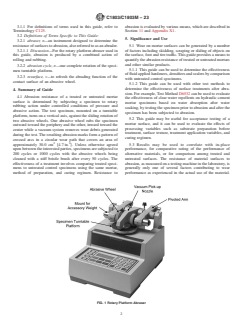
5.1 Wear on mortar surfaces can be generated by a number of factors including skidding, scraping or sliding of objects on the surface, foot and tire traffic. This guide provides a means to quantify the abrasion resistance of treated or untreated mortars and other similar products.
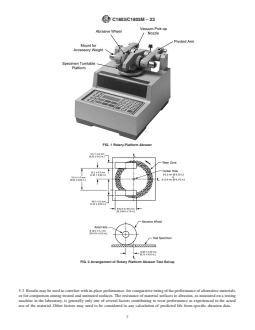
FIG. 1 Rotary Platform Abraser
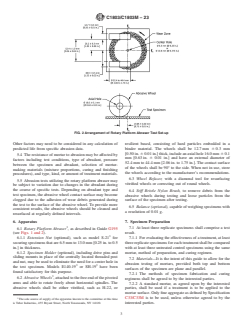
FIG. 2 Arrangement of Rotary Platform Abraser Test Set-up
5.1.1 This guide can be used to determine the effectiveness of fluid applied hardeners, densifiers and sealers by comparison with untreated control specimens.
5.1.2 This guide can be used with other test methods to determine the effectiveness of surface treatments after abrasion. For example, Test Method D6532 can be used to evaluate the effectiveness of clear water repellents on hydraulic cement mortar specimens based on water absorption after water soaking, by testing the specimen prior to abrasion and after the specimen has been subjected to abrasion.
5.2 This guide may be useful for acceptance testing of a mortar surface, and it can be used to evaluate the effects of processing variables such as substrate preparation before treatment, surface texture, treatment application variables, and curing regimen.
5.3 Results may be used to correlate with in-place performance, for comparative rating of the performance of alternative materials, or for comparison among treated and untreated surfaces. The resistance of material surfaces to abrasion, as measured on a testing machine in the laboratory, is generally only one of several factors contributing to wear performance as experienced in the actual use of the material. Other factors may need to be considered in any calculation of predicted life from specific abrasion data.
5.4 The resistance of mortar to abrasion may be affected by factors including test conditions, type of abradant, pressure between the specimen and abradant, selection of mortar-making materials (mixture proportions, curing and finishing procedures), and type, kind, or amo...
SCOPE
1.1 This guide is intended to assist in establishing procedures for determining the relative abrasion resistance of treated or untreated mortar surfaces.
1.2 This guide utilizes the rotary platform abraser, which generates a combination of rolling and rubbing to cause wear to the specimen surface. Wear can be quantified as cycles to a specific end-point. Other commonly used evaluations are presented in Appendix X1 and include mass loss, wear index, volume loss, or depth of wear.
1.3 The values stated either in SI units or inch-pound units are to be regarded separately as standard. The values stated in each system are not necessarily exact equivalents; therefore, to ensure conformance with the standard, each system shall be used independently of the other, and values from the two systems shall not be combined. Some values have only SI units because the inch-pound equivalents are not used in practice.
Note 1: Other procedures used to measure abrasion resistance of concrete surfaces include Test Methods C418, C779/C779M, C944/C944M, and C1138M. Other methods that reference the rotary platform abraser and may be of interest include Specification C744 and Test Methods C1353, D4060 and F510.
1.4 The text of this standard refers to notes and footnotes that provide explanatory material. These notes and footnotes (excluding those in tables and figures) shall not be considered as requirements of this standard.
1.5 This standard does not purport to address all of the safety concerns, if any, associated with its use. It is the responsibility of the user of this standard to establish appropriate safety, health, and environmental practices and determine the applicability of regulatory limitations prior to use.
1.6 This international standard was developed in accordance with internationally recognized principles on standardization established in the Decision on Principles for the Development of International Standards,...
- Status
- Published
- Publication Date
- 30-Nov-2023
- Technical Committee
- C09 - Concrete and Concrete Aggregates
- Drafting Committee
- C09.62 - Abrasion Testing
Buy Documents
ASTM C1803/C1803M-23 - Standard Guide for Abrasion Resistance of Mortar Surfaces Using a Rotary Platform Abraser
REDLINE ASTM C1803/C1803M-23 - Standard Guide for Abrasion Resistance of Mortar Surfaces Using a Rotary Platform Abraser
Overview
ASTM C1803/C1803M-23, titled Standard Guide for Abrasion Resistance of Mortar Surfaces Using a Rotary Platform Abraser, is an internationally recognized ASTM standard. It provides comprehensive guidance for measuring the abrasion resistance of both treated and untreated mortar surfaces using a rotary platform abraser. This testing method is critical for assessing how mortar products withstand wear caused by factors such as foot traffic, tire contact, scraping, or sliding objects. The guide also facilitates the evaluation of the effectiveness of surface treatments, such as hardeners, densifiers, and sealers, ensuring that construction materials meet durability expectations in both commercial and industrial applications.
Key Topics
- Abrasion Resistance Testing: Evaluates how mortar surfaces resist wear and tear using a rotary platform abraser that combines rolling and rubbing actions.
- Quantifiable Results: Abrasion can be measured by cycles to a specific end-point, mass loss, wear index, volume loss, or depth of wear.
- Comparative Analysis: Enables direct comparison between treated surfaces and untreated control samples to determine the effectiveness of surface treatments.
- Evaluation of Surface Treatments: Used to assess performance improvements provided by fluid-applied hardeners, densifiers, and sealers.
- Effects of Processing Variables: Considers how substrate preparation, surface texture, application methods, and curing regimens impact abrasion resistance.
- Test Standardization: Requires the use of either SI or inch-pound units, but these should not be intermixed.
- Comprehensive Reporting: Outlines requirements for documenting material proportions, testing conditions, treatment types, and evaluation criteria.
- Optional Criteria: Provides guidance for additional evaluation methods including mass loss, wear index, volume correction for density, and depth of wear.
Applications
The ASTM C1803/C1803M-23 standard is widely applied across various sectors for quality control and research in construction and material science, including:
- Construction Quality Assurance: Used during acceptance testing of mortar surfaces to verify compliance with wear resistance specifications for flooring, pavements, sidewalks, and industrial floors.
- Surface Treatment Evaluation: Assists manufacturers and contractors in determining the effectiveness of hardeners, sealers, or water repellent treatments under abrasion conditions.
- Material Comparison: Enables comparative rating of different mortar mixtures or surface treatments to select the best performing solution in terms of abrasion durability.
- Performance Prediction: Provides laboratory data that can correlate with real-world in-place performance, supporting life-cycle and maintenance planning for concrete structures.
- Research and Development: Informs decision-making about material improvements by assessing the impact of different aggregate choices, mixture proportions, and curing methods on abrasion resistance.
Related Standards
ASTM C1803/C1803M-23 references and complements several related ASTM standards to provide a full context for testing abrasion resistance:
- ASTM C418 - Abrasion Resistance of Concrete by Sandblasting
- ASTM C779/C779M - Abrasion Resistance of Horizontal Concrete Surfaces
- ASTM C944/C944M - Abrasion Resistance of Concrete or Mortar Surfaces by the Rotating-Cutter Method
- ASTM C1138M - Abrasion Resistance of Concrete (Underwater Method)
- ASTM C1353 - Abrasion Resistance of Dimension Stone Using a Rotary Platform Abraser
- ASTM D4060 - Abrasion Resistance of Organic Coatings by the Taber Abraser
- ASTM D6532 - Effect of Clear Water Repellent Treatments on Water Absorption of Hydraulic Cement Mortar Specimens
- ASTM F510 - Resistance to Abrasion of Resilient Floor Coverings
- ASTM G195 - Guide for Conducting Wear Tests Using a Rotary Platform Abraser
These standards together support industry best practices for evaluating the abrasion resistance of concrete, mortar, and related materials, providing multiple validated test methods and criteria for diverse construction and flooring applications.
Keywords: abrasion resistance, mortar surfaces, rotary platform abraser, ASTM C1803, mortar treatment, wear resistance testing, surface treatment evaluation, construction quality assurance.
Relations
- Effective Date
- 01-Dec-2023
- Effective Date
- 15-Dec-2023
- Effective Date
- 15-Jul-2021
Buy Documents
ASTM C1803/C1803M-23 - Standard Guide for Abrasion Resistance of Mortar Surfaces Using a Rotary Platform Abraser
REDLINE ASTM C1803/C1803M-23 - Standard Guide for Abrasion Resistance of Mortar Surfaces Using a Rotary Platform Abraser
Get Certified
Connect with accredited certification bodies for this standard

DIBt (Deutsches Institut für Bautechnik)
German Institute for Building Technology.
DIN CERTCO
DIN Group product certification.

Aboma Certification B.V.
Specialized in construction, metal, and transport sectors.
Sponsored listings
Frequently Asked Questions
ASTM C1803/C1803M-23 is a guide published by ASTM International. Its full title is "Standard Guide for Abrasion Resistance of Mortar Surfaces Using a Rotary Platform Abraser". This standard covers: SIGNIFICANCE AND USE 5.1 Wear on mortar surfaces can be generated by a number of factors including skidding, scraping or sliding of objects on the surface, foot and tire traffic. This guide provides a means to quantify the abrasion resistance of treated or untreated mortars and other similar products. FIG. 1 Rotary Platform Abraser FIG. 2 Arrangement of Rotary Platform Abraser Test Set-up 5.1.1 This guide can be used to determine the effectiveness of fluid applied hardeners, densifiers and sealers by comparison with untreated control specimens. 5.1.2 This guide can be used with other test methods to determine the effectiveness of surface treatments after abrasion. For example, Test Method D6532 can be used to evaluate the effectiveness of clear water repellents on hydraulic cement mortar specimens based on water absorption after water soaking, by testing the specimen prior to abrasion and after the specimen has been subjected to abrasion. 5.2 This guide may be useful for acceptance testing of a mortar surface, and it can be used to evaluate the effects of processing variables such as substrate preparation before treatment, surface texture, treatment application variables, and curing regimen. 5.3 Results may be used to correlate with in-place performance, for comparative rating of the performance of alternative materials, or for comparison among treated and untreated surfaces. The resistance of material surfaces to abrasion, as measured on a testing machine in the laboratory, is generally only one of several factors contributing to wear performance as experienced in the actual use of the material. Other factors may need to be considered in any calculation of predicted life from specific abrasion data. 5.4 The resistance of mortar to abrasion may be affected by factors including test conditions, type of abradant, pressure between the specimen and abradant, selection of mortar-making materials (mixture proportions, curing and finishing procedures), and type, kind, or amo... SCOPE 1.1 This guide is intended to assist in establishing procedures for determining the relative abrasion resistance of treated or untreated mortar surfaces. 1.2 This guide utilizes the rotary platform abraser, which generates a combination of rolling and rubbing to cause wear to the specimen surface. Wear can be quantified as cycles to a specific end-point. Other commonly used evaluations are presented in Appendix X1 and include mass loss, wear index, volume loss, or depth of wear. 1.3 The values stated either in SI units or inch-pound units are to be regarded separately as standard. The values stated in each system are not necessarily exact equivalents; therefore, to ensure conformance with the standard, each system shall be used independently of the other, and values from the two systems shall not be combined. Some values have only SI units because the inch-pound equivalents are not used in practice. Note 1: Other procedures used to measure abrasion resistance of concrete surfaces include Test Methods C418, C779/C779M, C944/C944M, and C1138M. Other methods that reference the rotary platform abraser and may be of interest include Specification C744 and Test Methods C1353, D4060 and F510. 1.4 The text of this standard refers to notes and footnotes that provide explanatory material. These notes and footnotes (excluding those in tables and figures) shall not be considered as requirements of this standard. 1.5 This standard does not purport to address all of the safety concerns, if any, associated with its use. It is the responsibility of the user of this standard to establish appropriate safety, health, and environmental practices and determine the applicability of regulatory limitations prior to use. 1.6 This international standard was developed in accordance with internationally recognized principles on standardization established in the Decision on Principles for the Development of International Standards,...
SIGNIFICANCE AND USE 5.1 Wear on mortar surfaces can be generated by a number of factors including skidding, scraping or sliding of objects on the surface, foot and tire traffic. This guide provides a means to quantify the abrasion resistance of treated or untreated mortars and other similar products. FIG. 1 Rotary Platform Abraser FIG. 2 Arrangement of Rotary Platform Abraser Test Set-up 5.1.1 This guide can be used to determine the effectiveness of fluid applied hardeners, densifiers and sealers by comparison with untreated control specimens. 5.1.2 This guide can be used with other test methods to determine the effectiveness of surface treatments after abrasion. For example, Test Method D6532 can be used to evaluate the effectiveness of clear water repellents on hydraulic cement mortar specimens based on water absorption after water soaking, by testing the specimen prior to abrasion and after the specimen has been subjected to abrasion. 5.2 This guide may be useful for acceptance testing of a mortar surface, and it can be used to evaluate the effects of processing variables such as substrate preparation before treatment, surface texture, treatment application variables, and curing regimen. 5.3 Results may be used to correlate with in-place performance, for comparative rating of the performance of alternative materials, or for comparison among treated and untreated surfaces. The resistance of material surfaces to abrasion, as measured on a testing machine in the laboratory, is generally only one of several factors contributing to wear performance as experienced in the actual use of the material. Other factors may need to be considered in any calculation of predicted life from specific abrasion data. 5.4 The resistance of mortar to abrasion may be affected by factors including test conditions, type of abradant, pressure between the specimen and abradant, selection of mortar-making materials (mixture proportions, curing and finishing procedures), and type, kind, or amo... SCOPE 1.1 This guide is intended to assist in establishing procedures for determining the relative abrasion resistance of treated or untreated mortar surfaces. 1.2 This guide utilizes the rotary platform abraser, which generates a combination of rolling and rubbing to cause wear to the specimen surface. Wear can be quantified as cycles to a specific end-point. Other commonly used evaluations are presented in Appendix X1 and include mass loss, wear index, volume loss, or depth of wear. 1.3 The values stated either in SI units or inch-pound units are to be regarded separately as standard. The values stated in each system are not necessarily exact equivalents; therefore, to ensure conformance with the standard, each system shall be used independently of the other, and values from the two systems shall not be combined. Some values have only SI units because the inch-pound equivalents are not used in practice. Note 1: Other procedures used to measure abrasion resistance of concrete surfaces include Test Methods C418, C779/C779M, C944/C944M, and C1138M. Other methods that reference the rotary platform abraser and may be of interest include Specification C744 and Test Methods C1353, D4060 and F510. 1.4 The text of this standard refers to notes and footnotes that provide explanatory material. These notes and footnotes (excluding those in tables and figures) shall not be considered as requirements of this standard. 1.5 This standard does not purport to address all of the safety concerns, if any, associated with its use. It is the responsibility of the user of this standard to establish appropriate safety, health, and environmental practices and determine the applicability of regulatory limitations prior to use. 1.6 This international standard was developed in accordance with internationally recognized principles on standardization established in the Decision on Principles for the Development of International Standards,...
ASTM C1803/C1803M-23 is classified under the following ICS (International Classification for Standards) categories: 91.100.10 - Cement. Gypsum. Lime. Mortar. The ICS classification helps identify the subject area and facilitates finding related standards.
ASTM C1803/C1803M-23 has the following relationships with other standards: It is inter standard links to ASTM C1803-20, ASTM C109/C109M-23, ASTM C109/C109M-21. Understanding these relationships helps ensure you are using the most current and applicable version of the standard.
ASTM C1803/C1803M-23 is available in PDF format for immediate download after purchase. The document can be added to your cart and obtained through the secure checkout process. Digital delivery ensures instant access to the complete standard document.
Standards Content (Sample)
This international standard was developed in accordance with internationally recognized principles on standardization established in the Decision on Principles for the
Development of International Standards, Guides and Recommendations issued by the World Trade Organization Technical Barriers to Trade (TBT) Committee.
Designation: C1803/C1803M − 23
Standard Guide for
Abrasion Resistance of Mortar Surfaces Using a Rotary
Platform Abraser
This standard is issued under the fixed designation C1803/C1803M; the number immediately following the designation indicates the
year of original adoption or, in the case of revision, the year of last revision. A number in parentheses indicates the year of last
reapproval. A superscript epsilon (´) indicates an editorial change since the last revision or reapproval.
1. Scope* mendations issued by the World Trade Organization Technical
Barriers to Trade (TBT) Committee.
1.1 This guide is intended to assist in establishing proce-
dures for determining the relative abrasion resistance of treated
2. Referenced Documents
or untreated mortar surfaces.
2.1 ASTM Standards:
1.2 This guide utilizes the rotary platform abraser, which
C33/C33M Specification for Concrete Aggregates
generates a combination of rolling and rubbing to cause wear
C109/C109M Test Method for Compressive Strength of
to the specimen surface. Wear can be quantified as cycles to a
Hydraulic Cement Mortars (Using 2-in. or [50 mm] Cube
specific end-point. Other commonly used evaluations are
Specimens)
presented in Appendix X1 and include mass loss, wear index,
C125 Terminology Relating to Concrete and Concrete Ag-
volume loss, or depth of wear.
gregates
1.3 The values stated either in SI units or inch-pound units
C418 Test Method for Abrasion Resistance of Concrete by
are to be regarded separately as standard. The values stated in
Sandblasting
each system are not necessarily exact equivalents; therefore, to
C744 Specification for Prefaced Concrete and Calcium Sili-
ensure conformance with the standard, each system shall be
cate Masonry Units
used independently of the other, and values from the two
C779/C779M Test Method for Abrasion Resistance of Hori-
systems shall not be combined. Some values have only SI units
zontal Concrete Surfaces
because the inch-pound equivalents are not used in practice.
C944/C944M Test Method for Abrasion Resistance of Con-
NOTE 1—Other procedures used to measure abrasion resistance of
crete or Mortar Surfaces by the Rotating-Cutter Method
concrete surfaces include Test Methods C418, C779/C779M, C944/
C1138M Test Method for Abrasion Resistance of Concrete
C944M, and C1138M. Other methods that reference the rotary platform
(Underwater Method)
abraser and may be of interest include Specification C744 and Test
Methods C1353, D4060 and F510. C1353 Test Method for Abrasion Resistance of Dimension
Stone Subjected to Foot Traffic Using a Rotary Platform
1.4 The text of this standard refers to notes and footnotes
Abraser
that provide explanatory material. These notes and footnotes
D4060 Test Method for Abrasion Resistance of Organic
(excluding those in tables and figures) shall not be considered
Coatings by the Taber Abraser
as requirements of this standard.
D6532 Test Method for Evaluation of the Effect of Clear
1.5 This standard does not purport to address all of the
Water Repellent Treatments on Water Absorption of Hy-
safety concerns, if any, associated with its use. It is the
draulic Cement Mortar Specimens
responsibility of the user of this standard to establish appro-
F510 Test Method for Resistance to Abrasion of Resilient
priate safety, health, and environmental practices and deter-
Floor Coverings Using an Abrader with a Grit Feed
mine the applicability of regulatory limitations prior to use.
Method
1.6 This international standard was developed in accor-
G195 Guide for Conducting Wear Tests Using a Rotary
dance with internationally recognized principles on standard-
Platform Abraser
ization established in the Decision on Principles for the
Development of International Standards, Guides and Recom-
3. Terminology
3.1 Definitions:
This guide is under the jurisdiction of ASTM Committee C09 on Concrete and
Concrete Aggregates and is the direct responsibility of Subcommittee C09.62 on
Abrasion Testing. For referenced ASTM standards, visit the ASTM website, www.astm.org, or
Current edition approved Dec. 1, 2023. Published January 2024. Originally contact ASTM Customer Service at service@astm.org. For Annual Book of ASTM
published in 2015. Last previous edition approved in 2020 as C1803–20. DOI: Standards volume information, refer to the standard’s Document Summary page on
10.1520/C1803-23. the ASTM website.
*A Summary of Changes section appears at the end of this standard
Copyright © ASTM International, 100 Barr Harbor Drive, PO Box C700, West Conshohocken, PA 19428-2959. United States
C1803/C1803M − 23
3.1.1 For definitions of terms used in this guide, refer to abrasion is evaluated by various means, which are described in
Terminology C125. Section 11 and Appendix X1.
3.2 Definitions of Terms Specific to This Guide:
5. Significance and Use
3.2.1 abraser, n—an instrument designed to determine the
resistance of surfaces to abrasion, also referred to as an abrader. 5.1 Wear on mortar surfaces can be generated by a number
3.2.1.1 Discussion—For the rotary platform abraser used in of factors including skidding, scraping or sliding of objects on
this guide, abrasion is produced by a combined action of the surface, foot and tire traffic. This guide provides a means to
rolling and rubbing. quantify the abrasion resistance of treated or untreated mortars
and other similar products.
3.2.2 abrasion cycle, n—one complete rotation of the speci-
5.1.1 This guide can be used to determine the effectiveness
men turntable platform.
of fluid applied hardeners, densifiers and sealers by comparison
3.2.3 resurface, v—to refresh the abrading function of the
with untreated control specimens.
contact surface of an abrasive wheel.
5.1.2 This guide can be used with other test methods to
determine the effectiveness of surface treatments after abra-
4. Summary of Guide
sion. For example, Test Method D6532 can be used to evaluate
4.1 Abrasion resistance of a treated or untreated mortar
the effectiveness of clear water repellents on hydraulic cement
surface is determined by subjecting a specimen to rotary
mortar specimens based on water absorption after water
rubbing action under controlled conditions of pressure and
soaking, by testing the specimen prior to abrasion and after the
abrasive action. The test specimen, mounted on a turntable
specimen has been subjected to abrasion.
platform, turns on a vertical axis, against the sliding rotation of
5.2 This guide may be useful for acceptance testing of a
two abrasive wheels. One abrasive wheel rubs the specimen
mortar surface, and it can be used to evaluate the effects of
outward toward the periphery and the other, inward toward the
processing variables such as substrate preparation before
center while a vacuum system removes wear debris generated
treatment, surface texture, treatment application variables, and
during the test. The resulting abrasion marks form a pattern of
curing regimen.
crossed arcs in a circular wear path that covers an area of
2 2
approximately 30.0 cm [4.7 in. ]. Unless otherwise agreed 5.3 Results may be used to correlate with in-place
upon between the interested parties, specimens are subjected to performance, for comparative rating of the performance of
200 cycles or 1000 cycles with the abrasive wheels being alternative materials, or for comparison among treated and
cleaned with a stiff bristle brush after every 50 cycles. The untreated surfaces. The resistance of material surfaces to
effectiveness of a treatment involves comparing treated speci- abrasion, as measured on a testing machine in the laboratory, is
mens to untreated control specimens using the same mortar, generally only one of several factors contributing to wear
method of preparation, and curing regimen. Resistance to
performance as experienced in the actual use of the material.
FIG. 1 Rotary Platform Abraser
C1803/C1803M − 23
FIG. 2 Arrangement of Rotary Platform Abraser Test Set-up
Other factors may need to be considered in any calculation of resilient based, consisting of hard particles embedded in a
predicted life from specific abrasion data. binder material. The wheels shall be 12.7 mm 6 0.3 mm
[0.50 in. 6 0.01 in.] thick, include an axial hole 16.0 mm 6 0.1
5.4 The resistance of mortar to abrasion may be affected by
mm [0.63 in. 6 0.01 in.] and have an external diameter of
factors including test conditions, type of abradant, pressure
52.4 mm to 44.4 mm [2.06 in. to 1.75 in.]. The contact surface
between the specimen and abradant, selection of mortar-
of the wheels shall be 90° to the side. When not in use, store
making materials (mixture proportions, curing and finishing
the wheels according to the manufacturer’s recommendations.
procedures), and type, kind, or amount of treatment materials.
6.3 Wheel Refacer, with a diamond tool for resurfacing
5.5 Abrasion tests utilizing the rotary platform abraser may
vitrified wheels or correcting out of round wheels.
be subject to variation due to changes in the abradant during
the course of specific tests. Depending on abradant type and
6.4 Stiff Bristle Nylon Brush, to remove debris from the
test specimen, the abrasive wheel contact surface may become
abrasive wheels during testing and loose particles from the
clogged due to the adhesion of wear debris generated during
surface of the specimen after testing.
the test to the surface of the abrasive wheel. To provide more
6.5 Balance (optional), capable of weighing specimens with
consistent results, the abrasive wheels should be cleaned and
a resolution of 0.01 g.
resurfaced at regularly defined intervals.
7. Specimen Preparation
6. Apparatus
7.1 At least three replicate specimens shall comprise a test
6.1 Rotary Platform Abraser , as described in Guide G195
(see Figs. 1 and 2). result.
6.1.1 Extension Nut (optional), such as model S-21 for 7.1.1 For evaluating the effectiveness of a treatment, at least
securing specimens that are 6.5 mm to 13.0 mm [0.25 in. to 0.5 three replicate specimens for each treatment shall be compared
in.] in thickness. with at least three untreated control specimens using the same
6.1.2 Specimen Holder (optional), including drive pins and mortar, method of preparation, and curing regimen.
sliding mounts in place of the centrally located threaded post
7.2 Materials—It is the intent of this guide to allow for the
and nut, may be used to eliminate the need for a center hole in
abrasion testing of mortars, provided both top and bottom
3 3
the test specimen. Models E140-19 or SH-19 have been
surfaces of the specimen are plane and parallel.
found satisfactory for this purpose.
7.2.1 The methods of specimen fabrication and curing
6.2 Abrasive Wheels , attached to the free end of the pivoted
regimens shall be agreed to by the interested parties.
arms and able to rotate freely about horizontal spindles. The
7.2.2 A standard mortar, as agreed upon by the interested
abrasive wheels shall be either vitrified, such as H-22, or
parties, shall be used if a treatment is to be applied to the
mortar surface. Only fine aggregate as defined by Specification
C33/C33M is to be used, unless otherwise agreed to by the
The sole source of supply of the apparatus known to the committee at this time
is Taber Industries, 455 Bryant Street, North Tonawanda, NY 14120. interested parties.
C1803/C1803M − 23
NOTE 2—The mortar proportions defined in Test Method C109/C109M NOTE 4—H-22 wheels have been found satisfactory for most testing.
have been found to be acceptable as a standard mortar for many tests. If Other abrasive wheels that may be of interest include the less aggressive
coarse aggregate is pre
...
This document is not an ASTM standard and is intended only to provide the user of an ASTM standard an indication of what changes have been made to the previous version. Because
it may not be technically possible to adequately depict all changes accurately, ASTM recommends that users consult prior editions as appropriate. In all cases only the current version
of the standard as published by ASTM is to be considered the official document.
Designation: C1803 − 20 C1803/C1803M − 23
Standard Guide for
Abrasion Resistance of Mortar Surfaces Using a Rotary
Platform Abraser
This standard is issued under the fixed designation C1803;C1803/C1803M; the number immediately following the designation indicates
the year of original adoption or, in the case of revision, the year of last revision. A number in parentheses indicates the year of last
reapproval. A superscript epsilon (´) indicates an editorial change since the last revision or reapproval.
1. Scope*
1.1 This guide is intended to assist in establishing procedures for determining the relative abrasion resistance of treated or
untreated mortar surfaces.
1.2 This guide utilizes the rotary platform abraser, which generates a combination of rolling and rubbing to cause wear to the
specimen surface. Wear can be quantified as cycles to a specific end-point. Other commonly used evaluations are presented in
Appendix X1 and include mass loss, wear index, or volume loss.volume loss, or depth of wear.
1.3 The values stated either in SI units or inch-pound units are to be regarded as standard. No other units of measurement are
included in this standard.separately as standard. The values stated in each system are not necessarily exact equivalents; therefore,
to ensure conformance with the standard, each system shall be used independently of the other, and values from the two systems
shall not be combined. Some values have only SI units because the inch-pound equivalents are not used in practice.
NOTE 1—Other procedures used to measure abrasion resistance of concrete surfaces include Test Methods C418, C779/C779M, C944/C944M, and
C1138M. Other methods that reference the rotary platform abraser and may be of interest include Specification C744 and Test Methods C1353, D4060
and F510.
1.4 The text of this standard refers to notes and footnotes that provide explanatory material. These notes and footnotes (excluding
those in tables and figures) shall not be considered as requirements of this standard.
1.5 This standard does not purport to address all of the safety concerns, if any, associated with its use. It is the responsibility
of the user of this standard to establish appropriate safety, health, and environmental practices and determine the applicability of
regulatory limitations prior to use.
1.6 This international standard was developed in accordance with internationally recognized principles on standardization
established in the Decision on Principles for the Development of International Standards, Guides and Recommendations issued
by the World Trade Organization Technical Barriers to Trade (TBT) Committee.
2. Referenced Documents
2.1 ASTM Standards:
C33/C33M Specification for Concrete Aggregates
C109/C109M Test Method for Compressive Strength of Hydraulic Cement Mortars (Using 2-in. or [50 mm] Cube Specimens)
This guide is under the jurisdiction of ASTM Committee C09 on Concrete and Concrete Aggregates and is the direct responsibility of Subcommittee C09.62 on Abrasion
Testing.
Current edition approved Dec. 15, 2020Dec. 1, 2023. Published January 2020January 2024. Originally published in 2015. Last previous edition approved in 20152020
as C1803–15. DOI: 10.1520/C1803-20.–20. DOI: 10.1520/C1803-23.
For referenced ASTM standards, visit the ASTM website, www.astm.org, or contact ASTM Customer Service at service@astm.org. For Annual Book of ASTM Standards
volume information, refer to the standard’s Document Summary page on the ASTM website.
*A Summary of Changes section appears at the end of this standard
Copyright © ASTM International, 100 Barr Harbor Drive, PO Box C700, West Conshohocken, PA 19428-2959. United States
C1803/C1803M − 23
C125 Terminology Relating to Concrete and Concrete Aggregates
C418 Test Method for Abrasion Resistance of Concrete by Sandblasting
C744 Specification for Prefaced Concrete and Calcium Silicate Masonry Units
C779/C779M Test Method for Abrasion Resistance of Horizontal Concrete Surfaces
C944/C944M Test Method for Abrasion Resistance of Concrete or Mortar Surfaces by the Rotating-Cutter Method
C1138M Test Method for Abrasion Resistance of Concrete (Underwater Method)
C1353 Test Method for Abrasion Resistance of Dimension Stone Subjected to Foot Traffic Using a Rotary Platform Abraser
D4060 Test Method for Abrasion Resistance of Organic Coatings by the Taber Abraser
D6532 Test Method for Evaluation of the Effect of Clear Water Repellent Treatments on Water Absorption of Hydraulic Cement
Mortar Specimens
F510 Test Method for Resistance to Abrasion of Resilient Floor Coverings Using an Abrader with a Grit Feed Method
G195 Guide for Conducting Wear Tests Using a Rotary Platform Abraser
3. Terminology
3.1 Definitions:
3.1.1 For definitions of terms used in this guide, refer to Terminology C125.
3.2 Definitions of Terms Specific to This Guide:
3.2.1 abraser, n—an instrument designed to determine the resistance of surfaces to abrasion, also referred to as an abrader.
3.2.1.1 Discussion—
For the rotary platform abraser used in this guide, abrasion is produced by a combined action of rolling and rubbing.
3.2.2 abrasion cycle, n—one complete rotation of the specimen turntable platform.
3.2.3 resurface, v—the procedure of refreshing the runningto refresh the abrading function of the contact surface of an abrasive
wheel.
4. Summary of Guide
4.1 Abrasion resistance of a treated or untreated mortar surface is determined by subjecting a specimen to rotary rubbing action
under controlled conditions of pressure and abrasive action. The test specimen, mounted on a turntable platform, turns on a vertical
axis, against the sliding rotation of two abradingabrasive wheels. One abradingabrasive wheel rubs the specimen outward toward
the periphery and the other, inward toward the center while a vacuum system removes wear debris generated during the test. The
resulting abrasion marks form a pattern of crossed arcs in a circular wear path that is 12.7 mm wide, whose inner diameter is
2 2
located 31.75 mm from the center of the specimen, and covers an area of approximately 3030.0 cm . [4.7 in. ]. Unless otherwise
agreed upon between the interested parties, specimens are subjected to 200 cycles or 1000 cycles with the abradingabrasive wheels
being cleaned with a stiff bristle brush after every 50 cycles. The effectiveness of a treatment involves comparing treated specimens
to untreated control (untreated) specimens using the same mortar, method of preparation, and curing regimen. Resistance to
abrasion is evaluated by various means, which are described in Section 11 and Appendix X1.
5. Significance and Use
5.1 Wear on mortar surfaces can be generated by a number of factors including skidding, scraping or sliding of objects on the
surface, foot and tire traffic. This guide provides a means to quantify the abrasion resistance of treated or untreated mortars and
other similar products.
5.1.1 This guide can be used to determine the effectiveness of fluid applied hardeners, densifiers and sealers by comparison with
untreated control specimens.
5.1.2 This guide can be used with other test methods to determine the effectiveness of surface treatments after abrasion. For
example, Test Method D6532 can be used to evaluate the effectiveness of clear water repellents on hydraulic cement mortar
specimens based on water absorption after water soaking, by testing the specimen prior to abrasion and after the specimen has been
subjected to abrasion.
5.2 This guide may be useful for acceptance testing of a mortar surface, and it can be used to evaluate the effects of processing
variables such as substrate preparation before treatment, surface texture, treatment application variables, and curing regimen.
C1803/C1803M − 23
FIG. 1 Rotary Platform Abraser
FIG. 2 Arrangement of Rotary Platform Abraser Test Set-up
5.3 Results may be used to correlate with in-place performance, for comparative rating of the performance of alternative materials,
or for comparison among treated and untreated surfaces. The resistance of material surfaces to abrasion, as measured on a testing
machine in the laboratory, is generally only one of several factors contributing to wear performance as experienced in the actual
use of the material. Other factors may need to be considered in any calculation of predicted life from specific abrasion data.
C1803/C1803M − 23
5.4 The resistance of mortar to abrasion may be affected by factors including test conditions, type of abradant, pressure between
the specimen and abradant, selection of mortar-making materials (mixture proportions, curing and finishing procedures), and type,
kind, or amount of treatment materials.
5.5 Abrasion tests utilizing the rotary platform abraser may be subject to variation due to changes in the abradant during the course
of specific tests. Depending on abradant type and test specimen, the abradingabrasive wheel contact surface may become clogged
due to the adhesion of wear debris generated during the test to the surface of the abrasive wheel. To provide more consistent results,
the abradingabrasive wheels should be cleaned and resurfaced at regularly defined intervals.
6. Apparatus
6.1 Rotary Platform Abraser , as described in Guide G195 (see Figs. 1 and 2).
6.1.1 Extension Nut (optional),such as model S-21 for securing specimens that are 6.5 mm to 13.0 mm [0.25 in. to 0.5 in.] in
thickness.
6.1.2 Specimen Holder (optional),including drive pins and sliding mounts in place of the centrally located threaded post and nut,
3 3
may be used to eliminate the need for a center hole in the test specimen. ModelModels E140-19 has or SH-19 have been found
satisfactory for this purpose.
6.2 Abrasive Wheels , attached to the free end of the pivoted arms and able to rotate freely about horizontal spindles. The abrasive
wheels shall be either vitrified, such as H-22, or resilient based, consisting of hard particles embedded in a binder material. The
wheels shall be 12.7 mm 60.3 mm thick 6 0.3 mm [0.50 in. 6 0.01 in.] thick, include an axial hole 16.0 mm 6 0.1 mm [0.63 in.
6 0.01 in.] and have an external diameter of 51.9 mm 60.5 mm when new, and in no case less than 44.4 mm. The running52.4 mm
to 44.4 mm [2.06 in. to 1.75 in.]. The contact surface of the wheels shall be 90° to the side. When not in use, store the wheels
according to the manufacturer’s recommendations.
6.3 Wheel Refacer, with a diamond tool for resurfacing vitrified wheels or correcting out of round wheels.
6.4 Stiff Bristle Nylon Brush, to remove debris from the abrasive wheels during testing and loose particles from the surface of the
specimen after testing.
6.5 Balance (optional), with an accuracy of at least 1 mg.capable of weighing specimens with a resolution of 0.01 g.
7. Specimen Preparation
7.1 At least three replicate specimens shall comprise a test result.
7.1.1 For evaluating the effectiveness of a treatment, at least three replicate specimens for each treatment shall be compared with
at least three untreated control (untreated) specimens using the same mortar, method of preparation, and curing regimen.
7.2 Materials—It is the intent of this guide to allow for the abrasion testing of mortars, provided both top and bottom surfaces
of the specimen are plane and parallel.
7.2.1 The methods of specimen fabrication and curing regimens shall be agreed to by the interested parties.
7.2.2 A standard mortar, as agreed upon by the interested parties, shall be used if a treatment is to be applied to the mortar surface.
Only fine aggregate as defined by Specification C33/C33M is to be used, unless otherwise agreed to by the interested parties.
NOTE 2—The mortar proportions defined in Test Method C109/C109M have been found to be acceptable as a standard mortar for many tests. If coarse
aggregate is present, test results will be controlled more by the abrasion resistance of the aggregate rather than the abrasion resistance of the mortar.
7.2.3 If the specimen surfaces are not plane and parallel, grind the surface not to be tested.
The sole source of supply of the apparatus known to the committee at this time is Taber Industries, 455 Bryant Street, North Tonawanda, NY 14120.
C1803/C1803M − 23
7.3 Specimen Size—Specimens shall be approximately 100 mm [4 in.] square or round, an
...