

ASTM E208-20e1
(Test Method)Standard Test Method for Conducting Drop-Weight Test to Determine Nil-Ductility Transition Temperature of Ferritic Steels
General Information
- Abstract
SIGNIFICANCE AND USE
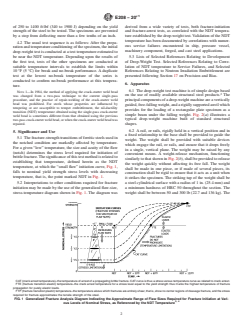
5.1 The fracture-strength transitions of ferritic steels used in the notched condition are markedly affected by temperature. For a given “low” temperature, the size and acuity of the flaw (notch) determines the stress level required for initiation of brittle fracture. The significance of this test method is related to establishing that temperature, defined herein as the NDT temperature, at which the “small flaw” initiation curve, Fig. 1, falls to nominal yield strength stress levels with decreasing temperature, that is, the point marked NDT in Fig. 1.
FIG. 1 Generalized Fracture Analysis Diagram Indicating the Approximate Range of Flaw Sizes Required for Fracture Initiation at Various Levels of Nominal Stress, as Referenced by the NDT Temperature3 , 4
CAT (crack arrest temperature)–the temperature of arrest of a propagating brittle fracture. CAT curve is thus a stress versus temperature curve as related to crack arrest.
FTE (fracture transition elastic) temperature–the crack arrest temperature for a stress level equal to the yield strength thus marks the highest temperature of fracture propagation for purely elastic loads.
FTP (fracture transition plastic) temperature–the temperature above which fractures are entirely shear, that is, show no center regions of cleavage fracture, and the stress required for fracture approximates the tensile strength of the steel.
5.2 Interpretations to other conditions required for fracture initiation may be made by the use of the generalized flaw-size, stress-temperature diagram shown in Fig. 1. The diagram was derived from a wide variety of tests, both fracture-initiation and fracture-arrest tests, as correlated with the NDT temperature established by the drop-weight test. Validation of the NDT temperature has been documented by correlations with numerous service failures encountered in ship, pressure vessel, machinery component, forged, and cast steel applications.
5.3 Lists of Selected References Relating to Develop...
SCOPE
1.1 This test method covers the determination of the nil-ductility transition (NDT) temperature of ferritic steels, 5/8 in. (15.9 mm) and thicker.
1.2 This test method may be used whenever the inquiry, contract, order, or specification states that the steels are subject to fracture toughness requirements as determined by the drop-weight test.
1.3 The values stated in inch-pound units are to be regarded as standard. The values given in parentheses are mathematical conversions to SI units that are provided for information only and are not considered standard.
1.4 This standard does not purport to address all of the safety concerns, if any, associated with its use. It is the responsibility of the user of this standard to establish appropriate safety, health, and environmental practices and determine the applicability of regulatory limitations prior to use.
1.5 This international standard was developed in accordance with internationally recognized principles on standardization established in the Decision on Principles for the Development of International Standards, Guides and Recommendations issued by the World Trade Organization Technical Barriers to Trade (TBT) Committee.
- Status
- Published
- Publication Date
- 30-Jun-2020
- Technical Committee
- E28 - Mechanical Testing
- Drafting Committee
- E28.07 - Impact Testing
Overview
ASTM E208-20e1: Standard Test Method for Conducting Drop-Weight Test to Determine Nil-Ductility Transition Temperature of Ferritic Steels is a widely recognized methodology developed by ASTM International. This standard specifies how to determine the nil-ductility transition (NDT) temperature of ferritic steels that are 5/8 inch (15.9 mm) thick and above. The NDT temperature is the highest temperature at which a standardized test specimen will break under specified drop-weight impact conditions, indicating the onset of brittle fracture. Understanding this transition is critical for ensuring the safety and integrity of structural steel components exposed to low-temperature environments.
Key Topics
- Nil-Ductility Transition (NDT) Temperature: The critical temperature below which ferritic steel behaves in a brittle manner when impacted.
- Drop-Weight Test Procedure: Details preparation, testing sequence, and equipment needed for consistent results, including specimen orientation, weld bead application, and temperature conditioning.
- Flaw Size and Stress Relationships: Explains how flaw (notch) size, acuity, and temperature affect fracture initiation, based on generalized flaw-size/stress-temperature diagrams.
- Fracture Terminology:
- CAT (Crack Arrest Temperature): The temperature at which a propagating brittle crack is arrested.
- FTE (Fracture Transition Elastic) Temperature: Marks the highest temperature for fracture propagation under purely elastic loads.
- FTP (Fracture Transition Plastic) Temperature: The temperature above which fractures are entirely shear and require tensile strength levels for failure.
- Test Conditions and Validations: Emphasizes the importance of using standard specimens and test conditions for valid specification purposes, as validated by correlation with actual service failures.
Applications
- Structural Integrity Assessment: Used by industries to evaluate the suitability of ferritic steels for critical applications where exposure to low temperatures could lead to brittle fracture. Examples include ships, pressure vessels, machinery components, and large forged or cast steel features.
- Material Specification Compliance: Frequently referenced in procurement documents, standards, and regulatory codes (e.g., ASME Boiler and Pressure Vessel Code) to verify that steels meet required fracture toughness criteria.
- Design and Safety Assurance: Engineers and designers utilize the NDT temperature to inform design decisions, particularly for infrastructure or components operating in potentially brittle conditions.
- Quality Control and Material Qualification: Serves as a reliable tool for both initial material approval and batch compliance during production, particularly for heavy structural components.
- Research and Failure Analysis: The method is an essential reference in materials research and investigations into structural failures attributed to brittle fracture at low temperatures.
Related Standards
- ASTM E23: Charpy Impact Test for determining the impact energy of materials, often used alongside ASTM E208.
- ASTM E1921: Standard Test Method for Determination of Reference Temperature, T0, for Ferritic Steels in the Transition Range.
- ASME Boiler and Pressure Vessel Code: Cites ASTM E208 for fracture toughness verification of pressure boundary materials.
- ISO 148: International standard for steel impact testing, relevant for comparison with drop-weight test outcomes.
- ASTM A20/A20M: General requirements for steel plates, which may reference drop-weight testing for certain grades.
Practical Value
The ASTM E208 drop-weight test is vital for industries requiring assurance of material performance in demanding environments. By accurately determining the nil-ductility transition temperature, organizations can safeguard against brittle fracture, optimize material selection, and comply with stringent regulatory and safety standards in sectors such as oil and gas, shipbuilding, power generation, and construction. This standard ensures uniformity and repeatability in impact testing, supporting global best practices in steel quality control and structural integrity assessment.
Get Certified
Connect with accredited certification bodies for this standard

Element Materials Technology
Materials testing and product certification.

Inštitut za kovinske materiale in tehnologije
Institute of Metals and Technology. Materials testing, metallurgical analysis, NDT.
Sponsored listings
Frequently Asked Questions
ASTM E208-20e1 is a standard published by ASTM International. Its full title is "Standard Test Method for Conducting Drop-Weight Test to Determine Nil-Ductility Transition Temperature of Ferritic Steels". This standard covers: SIGNIFICANCE AND USE 5.1 The fracture-strength transitions of ferritic steels used in the notched condition are markedly affected by temperature. For a given “low” temperature, the size and acuity of the flaw (notch) determines the stress level required for initiation of brittle fracture. The significance of this test method is related to establishing that temperature, defined herein as the NDT temperature, at which the “small flaw” initiation curve, Fig. 1, falls to nominal yield strength stress levels with decreasing temperature, that is, the point marked NDT in Fig. 1. FIG. 1 Generalized Fracture Analysis Diagram Indicating the Approximate Range of Flaw Sizes Required for Fracture Initiation at Various Levels of Nominal Stress, as Referenced by the NDT Temperature3 , 4 CAT (crack arrest temperature)–the temperature of arrest of a propagating brittle fracture. CAT curve is thus a stress versus temperature curve as related to crack arrest. FTE (fracture transition elastic) temperature–the crack arrest temperature for a stress level equal to the yield strength thus marks the highest temperature of fracture propagation for purely elastic loads. FTP (fracture transition plastic) temperature–the temperature above which fractures are entirely shear, that is, show no center regions of cleavage fracture, and the stress required for fracture approximates the tensile strength of the steel. 5.2 Interpretations to other conditions required for fracture initiation may be made by the use of the generalized flaw-size, stress-temperature diagram shown in Fig. 1. The diagram was derived from a wide variety of tests, both fracture-initiation and fracture-arrest tests, as correlated with the NDT temperature established by the drop-weight test. Validation of the NDT temperature has been documented by correlations with numerous service failures encountered in ship, pressure vessel, machinery component, forged, and cast steel applications. 5.3 Lists of Selected References Relating to Develop... SCOPE 1.1 This test method covers the determination of the nil-ductility transition (NDT) temperature of ferritic steels, 5/8 in. (15.9 mm) and thicker. 1.2 This test method may be used whenever the inquiry, contract, order, or specification states that the steels are subject to fracture toughness requirements as determined by the drop-weight test. 1.3 The values stated in inch-pound units are to be regarded as standard. The values given in parentheses are mathematical conversions to SI units that are provided for information only and are not considered standard. 1.4 This standard does not purport to address all of the safety concerns, if any, associated with its use. It is the responsibility of the user of this standard to establish appropriate safety, health, and environmental practices and determine the applicability of regulatory limitations prior to use. 1.5 This international standard was developed in accordance with internationally recognized principles on standardization established in the Decision on Principles for the Development of International Standards, Guides and Recommendations issued by the World Trade Organization Technical Barriers to Trade (TBT) Committee.
SIGNIFICANCE AND USE 5.1 The fracture-strength transitions of ferritic steels used in the notched condition are markedly affected by temperature. For a given “low” temperature, the size and acuity of the flaw (notch) determines the stress level required for initiation of brittle fracture. The significance of this test method is related to establishing that temperature, defined herein as the NDT temperature, at which the “small flaw” initiation curve, Fig. 1, falls to nominal yield strength stress levels with decreasing temperature, that is, the point marked NDT in Fig. 1. FIG. 1 Generalized Fracture Analysis Diagram Indicating the Approximate Range of Flaw Sizes Required for Fracture Initiation at Various Levels of Nominal Stress, as Referenced by the NDT Temperature3 , 4 CAT (crack arrest temperature)–the temperature of arrest of a propagating brittle fracture. CAT curve is thus a stress versus temperature curve as related to crack arrest. FTE (fracture transition elastic) temperature–the crack arrest temperature for a stress level equal to the yield strength thus marks the highest temperature of fracture propagation for purely elastic loads. FTP (fracture transition plastic) temperature–the temperature above which fractures are entirely shear, that is, show no center regions of cleavage fracture, and the stress required for fracture approximates the tensile strength of the steel. 5.2 Interpretations to other conditions required for fracture initiation may be made by the use of the generalized flaw-size, stress-temperature diagram shown in Fig. 1. The diagram was derived from a wide variety of tests, both fracture-initiation and fracture-arrest tests, as correlated with the NDT temperature established by the drop-weight test. Validation of the NDT temperature has been documented by correlations with numerous service failures encountered in ship, pressure vessel, machinery component, forged, and cast steel applications. 5.3 Lists of Selected References Relating to Develop... SCOPE 1.1 This test method covers the determination of the nil-ductility transition (NDT) temperature of ferritic steels, 5/8 in. (15.9 mm) and thicker. 1.2 This test method may be used whenever the inquiry, contract, order, or specification states that the steels are subject to fracture toughness requirements as determined by the drop-weight test. 1.3 The values stated in inch-pound units are to be regarded as standard. The values given in parentheses are mathematical conversions to SI units that are provided for information only and are not considered standard. 1.4 This standard does not purport to address all of the safety concerns, if any, associated with its use. It is the responsibility of the user of this standard to establish appropriate safety, health, and environmental practices and determine the applicability of regulatory limitations prior to use. 1.5 This international standard was developed in accordance with internationally recognized principles on standardization established in the Decision on Principles for the Development of International Standards, Guides and Recommendations issued by the World Trade Organization Technical Barriers to Trade (TBT) Committee.
ASTM E208-20e1 is classified under the following ICS (International Classification for Standards) categories: 77.040.10 - Mechanical testing of metals. The ICS classification helps identify the subject area and facilitates finding related standards.
ASTM E208-20e1 is available in PDF format for immediate download after purchase. The document can be added to your cart and obtained through the secure checkout process. Digital delivery ensures instant access to the complete standard document.
Standards Content (Sample)
This international standard was developed in accordance with internationally recognized principles on standardization established in the Decision on Principles for the
Development of International Standards, Guides and Recommendations issued by the World Trade Organization Technical Barriers to Trade (TBT) Committee.
´1
Designation: E208 − 20
Standard Test Method for
Conducting Drop-Weight Test to Determine Nil-Ductility
Transition Temperature of Ferritic Steels
This standard is issued under the fixed designation E208; the number immediately following the designation indicates the year of
original adoption or, in the case of revision, the year of last revision. A number in parentheses indicates the year of last reapproval. A
superscript epsilon (´) indicates an editorial change since the last revision or reapproval.
This standard has been approved for use by agencies of the U.S. Department of Defense.
ε NOTE—Footnote 2 was editorially corrected in February 2023.
INTRODUCTION
This drop-weight test was developed at the Naval Research Laboratory in 1952 and has been used
extensively to investigate the conditions required for initiation of brittle fractures in structural steels.
Drop-weight test facilities have been established at several Naval activities, research institutions, and
industrial organizations in this country and abroad. The method is used for specification purposes by
industrial organizations and is referenced in several ASTM specifications and the ASME Boiler and
Pressure Vessel Code. This procedure was prepared to ensure that tests conducted at all locations
would have a common meaning. This test method was originally published as Department of the Navy
document NAVSHIPS-250-634-3.
1. Scope* mendations issued by the World Trade Organization Technical
Barriers to Trade (TBT) Committee.
1.1 This test method covers the determination of the nil-
ductility transition (NDT) temperature of ferritic steels, ⁄8 in.
2. Referenced Documents
(15.9 mm) and thicker.
2.1 ASTM Adjuncts:
1.2 This test method may be used whenever the inquiry,
Drop-Weight Test Machine
contract, order, or specification states that the steels are subject
to fracture toughness requirements as determined by the
3. Terminology
drop-weight test.
3.1 Definitions of Terms Specific to This Standard:
1.3 The values stated in inch-pound units are to be regarded
3.1.1 ferritic—the word ferritic as used hereafter refers to all
as standard. The values given in parentheses are mathematical
α-Fe steels, including martensitic, pearlitic, and all other
conversions to SI units that are provided for information only
nonaustenitic steels.
and are not considered standard.
3.1.2 nil-ductility transition (NDT) temperature— the maxi-
1.4 This standard does not purport to address all of the
mum temperature where a standard drop-weight specimen
safety concerns, if any, associated with its use. It is the
breaks when tested according to the provisions of this method.
responsibility of the user of this standard to establish appro-
priate safety, health, and environmental practices and deter-
4. Summary of Test Method
mine the applicability of regulatory limitations prior to use.
4.1 The drop-weight test employs simple beam specimens
1.5 This international standard was developed in accor-
specially prepared to create a material crack in their tensile
dance with internationally recognized principles on standard-
surfaces at an early time interval of the test. The test is
ization established in the Decision on Principles for the
conducted by subjecting each of a series (generally four to
Development of International Standards, Guides and Recom-
eight) of specimens of a given material to a single impact load
at a sequence of selected temperatures to determine the
maximum temperature at which a specimen breaks. The impact
This test method is under the jurisdiction of the ASTM Committee E28 on
load is provided by a guided, free-falling weight with an energy
Mechanical Testing and is the direct responsibility of Subcommittee E28.07 on
Impact Testing.
Current edition approved July 1, 2020. Published July 2020. Originally approved
in 1963. Last previous edition approved in 2019 as E208 – 19. DOI: 10.1520/ Detail drawings for the construction of this machine are available from ASTM
E0208-20E01. Headquarters. Order ADJE0208-E-PDF. Original adjunct produced in 2002.
*A Summary of Changes section appears at the end of this standard
Copyright © ASTM International, 100 Barr Harbor Drive, PO Box C700, West Conshohocken, PA 19428-2959. United States
´1
E208 − 20
of 250 to 1400 ft·lbf (340 to 1900 J) depending on the yield derived from a wide variety of tests, both fracture-initiation
strength of the steel to be tested. The specimens are prevented and fracture-arrest tests, as correlated with the NDT tempera-
by a stop from deflecting more than a few tenths of an inch. ture established by the drop-weight test. Validation of the NDT
temperature has been documented by correlations with numer-
4.2 The usual test sequence is as follows: After the prepa-
ous service failures encountered in ship, pressure vessel,
ration and temperature conditioning of the specimen, the initial
machinery component, forged, and cast steel applications.
drop-weight test is conducted at a test temperature estimated to
be near the NDT temperature. Depending upon the results of 5.3 Lists of Selected References Relating to Development
the first test, tests of the other specimens are conducted at of Drop-Weight Test. Selected References Relating to Corre-
suitable temperature intervals to establish the limits within lation of NDT temperature to Service Failures, and Selected
10 °F (5 °C) for break and no-break performance. A duplicate References Relating to Neutron Irradiation Embrittlement are
test at the lowest no-break temperature of the series is presented following Section 17 on Precision and Bias.
conducted to confirm no-break performance at this tempera-
6. Apparatus
ture.
6.1 The drop-weight test machine is of simple design based
NOTE 1—In 1984, the method of applying the crack-starter weld bead
on the use of readily available structural steel products. The
was changed from a two-pass technique to the current single-pass
procedure, and the practice of repair-welding of the crack-starter weld principal components of a drop-weight machine are a vertically
bead was prohibited. For steels whose properties are influenced by
guided, free-falling weight, and a rigidly supported anvil which
tempering or are susceptible to temper embrittlement, the nil-ductility
provides for the loading of a rectangular plate specimen as a
transition (NDT) temperature obtained using the single-pass crack-starter
simple beam under the falling weight. Fig. 2(a) illustrates a
weld bead is sometimes different from that obtained using the previous
typical drop-weight machine built of standard structural
two-pass crack-starter weld bead, or when the crack-starter weld bead was
repaired. shapes.
6.2 A rail, or rails, rigidly held in a vertical position and in
5. Significance and Use
a fixed relationship to the base shall be provided to guide the
5.1 The fracture-strength transitions of ferritic steels used in
weight. The weight shall be provided with suitable devices
the notched condition are markedly affected by temperature.
which engage the rail, or rails, and ensure that it drops freely
For a given “low” temperature, the size and acuity of the flaw
in a single, vertical plane. The weight may be raised by any
(notch) determines the stress level required for initiation of
convenient means. A weight-release mechanism, functioning
brittle fracture. The significance of this test method is related to
similarly to that shown in Fig. 2(b), shall be provided to release
establishing that temperature, defined herein as the NDT
the weight quickly without affecting its free fall. The weight
temperature, at which the “small flaw” initiation curve, Fig. 1,
shall be made in one piece, or if made of several pieces, its
falls to nominal yield strength stress levels with decreasing
construction shall be rigid to ensure that it acts as a unit when
temperature, that is, the point marked NDT in Fig. 1.
it strikes the specimen. The striking tup of the weight shall be
5.2 Interpretations to other conditions required for fracture a steel cylindrical surface with a radius of 1 in. (25.4 mm) and
initiation may be made by the use of the generalized flaw-size, a minimum hardness of HRC 50 throughout the section. The
stress-temperature diagram shown in Fig. 1. The diagram was weight shall be between 50 and 300 lb (22.7 and 136 kg). The
CAT (crack arrest temperature)–the temperature of arrest of a propagating brittle fracture. CAT curve is thus a stress versus temperature curve as related to crack arrest.
FTE (fracture transition elastic) temperature–the crack arrest temperature for a stress level equal to the yield strength thus marks the highest temperature of fracture
propagation for purely elastic loads.
FTP (fracture transition plastic) temperature–the temperature above which fractures are entirely shear, that is, show no center regions of cleavage fracture, and the stress
required for fracture approximates the tensile strength of the steel.
FIG. 1 Generalized Fracture Analysis Diagram Indicating the Approximate Range of Flaw Sizes Required for Fracture Initiation at Vari-
3, 4
ous Levels of Nominal Stress, as Referenced by the NDT Temperature
´1
E208 − 20
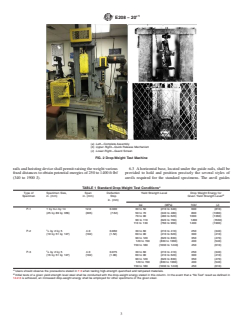
(a) Left—Complete Assembly
(b) Upper Right—Quick Release Mechanism
(c) Lower Right—Guard Screen
FIG. 2 Drop-Weight Test Machine
rails and hoisting device shall permit raising the weight various 6.3 A horizontal base, located under the guide rails, shall be
fixed distances to obtain potential energies of 250 to 1400 ft·lbf provided to hold and position precisely the several styles of
(340 to 1900 J). anvils required for the standard specimens. The anvil guides
A
TABLE 1 Standard Drop-Weight Test Conditions
Type of Specimen Size, Span Deflection Yield Strength Level Drop Weight Energy for
B
Specimen in. (mm) in. (mm) Stop Given Yield Strength Level
in. (mm)
ksi (MPa) ft·lbf (J)
P-1 1 by 3 ⁄2 by 14 12.0 0.300 30 to 50 (210 to 340) 600 (810)
(25 by 89 by 356) (305) (7.62) 50 to 70 (340 to 480) 800 (1080)
70 to 90 (480 to 620) 1000 (1360)
90 to 110 (620 to 760) 1200 (1630)
110 to 130 (760 to 900) 1400 (1900)
P-2 ⁄4 by 2 by 5 4.0 0.060 30 to 60 (210 to 410) 250 (340)
(19 by 51 by 127) (102) (1.52) 60 to 90 (410 to 620) 300 (410)
90 to 120 (620 to 830) 350 (470)
120 to 150 (830 to 1030) 400 (540)
150 to 180 (1030 to 1240) 450 (610)
P-3 ⁄8 by 2 by 5 4.0 0.075 30 to 60 (210 to 410) 250 (340)
(16 by 51 by 127) (102) (1.90) 60 to 90 (410 to 620) 300 (410)
90 to 120 (620 to 830) 350 (470)
120 to 150 (830 to 1030) 400 (540)
150 to 180 (1030 to 1240) 450 (610)
A
Users should observe the precautions stated in 7.3 when testing high-strength quenched and tempered materials.
B
Initial tests of a given yield strength level steel shall be conducted with the drop-weight energy stated in this column. In the event that a “No Test” result as defined in
14.2.3 is achieved, an increased drop-weight energy shall be employed for other specimens of the given steel.
´1
E208 − 20
shall position the anvil with the center-line of the deflection drop-weight tests of materials used for pressure vessel compo-
stops under the center-line of the striking tup of the weight. In nents at different fabrication sites.
general, the base also supports the guide rails, but this is not a
7. Precautions
requirement. The base shall rest on the rigid foundation. The
7.1 The drop-weight test was devised for measuring fracture
base-foundation system shall be sufficiently rigid to allow the
initiation characteristics of ⁄8 in. (15.9 mm) and thicker
normal drop-weight energy (Table 1) to deflect a standard
structural materials. This test is not recommended for steels
specimen to the stop at temperatures above the NDT tempera-
less than ⁄8 in. thick.
ture. The base shall not jump or shift during the test, and shall
be secured to the foundation if necessary to prevent motion.
7.2 This test method establishes standard specimens and
conditions to determine the NDT temperature of a given steel.
6.4 A guard screen, similar to that shown in Fig. 2(c), is
The use of standard specimens with nonstandard test condi-
recommended to stop broken specimen halves of the very
tions or the use of nonstandard specimens shall not be allowed
brittle steels which break into two pieces with both halves
for specification purposes.
being ejected forcefully from the drop-weight test machine.
7.3 This test method employs a small crack-starter weld
6.5 The general characteristics of two of the anvils required
bead deposited on the specimen surface, whose sole purpose is
are illustrated in Fig. 3. The anvils shall be made in accordance
to provide a brittle material for the initiation of a small,
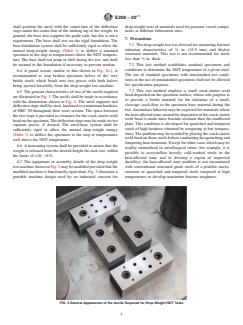
with the dimensions shown in Fig. 4. The anvil supports and
cleavage crack-flaw in the specimen base material during the
deflection stops shall be steel, hardened to a minimum hardness
test. Anomalous behavior may be expected for materials where
of HRC 50 throughout their cross section. The space between
the heat-affected zone created by deposition of the crack-starter
the two stops is provided as clearance for the crack-starter weld
weld bead is made more fracture resistant than the unaffected
bead on the specimen. The deflection stops may be made in two
plate. This condition is developed for quenched and tempered
separate pieces, if desired. The anvil-base system shall be
steels of high hardness obtained by tempering at low tempera-
sufficiently rigid to allow the normal drop-weight energy
tures. The problem may be avoided by placing the crack-starter
(Table 1) to deflect the specimen to the stop at temperatures
weld bead on these steels before conducting the quenching and
well above the NDT temperature.
tempering heat treatment. Except for other cases which may be
6.6 A measuring system shall be provided to ensure that the
readily rationalized in metallurgical terms (for example, it is
weight is released from the desired height for each test, within
possible to recrystallize heavily cold-worked steels in the
the limits of +10, −0 %.
heat-affected zone and to develop a region of improved
6.7 The equipment or assembly details of the drop-weight ductility), the heat-affected zone problem is not encountered
test machine shown in Fig. 2 may be modified provided that the with conventional structural grade steels of a pearlitic micro-
modified machine is functionally equivalent. Fig. 5 illustrates a structure or quenched and tempered steels tempered at high
portable machine design used by an industrial concern for temperatures to develop maximum fracture toughness.
FIG. 3 General Appearance of the Anvils Required for Drop-Weight NDT Tests
´1
E208 − 20
Specimen Type
Anvil Dimension Units Tolerance
P-1 P-2 P-3
S, Span in. 12.0 4.0 4.0 ±0.05
mm 305 100 100 ±1.5
D, Deflection stop in. 0.30 0.060 0.075 ±0.002
mm 7.60 1.50 1.90 ±0.05
A, Anvil length ←——————––not critical––——————→
B, Anvil width ←——————––not critical––——————→
C, Anvil thickness in. 1.5 min 1.5 min 1.5 min
mm 38 min 38 min 38 min
E, Support length in. 3.5 min 2.0 min 2.0 min
mm 90 min 50 min 50 min
F, Support width ←——————not less than G——————→
G, Support height in. 2.0 2.0 2.0 ±1
mm 50 50 50 ±25
R, Support radius in. 0.075 0.075 0.075 ±0.025
mm 1.0 1.0 1.0 ±0.1
H, Stop width in. 3.5 min 2.0 min 2.0 min ±2
mm 90 min 50 min 50 min ±50
I, Weld clearance in. 0.9 0.9 0.9 ±0.1
mm 22 22 22 ±3
J, Weld clearance depth in. 0.4 min 0.4 min 0.4 min
mm 10 min 10 min 10 min
FIG. 4 Anvil Dimensions
8. Test Specimens agreed to in advance by the purchaser. If the design of the
casting or forging does not allow an attached test-material
8.1 Identification of Material—All sample material and
coupon, the following requirements shall apply:
specimens removed from a given plate, shape, forging, or
casting product shall be marked to identify their particular 8.4.1 Drop-weight specimens cast or forged separately to
source (heat number, slab number, etc.). A simple identification the dimensions required for testing shall be allowed only where
system shall be used which can be employed in conjunction
the product dimensions are equivalent and the purchaser
with an itemized table to obtain all the pertinent information.
agrees.
8.4.2 Specimens may be taken from a separately produced
8.2 Orientation—The drop-weight test is insensitive to
specimen orientation with respect to rolling or forging direc- test-material coupon if the supplier can demonstrate that it is
tion. However, unless otherwise agreed to, all specimens equivalent to the product with respect to chemical composition,
specified by the purchaser shall be of the same orientation and
soundness, and metallurgical conditions. The material shall be
it shall be noted in the test report.
from the same heat and shall have been fabricated under
identical conditions as the product. The specimens shall be
8.3 Relation to Other Specimens—Unless otherwise speci-
machine-cut from locations agreed to in advance by the
fied by the purchaser, the specimens shall be removed from the
purchaser.
material at positions adjacent to the location of other type test
specimens (for example, mechanical test specimens) required
8.4.3 Specifically, in the case of casting requiring X-ray
for evaluation of other material properties.
quality standard, the separate test-material coupon shall be cast
separately but simultaneously with the product. Chills shall not
8.4 Special Conditions for Forgings and Castings—Where
be used. The test-material coupon shall be in proportion to the
drop-weight testing of cast or forged material is specified, the
thickness, T, in the cast product, where T is diameter of the
size and location of integrally attached pad projections or
prolongations to be used for specimen fabrication shall be largest circle that can be inscribed in any cross section of the
´1
E208 − 20
NDT temperatures, within 610 °F (65 °C), are determined for
a given steel with tests using any of the standard specimens. As
may be convenient for the particular thickness of material, any
of the standard specimens shown in Fig. 6 and prepared as
described in Section 8 may be chosen for this method. The
results obtained with standard test conditions shall comply with
the requirements of this method for determining the NDT
temperature.
8.6 Specimen Cutting—The specimen sample material and
the specimen ends may be flame-cut. The specimen sides shall
be saw-cut or machined, using adequate coolant to prevent
specimen overheating, and shall be a minimum of 1 in. from
any flame-cut surface. Products thicker than the standard
specimen thickness shall be machine-cut to standard thickness
from one side, preserving an as-fabricated surface unless
otherwise specified, or agreed to, in advance by the purchaser.
The as-fabricated surface so preserved shall be the welded
(tension) surface of the specimen during testing.
8.7 Crack-Starter Weld Bead—The centrally located weld
bead, approximately 2 in. (50 mm) long and ⁄2 in. (12.7 mm)
wide, shall be deposited on the as-fabricated tension surface of
the drop-weight specimen in a single pass. The length of the
crack-starter weld bead is not critical, provided that the
crack-starter weld bead notch is at the center of the specimen
and that the crack-starter weld bead does not contact the
support fixture at any time during the test. See additional
information relating to weld length in 8.10.3. To assist the
welding operator in centering the weld deposit properly on the
test piece, two punch marks spaced to the appropriate WL
dimension of Fig. 6 shall be positioned as A and D as shown in
Fig. 7(a). As an alternative or in addition to the punch marks,
a copper template containing a centrally positioned slot, 1 in by
expected weld length + ⁄2 in. (25 mm by expected weld
length + 13 mm) Fig. 7(b), may be used. The weld shall start
from either Point A or Dand shall proceed without interruption
as a stringer bead (no weaving) to the other point. The bead
appearance is determined by the amperage, arc voltage, and
FIG. 5 Portable Drop-Weight Test Machine Used for Tests at Dif-
speed of travel used. A current of 180 to 200 A, a medium arc
ferent Fabrication Sites
length, and a travel speed that produces a moderately high-
crowned bead have been found to be suitable conditions. An
casting, or where T is defined in advance by the purchaser as
enlarged view of an as-deposited crack-starter weld bead is
the nominal design thickness, as follows:
shown in Fig. 7(c). Each lot of electrodes shall be checked by
Thickness, T, in. (mm) Separately Cast, Nonchilled, Test-Coupon Size
the user in accordance with the requirements of 8.10 for
⁄2 (12.7) and less None required
suitability with the material the user is testing. Providing a heat
⁄8 to 2 (15.9 to 50.8) When several small castings are poured from one
heat, one casting shall be used to provide test sink under P-2 and P-3 specimens during welding is recom-
specimens, if adaptable
mended but not required in order to minimize microstructural
⁄8 to 1 (15.9 to 25.4) T by 2 by 5 in. (127 mm) for irregularly shaped
changes to these smaller specimens. Both metallic and water-
castings
>1 to 3 (25.4 to 76.2) T by 4.5T by 4.5T
box heat sinks have been used for this purpose. Use of a copper
>3 to 5 (76.2 to 127) T by 3T by 3T
template as depicted in Fig. 7 is especially useful for Type P-2
Over 5 (127) T by 3T by 3T for castings that are representative of
and P-3 specimens since in addition to heat sink advantages it
cast plates
Over 5 (127)
T by T by 6 T for castings that are representa-
eliminates weld spatter which can interfere with proper seating
œ
tive of cast plates
of the specimen during test.
8.4.4 Specimens showing casting or metallurgical faults on
8.7.1 Microstructure of Base Metal—Data presented show
broken fracture surfaces shall be “No-Test.”
that the method of depositing the weld bead can influence the
microstructure of the heat-affected zone under the weld notch
8.5 Size of Blank—Dimensions of the blank size required for
standard test specimens are shown in Fig. 6. Equally significant which in turn can influence the NDT temperature determined
´1
E208 − 20
Specimen Type
Dimension Units P-1 P-2 P-3
Dimension Tolerance Dimension Tolerance Dimension Tolerance
T, Thickness in. 1.0 ±0.12 0.75 ±0.04 0.62 ±0.02
mm 25 ±2.5 19 ±1.0 16 ±0.5
L, Length in. 14.0 ±0.5 5.0 ±0.5 5.0 ±0.5
mm 360 ±10 130 ±10 130 ±10
W, Width in. 3.5 ±0.1 2.0 ±0.04 2.0 ±0.04
mm 90 ±2.0 50 ±1.0 50
...