

ASTM B668-23
(Specification)Standard Specification for Iron-Nickel-Chromium-Molybdenum Alloy Seamless Pipe and Tube
General Information
- Abstract
ABSTRACT
This specification covers the standard requirements for UNS N08028 seamless cold-finished or hot-finished pipe and tube intended for general corrosive services. The pipe and tube shall be furnished in the solution-annealed condition and heat treated at a certain range of temperature by subsequent quenching in water or rapidly cooling by other means. Chemical and product analysis shall be conducted on each lot of material as described in a referenced ASTM document and shall conform to the required chemical composition for carbon, silicon, manganese, phosphorus, sulfur, chromium, nickel, molybdenum, copper, and iron. The material shall also be subjected to tension test, flaring test, and hydrostatic or nondestructive test to determine its mechanical properties which shall be in conformity with the tensile strength, yield strength, and elongation requirements.
SCOPE
1.1 This specification covers UNS N08028 and N08029 seamless cold-finished or hot-finished pipe and tube intended for general corrosive service.
1.2 The values stated in inch-pound units are to be regarded as standard. The values given in parentheses are mathematical conversions to SI units that are provided for information only and are not considered standard.
1.3 This standard does not purport to address all of the safety concerns, if any, associated with its use. It is the responsibility of the user of this standard to establish appropriate safety, health, and environmental practices and determine the applicability of regulatory limitations prior to use.
1.4 This international standard was developed in accordance with internationally recognized principles on standardization established in the Decision on Principles for the Development of International Standards, Guides and Recommendations issued by the World Trade Organization Technical Barriers to Trade (TBT) Committee.
- Status
- Published
- Publication Date
- 31-Oct-2023
- Technical Committee
- B02 - Nonferrous Metals and Alloys
- Drafting Committee
- B02.07 - Refined Nickel and Cobalt and Their Alloys
Buy Documents
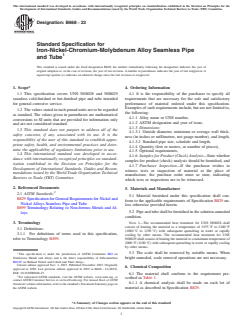


ASTM B668-23 - Standard Specification for Iron-Nickel-Chromium-Molybdenum Alloy Seamless Pipe and Tube
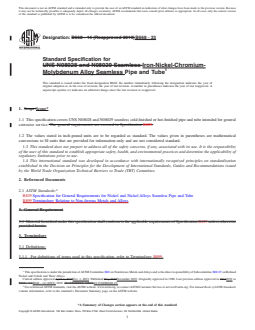
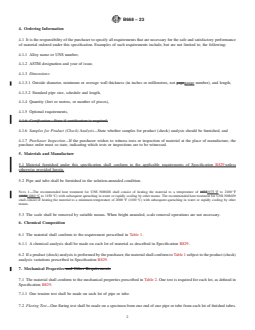
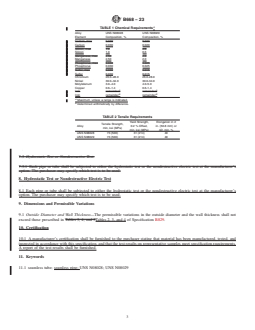

REDLINE ASTM B668-23 - Standard Specification for Iron-Nickel-Chromium-Molybdenum Alloy Seamless Pipe and Tube
Overview
ASTM B668-23 is the standard specification for seamless pipe and tube made from iron-nickel-chromium-molybdenum alloys, specifically UNS N08028 and N08029. Developed by ASTM International, this standard sets forth the requirements for the manufacturing, chemical composition, mechanical properties, testing, and delivery of seamless cold-finished or hot-finished pipe and tube intended for general corrosive service. The specification ensures high performance and reliability for industries that require resistance to various forms of corrosion.
Key Topics
Material Scope and Designation
- Covers UNS N08028 and N08029 seamless pipe and tube.
- Applies to both cold-finished and hot-finished manufacturing methods.
- Intended for general corrosive service where enhanced resistance is required.
Condition and Heat Treatment
- Material must be furnished in a solution-annealed condition, followed by rapid cooling.
- Proper heat treatment is critical for ensuring desired corrosion resistance and mechanical properties.
Chemical and Mechanical Requirements
- Strict limits on elements such as carbon, silicon, manganese, phosphorus, sulfur, chromium, nickel, molybdenum, copper, and iron.
- Each lot must meet required tensile strength, yield strength, and elongation standards.
Testing and Certification
- Chemical analysis, tension test, flaring test, and either a hydrostatic or nondestructive electric test are mandatory for each lot.
- Mandatory manufacturer’s certification stating that all materials and testing conform to specification requirements.
Ordering and Documentation
- Clear requirements on what information purchasers need to provide, such as alloy type, dimensions, quantity, and any desired certifications or inspections.
Applications
ASTM B668-23 seamless iron-nickel-chromium-molybdenum alloy pipes and tubes are widely used in situations demanding superior corrosion resistance and mechanical durability. Common applications include:
- Chemical Processing Industries: Ideal for transporting corrosive fluids, acids, and chemical compounds.
- Oil & Gas Sector: Used in piping systems exposed to sour service and harsh environments.
- Marine Engineering: Suitable for use in seawater applications, providing protection against chloride-induced corrosion.
- Power Generation: Applied in heat exchangers, condensers, and components operating under high-temperature and corrosive conditions.
- Pharmaceutical and Petrochemical Facilities: Ensures cleanliness and integrity in high-purity systems.
Related Standards
To ensure comprehensive compliance and performance, ASTM B668-23 references and aligns with several related standards:
- ASTM B829 - General Requirements for Nickel and Nickel Alloys Seamless Pipe and Tube.
- ASTM B899 - Terminology Relating to Non-ferrous Metals and Alloys.
Other standards of interest may include those covering welding, fitting, and fabrication of nickel and alloy piping systems, as well as specific industry standards for corrosive service applications.
Keywords: ASTM B668-23, seamless pipe, seamless tube, iron-nickel-chromium-molybdenum alloy, UNS N08028, UNS N08029, corrosion resistance, chemical processing pipes, ASTM standards, alloy piping specification
Relations
- Replaces
ASTM B668-14(2019) - Standard Specification for UNS N08028 and N08029 Seamless Pipe and Tube - Effective Date
- 01-Nov-2023
Buy Documents
ASTM B668-23 - Standard Specification for Iron-Nickel-Chromium-Molybdenum Alloy Seamless Pipe and Tube
REDLINE ASTM B668-23 - Standard Specification for Iron-Nickel-Chromium-Molybdenum Alloy Seamless Pipe and Tube
Get Certified
Connect with accredited certification bodies for this standard

Element Materials Technology
Materials testing and product certification.

Inštitut za kovinske materiale in tehnologije
Institute of Metals and Technology. Materials testing, metallurgical analysis, NDT.
Sponsored listings
Frequently Asked Questions
ASTM B668-23 is a technical specification published by ASTM International. Its full title is "Standard Specification for Iron-Nickel-Chromium-Molybdenum Alloy Seamless Pipe and Tube". This standard covers: ABSTRACT This specification covers the standard requirements for UNS N08028 seamless cold-finished or hot-finished pipe and tube intended for general corrosive services. The pipe and tube shall be furnished in the solution-annealed condition and heat treated at a certain range of temperature by subsequent quenching in water or rapidly cooling by other means. Chemical and product analysis shall be conducted on each lot of material as described in a referenced ASTM document and shall conform to the required chemical composition for carbon, silicon, manganese, phosphorus, sulfur, chromium, nickel, molybdenum, copper, and iron. The material shall also be subjected to tension test, flaring test, and hydrostatic or nondestructive test to determine its mechanical properties which shall be in conformity with the tensile strength, yield strength, and elongation requirements. SCOPE 1.1 This specification covers UNS N08028 and N08029 seamless cold-finished or hot-finished pipe and tube intended for general corrosive service. 1.2 The values stated in inch-pound units are to be regarded as standard. The values given in parentheses are mathematical conversions to SI units that are provided for information only and are not considered standard. 1.3 This standard does not purport to address all of the safety concerns, if any, associated with its use. It is the responsibility of the user of this standard to establish appropriate safety, health, and environmental practices and determine the applicability of regulatory limitations prior to use. 1.4 This international standard was developed in accordance with internationally recognized principles on standardization established in the Decision on Principles for the Development of International Standards, Guides and Recommendations issued by the World Trade Organization Technical Barriers to Trade (TBT) Committee.
ABSTRACT This specification covers the standard requirements for UNS N08028 seamless cold-finished or hot-finished pipe and tube intended for general corrosive services. The pipe and tube shall be furnished in the solution-annealed condition and heat treated at a certain range of temperature by subsequent quenching in water or rapidly cooling by other means. Chemical and product analysis shall be conducted on each lot of material as described in a referenced ASTM document and shall conform to the required chemical composition for carbon, silicon, manganese, phosphorus, sulfur, chromium, nickel, molybdenum, copper, and iron. The material shall also be subjected to tension test, flaring test, and hydrostatic or nondestructive test to determine its mechanical properties which shall be in conformity with the tensile strength, yield strength, and elongation requirements. SCOPE 1.1 This specification covers UNS N08028 and N08029 seamless cold-finished or hot-finished pipe and tube intended for general corrosive service. 1.2 The values stated in inch-pound units are to be regarded as standard. The values given in parentheses are mathematical conversions to SI units that are provided for information only and are not considered standard. 1.3 This standard does not purport to address all of the safety concerns, if any, associated with its use. It is the responsibility of the user of this standard to establish appropriate safety, health, and environmental practices and determine the applicability of regulatory limitations prior to use. 1.4 This international standard was developed in accordance with internationally recognized principles on standardization established in the Decision on Principles for the Development of International Standards, Guides and Recommendations issued by the World Trade Organization Technical Barriers to Trade (TBT) Committee.
ASTM B668-23 is classified under the following ICS (International Classification for Standards) categories: 77.150.40 - Nickel and chromium products. The ICS classification helps identify the subject area and facilitates finding related standards.
ASTM B668-23 has the following relationships with other standards: It is inter standard links to ASTM B668-14(2019). Understanding these relationships helps ensure you are using the most current and applicable version of the standard.
ASTM B668-23 is available in PDF format for immediate download after purchase. The document can be added to your cart and obtained through the secure checkout process. Digital delivery ensures instant access to the complete standard document.
Standards Content (Sample)
This international standard was developed in accordance with internationally recognized principles on standardization established in the Decision on Principles for the
Development of International Standards, Guides and Recommendations issued by the World Trade Organization Technical Barriers to Trade (TBT) Committee.
Designation: B668 − 23
Standard Specification for
Iron-Nickel-Chromium-Molybdenum Alloy Seamless Pipe
and Tube
This standard is issued under the fixed designation B668; the number immediately following the designation indicates the year of
original adoption or, in the case of revision, the year of last revision. A number in parentheses indicates the year of last reapproval. A
superscript epsilon (´) indicates an editorial change since the last revision or reapproval.
1. Scope* 4. Ordering Information
1.1 This specification covers UNS N08028 and N08029 4.1 It is the responsibility of the purchaser to specify all
seamless cold-finished or hot-finished pipe and tube intended requirements that are necessary for the safe and satisfactory
for general corrosive service. performance of material ordered under this specification.
Examples of such requirements include, but are not limited to,
1.2 The values stated in inch-pound units are to be regarded
the following:
as standard. The values given in parentheses are mathematical
4.1.1 Alloy name or UNS number,
conversions to SI units that are provided for information only
4.1.2 ASTM designation and year of issue,
and are not considered standard.
4.1.3 Dimensions:
1.3 This standard does not purport to address all of the
4.1.3.1 Outside diameter, minimum or average wall thick-
safety concerns, if any, associated with its use. It is the
ness (in inches or millimetres, not gauge number), and length,
responsibility of the user of this standard to establish appro-
4.1.3.2 Standard pipe size, schedule and length,
priate safety, health, and environmental practices and deter-
4.1.4 Quantity (feet or metres, or number of pieces),
mine the applicability of regulatory limitations prior to use.
4.1.5 Optional requirements,
1.4 This international standard was developed in accor-
4.1.6 Samples for Product (Check) Analysis—State whether
dance with internationally recognized principles on standard-
samples for product (check) analysis should be furnished, and
ization established in the Decision on Principles for the
4.1.7 Purchaser Inspection—If the purchaser wishes to
Development of International Standards, Guides and Recom-
witness tests or inspection of material at the place of
mendations issued by the World Trade Organization Technical
manufacture, the purchase order must so state, indicating
Barriers to Trade (TBT) Committee.
which tests or inspections are to be witnessed.
2. Referenced Documents
5. Materials and Manufacture
2.1 ASTM Standards:
5.1 Material furnished under this specification shall con-
B829 Specification for General Requirements for Nickel and
form to the applicable requirements of Specification B829 un-
Nickel Alloys Seamless Pipe and Tube
less otherwise provided herein.
B899 Terminology Relating to Non-ferrous Metals and Al-
5.2 Pipe and tube shall be furnished in the solution-annealed
loys
condition.
3. Terminology
NOTE 1—The recommended heat treatment for UNS N08028 shall
consist of heating the material to a temperature of 1975 °F to 2100 °F
3.1 Definitions:
(1080 °C to 1150 °C) with subsequent quenching in water or rapidly
3.1.1 For definitions of terms used in this specification,
cooling by other means. The recommended heat treatment for UNS
refer to Terminology B899.
N08029 shall consist of heating the material to a minimum temperature of
2000 °F (1100 °C) with subsequent quenching in water or rapidly cooling
by other means.
5.3 The scale shall be removed by suitable means. When
This specification is under the jurisdiction of ASTM Committee B02 on
Nonferrous Metals and Alloys and is the direct responsibility of Subcommittee bright annealed, scale removal operations are not necessary.
B02.07 on Refined Nickel and Cobalt and Their Alloys.
Current edition approved Nov. 1, 2023. Published November 2023. Originally
6. Chemical Composition
approved in 1980. Last previous edition approved in 2019 as B668 – 14 (2019).
DOI: 10.1520/B0668-23.
6.1 The material shall conform to the requirement pre-
For referenced ASTM standards, visit the ASTM website, www.astm.org, or
scribed in Table 1.
contact ASTM Customer Service at service@astm.org. For Annual Book of ASTM
6.1.1 A chemical analysis shall be made on each lot of
Standards volume information, refer to
...
This document is not an ASTM standard and is intended only to provide the user of an ASTM standard an indication of what changes have been made to the previous version. Because
it may not be technically possible to adequately depict all changes accurately, ASTM recommends that users consult prior editions as appropriate. In all cases only the current version
of the standard as published by ASTM is to be considered the official document.
Designation: B668 − 14 (Reapproved 2019) B668 − 23
Standard Specification for
UNS N08028 and N08029 Seamless Iron-Nickel-Chromium-
Molybdenum Alloy Seamless Pipe and Tube
This standard is issued under the fixed designation B668; the number immediately following the designation indicates the year of
original adoption or, in the case of revision, the year of last revision. A number in parentheses indicates the year of last reapproval. A
superscript epsilon (´) indicates an editorial change since the last revision or reapproval.
1. Scope Scope*
1.1 This specification covers UNS N08028 and N08029 seamless cold-finished or hot-finished pipe and tube intended for general
corrosive service. The general requirements are covered in Specification B829.
1.2 The values stated in inch-pound units are to be regarded as standard. The values given in parentheses are mathematical
conversions to SI units that are provided for information only and are not considered standard.
1.3 This standard does not purport to address all of the safety concerns, if any, associated with its use. It is the responsibility
of the user of this standard to establish appropriate safety, health, and environmental practices and determine the applicability of
regulatory limitations prior to use.
1.4 This international standard was developed in accordance with internationally recognized principles on standardization
established in the Decision on Principles for the Development of International Standards, Guides and Recommendations issued
by the World Trade Organization Technical Barriers to Trade (TBT) Committee.
2. Referenced Documents
2.1 ASTM Standards:
B829 Specification for General Requirements for Nickel and Nickel Alloys Seamless Pipe and Tube
B899 Terminology Relating to Non-ferrous Metals and Alloys
3. General Requirement
3.1 Material furnished under this specification shall conform to the applicable requirements of Specification B829 unless otherwise
provided herein.
3. Terminology
3.1 Definitions:
3.1.1 For definitions of terms used in this specification, refer to Terminology B899.
This specification is under the jurisdiction of ASTM Committee B02 on Nonferrous Metals and Alloys and is the direct responsibility of Subcommittee B02.07 on Refined
Nickel and Cobalt and Their Alloys.
Current edition approved April 1, 2019Nov. 1, 2023. Published May 2019November 2023. Originally approved in 1980. Last previous edition approved in 20142019 as
B668 – 14.B668 – 14 (2019). DOI: 10.1520/B0668-14R19.10.1520/B0668-23.
For referenced ASTM standards, visit the ASTM website, www.astm.org, or contact ASTM Customer Service at service@astm.org. For Annual Book of ASTM Standards
volume information, refer to the standard’s Document Summary page on the ASTM website.
*A Summary of Changes section appears at the end of this standard
Copyright © ASTM International, 100 Barr Harbor Drive, PO Box C700, West Conshohocken, PA 19428-2959. United States
B668 − 23
4. Ordering Information
4.1 It is the responsibility of the purchaser to specify all requirements that are necessary for the safe and satisfactory performance
of material ordered under this specification. Examples of such requirements include, but are not limited to, the following:
4.1.1 Alloy name or UNS number,
4.1.2 ASTM designation and year of issue,
4.1.3 Dimensions:
4.1.3.1 Outside diameter, minimum or average wall thickness (in inches or millimetres, not gagegauge number), and length,
4.1.3.2 Standard pipe size, schedule and length,
4.1.4 Quantity (feet or metres, or number of pieces),
4.1.5 Optional requirements,
4.1.6 Certification—State if certification is required,
4.1.6 Samples for Product (Check) Analysis—State whether samples for product (check) analysis should be furnished, and
4.1.7 Purchaser Inspection—If the purchaser wishes to witness tests or inspection of material at the place of manufacture, the
purchase order must so state, indicating which tests or inspections are to be witnessed.
5. Materials and Manufacture
5.1 Material furnished under this specification shall conform to the applicable requirements of Specification B829 unless
otherwise provided herein.
5.2 Pipe and tube shall be furnished in the solution-annealed condition.
NOTE 1—The recommended heat treatment for UNS N08028 shall consist of heating the material to a temperature of 19751975 °F to 2100 °F
(1080(1080 °C to 1150 °C) with subsequent quenching in water or rapidly cooling by other means. The recommended heat treatment for UNS N08029
shall consist of heating the material to a minimum temperature of 2000 °F (1100 °C) with subsequent quenching in water or rapidly coo
...