

ASTM F2024-10(2021)
(Practice)Standard Practice for X-ray Diffraction Determination of Phase Content of Plasma-Sprayed Hydroxyapatite Coatings
General Information
- Abstract
SIGNIFICANCE AND USE
3.1 Calcium phosphate coatings have been shown in animal and clinical studies to be biocompatible and to enhance the early attachment of bone to implant surfaces (see Refs. (1-5)).3
3.2 It is believed that the form of calcium phosphate ceramic and its purity with respect to secondary crystalline phases and amorphous material have an effect on its physical, mechanical, and biological properties. However, no definitive studies of effects on biological properties have been completed. To achieve reproducible clinical results and to permit the determination of the effects of properties of the coating on biological performance, it is essential that the properties of both clinical and experimental materials be well-characterized and consistent.
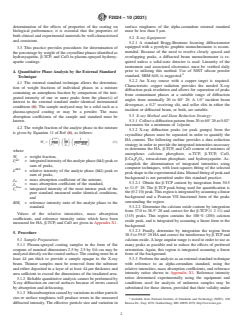
3.3 This practice provides procedures for determination of the percentage by weight of the crystalline phases identified as hydroxyapatite, β-TCP, and CaO in plasma-sprayed hydroxyapatite coatings.
SCOPE
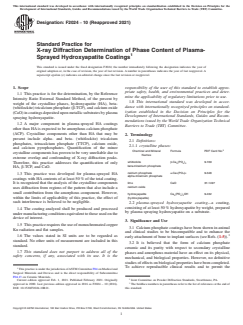
1.1 This practice is for the determination, by the Reference Intensity Ratio External Standard Method, of the percent by weight of the crystalline phases, hydroxyapatite (HA), beta-(whitlockite) tricalcium phosphate (β-TCP), and calcium oxide (CaO) in coatings deposited upon metallic substrates by plasma spraying hydroxyapatite.
1.2 A major component in plasma-sprayed HA coatings other than HA is expected to be amorphous calcium phosphate (ACP). Crystalline components other than HA that may be present include alpha- and beta- (whitlockite) tricalcium phosphates, tetracalcium phosphate (TTCP), calcium oxide, and calcium pyrophosphates. Quantification of the minor crystalline components has proven to be very unreliable due to extreme overlap and confounding of X-ray diffraction peaks. Therefore, this practice addresses the quantification of only HA, β-TCP, and CaO.
1.3 This practice was developed for plasma-sprayed HA coatings with HA contents of at least 50 % of the total coating. It is recognized that the analysis of the crystalline components uses diffraction from regions of the pattern that also include a small contribution from the amorphous component. However, within the limits of applicability of this practice, the effect of such interference is believed to be negligible.
1.4 The coating analyzed shall be produced and processed under manufacturing conditions equivalent to those used on the device of interest.
1.5 This practice requires the use of monochromated copper Kα radiation and flat samples.
1.6 The values stated in SI units are to be regarded as standard. No other units of measurement are included in this standard.
1.7 This standard does not purport to address all of the safety concerns, if any, associated with its use. It is the responsibility of the user of this standard to establish appropriate safety, health, and environmental practices and determine the applicability of regulatory limitations prior to use.
1.8 This international standard was developed in accordance with internationally recognized principles on standardization established in the Decision on Principles for the Development of International Standards, Guides and Recommendations issued by the World Trade Organization Technical Barriers to Trade (TBT) Committee.
- Status
- Published
- Publication Date
- 31-Jan-2021
- Technical Committee
- F04 - Medical and Surgical Materials and Devices
- Drafting Committee
- F04.13 - Ceramic Materials

Overview
ASTM F2024-10(2021) – Standard Practice for X-ray Diffraction Determination of Phase Content of Plasma-Sprayed Hydroxyapatite Coatings establishes the procedures for determining the percent by weight of crystalline phases present in plasma-sprayed hydroxyapatite (HA) coatings on metallic substrates. The standard utilizes the Reference Intensity Ratio (RIR) External Standard Method to quantify the primary crystalline phases: hydroxyapatite (HA), beta-tricalcium phosphate (β-TCP), and calcium oxide (CaO). Accurate measurement of these phases is essential for ensuring the consistency, quality, and biocompatibility of coatings used in medical implants and devices.
Calcium phosphate-based coatings, such as hydroxyapatite, are widely used in biomedical applications due to their demonstrated ability to enhance early bone attachment and exhibit biocompatibility. The proportion and purity of these crystalline phases influence the coating’s physical, mechanical, and biological properties, making thorough and reliable phase analysis a critical step in both research and clinical settings.
Key Topics
- X-ray Diffraction (XRD) Analysis: This standard specifies the RIR External Standard Method for distinguishing and quantifying HA, β-TCP, and CaO phases in plasma-sprayed coatings.
- Sample Preparation: Flat plasma-sprayed hydroxyapatite coatings with a minimum thickness of 44 μm are required. The method is not suitable for curved or irregular surfaces due to potential measurement errors.
- Quantification Limits: The analysis is designed for coatings containing at least 50% hydroxyapatite by weight. Quantification of minor crystalline components is not covered due to interference and peak overlap.
- Instrumentation: Requires the use of monochromated copper Kα radiation and a suitable X-ray diffractometer, following strict instrument calibration and validation routines.
- Reporting and Validation: Detailed reporting includes sample identification, analytical results for each phase, and the proportion of amorphous and minor phases. Ongoing revalidation of analytical procedures with known standards is required to ensure accuracy.
- Units and Compliance: Results are reported in SI units. Users must ensure compliance with all relevant safety, health, and environmental regulations when applying this method.
Applications
- Medical Implants: Ensures that hydroxyapatite coatings for dental and orthopedic implants exhibit well-characterized, reproducible phase content that supports early bone attachment and long-term biocompatibility.
- Research and Development: Provides a standardized approach for characterizing new plasma-sprayed hydroxyapatite coating formulations and for conducting comparative studies across laboratories.
- Quality Control: Facilitates routine quality assurance testing in manufacturing, supporting regulatory compliance and product consistency.
- Performance Evaluation: Enables the correlation of phase composition with mechanical and biological performance, informing improvements in coating technologies for medical devices.
Related Standards
- ASTM F1185 – Standard Specification for Composition of Hydroxyapatite for Surgical Implants: Specifies requirements for hydroxyapatite powders.
- ASTM F1609 – Standard Specification for Calcium Phosphate Coatings for Implantable Medical Devices: Covers requirements for calcium phosphate-based coatings.
- ASTM F1044 – Standard Test Method for Shear Testing of Calcium Phosphate Coatings: Provides procedures for mechanical testing of coated substrates.
- ASTM F1926 – Standard Test Method for Evaluation of the Environmental Stability of Calcium Phosphate Coatings: Details test procedures for coating durability.
By adhering to ASTM F2024-10(2021), manufacturers and researchers ensure that plasma-sprayed hydroxyapatite coatings used in implantable medical devices are accurately analyzed, supporting device safety, efficacy, and regulatory approval. This standard is an important reference for anyone involved in the development, testing, or manufacturing of calcium phosphate-based coatings in the biomedical field.
Get Certified
Connect with accredited certification bodies for this standard

DVS-ZERT GmbH
German welding certification society.
CARES (UK Certification Authority for Reinforcing Steels)
UK certification for reinforcing steels and construction.
EWF/IIW (European/International Welding Federation)
International welding personnel certification.
Sponsored listings
Frequently Asked Questions
ASTM F2024-10(2021) is a standard published by ASTM International. Its full title is "Standard Practice for X-ray Diffraction Determination of Phase Content of Plasma-Sprayed Hydroxyapatite Coatings". This standard covers: SIGNIFICANCE AND USE 3.1 Calcium phosphate coatings have been shown in animal and clinical studies to be biocompatible and to enhance the early attachment of bone to implant surfaces (see Refs. (1-5)).3 3.2 It is believed that the form of calcium phosphate ceramic and its purity with respect to secondary crystalline phases and amorphous material have an effect on its physical, mechanical, and biological properties. However, no definitive studies of effects on biological properties have been completed. To achieve reproducible clinical results and to permit the determination of the effects of properties of the coating on biological performance, it is essential that the properties of both clinical and experimental materials be well-characterized and consistent. 3.3 This practice provides procedures for determination of the percentage by weight of the crystalline phases identified as hydroxyapatite, β-TCP, and CaO in plasma-sprayed hydroxyapatite coatings. SCOPE 1.1 This practice is for the determination, by the Reference Intensity Ratio External Standard Method, of the percent by weight of the crystalline phases, hydroxyapatite (HA), beta-(whitlockite) tricalcium phosphate (β-TCP), and calcium oxide (CaO) in coatings deposited upon metallic substrates by plasma spraying hydroxyapatite. 1.2 A major component in plasma-sprayed HA coatings other than HA is expected to be amorphous calcium phosphate (ACP). Crystalline components other than HA that may be present include alpha- and beta- (whitlockite) tricalcium phosphates, tetracalcium phosphate (TTCP), calcium oxide, and calcium pyrophosphates. Quantification of the minor crystalline components has proven to be very unreliable due to extreme overlap and confounding of X-ray diffraction peaks. Therefore, this practice addresses the quantification of only HA, β-TCP, and CaO. 1.3 This practice was developed for plasma-sprayed HA coatings with HA contents of at least 50 % of the total coating. It is recognized that the analysis of the crystalline components uses diffraction from regions of the pattern that also include a small contribution from the amorphous component. However, within the limits of applicability of this practice, the effect of such interference is believed to be negligible. 1.4 The coating analyzed shall be produced and processed under manufacturing conditions equivalent to those used on the device of interest. 1.5 This practice requires the use of monochromated copper Kα radiation and flat samples. 1.6 The values stated in SI units are to be regarded as standard. No other units of measurement are included in this standard. 1.7 This standard does not purport to address all of the safety concerns, if any, associated with its use. It is the responsibility of the user of this standard to establish appropriate safety, health, and environmental practices and determine the applicability of regulatory limitations prior to use. 1.8 This international standard was developed in accordance with internationally recognized principles on standardization established in the Decision on Principles for the Development of International Standards, Guides and Recommendations issued by the World Trade Organization Technical Barriers to Trade (TBT) Committee.
SIGNIFICANCE AND USE 3.1 Calcium phosphate coatings have been shown in animal and clinical studies to be biocompatible and to enhance the early attachment of bone to implant surfaces (see Refs. (1-5)).3 3.2 It is believed that the form of calcium phosphate ceramic and its purity with respect to secondary crystalline phases and amorphous material have an effect on its physical, mechanical, and biological properties. However, no definitive studies of effects on biological properties have been completed. To achieve reproducible clinical results and to permit the determination of the effects of properties of the coating on biological performance, it is essential that the properties of both clinical and experimental materials be well-characterized and consistent. 3.3 This practice provides procedures for determination of the percentage by weight of the crystalline phases identified as hydroxyapatite, β-TCP, and CaO in plasma-sprayed hydroxyapatite coatings. SCOPE 1.1 This practice is for the determination, by the Reference Intensity Ratio External Standard Method, of the percent by weight of the crystalline phases, hydroxyapatite (HA), beta-(whitlockite) tricalcium phosphate (β-TCP), and calcium oxide (CaO) in coatings deposited upon metallic substrates by plasma spraying hydroxyapatite. 1.2 A major component in plasma-sprayed HA coatings other than HA is expected to be amorphous calcium phosphate (ACP). Crystalline components other than HA that may be present include alpha- and beta- (whitlockite) tricalcium phosphates, tetracalcium phosphate (TTCP), calcium oxide, and calcium pyrophosphates. Quantification of the minor crystalline components has proven to be very unreliable due to extreme overlap and confounding of X-ray diffraction peaks. Therefore, this practice addresses the quantification of only HA, β-TCP, and CaO. 1.3 This practice was developed for plasma-sprayed HA coatings with HA contents of at least 50 % of the total coating. It is recognized that the analysis of the crystalline components uses diffraction from regions of the pattern that also include a small contribution from the amorphous component. However, within the limits of applicability of this practice, the effect of such interference is believed to be negligible. 1.4 The coating analyzed shall be produced and processed under manufacturing conditions equivalent to those used on the device of interest. 1.5 This practice requires the use of monochromated copper Kα radiation and flat samples. 1.6 The values stated in SI units are to be regarded as standard. No other units of measurement are included in this standard. 1.7 This standard does not purport to address all of the safety concerns, if any, associated with its use. It is the responsibility of the user of this standard to establish appropriate safety, health, and environmental practices and determine the applicability of regulatory limitations prior to use. 1.8 This international standard was developed in accordance with internationally recognized principles on standardization established in the Decision on Principles for the Development of International Standards, Guides and Recommendations issued by the World Trade Organization Technical Barriers to Trade (TBT) Committee.
ASTM F2024-10(2021) is classified under the following ICS (International Classification for Standards) categories: 25.220.99 - Other treatments and coatings. The ICS classification helps identify the subject area and facilitates finding related standards.
ASTM F2024-10(2021) is available in PDF format for immediate download after purchase. The document can be added to your cart and obtained through the secure checkout process. Digital delivery ensures instant access to the complete standard document.
Standards Content (Sample)
This international standard was developed in accordance with internationally recognized principles on standardization established in the Decision on Principles for the
Development of International Standards, Guides and Recommendations issued by the World Trade Organization Technical Barriers to Trade (TBT) Committee.
Designation: F2024 − 10 (Reapproved 2021)
Standard Practice for
X-ray Diffraction Determination of Phase Content of Plasma-
Sprayed Hydroxyapatite Coatings
This standard is issued under the fixed designation F2024; the number immediately following the designation indicates the year of
original adoption or, in the case of revision, the year of last revision. A number in parentheses indicates the year of last reapproval. A
superscript epsilon (´) indicates an editorial change since the last revision or reapproval.
1. Scope responsibility of the user of this standard to establish appro-
priate safety, health, and environmental practices and deter-
1.1 This practice is for the determination, by the Reference
mine the applicability of regulatory limitations prior to use.
Intensity Ratio External Standard Method, of the percent by
1.8 This international standard was developed in accor-
weight of the crystalline phases, hydroxyapatite (HA), beta-
dance with internationally recognized principles on standard-
(whitlockite) tricalcium phosphate (β-TCP), and calcium oxide
ization established in the Decision on Principles for the
(CaO)incoatingsdepositeduponmetallicsubstratesbyplasma
Development of International Standards, Guides and Recom-
spraying hydroxyapatite.
mendations issued by the World Trade Organization Technical
1.2 A major component in plasma-sprayed HA coatings
Barriers to Trade (TBT) Committee.
other than HAis expected to be amorphous calcium phosphate
(ACP). Crystalline components other than HA that may be
2. Terminology
present include alpha- and beta- (whitlockite) tricalcium
2.1 Definitions:
phosphates, tetracalcium phosphate (TTCP), calcium oxide,
2.1.1 crystalline phases:
and calcium pyrophosphates. Quantification of the minor
Chemical and Mineral Formula PDF Card No.
crystalline components has proven to be very unreliable due to
Names
extreme overlap and confounding of X-ray diffraction peaks.
whitlockite β-Ca (PO ) 9-169
Therefore, this practice addresses the quantification of only 3 4 2
beta-tricalcium phosphate
HA, β-TCP, and CaO.
calcium phosphate α-Ca (PO ) 9-348
3 4 2
1.3 This practice was developed for plasma-sprayed HA
alpha-tricalcium phosphate
coatings with HAcontents of at least 50 % of the total coating.
It is recognized that the analysis of the crystalline components lime CaO 37-1497
calcium oxide
uses diffraction from regions of the pattern that also include a
small contribution from the amorphous component. However,
hydroxyapatite Ca (PO ) OH 9-432
5 4 3
within the limits of applicability of this practice, the effect of (hydroxylapatite)
such interference is believed to be negligible.
2.2 plasma-sprayed hydroxyapatite coating—a coating,
consisting of at least 50 % hydroxyapatite by weight, prepared
1.4 The coating analyzed shall be produced and processed
by plasma spraying hydroxyapatite on a substrate.
undermanufacturingconditionsequivalenttothoseusedonthe
device of interest.
3. Significance and Use
1.5 This practice requires the use of monochromated copper
3.1 Calcium phosphate coatings have been shown in animal
Kα radiation and flat samples.
and clinical studies to be biocompatible and to enhance the
1.6 The values stated in SI units are to be regarded as
early attachment of bone to implant surfaces (see Refs. (1-5)).
standard. No other units of measurement are included in this
3.2 It is believed that the form of calcium phosphate
standard.
ceramic and its purity with respect to secondary crystalline
1.7 This standard does not purport to address all of the
phases and amorphous material have an effect on its physical,
safety concerns, if any, associated with its use. It is the
mechanical, and biological properties. However, no definitive
studiesofeffectsonbiologicalpropertieshavebeencompleted.
To achieve reproducible clinical results and to permit the
ThispracticeisunderthejurisdictionofASTMCommitteeF04onMedicaland
Surgical Materials and Devices and is the direct responsibility of Subcommittee
F04.13 on Ceramic Materials.
Current edition approved Feb. 1, 2021. Published February 2021. Originally Joint Committee on Powder Diffraction Standards, Swarthmore, PA.
approved in 2000. Last previous edition approved in 2016 as F2024 – 10 (2016). The boldface numbers in parentheses refer to the list of references at the end of
DOI: 10.1520/F2024-10R21. this standard.
Copyright © ASTM International, 100 Barr Harbor Drive, PO Box C700, West Conshohocken, PA 19428-2959. United States
F2024 − 10 (2021)
determination of the effects of properties of the coating on surface roughness of the alpha-corundum external standard
biological performance, it is essential that the properties of must be less than 5 µm.
both clinical and experimental materials be well-characterized
5.2 X-ray Equipment:
and consistent.
5.2.1 A standard Bragg-Brentano focusing diffractometer
equipped with a pyrolytic graphite monochromator is recom-
3.3 This practice provides procedures for determination of
the percentage by weight of the crystalline phases identified as mended. Because of the need to resolve closely spaced and
overlapping peaks, a diffracted beam monochromator is re-
hydroxyapatite, β-TCP, and CaO in plasma-sprayed hydroxy-
apatite coatings. quired unless a solid-state detector is used. Linearity of the
instrument and associated electronics must be verified daily
prior to utilizing this method. Use of NIST silicon powder
4. Quantitative Phase Analysis by the External Standard
standard, SRM 640, is suggested.
Technique
5.2.2 An X-ray source with a copper target is required.
4.1 The external standard technique allows the determina-
Characteristic copper radiation provides the needed X-ray
tion of weight fractions of individual phases in a mixture
diffraction peak resolution and allows for separation of peaks
containing an amorphous fraction by comparison of the inte-
from contaminant phases at a suitable range of diffraction
grated intensity of one or more peaks from the phase(s) of
angles from nominally 20 to 60° 2θ. A 1.0° incident beam
interest to the external standard under identical instrumental
divergence, a 0.2° receiving slit, and soller slits in either the
conditions (6). The sample analyzed may be a solid such as a
incident or diffracted beam, or both, are suitable.
plasma-sprayed coating or may be a powder. The mass
5.3 X-ray Method and Data Reduction Strategy:
absorption coefficients of the sample and standard must be
5.3.1 Collect a diffraction pattern from 20 to 60° 2θ at 0.02°
known.
increments for a minimum of 1s/point.
4.2 The weight fraction of the analyte phase in the mixture
5.3.2 X-ray diffraction peaks (or peak groups) from the
is given by Equation 11 of Ref (6), as follows:
crystalline phases must be separated in order to quantify the
hkl
I χ 1
HA content. The following outline provides a data reduction
i m
W 5 · · (1)
S D S D S D
i REL Pure
I χ I ·RIR
strategy in order to provide the integrated intensities necessary
i s s i
to determine the HA, β-TCP, and CaO content of mixtures of
where:
amorphous calcium phosphate, α-TCP, β-TCP, CaO,
W = weight fraction,
i
β-Ca P O , tetracalcium phosphate, and hydroxyapatite. Ac-
hkl 2 2 7
I = integratedintensityoftheanalytephase(hkl)peakor
i
complish the determination of integrated intensities using
sum of peaks,
computer techniques, with least-squares fitting of the selected
REL
I = relative intensity of the analyte phase (hkl) peak or
i
peakshapetotheexperimentaldata.Manualfittingofpeakand
sum of peaks,
background is not permitted under this standard practice.
χ = mass absorption coefficient of the mixture,
m
5.3.2.1 Obtain the β-TCP content by integration from 30.5
χ = mass absorption coefficient of the standard,
s
Pure
to 31.5° 2θ. The β-TCP peak being used for quantification is
I = integrated intensity of the mo
...