


ASTM D1067-16
(Test Method)Standard Test Methods for Acidity or Alkalinity of Water
Standard Test Methods for Acidity or Alkalinity of Water
SIGNIFICANCE AND USE
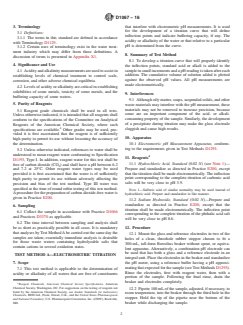
4.1 Acidity and alkalinity measurements are used to assist in establishing levels of chemical treatment to control scale, corrosion, and other adverse chemical equilibria.
4.2 Levels of acidity or alkalinity are critical in establishing solubilities of some metals, toxicity of some metals, and the buffering capacity of some waters.
SCOPE
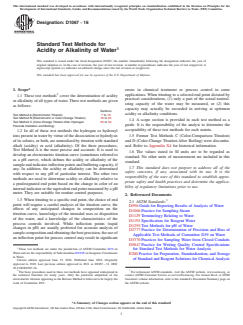
1.1 These test methods2 cover the determination of acidity or alkalinity of all types of water. Three test methods are given as follows:
Sections
Test Method A (Electrometric Titration)
7 to 15
Test Method B (Electrometric or Color-Change Titration)
16 to 24
Test Method C (Color-Change Titration After Hydrogen
Peroxide Oxidation and Boiling)
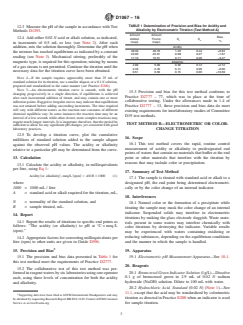
25 to 33
1.2 In all of these test methods the hydrogen or hydroxyl ions present in water by virtue of the dissociation or hydrolysis of its solutes, or both, are neutralized by titration with standard alkali (acidity) or acid (alkalinity). Of the three procedures, Test Method A is the most precise and accurate. It is used to develop an electrometric titration curve (sometimes referred to as a pH curve), which defines the acidity or alkalinity of the sample and indicates inflection points and buffering capacity, if any. In addition, the acidity or alkalinity can be determined with respect to any pH of particular interest. The other two methods are used to determine acidity or alkalinity relative to a predesignated end point based on the change in color of an internal indicator or the equivalent end point measured by a pH meter. They are suitable for routine control purposes.
1.3 When titrating to a specific end point, the choice of end point will require a careful analysis of the titration curve, the effects of any anticipated changes in composition on the titration curve, knowledge of the intended uses or disposition of the water, and a knowledge of the characteristics of the process controls involved. While inflection points (rapid changes in pH) are usually preferred for accurate analysis of sample composition and obtaining the best precision, the use of an inflection point for process control may result in significant errors in chemical treatment or process control in some applications. When titrating to a selected end point dictated by practical considerations, (1) only a part of the actual neutralizing capacity of the water may be measured, or (2) this capacity may actually be exceeded in arriving at optimum acidity or alkalinity conditions.
1.4 A scope section is provided in each test method as a guide. It is the responsibility of the analyst to determine the acceptability of these test methods for each matrix.
1.5 Former Test Methods C (Color-Comparison Titration) and D (Color-Change Titration After Boiling) were discontinued. Refer to Appendix X4 for historical information.
1.6 The values stated in SI units are to be regarded as standard. No other units of measurement are included in this standard.
1.7 This standard does not purport to address all of the safety concerns, if any, associated with its use. It is the responsibility of the user of this standard to establish appropriate safety and health practices and determine the applicability of regulatory limitations prior to use.
General Information
- Status
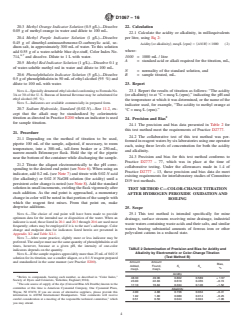
- Published
- Publication Date
- 14-Jun-2016
- Technical Committee
- D19 - Water
- Drafting Committee
- D19.05 - Inorganic Constituents in Water
Relations
- Effective Date
- 01-May-2020
- Effective Date
- 01-Aug-2018
- Effective Date
- 01-Aug-2018
- Effective Date
- 15-Jun-2012
- Effective Date
- 01-Jan-2012
- Effective Date
- 15-Jun-2011
- Effective Date
- 01-May-2011
- Effective Date
- 01-Dec-2010
- Effective Date
- 01-Mar-2010
- Effective Date
- 01-Oct-2008
- Effective Date
- 15-Jan-2008
- Effective Date
- 01-Dec-2007
- Effective Date
- 15-Dec-2006
- Effective Date
- 01-Sep-2006
- Effective Date
- 01-Sep-2006
Overview
ASTM D1067-16: Standard Test Methods for Acidity or Alkalinity of Water provides widely recognized procedures for determining the acidity or alkalinity of a broad range of water types. Developed by ASTM International, this standard is valuable for assuring water quality and supporting industrial, environmental, and laboratory practices. Accurate measurement of acidity and alkalinity supports effective chemical treatment, controls scale and corrosion, and guides the management of adverse chemical equilibria in water systems.
These test methods are essential for establishing the solubility and toxicity levels of certain metals and for evaluating water’s buffering capacity. ASTM D1067-16 supports regulatory compliance and ensures precise, reproducible results across industries that monitor or process water.
Key Topics
ASTM D1067-16 covers three main test methods:
- Test Method A: Electrometric Titration
- Offers the highest precision and accuracy
- Used to produce a pH (titration) curve, identifying inflection points and buffering capacity
- Test Method B: Electrometric or Color-Change Titration
- Employs standard titration with a pH meter or color indicator
- Suitable for routine daily water analysis and control
- Test Method C: Color-Change Titration After Hydrogen Peroxide Oxidation and Boiling
- Designed for waters with significant ferrous iron or polyvalent cations, such as mine drainage or industrial effluents
- Involves oxidation and boiling to ensure thorough analysis
All methods use standard alkali (for acidity) or acid (for alkalinity) solutions to neutralize hydrogen or hydroxyl ions present in water samples. The electrometric titration method stands out for its ability to define inflection points and evaluate acid/base buffering.
Key considerations include:
- Selection of endpoint based on application
- Effects of sample composition and matrix
- Importance of rapid analysis to prevent sample changes
Applications
ASTM D1067-16 has extensive practical value for many sectors, including:
- Industrial water treatment: Supports optimization of chemical dosing to manage scale and corrosion in boilers, cooling towers, and closed-loop systems
- Environmental monitoring: Used by regulatory agencies, laboratories, and environmental consultants to test natural waters, wastewater, and mine effluents for acidity or alkalinity, aiding compliance and impact assessment
- Municipal water supplies: Ensures potability and infrastructure protection by maintaining suitable pH conditions
- Metals industry: Critical for predicting solubility and toxicity of metals, especially in regulatory contexts
- Quality assurance laboratories: Employs rigorous titration and calibration procedures to guarantee reliable, repeatable results
The methods also guide the determination of appropriate pH endpoints and are adaptable to varying water matrices, from clean reagent water to complex wastewaters.
Related Standards
For comprehensive water analysis and control, ASTM D1067-16 is typically used in conjunction with:
- ASTM D1293: Test Methods for pH of Water
- ASTM D1193: Specification for Reagent Water
- ASTM D3370: Practices for Sampling Water from Closed Conduits
- ASTM D5847: Practice for Writing Quality Control Specifications for Standard Test Methods for Water Analysis
- ASTM D596: Guide for Reporting Results of Analysis of Water
- ASTM D2777: Practice for Determination of Precision and Bias of Water Test Methods
Keywords: acidity, alkalinity, water testing, electrometric titration, color-change titration, ASTM D1067, water quality, pH measurement, water treatment, environmental compliance
Following ASTM D1067-16 ensures reliable assessment of water’s acid-base properties, supporting effective water management and regulatory adherence across industries.
Buy Documents
ASTM D1067-16 - Standard Test Methods for Acidity or Alkalinity of Water

REDLINE ASTM D1067-16 - Standard Test Methods for Acidity or Alkalinity of Water
Get Certified
Connect with accredited certification bodies for this standard

NSF International
Global independent organization facilitating standards development and certification.

CIS Institut d.o.o.
Personal Protective Equipment (PPE) certification body. Notified Body NB-2890 for EU Regulation 2016/425 PPE.

Kiwa BDA Testing
Building and construction product certification.
Sponsored listings
Frequently Asked Questions
ASTM D1067-16 is a standard published by ASTM International. Its full title is "Standard Test Methods for Acidity or Alkalinity of Water". This standard covers: SIGNIFICANCE AND USE 4.1 Acidity and alkalinity measurements are used to assist in establishing levels of chemical treatment to control scale, corrosion, and other adverse chemical equilibria. 4.2 Levels of acidity or alkalinity are critical in establishing solubilities of some metals, toxicity of some metals, and the buffering capacity of some waters. SCOPE 1.1 These test methods2 cover the determination of acidity or alkalinity of all types of water. Three test methods are given as follows: Sections Test Method A (Electrometric Titration) 7 to 15 Test Method B (Electrometric or Color-Change Titration) 16 to 24 Test Method C (Color-Change Titration After Hydrogen Peroxide Oxidation and Boiling) 25 to 33 1.2 In all of these test methods the hydrogen or hydroxyl ions present in water by virtue of the dissociation or hydrolysis of its solutes, or both, are neutralized by titration with standard alkali (acidity) or acid (alkalinity). Of the three procedures, Test Method A is the most precise and accurate. It is used to develop an electrometric titration curve (sometimes referred to as a pH curve), which defines the acidity or alkalinity of the sample and indicates inflection points and buffering capacity, if any. In addition, the acidity or alkalinity can be determined with respect to any pH of particular interest. The other two methods are used to determine acidity or alkalinity relative to a predesignated end point based on the change in color of an internal indicator or the equivalent end point measured by a pH meter. They are suitable for routine control purposes. 1.3 When titrating to a specific end point, the choice of end point will require a careful analysis of the titration curve, the effects of any anticipated changes in composition on the titration curve, knowledge of the intended uses or disposition of the water, and a knowledge of the characteristics of the process controls involved. While inflection points (rapid changes in pH) are usually preferred for accurate analysis of sample composition and obtaining the best precision, the use of an inflection point for process control may result in significant errors in chemical treatment or process control in some applications. When titrating to a selected end point dictated by practical considerations, (1) only a part of the actual neutralizing capacity of the water may be measured, or (2) this capacity may actually be exceeded in arriving at optimum acidity or alkalinity conditions. 1.4 A scope section is provided in each test method as a guide. It is the responsibility of the analyst to determine the acceptability of these test methods for each matrix. 1.5 Former Test Methods C (Color-Comparison Titration) and D (Color-Change Titration After Boiling) were discontinued. Refer to Appendix X4 for historical information. 1.6 The values stated in SI units are to be regarded as standard. No other units of measurement are included in this standard. 1.7 This standard does not purport to address all of the safety concerns, if any, associated with its use. It is the responsibility of the user of this standard to establish appropriate safety and health practices and determine the applicability of regulatory limitations prior to use.
SIGNIFICANCE AND USE 4.1 Acidity and alkalinity measurements are used to assist in establishing levels of chemical treatment to control scale, corrosion, and other adverse chemical equilibria. 4.2 Levels of acidity or alkalinity are critical in establishing solubilities of some metals, toxicity of some metals, and the buffering capacity of some waters. SCOPE 1.1 These test methods2 cover the determination of acidity or alkalinity of all types of water. Three test methods are given as follows: Sections Test Method A (Electrometric Titration) 7 to 15 Test Method B (Electrometric or Color-Change Titration) 16 to 24 Test Method C (Color-Change Titration After Hydrogen Peroxide Oxidation and Boiling) 25 to 33 1.2 In all of these test methods the hydrogen or hydroxyl ions present in water by virtue of the dissociation or hydrolysis of its solutes, or both, are neutralized by titration with standard alkali (acidity) or acid (alkalinity). Of the three procedures, Test Method A is the most precise and accurate. It is used to develop an electrometric titration curve (sometimes referred to as a pH curve), which defines the acidity or alkalinity of the sample and indicates inflection points and buffering capacity, if any. In addition, the acidity or alkalinity can be determined with respect to any pH of particular interest. The other two methods are used to determine acidity or alkalinity relative to a predesignated end point based on the change in color of an internal indicator or the equivalent end point measured by a pH meter. They are suitable for routine control purposes. 1.3 When titrating to a specific end point, the choice of end point will require a careful analysis of the titration curve, the effects of any anticipated changes in composition on the titration curve, knowledge of the intended uses or disposition of the water, and a knowledge of the characteristics of the process controls involved. While inflection points (rapid changes in pH) are usually preferred for accurate analysis of sample composition and obtaining the best precision, the use of an inflection point for process control may result in significant errors in chemical treatment or process control in some applications. When titrating to a selected end point dictated by practical considerations, (1) only a part of the actual neutralizing capacity of the water may be measured, or (2) this capacity may actually be exceeded in arriving at optimum acidity or alkalinity conditions. 1.4 A scope section is provided in each test method as a guide. It is the responsibility of the analyst to determine the acceptability of these test methods for each matrix. 1.5 Former Test Methods C (Color-Comparison Titration) and D (Color-Change Titration After Boiling) were discontinued. Refer to Appendix X4 for historical information. 1.6 The values stated in SI units are to be regarded as standard. No other units of measurement are included in this standard. 1.7 This standard does not purport to address all of the safety concerns, if any, associated with its use. It is the responsibility of the user of this standard to establish appropriate safety and health practices and determine the applicability of regulatory limitations prior to use.
ASTM D1067-16 is classified under the following ICS (International Classification for Standards) categories: 13.060.50 - Examination of water for chemical substances. The ICS classification helps identify the subject area and facilitates finding related standards.
ASTM D1067-16 has the following relationships with other standards: It is inter standard links to ASTM D1129-13(2020)e2, ASTM D1066-18e1, ASTM D1066-18, ASTM D2777-12, ASTM D1293-12, ASTM D1066-11, ASTM D596-01(2011), ASTM D3370-10, ASTM D1129-10, ASTM D3370-08, ASTM D2777-08, ASTM D3370-07, ASTM D1066-06, ASTM D1129-06ae1, ASTM D1129-06a. Understanding these relationships helps ensure you are using the most current and applicable version of the standard.
ASTM D1067-16 is available in PDF format for immediate download after purchase. The document can be added to your cart and obtained through the secure checkout process. Digital delivery ensures instant access to the complete standard document.
Standards Content (Sample)
This international standard was developed in accordance with internationally recognized principles on standardization established in the Decision on Principles for the
Development of International Standards, Guides and Recommendations issued by the World Trade Organization Technical Barriers to Trade (TBT) Committee.
Designation: D1067 − 16
Standard Test Methods for
Acidity or Alkalinity of Water
This standard is issued under the fixed designation D1067; the number immediately following the designation indicates the year of
original adoption or, in the case of revision, the year of last revision. A number in parentheses indicates the year of last reapproval. A
superscript epsilon (´) indicates an editorial change since the last revision or reapproval.
This standard has been approved for use by agencies of the U.S. Department of Defense.
1. Scope* errors in chemical treatment or process control in some
2 applications. When titrating to a selected end point dictated by
1.1 These test methods cover the determination of acidity
practical considerations, (1) only a part of the actual neutral-
or alkalinity of all types of water. Three test methods are given
izing capacity of the water may be measured, or (2) this
as follows:
capacity may actually be exceeded in arriving at optimum
Sections
acidity or alkalinity conditions.
Test Method A (Electrometric Titration) 7 to 15
Test Method B (Electrometric or Color-Change Titration) 16 to 24
1.4 A scope section is provided in each test method as a
Test Method C (Color-Change Titration After Hydrogen 25 to 33
guide. It is the responsibility of the analyst to determine the
Peroxide Oxidation and Boiling)
acceptability of these test methods for each matrix.
1.2 In all of these test methods the hydrogen or hydroxyl
ions present in water by virtue of the dissociation or hydrolysis 1.5 Former Test Methods C (Color-Comparison Titration)
of its solutes, or both, are neutralized by titration with standard and D (Color-Change Titration After Boiling) were discontin-
alkali (acidity) or acid (alkalinity). Of the three procedures, ued. Refer to Appendix X4 for historical information.
Test Method A is the most precise and accurate. It is used to
1.6 The values stated in SI units are to be regarded as
develop an electrometric titration curve (sometimes referred to
standard. No other units of measurement are included in this
as a pH curve), which defines the acidity or alkalinity of the
standard.
sampleandindicatesinflectionpointsandbufferingcapacity,if
1.7 This standard does not purport to address all of the
any. In addition, the acidity or alkalinity can be determined
safety concerns, if any, associated with its use. It is the
with respect to any pH of particular interest. The other two
responsibility of the user of this standard to establish appro-
methods are used to determine acidity or alkalinity relative to
priate safety and health practices and determine the applica-
a predesignated end point based on the change in color of an
bility of regulatory limitations prior to use.
internalindicatorortheequivalentendpointmeasuredbyapH
meter. They are suitable for routine control purposes.
2. Referenced Documents
1.3 When titrating to a specific end point, the choice of end
2.1 ASTM Standards:
point will require a careful analysis of the titration curve, the
D596 Guide for Reporting Results of Analysis of Water
effects of any anticipated changes in composition on the
D1066 Practice for Sampling Steam
titration curve, knowledge of the intended uses or disposition
D1129 Terminology Relating to Water
of the water, and a knowledge of the characteristics of the
D1193 Specification for Reagent Water
process controls involved. While inflection points (rapid
D1293 Test Methods for pH of Water
changes in pH) are usually preferred for accurate analysis of
D2777 Practice for Determination of Precision and Bias of
samplecompositionandobtainingthebestprecision,theuseof
Applicable Test Methods of Committee D19 on Water
an inflection point for process control may result in significant
D3370 Practices for Sampling Water from Closed Conduits
D5847 Practice for Writing Quality Control Specifications
These test methods are under the jurisdiction of ASTM Committee D19 on
for Standard Test Methods for Water Analysis
Water and are the responsibility of Subcommittee D19.05 on Inorganic Constituents
E200 Practice for Preparation, Standardization, and Storage
in Water.
of Standard and Reagent Solutions for ChemicalAnalysis
Current edition approved June 15, 2016. Published June 2016. Originally
approved in 1949. Last previous edition approved in 2011 as D1067 – 11. DOI:
10.1520/D1067-16.
2 3
The basic procedures used in these test methods have appeared widespread in For referenced ASTM standards, visit the ASTM website, www.astm.org, or
the technical literature for many years. Only the particular adaptation of the contact ASTM Customer Service at service@astm.org. For Annual Book of ASTM
electrometric titration appearing as the Referee Method is believed to be largely the Standards volume information, refer to the standard’s Document Summary page on
work of Committee D19. the ASTM website.
*A Summary of Changes section appears at the end of this standard
Copyright © ASTM International, 100 Barr Harbor Drive, PO Box C700, West Conshohocken, PA 19428-2959. United States
D1067 − 16
3. Terminology that interfere with electrometric pH measurements. It is used
for the development of a titration curve that will define
3.1 Definitions:
inflection points and indicate buffering capacity, if any. The
3.1.1 The terms in this standard are defined in accordance
acidity or alkalinity of the water or that relative to a particular
with Terminology D1129.
pH is determined from the curve.
3.1.2 Certain uses of terminology exist in the water treat-
ment industry which may differ from these definitions. A
8. Summary of Test Method
discussion of terms is presented in Appendix X1.
8.1 To develop a titration curve that will properly identify
4. Significance and Use
the inflection points, standard acid or alkali is added to the
sampleinsmallincrementsandapHreadingistakenaftereach
4.1 Acidityandalkalinitymeasurementsareusedtoassistin
addition. The cumulative volume of solution added is plotted
establishing levels of chemical treatment to control scale,
against the observed pH values. All pH measurements are
corrosion, and other adverse chemical equilibria.
made electrometrically.
4.2 Levels of acidity or alkalinity are critical in establishing
solubilities of some metals, toxicity of some metals, and the
9. Interferences
buffering capacity of some waters.
9.1 Althoughoilymatter,soaps,suspendedsolids,andother
5. Purity of Reagents
waste materials may interfere with the pH measurement, these
materials may not be removed to increase precision, because
5.1 Reagent grade chemicals shall be used in all tests.
some are an important component of the acid- or alkali-
Unless otherwise indicated, it is intended that all reagents shall
consuming property of the sample. Similarly, the development
conform to the specifications of the Committee on Analytical
of a precipitate during titration may make the glass electrode
Reagents of the American Chemical Society, where such
sluggish and cause high results.
specifications are available. Other grades may be used, pro-
vided it is first ascertained that the reagent is of sufficiently
10. Apparatus
high purity to permit its use without lessening the accuracy of
the determination. 10.1 Electrometric pH Measurement Apparatus, conform-
ing to the requirements given in Test Methods D1293.
5.2 Unless otherwise indicated, references to water shall be
understood to mean reagent water conforming to Specification
11. Reagents
D1193, Type I. In addition, reagent water for this test shall be
11.1 Hydrochloric Acid, Standard (0.02 N) (see Note 1)—
free of carbon dioxide (CO ) and shall have a pH between 6.2
Prepare and standardize as directed in Practice E200, except
and 7.2 at 25°C. Other reagent water types may be used
that the titration shall be made electrometrically.The inflection
provided it is first ascertained that the water is of sufficiently
point corresponding to the complete titration of carbonic acid
high purity to permit its use without adversely affecting the
salts will be very close to pH 3.9.
precision and bias of the test method. Type III water was
specified at the time of round robin testing of this test method.
NOTE 1—Sulfuric acid of similar normality may be used instead of
Aprocedure for the preparation of carbon dioxide-free water is
hydrochloric acid. Prepare and standardize in like manner.
given in Practice E200.
11.2 Sodium Hydroxide, Standard (0.02 N)—Prepare and
standardize as directed in Practice E200, except that the
6. Sampling
titration shall be made electrometrically. The inflection point
6.1 Collect the sample in accordance with Practice D1066
corresponding to the complete titration of the phthalic acid salt
and Practices D3370 as applicable.
will be very close to pH 8.6.
6.2 The time interval between sampling and analysis shall
be as short as practically possible in all cases. It is mandatory 12. Procedure
that analyses byTest MethodAbe carried out the same day the
12.1 Mount the glass and reference electrodes in two of the
samples are taken; essentially immediate analysis is desirable
holes of a clean, threehole rubber stopper chosen to fit a
for those waste waters containing hydrolyzable salts that
300-mL, tall-form Berzelius beaker without spout, or equiva-
contain cations in several oxidation states.
lent apparatus. Alternatively, a combination pH electrode can
be used that has both a glass and a reference electrode in an
TEST METHOD A—ELECTROMETRIC TITRATION
integral unit. Place the electrodes in the beaker and standardize
7. Scope the pH meter, using a reference buffer having a pH approxi-
matingthatexpectedforthesample(seeTestMethodsD1293).
7.1 This test method is applicable to the determination of
Rinse the electrodes, first with reagent water, then with a
acidity or alkalinity of all waters that are free of constituents
portion of the sample. Following the final rinse, drain the
beaker and electrodes completely.
Reagent Chemicals, American Chemical Society Specifications, American
Chemical Society, Washington, DC. For suggestions on the testing of reagents not
12.2 Pipette 100 mLof the sample, adjusted, if necessary, to
listed by the American Chemical Society, see Analar Standards for Laboratory
room temperature, into the beaker through the third hole in the
Chemicals, BDH Ltd., Poole, Dorset, U.K., and the United States Pharmacopoeia
stopper. Hold the tip of the pipette near the bottom of the
and National Formulary, U.S. Pharmacopeial Convention, Inc. (USPC), Rockville,
MD. beaker while discharging the sample.
D1067 − 16
TABLE 1 Determination of Precision and Bias for Acidity and
12.3 Measure the pH of the sample in accordance with Test
Alkalinity by Electrometric Titration (Test Method A)
Methods D1293.
Amount Amount
Bias,
12.4 Add either 0.02 N acid or alkali solution, as indicated,
Added, Found, S S
t o
%
meq/L meq/L
in increments of 0.5 mL or less (see Note 2). After each
addition, mix the solution thoroughly. Determine the pH when Acidity
48.30 48.76 1.25 0.44 +0.94
the mixture has reached equilibrium as indicated by a constant
23.00 22.61 0.68 0.27 −1.67
reading (see Note 3). Mechanical stirring, preferably of the
17.10 16.51 0.71 0.26 −3.47
Alkalinity
magnetic type, is required for this operation; mixing by means
4.90 5.00 0.39 0.12 +2.12
of a gas stream is not permitted. Continue the titration until the
2.46 2.45 0.14 0.06 −0.00
necessary data for the titration curve have been obtained.
0.51 0.56 0.15 0.05 +10.59
NOTE 2—If the sample requires appreciably more than 25 mL of
standardsolutionforitstitration,useasmalleraliquot,ora0.1 Nsolution,
prepared and standardized in the same manner (see Practice E200).
NOTE 3—An electrometric titration curve is smooth, with the pH
15.3 Precision and bias for this test method conforms to
changing progressively in a single direction, if equilibrium is achieved
Practice D2777 – 77, which was in place at the time of
after each incremental addition of titrant, and may contain one or more
collaborative testing. Under the allowances made in 1.4 of
inflection points. Ragged or irregular curves may indicate that equilibrium
was not attained before adding succeeding increments. The time required
Practice D2777 – 13, these precision and bias data do meet
will vary with different waters as the reaction rate constants of different
existing requirements for interlaboratory studies of Committee
chemical equilibria vary. In some instances the reaction time may be an
D19 test methods.
interval of a few seconds while other slower, more complex reactions may
require much longer intervals. It is important, therefore, that the period be
TEST METHOD B—ELECTROMETRIC OR COLOR-
sufficienttoallowforanysignificantpHchanges,yetconsistentwithgood
CHANGE TITRATION
laboratory practices.
12.5 To develop a titration curve, plot the cumulative
16. Scope
millilitres of standard solution added to the sample aliquot
16.1 This test method covers the rapid, routine control
against the observed pH values. The acidity or alkalinity
measurement of acidity or alkalinity to predesignated end
relative to a particular pH may be determined from the curve.
points of waters that contain no materials that buffer at the end
13. Calculation point or other materials that interfere with the titration by
reasons that may include color or precipitation.
13.1 Calculate the acidity or alkalinity, in milliequivalents
per litre, using Eq 1:
17. Summary of Test Method
Acidity~or alkalinity!,meq/L ~epm! 5 AN/B 31000 (1)
17.1 The sample is titrated with standard acid or alkali to a
where:
designated pH, the end point being determined electrometri-
cally or by the color change of an internal indicator.
1000 = 1000 mL / litre
A = standard acid or alkali required for the titration, mL,
18. Interferences
N = normality of the standard solution, and
18.1 Natural color or the formation of a precipitate while
B = sample titrated, mL.
titrating the sample may mask the color change of an internal
indicator. Suspended solids may interfere in electrometric
14. Report
titrations by making the glass electrode sluggish. Waste mate-
14.1 Report the results of titrations to specific end points as
rials present in some waters may interfere chemically with
follows: “The acidity (or alkalinity) to pH at °C = meq⁄L
color titrations by destroying the indicator. Variable results
(epm).”
may be experienced with waters containing oxidizing or
reducing substances, depending on the equilibrium conditions
14.2 Appropriate factors for converting milliequivalents per
and the manner in which the sample is handled.
litre (epm) to other units are given in Guide D596.
15. Precision and Bias 19. Apparatus
19.1 Electrometric pH Measurement Apparatus—See 10.1.
15.1 The precision and bias data presented in Table 1 for
this test method meet the requirements of Practice D2777.
20. Reagents
15.2 The collaborative test of this test method was per-
20.1 Bromcresol Green Indicator Solution(lg/L)—Dissolve
formedinreagentwatersbysixlaboratoriesusingoneoperator
0.1 g of bromcresol green in 2.9 mL of 0.02 N sodium
each, using three levels of concentration for both the acidity
hydroxide (NaOH) solution. Dilute to 100 mL with water.
and alkalinity.
20.2 Hydrochloric Acid, Standard (0.02 N)(Note 1)—See
11.1, except that the acid may be standardized by colorimetric
Supporting data have been filed at ASTM International Headquarters and may
titration as directed in Practice E200 when an indicator is used
beobtainedbyrequestingResearchReportRR:D19-1149.ContactASTMCustomer
Service at service@astm.org. for sample titration.
D1067 − 16
20.3 Methyl Orange Indicator Solution (0.5 g/L)—Dissolve 22. Calculation
0.05 g of methyl orange in water and dilute to 100 mL.
22.1 Calculate the acidity or alkalinity, in milliequivalents
20.4 Methyl Purple Indicator Solution (l g/L)—Dissolve per litre, using Eq 2:
0.45 g of dimethyl-aminoazobenzene-O-carboxylic acid, so-
Acidity or alkalinity ,meq/L epm 5 AN/B 31000 (2)
~ ! ~ ! ~ !
dium salt, in approximately 300 mL of water. To this solution
where:
add 0.55 g of a water-soluble blue dye-stuff, Color Index No.
6,7
714, and dissolve. Dilute to 1 L with water. 1000 = 1000 mL / litre
A = standard acid or alkali required for the titration, mL,
20.5 Methyl Red Indicator Solution (1 g/L)—Dissolve 0.1 g
of water-soluble methyl red in water and dilute to 100 mL.
N = normality of the standard solution, and
20.6 Phenolphthalein Indicator Solution (5 g/L)—Dissolve
B = sample titrated, mL.
0.5 g of phenolphthalein in 50 mLof ethyl alcohol (95 %) and
dilute to 100 mL with water. 23. Report
23.1 Report the results of titration as follows: “The acidity
NOTE 4—Specially denatured ethyl alcohol conforming to Formula No.
3A or 30 of the U. S. Bureau of Internal Revenue may be substituted for
(or alkalinity) to at °C = meq⁄L (epm),” indicating the pH and
ethyl alcohol (95 %).
the temperature at which it was determined, or the name of the
NOTE 5—Indicators are available commercially in prepared form.
indicator used, for example, “The acidity to methyl orange at
20.7 Sodium Hydroxide, Standard (0.02 N)—See 11.2, ex-
°C = meq⁄L (epm).”
cept that the alkali may be standardized by colorimetric
titration as directed in Practice E200 when an indicator is used
24. Precision and Bias
for sample titration.
24.1 The precision and bias data presented in Table 2 for
this test method meet the requirements of Practice D2777.
21. Procedure
24.2 The collaborative test of this test method was per-
21.1 Depending on the method of titration to be used,
formedinreagentwatersbysixlaboratoriesusingoneoperator
pipette 100 mL of the sample, adjusted, if necessary, to room
each, using three levels of concentration for both the acidity
temperature, into a 300-mL, tall-form beaker or a 250-mL,
and alkalinity.
narrow-mouth Erlenmeyer flask. Hold the tip of the pipette
24.3 Precision and bias for this test method conforms to
near the bottom of the container while discharging the sample.
Practice D2777 – 77, which was in place at the time of
21.2 Titrate the aliquot electrometrically to the pH corre-
collaborative testing. Under the allowances made in 1.4 of
sponding to the desired end point (see Note 6). When using an
Practice D2777 – 13, these precision and bias data do meet
indicator, add 0.2 mL (see Note 7) and titrate with 0.02 N acid
existing requirements for interlaboratory studies of Committee
(for alkalinity) or 0.02 N NaOH solution (for acidity) until a
D19 test methods.
persistent color change is noted (see Note 8).Add th
...
This document is not an ASTM standard and is intended only to provide the user of an ASTM standard an indication of what changes have been made to the previous version. Because
it may not be technically possible to adequately depict all changes accurately, ASTM recommends that users consult prior editions as appropriate. In all cases only the current version
of the standard as published by ASTM is to be considered the official document.
Designation: D1067 − 11 D1067 − 16
Standard Test Methods for
Acidity or Alkalinity of Water
This standard is issued under the fixed designation D1067; the number immediately following the designation indicates the year of
original adoption or, in the case of revision, the year of last revision. A number in parentheses indicates the year of last reapproval. A
superscript epsilon (´) indicates an editorial change since the last revision or reapproval.
This standard has been approved for use by agencies of the U.S. Department of Defense.
1. Scope*
1.1 These test methods cover the determination of acidity or alkalinity of all types of water. Three test methods are given as
follows:
Sections
Test Method A (Electrometric Titration) 7 to 15
Test Method B (Electrometric or Color-Change Titration) 16 to 24
Test Method C (Color-Change Titration After Hydrogen 25 to 33
Peroxide Oxidation and Boiling)
1.2 In all of these test methods the hydrogen or hydroxyl ions present in water by virtue of the dissociation or hydrolysis of its
solutes, or both, are neutralized by titration with standard alkali (acidity) or acid (alkalinity). Of the three procedures, Test Method
A is the most precise and accurate. It is used to develop an electrometric titration curve (sometimes referred to as a pH curve),
which defines the acidity or alkalinity of the sample and indicates inflection points and buffering capacity, if any. In addition, the
acidity or alkalinity can be determined with respect to any pH of particular interest. The other two methods are used to determine
acidity or alkalinity relative to a predesignated end point based on the change in color of an internal indicator or the equivalent
end point measured by a pH meter. They are suitable for routine control purposes.
1.3 When titrating to a specific end point, the choice of end point will require a careful analysis of the titration curve, the effects
of any anticipated changes in composition on the titration curve, knowledge of the intended uses or disposition of the water, and
a knowledge of the characteristics of the process controls involved. While inflection points (rapid changes in pH) are usually
preferred for accurate analysis of sample composition and obtaining the best precision, the use of an inflection point for process
control may result in significant errors in chemical treatment or process control in some applications. When titrating to a selected
end point dictated by practical considerations, (1) only a part of the actual neutralizing capacity of the water may be measured,
or (2) this capacity may actually be exceeded in arriving at optimum acidity or alkalinity conditions.
1.4 A scope section is provided in each test method as a guide. It is the responsibility of the analyst to determine the
acceptability of these test methods for each matrix.
1.5 Former Test Methods C (Color-Comparison Titration) and D (Color-Change Titration After Boiling) were discontinued.
Refer to Appendix X4 for historical information.
1.6 The values stated in SI units are to be regarded as standard. No other units of measurement are included in this standard.
1.7 This standard does not purport to address all of the safety concerns, if any, associated with its use. It is the responsibility
of the user of this standard to establish appropriate safety and health practices and determine the applicability of regulatory
limitations prior to use.
2. Referenced Documents
2.1 ASTM Standards:
D596 Guide for Reporting Results of Analysis of Water
D1066 Practice for Sampling Steam
These test methods are under the jurisdiction of ASTM Committee D19 on Water and are the responsibility of Subcommittee D19.05 on Inorganic Constituents in Water.
Current edition approved April 1, 2011June 15, 2016. Published April 2011June 2016. Originally approved in 1949. Last previous edition approved in 20062011 as
D1067 – 06.D1067 – 11. DOI: 10.1520/D1067-11.10.1520/D1067-16.
The basic procedures used in these test methods have appeared widespread in the technical literature for many years. Only the particular adaptation of the electrometric
titration appearing as the Referee Method is believed to be largely the work of Committee D19.
For referenced ASTM standards, visit the ASTM website, www.astm.org, or contact ASTM Customer Service at service@astm.org. For Annual Book of ASTM Standards
volume information, refer to the standard’s Document Summary page on the ASTM website.
*A Summary of Changes section appears at the end of this standard
Copyright © ASTM International, 100 Barr Harbor Drive, PO Box C700, West Conshohocken, PA 19428-2959. United States
D1067 − 16
D1129 Terminology Relating to Water
D1193 Specification for Reagent Water
D1293 Test Methods for pH of Water
D2777 Practice for Determination of Precision and Bias of Applicable Test Methods of Committee D19 on Water
D3370 Practices for Sampling Water from Closed Conduits
D5847 Practice for Writing Quality Control Specifications for Standard Test Methods for Water Analysis
E200 Practice for Preparation, Standardization, and Storage of Standard and Reagent Solutions for Chemical Analysis
D1067 − 16
3. Terminology
3.1 Definitions—The terms in these test methods are defined in accordance with Terminology D1129.
3.1.1 Certain uses of terminology exist in the water treatment industry which may differ from these definitions. A discussion
of terms is presented in Appendix X1.
3.1 Definitions:
3.1.1 The terms in this standard are defined in accordance with Terminology D1129.
3.1.2 Certain uses of terminology exist in the water treatment industry which may differ from these definitions. A discussion
of terms is presented in Appendix X1.
4. Significance and Use
4.1 Acidity and alkalinity measurements are used to assist in establishing levels of chemical treatment to control scale,
corrosion, and other adverse chemical equilibria.
4.2 Levels of acidity or alkalinity are critical in establishing solubilities of some metals, toxicity of some metals, and the
buffering capacity of some waters.
5. Purity of Reagents
5.1 Reagent grade chemicals shall be used in all tests. Unless otherwise indicated, it is intended that all reagents shall conform
to the specifications of the Committee on Analytical Reagents of the American Chemical Society, where such specifications are
available. Other grades may be used, provided it is first ascertained that the reagent is of sufficiently high purity to permit its use
without lessening the accuracy of the determination.
5.2 Unless otherwise indicated, references to water shall be understood to mean reagent water conforming to Specification
D1193, Type I. In addition, reagent water for this test shall be free of carbon dioxide (CO ) and shall have a pH between 6.2 and
7.2 at 25°C. Other reagent water types may be used provided it is first ascertained that the water is of sufficiently high purity to
permit its use without adversely affecting the precision and bias of the test method. Type III water was specified at the time of round
robin testing of this test method. A procedure for the preparation of carbon dioxide-free water is given in Practice E200.
6. Sampling
6.1 Collect the sample in accordance with Practice D1066 and Practices D3370 as applicable.
6.2 The time interval between sampling and analysis shall be as short as practically possible in all cases. It is mandatory that
analyses by Test Method A be carried out the same day the samples are taken; essentially immediate analysis is desirable for those
waste waters containing hydrolyzable salts that contain cations in several oxidation states.
TEST METHOD A—ELECTROMETRIC TITRATION
7. Scope
7.1 This test method is applicable to the determination of acidity or alkalinity of all waters that are free of constituents that
interfere with electrometric pH measurements. It is used for the development of a titration curve that will define inflection points
and indicate buffering capacity, if any. The acidity or alkalinity of the water or that relative to a particular pH is determined from
the curve.
8. Summary of Test Method
8.1 To develop a titration curve that will properly identify the inflection points, standard acid or alkali is added to the sample
in small increments and a pH reading is taken after each addition. The cumulative volume of solution added is plotted against the
observed pH values. All pH measurements are made electrometrically.
9. Interferences
9.1 Although oily matter, soaps, suspended solids, and other waste materials may interfere with the pH measurement, these
materials may not be removed to increase precision, because some are an important component of the acid- or alkali-consuming
property of the sample. Similarly, the development of a precipitate during titration may make the glass electrode sluggish and cause
high results.
10. Apparatus
10.1 Electrometric pH Measurement Apparatus, conforming to the requirements given in Test Methods D1293.
Reagent Chemicals, American Chemical Society Specifications, American Chemical Society, Washington, DC. For suggestions on the testing of reagents not listed by
the American Chemical Society, see Analar Standards for Laboratory Chemicals, BDH Ltd., Poole, Dorset, U.K., and the United States Pharmacopoeia and National
Formulary, U.S. Pharmacopeial Convention, Inc. (USPC), Rockville, MD.
D1067 − 16
11. Reagents
11.1 Hydrochloric Acid, Standard (0.02 N) (see Note 1)—Prepare and standardize as directed in Practice E200, except that the
titration shall be made electrometrically. The inflection point corresponding to the complete titration of carbonic acid salts will be
very close to pH 3.9.
NOTE 1—Sulfuric acid of similar normality may be used instead of hydrochloric acid. Prepare and standardize in like manner.
11.2 Sodium Hydroxide, Standard (0.02 N)—Prepare and standardize as directed in Practice E200, except that the titration shall
be made electrometrically. The inflection point corresponding to the complete titration of the phthalic acid salt will be very close
to pH 8.6.
12. Procedure
12.1 Mount the glass and reference electrodes in two of the holes of a clean, threehole rubber stopper chosen to fit a 300-mL,
tall-form Berzelius beaker without spout, or equivalent apparatus. Alternatively, a combination pH electrode can be used that has
both a glass and a reference electrode in an integral unit. Place the electrodes in the beaker and standardize the pH meter, using
a reference buffer having a pH approximating that expected for the sample (see Test Methods D1293). Rinse the electrodes, first
with reagent water, then with a portion of the sample. Following the final rinse, drain the beaker and electrodes completely.
12.2 Pipette 100 mL of the sample, adjusted, if necessary, to room temperature, into the beaker through the third hole in the
stopper. Hold the tip of the pipette near the bottom of the beaker while discharging the sample.
12.3 Measure the pH of the sample in accordance with Test Methods D1293.
12.4 Add either 0.02 N acid or alkali solution, as indicated, in increments of 0.5 mL or less (see Note 2). After each addition,
mix the solution thoroughly. Determine the pH when the mixture has reached equilibrium as indicated by a constant reading (see
Note 3). Mechanical stirring, preferably of the magnetic type, is required for this operation; mixing by means of a gas stream is
not permitted. Continue the titration until the necessary data for the titration curve have been obtained.
NOTE 2—If the sample requires appreciably more than 25 mL of standard solution for its titration, use a smaller aliquot, or a 0.1 N solution, prepared
and standardized in the same manner (see Practice E200).
NOTE 3—An electrometric titration curve is smooth, with the pH changing progressively in a single direction, if equilibrium is achieved after each
incremental addition of titrant, and may contain one or more inflection points. Ragged or irregular curves may indicate that equilibrium was not attained
before adding succeeding increments. The time required will vary with different waters as the reaction rate constants of different chemical equilibria vary.
In some instances the reaction time may be an interval of a few seconds while other slower, more complex reactions may require much longer intervals.
It is important, therefore, that the period be sufficient to allow for any significant pH changes, yet consistent with good laboratory practices.
12.5 To develop a titration curve, plot the cumulative millilitersmillilitres of standard solution added to the sample aliquot
against the observed pH values. The acidity or alkalinity relative to a particular pH may be determined from the curve.
13. Calculation
13.1 Calculate the acidity or alkalinity, in milliequivalents per litre, using Eq 1:
Acidity~or alkalinity!,meq/L~epm!5 AN/B 31000 (1)
Acidity or alkalinity ,meq/L epm 5 AN/B 31000 (1)
~ ! ~ !
where:
1000 = 1000 mL / liter
1000 = 1000 mL / litre
A = standard acid or alkali required for the titration, mL,
N = normality of the standard solution, and
B = sample titrated, mL.
14. Report
14.1 Report the results of titrations to specific end points as follows: “The acidity (or alkalinity) to pH at °C = meq ⁄L (epm).”
14.2 Appropriate factors for converting milliequivalents per litre (epm) to other units are given in Guide D596.
15. Precision and Bias
15.1 The precision and bias data presented in Table 1 for this test method meet the requirements of Practice D2777.
15.2 The collaborative test of this test method was performed in reagent waters by six laboratories using one operator each,
using three levels of concentration for both the acidity and alkalinity.
Supporting data have been filed at ASTM International Headquarters and may be obtained by requesting Research Report RR:D19-1149. Contact ASTM Customer
Service at service@astm.org.
D1067 − 16
TABLE 1 Determination of Precision and Bias for Acidity and
Alkalinity by Electrometric Titration (Test Method A)
Amount Amount
Bias,
Added, Found, S S
t o
%
meq/L meq/L
Acidity
48.30 48.76 1.25 0.44 +0.94
23.00 22.61 0.68 0.27 −1.67
17.10 16.51 0.71 0.26 −3.47
Alkalinity
4.90 5.00 0.39 0.12 +2.12
2.46 2.45 0.14 0.06 −0.00
0.51 0.56 0.15 0.05 +10.59
15.3 Precision and bias for this test method conforms to Practice D2777–77, – 77, which was in place at the time of
collaborative testing. Under the allowances made in 1.4 of Practice D2777–08, – 13, these precision and bias data do meet existing
requirements for interlaboratory studies of Committee D19 test methods.
TEST METHOD B—ELECTROMETRIC OR COLOR-CHANGE TITRATION
16. Scope
16.1 This test method covers the rapid, routine control measurement of acidity or alkalinity to predesignated end points of
waters that contain no materials that buffer at the end point or other materials that interfere with the titration by reasons that may
include color or precipitation.
17. Summary of Test Method
17.1 The sample is titrated with standard acid or alkali to a designated pH, the end point being determined electrometrically or
by the color change of an internal indicator.
18. Interferences
18.1 Natural color or the formation of a precipitate while titrating the sample may mask the color change of an internal indicator.
Suspended solids may interfere in electrometric titrations by making the glass electrode sluggish. Waste materials present in some
waters may interfere chemically with color titrations by destroying the indicator. Variable results may be experienced with waters
containing oxidizing or reducing substances, depending on the equilibrium conditions and the manner in which the sample is
handled.
19. Apparatus
19.1 Electrometric pH Measurement Apparatus—See 10.1.
20. Reagents
20.1 Bromcresol Green Indicator Solution (l g/L)—Dissolve 0.1 g of bromcresol green in 2.9 mL of 0.02 N sodium hydroxide
(NaOH) solution. Dilute to 100 mL with water.
20.2 Hydrochloric Acid, Standard (0.02 N) (Note 1)—See 11.1, except that the acid may be standardized by colorimetric
titration as directed in Practice E200 when an indicator is used for sample titration.
20.3 Methyl Orange Indicator Solution (0.5 g/L)—Dissolve 0.05 g of methyl orange in water and dilute to 100 mL.
20.4 Methyl Purple Indicator Solution (l g/L)—Dissolve 0.45 g of dimethyl-aminoazobenzene-O-carboxylic acid, sodium salt,
6,7
in approximately 300 mL of water. To this solution add 0.55 g of a water-soluble blue dye-stuff, Color Index No. 714, and
dissolve. Dilute to 1 L with water.
20.5 Methyl Red Indicator Solution (1 g/L)—Dissolve 0.1 g of water-soluble methyl red in water and dilute to 100 mL.
20.6 Phenolphthalein Indicator Solution (5 g/L)—Dissolve 0.5 g of phenolphthalein in 50 mL of ethyl alcohol (95 %) and dilute
to 100 mL with water.
NOTE 4—Specially denatured ethyl alcohol conforming to Formula No. 3A or 30 of the U. S. Bureau of Internal Revenue may be substituted for ethyl
alcohol (95 %).
Refers to compounds, bearing such number, as described in “Color Index,” Society of Dyers and Colourists, Yorkshire, England (1924).
The sole source of supply of the dye (Calcocid Blue AX Double) known to the committee at this time is American Cyanamid Company, One Cyanamid Plaza, Wayne,
NJ 07470. If you are aware of alternative suppliers, please provide this information to ASTM International Headquarters. Your comments will receive careful consideration
at a meeting of the responsible technical committee, which you may attend.
D1067 − 16
NOTE 5—Indicators are available commercially in prepared form.
20.7 Sodium Hydroxide, Standard (0.02 N)—See 11.2, except that the alkali may be standardized by colorimetric titration as
directed in Practice E200 when an indicator is used for sample titration.
21. Procedure
21.1 Depending on the method of titration to be used, pipette 100 mL of the sample, adjusted, if necessary, to room temperature,
into a 300-mL, tall-form beaker or a 250-mL, narrow-mouth Erlenmeyer flask. Hold the tip of the pipette near the bottom of the
container while discharging the sample.
21.2 Titrate the aliquot electrometrically to the pH corresponding to the desired end point (see Note 6). When using an indicator,
add 0.2 mL (see Note 7) and titrate with 0.02 N acid (for alkalinity) or 0.02 N NaOH solution (for acidity) until a persistent color
change is noted (see Note 8). Add the standard solution in small increments, swirling the flask vigorously after each addition. As
the end point is approached, a momentary change in color will be noted in that portion of the sample with which the reagent first
mixes. From that point on, make dropwise additions.
NOTE 6—The choice of end point will have been made to provide optimum data for the intended use or disposition of the water. When an indicator
is used, those listed in 20.1 and 20.3 through 20.6 are used most frequently; others may be employed if it is to the user’s advantage. Color change and
endpoint data for indicators listed herein are presented in Appendix X2 and Table X2.1.
NOTE 7—After some practice, slightly more or less indicator may be preferred. The analyst must use the same quantity of phenolphthale
...
Questions, Comments and Discussion
Ask us and Technical Secretary will try to provide an answer. You can facilitate discussion about the standard in here.
Loading comments...