


ASTM C1184-23
(Specification)Standard Specification for Structural Silicone Sealants
Standard Specification for Structural Silicone Sealants
ABSTRACT
This specification describes the properties of cold liquid applied, single-component or multicomponent, chemically curing elastomeric structural silicone sealants herein referred to as the sealant. These sealants are intended to structurally adhere components of structural sealant glazing systems. Sealants shall be classified as to types and uses: Type S; Type M; Use G; and Use O. The physical, mechanical, and performance properties of the sealant shall conform to the requirements described. The following test methods shall be performed: rheological properties; extrudability; hardness; heat aging; tack-free time; tensile adhesion; and shelf life.
SCOPE
1.1 This specification covers the properties of cold liquid applied, single-component or multicomponent, chemically curing elastomeric structural silicone sealants herein referred to as the sealant. These sealants are intended to structurally adhere components of structural sealant glazing systems.
1.2 Only those properties for which there are industry-agreed-upon minimum acceptable requirements, as determined by available ASTM test methods, are described in this specification. Additional properties may be added as ASTM test methods for those properties become available.
1.3 The values stated in metric (SI) units are to be regarded as the standard. The values in parentheses are for information only.
1.4 Committee C24, with jurisdiction over this specification, is aware of two comparable standards by other organizations: ETAG No. 002 and the Chinese national standard GB16776.
Note 1: ETAG 002 is currently no longer supported.
1.5 This international standard was developed in accordance with internationally recognized principles on standardization established in the Decision on Principles for the Development of International Standards, Guides and Recommendations issued by the World Trade Organization Technical Barriers to Trade (TBT) Committee.
General Information
- Status
- Published
- Publication Date
- 30-Apr-2023
- Technical Committee
- C24 - Building Seals and Sealants
- Drafting Committee
- C24.10 - Specifications, Guides and Practices
Relations
- Refers
ASTM C639-15(2020) - Standard Test Method for Rheological (Flow) Properties of Elastomeric Sealants - Effective Date
- 01-May-2020
- Effective Date
- 01-May-2019
- Effective Date
- 01-Mar-2019
- Effective Date
- 01-Jan-2019
- Effective Date
- 01-Mar-2018
- Effective Date
- 01-Nov-2017
- Effective Date
- 01-Jan-2017
- Effective Date
- 15-Nov-2016
- Effective Date
- 01-Sep-2016
- Effective Date
- 01-Dec-2015
- Effective Date
- 01-Jul-2015
- Effective Date
- 01-Jun-2015
- Effective Date
- 15-Mar-2015
- Effective Date
- 01-Mar-2015
- Refers
ASTM C603-14 - Standard Test Method for Extrusion Rate and Application Life of Elastomeric Sealants - Effective Date
- 01-Jun-2014
Overview
ASTM C1184-23: Standard Specification for Structural Silicone Sealants sets requirements for cold liquid applied, single- or multicomponent, chemically curing elastomeric structural silicone sealants. These sealants are primarily used to provide structural adhesion in structural sealant glazing systems, which are essential in modern architectural applications. The standard defines minimum physical, mechanical, and performance properties for sealants to ensure product reliability, safety, and functionality in various structural and environmental conditions.
Key Topics
- Sealant Types and Uses:
- Type S: Single-component sealants
- Type M: Multicomponent sealants
- Use G: Tested on clear, uncoated float glass
- Use O: Tested on substrates other than clear, uncoated float glass (e.g., painted aluminum)
- Performance Requirements:
- Hardened sealant must be elastomeric and solid after application.
- Must pass industry-agreed minimum tests using standardized ASTM methods.
- Test Methods: Conformance is verified through recognized ASTM test methods for:
- Rheological properties
- Extrudability
- Hardness
- Heat aging
- Tack-free time
- Tensile adhesion
- Artificial weathering
- Shelf Life: Determined by the manufacturer, including identified storage conditions.
- Use of Primers: Application may require a primer, based on the manufacturer's guidance.
Applications
Structural silicone sealants specified by ASTM C1184-23 are critical in a range of architectural and construction applications, especially where glass or other façade materials are bonded structurally to framing systems. Key uses include:
- Structural Glazing Systems: Providing a secure and flexible method for attaching glass or panels to building frameworks, essential in curtain wall construction and high-performance facades.
- Load Transfer: Enabling the transfer of loads (such as wind pressure or thermal movement) from the glazing or panels to the structural frame, while accommodating building movement.
- Weather Sealing: Maintaining tight seals against water and air infiltration, aiding in energy efficiency and long-term durability.
- Diverse Substrate Compatibility: Usable with a range of substrates including glass, metal, stone, or coated panels, based on their classification as Use G or Use O sealants.
Before selection and use, it is important to confirm compatibility with the intended substrate, as specific adhesion or chemical compatibility must be established through project-specific testing.
Related Standards
ASTM C1184-23 references and aligns with widely recognized test methods and terminology, providing a robust foundation for quality assurance in sealant selection. Related standards include:
- ASTM C603: Extrusion Rate and Application Life of Elastomeric Sealants
- ASTM C639: Rheological Properties of Elastomeric Sealants
- ASTM C661: Hardness of Elastomeric Sealants
- ASTM C679: Tack-Free Time of Elastomeric Sealants
- ASTM C717: Terminology of Building Seals and Sealants
- ASTM C792: Heat Aging of Elastomeric Sealants
- ASTM C794 & C1135: Adhesion-in-Peel and Tensile Adhesion Properties
- ASTM C1087: Compatibility Testing with Structural Glazing Accessories
- ASTM C1401: Guide for Structural Sealant Glazing
- International Comparisons: European standard ETAG 002 (no longer supported) and Chinese GB 16776 for structural silicone sealants.
Conclusion
ASTM C1184-23 provides an internationally recognized framework for ensuring structural silicone sealants deliver the reliability, flexibility, and performance demanded by today’s building designs. Adherence to this standard supports safety, longevity, and compliance in structural glazing applications, making it an essential reference for architects, specifiers, and building professionals when selecting structural sealants.
Buy Documents

ASTM C1184-23 - Standard Specification for Structural Silicone Sealants
REDLINE ASTM C1184-23 - Standard Specification for Structural Silicone Sealants
Get Certified
Connect with accredited certification bodies for this standard

ICC Evaluation Service
Building products evaluation and certification.

QAI Laboratories
Building and construction product testing and certification.

Aboma Certification B.V.
Specialized in construction, metal, and transport sectors.
Sponsored listings
Frequently Asked Questions
ASTM C1184-23 is a technical specification published by ASTM International. Its full title is "Standard Specification for Structural Silicone Sealants". This standard covers: ABSTRACT This specification describes the properties of cold liquid applied, single-component or multicomponent, chemically curing elastomeric structural silicone sealants herein referred to as the sealant. These sealants are intended to structurally adhere components of structural sealant glazing systems. Sealants shall be classified as to types and uses: Type S; Type M; Use G; and Use O. The physical, mechanical, and performance properties of the sealant shall conform to the requirements described. The following test methods shall be performed: rheological properties; extrudability; hardness; heat aging; tack-free time; tensile adhesion; and shelf life. SCOPE 1.1 This specification covers the properties of cold liquid applied, single-component or multicomponent, chemically curing elastomeric structural silicone sealants herein referred to as the sealant. These sealants are intended to structurally adhere components of structural sealant glazing systems. 1.2 Only those properties for which there are industry-agreed-upon minimum acceptable requirements, as determined by available ASTM test methods, are described in this specification. Additional properties may be added as ASTM test methods for those properties become available. 1.3 The values stated in metric (SI) units are to be regarded as the standard. The values in parentheses are for information only. 1.4 Committee C24, with jurisdiction over this specification, is aware of two comparable standards by other organizations: ETAG No. 002 and the Chinese national standard GB16776. Note 1: ETAG 002 is currently no longer supported. 1.5 This international standard was developed in accordance with internationally recognized principles on standardization established in the Decision on Principles for the Development of International Standards, Guides and Recommendations issued by the World Trade Organization Technical Barriers to Trade (TBT) Committee.
ABSTRACT This specification describes the properties of cold liquid applied, single-component or multicomponent, chemically curing elastomeric structural silicone sealants herein referred to as the sealant. These sealants are intended to structurally adhere components of structural sealant glazing systems. Sealants shall be classified as to types and uses: Type S; Type M; Use G; and Use O. The physical, mechanical, and performance properties of the sealant shall conform to the requirements described. The following test methods shall be performed: rheological properties; extrudability; hardness; heat aging; tack-free time; tensile adhesion; and shelf life. SCOPE 1.1 This specification covers the properties of cold liquid applied, single-component or multicomponent, chemically curing elastomeric structural silicone sealants herein referred to as the sealant. These sealants are intended to structurally adhere components of structural sealant glazing systems. 1.2 Only those properties for which there are industry-agreed-upon minimum acceptable requirements, as determined by available ASTM test methods, are described in this specification. Additional properties may be added as ASTM test methods for those properties become available. 1.3 The values stated in metric (SI) units are to be regarded as the standard. The values in parentheses are for information only. 1.4 Committee C24, with jurisdiction over this specification, is aware of two comparable standards by other organizations: ETAG No. 002 and the Chinese national standard GB16776. Note 1: ETAG 002 is currently no longer supported. 1.5 This international standard was developed in accordance with internationally recognized principles on standardization established in the Decision on Principles for the Development of International Standards, Guides and Recommendations issued by the World Trade Organization Technical Barriers to Trade (TBT) Committee.
ASTM C1184-23 is classified under the following ICS (International Classification for Standards) categories: 91.100.50 - Binders. Sealing materials. The ICS classification helps identify the subject area and facilitates finding related standards.
ASTM C1184-23 has the following relationships with other standards: It is inter standard links to ASTM C639-15(2020), ASTM C1135-19, ASTM C717-19, ASTM C603-14(2019), ASTM C717-18, ASTM C717-17a, ASTM C717-17, ASTM C717-16a, ASTM C717-16, ASTM C1135-15, ASTM C794-15a, ASTM C639-15, ASTM C792-15, ASTM C794-15, ASTM C603-14. Understanding these relationships helps ensure you are using the most current and applicable version of the standard.
ASTM C1184-23 is available in PDF format for immediate download after purchase. The document can be added to your cart and obtained through the secure checkout process. Digital delivery ensures instant access to the complete standard document.
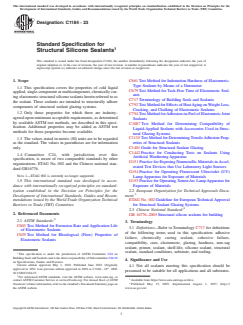
Standards Content (Sample)
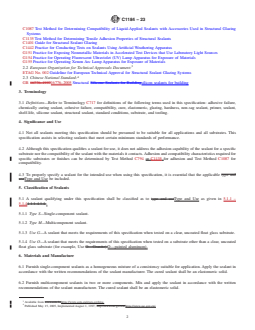
This international standard was developed in accordance with internationally recognized principles on standardization established in the Decision on Principles for the
Development of International Standards, Guides and Recommendations issued by the World Trade Organization Technical Barriers to Trade (TBT) Committee.
Designation: C1184 − 23
Standard Specification for
Structural Silicone Sealants
This standard is issued under the fixed designation C1184; the number immediately following the designation indicates the year of
original adoption or, in the case of revision, the year of last revision. A number in parentheses indicates the year of last reapproval. A
superscript epsilon (´) indicates an editorial change since the last revision or reapproval.
1. Scope C661 Test Method for Indentation Hardness of Elastomeric-
Type Sealants by Means of a Durometer
1.1 This specification covers the properties of cold liquid
C679 Test Method for Tack-Free Time of Elastomeric Seal-
applied, single-component or multicomponent, chemically cur-
ants
ing elastomeric structural silicone sealants herein referred to as
C717 Terminology of Building Seals and Sealants
the sealant. These sealants are intended to structurally adhere
C792 Test Method for Effects of Heat Aging on Weight Loss,
components of structural sealant glazing systems.
Cracking, and Chalking of Elastomeric Sealants
1.2 Only those properties for which there are industry-
C794 Test Method for Adhesion-in-Peel of Elastomeric Joint
agreed-upon minimum acceptable requirements, as determined
Sealants
by available ASTM test methods, are described in this speci-
C1087 Test Method for Determining Compatibility of
fication. Additional properties may be added as ASTM test
Liquid-Applied Sealants with Accessories Used in Struc-
methods for those properties become available.
tural Glazing Systems
1.3 The values stated in metric (SI) units are to be regarded C1135 Test Method for Determining Tensile Adhesion Prop-
erties of Structural Sealants
as the standard. The values in parentheses are for information
only. C1401 Guide for Structural Sealant Glazing
C1442 Practice for Conducting Tests on Sealants Using
1.4 Committee C24, with jurisdiction over this
Artificial Weathering Apparatus
specification, is aware of two comparable standards by other
G151 Practice for Exposing Nonmetallic Materials in Accel-
organizations: ETAG No. 002 and the Chinese national stan-
erated Test Devices that Use Laboratory Light Sources
dard GB16776.
G154 Practice for Operating Fluorescent Ultraviolet (UV)
NOTE 1—ETAG 002 is currently no longer supported.
Lamp Apparatus for Exposure of Materials
1.5 This international standard was developed in accor- G155 Practice for Operating Xenon Arc Lamp Apparatus for
dance with internationally recognized principles on standard- Exposure of Materials
ization established in the Decision on Principles for the 2.2 European Organization for Technical Approvals Docu-
Development of International Standards, Guides and Recom- ment:
mendations issued by the World Trade Organization Technical ETAG No. 002 Guideline for European Technical Approval
Barriers to Trade (TBT) Committee. for Structural Sealant Glazing Systems
2.3 Chinese National Standard:
2. Referenced Documents
GB 16776–2005 Structural silicon sealants for building
2.1 ASTM Standards:
3. Terminology
C603 Test Method for Extrusion Rate and Application Life
3.1 Definitions—Refer to Terminology C717 for definitions
of Elastomeric Sealants
of the following terms used in this specification: adhesive
C639 Test Method for Rheological (Flow) Properties of
failure, chemically curing sealant, cohesive failure,
Elastomeric Sealants
compatibility, cure, elastomeric, glazing, hardness, non-sag
sealant, primer, sealant, shelf-life, silicone sealant, structural
sealant, standard conditions, substrate, and tooling.
This specification is under the jurisdiction of ASTM Committee C24 on
Building Seals and Sealants and is the direct responsibility of Subcommittee C24.10
4. Significance and Use
on Specifications, Guides and Practices.
Current edition approved May 1, 2023. Published June 2023. Originally
4.1 Not all sealants meeting this specification should be
ε1
approved in 1991. Last previous edition approved in 2018 as C1184 – 18 . DOI:
presumed to be suitable for all applications and all substrates.
10.1520/C1184-23.
For referenced ASTM standards, visit the ASTM website, www.astm.org, or
contact ASTM Customer Service at service@astm.org. For Annual Book of ASTM Available from https://www.eota.eu/etags-archive.
Standards volume information, refer to the standard’s Document Summary page on Published May 15, 2005, Implemented August 1, 1997; https://
the ASTM website. www.sac.gov.cn/.
Copyright © ASTM International, 100 Barr Harbor Drive, PO Box C700, West Conshohocken, PA 19428-2959. United States
C1184 − 23
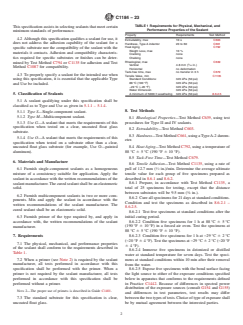
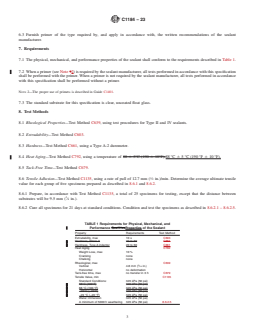
TABLE 1 Requirements for Physical, Mechanical, and
This specification assists in selecting sealants that meet certain
Performance Properties of the Sealant
minimum standards of performance.
Property Requirements Test Method
4.2 Although this specification qualifies a sealant for use, it
Extrudability, max 10 s C603
does not address the adhesion capability of the sealant for a Hardness, Type A indentor 20 to 60 C661
Heat Aging C792
specific substrate nor the compatibility of the sealant with the
Weight Loss, max 10 %
materials it contacts. Adhesion and compatibility characteris-
Cracking none
tics required for specific substrates or finishes can be deter-
Chalking none
Rheological, max C639
mined by Test Method C794 or C1135 for adhesion and Test
Vertical 4.8 mm ( ⁄16 in.)
Method C1087 for compatibility.
Horizontal no deformation
Tack-free time, max no transfer in 3 h C679
4.3 To properly specify a sealant for the intended use when
Tensile Value, min C1135
using this specification, it is essential that the applicable Type Standard Conditions: 345 kPa (50 psi)
88 °C (190 °F) 345 kPa (50 psi)
and Use be included.
−29 °C (−20 °F) 345 kPa (50 psi)
Water Immersion 345 kPa (50 psi)
A minimum of 5000 h weathering 345 kPa (50 psi) 8.6.2.5
5. Classification of Sealants
5.1 A sealant qualifying under this specification shall be
classified as to Type and Use as given in 5.1.1 – 5.1.4.
5.1.1 Type S—Single-component sealant. 8. Test Methods
5.1.2 Type M—Multicomponent sealant.
8.1 Rheological Properties—Test Method C639, using test
5.1.3 Use G—A sealant that meets the requirements of this procedures for Type II and IV sealants.
specification when tested on a clear, uncoated float glass
8.2 Extrudability—Test Method C603.
substrate.
8.3 Hardness—Test Method C661, using a Type A-2 durom-
5.1.4 Use O—A sealant that meets the requirements of this
eter.
specification when tested on a substrate other than a clear,
8.4 Heat Aging—Test Method C792, using a temperature of
uncoated float glass substrate (for example, Use O—painted
88 °C 6 5 °C (190 °F 6 10 °F).
aluminum).
8.5 Tack-Free Time—Test Method C679.
6. Materials and Manufacture
8.6 Tensile Adhesion—Test Method C1135, using a rate of
6.1 Furnish single-component sealants as a homogeneous pull of 12.7 mm ( ⁄2 in.)/min. Determine the average ultimate
mixture of a consistency suitable for application. Apply the tensile value for each group of five specimens prepared as
sealant in accordance with the written recommendations of the described in 8.6.1 and 8.6.2.
sealant manufacturer. The cured sealant shall be an elastomeric 8.6.1 Prepare, in accordance with Test Method C1135, a
solid. total of 25 specimens for testing, except that the distance
between substrates will be 9.5 mm ( ⁄8 in.).
6.2 Furnish multicomponent sealants in two or more com-
8.6.2 Cure all specimens for 21 days at standard conditions.
ponents. Mix and apply the sealant in accordance with the
Condition and test the specimens as described in 8.6.2.1 –
written recommendations of the sealant manufacturer. The
8.6.2.5.
cured sealant shall be an elastomeric solid.
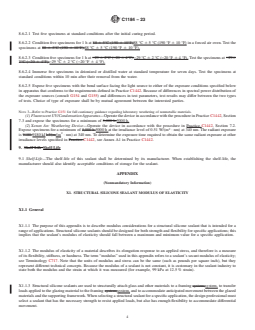
8.6.2.1 Test five specimens at standard conditions after the
6.3 Furnish primer of the type requir
...
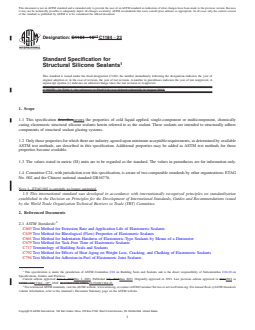
This document is not an ASTM standard and is intended only to provide the user of an ASTM standard an indication of what changes have been made to the previous version. Because
it may not be technically possible to adequately depict all changes accurately, ASTM recommends that users consult prior editions as appropriate. In all cases only the current version
of the standard as published by ASTM is to be considered the official document.
´1
Designation: C1184 − 18 C1184 − 23
Standard Specification for
Structural Silicone Sealants
This standard is issued under the fixed designation C1184; the number immediately following the designation indicates the year of
original adoption or, in the case of revision, the year of last revision. A number in parentheses indicates the year of last reapproval. A
superscript epsilon (´) indicates an editorial change since the last revision or reapproval.
ε NOTE—In Table 1, the reference to Shelf Life was deleted editorially in August 2018.
1. Scope
1.1 This specification describescovers the properties of cold liquid applied, single-component or multicomponent, chemically
curing elastomeric structural silicone sealants herein referred to as the sealant. These sealants are intended to structurally adhere
components of structural sealant glazing systems.
1.2 Only those properties for which there are industry-agreed-upon minimum acceptable requirements, as determined by available
ASTM test methods, are described in this specification. Additional properties may be added as ASTM test methods for those
properties become available.
1.3 The values stated in metric (SI) units are to be regarded as the standard. The values in parentheses are for information only.
1.4 Committee C24, with jurisdiction over this specification, is aware of two comparable standards by other organizations: ETAG
No. 002 and the Chinese national standard GB16776.
NOTE 1—ETAG 002 is currently no longer supported.
1.5 This international standard was developed in accordance with internationally recognized principles on standardization
established in the Decision on Principles for the Development of International Standards, Guides and Recommendations issued
by the World Trade Organization Technical Barriers to Trade (TBT) Committee.
2. Referenced Documents
2.1 ASTM Standards:
C603 Test Method for Extrusion Rate and Application Life of Elastomeric Sealants
C639 Test Method for Rheological (Flow) Properties of Elastomeric Sealants
C661 Test Method for Indentation Hardness of Elastomeric-Type Sealants by Means of a Durometer
C679 Test Method for Tack-Free Time of Elastomeric Sealants
C717 Terminology of Building Seals and Sealants
C792 Test Method for Effects of Heat Aging on Weight Loss, Cracking, and Chalking of Elastomeric Sealants
C794 Test Method for Adhesion-in-Peel of Elastomeric Joint Sealants
This specification is under the jurisdiction of ASTM Committee C24 on Building Seals and Sealants and is the direct responsibility of Subcommittee C24.10 on
Specifications, Guides and Practices.
Current edition approved June 1, 2018May 1, 2023. Published July 2018June 2023. Originally approved in 1991. Last previous edition approved in 20142018 as
ε1
C1184 – 14.C1184 – 18 . DOI: 10.1520/C1184-18E01.10.1520/C1184-23.
For referenced ASTM standards, visit the ASTM website, www.astm.org, or contact ASTM Customer Service at service@astm.org. For Annual Book of ASTM Standards
volume information, refer to the standard’s Document Summary page on the ASTM website.
Copyright © ASTM International, 100 Barr Harbor Drive, PO Box C700, West Conshohocken, PA 19428-2959. United States
C1184 − 23
C1087 Test Method for Determining Compatibility of Liquid-Applied Sealants with Accessories Used in Structural Glazing
Systems
C1135 Test Method for Determining Tensile Adhesion Properties of Structural Sealants
C1401 Guide for Structural Sealant Glazing
C1442 Practice for Conducting Tests on Sealants Using Artificial Weathering Apparatus
G151 Practice for Exposing Nonmetallic Materials in Accelerated Test Devices that Use Laboratory Light Sources
G154 Practice for Operating Fluorescent Ultraviolet (UV) Lamp Apparatus for Exposure of Materials
G155 Practice for Operating Xenon Arc Lamp Apparatus for Exposure of Materials
2.2 European Organization for Technical Approvals Document:
ETAG No. 002 Guideline for European Technical Approval for Structural Sealant Glazing Systems
2.3 Chinese National Standard:
GB 16776–199716776–2005 Structural Silicone Sealants for Buildingsilicon sealants for building
3. Terminology
3.1 Definitions—Refer to Terminology C717 for definitions of the following terms used in this specification: adhesive failure,
chemically curing sealant, cohesive failure, compatibility, cure, elastomeric, glazing, hardness, non-sag sealant, primer, sealant,
shelf-life, silicone sealant, structural sealant, standard conditions, substrate, and tooling.
4. Significance and Use
4.1 Not all sealants meeting this specification should be presumed to be suitable for all applications and all substrates. This
specification assists in selecting sealants that meet certain minimum standards of performance.
4.2 Although this specification qualifies a sealant for use, it does not address the adhesion capability of the sealant for a specific
substrate nor the compatibility of the sealant with the materials it contacts. Adhesion and compatibility characteristics required for
specific substrates or finishes can be determined by Test Method C794 or C1135 for adhesion and Test Method C1087 for
compatibility.
4.3 To properly specify a sealant for the intended use when using this specification, it is essential that the applicable type and
useType and Use be included.
5. Classification of Sealants
5.1 A sealant qualifying under this specification shall be classified as to type and useType and Use as given in 5.1.1 –
5.1.44.1.1-4.1.4.
5.1.1 Type S—Single-component sealant.
5.1.2 Type M—Multicomponent sealant.
5.1.3 Use G—A sealant that meets the requirements of this specification when tested on a clear, uncoated float glass substrate.
5.1.4 Use O—A sealant that meets the requirements of this specification when tested on a substrate other than a clear, uncoated
float glass substrate (for example, Use O—Granite).O—painted aluminum).
6. Materials and Manufacture
6.1 Furnish single-component sealants as a homogeneous mixture of a consistency suitable for application. Apply the sealant in
accordance with the written recommendations of the sealant manufacturer. The cured sealant shall be an elastomeric solid.
6.2 Furnish multicomponent sealants in two or more components. Mix and apply the sealant in accordance with the written
recommendations of the sealant manufacturer. The cured sealant shall be an elastomeric solid.
Available from www.eota.behttps://www.eota.eu/etags-archive.
Published May 15, 2005, Implemented August 1, 1997; http://www.sac.gov.cn/https://www.sac.gov.cn/.
C1184 − 23
6.3 Furnish primer of the type required by, and apply in accordance with, the written recommendations of the sealant
manufacturer.
7. Requirements
7.1 The physical, mechanical, and performance properties of the sealant shall conform to the requirements described in Table 1.
7.2 When a primer (see Note 12) is required by the sealant manufacturer, all tests performed in accordance with this specification
shall be performed with the primer. When a primer is not required by the sealant manufacturer, all tests performed in accordance
with this specification shall be performed without a primer.
NOTE 2—The proper use of primers is described in Guide C1401.
7.3 The standard substrate for this specification is clear, uncoated float glass.
8. Test Methods
8.1 Rheological Properties—Test Method C639, using test procedures for Type II and IV sealants.
8.2 Extrudability—Test Method C603.
8.3 Hardness—Test Method C661, using a Type A-2 durometer.
8.4 Heat Aging—Test Method C792, using a temperature of 88 6 5°C (190 6 10°F).88 °C 6 5 °C (190 °F 6 10 °F).
8.5 Tack-Free Time—Test Method C679.
8.6 Tensile Adhesion—Test Method C1135, using a rate of pull of 12.7 mm ( ⁄2 in.)/min. Determine the average ultimate tensile
value for each group of five specimens prepared as described in 8.6.1 and 8.6.2.
8.6.1 Prepare, in accordance with Test Method C1135, a total of 25 specimens for testing, except that the distance between
substrate
...
Questions, Comments and Discussion
Ask us and Technical Secretary will try to provide an answer. You can facilitate discussion about the standard in here.
Loading comments...