

ASTM C639-15(2020)
(Test Method)Standard Test Method for Rheological (Flow) Properties of Elastomeric Sealants
General Information
- Abstract
SIGNIFICANCE AND USE
5.1 The results obtained from this test method are simply a measure of the degree of horizontal or vertical flow of single-component or multi-component sealants when applied to a set joint configuration at two pre-determined temperatures. Only samples conditioned at the same temperature may be directly compared.
SCOPE
1.1 This test method describes a laboratory procedure for the determination of rheological (flow) properties of single- and multi-component chemically curing sealants for use in building construction.
1.2 Other suitable flow characteristics may be agreed upon between the seller and purchaser or specifier. Special non-sag properties and lower flow characteristics may be required for use in sloping joints where absolute leveling is not desired.
Note 1: The sealants are supplied in various rheological properties ranging from pourable fluids to stiff non-sagging pastes. Multi-component sealants are supplied as a base component with an activator or curing agent separately packaged. After mixing the multiple parts, the sealant is ready for application. Single-component sealants are supplied ready for use upon opening of the package and usually depend on the external environment for cure.
1.3 This test method describes four types of joint sealants:
1.3.1 Type I—Single-component flowable or self-leveling,
1.3.2 Type II—Single-component non-sag,
1.3.3 Type III—Multi-component flowable or self-leveling, and
1.3.4 Type IV—Multi-component non-sag.
1.4 The values stated in SI units are to be regarded as the standard. The values given in parentheses are for information only.
1.5 This standard does not purport to address all of the safety concerns, if any, associated with its use. It is the responsibility of the user of this standard to establish appropriate safety, health, and environmental practices and determine the applicability of regulatory limitations prior to use.
1.6 This international standard was developed in accordance with internationally recognized principles on standardization established in the Decision on Principles for the Development of International Standards, Guides and Recommendations issued by the World Trade Organization Technical Barriers to Trade (TBT) Committee.
- Status
- Published
- Publication Date
- 30-Apr-2020
- Technical Committee
- C24 - Building Seals and Sealants
- Drafting Committee
- C24.20 - General Test Methods


Overview
ASTM C639-15(2020): Standard Test Method for Rheological (Flow) Properties of Elastomeric Sealants provides a consistent laboratory procedure to determine the flow characteristics-often referred to as rheological properties-of single- and multi-component chemically curing elastomeric sealants. These performance qualities are critical in construction, where sealants must maintain their position and cohesive integrity in both vertical and horizontal joints under a range of ambient conditions.
This test method is widely referenced for evaluating sealant quality to ensure optimal application and long-term durability in building construction. The results from ASTM C639-15(2020) allow manufacturers, buyers, and specifiers to quantify and compare the flow and sag resistance attributes of different sealant formulations.
Key Topics
- Rheological Properties: The main focus is on measuring the flow (slump or sag) of elastomeric sealants when applied to joints in both vertical and horizontal positions and subjected to set temperatures.
- Sealant Types Covered:
- Type I: Single-component, flowable or self-leveling
- Type II: Single-component, non-sag
- Type III: Multi-component, flowable or self-leveling
- Type IV: Multi-component, non-sag
- Temperature Conditioning: Samples are tested at specified temperatures, and only those conditioned at the same temperature may be directly compared for their flow characteristics.
- Applicability: The standard is adaptable, allowing agreement between supplier and purchaser for special flow properties or modifications to meet unique performance or environmental requirements.
- Reporting Requirements: Detailed documentation must include sealant identification, type, flow or sag amount, surface conditions, and any deviations from standard procedure.
Applications
The ASTM C639-15(2020) test method has numerous practical applications in the construction and building materials industry:
- Sealant Selection: Enables architects and contractors to select appropriate elastomeric sealants for both horizontal joints (where self-leveling may be desired) and sloping or vertical joints (where non-sagging formulations are necessary).
- Product Comparison: Allows side-by-side performance comparisons between different commercial sealant products under controlled laboratory conditions.
- Quality Assurance: Assists manufacturers in quality control processes to ensure consistency and reliability of their products for end-users.
- Specification Compliance: Helps ensure that all sealants used on a project meet specified flow or sag criteria, supporting compliance with building codes or project requirements.
- Design Adaptation: Supports custom requirements for special applications, such as joints on inclined surfaces where reduced flow is needed.
Related Standards
- ASTM C717: Terminology of Building Seals and Sealants-Provides essential definitions relevant to sealant properties and application.
- ISO 7390:1987: Building Construction - Jointing Products - Determination of Resistance to Flow-Serves as an international comparison point for flow testing of joint sealants.
Keywords: elastomeric sealants, ASTM C639, rheological properties, flow test, sag test, horizontal slump, vertical slump, single-component sealant, multi-component sealant, non-sag, self-leveling, building construction, quality assurance, sealant performance.
For industry professionals requiring precise, repeatable measurement of sealant rheology, ASTM C639-15(2020) remains a fundamental standard for ensuring performance, durability, and suitability in all types of building joint applications.
Relations
- Replaces
ASTM C639-15 - Standard Test Method for Rheological (Flow) Properties of Elastomeric Sealants - Effective Date
- 01-May-2020
- Effective Date
- 01-Mar-2019
- Effective Date
- 01-Mar-2018
- Effective Date
- 01-Nov-2017
- Effective Date
- 01-Jan-2017
- Effective Date
- 15-Nov-2016
- Effective Date
- 01-Sep-2016
- Effective Date
- 01-May-2014
- Effective Date
- 01-Feb-2014
- Effective Date
- 01-Nov-2013
- Effective Date
- 01-Dec-2012
- Effective Date
- 01-May-2012
- Effective Date
- 15-Jan-2012
- Effective Date
- 01-Mar-2011
- Effective Date
- 15-Jan-2011
Get Certified
Connect with accredited certification bodies for this standard

DIBt (Deutsches Institut für Bautechnik)
German Institute for Building Technology.
DIN CERTCO
DIN Group product certification.

Aboma Certification B.V.
Specialized in construction, metal, and transport sectors.
Sponsored listings
Frequently Asked Questions
ASTM C639-15(2020) is a standard published by ASTM International. Its full title is "Standard Test Method for Rheological (Flow) Properties of Elastomeric Sealants". This standard covers: SIGNIFICANCE AND USE 5.1 The results obtained from this test method are simply a measure of the degree of horizontal or vertical flow of single-component or multi-component sealants when applied to a set joint configuration at two pre-determined temperatures. Only samples conditioned at the same temperature may be directly compared. SCOPE 1.1 This test method describes a laboratory procedure for the determination of rheological (flow) properties of single- and multi-component chemically curing sealants for use in building construction. 1.2 Other suitable flow characteristics may be agreed upon between the seller and purchaser or specifier. Special non-sag properties and lower flow characteristics may be required for use in sloping joints where absolute leveling is not desired. Note 1: The sealants are supplied in various rheological properties ranging from pourable fluids to stiff non-sagging pastes. Multi-component sealants are supplied as a base component with an activator or curing agent separately packaged. After mixing the multiple parts, the sealant is ready for application. Single-component sealants are supplied ready for use upon opening of the package and usually depend on the external environment for cure. 1.3 This test method describes four types of joint sealants: 1.3.1 Type I—Single-component flowable or self-leveling, 1.3.2 Type II—Single-component non-sag, 1.3.3 Type III—Multi-component flowable or self-leveling, and 1.3.4 Type IV—Multi-component non-sag. 1.4 The values stated in SI units are to be regarded as the standard. The values given in parentheses are for information only. 1.5 This standard does not purport to address all of the safety concerns, if any, associated with its use. It is the responsibility of the user of this standard to establish appropriate safety, health, and environmental practices and determine the applicability of regulatory limitations prior to use. 1.6 This international standard was developed in accordance with internationally recognized principles on standardization established in the Decision on Principles for the Development of International Standards, Guides and Recommendations issued by the World Trade Organization Technical Barriers to Trade (TBT) Committee.
SIGNIFICANCE AND USE 5.1 The results obtained from this test method are simply a measure of the degree of horizontal or vertical flow of single-component or multi-component sealants when applied to a set joint configuration at two pre-determined temperatures. Only samples conditioned at the same temperature may be directly compared. SCOPE 1.1 This test method describes a laboratory procedure for the determination of rheological (flow) properties of single- and multi-component chemically curing sealants for use in building construction. 1.2 Other suitable flow characteristics may be agreed upon between the seller and purchaser or specifier. Special non-sag properties and lower flow characteristics may be required for use in sloping joints where absolute leveling is not desired. Note 1: The sealants are supplied in various rheological properties ranging from pourable fluids to stiff non-sagging pastes. Multi-component sealants are supplied as a base component with an activator or curing agent separately packaged. After mixing the multiple parts, the sealant is ready for application. Single-component sealants are supplied ready for use upon opening of the package and usually depend on the external environment for cure. 1.3 This test method describes four types of joint sealants: 1.3.1 Type I—Single-component flowable or self-leveling, 1.3.2 Type II—Single-component non-sag, 1.3.3 Type III—Multi-component flowable or self-leveling, and 1.3.4 Type IV—Multi-component non-sag. 1.4 The values stated in SI units are to be regarded as the standard. The values given in parentheses are for information only. 1.5 This standard does not purport to address all of the safety concerns, if any, associated with its use. It is the responsibility of the user of this standard to establish appropriate safety, health, and environmental practices and determine the applicability of regulatory limitations prior to use. 1.6 This international standard was developed in accordance with internationally recognized principles on standardization established in the Decision on Principles for the Development of International Standards, Guides and Recommendations issued by the World Trade Organization Technical Barriers to Trade (TBT) Committee.
ASTM C639-15(2020) is classified under the following ICS (International Classification for Standards) categories: 91.100.50 - Binders. Sealing materials. The ICS classification helps identify the subject area and facilitates finding related standards.
ASTM C639-15(2020) has the following relationships with other standards: It is inter standard links to ASTM C639-15, ASTM C717-19, ASTM C717-18, ASTM C717-17a, ASTM C717-17, ASTM C717-16a, ASTM C717-16, ASTM C717-14a, ASTM C717-14, ASTM C717-13, ASTM C717-12b, ASTM C717-12a, ASTM C717-12, ASTM C717-11a, ASTM C717-11. Understanding these relationships helps ensure you are using the most current and applicable version of the standard.
ASTM C639-15(2020) is available in PDF format for immediate download after purchase. The document can be added to your cart and obtained through the secure checkout process. Digital delivery ensures instant access to the complete standard document.
Standards Content (Sample)
This international standard was developed in accordance with internationally recognized principles on standardization established in the Decision on Principles for the
Development of International Standards, Guides and Recommendations issued by the World Trade Organization Technical Barriers to Trade (TBT) Committee.
Designation: C639 − 15 (Reapproved 2020)
Standard Test Method for
Rheological (Flow) Properties of Elastomeric Sealants
This standard is issued under the fixed designation C639; the number immediately following the designation indicates the year of
original adoption or, in the case of revision, the year of last revision. A number in parentheses indicates the year of last reapproval. A
superscript epsilon (´) indicates an editorial change since the last revision or reapproval.
This standard has been approved for use by agencies of the U.S. Department of Defense.
1. Scope 2. Referenced Documents
1.1 This test method describes a laboratory procedure for 2.1 ASTM Standards:
the determination of rheological (flow) properties of single- C717 Terminology of Building Seals and Sealants
and multi-component chemically curing sealants for use in
3. Terminology
building construction.
1.2 Other suitable flow characteristics may be agreed upon 3.1 Definitions—Refer to Terminology C717, Section 4.1,
for definitions of the following terms used in this standard:
between the seller and purchaser or specifier. Special non-sag
properties and lower flow characteristics may be required for chemically curing sealants, compound, elastomeric, flow
(slump), non-sag sealant (non-slump), sealant, self-leveling
use in sloping joints where absolute leveling is not desired.
sealant (flowable), standard conditions.
NOTE 1—The sealants are supplied in various rheological properties
ranging from pourable fluids to stiff non-sagging pastes. Multi-component
4. Comparison to Other Standards
sealants are supplied as a base component with an activator or curing
agent separately packaged. After mixing the multiple parts, the sealant is
4.1 ISO 7390:1987 Building Construction-Jointing
ready for application. Single-component sealants are supplied ready for
Products-Determination of Resistance to Flow
use upon opening of the package and usually depend on the external
environment for cure.
5. Significance and Use
1.3 This test method describes four types of joint sealants:
5.1 The results obtained from this test method are simply a
1.3.1 Type I—Single-component flowable or self-leveling,
measure of the degree of horizontal or vertical flow of
1.3.2 Type II—Single-component non-sag,
single-component or multi-component sealants when applied
1.3.3 Type III—Multi-component flowable or self-leveling,
to a set joint configuration at two pre-determined temperatures.
and
Only samples conditioned at the same temperature may be
1.3.4 Type IV—Multi-component non-sag.
directly compared.
1.4 The values stated in SI units are to be regarded as the
standard. The values given in parentheses are for information
6. Apparatus
only.
6.1 Refrigerator, controlled at 4.4 62°C(40 6 3.6 °F).
1.5 This standard does not purport to address all of the
6.2 Oven, convention-type, controlled at 50 6 2 °C (122 6
safety concerns, if any, associated with its use. It is the
3.6 °F).
responsibility of the user of this standard to establish appro-
priate safety, health, and environmental practices and deter-
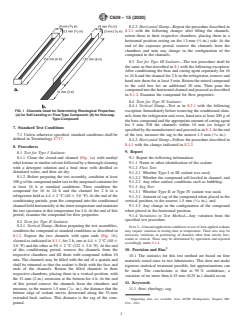
6.3 Channel, one, stainless steel (Type 304, No. 2-B finish,
mine the applicability of regulatory limitations prior to use.
No. 16 gauge), inside dimensions 19 mm wide, 13 mm deep,
1.6 This international standard was developed in accor-
3 1
152 mm long ( ⁄4 by ⁄2 by 6 in.), and closed at both ends (see
dance with internationally recognized principles on standard-
Fig. 1a).
ization established in the Decision on Principles for the
6.4 Channels, two, stainless steel (Type 304, No. 2-B finish,
Development of International Standards, Guides and Recom-
No. 16 gauge), inside dimensions 19 mm wide, 13 mm deep,
mendations issued by the World Trade Organization Technical
3 1
152 mm long ( ⁄4 by ⁄2 by 6 in.) with both ends open and the
Barriers to Trade (TBT) Committee.
back surface extended 51 mm (2 in.) (see Fig. 1b).
ThistestmethodisunderthejurisdictionofASTMCommitteeC24onBuilding
Seals and Sealants and is the direct responsibility of Subcommittee C24.20 on
General Test Methods. For referenced ASTM standards, visit the ASTM website, www.astm.org, or
Current edition approved May 1, 2020. Published June 2020. Originally contact ASTM Customer Service at service@astm.org. For Annual Book of ASTM
approved in 1969. Last previous edition approved in 2015 as C639 – 15. DOI: Standards volume information, refer to the standard’s Document Summary page on
10.1520/C0639-15R20. the ASTM website.
Copyright © ASTM International, 100 Barr Harbor Drive, PO Box C700, West Conshohocken, PA 19428-2959. United States
C639 − 15 (2020)
8.2.2 Horizontal Slump—Repeat the procedure described in
8.2.1 with the following change: after filling the channels,
return them to their respective chambers, placing them in a
horizontal position resting on the 13-mm ( ⁄2-in.) side. At the
end of the exposure period, remove the channels from the
chambers and note any change in the configuration of the
compound in the channels.
8.3 Test for Type III Sealants—The test procedure shall be
the same as that described in 8.1 with the following exception:
After conditioning the base and curing agent separately for 16
to 24 h and the channel for2hinthe refrigerator, remove and
hand mix them for at least 5 min. Return the mixed compound
to the cold box for an additional 3
...