


ASTM C792-15(2020)
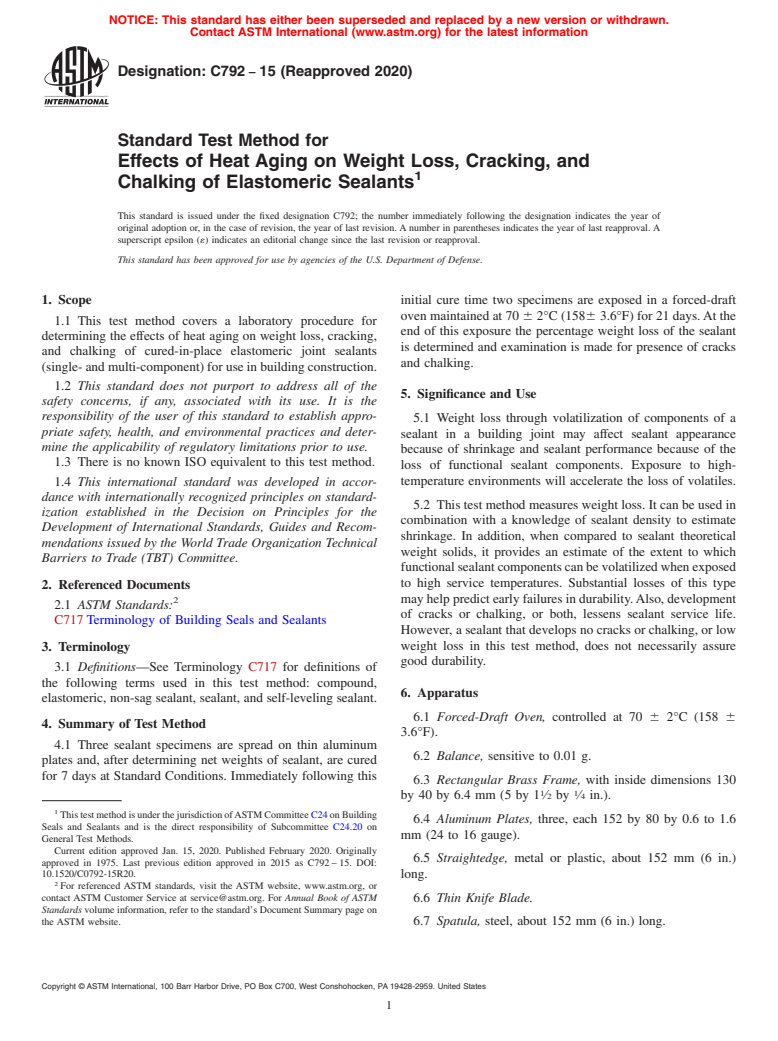
(Test Method)Standard Test Method for Effects of Heat Aging on Weight Loss, Cracking, and Chalking of Elastomeric Sealants
Standard Test Method for Effects of Heat Aging on Weight Loss, Cracking, and Chalking of Elastomeric Sealants
SIGNIFICANCE AND USE
5.1 Weight loss through volatilization of components of a sealant in a building joint may affect sealant appearance because of shrinkage and sealant performance because of the loss of functional sealant components. Exposure to high-temperature environments will accelerate the loss of volatiles.
5.2 This test method measures weight loss. It can be used in combination with a knowledge of sealant density to estimate shrinkage. In addition, when compared to sealant theoretical weight solids, it provides an estimate of the extent to which functional sealant components can be volatilized when exposed to high service temperatures. Substantial losses of this type may help predict early failures in durability. Also, development of cracks or chalking, or both, lessens sealant service life. However, a sealant that develops no cracks or chalking, or low weight loss in this test method, does not necessarily assure good durability.
SCOPE
1.1 This test method covers a laboratory procedure for determining the effects of heat aging on weight loss, cracking, and chalking of cured-in-place elastomeric joint sealants (single- and multi-component) for use in building construction.
1.2 This standard does not purport to address all of the safety concerns, if any, associated with its use. It is the responsibility of the user of this standard to establish appropriate safety, health, and environmental practices and determine the applicability of regulatory limitations prior to use.
1.3 There is no known ISO equivalent to this test method.
1.4 This international standard was developed in accordance with internationally recognized principles on standardization established in the Decision on Principles for the Development of International Standards, Guides and Recommendations issued by the World Trade Organization Technical Barriers to Trade (TBT) Committee.
General Information
Buy Standard

Standards Content (Sample)
NOTICE: This standard has either been superseded and replaced by a new version or withdrawn.
Contact ASTM International (www.astm.org) for the latest information
Designation: C792 − 15 (Reapproved 2020)
Standard Test Method for
Effects of Heat Aging on Weight Loss, Cracking, and
Chalking of Elastomeric Sealants
This standard is issued under the fixed designation C792; the number immediately following the designation indicates the year of
original adoption or, in the case of revision, the year of last revision. A number in parentheses indicates the year of last reapproval. A
superscript epsilon (´) indicates an editorial change since the last revision or reapproval.
This standard has been approved for use by agencies of the U.S. Department of Defense.
1. Scope initial cure time two specimens are exposed in a forced-draft
oven maintained at 70 6 2°C (1586 3.6°F) for 21 days. At the
1.1 This test method covers a laboratory procedure for
end of this exposure the percentage weight loss of the sealant
determining the effects of heat aging on weight loss, cracking,
is determined and examination is made for presence of cracks
and chalking of cured-in-place elastomeric joint sealants
and chalking.
(single- and multi-component) for use in building construction.
1.2 This standard does not purport to address all of the
5. Significance and Use
safety concerns, if any, associated with its use. It is the
responsibility of the user of this standard to establish appro-
5.1 Weight loss through volatilization of components of a
priate safety, health, and environmental practices and deter-
sealant in a building joint may affect sealant appearance
mine the applicability of regulatory limitations prior to use.
because of shrinkage and sealant performance because of the
1.3 There is no known ISO equivalent to this test method.
loss of functional sealant components. Exposure to high-
temperature environments will accelerate the loss of volatiles.
1.4 This international standard was developed in accor-
dance with internationally recognized principles on standard-
5.2 This test method measures weight loss. It can be used in
ization established in the Decision on Principles for the
combination with a knowledge of sealant density to estimate
Development of International Standards, Guides and Recom-
shrinkage. In addition, when compared to sealant theoretical
mendations issued by the World Trade Organization Technical
weight solids, it provides an estimate of the extent to which
Barriers to Trade (TBT) Committee.
functional sealant components can be volatilized when exposed
to high service temperatures. Substantial losses of this type
2. Referenced Documents
2 may help predict early failures in durability. Also, development
2.1 ASTM Standards:
of cracks or chalking, or both, lessens sealant service life.
C717 Terminology of Building Seals and Sealants
However, a sealant that develops no cracks or chalking, or low
weight loss in this test method, does not necessarily assure
3. Terminology
good durability.
3.1 Definitions—See Terminology C717 for definitions of
the following terms used in this test method: compound,
6. Apparatus
elastomeric, non-sag sealant, sealant, and self-leveling sealant.
6.1 Forced-Draft Oven, controlled at 70 6 2°C (158 6
4. Summary of Test Method
3.6°F).
4.1 Three sealant specimens are spread on thin aluminum
6.2 Balance, sensitive to 0.01 g.
plates and, after determining net weights of sealant, are cured
for 7 days at Standard Conditions. Immediately following this
6.3 Rectangular Brass Frame, with inside dimensions 130
1 1
by 40 by 6.4 mm (5 by 1 ⁄2 by ⁄4 in.).
This test method is under the jurisdiction of ASTM Committee C24 on Building
6.4 Aluminum Plates, three, each 152 by 80 by 0.6 to 1.6
Seals and Sealants and is the direct responsibility of Subcommittee C24.20 on
mm (24 to 16 gauge).
General Test Methods.
Current edition approved Jan. 15, 2020. Published February 2020. Originally
6.5 Straightedge, metal or plastic, about 152 mm (6 in.)
approved in 1975. Last previous edition approved in 2015 as C792 – 15. DOI:
10.1520/C0792-15R20. long.
For referenced ASTM standards, visit the ASTM website, www.astm.org, or
contact ASTM Customer Service at service@astm.org. For Annual Book of ASTM 6.6 Thin Knife Blade.
Standards volume information, refer to the standard’s Document Summary page on
the ASTM website. 6.7 Spatula, steel, about 152 mm (6 in.) long.
Copyright © ASTM International, 100 Barr Harbor Drive, PO Box C700, West Conshohocken, PA 19428-2959. United States
C792 − 15 (2020)
7. Procedure 7.2.6 Examine the sealants for cracking and chalking and
compare with the third (control) specimen.
7.1 Unless otherwise specified by those authorizing the test,
standard conditions of temperature and relative humidity for
NOTE 1—In the case of a pourable grade compound, do not lift the
rectangular frame until the sealant is sufficiently set that it will retain its
the test
...
This document is not an ASTM standard and is intended only to provide the user of an ASTM standard an indication of what changes have been made to the previous version. Because
it may not be technically possible to adequately depict all changes accurately, ASTM recommends that users consult prior editions as appropriate. In all cases only the current version
of the standard as published by ASTM is to be considered the official document.
Designation: C792 − 15 C792 − 15 (Reapproved 2020)
Standard Test Method for
Effects of Heat Aging on Weight Loss, Cracking, and
Chalking of Elastomeric Sealants
This standard is issued under the fixed designation C792; the number immediately following the designation indicates the year of
original adoption or, in the case of revision, the year of last revision. A number in parentheses indicates the year of last reapproval. A
superscript epsilon (´) indicates an editorial change since the last revision or reapproval.
This standard has been approved for use by agencies of the U.S. Department of Defense.
1. Scope
1.1 This test method covers a laboratory procedure for determining the effects of heat aging on weight loss, cracking, and
chalking of cured-in-place elastomeric joint sealants (single- and multicomponent)multi-component) for use in building
construction.
1.2 This standard does not purport to address all of the safety problems,concerns, if any, associated with its use. It is the
responsibility of the user of this standard to establish appropriate safety safety, health, and healthenvironmental practices and
determine the applicability of regulatory limitations prior to use.
1.3 There is no known ISO equivalent to this test method.
1.4 This international standard was developed in accordance with internationally recognized principles on standardization
established in the Decision on Principles for the Development of International Standards, Guides and Recommendations issued
by the World Trade Organization Technical Barriers to Trade (TBT) Committee.
2. Referenced Documents
2.1 ASTM Standards:
C717 Terminology of Building Seals and Sealants
3. Terminology
3.1 Definitions—See Terminology C717 for definitions of the following terms used in this test method: compound, elastomeric,
non-sag sealant, sealant, and self-leveling sealant.
4. Summary of Test Method
4.1 Three sealant specimens are spread on thin aluminum plates and, after determining net weights of sealant, are cured for 7
days at Standard Conditions. Immediately following this initial cure time two specimens are exposed in a forced-draft oven
maintained at 70 6 2°C (1586 3.6°F) for 21 days. At the end of this exposure the percentage weight loss of the sealant is
determined and examination is made for presence of cracks and chalking.
5. Significance and Use
5.1 Weight loss through volatilization of components of a sealant in a building joint may affect sealant appearance because of
shrinkage and sealant performance because of the loss of functional sealant components. Exposure to high-temperature
environments will accelerate the loss of volatiles.
5.2 This test method measures weight loss. It can be used in combination with a knowledge of sealant density to estimate
shrinkage. In addition, when compared to sealant theoretical weight solids, it provides an estimate of the extent to which functional
sealant components can be volatilized when exposed to high service temperatures. Substantial losses of this type may help predict
early failures in durability. Also, development of cracks or chalking, or both, lessens sealant service life. However, a sealant that
develops no cracks or chalking, or low weight loss in this test method, does not necessarily assure good durability.
This test method is under the jurisdiction of ASTM Committee C24 on Building Seals and Sealants and is the direct responsibility of Subcommittee C24.20 on General
Test Methods.
Current edition approved March 15, 2015Jan. 15, 2020. Published April 2015February 2020. Originally approved in 1975. Last previous edition approved in 20082015
as C792 – 04C792 – 15.(2008). DOI: 10.1520/C0792-15.10.1520/C0792-15R20.
For referenced ASTM standards, visit the ASTM website, www.astm.org, or contact ASTM Customer Service at service@astm.org. For Annual Book of ASTM Standards
volume information, refer to the standard’s Document Summary page on the ASTM website.
Copyright © ASTM International, 100 Barr Harbor Drive, PO Box C700, West Conshohocken, PA 19428-2959. United States
C792 − 15 (2020)
6. Apparatus
6.1 Forced-Draft Oven, controlled at 70 6 2°C (158 6 3.6°F).
6.2 Balance, sensitive to 0.01 g.
1 1
6.3 Rectangular Brass Frame, with inside dimensions 130 by 40 by 6.4 mm (5 by 1 ⁄2 by ⁄4 in.).
6.4 Aluminum Plates, three, each 152 by 80 by 0.6 to 1.6 mm (24 to 16 gage).gauge).
6.5 Straightedge, metal or plastic, about 152 mm (6 in.) long.
6.6 Thin Knife Blade.
6.7 Spatula, steel, about 152 mm (6 in.) long.
7. Procedure
7.1 Unless otherwise specified by those authorizing the test, standard conditions of temperature and relative humidity for the
test shall be found in Terminology C717.
7.2 Test of Mu
...
Questions, Comments and Discussion
Ask us and Technical Secretary will try to provide an answer. You can facilitate discussion about the standard in here.