

ASTM D3663-20
(Test Method)Standard Test Method for Surface Area of Catalysts and Catalyst Carriers
General Information
- Abstract
ABSTRACT
This test method establishes the standard procedure for determining the surface areas of catalyst and catalyst carriers that have Type II or IV nitrogen adsorption isotherms, and specified minimum area. A volumetric measuring system is used to obtain at least four data points which fit on the linear BET line. The surface area of a catalyst or catalyst carrier is determined by measuring the volume of nitrogen gas adsorbed at various low-pressure levels by the catalyst sample. Pressure differentials caused by introducing the catalyst surface area to a fixed volume of nitrogen in the test apparatus are measured and used to calculate BET surface area.
SCOPE
1.1 This test method covers the determination of surface areas of catalyst and catalyst carriers that have Type II or IV nitrogen adsorption isotherms, and at least 1 m2/g of area. A volumetric measuring system is used to obtain at least four data points which fit on the linear BET2 equation line.
1.2 Units—The values stated in SI units are to be regarded as standard. The values given in parentheses after SI units are provided for information only and are not considered standard.
1.3 This standard does not purport to address all of the safety concerns, if any, associated with its use. It is the responsibility of the user of this standard to establish appropriate safety, health, and environmental practices and determine the applicability of regulatory limitations prior to use.
1.4 This international standard was developed in accordance with internationally recognized principles on standardization established in the Decision on Principles for the Development of International Standards, Guides and Recommendations issued by the World Trade Organization Technical Barriers to Trade (TBT) Committee.
- Status
- Published
- Publication Date
- 30-Sep-2020
- Technical Committee
- D32 - Catalysts
- Drafting Committee
- D32.01 - Physical-Chemical Properties
Overview
ASTM D3663-20 is the Standard Test Method for Surface Area of Catalysts and Catalyst Carriers, published by ASTM International. This standard specifies a reproducible procedure for determining the surface area of catalytic materials and their supports using nitrogen adsorption techniques. It is applicable to catalysts and catalyst carriers exhibiting Type II or IV nitrogen adsorption isotherms with surface areas of at least 1 m²/g. The test results provide critical data for material characterization, process optimization, and quality assurance in the catalysis industry.
Key Topics
- Surface Area Determination: Focused on measuring the total surface area accessible to nitrogen molecules on catalyst and catalyst support particles. Results are typically expressed in square meters per gram (m²/g).
- BET Method: Utilizes the Brunauer, Emmett, and Teller (BET) equation to establish the linear range for calculating surface area from adsorption data.
- Nitrogen Adsorption Isotherms: Applies to materials with Type II or Type IV adsorption profiles, ensuring accurate measurement for a range of industrial catalysts.
- Volumetric Analysis: Describes the use of a volumetric system to record pressure changes as nitrogen adsorbs onto the sample. At least four data points within the linear BET region are required for analysis.
- Sample Preparation and Degassing: Outlines procedures for removing contaminants and moisture via vacuum and heat treatment, ensuring accurate adsorption measurements.
- Calculation and Reporting: Details methods for calculating sample mass, dead-space volume, and nitrogen adsorbed, followed by quantification of the surface area. Emphasizes the need to report pretreatment and degassing temperatures.
Applications
- Catalyst Development and Quality Control: Provides reliable surface area measurement crucial for designing and validating catalysts and their carriers in chemical, petrochemical, and environmental processes.
- Process Optimization: Surface area data influences catalyst activity, selectivity, and lifetime, driving improvements in process efficiency and product yield.
- Materials Research: Used to compare different supports and active phases, aiding in the selection of materials for advanced catalytic applications.
- Regulatory Compliance and Specification: Assists industries in meeting international quality standards for catalyst performance by supplying standardized and verifiable data.
- Academic and Industrial Laboratories: Offers a consistent approach for research and routine analysis, supporting interlaboratory comparison and method validation.
Related Standards
- ASTM D3766: Terminology Relating to Catalysts and Catalysis - Provides important definitions used in catalyst testing.
- ASTM E177: Practice for Use of the Terms Precision and Bias in ASTM Test Methods - Covers statistical parameters relevant to repeatability and reproducibility.
- ASTM E456: Terminology Relating to Quality and Statistics - Defines statistical terminology referenced in precision and bias sections.
- ASTM E691: Practice for Conducting an Interlaboratory Study to Determine the Precision of a Test Method - Offers guidance on evaluating test method precision across locations.
- IUPAC Recommendations: Referenced for the latest values of physical constants such as absolute zero in adsorption calculations.
Practical Value
Adopting ASTM D3663-20 ensures consistency and reliability in the measurement of catalyst surface area, fostering comparability across laboratories and compliance with international standards. This method is essential for quality management, product development, and scientific research involving catalysts and catalyst carriers. By following this standard, users benefit from robust, validated procedures that underpin the performance and evaluation of catalytic materials, making it an indispensable tool in catalyst characterization and industrial process control.
Keywords: catalyst, surface area, nitrogen adsorption, BET method, ASTM D3663, catalyst carrier, volumetric analysis, quality control, catalyst characterization.
Relations
- Effective Date
- 01-Feb-2024
- Effective Date
- 01-Jan-2024
- Effective Date
- 01-Apr-2022
- Effective Date
- 01-Nov-2018
- Effective Date
- 01-Oct-2017
- Effective Date
- 01-Oct-2017
- Effective Date
- 01-May-2014
- Effective Date
- 15-Nov-2013
- Effective Date
- 15-Nov-2013
- Effective Date
- 15-Nov-2013
- Effective Date
- 15-Nov-2013
- Effective Date
- 15-Aug-2013
- Effective Date
- 01-May-2013
- Effective Date
- 01-May-2013
- Effective Date
- 01-Mar-2013
Get Certified
Connect with accredited certification bodies for this standard

ECOCERT
Organic and sustainability certification.

Eurofins Food Testing Global
Global leader in food, environment, and pharmaceutical product testing.

Intertek Bangladesh
Intertek certification and testing services in Bangladesh.
Sponsored listings
Frequently Asked Questions
ASTM D3663-20 is a standard published by ASTM International. Its full title is "Standard Test Method for Surface Area of Catalysts and Catalyst Carriers". This standard covers: ABSTRACT This test method establishes the standard procedure for determining the surface areas of catalyst and catalyst carriers that have Type II or IV nitrogen adsorption isotherms, and specified minimum area. A volumetric measuring system is used to obtain at least four data points which fit on the linear BET line. The surface area of a catalyst or catalyst carrier is determined by measuring the volume of nitrogen gas adsorbed at various low-pressure levels by the catalyst sample. Pressure differentials caused by introducing the catalyst surface area to a fixed volume of nitrogen in the test apparatus are measured and used to calculate BET surface area. SCOPE 1.1 This test method covers the determination of surface areas of catalyst and catalyst carriers that have Type II or IV nitrogen adsorption isotherms, and at least 1 m2/g of area. A volumetric measuring system is used to obtain at least four data points which fit on the linear BET2 equation line. 1.2 Units—The values stated in SI units are to be regarded as standard. The values given in parentheses after SI units are provided for information only and are not considered standard. 1.3 This standard does not purport to address all of the safety concerns, if any, associated with its use. It is the responsibility of the user of this standard to establish appropriate safety, health, and environmental practices and determine the applicability of regulatory limitations prior to use. 1.4 This international standard was developed in accordance with internationally recognized principles on standardization established in the Decision on Principles for the Development of International Standards, Guides and Recommendations issued by the World Trade Organization Technical Barriers to Trade (TBT) Committee.
ABSTRACT This test method establishes the standard procedure for determining the surface areas of catalyst and catalyst carriers that have Type II or IV nitrogen adsorption isotherms, and specified minimum area. A volumetric measuring system is used to obtain at least four data points which fit on the linear BET line. The surface area of a catalyst or catalyst carrier is determined by measuring the volume of nitrogen gas adsorbed at various low-pressure levels by the catalyst sample. Pressure differentials caused by introducing the catalyst surface area to a fixed volume of nitrogen in the test apparatus are measured and used to calculate BET surface area. SCOPE 1.1 This test method covers the determination of surface areas of catalyst and catalyst carriers that have Type II or IV nitrogen adsorption isotherms, and at least 1 m2/g of area. A volumetric measuring system is used to obtain at least four data points which fit on the linear BET2 equation line. 1.2 Units—The values stated in SI units are to be regarded as standard. The values given in parentheses after SI units are provided for information only and are not considered standard. 1.3 This standard does not purport to address all of the safety concerns, if any, associated with its use. It is the responsibility of the user of this standard to establish appropriate safety, health, and environmental practices and determine the applicability of regulatory limitations prior to use. 1.4 This international standard was developed in accordance with internationally recognized principles on standardization established in the Decision on Principles for the Development of International Standards, Guides and Recommendations issued by the World Trade Organization Technical Barriers to Trade (TBT) Committee.
ASTM D3663-20 is classified under the following ICS (International Classification for Standards) categories: 71.040.30 - Chemical reagents. The ICS classification helps identify the subject area and facilitates finding related standards.
ASTM D3663-20 has the following relationships with other standards: It is inter standard links to ASTM D3766-24a, ASTM D3766-24, ASTM E456-13a(2022)e1, ASTM D3766-08(2018), ASTM E456-13A(2017)e3, ASTM E456-13A(2017)e1, ASTM E177-14, ASTM E456-13ae3, ASTM E456-13a, ASTM E456-13ae1, ASTM E456-13ae2, ASTM E456-13, ASTM E177-13, ASTM E691-13, ASTM D3766-08(2013). Understanding these relationships helps ensure you are using the most current and applicable version of the standard.
ASTM D3663-20 is available in PDF format for immediate download after purchase. The document can be added to your cart and obtained through the secure checkout process. Digital delivery ensures instant access to the complete standard document.
Standards Content (Sample)
This international standard was developed in accordance with internationally recognized principles on standardization established in the Decision on Principles for the
Development of International Standards, Guides and Recommendations issued by the World Trade Organization Technical Barriers to Trade (TBT) Committee.
Designation: D3663 − 20
Standard Test Method for
Surface Area of Catalysts and Catalyst Carriers
This standard is issued under the fixed designation D3663; the number immediately following the designation indicates the year of
original adoption or, in the case of revision, the year of last revision.Anumber in parentheses indicates the year of last reapproval.A
superscript epsilon (´) indicates an editorial change since the last revision or reapproval.
1. Scope 3.2 Definitions:
3.2.1 surface area of a catalyst, n—the total probe acces-
1.1 This test method covers the determination of surface
siblesurfaceofthecatalyst;itisexpressedinsquaremetresper
areas of catalyst and catalyst carriers that have Type II or IV
gram.
nitrogen adsorption isotherms, and at least 1 m /g of area. A
volumetricmeasuringsystemisusedtoobtainatleastfourdata
3.3 Symbols:
points which fit on the linear BET equation line.
1.2 Units—The values stated in SI units are to be regarded
P = initial helium pressure, torr
H
as standard. The values given in parentheses after SI units are 1
P = helium pressure after equilibration, torr
H
provided for informationonlyandarenotconsideredstandard.
T = temperatureofmanifoldatinitialheliumpressure,
H
1.3 This standard does not purport to address all of the
°C
safety concerns, if any, associated with its use. It is the
T = temperature of manifold after equilibration, °C
H
responsibility of the user of this standard to establish appro-
P = initial N pressure, torr
1 2
priate safety, health, and environmental practices and deter- T = manifold temperature at initial N pressure, K
1 2
mine the applicability of regulatory limitations prior to use. T ' = manifold temperature at initial N pressure, °C
1 2
P = pressure after equilibration, torr
1.4 This international standard was developed in accor-
P = liquid nitrogen vapor pressure, torr
dance with internationally recognized principles on standard- 0
T = liquid nitrogen temperature, K
s
ization established in the Decision on Principles for the
X = relative pressure, P /P
2 0
Development of International Standards, Guides and Recom-
V = volume of manifold, cm
d
mendations issued by the World Trade Organization Technical
V = extra volume bulb, cm
x
Barriers to Trade (TBT) Committee.
V = dead-space volume, cm
s
W = mass of sample, g
2. Referenced Documents
s
W = tare mass of sample tube, g
2.1 ASTM Standards:
W = sample+tare mass of tube, g
D3766Terminology Relating to Catalysts and Catalysis 3
V = volume of nitrogen in the dead-space, cm
ds
E177Practice for Use of the Terms Precision and Bias in
V = see 10.4.4
ASTM Test Methods
V = see 10.4.6
E456Terminology Relating to Quality and Statistics
V = see 10.4.7
t
E691Practice for Conducting an Interlaboratory Study to
V = see 10.4.9
a
Determine the Precision of a Test Method V = see 10.8
m
T = initial extra-volume bulb temperature, K
1x
3. Terminology
T '(i ) = initial extra-volume bulb temperature, °C
1 x
3.1 Consult Terminology D3766 for definitions of other T = extra-volume bulb temperature after equilibrium,
2 x
terms used. K
T '(i ) = extra-volume bulb temperature after equilibrium,
2 x
°C
This test method is under the jurisdiction of ASTM Committee D32 on
Catalysts and is the direct responsibility of Subcommittee D32.01 on Physical-
Chemical Properties.
4. Summary of Test Method
Current edition approved Oct. 1, 2020. Published November 2020. Originally
approved in 1978. Last previous edition approved in 2015 as D3663–03(2015).
4.1 The surface area of a catalyst or catalyst carrier is
DOI: 10.1520/D3663-20.
2 determined by measuring the amount of nitrogen gas adsorbed
Brunauer, Emmett, Teller, Journal of American Chemical Society, JACS, No.
60, 1938, p. 309.
at various low-pressure levels by the catalyst sample. Pressure
For referenced ASTM standards, visit the ASTM website, www.astm.org, or
differentials caused by introducing the catalyst surface area to
contact ASTM Customer Service at service@astm.org. For Annual Book of ASTM
a fixed volume of nitrogen in the test apparatus are measured
Standards volume information, refer to the standard’s Document Summary page on
the ASTM website. and used to calculate BET surface area.
Copyright © ASTM International, 100 Barr Harbor Drive, PO Box C700, West Conshohocken, PA 19428-2959. United States
D3663 − 20
5. Apparatus 5.6.1 It is preferred that the manifold be thermostated at a
particulartemperature,afewdegreesaboveambient,toobviate
5.1 Aschematicdiagramofasuitableapparatusisshownin
the necessity of recording this temperature at each reading.
Fig. 1. It may be constructed of glass or of metal. Commercial
metal instruments are available. It has the following features: 5.7 Thermometer, for measuring the temperature of the
5.1.1 Distribution Manifold, having a volume between 20 liquid nitrogen bath [ T (i)] in kelvins. This will preferably be
s
3 3
and 35 cm,(V ), known to the nearest 0.05 cm . This volume a nitrogen vapor-pressure thermometer, often referred to in a
d
is defined as the volume between the stopcocks or valves and commercial instrument as a pressure saturation tube, from
includes the pressure gauge. which P values may be derived.
5.1.2 Vacuum System, capable of attaining pressures below
−4
6. Reagents
10 torr (1 torr=133.3 Pa).This can include a vacuum gauge
(not shown in Fig. 1). Access to the distribution manifold is
6.1 Purity of Reagents—Reagent grade chemicals shall be
through the valve V. used in all tests. Unless otherwise indicated, it is intended that
5.1.3 Pressure-Measuring Device, that operates at constant
all reagents shall conform to the specifications of the Commit-
volume and is capable of measurements to the nearest 0.1 torr, tee onAnalytical Reagents of theAmerican Chemical Society,
in the range from 0 to 1000 torr (1 torr=133.3 Pa).
where such specifications are available. Other grades may be
used, provided it is first ascertained that the reagent is of
NOTE 1—See, for example, the article by Joy for a description of a
sufficiently high purity to permit its use without lessening the
constant-volume manometer.
accuracy of the determination.
5.1.4 Valve (H), from the helium supply to the distribution
6.2 Helium Gas—Acylinderofheliumgasatleast99.999%
manifold.
pure.
5.1.5 Valve (N), from the nitrogen supply to the distribution
manifold.
6.3 Liquid Nitrogen, of such purity that P is not more than
5.1.6 The connection between the sample tube and the S
20 torr above barometric pressure. A fresh daily supply is
valve can be a standard-taper glass joint, a glass-to-glass seal,
recommended.
or a compression fitting.
3 6.4 Nitrogen Gas—A cylinder of nitrogen gas at least
5.1.7 Extra Volume Bulb, (V ), should be 100 to 150 cm ,
x
99.999% pure.
known to the nearest 0.05 cm . V includes the volume of the
x
stopcock bore in the glass apparatus.
7. Procedure—Sample Preparation and Degassing
5.2 Sample Tubes,withvolumesfrom5to100cm depend-
7.1 Selectasampletubeofthedesiredsize.A5cm sample
ing on the application. Use sample tubes recommended by the
tube is preferred for samples not exceeding about 1 g, to
instrument manufacturer. If necessary, markings should be
minimizethedead-space.However,a25cm sampletubemay
placed on the sample tube about 30 to 50mm below the
be preferred for finely powdered catalysts, to avoid “boiling”
connectors to indicate the desired liquid nitrogen level.
when degassing is started.
5.3 Heating Mantles or Small Furnaces.
7.2 Fill the sample tube with nitrogen or helium, at atmo-
5.4 Dewar Flasks. sphericpressure,afterremovingairbyevacuation.Thismaybe
−7 done on the surface area unit, or on a separate piece of
5.5 Laboratory Balance, with 0.1mg (10 kg) sensitivity.
equipment.
5.6 Thermometer or Thermocouple, for measuring the tem-
peratureofthedistributionmanifold[T '(i)or T '(i)]indegrees
1 2
Reagent Chemicals, American Chemical Society Specifications, American
Celsius or kelvins.
Chemical Society, Washington, DC. For Suggestions on the testing of reagents not
listed by the American Chemical Society, see Analar Standards for Laboratory
Chemicals, BDH Ltd., Poole, Dorset, U.K., and the United States Pharmacopeia
and National Formulary, U.S. Pharmacopeial Convention, Inc. (USPC), Rockville,
4 MD.
Automated equipment is commercially available.
Joy, A. S., Vacuum, Vol 3, 1953, p. 254.
FIG. 1 Schematic Diagram of Surface Area Apparatus
D3663 − 20
considered equivalent to determination of dead-space by helium and can
7.3 Remove the sample tube from the system, cap, and
be used if helium is not available. Follow the recommendations of the
weigh. Record the mass as W .
instrument manufacturer for these measurements.
7.4 Place the catalyst sample, whose mass is known
8.3 PlaceaDewarflaskofliquidnitrogenaroundthesample
approximately,intothesampletube.Choosethesamplesizeto
and adjust the liquid level to a fixed point on the sample tube.
provideanestimatedtotalsamplesurfaceareaof20to100m .
Maintain this level throughout the test.
7.5 Attachthesampletubetotheapparatus.Ifothersamples
8.4 Zero the pressure gauge.
are to be run, attach them at this time to the other ports.
8.5 Admit the helium gas into the manifold to a pressure of
7.6 Open the S valves where there are samples.
600 to 900 torr by carefully opening the H valve. Record this
7.7 It may be necessary to close the V valve system
pressure as P , and the manifold temperature, T .
H1 H1
periodically to protect the diffusion pump fluid from exposure
8.6 Open the S valve to admit helium to the sample.
topressuresabove0.1torrforperiodsofmorethan30s.Close
8.7 After about 5 min of equilibration, readjust the liquid
the valve off for 2 min.
nitrogen level, and record the pressure as P , and manifold
H2
7.8 Install a heating mantle or furnace around each sample
temperature as T .
H2
and raise the temperature to about 300°C (573 K).
8.8 Repeat 8.5 – 8.7 for each sample on the manifold.
NOTE 2—Take special precautions if the moisture content exceeds
8.9 Open all S valves; then slowly open the V valve to
approximately5%toavoid“bumping”ofpowderedcatalyst,andtoavoid
surface area loss by self-steaming. A stepped or pressure-controlled
remove the helium gas.
heating routine is recommended under these circumstances.
8.10 When a pressure less than 0.01 torr has been attained,
NOTE 3—Not all catalysts or their supports are stable to 300°C. This
should be noted and the appropriate temperature should be used based on close the S valve. This operation should take 5 to 10 min.
thermal properties of the material.
9. Procedure—Nitrogen Adsorption
7.9 Continue degassing at about 300°C (573K) for a
−3
minimum of 3h, at a pressure not to exceed 10 torr.
9.1 Close the V valve and open the EV valve if the
Overnight degassing is permissible.
extra-volume bulb is to be used, when the surface area is
known to be high.
7.10 Remove the heating mantles, and allow the samples to
cool.
9.2 Recheck the zero setting
...
This document is not an ASTM standard and is intended only to provide the user of an ASTM standard an indication of what changes have been made to the previous version. Because
it may not be technically possible to adequately depict all changes accurately, ASTM recommends that users consult prior editions as appropriate. In all cases only the current version
of the standard as published by ASTM is to be considered the official document.
Designation: D3663 − 03 (Reapproved 2015) D3663 − 20
Standard Test Method for
Surface Area of Catalysts and Catalyst Carriers
This standard is issued under the fixed designation D3663; the number immediately following the designation indicates the year of
original adoption or, in the case of revision, the year of last revision. A number in parentheses indicates the year of last reapproval. A
superscript epsilon (´) indicates an editorial change since the last revision or reapproval.
1. Scope
1.1 This test method covers the determination of surface areas of catalyst and catalyst carriers that have Type II or IV nitrogen
adsorption isotherms, and at least 1 m /g of area. A volumetric measuring system is used to obtain at least four data points which
fit on the linear BET equation line.
1.2 Units—The values stated in SI units are to be regarded as the standard. The values given in parentheses are for information
only.after SI units are provided for information only and are not considered standard.
1.3 This standard does not purport to address all of the safety concerns, if any, associated with its use. It is the responsibility
of the user of this standard to establish appropriate safety safety, health, and healthenvironmental practices and determine the
applicability of regulatory limitations prior to use.
1.4 This international standard was developed in accordance with internationally recognized principles on standardization
established in the Decision on Principles for the Development of International Standards, Guides and Recommendations issued
by the World Trade Organization Technical Barriers to Trade (TBT) Committee.
2. Referenced Documents
2.1 ASTM Standards:
D3766 Terminology Relating to Catalysts and Catalysis
E177 Practice for Use of the Terms Precision and Bias in ASTM Test Methods
E456 Terminology Relating to Quality and Statistics
E691 Practice for Conducting an Interlaboratory Study to Determine the Precision of a Test Method
3. Terminology
3.1 Consult Terminology D3766 for definitions of other terms used.
3.2 Definitions:
3.2.1 surface area of a catalyst—catalyst, n—the total probe accessible surface of the catalyst. Itcatalyst; it is expressed in square
metres per gram.
3.3 Symbols:
This test method is under the jurisdiction of ASTM Committee D32 on Catalysts and is the direct responsibility of Subcommittee D32.01 on Physical-Chemical
Properties.
Current edition approved April 1, 2015Oct. 1, 2020. Published June 2015November 2020. Originally approved in 1978. Last previous edition approved in 20082015 as
D3663 – 03 (2008).(2015). DOI: 10.1520/D3663-03R15.10.1520/D3663-20.
Brunauer, Emmett, Teller, Journal of American Chemical Society, JACS, No. 60, 1938, p. 309.
For referenced ASTM standards, visit the ASTM website, www.astm.org, or contact ASTM Customer Service at service@astm.org. For Annual Book of ASTM Standards
volume information, refer to the standard’s Document Summary page on the ASTM website.
Copyright © ASTM International, 100 Barr Harbor Drive, PO Box C700, West Conshohocken, PA 19428-2959. United States
D3663 − 20
P = initial helium pressure, torr
H
P = helium pressure after equilibration, torr
H
T = temperature of manifold at initial helium pressure, °C
H
T = temperature of manifold after equilibration, °C
H
P = initial N pressure, torr
1 2
T = manifold temperature at initial N pressure, K
1 2
T ' = manifold temperature at initial N pressure, °C
1 2
P = pressure after equilibration, torr
P = liquid nitrogen vapor pressure, torr
T = liquid nitrogen temperature, K
s
X = relative pressure, P /P
2 0
V = volume of manifold, cm
d
V = extra volume bulb, cm
x
V = dead-space volume, cm
s
W = mass of sample, g
s
W = tare mass of sample tube, g
W = sample + tare mass of tube, g
V = volume of nitrogen in the dead-space, cm
ds
V = see 10.4.4
V = see 10.4.6
V = see 10.4.7
t
V = see 10.4.9
a
V = see 10.8
m
T = initial extra-volume bulb temperature, K
1x
T '(i ) = initial extra-volume bulb temperature, °C
1 x
T = extra-volume bulb temperature after equilibrium, K
2 x
T '(i ) = extra-volume bulb temperature after equilibrium, °C
2 x
4. Summary of Test Method
4.1 The surface area of a catalyst or catalyst carrier is determined by measuring the volumeamount of nitrogen gas adsorbed at
various low-pressure levels by the catalyst sample. Pressure differentials caused by introducing the catalyst surface area to a fixed
volume of nitrogen in the test apparatus are measured and used to calculate BET surface area.
5. Apparatus
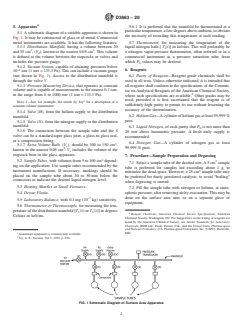
5.1 A schematic diagram of the a suitable apparatus is shown in Fig. 1. It may be constructed of glass or of metal. Commercial
metal instruments are available. It has the following features:
3 3
5.1.1 Distribution Manifold, having a volume between 20 and 35 cm , (V ), known to the nearest 0.05 cm . This volume is defined
d
as the volume between the stopcocks or valves and includes the pressure gauge.
FIG. 1 Schematic Diagram of Surface Area Apparatus
Automated equipment is commercially available.
D3663 − 20
−4
5.1.2 Vacuum System, capable of attaining pressures below 10 torr (1 torr = 133.3 Pa). This willcan include a vacuum gauge (not
shown in Fig. 1). Access to the distribution manifold is through the valve V.
5.1.3 Constant-Volume Gauge or Mercury Manometer, Pressure-Measuring Device, that operates at constant volume and is
capable of measurements to the nearest 0.1 torr, in the range from 0 to 1000 torr (1 torr = 133.3 Pa).
NOTE 1—See, for example, the article by Joy for a description of a constant-volume manometer.
5.1.4 Valve (H), from the helium supply to the distribution manifold.
5.1.5 Valve (N), from the nitrogen supply to the distribution manifold.
5.1.6 The connection between the sample tube and the S valve can be a standard-taper glass joint, a glass-to-glass seal, or a
compression fitting.
3 3
5.1.7 Extra Volume Bulb, (V ), should be 100 to 150 cm , known to the nearest 0.05 cm . V includes the volume of the stopcock
x x
bore in the glass apparatus.
5.2 Sample Tubes, with volumes from 5 to 100 cm100 cm depending on the application. Markings Use sample tubes
recommended by the instrument manufacturer. If necessary, markings should be placed on the sample tubestube about 30 to 50
mm 50 mm below the connectors to indicate the desired liquid nitrogen level.
5.3 Heating Mantles or Small Furnaces.
5.4 Dewar Flasks.
−7
5.5 Laboratory Balance, with 0.1 mg (10 kg) sensitivity.
5.6 Thermometer or Thermocouple, for measuring the temperature of the distribution manifold [T '(i) or T '(i)] in degrees
1 2
Celsius.Celsius or kelvins.
5.6.1 It is preferred that the manifold be thermostated at a particular temperature, a few degrees above ambient, to obviate the
necessity of recording this temperature at each reading.
5.7 Thermometer, for measuring the temperature of the liquid nitrogen bath [ T (i)] in kelvins. This will preferably be a nitrogen
s
vapor-pressure thermometer, often referred to in a commercial instrument as a pressure saturation tube, from which P values may
be derived.
6. Reagents
6.1 Purity of Reagents—Reagent grade chemicals shall be used in all tests. Unless otherwise indicated, it is intended that all
reagents shall conform to the specifications of the Committee on Analytical Reagents of the American Chemical Society, where
such specifications are available. Other grades may be used, provided it is first ascertained that the reagent is of sufficiently high
purity to permit its use without lessening the accuracy of the determination.
6.2 Helium Gas—A cylinder of helium gas at least 99.9 %99.999 % pure.
6.3 Liquid Nitrogen, of such purity that P is not more than 20 torr above barometric pressure. A fresh daily supply is
recommended.
Joy, A. S., Vacuum, Vol 3, 1953, p. 254.
Reagent Chemicals, American Chemical Society Specifications, American Chemical Society, Washington, DC. For Suggestions on the testing of reagents not listed by
the American Chemical Society, see AnnualAnalar Standards for Laboratory Chemicals, BDH Ltd., Poole, Dorset, U.K., and the United States Pharmacopeia and National
Formulary, U.S. Pharmacopeial Convention, Inc. (USPC), Rockville, MD.
D3663 − 20
6.4 Nitrogen Gas—A cylinder of nitrogen gas at least 99.999 % pure.
7. Procedure—Sample Preparation and Degassing
7.1 Select a sample tube of the desired size. A 5 cm sample tube is preferred for samples not exceeding about 1 g, to minimize
the dead-space. However, a 25 cm sample tube may be preferred for finely powdered catalysts, to avoid “boiling” when degassing
is started.
7.2 Fill the sample tube with nitrogen or helium, at atmospheric pressure, after removing air by evacuation. This may be done on
the surface area unit, or on a separate piece of equipment.
7.3 Remove the sample tube from the system, cap, and weigh. Record the mass as W .
7.4 Place the catalyst sample, whose mass is known approximately, into the sample tube. Choose the sample size to provide an
estimated total sample surface area of 20 to 100 m .
7.5 Attach the sample tube to the apparatus. If other samples are to be run, attach them at this time to the other ports.
7.6 Open the S valves where there are samples.
7.7 It may be necessary to close the V valve system periodically to protect the diffusion pump fluid from exposure to pressures
above 0.1 torr for periods of more than 30 s. Close the valve off for 2 min.
7.8 Install a heating mantle or furnace around each sample and raise the temperature to about 300°C300 °C (573 K).
NOTE 2—Take special precautions if the moisture content exceeds approximately 5 % to avoid “bumping” of powdered catalyst, and to avoid surface area
loss by self-steaming. It is recommended that the heating rate not exceed 100 KA stepped or pressure-controlled heating routine is recommended ⁄h under
these circumstances.
NOTE 3—Not all catalysts or their supports are stable to 300 °C. This should be noted and the appropriate temperature should be used based on thermal
properties of the material.
−3
7.9 Continue degassing at about 300°C300 °C (573 K) for a minimum of 3 h, 3 h, at a pressure not to exceed 10 torr. Overnight
degassing is permissible.
NOTE 3—Certain materials will decompose at 300°C (for example, alumina hydrates) or will sinter (for example, platinum black). Lower degassing
temperatures are permissible for such materials; however, the degassing temperature should be specified when reporting the results.
7.10 Remove the heating mantles, and allow the samples to cool.
7.11 Close the EV valve, if open.
7.12 Close the S valve.
7.13 It is permissible to exercise the option of preliminary degassing on an external unit. In such a case, follow the procedures
of 7.4 – 7.11 and then repeat on the surface area unit, except that the degassing time in 7.9 should not exceed 1 h.1 h.
7.14 If it is desired to weigh the sample after preliminary degassing on an external unit, backfill with the same gas used in 7.2
to above atmospheric pressure. Close the S valve.
7.15 Detach the sample tube from the apparatus, recap with the stopper used previously, and weigh. Record the mass as W .
D3663 − 20
−4
7.16 Remove the backfilled gas by evacuation to less than 10 torr at room temperature.
8. Procedure—Dead-Space Determination
8.1 From this point on, each sample being tested for surface area must be run on an individual basis. Thus each Step (8.2 – 9.17)
must be carried out separately for each tube in test.
8.2 The “dead-space” is the void volume of the charged sample tube, including the S valve, when the tube is immersed in liquid
nitrogen to the proper depth (see 5.2).
NOTE 4—The dead-space may be determined after the nitrogen adsorption, if more convenient, as long as ade
...