

ASTM E2652-22
(Test Method)Standard Test Method for Assessing Combustibility of Materials Using a Tube Furnace with a Cone-shaped Airflow Stabilizer, at 750 °C
General Information
- Abstract
SIGNIFICANCE AND USE
5.1 While actual building fire exposure conditions are not duplicated, this test method will assist in indicating those materials which do not act to aid combustion or add appreciable heat to an ambient fire.
5.2 This test method does not apply to laminated or coated materials.
5.3 This test method is technically equivalent to ISO 1182.
5.4 When appropriate pass/fail criteria are applied, materials that are reported as passing this test by complying with those criteria (such as the ones in Appendix X2) are typically classified as noncombustible materials.
SCOPE
1.1 This fire-test-response test method covers the determination under specified laboratory conditions of the combustibility of building materials. Under certain conditions, with the appropriate pass/fail criteria, the results from this test are used to classify materials as noncombustible materials.
1.2 Limitations of this fire-test response test method are shown below.
1.2.1 This test method does not apply to laminated or coated materials.
1.2.2 This test method is not suitable or satisfactory for materials that soften, flow, melt, intumesce or otherwise separate from the measuring thermocouple.
1.2.3 This test method does not provide a measure of an intrinsic property.
1.2.4 This test method does not provide a quantitative measure of heat generation or combustibility; it simply serves as a test method with selected (end point) measures of combustibility.
1.2.5 This test method does not measure the self-heating tendencies of materials.
1.2.6 In this test method materials are not being tested in the nature and form used in building aplications. The test specimen consists of a small, specified volume that is either (1) cut from a thick sheet; (2) assembled from multiple thicknesses of thin sheets; or (3) placed in a container if composed of grarnular powder or loose fiber materials.
1.2.7 Results from this test method apply to the specific test apparatus and test conditions and are likely to vary when changes are made to one or more of the following: (1) the size, shape, and arrangement of the specimen; (2) the distribution of organice content; (3) the exposure temperature; (4) the air supply; (5) the location of thermocouples.
1.3 This test method references notes and footnotes that provide explanatory information. These notes and footnotes, excluding those in tables and figures, shall not be considered as requirements of this test method.
1.4 The values stated in SI units are to be regarded as standard. The values given in parentheses are for information only.
1.5 This test method is technically equivalent to ISO 1182:2010 (see also Annex A2 and 6.4.5).
Note 1: While developed as technically equivalent to ISO 1182:2010, a change implemented in ISO 1182:2020 added a second furnace thermocouple to that standard, while this test method continues to use one furnace thermocouple.
1.6 This standard is used to measure and describe the response of materials, products, or assemblies to heat and flame under controlled conditions, but does not by itself incorporate all factors required for fire-hazard or fire-risk assessment of the materials, products, or assemblies under actual fire conditions.
1.7 Fire testing is inherently hazardous. Adequate safeguards for personnel and property shall be employed in conducting these tests.
1.8 This standard does not purport to address all of the safety concerns, if any, associated with its use. It is the responsibility of the user of this standard to establish appropriate safety, health, and environmental practices and determine the applicability of regulatory limitations prior to use.
1.9 This international standard was developed in accordance with internationally recognized principles on standardization established in the Decision on Principles for the Development of International Standards, Guides and Recommendations issued by the World Trade Orga...
- Status
- Published
- Publication Date
- 31-Oct-2022
- Technical Committee
- E05 - Fire Standards
- Drafting Committee
- E05.23 - Combustibility
Buy Documents
ASTM E2652-22 - Standard Test Method for Assessing Combustibility of Materials Using a Tube Furnace with a Cone-shaped Airflow Stabilizer, at 750 °C
REDLINE ASTM E2652-22 - Standard Test Method for Assessing Combustibility of Materials Using a Tube Furnace with a Cone-shaped Airflow Stabilizer, at 750 °C
Overview
ASTM E2652-22-"Standard Test Method for Assessing Combustibility of Materials Using a Tube Furnace with a Cone-shaped Airflow Stabilizer, at 750 °C"-is a pivotal fire-test-response standard developed by ASTM International. This test method evaluates the combustibility of building materials under controlled laboratory conditions using a refractory tube furnace stabilized at 750 °C with a unique cone-shaped airflow stabilizer. While it does not replicate real-world fire conditions or assess all aspects of fire hazards, ASTM E2652-22 provides critical data for identifying materials that do not contribute substantially to fire growth, supporting classifications such as "noncombustible" when appropriate criteria are applied.
Key Topics
Purpose and Scope
- Assesses the tendency of building materials to contribute to fire by determining combustibility under defined laboratory settings.
- Applies specifically to the tested apparatus and conditions; results may vary with changes in specimen size, shape, or arrangement.
- Not suitable for laminated, coated, or materials that melt, intumesce, or detach from the measuring thermocouple.
- Does not provide intrinsic or quantitative heat generation properties, nor does it assess self-heating behavior.
Test Apparatus Overview
- Utilizes a refractory tube furnace at 750 °C, equipped with a cone-shaped airflow stabilizer and a draft shield.
- Relies on thermocouples to record temperature changes during material exposure.
- Involves weighing specimens before and after testing and monitoring for sustained flaming.
Equivalency and Limitations
- Technically equivalent to ISO 1182:2010, though differences exist (e.g., ISO 1182:2020 version adds a second thermocouple).
- Data from ASTM E2652-22 may support regulatory or design requirements where noncombustible material classification is needed.
Applications
Building and Construction Materials
- Used by manufacturers and regulatory bodies to qualify new and existing building products as noncombustible when they pass set criteria, which may be defined by national or international codes.
- Supports selection of safe materials for critical construction applications such as fire barriers, insulation, and other passive fire protection systems.
Third-Party Certification and Regulatory Compliance
- Provides test data frequently required for code compliance in jurisdictions referencing ASTM E2652-22 or equivalent ISO fire resistance standards.
- Assists in quality assurance for manufacturers seeking third-party certification of fire performance for their products.
Research and Development
- Valuable in product development for comparing material performance, screening prototypes, and optimizing formulations for improved fire safety characteristics.
Related Standards
- ISO 1182:2010/2020
Reaction to Fire Tests for Building Products-Non-combustibility Test (technical equivalence, but ISO 1182:2020 includes a second furnace thermocouple) - ASTM E136
Test Method for Assessing Combustibility of Materials Using a Vertical Tube Furnace at 750 °C - ISO 13943
Fire Safety-Vocabulary (for definitions of fire safety terms) - IMO Fire Test Procedures Code
Referenced for marine safety applications
Keywords: combustibility, building materials, noncombustible classification, tube furnace, cone-shaped airflow stabilizer, ASTM E2652, ISO 1182, fire test method, construction product fire safety, fire resistance testing
Summary
ASTM E2652-22 is an essential method for evaluating and classifying the combustibility of building materials, ensuring their suitability for applications requiring enhanced fire safety. Its adoption supports regulatory compliance, safe material selection, and advancement in building technology, with strong alignment to global fire testing standards.
Relations
- Effective Date
- 01-Mar-2024
- Effective Date
- 01-Feb-2024
- Effective Date
- 01-Jan-2024
- Effective Date
- 01-Feb-2019
- Effective Date
- 15-Dec-2018
- Effective Date
- 01-Mar-2018
- Effective Date
- 01-Nov-2016
- Effective Date
- 01-Jan-2016
- Effective Date
- 01-Aug-2015
- Effective Date
- 01-Aug-2015
- Effective Date
- 01-Feb-2015
- Effective Date
- 01-Oct-2014
- Effective Date
- 15-Aug-2014
- Effective Date
- 01-Aug-2014
- Effective Date
- 01-Jul-2014
Buy Documents
ASTM E2652-22 - Standard Test Method for Assessing Combustibility of Materials Using a Tube Furnace with a Cone-shaped Airflow Stabilizer, at 750 °C
REDLINE ASTM E2652-22 - Standard Test Method for Assessing Combustibility of Materials Using a Tube Furnace with a Cone-shaped Airflow Stabilizer, at 750 °C
Get Certified
Connect with accredited certification bodies for this standard

CIS Institut d.o.o.
Personal Protective Equipment (PPE) certification body. Notified Body NB-2890 for EU Regulation 2016/425 PPE.

Kiwa BDA Testing
Building and construction product certification.
Kmetijski inštitut Slovenije
Agricultural Institute of Slovenia. Soil testing, plant health, agricultural product analysis.
Sponsored listings
Frequently Asked Questions
ASTM E2652-22 is a standard published by ASTM International. Its full title is "Standard Test Method for Assessing Combustibility of Materials Using a Tube Furnace with a Cone-shaped Airflow Stabilizer, at 750 °C". This standard covers: SIGNIFICANCE AND USE 5.1 While actual building fire exposure conditions are not duplicated, this test method will assist in indicating those materials which do not act to aid combustion or add appreciable heat to an ambient fire. 5.2 This test method does not apply to laminated or coated materials. 5.3 This test method is technically equivalent to ISO 1182. 5.4 When appropriate pass/fail criteria are applied, materials that are reported as passing this test by complying with those criteria (such as the ones in Appendix X2) are typically classified as noncombustible materials. SCOPE 1.1 This fire-test-response test method covers the determination under specified laboratory conditions of the combustibility of building materials. Under certain conditions, with the appropriate pass/fail criteria, the results from this test are used to classify materials as noncombustible materials. 1.2 Limitations of this fire-test response test method are shown below. 1.2.1 This test method does not apply to laminated or coated materials. 1.2.2 This test method is not suitable or satisfactory for materials that soften, flow, melt, intumesce or otherwise separate from the measuring thermocouple. 1.2.3 This test method does not provide a measure of an intrinsic property. 1.2.4 This test method does not provide a quantitative measure of heat generation or combustibility; it simply serves as a test method with selected (end point) measures of combustibility. 1.2.5 This test method does not measure the self-heating tendencies of materials. 1.2.6 In this test method materials are not being tested in the nature and form used in building aplications. The test specimen consists of a small, specified volume that is either (1) cut from a thick sheet; (2) assembled from multiple thicknesses of thin sheets; or (3) placed in a container if composed of grarnular powder or loose fiber materials. 1.2.7 Results from this test method apply to the specific test apparatus and test conditions and are likely to vary when changes are made to one or more of the following: (1) the size, shape, and arrangement of the specimen; (2) the distribution of organice content; (3) the exposure temperature; (4) the air supply; (5) the location of thermocouples. 1.3 This test method references notes and footnotes that provide explanatory information. These notes and footnotes, excluding those in tables and figures, shall not be considered as requirements of this test method. 1.4 The values stated in SI units are to be regarded as standard. The values given in parentheses are for information only. 1.5 This test method is technically equivalent to ISO 1182:2010 (see also Annex A2 and 6.4.5). Note 1: While developed as technically equivalent to ISO 1182:2010, a change implemented in ISO 1182:2020 added a second furnace thermocouple to that standard, while this test method continues to use one furnace thermocouple. 1.6 This standard is used to measure and describe the response of materials, products, or assemblies to heat and flame under controlled conditions, but does not by itself incorporate all factors required for fire-hazard or fire-risk assessment of the materials, products, or assemblies under actual fire conditions. 1.7 Fire testing is inherently hazardous. Adequate safeguards for personnel and property shall be employed in conducting these tests. 1.8 This standard does not purport to address all of the safety concerns, if any, associated with its use. It is the responsibility of the user of this standard to establish appropriate safety, health, and environmental practices and determine the applicability of regulatory limitations prior to use. 1.9 This international standard was developed in accordance with internationally recognized principles on standardization established in the Decision on Principles for the Development of International Standards, Guides and Recommendations issued by the World Trade Orga...
SIGNIFICANCE AND USE 5.1 While actual building fire exposure conditions are not duplicated, this test method will assist in indicating those materials which do not act to aid combustion or add appreciable heat to an ambient fire. 5.2 This test method does not apply to laminated or coated materials. 5.3 This test method is technically equivalent to ISO 1182. 5.4 When appropriate pass/fail criteria are applied, materials that are reported as passing this test by complying with those criteria (such as the ones in Appendix X2) are typically classified as noncombustible materials. SCOPE 1.1 This fire-test-response test method covers the determination under specified laboratory conditions of the combustibility of building materials. Under certain conditions, with the appropriate pass/fail criteria, the results from this test are used to classify materials as noncombustible materials. 1.2 Limitations of this fire-test response test method are shown below. 1.2.1 This test method does not apply to laminated or coated materials. 1.2.2 This test method is not suitable or satisfactory for materials that soften, flow, melt, intumesce or otherwise separate from the measuring thermocouple. 1.2.3 This test method does not provide a measure of an intrinsic property. 1.2.4 This test method does not provide a quantitative measure of heat generation or combustibility; it simply serves as a test method with selected (end point) measures of combustibility. 1.2.5 This test method does not measure the self-heating tendencies of materials. 1.2.6 In this test method materials are not being tested in the nature and form used in building aplications. The test specimen consists of a small, specified volume that is either (1) cut from a thick sheet; (2) assembled from multiple thicknesses of thin sheets; or (3) placed in a container if composed of grarnular powder or loose fiber materials. 1.2.7 Results from this test method apply to the specific test apparatus and test conditions and are likely to vary when changes are made to one or more of the following: (1) the size, shape, and arrangement of the specimen; (2) the distribution of organice content; (3) the exposure temperature; (4) the air supply; (5) the location of thermocouples. 1.3 This test method references notes and footnotes that provide explanatory information. These notes and footnotes, excluding those in tables and figures, shall not be considered as requirements of this test method. 1.4 The values stated in SI units are to be regarded as standard. The values given in parentheses are for information only. 1.5 This test method is technically equivalent to ISO 1182:2010 (see also Annex A2 and 6.4.5). Note 1: While developed as technically equivalent to ISO 1182:2010, a change implemented in ISO 1182:2020 added a second furnace thermocouple to that standard, while this test method continues to use one furnace thermocouple. 1.6 This standard is used to measure and describe the response of materials, products, or assemblies to heat and flame under controlled conditions, but does not by itself incorporate all factors required for fire-hazard or fire-risk assessment of the materials, products, or assemblies under actual fire conditions. 1.7 Fire testing is inherently hazardous. Adequate safeguards for personnel and property shall be employed in conducting these tests. 1.8 This standard does not purport to address all of the safety concerns, if any, associated with its use. It is the responsibility of the user of this standard to establish appropriate safety, health, and environmental practices and determine the applicability of regulatory limitations prior to use. 1.9 This international standard was developed in accordance with internationally recognized principles on standardization established in the Decision on Principles for the Development of International Standards, Guides and Recommendations issued by the World Trade Orga...
ASTM E2652-22 is classified under the following ICS (International Classification for Standards) categories: 13.220.50 - Fire-resistance of building materials and elements. The ICS classification helps identify the subject area and facilitates finding related standards.
ASTM E2652-22 has the following relationships with other standards: It is inter standard links to ASTM E136-24a, ASTM E136-24, ASTM E176-24, ASTM E136-19, ASTM E176-18a, ASTM E176-18, ASTM E136-16a, ASTM E136-16, ASTM E176-15a, ASTM E176-15ae1, ASTM E176-15, ASTM E176-14c, ASTM E176-14b, ASTM E176-14a, ASTM E176-14. Understanding these relationships helps ensure you are using the most current and applicable version of the standard.
ASTM E2652-22 is available in PDF format for immediate download after purchase. The document can be added to your cart and obtained through the secure checkout process. Digital delivery ensures instant access to the complete standard document.
Standards Content (Sample)
This international standard was developed in accordance with internationally recognized principles on standardization established in the Decision on Principles for the
Development of International Standards, Guides and Recommendations issued by the World Trade Organization Technical Barriers to Trade (TBT) Committee.
Designation:E2652 −22 An American National Standard
Standard Test Method for
Assessing Combustibility of Materials Using a Tube Furnace
with a Cone-shaped Airflow Stabilizer, at 750°C
This standard is issued under the fixed designation E2652; the number immediately following the designation indicates the year of
original adoption or, in the case of revision, the year of last revision. A number in parentheses indicates the year of last reapproval. A
superscript epsilon (´) indicates an editorial change since the last revision or reapproval.
1. Scope* excludingthoseintablesandfigures,shallnotbeconsideredas
requirements of this test method.
1.1 This fire-test-response test method covers the determi-
nation under specified laboratory conditions of the combusti- 1.4 The values stated in SI units are to be regarded as
bility of building materials. Under certain conditions, with the standard. The values given in parentheses are for information
appropriate pass/fail criteria, the results from this test are used only.
to classify materials as noncombustible materials.
1.5 This test method is technically equivalent to ISO
1.2 Limitations of this fire-test response test method are 1182:2010 (see also Annex A2 and 6.4.5).
shown below.
NOTE 1—While developed as technically equivalent to ISO 1182:2010,
1.2.1 Thistestmethoddoesnotapplytolaminatedorcoated
a change implemented in ISO 1182:2020 added a second furnace
materials.
thermocouple to that standard, while this test method continues to use one
furnace thermocouple.
1.2.2 This test method is not suitable or satisfactory for
materials that soften, flow, melt, intumesce or otherwise
1.6 This standard is used to measure and describe the
separate from the measuring thermocouple.
response of materials, products, or assemblies to heat and
1.2.3 This test method does not provide a measure of an
flame under controlled conditions, but does not by itself
intrinsic property.
incorporate all factors required for fire-hazard or fire-risk
1.2.4 This test method does not provide a quantitative
assessment of the materials, products, or assemblies under
measure of heat generation or combustibility; it simply serves
actual fire conditions.
as a test method with selected (end point) measures of
1.7 Fire testing is inherently hazardous. Adequate safe-
combustibility.
guards for personnel and property shall be employed in
1.2.5 This test method does not measure the self-heating
conducting these tests.
tendencies of materials.
1.8 This standard does not purport to address all of the
1.2.6 Inthistestmethodmaterialsarenotbeingtestedinthe
safety concerns, if any, associated with its use. It is the
natureandformusedinbuildingaplications.Thetestspecimen
responsibility of the user of this standard to establish appro-
consists of a small, specified volume that is either (1) cut from
priate safety, health, and environmental practices and deter-
a thick sheet; (2) assembled from multiple thicknesses of thin
mine the applicability of regulatory limitations prior to use.
sheets; or (3) placed in a container if composed of grarnular
1.9 This international standard was developed in accor-
powder or loose fiber materials.
dance with internationally recognized principles on standard-
1.2.7 Results from this test method apply to the specific test
ization established in the Decision on Principles for the
apparatus and test conditions and are likely to vary when
Development of International Standards, Guides and Recom-
changes are made to one or more of the following: (1) the size,
mendations issued by the World Trade Organization Technical
shape, and arrangement of the specimen; (2) the distribution of
Barriers to Trade (TBT) Committee.
organice content; (3) the exposure temperature; (4) the air
supply; (5) the location of thermocouples.
2. Referenced Documents
1.3 This test method references notes and footnotes that
2.1 ASTM Standards:
provide explanatory information. These notes and footnotes,
E136 TestMethodforAssessingCombustibilityofMaterials
Using a Vertical Tube Furnace at 750 °C
This test method is under the jurisdiction of ASTM Committee E05 on Fire
Standards and is the direct responsibility of Subcommittee E05.23 on Combustibil-
ity. For referenced ASTM standards, visit the ASTM website, www.astm.org, or
Current edition approved Nov. 1, 2022. Published November 2022. Originally contact ASTM Customer Service at service@astm.org. For Annual Book of ASTM
approved in 2009. Last previous edition approved in 2018 as E2652–18. DOI: Standards volume information, refer to the standard’s Document Summary page on
10.1520/E2652-22. the ASTM website.
*A Summary of Changes section appears at the end of this standard
Copyright © ASTM International, 100 Barr Harbor Drive, PO Box C700, West Conshohocken, PA 19428-2959. United States
E2652−22
E176 Terminology of Fire Standards 5.4 When appropriate pass/fail criteria are applied, materi-
als that are reported as passing this test by complying with
2.2 ISO Standards:
those criteria (such as the ones in Appendix X2) are typically
ISO 1182:2010 Reaction to Fire Tests for Building Products
classified as noncombustible materials.
– Non-combustibility Test
ISO 1182:2020 Reaction to Fire Tests for Building Products
6. Test Apparatus
– Non-combustibility Test
ISO 13943 Fire Safety — Vocabulary
6.1 General:
ISO 5725-2:1994 Accuracy (trueness and precision) of Mea-
6.1.1 Theapparatusshallconsistofarefractorytubefurnace
sured Methods and Results – Part 2: Basic Method for the
insulated and surrounded by a heating coil. A cone-shaped
Determination of Repeatability and Reproducibility of a
airflow stabilizer shall be attached to the base of the furnace
Standard Measurement Method
and a draft shield to its top. Details are shown in Fig. 1.
2.3 Other Standards:
6.1.2 Thermocouples shall be provided for measuring the
IMO Fire Test Procedures Code
furnace temperature and the furnace wall temperature. Op-
tional additional thermocouples shall be used if the specimen
3. Terminology
surface temperature and the specimen center temperature are
3.1 Definitions—For definitions of terms found in this test
required.
method, refer to Terminology E176 and ISO 13943. In case of 6.1.3 Athermal sensor shall be used to measure the furnace
conflict, the definitions given in Terminology E176 shall
temperature along its central axis.
prevail. 6.1.4 Unless stated otherwise, all dimensions shall have a
3.2 Definitions of Terms Specific to This Standard:
5 % tolerance.
3.2.1 homogeneous product, n—a product with nominally
6.2 Test Furnace:
uniform density and composition.
6.2.1 The test furnace shall consist primarily of the follow-
3.2.2 non-homogeneous product, n—a product that does not
ing.
satisfy the requirements of a homogeneous product.
6.2.2 The furnace tube shall be constructed of a refractory
3.2.2.1 Discussion—Non-homogeneous products are often
material, as specified in Table 1, of density 2800 kg/m 6 300
3 3 3
composed of more than one component.
kg/m (175 lb⁄ft 6 19 lb/ft ).
3.2.3 sustained flaming (for testing at 750 °C), n—sustained 6.2.3 The furnace shall be 150 mm 6 1 mm (5.9 in. 6 0.04
in.) high with an internal diameter of 75 mm 6 1 mm (2.9 in.
flaming for testing at 750 °C (1382 °F) is the persistence of a
6 0.04 in.) and a wall thickness of 10 mm 6 1 mm (0.4 in. 6
flameonoroveranypartofthevisiblepartofthetestspecimen
0.04 in.).
lasting5sor longer.
6.2.4 The furnace tube shall be surrounded by an annular
4. Summary of Test Method
spaceofthefollowingdimensions:150mm(5.9 in. 60.04in.)
high and of 10 mm (0.4 in. 6 0.04 in.) wall thickness.
4.1 This test method uses a furnace to expose building
6.2.4.1 Theannularspaceshallbefittedwithtopandbottom
materials for at least 30 min to a temperature of 750 °C
plates, recessed internally to locate the ends of the furnace
(1382 ºF).
tube.
4.2 The furnace consists of an enclosed refractory tube
6.2.4.2 The annular space shall be insulated with a 25 mm
surrounded by a heating coil with a cone-shaped airflow
(1 in.) mm layer of an insulating material having a thermal
stabilizer.
conductivity of 0.04 W⁄(m K) 6 0.01 W/(m K) (0.00077 6
4.3 Thermocouples are used to assess the temperature in-
0.00019 BTU in./(s ft °F)) at a mean temperature of 20 °C
creases resulting from combustion of the product.
(68 °F).Magnesiumoxidepowderofanominalbulkdensityof
3 3 3 3
170 kg⁄m 6 30 kg/m (10.6 lb⁄ft 6 1.9 lb/ft ) is a suitable
4.4 Weight loss and flaming combustion of the product is
material for this use.
also assessed.
6.2.5 The furnace tube shall be provided with a single
winding of 80/20 nickel/chromium electrical resistance tape,
5. Significance and Use
3mm 6 0.1 mm (0.12 in. 6 4/1000 in.) wide and 0.2 mm 6
5.1 While actual building fire exposure conditions are not
0.01 mm (8/1000 in. 6 0.4/1000 in.) thick.
duplicated, this test method will assist in indicating those
6.2.5.1 Wind the electrical resistance tape as specified in
materials which do not act to aid combustion or add appre-
Fig. 2.
ciable heat to an ambient fire.
6.2.5.2 Cut grooves into the furnace tube so as to allow
5.2 This test method does not apply to laminated or coated
accurate winding of the electrical tape.
materials.
6.2.6 An open-ended cone-shaped air-flow stabilizer shall
5.3 This test method is technically equivalent to ISO 1182. be attached to the underside of the furnace.
6.2.6.1 The air-flow stabilizer shall be 500 mm (19.7 in.)
long and shall be reduced uniformly from an internal diameter
Available fromAmerican National Standards Institute (ANSI), 25 W. 43rd St.,
of 75 mm 6 1 mm (2.9 in. 6 0.04 in.) at the top to an internal
4th Floor, New York, NY 10036, http://www.ansi.org.
diameter of 10.0 mm 6 0.5 mm (0.4 in. 6 0.4 in.) at the
Available from International Maritime Origanization, 55 Victoria St., London,
SWIH0EU, United Kingdom, http://www.imo.org. bottom.
E2652−22
FIG. 1Test Apparatus
Key to numbers in Fig. 1
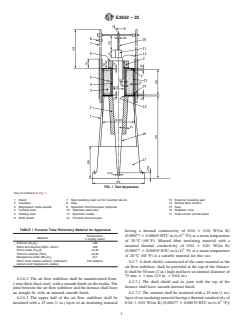
1 Stand 7 Heat resisting steel rod for insertion device 13 External insulating wall
2 Insulation 8 Stop 14 Mineral fiber cement
3 Magnesium oxide powder 9 Specimen thermocouples (optional) 15 Seal
4 Furnace tube 10 Stainless steel tube 16 Stabilizer cone
5 Heating coils 11 Specimen holder 17 Draft screen (metal sheet)
6 Draft shield 12 Furnace thermocouple
TABLE 1 Furnace Tube Refractory Material for Apparatus
having a thermal conductivity of 0.04 6 0.01 W/(m K)
Composition
(0.00077 6 0.00019 BTU in./(s ft °F)) at a mean temperature
Material
% (kg/kg mass)
of 20 °C (68 °F). Mineral fiber insulating material with a
Alumina (Al O ) >89
2 3
nominal thermal conductivity of 0.04 6 0.01 W/(m K)
Silica and alumina (SiO ,Al O ) >98
2 2 3
Ferric oxide (Fe O) <0,45
2 (0.00077 6 0.00019 BTU in./(s ft °F) at a mean temperature
Titanium dioxide (TiO ) <0,25
of 20 °C (68 °F) is a suitable material for this use.
Manganese oxide (Mn O ) <0,1
3 4
Other trace oxides (sodium, potassium, The balance
6.2.7 Adraft shield, constructed of the same material as the
calcium and magnesium oxides)
air flow stabilizer, shall be provided at the top of the furnace.
It shall be 50 mm (2 in.) high and have an internal diameter of
75 mm 6 1 mm (2.9 in. 6 0.04 in.)
6.2.6.2 The air flow stabilizer shall be manufactured from
6.2.7.1 The draft shield and its joint with the top of the
1 mm thick sheet steel, with a smooth finish on the inside. The
furnace shall have smooth internal finish.
joint between the air flow stabilizer and the furnace shall have
6.2.7.2 The exterior shall be insulated with a 25 mm (1 in.)
an airtight fit, with an internal smooth finish.
layer of an insulating material having a thermal conductivity of
6.2.6.3 The upper half of the air flow stabilizer shall be
insulated with a 25 mm (1 in.) layer of an insulating material 0.04 6 0.01 W/(m K) (0.00077 6 0.00019 BTU in./(s ft °F))
E2652−22
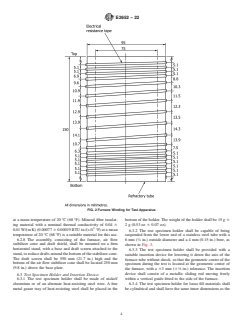
FIG. 2Furnace Winding for Test Apparatus
at a mean temperature of 20 °C (68 °F). Mineral fiber insulat- bottom of the holder. The weight of the holder shall be 15 g 6
ing material with a nominal thermal conductivity of 0.04 6 2 g (0.53 oz 6 0.07 oz).
0.01W/(mK)(0.00077 60.00019BTUin./(sft °F)atamean
6.3.2 The test specimen holder shall be capable of being
temperature of 20 °C (68 °F) is a suitable material for this use.
suspended from the lower end of a stainless steel tube with a
6.2.8 The assembly, consisting of the furnace, air flow
6mm( ⁄4 in.) outside diameter anda4mm (0.15 in.) bore, as
stabilizer cone and draft shield, shall be mounted on a firm
shown in Fig. 3.
horizontal stand, with a base and draft screen attached to the
6.3.3 The test specimen holder shall be provided with a
stand, to reduce drafts around the bottom of the stabilizer cone.
suitable insertion device for lowering it down the axis of the
The draft screen shall be 550 mm (21.7 in.) high and the
furnace tube without shock, so that the geometric center of the
bottom of the air flow stabilizer cone shall be located 250 mm
specimen during the test is located at the geometric center of
(9.8 in.) above the base plate. 1
the furnace, with a 63mm(6 ⁄8 in.) tolerance. The insertion
device shall consist of a metallic sliding rod moving freely
6.3 Test Specimen Holder and Insertion Device:
within a vertical guide fitted to the side of the furnace.
6.3.1 The test specimen holder shall be made of nickel/
chromium or of an alternate heat-resisting steel wire. A fine 6.3.4 The test specimen holder for loose fill materials shall
metal gauze tray of heat-resisting steel shall be placed in the be cylindrical and shall have the same inner dimensions as the
E2652−22
FIG. 3Specimen Holder for Solid Specimens
Key Dimensions in millimetres
1 Stainless steel tube T Specimen centre thermocouple
c
2 Aperture mesh 0,9 mm diameter of wire 0,4 mm T Specimen surface thermocouple
s
Note – use of T and T is optional
c s
outer dimensions of the test specimen. It shall be made of fine specified in 6.3.1. The specimen holder shall have an open end
metal wire gauze, constructed of heat resisting steel similar to at the top. The weight of the holder shall not exceed 30 g
the wire gauze used at the bottom of the test specimen holder (1.06 oz).
E2652−22
6.4 Thermocouples: 6.10 ElectricalInputMonitor—Anammeterandavoltmeter
6.4.1 Thermocouples shall have a wire diameter of 0.3 mm or wattmeter, shall be provided to enable rapid setting of the
furnace to approximately the operating temperature.
(0.01 in.) and an outer diameter of 1.5 mm (0.06 in.). The hot
junction shall be insulated and not earthed. The thermocouples
6.11 Power Controller—A power controller shall be pro-
shall be of either type K or type N. The thermocouple
vided for use as an alternative to the voltage stabilizer, variable
insulating material shall be either stainless steel or a nickel
transformer and electrical input monitor specified above. It
based alloy.
shall be of the type which incorporates phase-angle firing and
6.4.2 All new thermocouples shall be exposed to a Bunsen
shall be linked to a thyristor unit capable of supplying 1.5 VA.
burner yellow flame for not less than 60 s before use.
The maximum voltage shall not be greater than 100 V and the
current limit shall be adjusted to give “100 % power” equiva-
NOTE 2—This will reduce thermocouple reflectivity.
lent to the maximum rating of the heater coil. The stability of
6.4.3 The furnace thermocouple shall be located with its hot
the power controller shall be approximately 1 % and the set
junction 10.0 mm 6 0.5 mm (0.4 in. 6 0.04 in.) from the tube
point repeatability shall be 61.0 %. The power output shall be
wall and at a height corresponding to the geometric center of
linear over the set point range.
the furnace tube. A locating guide is a useful tool to set the
6.12 Temperature Indicator and Recorder—A temperature
position of the thermocouple. The correct position shall be
indicator shall be provided which is capable of measuring the
maintained with the help of a guide attached to the draft shield.
outputfromthethermocoupletothenearest1 °C(0.5 ºF)orthe
6.4.4 In addition to the thermocouple for the measurement
millivoltequivalent.Itshallproduceapermanentrecordofthis
of the furnace temperature, a similar thermocouple shall be
at intervals of not greater than 1 second.
provided for measuring the furnace wall temperature during
NOTE 3—A digital device or a multirange chart recorder with an
calibration.
operating range of 10 mV full scale deflection with a “zero” of approxi-
6.4.5 Additional required thermocouples are described in
mately 700 °C (1292 ºF) have been found suitable instruments.
6.4.5.1 and 6.4.5.2; they are not to be utilized when testing is
6.13 Timing Device—A timing device shall be provided,
intended to comply with ISO 1182. See also Annex A2.
which is capable of recording elapsed time to the nearest
6.4.5.1 Test Specimen Center Thermocouple—The test
second and accurate to within1sin1h.
specimen center thermocouple shall be positioned so that its
hot junction is located at the geometric center of the test 6.14 Desiccator—Adesiccator shall be provided for storing
specimen. This shall be achieved by drillinga2mm (0.08 in.) the conditioned test specimens.
diameter hole axially in the top of the test specimen.
7. Test Specimens
6.4.5.2 Test Specimen Surface Thermocouple—The test
specimen surface thermocouple shall be positioned so that its
7.1 Alltestspecimensshallbetakenfromasamplewhichis
hot junction is in contact with the test specimen at mid-height
sufficiently large to be representative of the product.
of the test specimen at the start of the test. It shall be located
7.2 Dimensions—The test specimens shall be cylindrical
diametrically opposite the furnace thermocouple.
and each shall be 50 mm 6 3 mm (2.0 in. 6 0.1 in.) high and
6.4.6 An optional mirror is described in Annex A2.
3 3 3
have a volume of 76 000 mm 6 8000 mm (4.6 in. 6 0.5
6.5 Thermal Sensor—The thermal sensor shall be con-
in. )andadiameterof45 mm+0/-2mm(1.8 in.+0/-0.08in.).
structed of a thermocouple of the type specified in 6.4, brazed
7.3 Test Specimen Preparation:
to a copper cylinder 10.0 mm 6 0.2 mm (0.4 in. 6 0.001 in.)
7.3.1 If the material is under 50 mm 6 3 mm (2.0 in. 6 0.1
in diameter and 15.0 mm 6 0.2 mm (0.6 in. 6 0.001 in.) high.
in.) thick, cylindrical test specimens of the required thickness
6.6 Mirror—To facilitate observation of sustained flaming
shall be created by using multiple layers of material to obtain
andforoperatorsafety,itisadvisabletoprovideamirrorabove
a test specimen that is 50 mm 6 3 mm (2.0 in. 6 0.1 in.) thick.
the apparatus, positioned so that it will not affect the test. A
7.3.2 If the material is over 50 mm 6 3 mm (2.0 in. 6 0.1
square mirror, 300 mm (11.8 in.) per side, at an angle of 30° to
in.) thick, material thickness shall be reduced to obtain a
the horizontal, and placed 1 m (1.1 yd) above the furnace has
cylindrical test specimen that is 50 mm 6 3 mm (2.0 in. 6 0.1
been found suitable.
in.) thick.
7.3.3 The layers shall be placed horizontally in the speci-
6.7 Balance—A balance with an accuracy of 0.01 g
men holder and held together by means of two wires of
(0.004 oz) is required.
nickel/chromium or of an alternate heat-resisting steel, to
6.8 Voltage Stabilizer—A single-phase automatic voltage
prevent air gaps between layers. The maximum wire diameter
stabilizer, with a rating of not less than 1.5 kVA, shall be
shall be 0.5 mm (0.2 in.).
provided. It shall be capable of maintaining the accuracy of the
7.3.4 Test specimens of loose fill materials shall be fully
outputvoltagewithin 61 %oftheratedvalue,fromzerotofull
representative of the material in its actual use.
load.
7.3.5 The test specimens shall be dried in a ventilated oven
6.9 Variable Transformer—A voltage transformer capable maintained at 60 °C 6 5 °C (140 ºF 6 9 ºF), for between 20 h
of handling at least 1.5 kVA and of regulating the voltage and 24 h, and cooled to ambient temperature in a desiccator
output from zero to a maximum value equal to that of the input prior to testing. The weight of each specimen shall be deter-
voltage shall be provided. The voltage output shall vary mined to an accuracy of 0.01 g (0.004 oz) prior to test and
linearly over the range. recorded.
E2652−22
7.3.6 Not less than four identical specimens shall be tested. mid-height point of the furnace tube and at positions both
30 mm (1.2 in.) above and 30 mm (1.2 in.) below the
8. Procedure
mid-height point.
8.1 Test Setup: 8.2.1.1 The contact thermocouple shall be of the type
8.1.1 Conduct the test at room conditions of 21 °C 63°C described in 6.4.1. A typical arrangement is for the thermo-
(70 °F 6 5 °F). couple end to be bent to allow a horizontal contact with the
8.1.2 Thetestapparatusshallnotbeexposedtodraftsorany interior of the furnace wall (as shown in Fig. 4). The contact
form of strong direct sunlight or artificial illumination which
thermocouple shall be supported along its length, for example
would adversely affect the observation of flaming inside the by placing it within a porcelain sheath.
furnace.
8.2.2 Conduct this procedure by using a thermocouple
8.1.3 The room temperature shall not change by more than
scanning device with the thermocouple and insulating tubes in
3 °C (5 °F) during a test.
the positions specified above. Pay particular attention to the
contact between thermocouple and furnace wall which, if poor,
8.2 Furnace Wall Temperature Calibration:
will lead to low temperature readings. At each measurement
8.2.1 When the furnace temperature is stabilized, measure
point the temperature recorded by the thermocouple shall be
the temperature of the furnace wall using the contact thermo-
stable before a temperature reading is taken.
couple (see 8.2.1.1) and the temperature indicator specified.
8.2.3 Obtain nine temperature readings T (i=axis1to3;
Make measurements on three vertical axes of the furnace wall
i;j
j= level a to c for +30 mm; 0 mm and -30 mm) as shown in
(at 0, 120 and 240 degrees from the vertical axis) such that the
Table 2.
distances separating each of the axes a
...
This document is not an ASTM standard and is intended only to provide the user of an ASTM standard an indication of what changes have been made to the previous version. Because
it may not be technically possible to adequately depict all changes accurately, ASTM recommends that users consult prior editions as appropriate. In all cases only the current version
of the standard as published by ASTM is to be considered the official document.
Designation: E2652 − 18 E2652 − 22 An American National Standard
Standard Test Method for
Assessing Combustibility of Materials Using a Tube Furnace
with a Cone-shaped Airflow Stabilizer, at 750°C750 °C
This standard is issued under the fixed designation E2652; the number immediately following the designation indicates the year of
original adoption or, in the case of revision, the year of last revision. A number in parentheses indicates the year of last reapproval. A
superscript epsilon (´) indicates an editorial change since the last revision or reapproval.
1. Scope*
1.1 This fire-test-response test method covers the determination under specified laboratory conditions of the combustibility of
building materials. Under certain conditions, with the appropriate pass/fail criteria, the results from this test are used to classify
materials as noncombustible materials.
1.2 Limitations of this fire-test response test method are shown below.
1.2.1 This test method does not apply to laminated or coated materials.
1.2.2 This test method is not suitable or satisfactory for materials that soften, flow, melt, intumesce or otherwise separate from the
measuring thermocouple.
1.2.3 This test method does not provide a measure of an intrinsic property.
1.2.4 This test method does not provide a quantitative measure of heat generation or combustibility; it simply serves as a test
method with selected (end point) measures of combustibility.
1.2.5 This test method does not measure the self-heating tendencies of materials.
1.2.6 In this test method materials are not being tested in the nature and form used in building aplications. The test specimen
consists of a small, specified volume that is either (1) cut from a thick sheet; (2) assembled from multiple thicknesses of thin sheets;
or (3) placed in a container if composed of grarnular powder or loose fiber materials.
1.2.7 Results from this test method apply to the specific test apparatus and test conditions and are likely to vary when changes
are made to one or more of the following: (1) the size, shape, and arrangement of the specimen; (2) the distribution of organice
content; (3) the exposure temperature; (4) the air supply; (5) the location of thermocouples.
1.3 This test method references notes and footnotes that provide explanatory information. These notes and footnotes, excluding
those in tables and figures, shall not be considered as requirements of this test method.
1.4 The values stated in SI units are to be regarded as standard. The values given in parentheses are for information only.
1.5 This test method is technically equivalent to ISO 11821182:2010 (see also Annex A2 and 6.4.5).
This test method is under the jurisdiction of ASTM Committee E05 on Fire Standards and is the direct responsibility of Subcommittee E05.23 on Combustibility.
Current edition approved Dec. 15, 2018Nov. 1, 2022. Published January 2019November 2022. Originally approved in 2009. Last previous edition approved in 20162018
as E2652–16.–18. DOI: 10.1520/E2652-18.10.1520/E2652-22.
*A Summary of Changes section appears at the end of this standard
Copyright © ASTM International, 100 Barr Harbor Drive, PO Box C700, West Conshohocken, PA 19428-2959. United States
E2652 − 22
NOTE 1—While developed as technically equivalent to ISO 1182:2010, a change implemented in ISO 1182:2020 added a second furnace thermocouple
to that standard, while this test method continues to use one furnace thermocouple.
1.6 This standard is used to measure and describe the response of materials, products, or assemblies to heat and flame under
controlled conditions, but does not by itself incorporate all factors required for fire-hazard or fire-risk assessment of the materials,
products, or assemblies under actual fire conditions.
1.7 FIreFire testing is inherently hazardous. Adequate safeguards for personnel and property shall be employed in conducting
these tests.
1.8 This standard does not purport to address all of the safety concerns, if any, associated with its use. It is the responsibility
of the user of this standard to establish appropriate safety, health, and environmental practices and determine the applicability of
regulatory limitations prior to use.
1.9 This international standard was developed in accordance with internationally recognized principles on standardization
established in the Decision on Principles for the Development of International Standards, Guides and Recommendations issued
by the World Trade Organization Technical Barriers to Trade (TBT) Committee.
2. Referenced Documents
2.1 ASTM Standards:
E136 Test Method for Assessing Combustibility of Materials Using a Vertical Tube Furnace at 750 °C
E176 Terminology of Fire Standards
2.2 ISO Standards:
ISO 11821182:2010 Reaction to Fire Tests for Building Products – Non-combustibility Test
ISO 1182:2020 Reaction to Fire Tests for Building Products – Non-combustibility Test
ISO 13943 Fire Safety — Vocabulary
ISO 5725-2:1994 Accuracy (trueness and precision) of Measured Methods and Results – Part 2: Basic Method for the
Determination of Repeatability and Reproducibility of a Standard Measurement Method
2.3 Other Standards:
IMO Fire Test Procedures Code
3. Terminology
3.1 Definitions—For definitions of terms found in this test method, refer to Terminology E176 and ISO 13943. In case of
conflict, the definitions given in Terminology E176 shall prevail.
3.2 Definitions of Terms Specific to This Standard:
3.2.1 homogeneous product, n—a product with nominally uniform density and composition.
3.2.2 non-homogeneous product, n—a product that does not satisfy the requirements of a homogeneous product.
3.2.2.1 Discussion—
Non-homogeneous products are often composed of more than one component.
3.2.3 sustained flaming (for testing at 750°C),750 °C), n—sustained flaming for testing at 750°C (1382°F)750 °C (1382 °F) is the
persistence of a flame on or over any part of the visible part of the test specimen lasting 5 s or longer.
4. Summary of Test Method
4.1 This test method uses a furnace to expose building materials for at least 30 min to a temperature of 750°C (1382ºF).750 °C
(1382 ºF).
4.2 The furnace consists of an enclosed refractory tube surrounded by a heating coil with a cone-shaped airflow stabilizer.
For referenced ASTM standards, visit the ASTM website, www.astm.org, or contact ASTM Customer Service at service@astm.org. For Annual Book of ASTM Standards
volume information, refer to the standard’s Document Summary page on the ASTM website.
Available from American National Standards Institute (ANSI), 25 W. 43rd St., 4th Floor, New York, NY 10036, http://www.ansi.org.
Available from International Maritime Origanization, 55 Victoria St., London, SWIH0EU, United Kingdom, http://www.imo.org.
E2652 − 22
4.3 Thermocouples are used to assess the temperature increases resulting from combustion of the product.
4.4 Weight loss and flaming combustion of the product is also assessed.
5. Significance and Use
5.1 While actual building fire exposure conditions are not duplicated, this test method will assist in indicating those materials
which do not act to aid combustion or add appreciable heat to an ambient fire.
5.2 This test method does not apply to laminated or coated materials.
5.3 This test method is technically equivalent to ISO 1182.
5.4 When appropriate pass/fail criteria are applied, materials that are reported as passing this test by complying with those criteria
(such as the ones in Appendix X2) are typically classified as noncombustible materials.
6. Test Apparatus
6.1 General:
6.1.1 The apparatus shall consist of a refractory tube furnace insulated and surrounded by a heating coil. A cone-shaped airflow
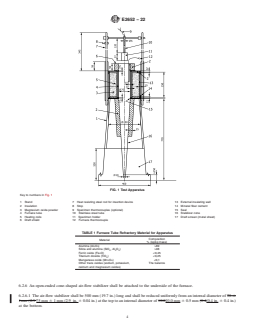
stabilizer shall be attached to the base of the furnace and a draft shield to its top. Details are shown in Fig. 1.
6.1.2 Thermocouples shall be provided for measuring the furnace temperature and the furnace wall temperature. Optional
additional thermocouples shall be used if the specimen surface temperature and the specimen center temperature are required.
6.1.3 A thermal sensor shall be used to measure the furnace temperature along its central axis.
6.1.4 Unless stated otherwise, all dimensions shall have a 5 % tolerance.
6.2 Test Furnace:
6.2.1 The test furnace shall consist primarily of the following.
6.2.2 The furnace tube shall be constructed of a refractory material, as specified in Table 1, of density 2800 2800 kg/m 6 300
3 3 3
kg/m (175(175 lb ⁄ft 6 19 lb/ft ).
6.2.3 The furnace shall be 150150 mm 6 1 mm (5.9(5.9 in. 6 0.04 in.) high with an internal diameter of 7575 mm 6 1 mm
(2.9(2.9 in. 6 0.04 in.) and a wall thickness of 1010 mm 6 1 mm (0.4(0.4 in. 6 0.04 in.).
6.2.4 The furnace tube shall be surrounded by an annular space of the following dimensions: 150 mm (5.9(5.9 in. 6 0.04 in.) high
and of 10 mm (0.4(0.4 in. 6 0.04 in.) wall thickness.
6.2.4.1 The annular space shall be fitted with top and bottom plates, recessed internally to locate the ends of the furnace tube.
6.2.4.2 The annular space shall be insulated with a 25 mm (1 in.) mm layer of an insulating material having a thermal conductivity
of 0.040.04 W ⁄(m K) 6 0.01 W/(m K) (0.00077 6 0.00019 BTU in./(s ft °F)) at a mean temperature of 20°C (68°F).20 °C
3 3 3 3
(68 °F). Magnesium oxide powder of a nominal bulk density of 170170 kg ⁄m 6 30 kg/m (10.6(10.6 lb ⁄ft 6 1.9 lb/ft ) is a
suitable material for this use.
6.2.5 The furnace tube shall be provided with a single winding of 80/20 nickel/chromium electrical resistance tape,
3 mm 6 0.1 mm (0.12(0.12 in. 6 4/1000 in.) wide and 0.20.2 mm 6 0.01 mm (8/1000(8/1000 in. 6 0.4/1000 in.) thick.
6.2.5.1 Wind the electrical resistance tape as specified in Fig. 2.
6.2.5.2 Cut grooves into the furnace tube so as to allow accurate winding of the electrical tape.
E2652 − 22
FIG. 1 Test Apparatus
Key to numbers in Fig. 1
1 Stand 7 Heat resisting steel rod for insertion device 13 External insulating wall
2 Insulation 8 Stop 14 Mineral fiber cement
3 Magnesium oxide powder 9 Specimen thermocouples (optional) 15 Seal
4 Furnace tube 10 Stainless steel tube 16 Stabilizer cone
5 Heating coils 11 Specimen holder 17 Draft screen (metal sheet)
6 Draft shield 12 Furnace thermocouple
TABLE 1 Furnace Tube Refractory Material for Apparatus
Composition
Material
% (kg/kg mass)
Alumina (Al O ) >89
2 3
Silica and alumina (SiO , Al O ) >98
2 2 3
Ferric oxide (Fe O) <0,45
Titanium dioxide (TiO ) <0,25
Manganese oxide (Mn O ) <0,1
3 4
Other trace oxides (sodium, potassium, The balance
calcium and magnesium oxides)
6.2.6 An open-ended cone-shaped air-flow stabilizer shall be attached to the underside of the furnace.
6.2.6.1 The air-flow stabilizer shall be 500 mm (19.7 in.) long and shall be reduced uniformly from an internal diameter of 75 6
1mm (2.9 75 mm 6 1 mm (2.9 in. 6 0.04 in.) at the top to an internal diameter of 10.010.0 mm 6 0.5 mm (0.4(0.4 in. 6 0.4 in.)
at the bottom.
E2652 − 22
FIG. 2 Furnace Winding for Test Apparatus
6.2.6.2 The air flow stabilizer shall be manufactured from
1 mm thick sheet steel, with a smooth finish on the inside. The joint between the air flow stabilizer and the furnace shall have an
airtight fit, with an internal smooth finish.
6.2.6.3 The upper half of the air flow stabilizer shall be insulated with a 25 mm (1 in.) layer of an insulating material having a
thermal conductivity of 0.04 6 0.01 W/(m K) (0.00077 6 0.00019 BTU in./(s ft °F)) at a mean temperature of 20°C (68°F).20 °C
(68 °F). Mineral fiber insulating material with a nominal thermal conductivity of 0.04 6 0.01 W/(m K) (0.00077 6 0.00019 BTU
in./(s ft °F) at a mean temperature of 20°C (68°F)20 °C (68 °F) is a suitable material for this use.
6.2.7 A draft shield, constructed of the same material as the air flow stabilizer, shall be provided at the top of the furnace. It shall
be 50 mm (2 in.) high and have an internal diameter of 7575 mm 6 1 mm (2.9(2.9 in. 6 0.04 in.)
6.2.7.1 The draft shield and its joint with the top of the furnace shall have smooth internal finish.
6.2.7.2 The exterior shall be insulated with a 25 mm (1 in.) layer of an insulating material having a thermal conductivity of 0.04
6 0.01 W/(m K) (0.00077 6 0.00019 BTU in./(s ft °F)) at a mean temperature of 20°C (68°F).20 °C (68 °F). Mineral fiber
E2652 − 22
insulating material with a nominal thermal conductivity of 0.04 6 0.01 W/(m K) (0.00077 6 0.00019 BTU in./(s ft °F) at a mean
temperature of 20°C (68°F)20 °C (68 °F) is a suitable material for this use.
6.2.8 The assembly, consisting of the furnace, air flow stabilizer cone and draft shield, shall be mounted on a firm horizontal stand,
with a base and draft screen attached to the stand, to reduce drafts around the bottom of the stabilizer cone. The draft screen shall
be 550 mm (21.7 in.) high and the bottom of the air flow stabilizer cone shall be located 250 mm (9.8 in.) above the base plate.
6.3 Test Specimen Holder and Insertion Device:
6.3.1 The test specimen holder shall be made of nickel/chromium or of an alternate heat-resisting steel wire. A fine metal gauze
tray of heat-resisting steel shall be placed in the bottom of the holder. The weight of the holder shall be 15 6 2 g (0.53 15 g 6
2 g (0.53 oz 6 0.07 oz).
6.3.2 The test specimen holder shall be capable of being suspended from the lower end of a stainless steel tube with a 6 mm 6 mm
( ⁄4 in.) outside diameter and a 4 mm (0.15 in.) bore, as shown in Fig. 3.
6.3.3 The test specimen holder shall be provided with a suitable insertion device for lowering it down the axis of the furnace tube
without shock, so that the geometric center of the specimen during the test is located at the geometric center of the furnace, with
a 63 mm (6 ⁄8 in.) tolerance. The insertion device shall consist of a metallic sliding rod moving freely within a vertical guide fitted
to the side of the furnace.
6.3.4 The test specimen holder for loose fill materials shall be cylindrical and shall have the same inner dimensions as the outer
dimensions of the test specimen. It shall be made of fine metal wire gauze, constructed of heat resisting steel similar to the wire
gauze used at the bottom of the test specimen holder specified in 6.3.1. The specimen holder shall have an open end at the top.
The weight of the holder shall not exceed 30 g (1.06 oz).(1.06 oz).
6.4 Thermocouples:
6.4.1 Thermocouples shall have a wire diameter of 0.3 mm (0.01 in.) and an outer diameter of 1.5 mm (0.06 in.). The hot junction
shall be insulated and not earthed. The thermocouples shall be of either type K or type N. The thermocouple insulating material
shall be either stainless steel or a nickel based alloy.
6.4.2 All new thermocouples shall be exposed to a Bunsen burner yellow flame for not less than 60 s before use.
NOTE 2—This will reduce thermocouple reflectivity.
6.4.3 The furnace thermocouple shall be located with its hot junction 10.010.0 mm 6 0.5 mm (0.4(0.4 in. 6 0.04 in.) from the
tube wall and at a height corresponding to the geometric center of the furnace tube. A locating guide is a useful tool to set the
position of the thermocouple. The correct position shall be maintained with the help of a guide attached to the draft shield.
6.4.4 In addition to the thermocouple for the measurement of the furnace temperature, a similar thermocouple shall be provided
for measuring the furnace wall temperature during calibration.
6.4.5 Additional required thermocouples are described in 6.4.5.1 and 6.4.5.2; they are not to be utilized when testing is intended
to comply with ISO 1182. See also Annex A2.
6.4.5.1 Test Specimen Center Thermocouple—The test specimen center thermocouple shall be positioned so that its hot junction
is located at the geometric center of the test specimen. This shall be achieved by drilling a 2 mm (0.08 in.) diameter hole axially
in the top of the test specimen.
6.4.5.2 Test Specimen Surface Thermocouple—The test specimen surface thermocouple shall be positioned so that its hot junction
is in contact with the test specimen at mid-height of the test specimen at the start of the test. It shall be located diametrically
opposite the furnace thermocouple.
6.4.6 An optional mirror is described in Annex A2.
E2652 − 22
FIG. 3 Specimen Holder for Solid Specimens
Key Dimensions in millimetres
1 Stainless steel tube T Specimen centre thermocouple
c
2 Aperture mesh 0,9 mm diameter of wire 0,4 mm T Specimen surface thermocouple
s
Note – use of T and T is optional
c s
6.5 Thermal Sensor—The thermal sensor shall be constructed of a thermocouple of the type specified in 6.4, brazed to a copper
cylinder 10.010.0 mm 6 0.2 mm (0.4(0.4 in. 6 0.001 in.) in diameter and 15.015.0 mm 6 0.2 mm (0.6(0.6 in. 6 0.001 in.) high.
6.6 Mirror—To facilitate observation of sustained flaming and for operator safety, it is advisable to provide a mirror above the
apparatus, positioned so that it will not affect the test. A square mirror, 300 mm (11.8 in.) per side, at an angle of 30° to the
horizontal, and placed 1 m (1.1 yd) above the furnace has been found suitable.
E2652 − 22
6.7 Balance—A balance with an accuracy of 0.01 g (0.004 oz) (0.004 oz) is required.
6.8 Voltage Stabilizer—A single-phase automatic voltage stabilizer, with a rating of not less than 1.5 kVA, shall be provided. It
shall be capable of maintaining the accuracy of the output voltage within 61 % of the rated value, from zero to full load.
6.9 Variable Transformer—A voltage transformer capable of handling at least 1.5 kVA and of regulating the voltage output from
zero to a maximum value equal to that of the input voltage shall be provided. The voltage output shall vary linearly over the range.
6.10 Electrical Input Monitor—An ammeter and a voltmeter or wattmeter, shall be provided to enable rapid setting of the furnace
to approximately the operating temperature.
6.11 Power Controller—A power controller shall be provided for use as an alternative to the voltage stabilizer, variable
transformer and electrical input monitor specified above. It shall be of the type which incorporates phase-angle firing and shall be
linked to a thyristor unit capable of supplying 1.5 VA. The maximum voltage shall not be greater than 100 V and the current limit
shall be adjusted to give “100 % power” equivalent to the maximum rating of the heater coil. The stability of the power controller
shall be approximately 1 % and the set point repeatability shall be 61.0 %. The power output shall be linear over the set point
range.
6.12 Temperature Indicator and Recorder—A temperature indicator shall be provided which is capable of measuring the output
from the thermocouple to the nearest 1°C (0.5ºF)1 °C (0.5 ºF) or the millivolt equivalent. It shall produce a permanent record of
this at intervals of not greater than 1 second.
NOTE 3—A digital device or a multirange chart recorder with an operating range of 10 mV full scale deflection with a “zero” of approximately 700°C
(1292ºF)700 °C (1292 ºF) have been found suitable instruments.
6.13 Timing Device—A timing device shall be provided, which is capable of recording elapsed time to the nearest second and
accurate to within 1 s in 1 h.
6.14 Desiccator—A desiccator shall be provided for storing the conditioned test specimens.
7. Test Specimens
7.1 All test specimens shall be taken from a sample which is sufficiently large to be representative of the product.
7.2 Dimensions—The test specimens shall be cylindrical and each shall be 5050 mm 6 3 mm (2.0(2.0 in. 6 0.1 in.) high and have
3 3 3 3
a volume of 76 000000 mm 6 8000 mm (4.6(4.6 in. 6 0.5 in. ) and a diameter of 4545 mm + 0/-2 mm (1.8(1.8 in. + 0/-0.08
in.).
7.3 Test Specimen Preparation:
7.3.1 If the material is under 5050 mm 6 3 mm (2.0(2.0 in. 6 0.1 in.) thick, cylindrical test specimens of the required thickness
shall be created by using multiple layers of material to obtain a test specimen that is 5050 mm 6 3 mm (2.0(2.0 in. 6 0.1 in.) thick.
7.3.2 If the material is over 5050 mm 6 3 mm (2.0(2.0 in. 6 0.1 in.) thick, material thickness shall be reduced to obtain a
cylindrical test specimen that is 5050 mm 6 3 mm (2.0(2.0 in. 6 0.1 in.) thick.
7.3.3 The layers shall be placed horizontally in the specimen holder and held together by means of two wires of nickel/chromium
or of an alternate heat-resisting steel, to prevent air gaps between layers. The maximum wire diameter shall be 0.5 mm (0.2 in.).
7.3.4 Test specimens of loose fill materials shall be fully representative of the material in its actual use.
7.3.5 The test specimens shall be dried in a ventilated oven maintained at 6060 °C 6 5°C (1405 °C (140 ºF 6 9ºF),9 ºF), for
between 2020 h and 24 h, and cooled to ambient temperature in a desiccator prior to testing. The weight of each specimen shall
be determined to an accuracy of 0.01 g (0.004 oz) prior to test and recorded.
E2652 − 22
7.3.6 Not less than four identical specimens shall be tested.
8. Procedure
8.1 Test Setup:
8.1.1 Conduct the test at room conditions of 2121 °C 6 3°C (703 °C (70 °F 6 5°F).5 °F).
8.1.2 The test apparatus shall not be exposed to drafts or any form of strong direct sunlight or artificial illumination which would
adversely affect the observation of flaming inside the furnace.
8.1.3 The room temperature shall not change by more than 3°C (5°F)3 °C (5 °F) during a test.
8.2 Furnace Wall Temperature Calibration:
8.2.1 When the furnace temperature is stabilized, measure the temperature of the furnace wall using the contact thermocouple (see
8.2.1.1) and the temperature indicator specified. Make measurements on three vertical axes of the furnace wall (at 0, 120 and 240
degrees from the vertical axis) such that the distances separating each of the axes are the same. Record the temperatures on each
axis at a position corresponding to the mid-height point of the furnace tube and at positions both 30 mm 30 mm (1.2 in.) above
and 30 mm (1.2 in.) below the mid-height point.
8.2.1.1 The contact thermocouple shall be of the type described in 6.4.1. A typical arrangement is for the thermocouple end to be
bent to allow a horizontal contact with the interior of the furnace wall (as shown in Fig. 4). The contact thermocouple shall be
supported along its length, for example by placing it within a porcelain sheath.
8.2.2 Conduct this procedure by using a thermocouple scanning device with the thermocouple and insulating tubes in the positions
specified above. Pay particular attention to the contact between thermocouple and furnace wall which, if poor, will lead to low
temperature readings. At each measurement point the temperature recorded by the thermo
...