


ASTM B360-20
(Specification)Standard Specification for Hard-Drawn Copper Capillary Tube for Restrictor Applications
Standard Specification for Hard-Drawn Copper Capillary Tube for Restrictor Applications
SCOPE
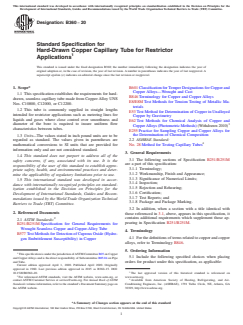
1.1 This specification establishes the requirements for hard-drawn, seamless capillary tube made from Copper Alloy UNS Nos. C10800, C12000, or C12200.
1.2 This tube is commonly supplied in straight lengths intended for restrictor applications such as metering lines for liquids and gases where close control over smoothness and diameter of the bore is required to insure uniform flow characteristics between tubes.
1.3 Units—The values stated in inch pound units are to be regarded as standard. The values given in parentheses are mathematical conversions to SI units that are provided for information only and are not considered standard.
1.4 This standard does not purport to address all of the safety concerns, if any, associated with its use. It is the responsibility of the user of this standard to establish appropriate safety, health, and environmental practices and determine the applicability of regulatory limitations prior to use.
1.5 This international standard was developed in accordance with internationally recognized principles on standardization established in the Decision on Principles for the Development of International Standards, Guides and Recommendations issued by the World Trade Organization Technical Barriers to Trade (TBT) Committee.
General Information
- Status
- Published
- Publication Date
- 31-Mar-2020
- Technical Committee
- B05 - Copper and Copper Alloys
- Drafting Committee
- B05.04 - Pipe and Tube
Relations
- Effective Date
- 01-Apr-2020
- Effective Date
- 01-Jan-2024
- Effective Date
- 01-Aug-2019
- Effective Date
- 01-Apr-2019
- Effective Date
- 01-Jan-2019
- Effective Date
- 01-Oct-2018
- Effective Date
- 01-Mar-2018
- Effective Date
- 01-Oct-2017
- Effective Date
- 01-Oct-2016
- Effective Date
- 15-Jul-2016
- Effective Date
- 01-Apr-2016
- Effective Date
- 01-Feb-2015
- Effective Date
- 01-Jun-2013
- Effective Date
- 01-Oct-2012
- Effective Date
- 01-Dec-2011
Overview
ASTM B360-20, published by ASTM International, defines the requirements for hard-drawn, seamless copper capillary tubes specifically intended for restrictor applications. These capillary tubes are manufactured from Copper Alloy UNS Nos. C10800, C12000, or C12200. The standard addresses the material’s chemical composition, dimensions, mechanical properties, and essential requirements for tubes used as metering lines for liquids and gases where precise control of flow, smoothness, and bore diameter is critical for performance.
Key Topics
Material Requirements:
- Tubes must be made from Copper Alloy UNS C10800 (oxygen-free, low phosphorus), C12000 (phosphorus deoxidized, low residual phosphorus), or C12200 (phosphorus deoxidized, high residual phosphorus).
- Strict purity and soundness criteria must be met to ensure product suitability.
Manufacturing and Temper:
- Tubes are produced by cold drawing, resulting in a uniform wrought structure.
- The standard provides that tubes are supplied in the H80 (hard drawn) condition.
Dimensional and Quality Specifications:
- Close tolerances apply to inside and outside diameters, straightness, and wall thickness.
- Stringent cleanness requirements ensure that residue inside the tube is minimal, as low contamination is vital for flow control.
Mechanical Properties:
- A minimum tensile strength is specified.
- Embrittlement resistance is verified upon request, ensuring long-term reliability.
Ordering and Identification:
- Purchase orders must specify all relevant details, including alloy type, dimensions, air flow requirements, quantity, and any special testing or certification needs.
Testing and Inspection:
- Methods for chemical analysis, tensile testing, embrittlement, cleanness, and air flow are established.
- Sampling guidelines and retesting procedures safeguard consistent quality.
Applications
Hard-drawn copper capillary tubes conforming to ASTM B360-20 are extensively used in:
- Refrigeration and Air Conditioning:
- As restrictor tubes or metering lines to control the flow of refrigerants with high precision.
- Instrumentation and Flow Metering:
- For accurately measuring or regulating the flow of liquids and gases in industrial process control systems.
- Medical and Laboratory Equipment:
- Ensuring uniform flow characteristics where bore smoothness and dimensional accuracy are crucial.
- Specialty Manufacturing:
- In applications demanding resistance to embrittlement, low contamination, and exact flow rates.
The stringent manufacturing, cleanliness, and dimensional standards make ASTM B360-20 tubes highly reliable where exact flow rates and bore quality are necessary for safety and performance.
Related Standards
For further information and to ensure compatibility and compliance, users of ASTM B360-20 should consult these related standards:
- ASTM B251/B251M: General Requirements for Wrought Seamless Copper and Copper-Alloy Tube
- ASTM B577: Test Methods for Detection of Cuprous Oxide (Hydrogen Embrittlement Susceptibility) in Copper
- ASTM B601: Classification for Temper Designations for Copper and Copper Alloys
- ASTM B846: Terminology for Copper and Copper Alloys
- ASTM E8/E8M: Test Methods for Tension Testing of Metallic Materials
- ASTM E53: Test Method for Determination of Copper in Unalloyed Copper by Gravimetry
- ASHRAE Standard 28: Method for Testing Capillary Tubes
Keywords:
Capillary tube, restrictor tube, hard-drawn copper, copper alloy, flow control, metering tube, ASTM B360, UNS C10800, C12000, C12200, precision flow, refrigeration, instrumentation tube
By adhering to ASTM B360-20, manufacturers and users ensure that copper capillary restrictor tubes meet global standards for quality, performance, and safety in critical flow control applications.
Buy Documents
ASTM B360-20 - Standard Specification for Hard-Drawn Copper Capillary Tube for Restrictor Applications
REDLINE ASTM B360-20 - Standard Specification for Hard-Drawn Copper Capillary Tube for Restrictor Applications
Get Certified
Connect with accredited certification bodies for this standard

Institut za varilstvo d.o.o. (Welding Institute)
Slovenia's leading welding institute since 1952. ISO 3834, EN 1090, pressure equipment certification, NDT personnel, welder qualification. Only IIW Au
Sponsored listings
Frequently Asked Questions
ASTM B360-20 is a technical specification published by ASTM International. Its full title is "Standard Specification for Hard-Drawn Copper Capillary Tube for Restrictor Applications". This standard covers: SCOPE 1.1 This specification establishes the requirements for hard-drawn, seamless capillary tube made from Copper Alloy UNS Nos. C10800, C12000, or C12200. 1.2 This tube is commonly supplied in straight lengths intended for restrictor applications such as metering lines for liquids and gases where close control over smoothness and diameter of the bore is required to insure uniform flow characteristics between tubes. 1.3 Units—The values stated in inch pound units are to be regarded as standard. The values given in parentheses are mathematical conversions to SI units that are provided for information only and are not considered standard. 1.4 This standard does not purport to address all of the safety concerns, if any, associated with its use. It is the responsibility of the user of this standard to establish appropriate safety, health, and environmental practices and determine the applicability of regulatory limitations prior to use. 1.5 This international standard was developed in accordance with internationally recognized principles on standardization established in the Decision on Principles for the Development of International Standards, Guides and Recommendations issued by the World Trade Organization Technical Barriers to Trade (TBT) Committee.
SCOPE 1.1 This specification establishes the requirements for hard-drawn, seamless capillary tube made from Copper Alloy UNS Nos. C10800, C12000, or C12200. 1.2 This tube is commonly supplied in straight lengths intended for restrictor applications such as metering lines for liquids and gases where close control over smoothness and diameter of the bore is required to insure uniform flow characteristics between tubes. 1.3 Units—The values stated in inch pound units are to be regarded as standard. The values given in parentheses are mathematical conversions to SI units that are provided for information only and are not considered standard. 1.4 This standard does not purport to address all of the safety concerns, if any, associated with its use. It is the responsibility of the user of this standard to establish appropriate safety, health, and environmental practices and determine the applicability of regulatory limitations prior to use. 1.5 This international standard was developed in accordance with internationally recognized principles on standardization established in the Decision on Principles for the Development of International Standards, Guides and Recommendations issued by the World Trade Organization Technical Barriers to Trade (TBT) Committee.
ASTM B360-20 is classified under the following ICS (International Classification for Standards) categories: 23.040.15 - Non-ferrous metal pipes. The ICS classification helps identify the subject area and facilitates finding related standards.
ASTM B360-20 has the following relationships with other standards: It is inter standard links to ASTM B360-15, ASTM E8/E8M-24, ASTM B846-19a, ASTM B577-19, ASTM B846-19, ASTM B601-18a, ASTM B601-18, ASTM B251/B251M-17, ASTM B601-16, ASTM E8/E8M-16, ASTM B577-16, ASTM E8/E8M-15, ASTM E8/E8M-13, ASTM B601-12, ASTM E8/E8M-11. Understanding these relationships helps ensure you are using the most current and applicable version of the standard.
ASTM B360-20 is available in PDF format for immediate download after purchase. The document can be added to your cart and obtained through the secure checkout process. Digital delivery ensures instant access to the complete standard document.
Standards Content (Sample)
This international standard was developed in accordance with internationally recognized principles on standardization established in the Decision on Principles for the
Development of International Standards, Guides and Recommendations issued by the World Trade Organization Technical Barriers to Trade (TBT) Committee.
Designation:B360 −20
Standard Specification for
Hard-Drawn Copper Capillary Tube for Restrictor
Applications
This standard is issued under the fixed designation B360; the number immediately following the designation indicates the year of
original adoption or, in the case of revision, the year of last revision. A number in parentheses indicates the year of last reapproval. A
superscript epsilon (´) indicates an editorial change since the last revision or reapproval.
1. Scope* B601 Classification forTemper Designations for Copper and
Copper Alloys—Wrought and Cast
1.1 This specification establishes the requirements for hard-
B846 Terminology for Copper and Copper Alloys
drawn, seamless capillary tube made from Copper Alloy UNS
E8/E8M Test Methods for Tension Testing of Metallic Ma-
Nos. C10800, C12000, or C12200.
terials
1.2 This tube is commonly supplied in straight lengths
E53 Test Method for Determination of Copper in Unalloyed
intended for restrictor applications such as metering lines for
Copper by Gravimetry
liquids and gases where close control over smoothness and
E62 Test Methods for Chemical Analysis of Copper and
diameter of the bore is required to insure uniform flow 3
CopperAlloys (Photometric Methods) (Withdrawn 2010)
characteristics between tubes.
E255 Practice for Sampling Copper and Copper Alloys for
1.3 Units—The values stated in inch pound units are to be the Determination of Chemical Composition
2.2 ASHRAE Standard:
regarded as standard. The values given in parentheses are
mathematical conversions to SI units that are provided for No. 28 Method for Testing Capillary Tubes
information only and are not considered standard.
3. General Requirements
1.4 This standard does not purport to address all of the
3.1 The following sections of Specification B251/B251M
safety concerns, if any, associated with its use. It is the
are a part of this specification:
responsibility of the user of this standard to establish appro-
3.1.1 Terminology;
priate safety, health, and environmental practices and deter-
3.1.2 Workmanship, Finish and Appearance;
mine the applicability of regulatory limitations prior to use.
3.1.3 Significance of Numerical Limits;
1.5 This international standard was developed in accor-
3.1.4 Inspection;
dance with internationally recognized principles on standard-
3.1.5 Rejection and Rehearing;
ization established in the Decision on Principles for the
3.1.6 Certification;
Development of International Standards, Guides and Recom-
3.1.7 Test Reports; and
mendations issued by the World Trade Organization Technical
3.1.8 Package and Package Marking.
Barriers to Trade (TBT) Committee.
3.2 In addition, when a section with a title identical with
2. Referenced Documents
those referenced in 3.1, above, appears in this specification, it
contains additional requirements which supplement those ap-
2.1 ASTM Standards:
pearing in Specification B251/B251M.
B251/B251M Specification for General Requirements for
Wrought Seamless Copper and Copper-Alloy Tube
4. Terminology
B577 Test Methods for Detection of Cuprous Oxide (Hydro-
4.1 For the definitions of terms related to copper and copper
gen Embrittlement Susceptibility) in Copper
alloys, refer to Terminology B846.
5. Ordering Information
ThisspecificationisunderthejurisdictionofASTMCommitteeB05onCopper
5.1 Include the following specified choices when placing
and CopperAlloys and is the direct responsibility of Subcommittee B05.04 on Pipe
and Tube.
orders for product under this specification, as applicable:
Current edition approved April 1, 2020. Published April 2020. Originally
approved in 1960. Last previous edition approved in 2015 as B360–15. DOI:
10.1520/B0360–20. The last approved version of this historical standard is referenced on
For referenced ASTM standards, visit the ASTM website, www.astm.org, or www.astm.org.
contact ASTM Customer Service at service@astm.org. For Annual Book of ASTM Available from American Society of Heating, Refrigerating, and Air-
Standards volume information, refer to the standard’s Document Summary page on Conditioning Engineers, Inc. (ASHRAE), 1791 Tullie Circle, NE, Atlanta, GA
the ASTM website. 30329, http://www.ashrae.org.
*A Summary of Changes section appears at the end of this standard
Copyright © ASTM International, 100 Barr Harbor Drive, PO Box C700, West Conshohocken, PA 19428-2959. United States
B360−20
TABLE 1 Chemical Requirements
sidual phosphorus), or C12200 (phosphorus deoxidized, high
Element, Percent C10800 C12000 C12200 residual phosphorus) of such purity and soundness as to be
A B B
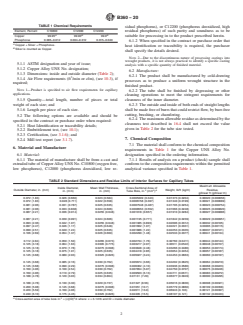
Copper 99.95 99.90 99.9 suitable for processing in to the product prescribed herein.
Phosphorus 0.005–0.012 0.004–0.012 0.015–0.040
6.1.2 When specified in the contract or purchase order that
A
Copper + Silver + Phosphorus.
heat identification or traceability is required, the purchaser
B
Silver is counted as Copper.
shall specify the details desired.
NOTE 2—Due to the discontinuous nature of processing castings into
wrought products, it is not always practical to identify a specific casting
5.1.1 ASTM designation and year of issue;
analysis with a specific quantity of finished material.
5.1.2 Copper Alloy UNS No. designation;
6.2 Manufacture:
5.1.3 Dimensions: inside and outside diameter (Table 2);
6.2.1 The product shall be manufactured by cold-drawing
5.1.4 Air Flow requirements (ft /min or cfm), (see 10.3), if
processes as to produce a uniform wrought structure in the
required;
finished product.
NOTE 1—Product is specified to air flow requirements for capillary
6.2.2 The tube shall be finished by degreasing or other
applications.
cleaning operations to meet the stringent requirements for
5.1.5 Quantity—total length, number of pieces or total cleanness of the inner diameter.
weight of each size; and
6.2.3 The outside and inside of both ends of straight lengths
5.1.6 Length per piece of each size. shall be made free of burrs that could restrict flow, by burr-free
cutting, brushing, or chamfering.
5.2 The following options are available and should be
6.2.4 The maximum allowable residue as determined by the
specified in the contract or purchase order when required:
cleanness test described in 16.4 shall not exceed the value
5.2.1 Heat Identification or traceability details;
given in Table 2 for the tube size tested.
5.2.2 Embrittlement test, (see 10.1);
5.2.3 Certification, (see 3.1.6); and
7. Chemical Composition
5.2.4 Mill test report (see 3.1.7).
7.1 The material shall conform to the chemical composition
6. Material and Manufacture
requirements in Table 1 for the Copper UNS Alloy No.
6.1 Material: designation specified in the ordering information.
6.1.1 The material of manufacture shall be from a cast and 7.1.1 Results of analysis on a product (check) sample shall
extruded tube of CopperAlloy UNS No. C10800 (oxygen free, conform to the composition requirements within the permitted
low phosphorus), C12000 (phosphorus deoxidized, low re- analytical variance specified in Table 1.
TABLE 2 Standard Dimensions and Residue Limits of Interior Surfaces for Capillary Tubes
Maximum Allowable
Inside Diameter, Mean Wall Thickness, Cross-Sectional Area of
Outside Diameter, in. (mm) Weight, lb/ft (kg/m) Residue,
2 2 A
in. (mm) in. (mm) Tube Bore, in. (mm )
g/linear ft (g/linear m)
0.072 (1.83) 0.026 (0.660) 0.023 (0.584) 0.0005309 (0.343) 0.01373 (0.0204) 0.00020 (0.000656)
0.072 (1.83) 0.028 (0.711) 0.022 (0.558) 0.0006158 (0.397) 0.01340 (0.0199) 0.00021 (0.000689)
0.081 (2.06) 0.031 (0.787) 0.025 (0.635) 0.0007548 (0.487) 0.01705 (0.0254) 0.00023 (0.000754)
0.081 (2.06) 0.033 (0.838) 0.024 (0.606) 0.0008553 (0.552) 0.01666 (0.0248) 0.00025 (0.000820)
0.087 (2.21) 0.036 (0.914) 0.0255 (0.648) 0.001018 (0.657) 0.01910 (0.0284) 0.00027 (0.000886)
0.087 (2.21) 0.039 (0.991) 0.024 (0.606) 0.001195 (0.771) 0.01842 (0.0239) 0.00029 (0.000951)
0.093 (2.36) 0.042 (1.07) 0.0255 (0.648) 0.001385 (0.893) 0.02096 (0.0312) 0.00032 (0.00105)
0.097 (2.47) 0.046 (1.17) 0.025 (0.648) 0.001662 (1.07) 0.02221 (0.0331) 0.00035 (0.00115)
0.099 (2.51) 0.049 (1.24) 0.025 (0.635) 0.001886 (1.22) 0.02253 (0.0335) 0.00037 (0.00121)
0.106 (2.69) 0.054 (1.37) 0.026 (0.660) 0.002290 (1.48) 0.02533 (0.0377) 0.00041 (0.00134)
0.112 (2.84) 0.059 (1.50) 0.0265 (0.673) 0.002734 (1.76) 0.02760 (0.0411) 0.00044 (0.00144)
0.125 (3.18) 0.064 (1.63) 0.0305 (0.775) 0.003217 (2.07) 0.03511 (0.0522) 0.00048 (0.00157)
0.125 (3.18) 0.070 (1.78) 0.0275 (0.698) 0.003848 (2.48) 0.03266 (0.0486) 0.00053 (0.00174)
0.125 (3.18) 0.075 (1.91) 0.025 (0.635) 0.004418 (2.85) 0.03054 (0.0454) 0.00057 (0.00187)
0.145 (3.68) 0.080 (2.03) 0.0325 (0.826) 0.005027 (3.24) 0.04453 (0.0663) 0.00060 (0.00197)
0.145 (3.68) 0.085 (2.16) 0.030 (0.762) 0.005674 (3.66) 0.04202 (0.0625) 0.00064 (0.00210)
0.145 (3.68) 0.090 (2.29) 0.0275 (0.698) 0.006362 (4.10) 0.03936 (0.0586) 0.00068 (0.00223)
0.160 (4.06) 0.100 (2.54) 0.030 (0.762) 0.007854 (5.07) 0.04750 (0.0707) 0.00075 (0.00246)
0.160 (4.06) 0.110 (2.79) 0.025 (0.635) 0.009503 (6.13) 0.04111 (0.0611) 0.00083 (0.00272)
0.188 (4.78) 0.120 (3.03) 0.034 (0.864) 0.01131 (7.29) 0.06377 (0.0949) 0.00090 (0.00295)
0.188 (4.78) 0.130 (3.30) 0.029 (0.737) 0.01327 (8.56) 0.05616 (0.0836) 0.00098 (0.00321)
0.200 (5.08) 0.145 (3.68) 0.0275 (0.698) 0.01651 (10.7) 0.05779 (0.0860) 0.00109 (0.00358)
0.220 (5.59) 0.160 (4.06) 0.030 (0.762) 0.02011 (13.0) 0.06943 (0.103) 0.00121 (0.00397)
0.240 (6.10) 0.175 (4.45) 0.0325 (0.826) 0.02405 (15.5) 0.08107 (0.121) 0.00132 (0.00433)
A 2 2
Cross-section area of tube bore in. =(π)(ID) /4 where: π = 3.1416 and ID = inside diameter.
B360−20
7.2 These composition limits do not preclude the presence 12. Workmanship, Finish, and Appearance
ofotherelements.Byagreementbetweenthemanufacturerand
12.1 The product shall be free of defects, but blemishes of
purchaser, limits may be established and analysis required for
a nature that do not interfere with the intended application are
unnamed elements.
acceptable.
12.2 The inside and outside edges of both ends of straight
8. Temper
lengths of tube shall be free of burrs (see 6.2.3).
8.1 The product shall be furnished in the H80 (hard drawn)
condition in accordance with Classification B601.
13. Sampling
9. Mechanical Property Requirements
13.1 The lot size, portion size, and selection of pieces shall
be as follows:
9.1 Tensile Strength:
13.1.1 Lot Size—1000 pieces, or maximum of 100 lb, or
...
This document is not an ASTM standard and is intended only to provide the user of an ASTM standard an indication of what changes have been made to the previous version. Because
it may not be technically possible to adequately depict all changes accurately, ASTM recommends that users consult prior editions as appropriate. In all cases only the current version
of the standard as published by ASTM is to be considered the official document.
Designation: B360 − 15 B360 − 20
Standard Specification for
Hard-Drawn Copper Capillary Tube for Restrictor
Applications
This standard is issued under the fixed designation B360; the number immediately following the designation indicates the year of
original adoption or, in the case of revision, the year of last revision. A number in parentheses indicates the year of last reapproval. A
superscript epsilon (´) indicates an editorial change since the last revision or reapproval.
1. Scope*
1.1 This specification establishes the requirements for hard-drawn, seamless capillary tube made from Copper Alloy UNS Nos.
C10800, C12000, or C12200.
1.2 This tube is commonly supplied in straight lengths intended for restrictor applications such as metering lines for liquids and
gases where close control over smoothness and diameter of the bore is required to insure uniform flow characteristics between
tubes.
1.3 Units—The values stated in inch pound units are to be regarded as standard. The values given in parentheses are
mathematical conversions to SI units that are provided for information only and are not considered standard.
1.4 This standard does not purport to address all of the safety concerns, if any, associated with its use. It is the responsibility
of the user of this standard to establish appropriate safety safety, health, and healthenvironmental practices and determine the
applicability of regulatory limitations prior to use.
1.5 This international standard was developed in accordance with internationally recognized principles on standardization
established in the Decision on Principles for the Development of International Standards, Guides and Recommendations issued
by the World Trade Organization Technical Barriers to Trade (TBT) Committee.
2. Referenced Documents
2.1 ASTM Standards:
B251B251/B251M Specification for General Requirements for Wrought Seamless Copper and Copper-Alloy Tube (Metric)
B0251_B0251M
B577 Test Methods for Detection of Cuprous Oxide (Hydrogen Embrittlement Susceptibility) in Copper
B601 Classification for Temper Designations for Copper and Copper Alloys—Wrought and Cast
B846 Terminology for Copper and Copper Alloys
E8/E8M Test Methods for Tension Testing of Metallic Materials
E53 Test Method for Determination of Copper in Unalloyed Copper by Gravimetry
E62 Test Methods for Chemical Analysis of Copper and Copper Alloys (Photometric Methods) (Withdrawn 2010)
E255 Practice for Sampling Copper and Copper Alloys for the Determination of Chemical Composition
2.2 ASHRAE Standard:
No. 28 Method for Testing Capillary Tubes
3. General Requirements
3.1 The following sections of Specification B251B251/B251M are a part of this specification.specification:
3.1.1 Terminology,Terminology;
3.1.2 Workmanship, Finish and Appearance,Appearance;
This specification is under the jurisdiction of ASTM Committee B05 on Copper and Copper Alloys and is the direct responsibility of Subcommittee B05.04 on Pipe and
Tube.
Current edition approved July 1, 2015April 1, 2020. Published July 2015April 2020. Originally approved in 1960. Last previous edition approved in 20092015 as
B360 – 09.B360–15. DOI: 10.1520/B0360-15.10.1520/B0360–20.
For referenced ASTM standards, visit the ASTM website, www.astm.org, or contact ASTM Customer Service at service@astm.org. For Annual Book of ASTM Standards
volume information, refer to the standard’s Document Summary page on the ASTM website.
The last approved version of this historical standard is referenced on www.astm.org.
Available from American Society of Heating, Refrigerating, and Air-Conditioning Engineers, Inc. (ASHRAE), 1791 Tullie Circle, NE, Atlanta, GA 30329,
http://www.ashrae.org.
*A Summary of Changes section appears at the end of this standard
Copyright © ASTM International, 100 Barr Harbor Drive, PO Box C700, West Conshohocken, PA 19428-2959. United States
B360 − 20
3.1.3 Significance of Numerical Limits,Limits;
3.1.4 Inspection,Inspection;
3.1.5 Rejection and Rehearing,Rehearing;
3.1.6 Certification,Certification;
3.1.7 Test Reports,Reports; and
3.1.8 Package and Package Marking.
3.2 In addition, when a section with a title identical with those referenced in 3.1, above, appears in this specification, it contains
additional requirements which supplement those appearing in Specification B251B251/B251M.
4. Terminology
4.1 For the definitions of terms related to copper and copper alloys, refer to Terminology B846.
5. Ordering Information
5.1 The contract or purchase order Include the following specified choices when placing orders for product under this
specification shall include the following information, specification, as applicable:
5.1.1 ASTM designation and year of issue (for example, B360 – XX),issue;
5.1.2 Copper Alloy UNS No. (for example, C10800, Section designation;7, and Table 1),
5.1.3 Dimensions: inside and outside diameter (Table 2),);
5.1.4 Air Flow requirements (ft /min or cfm), (see 10.3), if required.required;
NOTE 1—Product is specified to air flow requirements for capillary applications.
5.1.5 Quantity, total Quantity—total length, number of pieces or total weight of each size,size; and
5.1.6 Length per piece of each size, andsize.
5.2 The following options are available and should be specified in the contract or purchase order when required:
5.2.1 Heat Identification or traceability details,details;
5.2.2 Embrittlement test, (see 10.1),);
5.2.3 Certification, (see 3.1.6),); and
5.2.4 Mill test report (see 3.1.7).
6. Material and Manufacture
6.1 Material:
6.1.1 The material of manufacture shall be from a cast and extruded tube of Copper Alloy UNS No. C10800 (oxygen free, low
phosphorus), C12000 (phosphorus deoxidized, low residual phosphorus), or C12200 (phosphorus deoxidized, high residual
phosphorus) of such purity and soundness as to be suitable for processing in to the product prescribed herein.
6.1.2 In the event When specified in the contract or purchase order that heat identification or traceability is required, the
purchaser shall specify the details desired.
NOTE 2—Due to the discontinuous nature of processing castings into wrought products, it is not always practical to identify a specific casting analysis
with a specific quantity of finished material.
6.2 Manufacture:
6.2.1 The product shall be manufactured by cold drawing cold-drawing processes as to produce a uniform wrought structure
in the finished product.
6.2.2 The tube shall be finished by degreasing or other cleaning operations to meet the stringent requirements for cleanness of
the inner diameter.
6.2.3 The outside and inside of both ends of straight lengths shall be made free of burrs that could restrict flow, by burr-free
cutting, brushing, or chamfering.
6.2.4 The maximum allowable residue as determined by the cleanness test described in 16.4 shall not exceed the value given
in Table 2 for the tube size tested.
7. Chemical Composition
7.1 The material shall conform to the chemical composition requirements in Table 1 for the Copper UNS Alloy No. designation
specified in the ordering information.
TABLE 1 Chemical Requirements
Element, Percent C10800 C12000 C12200
A B B
Copper 99.95 99.90 99.9
Phosphorus 0.005–0.012 0.004–0.012 0.015–0.040
A
Copper + Silver + Phosphorus.
B
Silver is counted as Copper.
B360 − 20
TABLE 2 Standard Dimensions and Residue Limits of Interior Surfaces for Capillary Tubes
Maximum Allowable
Inside Diameter, Mean Wall Thickness, Cross-Sectional Area of
Outside Diameter, in. (mm) Weight, lb/ft (kg/m) Residue,
2 2 A
in. (mm) in. (mm) Tube Bore, in. (mm )
g/linear ft (g/linear m)
0.072 (1.83) 0.026 (0.660) 0.023 (0.584) 0.0005309 (0.343) 0.01373 (0.0204) 0.00020 (0.000656)
0.072 (1.83) 0.028 (0.711) 0.022 (0.558) 0.0006158 (0.397) 0.01340 (0.0199) 0.00021 (0.000689)
0.081 (2.06) 0.031 (0.787) 0.025 (0.635) 0.0007548 (0.487) 0.01705 (0.0254) 0.00023 (0.000754)
0.081 (2.06) 0.033 (0.838) 0.024 (0.606) 0.0008553 (0.552) 0.01666 (0.0248) 0.00025 (0.000820)
0.087 (2.21) 0.036 (0.914) 0.0255 (0.648) 0.001018 (0.657) 0.01910 (0.0284) 0.00027 (0.000886)
0.087 (2.21) 0.039 (0.991) 0.024 (0.606) 0.001195 (0.771) 0.01842 (0.0239) 0.00029 (0.000951)
0.093 (2.36) 0.042 (1.07) 0.0255 (0.648) 0.001385 (0.893) 0.02096 (0.0312) 0.00032 (0.00105)
0.097 (2.47) 0.046 (1.17) 0.025 (0.648) 0.001662 (1.07) 0.02221 (0.0331) 0.00035 (0.00115)
0.099 (2.51) 0.049 (1.24) 0.025 (0.635) 0.001886 (1.22) 0.02253 (0.0335) 0.00037 (0.00121)
0.106 (2.69) 0.054 (1.37) 0.026 (0.660) 0.002290 (1.48) 0.02533 (0.0377) 0.00041 (0.00134)
0.112 (2.84) 0.059 (1.50) 0.0265 (0.673) 0.002734 (1.76) 0.02760 (0.0411) 0.00044 (0.00144)
0.125 (3.18) 0.064 (1.63) 0.0305 (0.775) 0.003217 (2.07) 0.03511 (0.0522) 0.00048 (0.00157)
0.125 (3.18) 0.070 (1.78) 0.0275 (0.698) 0.003848 (2.48) 0.03266 (0.0486) 0.00053 (0.00174)
0.125 (3.18) 0.075 (1.91) 0.025 (0.635) 0.004418 (2.85) 0.03054 (0.0454) 0.00057 (0.00187)
0.145 (3.68) 0.080 (2.03) 0.0325 (0.826) 0.005027 (3.24) 0.04453 (0.0663) 0.00060 (0.00197)
0.145 (3.68) 0.085 (2.16) 0.030 (0.762) 0.005674 (3.66) 0.04202 (0.0625) 0.00064 (0.00210)
0.145 (3.68) 0.090 (2.29) 0.0275 (0.698) 0.006362 (4.10) 0.03936 (0.0586) 0.00068 (0.00223)
0.160 (4.06) 0.100 (2.54) 0.030 (0.762) 0.007854 (5.07) 0.04750 (0.0707) 0.00075 (0.00246)
0.160 (4.06) 0.110 (2.79) 0.025 (0.635) 0.009503 (6.13) 0.04111 (0.0611) 0.00083 (0.00272)
0.188 (4.78) 0.120 (3.03) 0.034 (0.864) 0.01131 (7.29) 0.06377 (0.0949) 0.00090 (0.00295)
0.188 (4.78) 0.130 (3.30) 0.029 (0.737) 0.01327 (8.56) 0.05616 (0.0836) 0.00098 (0.00321)
0.200 (5.08) 0.145 (3.68) 0.0275 (0.698) 0.01651 (10.7) 0.05779 (0.0860) 0.00109 (0.00358)
0.220 (5.59) 0.160 (4.06) 0.030 (0.762) 0.02011 (13.0) 0.06943 (0.103) 0.00121 (0.00397)
0.240 (6.10) 0.175 (4.45) 0.0325 (0.826) 0.02405 (15.5) 0.08107 (0.121) 0.00132 (0.00433)
A 2 2
Cross-section area of tube bore in. = (π)(ID) /4 where: π = 3.1416 and ID = inside diameter.
7.1.1 Results of analysis on a product (check) sample shall conform to the composition requirements within the permitted
analytical variance specified in Table 1.
7.2 These composition limits do not preclude the presence of other elements. By agreement between the manufacturer and
purchaser, limits may be established and analysis required for un-namedunnamed elements.
8. Temper
8.1 The tubesproduct shall be furnished in the H80 (hard drawn) condition.condition in accordance with Classification B601.
9. Mechanical Property Requirements
9.1 Tensile Strength:
9.1.1 The tubesproduct shall have a tensile strength of 45 ksi (310 MPa) minimum.minimum when tested in accordance with
Test Methods E8/E8M.
10. Other Requirements
10.1 Embrittlement Requirement:
10.1.1 Samples of product produced from Coppers UNS Nos. C10800 and C12000 shall be capable of passing the embrittlement
test of Procedure B of Test Methods B577. The actual performance of this test is not mandatory under the terms of this specification
unless specified in the ordering information. In case of a dispute, a referee method in accordance with Procedure C shall be
employed.
10.2 Cleanness Requirement:
2 2
10.2.1 The residue attributable to the tubes shall not exceed 0.0002 g/in. (0.310 g/m ) of internal surface of the tube when
subjected to test as directed in 16.4 (Refer(
...
Questions, Comments and Discussion
Ask us and Technical Secretary will try to provide an answer. You can facilitate discussion about the standard in here.
Loading comments...