

ASTM D7877-24
(Guide)Standard Guide for Electronic Methods for Detecting and Locating Leaks in Waterproof Membranes
General Information
- Abstract
SIGNIFICANCE AND USE
4.1 The failure to correct membrane defects during and as soon as possible after its installation can cause premature failure of the membrane. Problems include design deficiencies, faulty application of the membrane system, and damage by subsequent trades.4 Roof designs incorporating a waterproof membrane under overburden such as a vegetative roof, insulation layer, wear-course, or topping slab greatly exacerbate the problem of leak locating.
4.2 This guide describes methods for using electric conductance testing to locate breaches in waterproof membranes.5 The methods described include testing procedures designed to provide a part of the construction quality control of membrane installations.
4.3 The methods described in this guide may also be used for integrity or forensic testing of existing waterproof membranes; specific limitations apply.
4.4 The electric conductance methods described in this guide require a conductive substrate under the membrane to serve as a ground return path for the test currents. In roof assemblies where the membrane is installed over electric insulating material such as insulating foam or a protection board, or both, the electric path to any conductive deck is interrupted. The situation can be remedied by placing a conductive material directly under the membrane. The conductive material provides the return path for the test currents.
SCOPE
1.1 This guide describes standard procedures for using electrical conductance measurement methods to locate leaks in exposed or covered waterproof membranes.
1.2 This guide addresses the need for a general technical description of the current methods and procedures that are used to test and verify the integrity of waterproof membranes.
1.3 This guide is not intended to replace visual, infrared, or other methods of inspection. It is to be used in conjunction with other methods of roof inspection when specified.
1.4 This guide recommends that the leak location equipment, procedures, and survey parameters used are calibrated to meet established minimum leak detection sensitivity. The leak detection sensitivity calibration should be verified on a regular basis according to the manufacturer’s recommendations.
1.5 Leak location surveys can be used on waterproofing membranes installed in roofs, plaza decks, pools, water features, covered reservoirs, and other waterproofing applications.
1.6 The procedures are applicable for membranes made of materials such as polyethylene, polypropylene, polyvinyl chloride, bituminous material, and other electrically insulating materials.
1.7 This guide provides a general description of the equipment and methods for locating membrane breaches using electric conductance. Refer to the manufacturer’s instructions for the proper operation and use of the equipment described in this guide.
1.8 This standard does not purport to address all of the safety concerns, if any, associated with its use. It is the responsibility of the user of this standard to establish appropriate safety, health, and environmental practices and determine the applicability of regulatory limitations prior to use.
1.9 This international standard was developed in accordance with internationally recognized principles on standardization established in the Decision on Principles for the Development of International Standards, Guides and Recommendations issued by the World Trade Organization Technical Barriers to Trade (TBT) Committee.
- Status
- Published
- Publication Date
- 14-Jan-2024
- Technical Committee
- D08 - Roofing and Waterproofing
- Drafting Committee
- D08.22 - Waterproofing and Dampproofing Systems
Buy Documents
ASTM D7877-24 - Standard Guide for Electronic Methods for Detecting and Locating Leaks in Waterproof Membranes
REDLINE ASTM D7877-24 - Standard Guide for Electronic Methods for Detecting and Locating Leaks in Waterproof Membranes
Overview
ASTM D7877-24: Standard Guide for Electronic Methods for Detecting and Locating Leaks in Waterproof Membranes provides a comprehensive reference for identifying breaches in waterproofing systems using electronic leak detection. This international standard outlines procedures for using electrical conductance methods to accurately locate leaks in exposed or covered waterproof membranes. By detecting and addressing membrane defects early, this guide helps prevent premature failures caused by design deficiencies, improper application, or damage during subsequent construction.
Leak detection is critical in modern building designs, especially for roof assemblies with overburden such as vegetative roofs, insulation layers, or wear courses. The methods detailed in ASTM D7877-24 enhance construction quality control and can be applied both during initial installation and for the integrity or forensic testing of existing waterproof membranes.
Key Topics
Electric Conductance Leak Detection
The guide describes essential principles and standardized procedures for leak location through electric conductance measurements, ensuring a systematic approach to membrane integrity verification.Calibration and Sensitivity
Leak detection equipment and procedures must be calibrated to meet established minimum leak detection sensitivity. Regular calibration and verification against manufacturer recommendations are crucial for reliable results.Applicability and Limitations
- Methods apply to membranes made from polyethylene, polypropylene, polyvinyl chloride (PVC), bituminous materials, and other electrically insulating membranes.
- A conductive substrate is required beneath the membrane for accurate testing; nonconductive substrates necessitate installation of a conductive layer.
- Not suitable for scanning conductive membranes, such as some EPDM types, or where the membrane is installed solely over insulation.
Types of Electric Leak Detection
- Low Voltage Horizontal Membrane Scanning: Uses a wet membrane surface and scanning platform to detect current leakage at breach points.
- Electric Field Vector Mapping: Employs a perimeter conductor and probes to track voltage gradients and pinpoint leak locations.
- Vertical Surface Scanning: Designed for vertical applications including corners, seams, and parapet walls.
- High Voltage Testing: Suitable for dry surfaces, this method uses an electrode brush to sweep for arcing through breaches, requiring careful voltage adjustment for membrane thickness.
Reporting and Record Keeping
The standard emphasizes detailed field note documentation, daily and periodic reporting, and maintenance of breach location and repair logs for effective quality assurance.
Applications
ASTM D7877-24 is valuable for construction professionals, roofing contractors, waterproofing consultants, and building maintenance teams. It supports:
Construction Quality Assurance:
Integration of electronic leak detection during membrane installation helps catch and address flaws early, reducing costly repairs.Routine Maintenance and Forensic Analysis:
The standard's methods facilitate ongoing monitoring or investigation of leak causes in existing structures, including roofs, plaza decks, pools, water features, and reservoirs.Versatile Membrane Compatibility:
Procedures are applicable to horizontal, sloped, and vertical membranes across a variety of materials and building applications.Support for Complex Roof Assemblies:
Particularly effective for identifying leaks under overburden or protected roofing systems, which typically hide defects from visual inspection.
Related Standards
- ASTM D1079: Terminology Relating to Roofing and Waterproofing – provides definitions for terms used throughout ASTM D7877-24
- NFPA 70: National Electrical Code – referenced for voltage classifications and safety considerations
Maintaining compliance with ASTM D7877-24 enhances the integrity of waterproofing systems and ensures robust leak detection through proven electric conductance methods, fostering safe and sustainable building environments.
Relations
- Effective Date
- 15-Jan-2024
- Referred By
ASTM D8014-17 - Standard Guide for Selection of Membranes Used in Vegetative Roofing Systems - Effective Date
- 15-Jan-2024
- Effective Date
- 15-Jan-2024
- Effective Date
- 15-Jan-2024
Buy Documents
ASTM D7877-24 - Standard Guide for Electronic Methods for Detecting and Locating Leaks in Waterproof Membranes
REDLINE ASTM D7877-24 - Standard Guide for Electronic Methods for Detecting and Locating Leaks in Waterproof Membranes
Get Certified
Connect with accredited certification bodies for this standard

DIBt (Deutsches Institut für Bautechnik)
German Institute for Building Technology.
DIN CERTCO
DIN Group product certification.

Aboma Certification B.V.
Specialized in construction, metal, and transport sectors.
Sponsored listings
Frequently Asked Questions
ASTM D7877-24 is a guide published by ASTM International. Its full title is "Standard Guide for Electronic Methods for Detecting and Locating Leaks in Waterproof Membranes". This standard covers: SIGNIFICANCE AND USE 4.1 The failure to correct membrane defects during and as soon as possible after its installation can cause premature failure of the membrane. Problems include design deficiencies, faulty application of the membrane system, and damage by subsequent trades.4 Roof designs incorporating a waterproof membrane under overburden such as a vegetative roof, insulation layer, wear-course, or topping slab greatly exacerbate the problem of leak locating. 4.2 This guide describes methods for using electric conductance testing to locate breaches in waterproof membranes.5 The methods described include testing procedures designed to provide a part of the construction quality control of membrane installations. 4.3 The methods described in this guide may also be used for integrity or forensic testing of existing waterproof membranes; specific limitations apply. 4.4 The electric conductance methods described in this guide require a conductive substrate under the membrane to serve as a ground return path for the test currents. In roof assemblies where the membrane is installed over electric insulating material such as insulating foam or a protection board, or both, the electric path to any conductive deck is interrupted. The situation can be remedied by placing a conductive material directly under the membrane. The conductive material provides the return path for the test currents. SCOPE 1.1 This guide describes standard procedures for using electrical conductance measurement methods to locate leaks in exposed or covered waterproof membranes. 1.2 This guide addresses the need for a general technical description of the current methods and procedures that are used to test and verify the integrity of waterproof membranes. 1.3 This guide is not intended to replace visual, infrared, or other methods of inspection. It is to be used in conjunction with other methods of roof inspection when specified. 1.4 This guide recommends that the leak location equipment, procedures, and survey parameters used are calibrated to meet established minimum leak detection sensitivity. The leak detection sensitivity calibration should be verified on a regular basis according to the manufacturer’s recommendations. 1.5 Leak location surveys can be used on waterproofing membranes installed in roofs, plaza decks, pools, water features, covered reservoirs, and other waterproofing applications. 1.6 The procedures are applicable for membranes made of materials such as polyethylene, polypropylene, polyvinyl chloride, bituminous material, and other electrically insulating materials. 1.7 This guide provides a general description of the equipment and methods for locating membrane breaches using electric conductance. Refer to the manufacturer’s instructions for the proper operation and use of the equipment described in this guide. 1.8 This standard does not purport to address all of the safety concerns, if any, associated with its use. It is the responsibility of the user of this standard to establish appropriate safety, health, and environmental practices and determine the applicability of regulatory limitations prior to use. 1.9 This international standard was developed in accordance with internationally recognized principles on standardization established in the Decision on Principles for the Development of International Standards, Guides and Recommendations issued by the World Trade Organization Technical Barriers to Trade (TBT) Committee.
SIGNIFICANCE AND USE 4.1 The failure to correct membrane defects during and as soon as possible after its installation can cause premature failure of the membrane. Problems include design deficiencies, faulty application of the membrane system, and damage by subsequent trades.4 Roof designs incorporating a waterproof membrane under overburden such as a vegetative roof, insulation layer, wear-course, or topping slab greatly exacerbate the problem of leak locating. 4.2 This guide describes methods for using electric conductance testing to locate breaches in waterproof membranes.5 The methods described include testing procedures designed to provide a part of the construction quality control of membrane installations. 4.3 The methods described in this guide may also be used for integrity or forensic testing of existing waterproof membranes; specific limitations apply. 4.4 The electric conductance methods described in this guide require a conductive substrate under the membrane to serve as a ground return path for the test currents. In roof assemblies where the membrane is installed over electric insulating material such as insulating foam or a protection board, or both, the electric path to any conductive deck is interrupted. The situation can be remedied by placing a conductive material directly under the membrane. The conductive material provides the return path for the test currents. SCOPE 1.1 This guide describes standard procedures for using electrical conductance measurement methods to locate leaks in exposed or covered waterproof membranes. 1.2 This guide addresses the need for a general technical description of the current methods and procedures that are used to test and verify the integrity of waterproof membranes. 1.3 This guide is not intended to replace visual, infrared, or other methods of inspection. It is to be used in conjunction with other methods of roof inspection when specified. 1.4 This guide recommends that the leak location equipment, procedures, and survey parameters used are calibrated to meet established minimum leak detection sensitivity. The leak detection sensitivity calibration should be verified on a regular basis according to the manufacturer’s recommendations. 1.5 Leak location surveys can be used on waterproofing membranes installed in roofs, plaza decks, pools, water features, covered reservoirs, and other waterproofing applications. 1.6 The procedures are applicable for membranes made of materials such as polyethylene, polypropylene, polyvinyl chloride, bituminous material, and other electrically insulating materials. 1.7 This guide provides a general description of the equipment and methods for locating membrane breaches using electric conductance. Refer to the manufacturer’s instructions for the proper operation and use of the equipment described in this guide. 1.8 This standard does not purport to address all of the safety concerns, if any, associated with its use. It is the responsibility of the user of this standard to establish appropriate safety, health, and environmental practices and determine the applicability of regulatory limitations prior to use. 1.9 This international standard was developed in accordance with internationally recognized principles on standardization established in the Decision on Principles for the Development of International Standards, Guides and Recommendations issued by the World Trade Organization Technical Barriers to Trade (TBT) Committee.
ASTM D7877-24 is classified under the following ICS (International Classification for Standards) categories: 91.100.60 - Thermal and sound insulating materials. The ICS classification helps identify the subject area and facilitates finding related standards.
ASTM D7877-24 has the following relationships with other standards: It is inter standard links to ASTM D7877-22, ASTM D8014-17, ASTM E2777-20, ASTM D8231-19. Understanding these relationships helps ensure you are using the most current and applicable version of the standard.
ASTM D7877-24 is available in PDF format for immediate download after purchase. The document can be added to your cart and obtained through the secure checkout process. Digital delivery ensures instant access to the complete standard document.
Standards Content (Sample)
This international standard was developed in accordance with internationally recognized principles on standardization established in the Decision on Principles for the
Development of International Standards, Guides and Recommendations issued by the World Trade Organization Technical Barriers to Trade (TBT) Committee.
Designation: D7877 − 24
Standard Guide for
Electronic Methods for Detecting and Locating Leaks in
Waterproof Membranes
This standard is issued under the fixed designation D7877; the number immediately following the designation indicates the year of
original adoption or, in the case of revision, the year of last revision. A number in parentheses indicates the year of last reapproval. A
superscript epsilon (´) indicates an editorial change since the last revision or reapproval.
1. Scope 1.9 This international standard was developed in accor-
dance with internationally recognized principles on standard-
1.1 This guide describes standard procedures for using
ization established in the Decision on Principles for the
electrical conductance measurement methods to locate leaks in
Development of International Standards, Guides and Recom-
exposed or covered waterproof membranes.
mendations issued by the World Trade Organization Technical
1.2 This guide addresses the need for a general technical
Barriers to Trade (TBT) Committee.
description of the current methods and procedures that are used
to test and verify the integrity of waterproof membranes.
2. Referenced Documents
1.3 This guide is not intended to replace visual, infrared, or
2.1 ASTM Standards:
other methods of inspection. It is to be used in conjunction with
D1079 Terminology Relating to Roofing and Waterproofing
other methods of roof inspection when specified.
2.2 NFPA Standard:
NFPA 70 National Electric Code
1.4 This guide recommends that the leak location
equipment, procedures, and survey parameters used are cali-
3. Terminology
brated to meet established minimum leak detection sensitivity.
The leak detection sensitivity calibration should be verified on 3.1 For definitions of terms, see Terminology D1079.
a regular basis according to the manufacturer’s recommenda-
3.2 Definitions of Terms Specific to This Standard:
tions.
3.2.1 breach—as defined for this guide, a membrane breach
1.5 Leak location surveys can be used on waterproofing is a defect in the membrane that allows surface water to reach
membranes installed in roofs, plaza decks, pools, water the substrate below.
features, covered reservoirs, and other waterproofing applica-
3.2.2 conductance—the ability of a material to pass elec-
tions.
trons. The unit of conductance is the Siemens (S); the relation-
1.6 The procedures are applicable for membranes made of ship that exists between resistance (R) and conductance (G) is
a reciprocal one. In terms of resistance and conductance:
materials such as polyethylene, polypropylene, polyvinyl
chloride, bituminous material, and other electrically insulating
R 5 1⁄G ohms, G 5 1⁄R Siemens (1)
materials.
3.2.3 deck—the structural surface to which the roofing or
1.7 This guide provides a general description of the equip-
waterproofing system (including insulation) is applied.
ment and methods for locating membrane breaches using
3.2.4 electric current—the flow of electric charge. The
electric conductance. Refer to the manufacturer’s instructions
electric charge that flows is carried by mobile electrons in a
for the proper operation and use of the equipment described in
conductor measured in amps.
this guide.
3.2.5 electric gradient—the potential difference between
1.8 This standard does not purport to address all of the
two points measured in volts.
safety concerns, if any, associated with its use. It is the
3.2.6 high voltage—for purposes of this guide, the National
responsibility of the user of this standard to establish appro-
Electrical Code (NEC) defines high voltage as any voltage over
priate safety, health, and environmental practices and deter-
1000 V.
mine the applicability of regulatory limitations prior to use.
1 2
This guide is under the jurisdiction of ASTM Committee D08 on Roofing and For referenced ASTM standards, visit the ASTM website, www.astm.org, or
Waterproofing and is the direct responsibility of Subcommittee D08.22 on Water- contact ASTM Customer Service at service@astm.org. For Annual Book of ASTM
proofing and Dampproofing Systems. Standards volume information, refer to the standard’s Document Summary page on
Current edition approved Jan. 15, 2024. Published January 2024. Originally the ASTM website.
approved in 2014. Last previous edition approved in 2022 as D7877 – 22. DOI: Available from National Fire Protection Association (NFPA), 1 Batterymarch
10.1520/D7877-24. Park, Quincy, MA 02169-7471, http://www.nfpa.org.
Copyright © ASTM International, 100 Barr Harbor Drive, PO Box C700, West Conshohocken, PA 19428-2959. United States
D7877 − 24
3.2.7 leak—any unintended opening, perforation, slit, tear, 4.3 The methods described in this guide may also be used
puncture, crack, hole, cut, or similar breaches through an for integrity or forensic testing of existing waterproof mem-
installed waterproofing membrane which may allow the pas- branes; specific limitations apply.
sage of liquid. Scratches, gouges, or other aberrations that do
4.4 The electric conductance methods described in this
not completely penetrate the membrane are not considered to
guide require a conductive substrate under the membrane to
be leaks as the term is used in this guide although they may be
serve as a ground return path for the test currents. In roof
defects requiring attention.
assemblies where the membrane is installed over electric
3.2.8 leak detection sensitivity—the smallest size liquid
insulating material such as insulating foam or a protection
water leak that the leak location equipment and survey meth-
board, or both, the electric path to any conductive deck is
odology are capable of detecting under a given set of condi-
interrupted. The situation can be remedied by placing a
tions. The leak detection sensitivity specification is usually
conductive material directly under the membrane. The conduc-
stated as the minimum electrical leakage current that can be
tive material provides the return path for the test currents.
detected and is directly related to the area of the smallest liquid
5. Summary of Conductance Leak Location
water leak that can be reliably detected.
5.1 The principle of the conductance leak location method is
3.2.9 low voltage—for purposes of this guide, the National
the establishment of an electrical potential between the elec-
Electrical Code (NEC) defines low voltage as 0 to 60 V,
trically insulating waterproof membrane and the underlying
inherently limited power source.
substrate.
3.2.10 potential—electrical voltage measured relative to a
5.2 For methods employing low voltage electrical potential,
reference point.
a controlled covering of water on the surface forms the
3.2.11 sensitive voltmeter—a voltmeter that is capable of
conductive path horizontally across the membrane to any
reading voltage levels in the millivolt or microvolt range.
membrane breach. At a breach location, an electrical path to the
3.2.12 substrate—the surface upon which the roofing or
deck is formed through the water leaking to the deck below. A
waterproofing membrane is placed (structural deck or insula-
sensitive receiver detects the leakage current and alerts the
tion).
operator.
3.2.13 waterproof membrane—an element of the exterior
5.3 For methods using a high voltage potential, an electrode
enclosure of a building intended to provide a continuous barrier
is swept across the surface of the membrane. The electrode is
to prevent the passage of water under hydrostatic pressure.
charged to a high potential relative to the deck below. At a
3.2.13.1 Discussion—Waterproof membranes tested by
breach location an electrical arc occurs from the electrode to
electrical conductance methods may be horizontal, sloped, or
the deck below. The arc discharge is electronically detected and
vertical.
the operator alerted.
3.2.13.2 Discussion—Examples of waterproof membranes
5.4 The leak-locate methods in this guide describe the
included in this guide are: below-grade waterproofing
electrical conductance techniques used to detect and locate
membranes, above-grade waterproofing membranes, water-
membrane breaches. These methods, while accurate and
proof membranes covered by wearing courses, vegetative roof
effective, are subject to noted limitations.
membranes, planter waterproofing membranes, protected roof
membranes, and roofing membranes.
5.5 Electric conductance leak location requires that the deck
material directly below the membrane be sufficiently conduc-
4. Significance and Use
tive for the test method employed. In most instances, a concrete
4.1 The failure to correct membrane defects during and as
substrate is sufficiently conductive to allow this method. In
soon as possible after its installation can cause premature
certain membrane assemblies where the substrate is
failure of the membrane. Problems include design deficiencies,
nonconductive, it may be possible to install a conductive
faulty application of the membrane system, and damage by
material directly under the membrane to facilitate testing.
subsequent trades. Roof designs incorporating a waterproof
membrane under overburden such as a vegetative roof, insu- 6. Training
lation layer, wear-course, or topping slab greatly exacerbate the
6.1 The operator should be experienced with the test equip-
problem of leak locating.
ment and complete a training course offered by the company
4.2 This guide describes methods for using electric conduc- supplying the test equipment. A resume of previous experience
tance testing to locate breaches in waterproof membranes. The is recommended.
methods described include testing procedures designed to
7. Low Voltage Horizontal Membrane Scanning Platform
provide a part of the construction quality control of membrane
installations. 7.1 The principle of the scanning platform method is to
establish a voltage potential between the platform and the roof
deck and track any leakage current passing through the
Bailey, D. M., et al., “Survey of Passive Leak Location Technologies,” U.S.
Army Corps of Engineers Construction Engineering Research Laboratories, USAC-
membrane. This is accomplished by wetting the surface of the
ERL Technical Report FM-94/04.
membrane under test, generating a voltage with respect to the
Vokey, D. and Townsend, D., “Electrical Conductance Methods for Locating
deck, and then locating areas where electrical current flows
Leaks in Roofing and Waterproof Membranes,” Journal of ASTM International, Vol
8, No. 9. from the platform through membrane breaches to the deck.
D7877 − 24
7.2 The basic circuit and application of a dual sweep method is not suited to scanning membranes with overburden.
scanning platform is shown in Fig. 1. The platform is con- The equipment manufacturer’s instructions provide recommen-
structed with two sets of metal sweeps which make continuous dation for addressing these issues.
electrical contact with the membrane surface. The outer sweep
NOTE 1—Certain scanning equipment designs provide built-in isolation
forms a continuous perimeter around the platform with the
of the sweep from drains and other grounds, thereby lowering the potential
inner sweep contained wi
...
This document is not an ASTM standard and is intended only to provide the user of an ASTM standard an indication of what changes have been made to the previous version. Because
it may not be technically possible to adequately depict all changes accurately, ASTM recommends that users consult prior editions as appropriate. In all cases only the current version
of the standard as published by ASTM is to be considered the official document.
Designation: D7877 − 22 D7877 − 24
Standard Guide for
Electronic Methods for Detecting and Locating Leaks in
Waterproof Membranes
This standard is issued under the fixed designation D7877; the number immediately following the designation indicates the year of
original adoption or, in the case of revision, the year of last revision. A number in parentheses indicates the year of last reapproval. A
superscript epsilon (´) indicates an editorial change since the last revision or reapproval.
1. Scope
1.1 This guide describes standard procedures for using electrical conductance measurement methods to locate leaks in exposed
or covered waterproof membranes.
1.2 This guide addresses the need for a general technical description of the current methods and procedures that are used to test
and verify the integrity of waterproof membranes.
1.3 This guide is not intended to replace visual, infrared, or other methods of inspection. It is to be used in conjunction with other
methods of roof inspection when specified.
1.4 This guide recommends that the leak location equipment, procedures, and survey parameters used are calibrated to meet
established minimum leak detection sensitivity. The leak detection sensitivity calibration should be verified on a regular basis
according to the manufacturer’s recommendations.
1.5 Leak location surveys can be used on waterproofing membranes installed in roofs, plaza decks, pools, water features, covered
reservoirs, and other waterproofing applications.
1.6 The procedures are applicable for membranes made of materials such as polyethylene, polypropylene, polyvinyl chloride,
bituminous material, and other electrically insulating materials.
1.7 This guide provides a general description of the equipment and methods for locating membrane breaches using electric
conductance. Refer to the manufacturer’s instructions for the proper operation and use of the equipment described in this guide.
1.8 This standard does not purport to address all of the safety concerns, if any, associated with its use. It is the responsibility
of the user of this standard to establish appropriate safety, health, and environmental practices and determine the applicability of
regulatory limitations prior to use.
1.9 This international standard was developed in accordance with internationally recognized principles on standardization
established in the Decision on Principles for the Development of International Standards, Guides and Recommendations issued
by the World Trade Organization Technical Barriers to Trade (TBT) Committee.
This guide is under the jurisdiction of ASTM Committee D08 on Roofing and Waterproofing and is the direct responsibility of Subcommittee D08.22 on Waterproofing
and Dampproofing Systems.
Current edition approved Oct. 15, 2022Jan. 15, 2024. Published December 2022January 2024. Originally approved in 2014. Last previous edition approved in 20142022
as D7877 – 14.D7877 – 22. DOI: 10.1520/D7877-22.10.1520/D7877-24.
Copyright © ASTM International, 100 Barr Harbor Drive, PO Box C700, West Conshohocken, PA 19428-2959. United States
D7877 − 24
2. Referenced Documents
2.1 ASTM Standards:
D1079 Terminology Relating to Roofing and Waterproofing
2.2 NFPA Standard:
NFPA 70 National Electric Code
3. Terminology
3.1 For definitions of terms, see Terminology D1079.
3.2 Definitions of Terms Specific to This Standard:
3.2.1 breach—as defined for this guide, a membrane breach is a defect in the membrane that allows surface water to reach the
substrate below.
3.2.2 conductance—the ability of a material to pass electrons. The unit of conductance is the Siemens (S); the relationship that
exists between resistance (R) and conductance (G) is a reciprocal one. In terms of resistance and conductance:
R5 1⁄G ohms, G 5 1⁄R Siemens (1)
3.2.3 deck—the structural surface to which the roofing or waterproofing system (including insulation) is applied.
3.2.4 electric current—the flow of electric charge. The electric charge that flows is carried by mobile electrons in a conductor
measured in amps.
3.2.5 electric gradient—the potential difference between two points measured in volts.
3.2.6 high voltage—for purposes of this guide, the National Electrical Code (NEC) 2020 defines high voltage as any voltage over
1000 V.
3.2.7 leak—any unintended opening, perforation, slit, tear, puncture, crack, hole, cut, or similar breaches through an installed
waterproofing membrane which may allow the passage of liquid. Scratches, gouges, or other aberrations that do not completely
penetrate the membrane are not considered to be leaks as the term is used in this guide although they may be defects requiring
attention.
3.2.8 leak detection sensitivity—the smallest size liquid water leak that the leak location equipment and survey methodology are
capable of detecting under a given set of conditions. The leak detection sensitivity specification is usually stated as the minimum
electrical leakage current that can be detected and is directly related to the area of the smallest liquid water leak that can be reliably
detected.
3.2.9 low voltage—for purposes of this guide, the National Electrical Code (NEC) 2020 defines low voltage as 0 to 60 V,
inherently limited power source.
3.2.10 potential—electrical voltage measured relative to a reference point.
3.2.11 sensitive voltmeter—a voltmeter that is capable of reading voltage levels in the millivolt or microvolt range.
3.2.12 substrate—the surface upon which the roofing or waterproofing membrane is placed (structural deck or insulation).
3.2.13 waterproof membrane—an element of the exterior enclosure of a building intended to provide a continuous barrier to
prevent the passage of water under hydrostatic pressure.
For referenced ASTM standards, visit the ASTM website, www.astm.org, or contact ASTM Customer Service at service@astm.org. For Annual Book of ASTM Standards
volume information, refer to the standard’s Document Summary page on the ASTM website.
Available from National Fire Protection Association (NFPA), 1 Batterymarch Park, Quincy, MA 02169-7471, http://www.nfpa.org.
D7877 − 24
3.2.13.1 Discussion—
Waterproof membranes tested by electrical conductance methods may be horizontal, sloped, or vertical.
3.2.13.2 Discussion—
Examples of waterproof membranes included in this guide are: below-grade waterproofing membranes, above-grade waterproofing
membranes, waterproof membranes covered by wearing courses, vegetative roof membranes, planter waterproofing membranes,
protected roof membranes, and roofing membranes.
4. Significance and Use
4.1 The failure to correct membrane defects during and as soon as possible after its installation can cause premature failure of the
membrane. Problems include design deficiencies, faulty application of the membrane system, and damage by subsequent trades.
Roof designs incorporating a waterproof membrane under overburden such as a vegetative roof, insulation layer, wear-course, or
topping slab greatly exacerbate the problem of leak locating.
4.2 This guide describes methods for using electric conductance testing to locate breaches in waterproof membranes. The
methods described include testing procedures designed to provide a part of the construction quality control of membrane
installations.
4.3 The methods described in this guide may also be used for integrity or forensic testing of existing waterproof membranes;
specific limitations apply.
4.4 The electric conductance methods described in this guide require a conductive substrate under the membrane to serve as a
ground return path for the test currents. In roof assemblies where the membrane is installed over electric insulating material such
as insulating foam or a protection board, or both, the electric path to any conductive deck is interrupted. The situation can be
remedied by placing a conductive material directly under the membrane. The conductive material provides the return path for the
test currents.
5. Summary of Conductance Leak Location
5.1 The principle of the conductance leak location method is the establishment of an electrical potential between the electrically
insulating waterproof membrane and the underlying substrate.
5.2 For methods employing low voltage electrical potential, a controlled covering of water on the surface forms the conductive
path horizontally across the membrane to any membrane breach. At a breach location, an electrical path to the deck is formed
through the water leaking to the deck below. A sensitive receiver detects the leakage current and alerts the operator.
5.3 For methods using a high voltage potential, an electrode is swept across the surface of the membrane. The electrode is charged
to a high potential relative to the deck below. At a breach location an electrical arc occurs from the electrode to the deck below.
The arc discharge is electronically detected and the operator alerted.
5.4 The leak-locate methods in this guide describe the electrical conductance techniques used to detect and locate membrane
breaches. These methods, while accurate and effective, are subject to noted limitations.
5.5 Electric conductance leak location requires that the deck material directly below the membrane be sufficiently conductive for
the test method employed. In most instances, a concrete substrate is sufficiently conductive to allow this method. In certain
membrane assemblies where the substrate is nonconductive, it may be possible to install a conductive material directly under the
membrane to facilitate testing.
6. Training
6.1 The operator should be experienced with the test equipment and complete a training course offered by the company supplying
the test equipment. A resume of previous experience is recommended.
Bailey, D. M., et al., “Survey of Passive Leak Location Technologies,” U.S. Army Corps of Engineers Construction Engineering Research Laboratories, USACERL
Technical Report FM-94/04.
Vokey, D. and Townsend, D., “Electrical Conductance Methods for Locating Leaks in Roofing and Waterproof Membranes,” Journal of ASTM International, Vol 8, No.
9.
D7877 − 24
7. Low Voltage Horizontal Membrane Scanning Platform
7.1 The principle of the scanning platform method is to establish a voltage potential between the platform and the roof deck and
track any leakage current passing through the membrane. This is accomplished by wetting the surface of the membrane under test,
generating a voltage with respect to the deck, and then locating areas where electrical current flows from the platform through
membrane breaches to the deck.
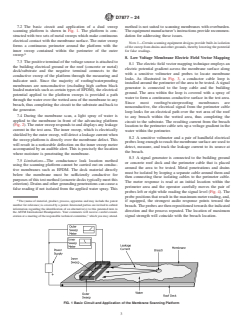
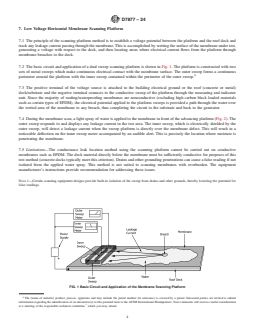
7.2 The basic circuit and application of a dual sweep scanning platform is shown in Fig. 1. The platform is constructed with two
sets of metal sweeps which make continuous electrical contact with the membrane surface. The outer sweep forms a continuous
perimeter around the platform with the inner sweep contained within the perimeter of the outer sweep.
7.3 The positive terminal of the voltage source is attached to the building electrical ground or the roof (concrete or metal)
deck/substrate and the negative terminal connects to the conductive sweep of the platfor
...