

ASTM E398-20
(Test Method)Standard Test Method for Water Vapor Transmission Rate of Sheet Materials Using Dynamic Relative Humidity Measurement
General Information
- Abstract
SIGNIFICANCE AND USE
5.1 No single set of test conditions can represent all climatic and use conditions, so this WVTR test method serves more to compare different materials at a stated set of conditions than to predict their actual performance in the field under any conditions.
5.2 The water vapor transmission rate, under known and carefully controlled conditions, may be used to evaluate the vapor barrier qualities of a sheet. Direct correlation of values obtained under different conditions of test temperature and relative humidity will be valid provided the barrier material under test does not undergo changes in solid state (such as a crystalline transition or melting point) at or between the conditions of test.
SCOPE
1.1 This test method covers dynamic evaluation of the rate of transfer of water vapor through a flexible barrier material and allows conversion to the generally recognized units of water vapor transmission (WVT) as obtained by various other test methods including the gravimetric method described in Test Methods E96/E96M.
1.2 Limitations—This test method is limited to flexible barrier sheet materials composed of either completely hydrophobic materials, or combinations of hydrophobic and hydrophilic materials having at least one surface that is hydrophobic.
1.3 The minimum test value obtained by this test method is limited by the leakage of water vapor past the clamping seals of the test instrument. A reasonable value may be approximately 0.01 g/24 h·m2 for any WVTR method including the desiccant procedure of Test Methods E96/E96M at 37.8 °C, and 90 % relative humidity. This limit can be checked for each instrument with an impervious specimen such as aluminum foil. Calibration procedures can compensate for the leakage rate if so stated.
1.4 This test method is not suitable for referee testing at this time, but is suitable for control testing and material comparison.
1.5 Several other ASTM test methods are available to test a similar property. This test method is unique in that it closely duplicates typical product storage where a transfer of moisture from a package into the environment is allowed to proceed without constantly sweeping the environmental side with dry gas. Methods with constantly swept dry sides include Test Methods F1249 and F3299.
1.6 The values stated in SI units are to be regarded as standard. No other units of measurement are included in this standard.
1.7 This standard does not purport to address all of the safety concerns, if any, associated with its use. It is the responsibility of the user of this standard to establish appropriate safety, health, and environmental practices and determine the applicability of regulatory limitations prior to use.
1.8 This international standard was developed in accordance with internationally recognized principles on standardization established in the Decision on Principles for the Development of International Standards, Guides and Recommendations issued by the World Trade Organization Technical Barriers to Trade (TBT) Committee.
- Status
- Published
- Publication Date
- 31-May-2020
- Technical Committee
- F02 - Primary Barrier Packaging
- Drafting Committee
- F02.10 - Permeation
Buy Documents
ASTM E398-20 - Standard Test Method for Water Vapor Transmission Rate of Sheet Materials Using Dynamic Relative Humidity Measurement
REDLINE ASTM E398-20 - Standard Test Method for Water Vapor Transmission Rate of Sheet Materials Using Dynamic Relative Humidity Measurement
Overview
ASTM E398-20 is the standard test method for measuring the Water Vapor Transmission Rate (WVTR) of sheet materials using dynamic relative humidity measurement. Developed by ASTM International, this method offers a dynamic approach to evaluate the rate at which water vapor passes through flexible barrier materials. Unlike continuous dry gas sweep methods, this test closely simulates actual product storage environments where moisture transfer occurs naturally between a package and its surrounding environment.
This standard is primarily designed for flexible sheet materials that are either entirely hydrophobic or have at least one hydrophobic surface. By providing controlled, comparable measurements, ASTM E398-20 is valuable for material comparison and quality control processes related to vapor barrier performance.
Key Topics
- Water Vapor Transmission Rate (WVTR): Measurement of how much water vapor passes through a material over a specific period under controlled temperature and humidity conditions.
- Dynamic Relative Humidity Measurement: Use of relative humidity sensors to monitor moisture transfer without constantly sweeping the sample area with dry gas.
- Applicable Material Types: Flexible barriers made of hydrophobic materials or hydrophobic-hydrophilic combinations, provided there is at least one hydrophobic surface.
- Test Environment Control: Standard conditions often used include 37.8 °C (100 °F) and a 90% relative humidity differential, though other conditions may be specified.
- Repeatability and Reproducibility: Data collected under this test method provide reliable material comparisons and consistent quality monitoring, although it is not intended for referee or legal dispute testing.
- Calibration and Standardization: Calibration is conducted using gravimetrically-assessed films and NIST-certified sensors to ensure accuracy.
- Limitations: Minimum detectable WVTR values are influenced by instrument design, especially leakage at sealing points. The method is not suitable for rigid materials or for samples that undergo solid-state changes under test conditions.
Applications
ASTM E398-20 is widely used across industries that require precise characterization of material barrier properties:
- Flexible Packaging: Evaluate and compare films for food packaging, pharmaceuticals, electronics, and consumer goods to ensure product shelf life and quality.
- Material Development: Support research and development for improved barrier films in packaging, insulation, and specialty sheet materials.
- Quality Assurance: Routine control testing to ensure manufacturing consistency in water vapor barrier properties.
- Product Storage Simulation: Simulate real-world conditions where products may experience moisture ingress, helping manufacturers make informed decisions on material selection.
- Comparison of Barrier Materials: Benchmark different materials under identical, controlled conditions to identify optimal solutions for moisture-sensitive applications.
Related Standards
To support accurate and comprehensive testing, ASTM E398-20 references and aligns with other key standards:
- ASTM E96/E96M: Standard Test Methods for Water Vapor Transmission of Materials (gravimetric method).
- ASTM F1249: Test Method for Water Vapor Transmission Rate Through Plastic Film and Sheeting Using a Modulated Infrared Sensor.
- ASTM F3299: Test Method for Water Vapor Transmission Rate Through Plastic Film and Sheeting Using an Electrolytic Detection Sensor.
- ASTM C168: Terminology Relating to Thermal Insulation.
- ASTM F17: Terminology Relating to Primary Barrier Packaging.
- ASTM E177: Practice for Use of the Terms Precision and Bias in ASTM Test Methods.
- ASTM E691: Practice for Conducting an Interlaboratory Study to Determine the Precision of a Test Method.
Practical Value
Implementing ASTM E398-20 ensures objective, repeatable, and directly comparable WVTR results under controlled laboratory conditions. This test method enhances material selection, supports quality assurance programs, and underpins regulatory compliance for water vapor barrier performance in flexible packaging and other critical applications. By offering a dynamic alternative to continuous dry gas sweep methods, ASTM E398-20 provides practical insights aligned with real-world storage and usage scenarios.
Keywords: water vapor transmission rate, ASTM E398-20, WVTR testing, dynamic relative humidity, flexible barrier material, packaging, moisture barrier, material comparison, quality control, ASTM standards
Relations
- Effective Date
- 15-Apr-2024
- Effective Date
- 01-Mar-2024
- Effective Date
- 15-Nov-2023
- Effective Date
- 01-Jun-2020
- Effective Date
- 01-May-2020
- Effective Date
- 01-Oct-2018
- Effective Date
- 15-Aug-2018
- Effective Date
- 15-Apr-2018
- Effective Date
- 01-Jun-2017
- Effective Date
- 01-Jun-2017
- Effective Date
- 15-Oct-2015
- Effective Date
- 01-Jun-2015
- Effective Date
- 01-May-2015
- Effective Date
- 15-Oct-2014
- Effective Date
- 01-May-2014
Buy Documents
ASTM E398-20 - Standard Test Method for Water Vapor Transmission Rate of Sheet Materials Using Dynamic Relative Humidity Measurement
REDLINE ASTM E398-20 - Standard Test Method for Water Vapor Transmission Rate of Sheet Materials Using Dynamic Relative Humidity Measurement
Get Certified
Connect with accredited certification bodies for this standard

BRCGS (Brand Reputation Compliance Global Standards)
Global food safety and quality standards owner.
Sponsored listings
Frequently Asked Questions
ASTM E398-20 is a standard published by ASTM International. Its full title is "Standard Test Method for Water Vapor Transmission Rate of Sheet Materials Using Dynamic Relative Humidity Measurement". This standard covers: SIGNIFICANCE AND USE 5.1 No single set of test conditions can represent all climatic and use conditions, so this WVTR test method serves more to compare different materials at a stated set of conditions than to predict their actual performance in the field under any conditions. 5.2 The water vapor transmission rate, under known and carefully controlled conditions, may be used to evaluate the vapor barrier qualities of a sheet. Direct correlation of values obtained under different conditions of test temperature and relative humidity will be valid provided the barrier material under test does not undergo changes in solid state (such as a crystalline transition or melting point) at or between the conditions of test. SCOPE 1.1 This test method covers dynamic evaluation of the rate of transfer of water vapor through a flexible barrier material and allows conversion to the generally recognized units of water vapor transmission (WVT) as obtained by various other test methods including the gravimetric method described in Test Methods E96/E96M. 1.2 Limitations—This test method is limited to flexible barrier sheet materials composed of either completely hydrophobic materials, or combinations of hydrophobic and hydrophilic materials having at least one surface that is hydrophobic. 1.3 The minimum test value obtained by this test method is limited by the leakage of water vapor past the clamping seals of the test instrument. A reasonable value may be approximately 0.01 g/24 h·m2 for any WVTR method including the desiccant procedure of Test Methods E96/E96M at 37.8 °C, and 90 % relative humidity. This limit can be checked for each instrument with an impervious specimen such as aluminum foil. Calibration procedures can compensate for the leakage rate if so stated. 1.4 This test method is not suitable for referee testing at this time, but is suitable for control testing and material comparison. 1.5 Several other ASTM test methods are available to test a similar property. This test method is unique in that it closely duplicates typical product storage where a transfer of moisture from a package into the environment is allowed to proceed without constantly sweeping the environmental side with dry gas. Methods with constantly swept dry sides include Test Methods F1249 and F3299. 1.6 The values stated in SI units are to be regarded as standard. No other units of measurement are included in this standard. 1.7 This standard does not purport to address all of the safety concerns, if any, associated with its use. It is the responsibility of the user of this standard to establish appropriate safety, health, and environmental practices and determine the applicability of regulatory limitations prior to use. 1.8 This international standard was developed in accordance with internationally recognized principles on standardization established in the Decision on Principles for the Development of International Standards, Guides and Recommendations issued by the World Trade Organization Technical Barriers to Trade (TBT) Committee.
SIGNIFICANCE AND USE 5.1 No single set of test conditions can represent all climatic and use conditions, so this WVTR test method serves more to compare different materials at a stated set of conditions than to predict their actual performance in the field under any conditions. 5.2 The water vapor transmission rate, under known and carefully controlled conditions, may be used to evaluate the vapor barrier qualities of a sheet. Direct correlation of values obtained under different conditions of test temperature and relative humidity will be valid provided the barrier material under test does not undergo changes in solid state (such as a crystalline transition or melting point) at or between the conditions of test. SCOPE 1.1 This test method covers dynamic evaluation of the rate of transfer of water vapor through a flexible barrier material and allows conversion to the generally recognized units of water vapor transmission (WVT) as obtained by various other test methods including the gravimetric method described in Test Methods E96/E96M. 1.2 Limitations—This test method is limited to flexible barrier sheet materials composed of either completely hydrophobic materials, or combinations of hydrophobic and hydrophilic materials having at least one surface that is hydrophobic. 1.3 The minimum test value obtained by this test method is limited by the leakage of water vapor past the clamping seals of the test instrument. A reasonable value may be approximately 0.01 g/24 h·m2 for any WVTR method including the desiccant procedure of Test Methods E96/E96M at 37.8 °C, and 90 % relative humidity. This limit can be checked for each instrument with an impervious specimen such as aluminum foil. Calibration procedures can compensate for the leakage rate if so stated. 1.4 This test method is not suitable for referee testing at this time, but is suitable for control testing and material comparison. 1.5 Several other ASTM test methods are available to test a similar property. This test method is unique in that it closely duplicates typical product storage where a transfer of moisture from a package into the environment is allowed to proceed without constantly sweeping the environmental side with dry gas. Methods with constantly swept dry sides include Test Methods F1249 and F3299. 1.6 The values stated in SI units are to be regarded as standard. No other units of measurement are included in this standard. 1.7 This standard does not purport to address all of the safety concerns, if any, associated with its use. It is the responsibility of the user of this standard to establish appropriate safety, health, and environmental practices and determine the applicability of regulatory limitations prior to use. 1.8 This international standard was developed in accordance with internationally recognized principles on standardization established in the Decision on Principles for the Development of International Standards, Guides and Recommendations issued by the World Trade Organization Technical Barriers to Trade (TBT) Committee.
ASTM E398-20 is classified under the following ICS (International Classification for Standards) categories: 55.040 - Packaging materials and accessories. The ICS classification helps identify the subject area and facilitates finding related standards.
ASTM E398-20 has the following relationships with other standards: It is inter standard links to ASTM C168-24, ASTM E96/E96M-24, ASTM E96/E96M-23, ASTM F1249-20, ASTM F17-20, ASTM F17-18a, ASTM F17-18, ASTM C168-18, ASTM C168-17, ASTM F17-17, ASTM C168-15a, ASTM C168-15, ASTM E96/E96M-15, ASTM E96/E96M-14, ASTM E177-14. Understanding these relationships helps ensure you are using the most current and applicable version of the standard.
ASTM E398-20 is available in PDF format for immediate download after purchase. The document can be added to your cart and obtained through the secure checkout process. Digital delivery ensures instant access to the complete standard document.
Standards Content (Sample)
This international standard was developed in accordance with internationally recognized principles on standardization established in the Decision on Principles for the
Development of International Standards, Guides and Recommendations issued by the World Trade Organization Technical Barriers to Trade (TBT) Committee.
Designation: E398 − 20
Standard Test Method for
Water Vapor Transmission Rate of Sheet Materials Using
Dynamic Relative Humidity Measurement
This standard is issued under the fixed designation E398; the number immediately following the designation indicates the year of
original adoption or, in the case of revision, the year of last revision. A number in parentheses indicates the year of last reapproval. A
superscript epsilon (´) indicates an editorial change since the last revision or reapproval.
1. Scope 1.7 This standard does not purport to address all of the
safety concerns, if any, associated with its use. It is the
1.1 This test method covers dynamic evaluation of the rate
responsibility of the user of this standard to establish appro-
of transfer of water vapor through a flexible barrier material
priate safety, health, and environmental practices and deter-
and allows conversion to the generally recognized units of
mine the applicability of regulatory limitations prior to use.
water vapor transmission (WVT) as obtained by various other
1.8 This international standard was developed in accor-
test methods including the gravimetric method described in
dance with internationally recognized principles on standard-
Test Methods E96/E96M.
ization established in the Decision on Principles for the
1.2 Limitations—This test method is limited to flexible
Development of International Standards, Guides and Recom-
barrier sheet materials composed of either completely hydro-
mendations issued by the World Trade Organization Technical
phobic materials, or combinations of hydrophobic and hydro-
Barriers to Trade (TBT) Committee.
philic materials having at least one surface that is hydrophobic.
2. Referenced Documents
1.3 The minimum test value obtained by this test method is
limited by the leakage of water vapor past the clamping seals 2.1 ASTM Standards:
of the test instrument. A reasonable value may be approxi- C168 Terminology Relating to Thermal Insulation
mately 0.01 g/24 h·m for any WVTR method including the E96/E96M Test Methods for Water Vapor Transmission of
desiccant procedure of Test Methods E96/E96M at 37.8 °C, Materials
and 90 % relative humidity. This limit can be checked for each E177 Practice for Use of the Terms Precision and Bias in
instrument with an impervious specimen such as aluminum ASTM Test Methods
foil. Calibration procedures can compensate for the leakage E691 Practice for Conducting an Interlaboratory Study to
rate if so stated. Determine the Precision of a Test Method
F17 Terminology Relating to Primary Barrier Packaging
1.4 This test method is not suitable for referee testing at this
F1249 Test Method for Water Vapor Transmission Rate
time, but is suitable for control testing and material compari-
Through Plastic Film and Sheeting Using a Modulated
son.
Infrared Sensor
1.5 Several otherASTM test methods are available to test a
F3299 Test Method for Water Vapor Transmission Rate
similar property. This test method is unique in that it closely
Through Plastic Film and Sheeting Using an Electrolytic
duplicates typical product storage where a transfer of moisture
Detection Sensor (Coulometric P O Sensor)
2 5
from a package into the environment is allowed to proceed
without constantly sweeping the environmental side with dry 3. Terminology
gas. Methods with constantly swept dry sides include Test
3.1 Definitions—For definitions of terms concerning the
Methods F1249 and F3299.
transmission of water vapor, refer to Terminologies C168 and
1.6 The values stated in SI units are to be regarded as
F17.
standard. No other units of measurement are included in this
4. Summary of Test Method
standard.
4.1 Thespecimenismountedbetweentwochambers,oneof
relatively high relative humidity and the other of relatively low
This test method is under the jurisdiction ofASTM Committee F02 on Primary relative humidity. After conditioning and isolation of
Barrier Packaging and is the direct responsibility of Subcommittee F02.10 on
Permeation. A previous version was under the jurisdiction of ASTM Committee
C16. For referenced ASTM standards, visit the ASTM website, www.astm.org, or
CurrenteditionapprovedJune1,2020.PublishedJuly2020.Originallyapproved contact ASTM Customer Service at service@astm.org. For Annual Book of ASTM
in 1970. Last previous edition approved in 2013 as E398 – 13. DOI: 10.1520/ Standards volume information, refer to the standard’s Document Summary page on
E0398-20. the ASTM website.
Copyright © ASTM International, 100 Barr Harbor Drive, PO Box C700, West Conshohocken, PA 19428-2959. United States
E398 − 20
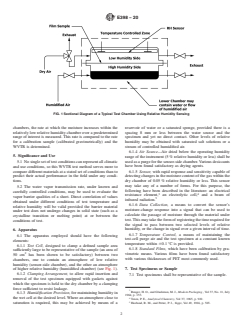
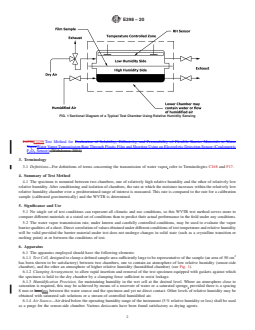
FIG. 1 Sectional Diagram of a Typical Test Chamber Using Relative Humidity Sensing
chambers, the rate at which the moisture increases within the reservoir of water or a saturated sponge, provided there is a
relatively low relative humidity chamber over a predetermined spacing 8 mm or less between the water source and the
range of interest is measured. This rate is compared to the rate specimen and yet no direct contact. Other levels of relative
for a calibration sample (calibrated gravimetrically) and the humidity may be obtained with saturated salt solutions or a
WVTR is determined. stream of controlled humidified air.
6.1.4 Air Source—Air dried below the operating humidity
5. Significance and Use
range of the instrument (5 % relative humidity or less) shall be
5.1 No single set of test conditions can represent all climatic used as a purge for the sensor-side chamber.Various desiccants
have been found satisfactory as drying agents.
and use conditions, so this WVTR test method serves more to
compare different materials at a stated set of conditions than to
6.1.5 Sensor, with rapid response and sensitivity capable of
predict their actual performance in the field under any condi- detecting changes in the moisture content of the gas within the
tions. dry chamber of 0.05 % relative humidity or less. This sensor
may take any of a number of forms. For this purpose, the
5.2 The water vapor transmission rate, under known and
following have been described in the literature: an electrical
carefully controlled conditions, may be used to evaluate the
3 4
resistance element, an electrolytic cell, and a beam of
vapor barrier qualities of a sheet. Direct correlation of values
infrared radiation.
obtained under different conditions of test temperature and
6.1.6 Data Collection, a means to convert the sensor’s
relative humidity will be valid provided the barrier material
moisture-change response into a signal that can be used to
under test does not undergo changes in solid state (such as a
calculate the passage of moisture through the material under
crystalline transition or melting point) at or between the
test.This may take the form of registering the time required for
conditions of test.
the signal to pass between two selected levels of relative
humidity, or the change in signal over a given interval of time.
6. Apparatus
6.1.7 Temperature Control, a means of maintaining the
6.1 The apparatus employed should have the following
test-cell purge air and the test specimen at a constant known
elements:
temperature within 60.1 °C is provided.
6.1.1 Test Cell, designed to clamp a defined sample area
6.1.8 Standard Films, which have been calibration by gra-
sufficiently large to be representative of the sample (an area of
vimetric means. Various films have been found satisfactory
50 cm has been shown to be satisfactory) between two
with various thicknesses of PET most commonly used.
chambers, one to contain an atmosphere of low relative
humidity (sensor-side chamber), and the other an atmosphere
7. Test Specimens or Sample
of higher relative humidity (humidified chamber) (see Fig. 1).
6.1.2 Clamping Arrangement, to allow rapid insertion and
7.1 Test specimens shall be representative of the sample.
removal of the test specimen equipped with gaskets against
which the specimen is held to the dry chamber by a clamping
force sufficient to resist leakage.
Ranger, H. O., and Gluckman, M. J., Modern Packaging , Vol 37, No. 11, July
6.1.3 Humidification Provision, for maintaining humidity in
1964, p. 153.
the wet cell at the desired level. Where an atmosphere close to
Toren, P. E., Analytical Chemistry, Vol 37, 1965, p. 922.
saturation is required, this may be achieved by means of a Husband, R. M., and Petter, P. J., Tappi, Vol 49, 1966, p. 565.
E398 − 20
7.2 Where the test specimen is completely hydrophobic, no 10.2.1 In dynamic test procedures, the presence of a water-
special conditioning procedure is required except that the sensitive surface in the dry chamber may result in a reproduc-
surface exposed in the dry cell must not have visible free water ible but false reading due in part to edge effects. Tests in this
present. orientation cannot reliably be made by this procedure.
7.3 For specimens containing a hydrophilic layer, consider- 10.3 Purge the dry chamber with the dried, purge air until
ation must be given to its orientation. If the hydrophilic layer, the cell and e
...
This document is not an ASTM standard and is intended only to provide the user of an ASTM standard an indication of what changes have been made to the previous version. Because
it may not be technically possible to adequately depict all changes accurately, ASTM recommends that users consult prior editions as appropriate. In all cases only the current version
of the standard as published by ASTM is to be considered the official document.
Designation: E398 − 13 E398 − 20
Standard Test Method for
Water Vapor Transmission Rate of Sheet Materials Using
Dynamic Relative Humidity Measurement
This standard is issued under the fixed designation E398; the number immediately following the designation indicates the year of
original adoption or, in the case of revision, the year of last revision. A number in parentheses indicates the year of last reapproval. A
superscript epsilon (´) indicates an editorial change since the last revision or reapproval.
1. Scope
1.1 This test method covers dynamic evaluation of the rate of transfer of water vapor through a flexible barrier material and
allows conversion to the generally recognized units of water vapor transmission (WVT) as obtained by various other test methods
including the gravimetric method described in Test Methods E96/E96M.
1.2 Limitations—This test method is limited to flexible barrier sheet materials composed of either completely hydrophobic
materials, or combinations of hydrophobic and hydrophilic materials having at least one surface that is hydrophobic.
1.3 The minimum test value obtained by this test method is limited by the leakage of water vapor past the clamping seals of
the test instrument. A reasonable value may be approximately 0.01 g/24 h·m for any WVTR method including the desiccant
procedure of Test Methods E96/E96M at 37.8°C,37.8 °C, and 90 % relative humidity. This limit can be checked for each
instrument with an impervious specimen such as aluminum foil. Calibration procedures can compensate for the leakage rate if so
stated.
1.4 This test method is not suitable for referee testing at this time, but is suitable for control testing and material comparison.
1.5 Several other ASTM test methods are available to test a similar property. This test method is unique in that it closely
duplicates typical product storage where a transfer of moisture from a package into the environment is allowed to proceed without
constantly sweeping the environmental side with dry gas. Methods with constantly swept dry sides include Test Methods F1249,
F372, and F1770F3299.
1.6 The values stated in SI units are to be regarded as standard. No other units of measurement are included in this standard.
1.7 This standard does not purport to address all of the safety concerns, if any, associated with its use. It is the responsibility
of the user of this standard to establish appropriate safety safety, health, and healthenvironmental practices and determine the
applicability of regulatory limitations prior to use.
1.8 This international standard was developed in accordance with internationally recognized principles on standardization
established in the Decision on Principles for the Development of International Standards, Guides and Recommendations issued
by the World Trade Organization Technical Barriers to Trade (TBT) Committee.
2. Referenced Documents
2.1 ASTM Standards:
C168 Terminology Relating to Thermal Insulation
E96/E96M Test Methods for Water Vapor Transmission of Materials
E177 Practice for Use of the Terms Precision and Bias in ASTM Test Methods
E691 Practice for Conducting an Interlaboratory Study to Determine the Precision of a Test Method
F17 Terminology Relating to Primary Barrier Packaging
F372 Test Method for Water Vapor Transmission Rate of Flexible Barrier Materials Using an Infrared Detection Technique
(Withdrawn 2009)
F1249 Test Method for Water Vapor Transmission Rate Through Plastic Film and Sheeting Using a Modulated Infrared Sensor
This test method is under the jurisdiction of ASTM Committee F02 on FlexiblePrimary Barrier Packaging and is the direct responsibility of Subcommittee F02.10 on
Permeation. A previous version was under the jurisdiction of ASTM Committee C16.
Current edition approved Oct. 1, 2013June 1, 2020. Published November 2013July 2020. Originally approved in 1970. Last previous edition approved in 20092013 as
ϵ1
E398 – 03E398 – 13.(2009) . DOI: 10.1520/E0398-13.10.1520/E0398-20.
For referenced ASTM standards, visit the ASTM website, www.astm.org, or contact ASTM Customer Service at service@astm.org. For Annual Book of ASTM Standards
volume information, refer to the standard’s Document Summary page on the ASTM website.
Copyright © ASTM International, 100 Barr Harbor Drive, PO Box C700, West Conshohocken, PA 19428-2959. United States
E398 − 20
FIG. 1 Sectional Diagram of a Typical Test Chamber Using Relative Humidity Sensing
F1770F3299 Test Method for Evaluation of Solubility, Diffusivity, and Permeability of Flexible Barrier Materials to Water
VaporWater Vapor Transmission Rate Through Plastic Film and Sheeting Using an Electrolytic Detection Sensor (Coulometric
P O Sensor) (Withdrawn 2004)
2 5
3. Terminology
3.1 Definitions—For definitions of terms concerning the transmission of water vapor, refer to Terminologies C168 and F17.
4. Summary of Test Method
4.1 The specimen is mounted between two chambers, one of relatively high relative humidity and the other of relatively low
relative humidity. After conditioning and isolation of chambers, the rate at which the moisture increases within the relatively low
relative humidity chamber over a predetermined range of interest is measured. This rate is compared to the rate for a calibration
sample (calibrated gravimetrically) and the WVTR is determined.
5. Significance and Use
5.1 No single set of test conditions can represent all climatic and use conditions, so this WVTR test method serves more to
compare different materials at a stated set of conditions than to predict their actual performance in the field under any conditions.
5.2 The water vapor transmission rate, under known and carefully controlled conditions, may be used to evaluate the vapor
barrier qualities of a sheet. Direct correlation of values obtained under different conditions of test temperature and relative humidity
will be valid provided the barrier material under test does not undergo changes in solid state (such as a crystalline transition or
melting point) at or between the conditions of test.
6. Apparatus
6.1 The apparatus employed should have the following elements:
6.1.1 Test Cell, designed to clamp a defined sample area sufficiently large to be representative of the sample (an area of 50 cm
has been shown to be satisfactory) between two chambers, one to contain an atmosphere of low relative humidity (sensor-side
chamber), and the other an atmosphere of higher relative humidity (humidified chamber) (see Fig. 1).
6.1.2 Clamping Arrangement, to allow rapid insertion and removal of the test specimen equipped with gaskets against which
the specimen is held to the dry chamber by a clamping force sufficient to resist leakage.
6.1.3 Humidification Provision, for maintaining humidity in the wet cell at the desired level. Where an atmosphere close to
saturation is required, this may be achieved by means of a reservoir of water or a saturated sponge, provided there is a spacing
8 mm or less,less between the water source and the specimen and yet no direct contact. Other levels of relative humidity may be
obtained with saturated salt solutions or a stream of controlled humidified air.
6.1.4 Air Source—Air dried below the operating humidity range of the instrument (5 % relative humidity or less) shall be used
as a purge for the sensor-side chamber. Various desiccants have been found satisfactory as drying agents.
E398 − 20
6.1.5 Sensor, with rapid response and sensitivity capable of detecting changes in the moisture content of the gas within the dry
chamber of 0.05 % relative humidity or less. This sensor may take any of a number of forms. For this purpose, the following have
3 4 5
been described in the literature: an electrical resistance element, an electrolytic cell, and a beam of infrared radiation.
6.1.6 Data Collection, a means to convert the sensor’s moisture-change response into a signal that can be used to calculate the
passage of moisture through the material under test. This may take the form of registering the time required for the signal to pass
between two selected levels of relative humidity, or the change in signal over a given interval of time.
6.1.7 Temperature Control, a means of maintaining the test-cell purge air and the test specimen at a constant known temperature
within 60.1°C60.1 °C is provided.
6.1.8 Standard Films, which have been calibration by gravimetric means. Various films have been found satisfactory with
various thicknesses of PET most commonly used.
7. Test Specimens or Sample
7.1 Test specimens shall be representative of the sample.
7.2 Where the test specimen is completely hydrophobic, no special conditioning procedure is required except that the surface
exposed in the dry cell must not have visible free water present.
7.3 For specimens containing a hydrophilic layer, consideration must be given to its orientation. If the hydrophilic layer, such
as paper, is facing the dry side of the test apparatus, false readings may result.
8. Testing Conditions and Instrument Test Range
8.1 The conditions for the test are selected. In the U.S.A., a standard condition of 37.8°C37.8 °C and 90 or 100 % relative
humidity differential is commonly used, but the level can be whatever condition is
...