

ASTM B1008-18
(Test Method)Standard Test Method for Stress-Strain Testing for Overhead Electrical Conductors
General Information
- Abstract
SIGNIFICANCE AND USE
5.1 To model the mechanical characteristics of overhead electrical conductor, stress-strain characteristics must be determined. The most accurate method for determination of these characteristics is a laboratory stress-strain test. These mechanical characteristics can then be used to determine the strain response of a conductor to mechanical loads, and thus predict the sag of the conductor. This can then be used to determine the required installation parameters to provide safe clearance and tension for the conductor usage.
SCOPE
1.1 This test method covers the measurement of the elastic and short-term creep characteristics of conductors for overhead power lines.
1.2 Stress-strain data from tests performed in accordance with IEC 61089 are compliant with this standard.
1.3 Stress-strain data from prior Aluminum Association testing procedures are compliant with this standard.
1.4 The values stated in either SI units or inch-pound units are to be regarded separately as standard. The values stated in each system may not be exact equivalents; therefore, each system shall be used independently of the other. Combining values from the two systems may result in non-conformance with the standard.
1.5 This standard does not purport to address all of the safety concerns, if any, associated with its use. It is the responsibility of the user of this standard to establish appropriate safety, health, and environmental practices and determine the applicability of regulatory limitations prior to use.
1.6 This international standard was developed in accordance with internationally recognized principles on standardization established in the Decision on Principles for the Development of International Standards, Guides and Recommendations issued by the World Trade Organization Technical Barriers to Trade (TBT) Committee.
- Status
- Published
- Publication Date
- 31-Oct-2018
- Technical Committee
- B01 - Electrical Conductors
- Drafting Committee
- B01.02 - Methods of Test and Sampling Procedure
Overview
ASTM B1008-18: Standard Test Method for Stress-Strain Testing for Overhead Electrical Conductors is a key international standard published by ASTM for evaluating the mechanical performance of overhead conductors used in power transmission. The standard outlines laboratory procedures for measuring the elastic and short-term creep characteristics of electrical conductors, supporting reliable sag and tension predictions crucial for safe installation and long-term performance of overhead lines.
This test method is essential for modeling the mechanical properties of both composite and homogeneous conductors, ensuring data consistency with industry-recognized methods such as those of IEC 61089 and the Aluminum Association. Accurate stress-strain data are necessary for design decisions that safeguard public and infrastructure safety in overhead electrical systems.
Key Topics
- Mechanical Characterization: Details procedures for quantifying a conductor’s elastic and short-term creep behavior, two critical factors in determining line sag and tension characteristics.
- Test Sample Preparation: Specifies requirements for representative sampling, correct end fitting installation, handling, and avoidance of pre-test damage or deformation.
- Test Apparatus and Measurement: Defines the apparatus needed for stress-strain testing, requirements for temperature stability, strain measurement accuracy, and calibration.
- Testing Procedure: Outlines step-by-step methods for loading, unloading, and holding at specified stress levels to simulate operational stresses, ensuring repeatable and comprehensive data acquisition.
- Data Reporting: Provides requirements for thorough reporting, including mechanical properties, test conditions, calibration data, graphical plots, and observed anomalies.
- Safety Considerations: Emphasizes the importance of safe practices during sample handling, testing, and preparation, including use of eye protection and safety cages.
- International Harmonization: Recognizes compliance with stress-strain data from IEC 61089 and Aluminum Association procedures, supporting global interoperability.
Applications
- Transmission and Distribution Line Design: Accurate stress-strain data ensures optimal selection and tensioning of conductors, minimizing sag and maximizing clearance for safe operation.
- Conductor Manufacturer Quality Control: Routine testing based on ASTM B1008-18 verifies that batches of conductors meet performance specifications before installation.
- Asset Management and System Upgrades: Infrastructure planners use this standard to assess mechanical performance of new and existing conductor types, enabling informed upgrade or replacement strategies.
- International Projects and Contracts: Standardized test methods facilitate global collaboration by ensuring test data is recognized and accepted across different regulatory environments.
Related Standards
- IEC 61089: Internationally recognized method for physical and mechanical testing of overhead conductors. Stress-strain data generated according to IEC 61089 is compatible with ASTM B1008-18.
- Aluminum Association Guide for Stress-Strain and Creep Testing of Conductors (1999): Previous industry benchmarks are recognized as compliant with this standard.
- ASTM E4: Practices for force verification of testing machines, necessary for calibrating tension measurement devices.
- ASTM E83: Practice for verification and classification of extensometer systems.
- ASTM E220: Calibration of thermocouples, ensuring accurate temperature control during tests.
Practical Value
Implementing ASTM B1008-18 provides confidence in the mechanical characterization of overhead electrical conductors, ensuring predictable line sag, sufficient clearance, and safe long-term operation. By following this standard, utilities, manufacturers, and engineers gain repeatable, accurate stress-strain measurements critical for the reliability of overhead power lines. This contributes directly to public safety, infrastructure longevity, and international consistency in the design, installation, and maintenance of electrical transmission systems.
Keywords: ASTM B1008-18, stress-strain testing, overhead electrical conductor, sag prediction, mechanical characteristics, power transmission, strain measurement, international standard.
Relations
- Effective Date
- 01-Jun-2014
- Effective Date
- 01-Nov-2013
- Effective Date
- 01-Jun-2010
- Effective Date
- 01-Jun-2010
- Effective Date
- 01-Jan-2010
- Effective Date
- 01-Nov-2009
- Effective Date
- 01-Apr-2009
- Effective Date
- 01-Dec-2008
- Refers
ASTM E220-07a - Standard Test Method for Calibration of Thermocouples By Comparison Techniques - Effective Date
- 01-Nov-2007
- Refers
ASTM E220-07e1 - Standard Test Method for Calibration of Thermocouples By Comparison Techniques - Effective Date
- 01-May-2007
- Effective Date
- 01-May-2007
- Effective Date
- 01-Jan-2007
- Effective Date
- 01-May-2006
- Effective Date
- 10-Aug-2003
- Effective Date
- 10-Nov-2002
Get Certified
Connect with accredited certification bodies for this standard

IMQ S.p.A. (Certification)
Italian electrical product certification.

SLG Prüf- und Zertifizierungs GmbH
German testing and certification body.

UL Solutions
Global safety science company with testing, inspection and certification.
Sponsored listings
Frequently Asked Questions
ASTM B1008-18 is a standard published by ASTM International. Its full title is "Standard Test Method for Stress-Strain Testing for Overhead Electrical Conductors". This standard covers: SIGNIFICANCE AND USE 5.1 To model the mechanical characteristics of overhead electrical conductor, stress-strain characteristics must be determined. The most accurate method for determination of these characteristics is a laboratory stress-strain test. These mechanical characteristics can then be used to determine the strain response of a conductor to mechanical loads, and thus predict the sag of the conductor. This can then be used to determine the required installation parameters to provide safe clearance and tension for the conductor usage. SCOPE 1.1 This test method covers the measurement of the elastic and short-term creep characteristics of conductors for overhead power lines. 1.2 Stress-strain data from tests performed in accordance with IEC 61089 are compliant with this standard. 1.3 Stress-strain data from prior Aluminum Association testing procedures are compliant with this standard. 1.4 The values stated in either SI units or inch-pound units are to be regarded separately as standard. The values stated in each system may not be exact equivalents; therefore, each system shall be used independently of the other. Combining values from the two systems may result in non-conformance with the standard. 1.5 This standard does not purport to address all of the safety concerns, if any, associated with its use. It is the responsibility of the user of this standard to establish appropriate safety, health, and environmental practices and determine the applicability of regulatory limitations prior to use. 1.6 This international standard was developed in accordance with internationally recognized principles on standardization established in the Decision on Principles for the Development of International Standards, Guides and Recommendations issued by the World Trade Organization Technical Barriers to Trade (TBT) Committee.
SIGNIFICANCE AND USE 5.1 To model the mechanical characteristics of overhead electrical conductor, stress-strain characteristics must be determined. The most accurate method for determination of these characteristics is a laboratory stress-strain test. These mechanical characteristics can then be used to determine the strain response of a conductor to mechanical loads, and thus predict the sag of the conductor. This can then be used to determine the required installation parameters to provide safe clearance and tension for the conductor usage. SCOPE 1.1 This test method covers the measurement of the elastic and short-term creep characteristics of conductors for overhead power lines. 1.2 Stress-strain data from tests performed in accordance with IEC 61089 are compliant with this standard. 1.3 Stress-strain data from prior Aluminum Association testing procedures are compliant with this standard. 1.4 The values stated in either SI units or inch-pound units are to be regarded separately as standard. The values stated in each system may not be exact equivalents; therefore, each system shall be used independently of the other. Combining values from the two systems may result in non-conformance with the standard. 1.5 This standard does not purport to address all of the safety concerns, if any, associated with its use. It is the responsibility of the user of this standard to establish appropriate safety, health, and environmental practices and determine the applicability of regulatory limitations prior to use. 1.6 This international standard was developed in accordance with internationally recognized principles on standardization established in the Decision on Principles for the Development of International Standards, Guides and Recommendations issued by the World Trade Organization Technical Barriers to Trade (TBT) Committee.
ASTM B1008-18 is classified under the following ICS (International Classification for Standards) categories: 29.240.20 - Power transmission and distribution lines. The ICS classification helps identify the subject area and facilitates finding related standards.
ASTM B1008-18 has the following relationships with other standards: It is inter standard links to ASTM E4-14, ASTM E220-13, ASTM E83-10a, ASTM E4-10, ASTM E83-10, ASTM E4-09a, ASTM E4-09, ASTM E4-08, ASTM E220-07a, ASTM E220-07e1, ASTM E220-07, ASTM E4-07, ASTM E83-06, ASTM E4-03, ASTM E4-02. Understanding these relationships helps ensure you are using the most current and applicable version of the standard.
ASTM B1008-18 is available in PDF format for immediate download after purchase. The document can be added to your cart and obtained through the secure checkout process. Digital delivery ensures instant access to the complete standard document.
Standards Content (Sample)
This international standard was developed in accordance with internationally recognized principles on standardization established in the Decision on Principles for the
Development of International Standards, Guides and Recommendations issued by the World Trade Organization Technical Barriers to Trade (TBT) Committee.
Designation: B1008 − 18
Standard Test Method for
Stress-Strain Testing for Overhead Electrical Conductors
This standard is issued under the fixed designation B1008; the number immediately following the designation indicates the year of
original adoption or, in the case of revision, the year of last revision.Anumber in parentheses indicates the year of last reapproval.A
superscript epsilon (´) indicates an editorial change since the last revision or reapproval.
1. Scope 2.2 Aluminum Association Document:
Aluminum Association Guide for Stress-Strain and Creep
1.1 This test method covers the measurement of the elastic
Testing of Conductors, 1999
andshort-termcreepcharacteristicsofconductorsforoverhead
2.3 IEC Document:
power lines.
IEC 61089:1991Appendix B, Stress-strain Test Method
1.2 Stress-strain data from tests performed in accordance
with IEC 61089 are compliant with this standard.
3. Terminology
1.3 Stress-strain data from prior Aluminum Association
3.1 Definitions:
testing procedures are compliant with this standard.
3.1.1 banding clamps, n—any of several means for locking
1.4 The values stated in either SI units or inch-pound units
together all strands of a conductor or core sample.
are to be regarded separately as standard. The values stated in
3.1.2 composite conductor, n—a conductor made of two
each system may not be exact equivalents; therefore, each
distinct elements, a single wire or stranded core primarily used
system shall be used independently of the other. Combining
for reinforcement or support and an outer stranded component
values from the two systems may result in non-conformance
of a second, more conductive material.
with the standard.
3.1.3 conductor stress-strain, n—elastic and short-term
1.5 This standard does not purport to address all of the
creep behavior of a conductor.
safety concerns, if any, associated with its use. It is the
3.1.4 creep, n—permanent elongation of a material under
responsibility of the user of this standard to establish appro-
stress, for a given temperature and time.
priate safety, health, and environmental practices and deter-
3.1.5 elastic strain, n—elongation caused by stress that is
mine the applicability of regulatory limitations prior to use.
completely recovered when the stress is released.
1.6 This international standard was developed in accor-
dance with internationally recognized principles on standard-
3.1.6 final modulus, n—a linear relationship between stress
ization established in the Decision on Principles for the
and strain after the conductor has experienced its maximum
Development of International Standards, Guides and Recom-
strain.
mendations issued by the World Trade Organization Technical
3.1.7 gauge length (gauge section), n—the distance over
Barriers to Trade (TBT) Committee.
which the strain is measured.
3.1.8 gauge rod, n—the rigid frame used to set the gauge
2. Referenced Documents
length.
2.1 ASTM Standards:
3.1.9 homogeneous conductor, n—a conductor made of a
E4Practices for Force Verification of Testing Machines
single wire or stranded using strands of the same material.
E83Practice for Verification and Classification of Exten-
3.1.10 initial modulus, n—a fitted curve through test data
someter Systems
that describes the expected behavior of the conductor during
E220Test Method for Calibration of Thermocouples By
loading.
Comparison Techniques
3.1.11 modulus of elasticity (MOE, elastic modulus, E),
n—the slope of the linear, elastic portions of the stress-strain
This test method is under the jurisdiction of ASTM Committee B01 on
data for a conductor or conductor component.
Electrical Conductors and is the direct responsibility of Subcommittee B01.02 on
Methods of Test and Sampling Procedure.
Current edition approved Nov. 1, 2018. Published January 2019. DOI: 10.1520/
B1008-18. Available fromAluminumAssociation, 1400 Crystal Dr., Suite 430,Arlington,
For referenced ASTM standards, visit the ASTM website, www.astm.org, or VA 22202, http://www.aluminum.org.
contact ASTM Customer Service at service@astm.org. For Annual Book of ASTM Available from International Electrotechnical Commission (IEC), 3, rue de
Standards volume information, refer to the standard’s Document Summary page on Varembé, 1st Floor, P.O. Box 131, CH-1211, Geneva 20, Switzerland, http://
the ASTM website. www.iec.ch.
Copyright © ASTM International, 100 Barr Harbor Drive, PO Box C700, West Conshohocken, PA 19428-2959. United States
B1008 − 18
3.1.11.1 virtual stress (for composite conductors), n—stress mined. The most accurate method for determination of these
in a conductor component multiplied by the area fraction of characteristicsisalaboratorystress-straintest.Thesemechani-
that component. cal characteristics can then be used to determine the strain
response of a conductor to mechanical loads, and thus predict
3.1.12 one-hour creep, n—permanent elongation of the
thesagoftheconductor.Thiscanthenbeusedtodeterminethe
conductor sample after holding it for an hour at various stress
required installation parameters to provide safe clearance and
levels.
tension for the conductor usage.
3.1.13 one-hour modulus, n—see initial modulus.
3.1.14 plastic strain, n—permanent deformation after the
6. Interferences
stress is removed.
6.1 Error Due toAmbient Temperature Change—Magnitude
3.1.15 rated breaking strength (RBS), n—a minimum theo-
of the error depends on the ambient temperature profile of the
reticaltensilevalueassignedtoaconductorcalculatedfromthe
lab and the materials and the relative thermal response times
relevant product specifications.
for the gauge rod and the sample. Provided the laboratory is
3.1.16 rated tensile strength (RTS), n—see RBS.
temperature-controlled per the requirements of this standard,
the typical strain measurement error from this source is 5
3.1.17 sample length, n—overall length of the conductor,
strain-ppm (0.0005 strain%).
inclusive of the end sections used for gripping.
3.1.18 σ ,n—initial load target, in psi (MPa), for the core 6.2 Errors in the Tension Measurement—Strain is approxi-
core
mately linear with tension. Therefore the 1% of reading
stress-strain test.
allowed in the tension measurement translates directly to an
3.1.19 σ ,n—initial load, in psi (MPa), applied dur-
composite
additional 1% of reading error in the strain measurement.
ing the composite stress-strain test.
6.3 Error in Straightening the Sample Prior to Test—Error
3.1.20 strain—fractional change in the original length of a
from slack due to conductor sag may be considered negligible
conductor.
provided the conductor is supported as specified in 7.7.
3.1.21 stress, n—tension in a conductor or conductor
6.4 Even with the best possible test accuracy, users should
component, divided by the solid area of that conductor or
conductor component. recognizethattherearesagpredictionerrorsduetodifferences
in test sample properties versus the properties of the conductor
3.1.22 yield, n—permanent elongation that occurs at and
following handling and installation. Prudent line designers
abovethenominalyieldstrengthoftheconductororconductor
provide a safety factor to allow for known uncertainties in sag
component.
predictions, including uncertainties in the stress-strain mea-
4. Summary of Test Method surement and normal variation in the properties of different
conductor lots.
4.1 Conductor and, if present, the conductor core are sub-
jected to a series of loading and unloading at progressively
7. Apparatus
higher stress levels to determine the elastic and short-time
creep characteristics of composite and homogeneous conduc-
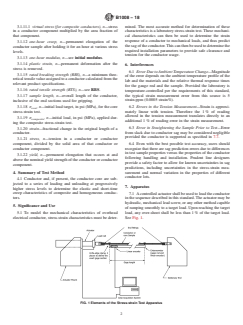
7.1 Acontrolledactuatorshallbeusedtoloadtheconductor
tors. inthesequencedescribedinthisstandard.Theactuatormaybe
hydraulic,mechanicalleadscrew,oranyothermethodcapable
5. Significance and Use
of ramping smoothly to a target load. Upon reaching the target
5.1 To model the mechanical characteristics of overhead load, any over-shoot shall be less than 1% of the target load.
electrical conductor, stress-strain characteristics must be deter- See Fig. 1.
FIG. 1 Elements of the Stress-strain Test Apparatus
B1008 − 18
7.2 The frame shall be long enough to test samples with 9.1.7 Samples shall be transported as straight sections,
lengths specified in 9.3. preferably inside a protective tube, or coiled with a coil
diameter not less than 40 times the conductor diameter.
7.3 Temperature measurements shall be taken of ambient,
sample surface and gauge rod. 9.2 Core Samples:
9.2.1 The core sample shall be either taken from a compos-
7.4 Strain shall be measured with an accuracy of 60.001
itesamplepreparedinaccordancewith9.1(withthealuminum
strain% (10 strain-ppm). Resolution of the recorded data shall
removed), or taken directly from the core pay-off reel.
be 0.00005 strain% (0.5 strain-ppm) or lower.
9.2.2 End Preparation:
NOTE 1—This issue has caused confusion because the measurement
9.2.2.1 The core sample may be prepared identical to the
(strain)andtheerrorarebothexpressedinpercentorppm.Tobeclear:the
allowable error values in this section are absolute error in strain%, and composite sample, and the aluminum layers removed prior to
strain-ppm, and not percent error on the measured value of strain.
the test. Alternately, the aluminum may be removed first, and
the bare core prepared for the test.
7.5 Actuator displacement shall be measured using an
9.2.2.2 The core sample may be taken directly from the
instrument meeting the specifications of 11.4.
original payout reel.
7.6 Time, tension, strain, actuator position, and all tempera-
9.3 Sample Gauge Length:
turechannelsmustberecorded,asaminimum,atfrequencyof
9.3.1 The gauge length where strain is measured may not
once per second. During hold periods, the frequency can be
include the 12 in. (30 cm) nearest to the fitting. Minimum
reduced to once per five minutes.
gauge length shall be 400× the sample diameter not to exceed
7.7 The sample shall be supported in a straight line with a
500 in. Shorter gauge lengths may be used provided the
maximum sag of ⁄4 in. (6 mm) between any two supports. See
laboratory provides justification, demonstrating the accuracy
X2.5 for best practices.
requirements are met.
7.8 The ambient temperature during the test shall be be-
10. Preparation of Apparatus
tween 15 and 40°C, and preferably stable at or near 23°C
(73°F). The ambient temperature shall be stable within 61°C
10.1 Calibration status and proper operation of the controls
for the duration of the test.
shall be verified prior to the start of the test.
8. Hazards
11. Calibration and Standardization
8.1 Standard industrial safety precautions are appropriate 11.1 Calibration of the tension instrument shall conform to
during sample handling and preparation. Coiled samples may the requirements of Practices E4.
whipunexpectedly,andthereforetheendsshouldberestrained.
11.2 Calibration of the strain instrument shall conform to
Eye protection is recommended during all phases of sample
the requirements of Practice E83.
preparation and testing.
11.3 Calibration of temperature instruments shall be in
8.2 Chemical and respiratory hazards may exist when han-
accordance with Test Method E220, and temperature shall be
dling potting compounds for cast resin end fittings.
recorded with a resolution of 0.1°C.
8.3 Sample rupture is possible during loading tests.
11.4 Actuator displacement shall be measured using an
Therefore, safety cages for the testing machine are recom-
instrument with an accuracy of 60.004 in (0.1 mm) and
mended.
resolution of 0.0005 in (0.01 mm).
9. Sampling, Test Specimens, and Test Units
12. Conditioning
9.1 Conductor Samples:
12.1 Thesample,thegaugerod,andallinstrumentsshallbe
9.1.1 The test samples shall be taken from standard produc-
at thermal equilibrium with a stable lab ambient during all
tion and representative of the production process. phases of the stress-strain test.
9.1.2 Samples removed from the production line shall have
13. Procedure
temporary clamps applied inboard of each cut to prevent
shifting of any strand or layer relative to the core.
13.1 Composite Conductor:
9.1.3 Samples removed from shipping reels shall not in-
13.1.1 Install the sample and apply an initial load of 8% of
clude end sections if there is evidence that any strand or layer
the conductor RBS or 1000 lb (4.45 kN), whichever is less.
has shifted and the manufacturing pre-stress has been released.
13.1.2 Remove sag by supporting the weight of the sample
9.1.4 The end termination used for testing shall prevent
(see 7.7).
shifting on any conductor component. Appendix X2 contains
13.1.3 Install the extensometer and set to zero strain while
acceptable methods.
the conductor is at initial load.
9.1.5 The conductor manufacturer, at their sole discretion,
13.1.4 Increase load smoothly to 30% of the conductor
may direct the acceptable design for the end termination
RBS within two minutes but not less than one minute. Hold
suitable for their product.
load at 30% RBS for 30 6 0.25 min,
9.1.6 The method used to cut the conductor shall not cause 13.1.5 Return to the initial load at the same rate as used
the conductor core or any strand to slip inside the clamp(s). during the increase to load (Note 2).
B1008 − 18
NOTE 2—Initial load may be modified to 50% of the prior load hold
where:
target, if necessary, to avoid excessive bird caging of the aluminum
σ = initialloadtarget,inpsi,forthecorestress-strain
core
strands for conductors with annealed aluminum strands and a low-
test
modulus core.
σ = initial load, in psi, applied during the composite
composite
13.1.6 Increase load smoothly to 50% of the conductor
stress-strain test
ratingatthesamerateusedfortherampto30%RBS.Holdfor
E = elastic modulus, in psi, found during the com-
composite
60 6 0.25 min.
posite conductor test
13.1.7 Return to the initial load (Note 2).
E = elastic modulus, in psi, for the core
core
13.1.8 Increase load smoothly to 70% of the conductor
NOTE 4—For composite cores, the manufacturer should provide values
ratingatthesamerateusedfortherampto30%RBS.Holdfor
for initial moduli. For steel cores, the initial moduli may be taken as:
27.5 × 10 for single-wire steel cores
60 6 0.25 min.
27.0 × 10 for 7-wire steel cores
13.1.9 Return to the initial load (Note 2).
26.5 × 10 for 19-wire steel cores
13.1.10 Increase load smoothly to 85% of the conductor
13.2.2 Set the strain indicator to zero with the core at the
ratingatthesamerateusedfortherampto30%RBS.Holdfor
initial tension.
60 6 0.25 min.
13.2.3 Subject the core to the same initial strains and hold
13.1.11 Return to the initial load (Note 2).
pe
...