


ASTM D7563-10(2016)
(Test Method)Standard Test Method for Evaluation of the Ability of Engine Oil to Emulsify Water and Simulated Ed85 Fuel
Standard Test Method for Evaluation of the Ability of Engine Oil to Emulsify Water and Simulated Ed85 Fuel
SIGNIFICANCE AND USE
5.1 During engine operation, engine oil can become contaminated by water and fuel. In the case of Ed85 fuels, this contamination can result in a non-emulsified aqueous bottom layer in the oil that can affect the lubrication and detergency of the engine oil. To avoid field problems, engine oil should be capable of emulsifying water contamination to the extent that no aqueous layer appears.
5.2 The test described in this method is designed to evaluate the ability of an engine oil, contaminated with a specified amount of water (volume fraction of 10 % of the original oil sample) and simulated Ed85 fuel (also a volume fraction of 10 % of the original oil sample), to emulsify the water after agitation in a blender and to maintain this emulsion at temperatures of 20 °C to 25 °C and –5 °C to 0 °C for at least 24 h.
5.3 This test method has potential use in specifications of engine lubricating oils, such as Specification D4485.
SCOPE
1.1 This test method describes a qualitative procedure to measure the ability of a specific volume of engine oil to emulsify a specific added volume of combined water and simulated Ed85 fuel upon agitation in a high-speed blender and to retain this emulsified state for at least 24 h at temperatures of both 20 °C to 25 °C and –5 °C to 0 °C.
1.2 Information Letters are published periodically by the ASTM Test Monitoring Center (TMC) to update this and other test methods under the jurisdiction of Subcommittee D02.B0. Copies of these letters can be obtained by writing the Center.2
1.3 The values stated in SI units are to be regarded as standard. No other units of measurement are included in this standard.
1.4 This standard does not purport to address all of the safety concerns, if any, associated with its use. It is the responsibility of the user of this standard to establish appropriate safety and health practices and determine the applicability of regulatory limitations prior to use.
General Information
Buy Standard
Standards Content (Sample)
NOTICE: This standard has either been superseded and replaced by a new version or withdrawn.
Contact ASTM International (www.astm.org) for the latest information
Designation: D7563 − 10 (Reapproved 2016)
Standard Test Method for
Evaluation of the Ability of Engine Oil to Emulsify Water and
Simulated Ed85 Fuel
This standard is issued under the fixed designation D7563; the number immediately following the designation indicates the year of
original adoption or, in the case of revision, the year of last revision. A number in parentheses indicates the year of last reapproval. A
superscript epsilon (´) indicates an editorial change since the last revision or reapproval.
1. Scope D5798 Specification for Ethanol Fuel Blends for Flexible-
Fuel Automotive Spark-Ignition Engines
1.1 This test method describes a qualitative procedure to
D5854 Practice for Mixing and Handling of Liquid Samples
measure the ability of a specific volume of engine oil to
of Petroleum and Petroleum Products
emulsify a specific added volume of combined water and
E1272 Specification for Laboratory Glass Graduated Cylin-
simulated Ed85 fuel upon agitation in a high-speed blender and
ders
to retain this emulsified state for at least 24 h at temperatures of
both 20 °C to 25 °C and –5 °C to 0 °C.
3. Terminology
1.2 Information Letters are published periodically by the
3.1 Definitions:
ASTM Test Monitoring Center (TMC) to update this and other
3.1.1 denatured fuel ethanol, n—fuel ethanol made unfit for
test methods under the jurisdiction of Subcommittee D02.B0.
beverage use by the addition of denaturants. D4806
Copies of these letters can be obtained by writing the Center.
3.1.2 fuel ethanol (Ed75-Ed85), n—blend of ethanol and
1.3 The values stated in SI units are to be regarded as
hydrocarbon of which the ethanol portion is nominally 75 to 85
standard. No other units of measurement are included in this
volume % denatured fuel ethanol. D5798
standard.
3.1.3 engine oil, n—liquid that reduces friction or wear, or
1.4 This standard does not purport to address all of the
both, between the moving parts within an engine; removes
safety concerns, if any, associated with its use. It is the
heat, particularly from the underside of pistons; and serves as
responsibility of the user of this standard to establish appro-
a combustion gas sealant for piston rings.
priate safety and health practices and determine the applica-
3.1.3.1 Discussion—It may contain additives to enhance
bility of regulatory limitations prior to use.
certain properties. Inhibition of engine rusting, deposit
formation, valve train wear, oil oxidation, and foaming are
2. Referenced Documents
examples. D4175
2.1 ASTM Standards:
3.2 Definitions of Terms Specific to This Standard:
D1193 Specification for Reagent Water
3.2.1 simulated Ed85 fuel, n—laboratory blend made to
D4175 Terminology Relating to Petroleum Products, Liquid
simulate Ed85 fuel by mixing 85 % denatured fuel ethanol and
Fuels, and Lubricants
15 % unleaded gasoline by volume.
D4485 Specification for Performance of Active API Service
Category Engine Oils
3.2.2 test oil, n—any engine oil subjected to evaluation in
D4806 Specification for Denatured Fuel Ethanol for Blend-
this test method.
ing with Gasolines for Use as Automotive Spark-Ignition
Engine Fuel 4. Summary of Test Method
4.1 Distilled water, simulated Ed85 fuel, and the test oil are
This test method is under the jurisdiction of ASTM Committee D02 on
emulsified in a high-speed blender. Portions of the resulting
Petroleum Products, Liquid Fuels, and Lubricants and is the direct responsibility of
emulsion are stored in two graduated cylinders (or suitably
Subcommittee D02.B0.07 on Development and Surveillance of Bench Tests
dimensioned alternative containers) at temperatures of 20 °C to
Methods.
Current edition approved April 1, 2016. Published May 2016. Originally 25 °C and –5 °C to 0 °C for 24 h. Presence or absence of an
approved in 2010. Last previous edition approved in 2010 as D7563 – 10. DOI:
aqueous layer at the bottom of either of the containers after this
10.1520/D7563-10R16.
time interval is observed and reported.
Information letters may be obtained from the ASTM Test Monitoring Center,
6555 Penn Avenue, Pittsburgh, PA 15206-4489. www.standards.astmtmc.cmu.edu.
For referenced ASTM standards, visit the ASTM website, www.astm.org, or 5. Significance and Use
contact ASTM Customer Service at service@astm.org. For Annual Book of ASTM
5.1 During engine operation, engine oil can become con-
Standards volume information, refer to the standard’s Document Summary page on
the ASTM website. taminated by water and fuel. In the case of Ed85 fuels, this
Copyright © ASTM International, 100 Barr Harbor Drive, PO Box C700, West Conshohocken, PA 19428-2959. United States
D7563 − 10 (2016)
contamination can result in a non-emulsified aqueous bottom 6.4.2 Warm cabinet or oven capable of controlling tempera-
layer in the oil that can affect the lubrication and detergency of ture within a range of 20 ºC to 25 °C.
the engine oil. To avoid field problems, engine oil should be
6.5 Time-Measuring Equipment:
capable of emulsifying water contamination to the extent that
6.5.1 Stopwatch or other timer capable of measuring 1 min
no aqueous layer appears.
with a minimum precision of 61 s.
5.2 The test described in this method is designed to evaluate 6.5.2 Clock or other timer capable of measuring 24 h with a
the ability of an engine oil, contaminated with a specified minimum precision of 65 min.
amount of water (volume fraction of 10 % of the original oil
6.6 Laboratory Hood Vented Exteriorly or Other Well-
sample) and simulated Ed85 fuel (also a volume fraction of
Ventilated Work Space—Suitable for pouring volatile, flam-
10 % of the original oil sample), to emulsify the water after
mable fluids such as denatured fuel ethanol and gasoline into
agitation in a blender and to maintain this emulsion at
graduated cylinders and containers. Ensure there is no ignition
temperatures of 20 °C to 25 °C and –5 °C to 0 °C for at least
source within the hood or nearby when using an open work
24 h.
space, particularly at lower levels where hydrocarbon volatiles
5.3 This test method has potential use in specifications of tend to congregate.
engine lubricating oils, such as Specification D4485.
7. Reagents and Materials
6. Apparatus and Supporting Equipment
7.1 Purity of Water—Unless otherwise indicated, references
to water shall be understood to mean reagent water that meets
6.1 Blender—Commercial laboratory blender with its asso-
or exceeds that defined as Type IV of Specification D1193.
ciated glass or stainless steel liquid container having suitable
blending capacity for this use and a blade rotating at approxi-
7.2 Denatured Fuel Ethanol—Use product conforming to
mately 10 000 r/min 6 2000 r ⁄min as measured by a strobo-
Specification D4806. Refer to Specification D4806 and Prac-
scopic tachometer.
tice D5854 for information on container selection, storage and
handling. Product stored for more than three months should be
NOTE 1—This speed is generally equivalent to the low-speed setting on
checked to ensure it has not deteriorated or been contaminated
two-speed commercial mixers or the “2” or “3” setting on seven-speed
commercial mixers.
before use. (Warning—Danger! Extremely flammable. Vapors
may cause flash fire.)
6.2 Glass, Graduated Cylinders—Unless otherwise stated,
all graduated cylinders shall conform to Specification E1272,
7.3 Unleaded Gasoline—Use only Haltermann EEE un-
Class B, Style I.
leaded fuel coded HF003. Fuel stored for more than three
6.2.1 For Measuring Volume of Test Oil and Unleaded
months should be checked to ensure it has not deteriorated or
Fuel—Having a capacity of 250 mL with graduation marks of
been contaminated before use. (Warning—Danger! Extremely
2 mL.
flammable. Health Hazard.)
6.2.2 For Measuring Volumes of Simulated Ed85 Fuel and
7.4 Cleaning Solvents—Reagent grade acetone and isooc-
Water—Having a capacity of 25 mL with graduation marks of
tane. (Warning—Danger! Extremely flammable. Vapors may
0.2 mL.
cause flash fire.)
6.2.3 For Preparing the Simulated Ed85 Fuel—Glass-
stoppered and conforming to Specification E1272, Class B,
8. Hazards
Style II and having a capacity of 1 L with graduation marks of
8.1 Specific Hazards—Because of fire danger, carefully pour
10 mL.
denatured fuel ethanol and gasoline into graduated cylinders
6.3 Containers for Observation of Emulsified Samples—Use
and containers in a laboratory hood, preferably from containers
either of the following types:
of capacity no greater than about 2 L. See also 7.2 and 7.3.
6.3.1 Glass-stoppered, graduated cylinders conforming to
Specification E1272, Class B, Style II and having a capacity of
9. Procedure
100 mL with graduation marks of 1 mL (see Fig. 1).
9.1 Clean blender and other glassware with isooctane fol-
6.3.2 Glass, flat-bottomed, sample bottles with an outer
lowed by acetone (see warning in 7.4).
diameter of approximately 30 mm, a minimum height of
9.1.1 First, rinse total inner surface of all vessels three
150 mm and capable of being closed by a solvent resistant
times with isooctane followed by similarly rinsing three times
screw cap (see Fig. 1). The height of the bottles should be such
with acetone and dry thoroughly.
that 100 mL of fluid comes below the shoulder to allow
9.2 Blending the Simulated Ed85 Fuel:
accurate measurement of the height of 100 mL of emulsion
9.2.1 In a laboratory hood, carefully pour denatured fuel
(see 9.6 and X1.2.1).
ethanol (see warning in 7.2 and Section 8) into a clean, dry,
NOTE 2—A simple way of marking the sample bottles is to pour 100 mL
of water from a graduated cylinder into each clean and dry bottle, mark the
level of the water meniscus on the bottle (suggest using a glass scribing
The sole source of supply of this fuel known to the committee at this time is
tool or triangular metal file), and dry the bottle before proceeding.
Haltermann Products, 1201 Sh
...
This document is not an ASTM standard and is intended only to provide the user of an ASTM standard an indication of what changes have been made to the previous version. Because
it may not be technically possible to adequately depict all changes accurately, ASTM recommends that users consult prior editions as appropriate. In all cases only the current version
of the standard as published by ASTM is to be considered the official document.
Designation: D7563 − 10 D7563 − 10 (Reapproved 2016)
Standard Test Method for
Evaluation of the Ability of Engine Oil to Emulsify Water and
Simulated Ed85 Fuel
This standard is issued under the fixed designation D7563; the number immediately following the designation indicates the year of
original adoption or, in the case of revision, the year of last revision. A number in parentheses indicates the year of last reapproval. A
superscript epsilon (´) indicates an editorial change since the last revision or reapproval.
1. Scope
1.1 This test method describes a qualitative procedure to measure the ability of a specific volume of engine oil to emulsify a
specific added volume of combined water and simulated Ed85 fuel upon agitation in a high-speed blender and to retain this
emulsified state for at least 24 h 24 h at temperatures of both 20 °C to 25 °C and -5 °C to 0 °C.20 °C to 25 °C and –5 °C to 0 °C.
1.2 Information Letters are published periodically by the ASTM Test Monitoring Center (TMC) to update this and other test
methods under the jurisdiction of Subcommittee D02.B0. Copies of these letters can be obtained by writing the Center.
1.3 The values stated in SI units are to be regarded as standard. No other units of measurement are included in this standard.
1.4 This standard does not purport to address all of the safety concerns, if any, associated with its use. It is the responsibility
of the user of this standard to establish appropriate safety and health practices and determine the applicability of regulatory
limitations prior to use.
2. Referenced Documents
2.1 ASTM Standards:
D1193 Specification for Reagent Water
D4175 Terminology Relating to Petroleum Products, Liquid Fuels, and Lubricants
D4485 Specification for Performance of Active API Service Category Engine Oils
D4806 Specification for Denatured Fuel Ethanol for Blending with Gasolines for Use as Automotive Spark-Ignition Engine Fuel
D5798 Specification for Ethanol Fuel Blends for Flexible-Fuel Automotive Spark-Ignition Engines
D5854 Practice for Mixing and Handling of Liquid Samples of Petroleum and Petroleum Products
E1272 Specification for Laboratory Glass Graduated Cylinders
3. Terminology
3.1 Definitions:
3.1.1 denatured fuel ethanol, n—fuel ethanol made unfit for beverage use by the addition of denaturants. D4806
3.1.2 fuel ethanol (Ed75-Ed85), n—blend of ethanol and hydrocarbon of which the ethanol portion is nominally 75 to 85
volume % denatured fuel ethanol. D5798
3.1.3 engine oil, n—liquid that reduces friction or wear, or both, between the moving parts within an engine; removes heat,
particularly from the underside of pistons; and serves as a combustion gas sealant for piston rings.
This test method is under the jurisdiction of ASTM Committee D02 on Petroleum Products Products, Liquid Fuels, and Lubricants and is the direct responsibility of
Subcommittee D02.B0.07 on Development and Surveillance of Bench Tests Methods.
Current edition approved Jan. 1, 2010April 1, 2016. Published March 2010May 2016. Originally approved in 2010. Last previous edition approved in 2010 as D7563 – 10.
DOI: 10.1520/D7563-10R16.
Information letters may be obtained from the ASTM Test Monitoring Center, 6555 Penn Avenue, Pittsburgh, PA 15206-4489. www.standards.astmtmc.cmu.edu.
For referenced ASTM standards, visit the ASTM website, www.astm.org, or contact ASTM Customer Service at service@astm.org. For Annual Book of ASTM Standards
volume information, refer to the standard’s Document Summary page on the ASTM website.
3.1.3.1 Discussion—
It may contain additives to enhance certain properties. Inhibition of engine rusting, deposit formation, valve train wear, oil
oxidation, and foaming are examples. D4175
3.2 Definitions of Terms Specific to This Standard:
Copyright © ASTM International, 100 Barr Harbor Drive, PO Box C700, West Conshohocken, PA 19428-2959. United States
D7563 − 10 (2016)
3.2.1 simulated Ed85 fuel, n—laboratory blend made to simulate Ed85 fuel by mixing 85 % 85 % denatured fuel ethanol and
15 % 15 % unleaded gasoline by volume.
3.2.2 test oil, n—any engine oil subjected to evaluation in this test method.
4. Summary of Test Method
4.1 Distilled water, simulated Ed85 fuel, and the test oil are emulsified in a high-speed blender. Portions of the resulting
emulsion are stored in two graduated cylinders (or suitably dimensioned alternative containers) at temperatures of 20 °C to 25 °C
and -520 °C to 25 °C and –5 °C to 0 °C for 24 h. Presence or absence of an aqueous layer at the bottom of either of the containers
after this time interval is observed and reported.
5. Significance and Use
5.1 During engine operation, engine oil can become contaminated by water and fuel. In the case of Ed85 fuels, this
contamination can result in a non-emulsified aqueous bottom layer in the oil that can affect the lubrication and detergency of the
engine oil. To avoid field problems, engine oil should be capable of emulsifying water contamination to the extent that no aqueous
layer appears.
5.2 The test described in this method is designed to evaluate the ability of an engine oil, contaminated with a specified amount
of water (volume fraction of 10 % of the original oil sample) and simulated Ed85 fuel (also a volume fraction of 10 % of the
original oil sample), to emulsify the water after agitation in a blender and to maintain this emulsion at temperatures of 20 °C to
25 °C and -5 °C to 0 °C 20 °C to 25 °C and –5 °C to 0 °C for at least 24 h.24 h.
5.3 This test method has potential use in specifications of engine lubricating oils, such as Specification D4485.
6. Apparatus and Supporting Equipment
6.1 Blender—Commercial laboratory blender with its associated glass or stainless steel liquid container having suitable blending
capacity for this use and a blade rotating at approximately 10 000 10 000 r/min 6 20002000 r ⁄ r/min min as measured by a
stroboscopic tachometer.
NOTE 1—This speed is generally equivalent to the low-speed setting on two-speed commercial mixers or the “2” or “3” setting on seven-speed
commercial mixers.
6.2 Glass, Graduated Cylinders—Unless otherwise stated, all graduated cylinders shall conform to Specification E1272, Class
B, Style I.
6.2.1 For Measuring Volume of Test Oil and Unleaded Fuel—Having a capacity of 250 mL 250 mL with graduation marks of
2 mL.2 mL.
6.2.2 For Measuring Volumes of Simulated Ed85 Fuel and Water—Having a capacity of 25 mL 25 mL with graduation marks
of 0.2 mL.0.2 mL.
6.2.3 For Preparing the Simulated Ed85 Fuel—Glass-stoppered and conforming to Specification E1272, Class B, Style II and
having a capacity of 1 L 1 L with graduation marks of 10 mL.10 mL.
6.3 Containers for Observation of Emulsified Samples—Use either of the following types:
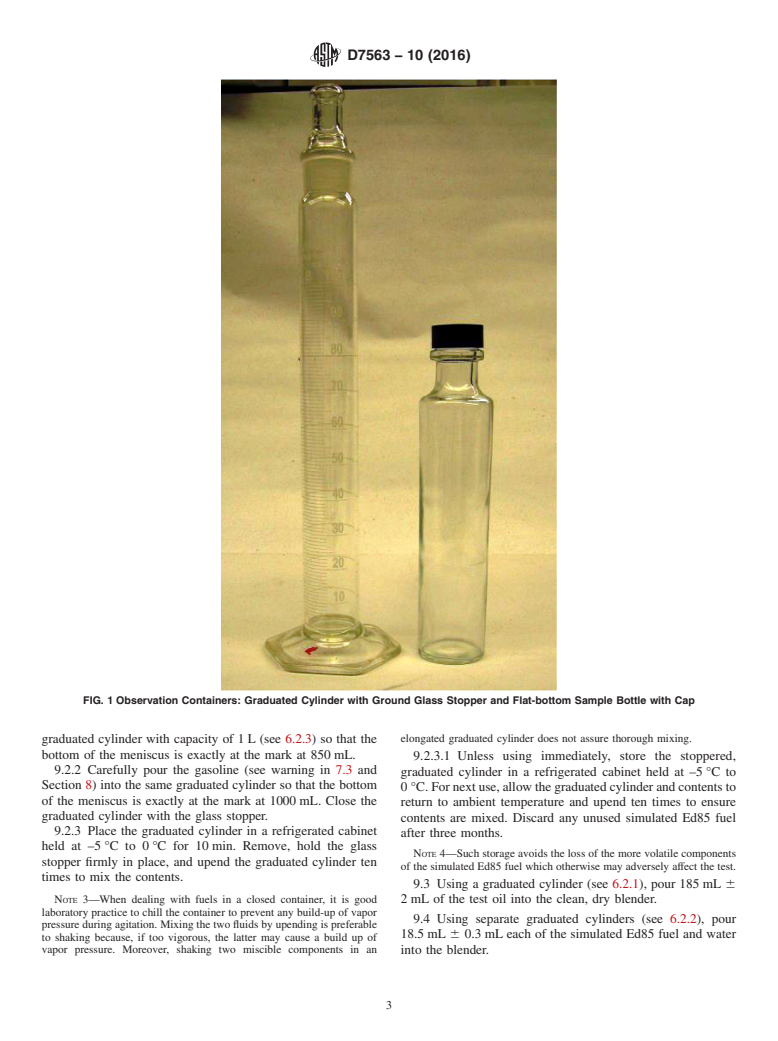
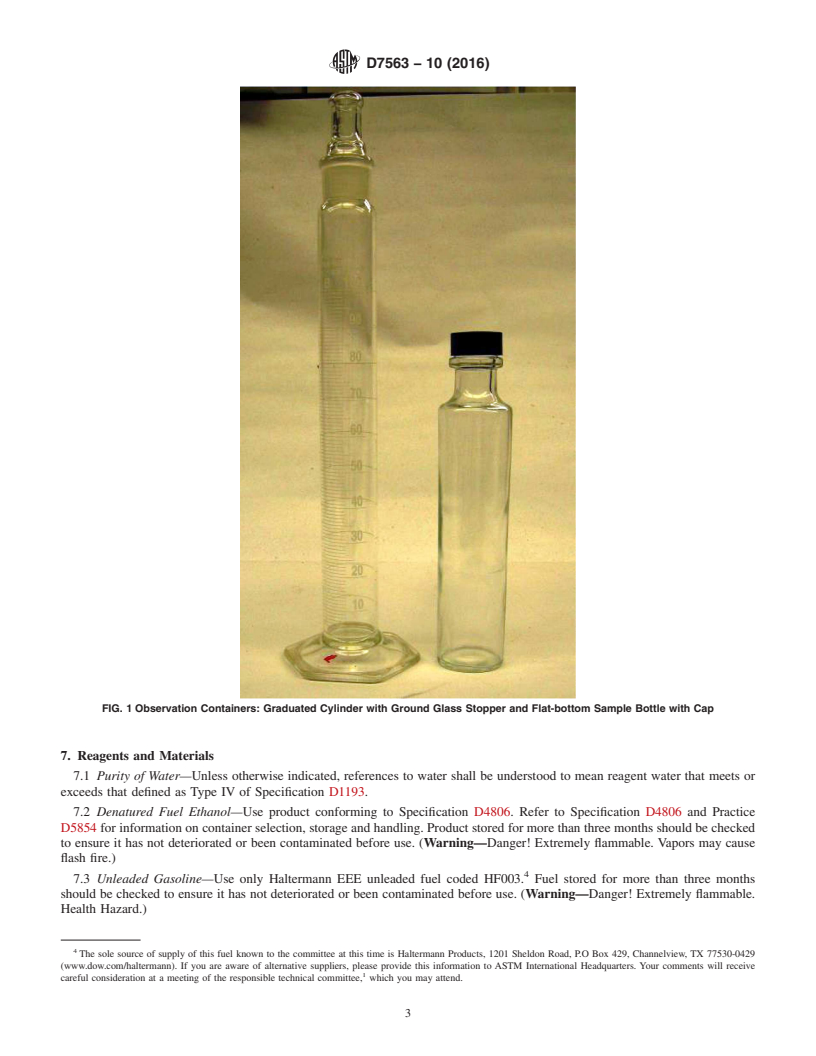
6.3.1 Glass-stoppered, graduated cylinders conforming to Specification E1272, Class B, Style II and having a capacity of 100
mL 100 mL with graduation marks of 1 mL (see Fig. 1).
6.3.2 Glass, flat-bottomed, sample bottles with an outer diameter of approximately 30 mm, 30 mm, a minimum height of
150 mm and capable of being closed by a solvent resistant screw cap (see Fig. 1). The height of the bottles should be such that
100 mL 100 mL of fluid comes below the shoulder to allow accurate measurement of the height of 100 mL 100 mL of emulsion
(see 9.6 and X1.2.1).
NOTE 2—A simple way of marking the sample bottles is to pour 100 mL of water from a graduated cylinder into each clean and dry bottle, mark the
level of the water meniscus on the bottle (suggest using a glass scribing tool or triangular metal file), and dry the bottle before proceeding.
6.4 Temperature Chambers:
6.4.1 Cold cabinet or refrigerator capable of controlling temperature within a range of -5 ºC to 0 °C.–5 ºC to 0 °C.
6.4.2 Warm cabinet or oven capable of controlling temperature within a range of 20 ºC to 25 °C.20 ºC to 25 °C.
6.5 Time-Measuring Equipment:
6.5.1 Stopwatch or other timer capable of measuring 1 min 1 min with a minimum precision of 6 1 s.61 s.
6.5.2 Clock or other timer capable of measuring 24 h 24 h with a minimum precision of 6 5 min.65 min.
6.6 Laboratory Hood Vented Exteriorly or Other Well-Ventilated Work Space—Suitable for pouring volatile, flammable fluids
such as denatured fuel ethanol and gasoline into graduated cylinders and containers. Ensure there is no ignition source within the
hood or nearby when using an open work space, particularly at lower levels where hydrocarbon volatiles tend to congregate.
D7563 − 10 (2016)
FIG. 1 Observation Containers: Graduated Cylinder with Ground Glass Stopper and Flat-bottom Sample Bottle with Cap
7. Reagents and Materials
7.1 Purity of Water—Unless otherwise indicated, references to water shall be understood to mean reagent water that meets or
exceeds that defined as Type IV of Specification D1193.
7.2 Denatured Fuel Ethanol—Use product conforming to Specification D4806. Refer to Specification D4806 and Practice
D5854 for information on container selection, storage and handling. Product stored for more than three months should be checked
to ensure it has not deteriorated or been contaminated before use. (Warning—Danger! Extremely flammable. Vapors may cause
flash fire.)
7.3 Unleaded Gasoline—Use only Haltermann EEE unleaded fuel coded HF003. Fuel stored for more than three months
should be checked to ensure it has not deteriorated or been contaminated before use. (Warning—Danger! Extremely flammable.
Health Hazard.)
The sole source of supply of this fuel known to the committee at this time is Haltermann Products, 1201 Sheldon Road, P.O Box 429, Channelview, TX 77530-0429
(www.dow.com/haltermann). If you are aware of alternative suppliers, please provide this information to ASTM International Headquarters. Your comments will receive
careful consideration at a meeting of the responsible technical committee, which you may attend.
D7563 − 10 (2016)
7.4 Cleaning Solvents—Reagent grade acetone and isooctane. (Warning—Danger! Extremely fla
...
Questions, Comments and Discussion
Ask us and Technical Secretary will try to provide an answer. You can facilitate discussion about the standard in here.