

ASTM D511-14(2021)e1
(Test Method)Standard Test Methods for Calcium and Magnesium In Water
General Information
- Abstract
SIGNIFICANCE AND USE
4.1 Calcium and magnesium salts in water are the primary components of water hardness which can cause pipe or tube scaling.
SCOPE
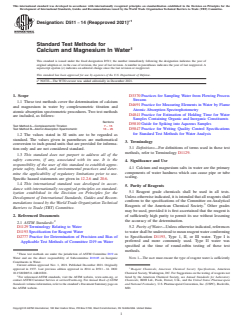
1.1 These test methods cover the determination of calcium and magnesium in water by complexometric titration and atomic absorption spectrometric procedures. Two test methods are included, as follows:
Sections
Test Method A—Complexometric Titration
7 – 15
Test Method B—Atomic Absorption Spectrometric
16 – 25
1.2 The values stated in SI units are to be regarded as standard. The values given in parentheses are mathematical conversion to inch-pound units that are provided for information only and are not considered standard.
1.3 This standard does not purport to address all of the safety concerns, if any, associated with its use. It is the responsibility of the user of this standard to establish appropriate safety, health, and environmental practices and determine the applicability of regulatory limitations prior to use. Specific hazard statements are given in 12.2.6 and 20.6.
1.4 This international standard was developed in accordance with internationally recognized principles on standardization established in the Decision on Principles for the Development of International Standards, Guides and Recommendations issued by the World Trade Organization Technical Barriers to Trade (TBT) Committee.
- Status
- Published
- Publication Date
- 31-Oct-2021
- Technical Committee
- D19 - Water
- Drafting Committee
- D19.05 - Inorganic Constituents in Water
Overview
ASTM D511-14(2021)e1, published by ASTM International, establishes standardized test methods for the determination of calcium and magnesium in water. These elements are the principal contributors to water hardness, which can lead to the scaling of pipes and tubes in water systems. The standard provides robust procedures for both routine and advanced analyses, ensuring reliable and comparable results in diverse water matrices. The test methods enhance water quality monitoring and support regulatory compliance in water treatment, environmental analysis, and industrial applications.
Key Topics
Scope and Significance
- Encompasses the detection of calcium and magnesium in water using two primary laboratory procedures:
- Complexometric Titration (Test Method A)
- Atomic Absorption Spectrometric (Test Method B)
- Addresses the importance of quantifying these constituents as a measure of water hardness and potential for scaling in industrial systems.
- Highlights that users must ensure proper safety, health, and environmental practices when performing these test methods.
- Encompasses the detection of calcium and magnesium in water using two primary laboratory procedures:
Test Methods
- Complexometric Titration: Utilizes EDTA as a titrant to complex with calcium and magnesium ions. This method is suitable for a wide range of water types and concentrations.
- Atomic Absorption Spectrometry: Employs flame photometric determination of calcium and magnesium concentrations. This method is particularly effective for lower concentration ranges and for samples with high potential interferences.
Sample Collection and Quality Assurance
- Stresses specific procedures for sampling, sample preservation (acidification), and handling to prevent contamination or analyte loss.
- Outlines quality control protocols, including calibration, use of reference materials, blanks, duplicates, and matrix spikes to ensure accuracy and precision.
Interferences and Corrections
- Discusses sources of method interferences such as heavy metals, strontium, orthophosphate, and sulfate, with recommended mitigation steps to ensure reliable measurements.
- Offers guidance on corrections for strontium and other potential contaminants during determination.
Applications
- Water Treatment Plants
- Monitoring and controlling water hardness to optimize scale prevention and softening processes.
- Environmental Laboratories
- Assessment of drinking water, surface water, groundwater, and wastewater to comply with regulatory requirements.
- Industrial Water Systems
- Managing cooling towers, boilers, and process water to minimize scale formation and maintain system efficiency.
- Research and Quality Control
- Supporting analytical research, method validation, and laboratory accreditation requirements concerning water chemistry.
Related Standards
- ASTM D1129 – Terminology Relating to Water
- ASTM D1193 – Specification for Reagent Water
- ASTM D2777 – Practice for Determination of Precision and Bias of Applicable Test Methods
- ASTM D3370 – Practices for Sampling Water from Flowing Process Streams
- ASTM D4691 – Practice for Measuring Elements in Water by Flame Atomic Absorption Spectrophotometry
- ASTM D4841 – Practice for Estimation of Holding Time for Water Samples
- ASTM D5810 – Guide for Spiking into Aqueous Samples
- ASTM D5847 – Practice for Writing Quality Control Specifications for Water Analysis
These referenced documents support proper terminology, reagent quality, sampling, measurement techniques, and quality assurance for water analysis.
In summary, ASTM D511-14(2021)e1 is an essential standard for accurate determination of calcium and magnesium in water, forming a foundation for effective water quality management and regulatory compliance in both environmental and industrial contexts. By following these standardized methods, laboratories and facilities ensure the reliability and comparability of their water hardness measurements.
Relations
- Effective Date
- 01-May-2020
- Effective Date
- 01-Jan-2013
- Effective Date
- 01-Jan-2013
- Effective Date
- 15-Jun-2012
- Effective Date
- 01-Sep-2011
- Effective Date
- 01-May-2011
- Effective Date
- 01-Dec-2010
- Effective Date
- 01-Mar-2010
- Effective Date
- 01-Oct-2008
- Effective Date
- 15-Jul-2008
- Effective Date
- 15-Jan-2008
- Effective Date
- 01-Dec-2007
- Effective Date
- 15-Jun-2007
- Effective Date
- 01-Sep-2006
- Effective Date
- 01-Sep-2006
Get Certified
Connect with accredited certification bodies for this standard

CIS Institut d.o.o.
Personal Protective Equipment (PPE) certification body. Notified Body NB-2890 for EU Regulation 2016/425 PPE.

Kiwa BDA Testing
Building and construction product certification.
Kmetijski inštitut Slovenije
Agricultural Institute of Slovenia. Soil testing, plant health, agricultural product analysis.
Sponsored listings
Frequently Asked Questions
ASTM D511-14(2021)e1 is a standard published by ASTM International. Its full title is "Standard Test Methods for Calcium and Magnesium In Water". This standard covers: SIGNIFICANCE AND USE 4.1 Calcium and magnesium salts in water are the primary components of water hardness which can cause pipe or tube scaling. SCOPE 1.1 These test methods cover the determination of calcium and magnesium in water by complexometric titration and atomic absorption spectrometric procedures. Two test methods are included, as follows: Sections Test Method A—Complexometric Titration 7 – 15 Test Method B—Atomic Absorption Spectrometric 16 – 25 1.2 The values stated in SI units are to be regarded as standard. The values given in parentheses are mathematical conversion to inch-pound units that are provided for information only and are not considered standard. 1.3 This standard does not purport to address all of the safety concerns, if any, associated with its use. It is the responsibility of the user of this standard to establish appropriate safety, health, and environmental practices and determine the applicability of regulatory limitations prior to use. Specific hazard statements are given in 12.2.6 and 20.6. 1.4 This international standard was developed in accordance with internationally recognized principles on standardization established in the Decision on Principles for the Development of International Standards, Guides and Recommendations issued by the World Trade Organization Technical Barriers to Trade (TBT) Committee.
SIGNIFICANCE AND USE 4.1 Calcium and magnesium salts in water are the primary components of water hardness which can cause pipe or tube scaling. SCOPE 1.1 These test methods cover the determination of calcium and magnesium in water by complexometric titration and atomic absorption spectrometric procedures. Two test methods are included, as follows: Sections Test Method A—Complexometric Titration 7 – 15 Test Method B—Atomic Absorption Spectrometric 16 – 25 1.2 The values stated in SI units are to be regarded as standard. The values given in parentheses are mathematical conversion to inch-pound units that are provided for information only and are not considered standard. 1.3 This standard does not purport to address all of the safety concerns, if any, associated with its use. It is the responsibility of the user of this standard to establish appropriate safety, health, and environmental practices and determine the applicability of regulatory limitations prior to use. Specific hazard statements are given in 12.2.6 and 20.6. 1.4 This international standard was developed in accordance with internationally recognized principles on standardization established in the Decision on Principles for the Development of International Standards, Guides and Recommendations issued by the World Trade Organization Technical Barriers to Trade (TBT) Committee.
ASTM D511-14(2021)e1 is classified under the following ICS (International Classification for Standards) categories: 13.060.50 - Examination of water for chemical substances. The ICS classification helps identify the subject area and facilitates finding related standards.
ASTM D511-14(2021)e1 has the following relationships with other standards: It is inter standard links to ASTM D1129-13(2020)e2, ASTM D4841-88(2013)e1, ASTM D4841-88(2013), ASTM D2777-12, ASTM D4691-11, ASTM D5810-96(2011), ASTM D3370-10, ASTM D1129-10, ASTM D3370-08, ASTM D4841-88(2008), ASTM D2777-08, ASTM D3370-07, ASTM D4691-02(2007), ASTM D1129-06ae1, ASTM D1129-06a. Understanding these relationships helps ensure you are using the most current and applicable version of the standard.
ASTM D511-14(2021)e1 is available in PDF format for immediate download after purchase. The document can be added to your cart and obtained through the secure checkout process. Digital delivery ensures instant access to the complete standard document.
Standards Content (Sample)
This international standard was developed in accordance with internationally recognized principles on standardization established in the Decision on Principles for the
Development of International Standards, Guides and Recommendations issued by the World Trade Organization Technical Barriers to Trade (TBT) Committee.
´1
Designation: D511 − 14 (Reapproved 2021)
Standard Test Methods for
Calcium and Magnesium In Water
This standard is issued under the fixed designation D511; the number immediately following the designation indicates the year of
original adoption or, in the case of revision, the year of last revision. A number in parentheses indicates the year of last reapproval. A
superscript epsilon (´) indicates an editorial change since the last revision or reapproval.
This standard has been approved for use by agencies of the U.S. Department of Defense.
ε NOTE—The WTO caveat was added editorially in December 2021.
1. Scope D3370 Practices for Sampling Water from Flowing Process
Streams
1.1 These test methods cover the determination of calcium
D4691 Practice for Measuring Elements in Water by Flame
and magnesium in water by complexometric titration and
Atomic Absorption Spectrophotometry
atomic absorption spectrometric procedures. Two test methods
D4841 Practice for Estimation of Holding Time for Water
are included, as follows:
Samples Containing Organic and Inorganic Constituents
Sections
D5810 Guide for Spiking into Aqueous Samples
Test Method A—Complexometric Titration 7–15
Test Method B—Atomic Absorption Spectrometric 16–25 D5847 Practice for Writing Quality Control Specifications
for Standard Test Methods for Water Analysis
1.2 The values stated in SI units are to be regarded as
standard. The values given in parentheses are mathematical
3. Terminology
conversion to inch-pound units that are provided for informa-
3.1 Definitions—For definitions of terms used in these test
tion only and are not considered standard.
methods, refer to Terminology D1129.
1.3 This standard does not purport to address all of the
safety concerns, if any, associated with its use. It is the
4. Significance and Use
responsibility of the user of this standard to establish appro-
4.1 Calcium and magnesium salts in water are the primary
priate safety, health, and environmental practices and deter-
components of water hardness which can cause pipe or tube
mine the applicability of regulatory limitations prior to use.
scaling.
Specific hazard statements are given in 12.2.6 and 20.6.
1.4 This international standard was developed in accor-
5. Purity of Reagents
dance with internationally recognized principles on standard-
5.1 Reagent grade chemicals shall be used in all tests.
ization established in the Decision on Principles for the
Unless otherwise indicated, it is intended that all reagents shall
Development of International Standards, Guides and Recom-
conform to the specifications of the Committee on Analytical
mendations issued by the World Trade Organization Technical
Reagents of the American Chemical Society. Other grades
Barriers to Trade (TBT) Committee.
may be used, provided it is first ascertained that the reagent is
of sufficiently high purity to permit its use without lessening
2. Referenced Documents
the accuracy of the determination.
2.1 ASTM Standards:
5.2 Purity of Water—Unless otherwise indicated, references
D1129 Terminology Relating to Water
towatershallbeunderstoodtomeanreagentwaterconforming
D1193 Specification for Reagent Water
to Specification D1193, Type 1, II, or III water. Type I is
D2777 Practice for Determination of Precision and Bias of
preferred and more commonly used. Type II water was
Applicable Test Methods of Committee D19 on Water
specified at the time of round-robin testing of these test
methods.
These test methods are under the jurisdiction of ASTM Committee D19 on
Water and are the direct responsibility of Subcommittee D19.05 on Inorganic NOTE 1—The user must ensure the type of reagent water is sufficiently
Constituents in Water.
Current edition approved Nov. 1, 2021. Published December 2021. Originally
approved in 1937. Last previous edition approved in 2014 as D511 – 14. DOI: Reagent Chemicals, American Chemical Society Specifications, American
10.1520/D0511-14R21E01. Chemical Society, Washington, DC. For Suggestions on the testing of reagents not
For referenced ASTM standards, visit the ASTM website, www.astm.org, or listed by the American Chemical Society, see Annual Standards for Laboratory
contact ASTM Customer Service at service@astm.org. For Annual Book of ASTM Chemicals, BDH Ltd., Poole, Dorset, U.K., and the United States Pharmacopeia
Standards volume information, refer to the standard’s Document Summary page on and National Formulary, U.S. Pharmacopeial Convention, Inc. (USPC), Rockville,
the ASTM website. MD.
Copyright © ASTM International, 100 Barr Harbor Drive, PO Box C700, West Conshohocken, PA 19428-2959. United States
´1
D511 − 14 (2021)
free of interferences.The water should be analyzed using this test method.
minimized by the addition of hydroxylamine and cyanide,
which reduce or complex the metals, or both. Metal concen-
6. Sampling
trations as high as 5 mg/L of iron, 10 mg/L of manganese, 10
6.1 Collect the sample in accordance with Practices D3370.
mg/L of copper, 10 mg/L of zinc, and 10 mg/L of lead can be
tolerated when hydroxylamine and cyanide are added.
6.2 If total recoverable calcium and magnesium concentra-
tions are being determined, acidify the water sample with
9.2 In the titration of calcium plus magnesium, the higher
+2
HNO (sp gr 1.42) to a pH of 2 or less immediately at the time
oxidation states of manganese above Mn react rapidly with
of collection; normally about 2 mL/Lare required.The holding
the indicator to form discolored oxidation products. Hydrox-
time for the samples may be calculated in accordance with
ylamine hydrochloride reagent is used to reduce manganese to
Practice D4841.
the divalent state. The divalent manganese interference can be
eliminated by addition of one or two small crystals of potas-
NOTE 2—Alternatively, the pH may be adjusted in the laboratory if the
sium ferrocyanide.
sample is returned within 14 days. However, acid must be added at least
24hoursbeforeanalysistodissolveanymetalsthatadsorbtothecontainer 9.2.1 Orthophosphate and sulfate ions interfere at concen-
walls. This could reduce hazards of working with acids in the field when
trations in excess of 500 and 10 000 mg/L, respectively.
appropriate.
9.2.2 In the presence of aluminum concentrations in excess
6.3 If dissolved calcium and magnesium concentrations are
of 10 mg/L, the blue color that indicates that the end point has
being determined, filter the samples through a 0.45-µm mem-
been reached will appear and then, on short standing, will
brane filter and acidify with HNO (sp gr 1.42) to a pH of 2 or
revert to red. The reversion should not be confused with the
less immediately at time of collection; normally about 2 mL/L
gradual change that normally takes place in the titrated sample
are required.
several minutes after the titration has been completed.
6.4 A number of sources of calcium contamination have
9.3 In the titration of calcium, ammonium purpurate reacts
beenencounteredinlaboratories.Amongthemostcommonare
with strontium but not with magnesium or barium. However,
plastic ware, paper towels, and dust. Rinsing plastic ware with
the end point in the presence of strontium is sluggish, and the
sample prior to use, avoiding contact of apparatus with paper
titrationisnotstrictlystoichiometric.Bariumdoesnottitrateas
towels,andkeepingexposuretotheairtoaminimumwilllimit
calcium, but affects the indicator in some unknown way so that
the possibility of contamination.
no end point, or at best a poor end point, is obtained. Barium
can be removed by prior precipitation with sulfuric acid, but
TEST METHOD A—COMPLEXOMETRIC
care must be exercised to prevent precipitation of calcium.
TITRATION
Orthophosphate will precipitate calcium at the pH of the test.
7. Scope 9.4 A possible interference from the commonly used
polyphosphates, organic phosphonates, and EDTA/NTA com-
7.1 This test method is applicable to most waters in a range
pounds in water treatment should be recognized.
from 1 to 1000 mg/L of calcium plus magnesium expressed as
calcium, but may fail in the analysis of highly colored waters,
10. Apparatus
brines, or waters that contain excessive amounts of metals.The
10.1 Titration Assembly—Some analysts prefer to use con-
upper and lower limits may be extended by either dilution or
ventionallightingandhandstirring.Othersreportbetterresults
use of micro apparatus.
by using a visual-titration assembly consisting of a motor-
7.2 Data are not available to determine which matrices were
driven stirrer, 25-mL burette, white-porcelain-base burette
used to obtain the precision and bias data, and it is the
holder, and shaded incandescent lamp. The sample beaker is
responsibility of the analyst to determine the acceptability of
placed near the front of the porcelain base and the reaction is
this test method for the matrix being analyzed.
viewed diagonally downward through the side of the beaker
and against the white background. Illumination is from behind
8. Summary of Test Method
the beaker. The capacity of the burette, type lighting, and
8.1 EDTA (ethylenediamine tetraacetic acid or its salts) is
background color may be varied depending on the ionic
added to a sample containing calcium and magnesium ions
concentrations normally encountered and the indicator chosen.
after the pH of the solution is adjusted to 10 for the determi-
10.2 pH Meter, with expanded mV scale.
nation of calcium and magnesium or from pH 12 to 13 for the
determination of calcium alone.The EDTAinitially complexes
11. Reagents and Materials
thecalciumandthenthemagnesium.Theendpointisobserved
by the use of a suitable indicator. At a pH of 12 to 13
11.1 Buffer Solution, Ammonium Chloride-Ammonium
magnesium is precipitated. Magnesium is determined by the
Hydroxide—Dissolve 67.6 g of ammonium chloride (NH Cl)
difference between an aliquot titrated at pH 10 and one titrated
in 200 mL of water. Add 570 mL of concentrated ammonium
at pH 12 to 13.
hydroxide (NH OH, sp gr 0.900). Add 5.00 g of magnesium
salt of EDTA and dilute to 1000 mL. Store in a tightly
9. Interferences
stoppered plastic bottle to prevent the loss of ammonia.
9.1 EDTA reacts with iron, manganese, copper, zinc, lead, Discard the solution when 1 mLadded to a neutralized sample
cobalt, nickel, barium, strontium, calcium, magnesium, and fails to produce a pH of 10.0 6 0.1 at the titration end point.
several other metals. The interference of heavy metals is To attain highest accuracy, adjust the magnesium level to exact
´1
D511 − 14 (2021)
equivalencethroughtheappropriateadditionofasmallamount Material such as fine-textured, acid-washed, ashless paper, or
of either disodium EDTA or magnesium sulfate (MgSO ). glass fiber paper are acceptable. The user must first ascertain
that the filter paper is of sufficient purity to use without
11.2 Calcium Indicator Solution:
adversely affecting the bias and precision of the test method.
11.2.1 Ammonium Purpurate—Mix thoroughly 1.0 g of
ammonium purpurate with 200 g of sucrose. Place in a bottle
12. Procedure
provided with a dispensing spoon of 0.2-g capacity.
11.2.2 Fluorescein Methylene Iminodiacetic Acid —Grind
12.1 Calcium Plus Magnesium:
0.2 g of fluorescein methylene iminodiacetic acid and 0.12 g of 12.1.1 Measure 100.0 mL of a well-mixed acidified sample
thymolphthalein with 20 g of potassium chloride to 40 to 50
(see 6.2) into a 125-mL beaker or flask.
mesh size. Place in a bottle provided with a dispensing spoon
NOTE 4—If only dissolved calcium plus magnesium is to be
of 0.2-g capacity.
determined, omit 12.1.1 through 12.1.4 and proceed to 12.1.5.
11.3 Calcium Solution, Standard (1.00 mL = 0.400 mg
12.1.2 Add 5 mL of hydrochloric acid (HCl, sp gr 1.19) to
calcium)—Suspend 1.000 g of calcium carbonate (CaCO ),
3 each sample.
driedat180°Cfor1.0hbeforeweighing,inapproximately600
12.1.3 Heatthesamplesonasteambathorhotplateuntilthe
mLof water and dissolve cautiously with a minimum of dilute
volume has been reduced to 15 to 20 mL, making certain that
HCl. Dilute to 1000 mL with water in a volumetric flask.
the samples do not boil.
11.3.1 Alternatively, certified calcium stock solutions of
NOTE 5—For samples with high levels of dissolved or suspended
appropriate known purity are commercially available through
matter, the amount of reduction in volume is left to the discretion of the
chemical supply vendors and may be used.
analyst.
11.4 Chrome Black T Solution (4.0 g/L)—Dissolve 0.4 g of
12.1.4 Cool and filter the samples through a suitable filter
Chrome Black T in 100 mL of water. This solution has a shelf
(such as fine-textured, acid-washed, ashless paper) into
life of approximately 1 week. Alternatively, a dry powder
100-mL volumetric flasks. Wash the paper two or three times
mixture composed of 0.5 g of dye and 100 g of powdered
with water and bring to the volume.
sodium chloride may be used. Store this in a dark-colored
12.1.5 Measure 50 mL of the filtered sample (50.00-mL
bottleprovidedwithadispensingspoonofapproximately0.2-g
maximum) into a 150-mL beaker and adjust the volume to
capacity. The shelf life is at least 1 year.
approximately50mL.AdjustthepHto7to10bythedropwise
addition of ammonium hydroxide (NH OH, sp gr 0.900).
NOTE 3—Chrome Black T is also known as Eriochrome Black T.
11.5 EDTA Solution, Standard (0.01 M, 1 mL = 0.401 mg NOTE 6—For analysis of brines an appropriate aliquot size often can be
determined from knowledge of the specific gravity, for example:
calcium or 0.243 mg magnesium)—Dissolve 3.72 g of
1.000 to 1.025, use 25 mL
Na EDTA dihydrate, which has been dried overnight over
1.025 to 1.050, use 10 mL
H SO in a desiccator, in water (or at 80°C. for 1 hour) and
2 4
1.050 to 1.090, use 5 mL
dilute to 1000 mL in a volumetric flask. The reagent is stable
1.090 to 1.120, use 1 mL
1.120 to 1.180, use 0.1 mL
for several weeks. Check the titer of the reagent by titrating
25.00 mL of CaCO standard solution as described in the
12.1.6 Insert the beaker in the titration assembly and start
procedure for sample analysis.
the stirrer.
12.1.7 Add 1 mL of NH OH·HCl solution (11.6).
11.6 Hydroxylamine Hydrochloride Solution (30 g/L)—
12.1.8 Add 1 mL of buffer solution (11.1). Measure the pH
Dissolve 30 g of hydroxylamine hydrochloride (NH OH·HCl)
and verify that it falls in the pH range from 10.0 + 0.1.Adjust
in water and dilute to 1000 mL.
by the dropwise addition of ammonium hydroxide.
11.7 Potassium Ferrocyanide—(K Fe(CN) ·3H O).
4 6 2
12.1.9 Add 2 mL of NaCN solution (11.8). (Warning—
11.8 Sodium Cyanide Solution (25 g/L)—Dissolve 25 g of Sodium cyanide is a deadly poison. Do not add NaCN to any
sodium cyanide (NaCN) in water and dilute to 1000 mL.
acid solution or acidify any solution containing it. Use this
(Warning—Sodium cyanide is a deadly poison. Do not add reagent in a fume hood.)
NaCNtoanyacidsolutionoracidifyanysolutioncontainingit.
12.1.10 If manganese is present, add one or two small
Use this reagent in a fume hood.) crystals K Fe(CN) ·3HO(11.7).
4 6 2
12.1.11 Add 4 to 5 drops of Chrome Black T indicator
11.9 Sodium Hydroxide Solution (80 g/Lor 2 M)—Dissolve
solution (11.4). If powdered indicator is used add approxi-
80 g of sodium hydroxide (NaOH) in 800 mL of water. Cool
mately 0.2 g.
and dilute to 1000 mL.
12.1.12 Titrate with standard EDTA solution (11.5) until
11.9.1 Alternatively, a commercially prepared solution of
blue or purple swirls begin to show. The end point is reached
sodium hydroxide of appropriate known purity is available
when all traces of red and purple have disappeared and the
through chemical supply vendors and may be used.
solutionispureblueincolor.Thetitrationshouldbecompleted
11.10 Filter Paper—Purchasesuitablefilterpaper.Typically
within 5 min of the buffer addition. If more than 15 mL of
the filter papers have a pore size of 0.45-µm membrane.
titrant is required, take a smaller sample aliquot and repeat the
test.
12.1.13 Record the volume of EDTA solution required to
Calcein, W., Fluoroscein Complexon, and Fluorexon, supplied by various
commercial firms, have been found satisfactory for this purpose. titrate calcium plus magnesium.
´1
D511 − 14 (2021)
12.1.14 Determine a reagent blank correction by similarly Calcium as CaCO , mg/L 5 mg/L Ca 32.50 (4)
~ !
titrating 50 mL of water including all added reagents.
Magnesium ~as CaCO !, mg/L 5 mg/L Mg 34.12 (5)
12.2 Calcium:
14. Precision and Bias
12.2.1 Refill the burette with EDTA standard solution
14.1 Data are not available to determine which matrices
(11.5).
were used to obtain precision and bias data.
12.2.2 Pipetteanotheraliquotofthesamesample(50.00mL
maximum) into a 150-mL beaker and adjust the volume to
14.2 The precision of this test method for calcium, ranging
approximately 50 mL (see Note 6).
in calcium concentration between 13 and 88 mg/L, may be
12.2.3 Insert the beaker in the titration assembly and start
expressed using Eq 6 and Eq 7:
the stirrer.
S 5 0.006 X10.62 (6)
T
12.2.4 Add 1 mL of NH OH·HCl (11.6).
S 5 0.006 X10.51 (7)
12.2.5 Add 1 mL of NaOH solution (11.9). The pH should O
range from 12 to 13.
where:
12.2.6 Add 1 mL of NaCN (11.8). (Warning—Sodium
S = overall precision,
T
cyanide is a deadly poison. Do not add NaCN to any acid
S = single-operator precision, and
O
solution or acidify any solution containing it. Use this reagent
X = determined concentration of calcium, mg/L.
in a fume hood.)
14.3 Bias—Recoveries of known amounts of calcium using
12.2.7 Add 0.2 g of calcium indicator solution (11.2) and
this test method were as follows:
proceed immediately with the titration.
Statistically Sig-
12.2.8 Titrate with standard EDTA solution (11.5)tothe
Amount Amount nificant, 95 %
appropriate end point. If ammonium purpurate is used, the end
Added, Found, Bias, Confidence
point will be indicated by color change from orange pink to mg/L mg/L % Level
13.3 13.5 +1.5 no
pale pinkish purple. If fluorescein methylene iminodiacetic
41.8 43.0 +2.9 yes
acid is used, the end point will be indicated by a color change
84.6 87.7 +3.7 yes
from deep green to purple. The titration should be completed
14.4 This information was derived from round-robin testing
within 5 min of the addition of NaOH solution. If more than 15
in which four laboratories, including eight operators, partici-
mL of titrant is required, take a smaller sample aliquot and
pated. No data were rejected. Four sample levels were run on
repeat the test.
eachofthreedays,butonelevelwasrejectedashavinggrossly
12.2.9 Record the volume of EDTA solution required to
deteriorated in shipment. The method of “least squares” was
titrate the calcium.
used to determine the precision statements.
12.2.10 Determine a reagent blank correction by similarly
14.5 The precision of this test method for magnesium
titrating 50 mL of water including all added reagents.
ranging in magnesium concentration from between 2.5 and 36
mg/L may be expressed using Eq 8 and Eq 9:
13. Calculation
S 5 0.017 X10.85 (8)
T
13.1 Calculate the concentration of calcium and magnesium
S 5 0.002 X10.70 (9)
in milligrams per litre using Eq 1 and Eq 2:
O
Calcium, mg/L 5 A 3B/D 340 100 (1)
~ ! where:
Magnesium, mg/L 5 ~~C 3B/E! 2 ~A 3B/D!! 324 300 (2) S = overall precision,
T
S = single-operator precision, and
O
where:
X = determined concentration of magnesium, mg/L.
A = EDTA standard solution required to titrate calcium in
14.6 Bias—Recoveries of known amounts of magnesium
12.2.9 minus the blank correction determined in
using this test method were as follows:
12.2.10, mL,
Amount Amount Statistically Signifi-
B = molarity of EDTA standard solution,
Added, Found, Bias, cant, 95 % Confi-
C = EDTAstandard solution required to titrate calcium plus
mg/L mg/L % dence Level
magnesium in 12.1.13 minus the blank correction de-
2.38 2.54 +6.7 no
14.7 15.0 +2.0 no
termined in 12.1.14, mL,
22.2 21.8 −1.8 no
D = sample taken in 12.2.2, mL, and
35.9 36.1 +0.6 no
E = sample taken in 12.1.5, mL.
14.7 This information was derived from round-robin testing
13.2 If the concentration of strontium is determined to be
in which four laboratories, including eight operators, partici-
significant (see Sections 9.1 and 9.3), make a correction for
pated. No data were rejected. Four sample levels were run on
strontium concentration using Eq 3:
each of three days. The method of “least squares” was used to
Corrected mg/L calcium 5 mg/L calcium (3) determine the precision statements.
2 mg/L strontium 30.46
~ !
Supporting data have been filed at ASTM International Headquarters and may
13.3 Results for calcium and magnesium may be repre-
beobtainedbyrequestingResearchReportRR:D19-1027.ContactASTMCustomer
sented as CaCO using Eq 4 and Eq 5: Service at service@astm.org.
´1
D511 − 14 (2021)
14.8 The single-operator precision for calcium determined applying the F test and t test in evaluating the acceptability of
for synthetic sodium chloride brines having the composition the mean and standard deviation.
listed in Table 1 is as follows:
15.4 Laboratory Control Sample (LCS):
S 5 76
15.4.1 To ensure that the test method is in control, prepare
O
and analyze an LCS containing a known concentration of
For magnesium, it is:
calcium and magnesium in water with each batch (laboratory-
S 5 51
O
defined or twenty samples).The laboratory control samples for
14.9 These data may not apply to waters of other matrices. a large batch should cover the analytical ranger when possible.
TheLCSmustbetakenthroughallofthestepsoftheanalytical
14.10 Four independent laboratories participated in the
method including sample preservation and pretreatment. The
round-robin study.
result obtained for a mid-range LCS should fall within 615 %
14.11 This section of precision and bias conforms to Prac-
of the known concentration.
tice D2777 – 77, which was in place at the time of collabora-
15.4.2 If the result is not within these limits, analysis of
tive testing. Under the allowances made in 1.4 of D2777 – 13,
samples is halted until the problem is corrected, and either all
these precision and bias data do meet existing requirements of
thesamplesinthebatchmustbereanalyzed,ortheresultsmust
interlaboratory studies of Committee D19 test methods.
be qualified with an indication that they do not fall within the
performance criteria of the test method.
15. Quality Control
15.5
...