

ASTM G30-22
(Practice)Standard Practice for Making and Using U-Bend Stress-Corrosion Test Specimens
General Information
- Abstract
SIGNIFICANCE AND USE
5.1 The U-bend specimen may be used for any metal alloy sufficiently ductile to be formed into the U-shape without mechanically cracking. The specimen is most easily made from strip or sheet but can be machined from plate, bar, castings, or weldments; wire specimens may be used also.
5.2 Since the U-bend usually contains large amounts of elastic and plastic strain, it provides one of the most severe tests available for smooth (as opposed to notched or precracked) stress-corrosion test specimens. The stress conditions are not usually known and a wide range of stresses exist in a single stressed specimen. The specimen is therefore unsuitable for studying the effects of different applied stresses on stress-corrosion cracking or for studying variables that have only a minor effect on cracking. The advantage of the U-bend specimen is that it is simple and economical to make and use. It is most useful for detecting large differences between the stress-corrosion cracking resistance of (a) different metals in the same environment, (b) one metal in different metallurgical conditions in the same environment, or (c) one metal in several environments.
SCOPE
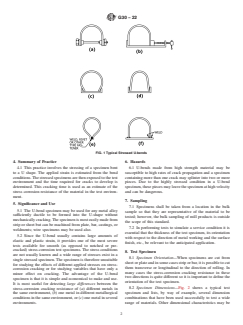
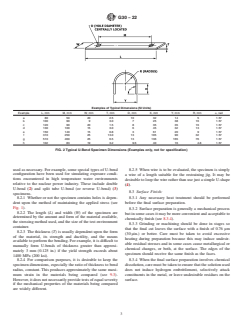
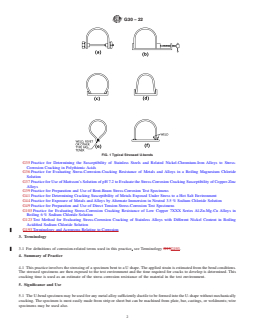
1.1 This practice covers procedures for making and using U-bend specimens for the evaluation of stress-corrosion cracking in metals. The U-bend specimen is generally a rectangular strip that is bent 180° around a predetermined radius and maintained in this constant strain condition during the stress-corrosion test. Bends slightly less than or greater than 180° are sometimes used. Typical U-bend configurations showing several different methods of maintaining the applied stress are shown in Fig. 1.
FIG. 1 Typical Stressed U-bends
1.2 U-bend specimens usually contain both elastic and plastic strain. In some cases (for example, very thin sheet or small diameter wire) it is possible to form a U-bend and produce only elastic strain. However, bent-beam (Practice G39 or direct tension (Practice G49)) specimens are normally used to study stress-corrosion cracking of strip or sheet under elastic strain only.
1.3 This practice is concerned only with the test specimen and not the environmental aspects of stress-corrosion testing, which are discussed elsewhere (1)2 and in Practices G35, G36, G37, G41, G44, G103 and Test Method G123.
1.4 The values stated in SI units are to be regarded as standard. The values given in parentheses after SI units are provided for information only and are not considered standard.
1.5 This standard does not purport to address all of the safety concerns, if any, associated with its use. It is the responsibility of the user of this standard to establish appropriate safety, health, and environmental practices and determine the applicability of regulatory limitations prior to use.
1.6 This international standard was developed in accordance with internationally recognized principles on standardization established in the Decision on Principles for the Development of International Standards, Guides and Recommendations issued by the World Trade Organization Technical Barriers to Trade (TBT) Committee.
- Status
- Published
- Publication Date
- 30-Apr-2022
- Technical Committee
- G01 - Corrosion of Metals
- Drafting Committee
- G01.06 - Environmentally Assisted Cracking
Overview
ASTM G30-22: Standard Practice for Making and Using U-Bend Stress-Corrosion Test Specimens provides comprehensive procedures for preparing and employing U-bend specimens to evaluate the susceptibility of metals and alloys to stress-corrosion cracking (SCC). Developed by ASTM International, this standard outlines practices applicable to a wide range of ductile materials, with a focus on facilitating severe SCC testing under well-controlled laboratory conditions. U-bend test specimens are typically created by bending strips or sheets of metal into a 180° “U” shape, maintaining them under constant strain, and observing their resistance to cracking when exposed to corrosive environments.
Key Topics
- Specimen Preparation: The practice covers methods for producing U-bend specimens from various forms, such as strips, sheets, plates, bars, castings, weldments, and wires. The specimen is formed by bending a rectangular piece around a predetermined radius to create a stressed U-shape.
- Stress Conditions: U-bend specimens inherently possess both elastic and plastic strain, making the test among the most severe smooth specimen stress-corrosion tests available. Due to the wide range of stress present in a single specimen and the unknown stress distribution, U-bend tests are best suited to detect significant materials differences, rather than precise stress effects.
- Applications Range: U-bend testing can determine differences in SCC resistance between different metals, different metallurgical conditions of the same metal, or the same material tested in different environments.
- Surface and Dimensional Control: The standard specifies that surface preparation, specimen orientation, and dimensional consistency are vital for reproducibility. Proper surface finish, avoidance of unwanted residual stresses, and careful specimen identification are emphasized.
- Safety and Hazards: It is noted that highly stressed U-bend specimens, especially of high-strength materials, may fracture violently, necessitating careful handling and appropriate safety practices.
Applications
U-bend stress-corrosion test specimens as described in ASTM G30-22 are widely used for:
- Material Screening: Comparing the SCC resistance of various alloys in the same environment to guide material selection in industries such as chemical processing, energy generation, and transportation.
- Process Evaluation: Assessing the impact of metallurgical conditions-such as different heat treatments or welding processes-on the SCC behavior of a single alloy type.
- Environment Testing: Evaluating how changes in service environments (e.g., different chemicals, temperatures, or pH levels) affect the SCC performance of a material.
- Quality Control & R&D: Supporting research and development of new metal products and quality assurance by identifying potential SCC vulnerabilities early in the product lifecycle.
U-bend SCC testing is especially valued for its simplicity, cost-effectiveness, and ability to clearly distinguish materials with grossly different SCC resistances. It is particularly effective for use in academia, industrial laboratories, and contract testing organizations focused on corrosion testing.
Related Standards
Several ASTM standards are closely related to or frequently referenced alongside ASTM G30-22:
- ASTM G1: Preparing, Cleaning, and Evaluating Corrosion Test Specimens
- ASTM G35, G36, G37, G41, G44, G103: Standards covering environment-specific SCC testing procedures for various alloys
- ASTM G39: Practice for Preparation and Use of Bent-Beam Stress-Corrosion Test Specimens (elastic strain focus)
- ASTM G49: Practice for Preparation and Use of Direct Tension Stress-Corrosion Test Specimens
- ASTM E3: Guide for Preparation of Metallographic Specimens
- ASTM G193: Terminology and Acronyms Relating to Corrosion
Utilizing ASTM G30-22 in conjunction with these standards ensures consistent, effective, and internationally recognized stress-corrosion cracking testing methods for metals and alloys. This standard supports industry-wide quality, safety, and performance in materials engineering and product design.
Relations
- Effective Date
- 01-Nov-2023
- Effective Date
- 01-Oct-2018
- Effective Date
- 01-Oct-2018
- Effective Date
- 01-May-2013
- Effective Date
- 01-May-2013
- Effective Date
- 01-Dec-2011
- Effective Date
- 01-Mar-2011
- Effective Date
- 01-Mar-2011
- Effective Date
- 01-Mar-2011
- Effective Date
- 01-Feb-2011
- Effective Date
- 01-Sep-2010
- Effective Date
- 01-Jul-2007
- Effective Date
- 01-Jul-2007
- Effective Date
- 01-Nov-2006
- Effective Date
- 01-Nov-2006
Get Certified
Connect with accredited certification bodies for this standard

Element Materials Technology
Materials testing and product certification.

Inštitut za kovinske materiale in tehnologije
Institute of Metals and Technology. Materials testing, metallurgical analysis, NDT.
Sponsored listings
Frequently Asked Questions
ASTM G30-22 is a standard published by ASTM International. Its full title is "Standard Practice for Making and Using U-Bend Stress-Corrosion Test Specimens". This standard covers: SIGNIFICANCE AND USE 5.1 The U-bend specimen may be used for any metal alloy sufficiently ductile to be formed into the U-shape without mechanically cracking. The specimen is most easily made from strip or sheet but can be machined from plate, bar, castings, or weldments; wire specimens may be used also. 5.2 Since the U-bend usually contains large amounts of elastic and plastic strain, it provides one of the most severe tests available for smooth (as opposed to notched or precracked) stress-corrosion test specimens. The stress conditions are not usually known and a wide range of stresses exist in a single stressed specimen. The specimen is therefore unsuitable for studying the effects of different applied stresses on stress-corrosion cracking or for studying variables that have only a minor effect on cracking. The advantage of the U-bend specimen is that it is simple and economical to make and use. It is most useful for detecting large differences between the stress-corrosion cracking resistance of (a) different metals in the same environment, (b) one metal in different metallurgical conditions in the same environment, or (c) one metal in several environments. SCOPE 1.1 This practice covers procedures for making and using U-bend specimens for the evaluation of stress-corrosion cracking in metals. The U-bend specimen is generally a rectangular strip that is bent 180° around a predetermined radius and maintained in this constant strain condition during the stress-corrosion test. Bends slightly less than or greater than 180° are sometimes used. Typical U-bend configurations showing several different methods of maintaining the applied stress are shown in Fig. 1. FIG. 1 Typical Stressed U-bends 1.2 U-bend specimens usually contain both elastic and plastic strain. In some cases (for example, very thin sheet or small diameter wire) it is possible to form a U-bend and produce only elastic strain. However, bent-beam (Practice G39 or direct tension (Practice G49)) specimens are normally used to study stress-corrosion cracking of strip or sheet under elastic strain only. 1.3 This practice is concerned only with the test specimen and not the environmental aspects of stress-corrosion testing, which are discussed elsewhere (1)2 and in Practices G35, G36, G37, G41, G44, G103 and Test Method G123. 1.4 The values stated in SI units are to be regarded as standard. The values given in parentheses after SI units are provided for information only and are not considered standard. 1.5 This standard does not purport to address all of the safety concerns, if any, associated with its use. It is the responsibility of the user of this standard to establish appropriate safety, health, and environmental practices and determine the applicability of regulatory limitations prior to use. 1.6 This international standard was developed in accordance with internationally recognized principles on standardization established in the Decision on Principles for the Development of International Standards, Guides and Recommendations issued by the World Trade Organization Technical Barriers to Trade (TBT) Committee.
SIGNIFICANCE AND USE 5.1 The U-bend specimen may be used for any metal alloy sufficiently ductile to be formed into the U-shape without mechanically cracking. The specimen is most easily made from strip or sheet but can be machined from plate, bar, castings, or weldments; wire specimens may be used also. 5.2 Since the U-bend usually contains large amounts of elastic and plastic strain, it provides one of the most severe tests available for smooth (as opposed to notched or precracked) stress-corrosion test specimens. The stress conditions are not usually known and a wide range of stresses exist in a single stressed specimen. The specimen is therefore unsuitable for studying the effects of different applied stresses on stress-corrosion cracking or for studying variables that have only a minor effect on cracking. The advantage of the U-bend specimen is that it is simple and economical to make and use. It is most useful for detecting large differences between the stress-corrosion cracking resistance of (a) different metals in the same environment, (b) one metal in different metallurgical conditions in the same environment, or (c) one metal in several environments. SCOPE 1.1 This practice covers procedures for making and using U-bend specimens for the evaluation of stress-corrosion cracking in metals. The U-bend specimen is generally a rectangular strip that is bent 180° around a predetermined radius and maintained in this constant strain condition during the stress-corrosion test. Bends slightly less than or greater than 180° are sometimes used. Typical U-bend configurations showing several different methods of maintaining the applied stress are shown in Fig. 1. FIG. 1 Typical Stressed U-bends 1.2 U-bend specimens usually contain both elastic and plastic strain. In some cases (for example, very thin sheet or small diameter wire) it is possible to form a U-bend and produce only elastic strain. However, bent-beam (Practice G39 or direct tension (Practice G49)) specimens are normally used to study stress-corrosion cracking of strip or sheet under elastic strain only. 1.3 This practice is concerned only with the test specimen and not the environmental aspects of stress-corrosion testing, which are discussed elsewhere (1)2 and in Practices G35, G36, G37, G41, G44, G103 and Test Method G123. 1.4 The values stated in SI units are to be regarded as standard. The values given in parentheses after SI units are provided for information only and are not considered standard. 1.5 This standard does not purport to address all of the safety concerns, if any, associated with its use. It is the responsibility of the user of this standard to establish appropriate safety, health, and environmental practices and determine the applicability of regulatory limitations prior to use. 1.6 This international standard was developed in accordance with internationally recognized principles on standardization established in the Decision on Principles for the Development of International Standards, Guides and Recommendations issued by the World Trade Organization Technical Barriers to Trade (TBT) Committee.
ASTM G30-22 is classified under the following ICS (International Classification for Standards) categories: 77.060 - Corrosion of metals. The ICS classification helps identify the subject area and facilitates finding related standards.
ASTM G30-22 has the following relationships with other standards: It is inter standard links to ASTM G49-85(2023)e1, ASTM G36-94(2018), ASTM G41-90(2018), ASTM G41-90(2013), ASTM G36-94(2013), ASTM G1-03(2011), ASTM G123-00(2011), ASTM G103-97(2011), ASTM G39-99(2011), ASTM G37-98(2011), ASTM G35-98(2010), ASTM E3-01(2007)e1, ASTM E3-01(2007), ASTM G41-90(2006), ASTM G36-94(2006). Understanding these relationships helps ensure you are using the most current and applicable version of the standard.
ASTM G30-22 is available in PDF format for immediate download after purchase. The document can be added to your cart and obtained through the secure checkout process. Digital delivery ensures instant access to the complete standard document.
Standards Content (Sample)
This international standard was developed in accordance with internationally recognized principles on standardization established in the Decision on Principles for the
Development of International Standards, Guides and Recommendations issued by the World Trade Organization Technical Barriers to Trade (TBT) Committee.
Designation: G30 − 22
Standard Practice for
Making and Using U-Bend Stress-Corrosion Test
Specimens
ThisstandardisissuedunderthefixeddesignationG30;thenumberimmediatelyfollowingthedesignationindicatestheyearoforiginal
adoptionor,inthecaseofrevision,theyearoflastrevision.Anumberinparenthesesindicatestheyearoflastreapproval.Asuperscript
epsilon (´) indicates an editorial change since the last revision or reapproval.
1. Scope mendations issued by the World Trade Organization Technical
Barriers to Trade (TBT) Committee.
1.1 This practice covers procedures for making and using
U-bendspecimensfortheevaluationofstress-corrosioncrack-
2. Referenced Documents
ing in metals. The U-bend specimen is generally a rectangular
strip that is bent 180° around a predetermined radius and
2.1 ASTM Standards:
maintained in this constant strain condition during the stress-
E3Guide for Preparation of Metallographic Specimens
corrosiontest.Bendsslightlylessthanorgreaterthan180°are
G1Practice for Preparing, Cleaning, and Evaluating Corro-
sometimes used. Typical U-bend configurations showing sev-
sion Test Specimens
eral different methods of maintaining the applied stress are
G35Practice for Determining the Susceptibility of Stainless
shown in Fig. 1.
Steels and Related Nickel-Chromium-Iron Alloys to
Stress-Corrosion Cracking in Polythionic Acids
1.2 U-bend specimens usually contain both elastic and
G36Practice for Evaluating Stress-Corrosion-Cracking Re-
plastic strain. In some cases (for example, very thin sheet or
sistance of Metals and Alloys in a Boiling Magnesium
small diameter wire) it is possible to form a U-bend and
Chloride Solution
produceonlyelasticstrain.However,bent-beam(PracticeG39
G37Practice for Use of Mattsson’s Solution of pH 7.2 to
or direct tension (Practice G49)) specimens are normally used
Evaluate the Stress-Corrosion Cracking Susceptibility of
tostudystress-corrosioncrackingofstriporsheetunderelastic
Copper-Zinc Alloys
strain only.
G39Practice for Preparation and Use of Bent-Beam Stress-
1.3 This practice is concerned only with the test specimen
Corrosion Test Specimens
and not the environmental aspects of stress-corrosion testing,
G41Practice for Determining Cracking Susceptibility of
which are discussed elsewhere (1) and in Practices G35, G36,
Metals Exposed Under Stress to a Hot Salt Environment
G37, G41, G44, G103 and Test Method G123.
G44PracticeforExposureofMetalsandAlloysbyAlternate
1.4 The values stated in SI units are to be regarded as
Immersion in Neutral 3.5% Sodium Chloride Solution
standard. The values given in parentheses after SI units are
G49Practice for Preparation and Use of Direct Tension
providedforinformationonlyandarenotconsideredstandard.
Stress-Corrosion Test Specimens
1.5 This standard does not purport to address all of the G103PracticeforEvaluatingStress-CorrosionCrackingRe-
safety concerns, if any, associated with its use. It is the sistance of Low Copper 7XXX Series Al-Zn-Mg-Cu
responsibility of the user of this standard to establish appro- Alloys in Boiling 6% Sodium Chloride Solution
priate safety, health, and environmental practices and deter- G123TestMethodforEvaluatingStress-CorrosionCracking
mine the applicability of regulatory limitations prior to use. of Stainless Alloys with Different Nickel Content in
Boiling Acidified Sodium Chloride Solution
1.6 This international standard was developed in accor-
dance with internationally recognized principles on standard- G193Terminology and Acronyms Relating to Corrosion
ization established in the Decision on Principles for the
Development of International Standards, Guides and Recom- 3. Terminology
3.1 For definitions of corrosion-related terms used in this
practice, see Terminology G193.
This practice is under the jurisdiction ofASTM Committee G01 on Corrosion
of Metals and is the direct responsibility of Subcommittee G01.06 on Environmen-
tally Assisted Cracking.
Current edition approved May 1, 2022. Published May 2022. Originally
approvedin1972.Lastpreviouseditionapprovedin2016asG30–97(2016).DOI: For referenced ASTM standards, visit the ASTM website, www.astm.org, or
10.1520/G0030-22. contact ASTM Customer Service at service@astm.org. For Annual Book of ASTM
The boldface numbers in parentheses refer to a list of references at the end of Standards volume information, refer to the standard’s Document Summary page on
this standard. the ASTM website.
Copyright © ASTM International, 100 Barr Harbor Drive, PO Box C700, West Conshohocken, PA 19428-2959. United States
G30−22
FIG. 1 Typical Stressed U-bends
4. Summary of Practice 6. Hazards
4.1 This practice involves the stressing of a specimen bent 6.1 U-bends made from high strength material may be
to a U shape. The applied strain is estimated from the bend susceptible to high rates of crack propagation and a specimen
conditions.Thestressedspecimensarethenexposedtothetest containing more than one crack may splinter into two or more
environment and the time required for cracks to develop is pieces. Due to the highly stressed condition in a U-bend
determined. This cracking time is used as an estimate of the specimen,thesepiecesmayleavethespecimenathighvelocity
stress corrosion resistance of the material in the test environ- and can be dangerous.
ment.
7. Sampling
5. Significance and Use
7.1 Specimens shall be taken from a location in the bulk
5.1 The U-bend specimen may be used for any metal alloy
sample so that they are representative of the material to be
sufficiently ductile to be formed into the U-shape without
tested; however, the bulk sampling of mill products is outside
mechanicallycracking.Thespecimenismosteasilymadefrom
the scope of this standard.
strip or sheet but can be machined from plate, bar, castings, or
7.2 In performing tests to simulate a service condition it is
weldments; wire specimens may be used also.
essential that the thickness of the test specimen, its orientation
5.2 Since the U-bend usually contains large amounts of
with respect to the direction of metal working and the surface
elastic and plastic strain, it provides one of the most severe
finish, etc., be relevant to the anticipated application.
tests available for smooth (as opposed to notched or pre-
cracked) stress-corrosion test specimens. The stress conditions
8. Test Specimen
are not usually known and a wide range of stresses exist in a
8.1 Specimen Orientation—When specimens are cut from
single stressed specimen.The specimen is therefore unsuitable
sheetorplateandinsomecasesstriporbar,itispossibletocut
for studying the effects of different applied stresses on stress-
them transverse or longitudinal to the direction of rolling. In
corrosion cracking or for studying variables that have only a
many cases the stress-corrosion cracking resistance in these
minor effect on cracking. The advantage of the U-bend
two directions is quite different so it is important to define the
specimen is that it is simple and economical to make and use.
orientation of the test specimen.
It is most useful for detecting large differences between the
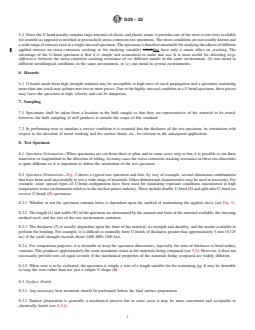
stress-corrosion cracking resistance of (a) different metals in 8.2 Specimen Dimensions—Fig. 2 shows a typical test
the same environment, (b) one metal in different metallurgical specimen and lists, by way of example, several dimension
conditionsinthesameenvironment,or(c)onemetalinseveral combinations that have been used successfully to test a wide
environments. range of materials. Other dimensional characteristics may be
G30−22
Examples of Typical Dimensions (SI Units)
Example L, mm M, mm W, mm T, mm D, mm X, mm Y, mm R, mm α,rad
a 80 50 20 2.5 10 32 14 5 1.57
b 100 90 9 3.0 7 25 38 16 1.57
c 120 90 20 1.5 8 35 35 16 1.57
d 130 100 15 3.0 6 45 32 13 1.57
e 150 140 15 0.8 3 61 20 9 1.57
f 310 250 25 13.0 13 105 90 32 1.57
g 510 460 25 6.5 13 136 165 76 1.57
h 102 83 19 3.2 9.6 40 16 4.8 1.57
FIG. 2 Typical U-Bend Specimen Dimensions (Examples only, not for specification)
used as necessary. For example, some special types of U-bend 8.2.5 When wire is to be evaluated, the specimen is simply
configuration have been used for simulating exposure condi- a wire of a length suitable for the restraining jig. It may be
tions encountered in high temperature water environments
desirabletoloopthewireratherthanusejustasimpleU-shape
relative to the nuclear power industry. These include double
(4).
U-bend (2) and split tube U-bend (or reverse U-bend) (3)
8.3 Surface Finish:
specimens.
8.3.1 Any necessary heat treatment should be performed
8.2.1 Whether or not the specimen contains holes is depen-
dent upon the method of maintaining the applied stress (see before the final surface preparation.
Fig. 1).
8.3.2 Surface preparation is generally a mechanical process
8.2.2 The length (L) and width (W) of the specimen are
butinsomecasesitmaybemoreconvenientandacceptableto
determined by the amount and form of the material available,
chemically finish (see 8.3.4).
the stressing method used, and the size of the test environment
8.3.3 Grinding or machining should be done in stages so
container.
that the final cut leaves the surface with a finish of 0.76 µm
8.2.3 The thickness (T) is usually dependent upon the form
(30µin.) or better. Care must be taken to avoid excessive
of the material, its strength and ductility, and the means
heating during preparation because this may induce undesir-
available to perform the bending. For example, it is difficult to
able residual stresses and in some cases cause metallurgical or
manually form U-bends of thickness greater than approxi-
chemical changes, or both, at the surface. The edges of the
mately 3 mm (0.125 in.) if the yield strength exceeds about
specimen should receive the same finish as the faces.
1400 MPa (200 ksi).
8.2.4 For comparison purposes, it is desirable to keep the 8.3.4 When the final surface preparation involves chemical
specimen dimensions, especially the ratio of thickness to bend dissolution, care must be taken to ensure that the solution used
radius, constant. This produces approximately the same maxi- does not induce hydrogen embrittlement, selectively attack
mum strain in the materials being compared (see 9.3). constituents in the metal, or leave undesirable residues on the
However,itdoesnotnecessarilyprovidetestsofequalseverity
surface.
if the mechanical properties of the materials being compared
are widely different.
G30−22
FIG. 3 True Stress-True Strain Relationships for Stressed U-Bends
8.3.5 Itmaybedesirabletotestasurface(forexample,cold the actual relationship obtained will depend upon the method
rolled or cold rolled, annealed, and pickled) without surface of stressing (see Section 10). For the conditions shown in Fig.
metal removal. In such cases the edges of the specimen should 3(d), a quantitative measure of the maximum test stress can be
be milled. Sheared edges should be avoided in all cases. made (6).
8.3.6 The final stage of surface preparation is degreasing.
9.3 The total strain (ε) on the outside of the bend can be
Depending upon the method of stressing, this may be done
closely approximated to the equation:
before or after stressing.
ε 5 T/2R when T,,R
8.4 Identification of the specimen is best achieved by
where:
stamping or scribing near one of the ends of the test specimen,
well away from the area to be stressed. Alternatively, nonme- T = specimen thickness, and
R = radius of bend curvature.
tallic tags may be attached to the bolt or fixture used to
maintain the specimen in a stressed condition during the test.
10. Stressing the Specimen
9. Stress Considerations
10.1 Stressing is usually achieved by either a one- or a
9.1 The stress of principal interest in the U-bend specimen two-stage operation.
iscircumferential.Itisnonuniformbecause(a)thereisastress
10.2 Single-stage stressing is accomplished by bending the
gradient through the thickness varying from a maximum
specimen into shape and maintaining it in that shape without
tensionontheoutersurfacetoamaximumcompressiononthe
allowing relaxation of the tensile elastic strain. Typical stress-
inner surface, (b) the stress varies from zero at the ends of the
ing sequences are shown in Fig. 4. The method shown in Fig.
specimen to a maximum at the center of the bend, and (c) the
4(a) may be performed in a tension testing machine and is
stress may vary across t
...
This document is not an ASTM standard and is intended only to provide the user of an ASTM standard an indication of what changes have been made to the previous version. Because
it may not be technically possible to adequately depict all changes accurately, ASTM recommends that users consult prior editions as appropriate. In all cases only the current version
of the standard as published by ASTM is to be considered the official document.
Designation: G30 − 97 (Reapproved 2016) G30 − 22
Standard Practice for
Making and Using U-Bend Stress-Corrosion Test
Specimens
This standard is issued under the fixed designation G30; the number immediately following the designation indicates the year of original
adoption or, in the case of revision, the year of last revision. A number in parentheses indicates the year of last reapproval. A superscript
epsilon (´) indicates an editorial change since the last revision or reapproval.
1. Scope
1.1 This practice covers procedures for making and using U-bend specimens for the evaluation of stress-corrosion cracking in
metals. The U-bend specimen is generally a rectangular strip whichthat is bent 180° around a predetermined radius and maintained
in this constant strain condition during the stress-corrosion test. Bends slightly less than or greater than 180° are sometimes used.
Typical U-bend configurations showing several different methods of maintaining the applied stress are shown in Fig. 1.
1.2 U-bend specimens usually contain both elastic and plastic strain. In some cases (for example, very thin sheet or small diameter
wire) it is possible to form a U-bend and produce only elastic strain. However, bent-beam (Practice G39 or direct tension (Practice
G49)) specimens are normally used to study stress-corrosion cracking of strip or sheet under elastic strain only.
1.3 This practice is concerned only with the test specimen and not the environmental aspects of stress-corrosion testing, which
are discussed elsewhere (1) and in Practices G35, G36, G37, G41, G44, G103 and Test Method G123.
1.4 The values stated in SI units are to be regarded as standard. The inch-pound unitsvalues given in parentheses after SI units
are provided for information. information only and are not considered standard.
1.5 This standard does not purport to address all of the safety concerns, if any, associated with its use. It is the responsibility
of the user of this standard to establish appropriate safety safety, health, and healthenvironmental practices and determine the
applicability of regulatory limitations prior to use.
1.6 This international standard was developed in accordance with internationally recognized principles on standardization
established in the Decision on Principles for the Development of International Standards, Guides and Recommendations issued
by the World Trade Organization Technical Barriers to Trade (TBT) Committee.
2. Referenced Documents
2.1 ASTM Standards:
E3 Guide for Preparation of Metallographic Specimens
G1 Practice for Preparing, Cleaning, and Evaluating Corrosion Test Specimens
G15 Terminology Relating to Corrosion and Corrosion Testing (Withdrawn 2010)
This practice is under the jurisdiction of ASTM Committee G01 on Corrosion of Metals and is the direct responsibility of Subcommittee G01.06 on Environmentally
Assisted Cracking.
Current edition approved May 1, 2016May 1, 2022. Published June 2016May 2022. Originally approved in 1972. Last previous edition approved in 20152016 as G30 – 97
(2015).(2016). DOI: 10.1520/G0030-97R16.10.1520/G0030-22.
The boldface numbers in parentheses refer to a list of references at the end of this standard.
For referenced ASTM standards, visit the ASTM website, www.astm.org, or contact ASTM Customer Service at service@astm.org. For Annual Book of ASTM Standards
volume information, refer to the standard’sstandard’s Document Summary page on the ASTM website.
Copyright © ASTM International, 100 Barr Harbor Drive, PO Box C700, West Conshohocken, PA 19428-2959. United States
G30 − 22
FIG. 1 Typical Stressed U-bends
G35 Practice for Determining the Susceptibility of Stainless Steels and Related Nickel-Chromium-Iron Alloys to Stress-
Corrosion Cracking in Polythionic Acids
G36 Practice for Evaluating Stress-Corrosion-Cracking Resistance of Metals and Alloys in a Boiling Magnesium Chloride
Solution
G37 Practice for Use of Mattsson’s Solution of pH 7.2 to Evaluate the Stress-Corrosion Cracking Susceptibility of Copper-Zinc
Alloys
G39 Practice for Preparation and Use of Bent-Beam Stress-Corrosion Test Specimens
G41 Practice for Determining Cracking Susceptibility of Metals Exposed Under Stress to a Hot Salt Environment
G44 Practice for Exposure of Metals and Alloys by Alternate Immersion in Neutral 3.5 % Sodium Chloride Solution
G49 Practice for Preparation and Use of Direct Tension Stress-Corrosion Test Specimens
G103 Practice for Evaluating Stress-Corrosion Cracking Resistance of Low Copper 7XXX Series Al-Zn-Mg-Cu Alloys in
Boiling 6 % Sodium Chloride Solution
G123 Test Method for Evaluating Stress-Corrosion Cracking of Stainless Alloys with Different Nickel Content in Boiling
Acidified Sodium Chloride Solution
G193 Terminology and Acronyms Relating to Corrosion
3. Terminology
3.1 For definitions of corrosion-related terms used in this practice, see Terminology G15G193.
4. Summary of Practice
4.1 This practice involves the stressing of a specimen bent to a U shape. The applied strain is estimated from the bend conditions.
The stressed specimens are then exposed to the test environment and the time required for cracks to develop is determined. This
cracking time is used as an estimate of the stress corrosion resistance of the material in the test environment.
5. Significance and Use
5.1 The U-bend specimen may be used for any metal alloy sufficiently ductile to be formed into the U-shape without mechanically
cracking. The specimen is most easily made from strip or sheet but can be machined from plate, bar, castings, or weldments; wire
specimens may be used also.
G30 − 22
5.2 Since the U-bend usually contains large amounts of elastic and plastic strain, it provides one of the most severe tests available
for smooth (as opposed to notched or precracked) stress-corrosion test specimens. The stress conditions are not usually known and
a wide range of stresses exist in a single stressed specimen. The specimen is therefore unsuitable for studying the effects of different
applied stresses on stress-corrosion cracking or for studying variables whichthat have only a minor effect on cracking. The
advantage of the U-bend specimen is that it is simple and economical to make and use. It is most useful for detecting large
differences between the stress-corrosion cracking resistance of (a) different metals in the same environment, (b) one metal in
different metallurgical conditions in the same environment, or (c) one metal in several environments.
6. Hazards
6.1 U-bends made from high strength material may be susceptible to high rates of crack propagation and a specimen containing
more than one crack may splinter into two or more pieces. Due to the highly stressed condition in a U-bend specimen, these pieces
may leave the specimen at high velocity and can be dangerous.
7. Sampling
7.1 Specimens shall be taken from a location in the bulk sample so that they are representative of the material to be tested;
however, the bulk sampling of mill products is outside the scope of this standard.
7.2 In performing tests to simulate a service condition it is essential that the thickness of the test specimen, its orientation with
respect to the direction of metal working and the surface finish, etc., be relevant to the anticipated application.
8. Test Specimen
8.1 Specimen Orientation—When specimens are cut from sheet or plate and in some cases strip or bar, it is possible to cut them
transverse or longitudinal to the direction of rolling. In many cases the stress-corrosion cracking resistance in these two directions
is quite different so it is important to define the orientation of the test specimen.
8.2 Specimen Dimensions—Fig. 2 shows a typical test specimen and lists, by way of example, several dimension combinations
that have been used successfully to test a wide range of materials. Other dimensional characteristics may be used as necessary. For
example, some special types of U-bend configuration have been used for simulating exposure conditions encountered in high
temperature water environments relative to the nuclear power industry. These include double U-bend (2) and split tube U-bend (or
reverse U-bend) (3) specimens.
8.2.1 Whether or not the specimen contains holes is dependent upon the method of maintaining the applied stress (see Fig. 1).
8.2.2 The length (L) and width (W) of the specimen are determined by the amount and form of the material available, the stressing
method used, and the size of the test environment container.
8.2.3 The thickness (T) is usually dependent upon the form of the material, its strength and ductility, and the means available to
perform the bending. For example, it is difficult to manually form U-bends of thickness greater than approximately 3 mm (0.125
in.) if the yield strength exceeds about 1400 MPa (200 ksi).
8.2.4 For comparison purposes, it is desirable to keep the specimen dimensions, especially the ratio of thickness to bend radius,
constant. This produces approximately the same maximum strain in the materials being compared (see 9.3). However, it does not
necessarily provide tests of equal severity if the mechanical properties of the materials being compared are widely different.
8.2.5 When wire is to be evaluated, the specimen is simply a wire of a length suitable for the restraining jig. It may be desirable
to loop the wire rather than use just a simple U-shape (4).
8.3 Surface Finish:
8.3.1 Any necessary heat treatment should be performed before the final surface preparation.
8.3.2 Surface preparation is generally a mechanical process but in some cases it may be more convenient and acceptable to
chemically finish (see 8.3.4).
G30 − 22
Examples of Typical Dimensions (SI Units)
Example L, mm M, mm W, mm T, mm D, mm X, mm Y, mm R, mm α, rad
a 80 50 20 2.5 10 32 14 5 1.57
b 100 90 9 3.0 7 25 38 16 1.57
c 120 90 20 1.5 8 35 35 16 1.57
d 130 100 15 3.0 6 45 32 13 1.57
e 150 140 15 0.8 3 61 20 9 1.57
f 310 250 25 13.0 13 105 90 32 1.57
g 510 460 25 6.5 13 136 165 76 1.57
h 102 83 19 3.2 9.6 40 16 4.8 1.57
FIG. 2 Typical U-Bend Specimen Dimensions (Examples only, not for specification)
8.3.3 Grinding or machining should be done in stages so that the final cut leaves the surface with a finish of 0.76 μm (30 μin.)
or better. Care must be taken to avoid excessive heating during preparation because this may induce undesirable residual stresses
and in some cases cause metallurgical or chemical changes, or both, at the surface. The edges of the specimen should receive the
same finish as the faces.
8.3.4 When the final surface preparation involves chemical dissolution, care must be taken to ensure that the solution used does
not induce hydrogen embrittlement, selectively attack constituents in the metal, or leave undesirable residues on the surface.
8.3.5 It may be desirable to test a surface (for example, cold rolled or cold rolled, annealed, and pickled) without surface metal
removal. In such cases the edges of the specimen should be milled. Sheared edges should be avoided in all cases.
8.3.6 The final stage of surface preparation is degreasing. Depending upon the method of stressing, this may be done before or
after stressing.
8.4 Identification of the specimen is best achieved by stamping or scribing near one of the ends of the test specimen, well away
from the area to be stressed. Alternatively, nonmetallic tags may be attached to the bolt or fixture used to maintain the specimen
in a stressed condition during the test.
9. Stress Considerations
9.1 The stress of principal interest in the U-bend specimen is circumferential. It is nonuniform because (a) there is a stress gradient
through the thickness varying from a maximum tension on the outer surface to a maximum compression on the inner surface, (b)
the stress varies from zero at the ends of the specimen to a maximum at the center of the bend, and (c) the stress may vary across
the width of the bend. The stress distribution has been studied (5).
9.2 When a U-bend specimen is stressed, the material in the outer fibers of the bend is strained into the plastic portion of the true
stress-true strain curve; for example, into Section AB in Fig. 3(a). Fig. 3(b–e) show several stress-strain relationships that can exist
in the outer fibers of the U-bend test specimen; the actual relationship obtained will depend upon the method of stressing (see
Section 10). For the conditions shown in Fig. 3(d), a quantitative measure of the maximum test stress can be made (6).
G30 − 22
FIG. 3 True Stress-True Strain Relationships for Stressed U-Bends
9.3 The total strain (ε) on the outside of the bend can be closely approximated to the equation:
ε5 T/2R when T,,R
where:
where:
T
...