

ASTM D5600-22
(Test Method)Standard Test Method for Trace Metals in Petroleum Coke by Inductively Coupled Plasma Atomic Emission Spectrometry (ICP-AES)
General Information
- Abstract
SIGNIFICANCE AND USE
5.1 The presence and concentration of various metallic elements in a petroleum coke are major factors in determining the suitability of the coke for various end uses. This test method provides a means of determining the concentrations of these metallic elements in a coke sample.
5.2 The test method provides a standard procedure for use by buyer and seller in the commercial transfer of petroleum coke to determine whether the petroleum coke meets the specifications of the purchasing party.
SCOPE
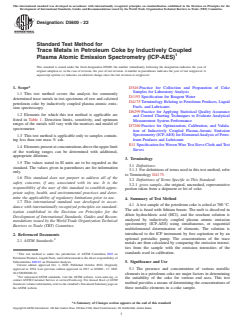
1.1 This test method covers the analysis for commonly determined trace metals in test specimens of raw and calcined petroleum coke by inductively coupled plasma atomic emission spectroscopy.
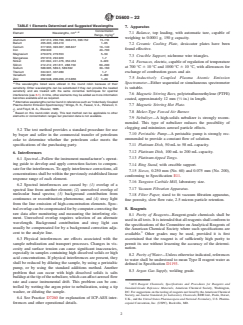
1.2 Elements for which this test method is applicable are listed in Table 1. Detection limits, sensitivity, and optimum ranges of the metals will vary with the matrices and model of spectrometer.
1.3 This test method is applicable only to samples containing less than one mass % ash.
1.4 Elements present at concentrations above the upper limit of the working ranges can be determined with additional, appropriate dilutions.
1.5 The values stated in SI units are to be regarded as the standard. The values given in parentheses are for information only.
1.6 This standard does not purport to address all of the safety concerns, if any, associated with its use. It is the responsibility of the user of this standard to establish appropriate safety, health, and environmental practices and determine the applicability of regulatory limitations prior to use.
1.7 This international standard was developed in accordance with internationally recognized principles on standardization established in the Decision on Principles for the Development of International Standards, Guides and Recommendations issued by the World Trade Organization Technical Barriers to Trade (TBT) Committee.
- Status
- Published
- Publication Date
- 30-Sep-2022
- Technical Committee
- D02 - Petroleum Products, Liquid Fuels, and Lubricants
- Drafting Committee
- D02.03 - Elemental Analysis
Buy Documents
ASTM D5600-22 - Standard Test Method for Trace Metals in Petroleum Coke by Inductively Coupled Plasma Atomic Emission Spectrometry (ICP-AES)
REDLINE ASTM D5600-22 - Standard Test Method for Trace Metals in Petroleum Coke by Inductively Coupled Plasma Atomic Emission Spectrometry (ICP-AES)
Overview
ASTM D5600-22 is an internationally recognized standard that defines the test method for determining the concentration of trace metals in petroleum coke using Inductively Coupled Plasma Atomic Emission Spectrometry (ICP-AES). The ability to accurately measure metallic elements is critical when evaluating the suitability of petroleum coke for various industrial processes and end uses. This standard is essential for both buyers and sellers to ensure that petroleum coke meets specified quality requirements during commercial transactions.
Key Topics
- Test Scope: ASTM D5600-22 applies to the analysis of trace metals in both raw and calcined petroleum coke samples with less than one mass percent ash.
- Analyzed Elements: The method covers the quantification of key metals including aluminum, barium, calcium, iron, magnesium, manganese, nickel, silicon, sodium, titanium, vanadium, and zinc.
- Sample Preparation and Analysis:
- Samples are ground, ashed, and fused with lithium borate before dissolution and analysis.
- The final solution is introduced into the ICP-AES instrument, which simultaneously or sequentially determines the multi-element content.
- Commercial and Regulatory Context: This standard enables alignment with commercial quality specifications and regulatory requirements, providing a basis for negotiation and quality assurance.
Applications
ASTM D5600-22 finds practical application across the petroleum and petrochemical industries due to its focus on trace metals in petroleum coke. Key use cases include:
- Product Quality Assessment: Producer and buyer laboratories use this test method to ensure that petroleum coke meets threshold values for trace metals, which can impact downstream processing or the final product characteristics.
- Contractual Compliance: The standard procedure supports verification that shipments of petroleum coke comply with the quantitative metal specifications in purchase contracts.
- Environmental and Process Control: Determining trace metal levels aids in monitoring and optimizing refinery coke processing, as excess metals can affect process equipment or environmental emissions.
- Research and Product Development: The method is used in laboratory settings for product characterization, supporting R&D in developing new coke products or refining processes.
Related Standards
Several ASTM standards are related or referenced in conjunction with ASTM D5600-22 for comprehensive sample preparation, quality assurance, and analytical consistency:
- ASTM D346: Practice for Collection and Preparation of Coke Samples for Laboratory Analysis
- ASTM D1193: Specification for Reagent Water
- ASTM D4175: Terminology Relating to Petroleum Products, Liquid Fuels, and Lubricants
- ASTM D6299: Practice for Applying Statistical Quality Assurance and Control Charting Techniques to Evaluate Analytical Measurement System Performance
- ASTM D7260: Practice for Optimization, Calibration, and Validation of ICP-AES for Elemental Analysis of Petroleum Products and Lubricants
- ASTM E11: Specification for Woven Wire Test Sieve Cloth and Test Sieves
Practical Value
Implementing ASTM D5600-22 in your laboratory or quality assurance program offers numerous benefits:
- Accurate Measurement: ICP-AES allows for the detection and quantification of trace metals at low concentration ranges, ensuring reliable product evaluation.
- Standardization: Following a recognized test method ensures comparability of results across laboratories and enhances transparency in commercial transactions.
- Risk Reduction: Identification and control of trace metals help mitigate risks in processing, environmental impact, and product performance.
- Global Acceptance: Developed under internationally accepted protocols, ASTM D5600-22 supports compliance with global trade and regulatory requirements.
For further guidance on trace metal analysis, refer to official ASTM documentation and related standards to ensure complete, standardized laboratory practices for petroleum coke analysis.
Relations
- Refers
ASTM D4175-23a - Standard Terminology Relating to Petroleum Products, Liquid Fuels, and Lubricants - Effective Date
- 15-Dec-2023
- Effective Date
- 01-Dec-2023
- Refers
ASTM D4175-23e1 - Standard Terminology Relating to Petroleum Products, Liquid Fuels, and Lubricants - Effective Date
- 01-Jul-2023
- Effective Date
- 01-May-2019
- Effective Date
- 15-Dec-2017
- Effective Date
- 15-Nov-2017
- Effective Date
- 01-Jan-2017
- Effective Date
- 01-Oct-2013
- Effective Date
- 01-Oct-2013
- Effective Date
- 01-May-2010
- Effective Date
- 01-Mar-2010
- Effective Date
- 01-Mar-2010
- Effective Date
- 01-Nov-2009
- Effective Date
- 01-May-2009
- Effective Date
- 15-Oct-2008
Buy Documents
ASTM D5600-22 - Standard Test Method for Trace Metals in Petroleum Coke by Inductively Coupled Plasma Atomic Emission Spectrometry (ICP-AES)
REDLINE ASTM D5600-22 - Standard Test Method for Trace Metals in Petroleum Coke by Inductively Coupled Plasma Atomic Emission Spectrometry (ICP-AES)
Get Certified
Connect with accredited certification bodies for this standard

Element Materials Technology
Materials testing and product certification.

ABS Group Brazil
ABS Group certification services in Brazil.

ABS Quality Evaluations Inc.
American Bureau of Shipping quality certification.
Sponsored listings
Frequently Asked Questions
ASTM D5600-22 is a standard published by ASTM International. Its full title is "Standard Test Method for Trace Metals in Petroleum Coke by Inductively Coupled Plasma Atomic Emission Spectrometry (ICP-AES)". This standard covers: SIGNIFICANCE AND USE 5.1 The presence and concentration of various metallic elements in a petroleum coke are major factors in determining the suitability of the coke for various end uses. This test method provides a means of determining the concentrations of these metallic elements in a coke sample. 5.2 The test method provides a standard procedure for use by buyer and seller in the commercial transfer of petroleum coke to determine whether the petroleum coke meets the specifications of the purchasing party. SCOPE 1.1 This test method covers the analysis for commonly determined trace metals in test specimens of raw and calcined petroleum coke by inductively coupled plasma atomic emission spectroscopy. 1.2 Elements for which this test method is applicable are listed in Table 1. Detection limits, sensitivity, and optimum ranges of the metals will vary with the matrices and model of spectrometer. 1.3 This test method is applicable only to samples containing less than one mass % ash. 1.4 Elements present at concentrations above the upper limit of the working ranges can be determined with additional, appropriate dilutions. 1.5 The values stated in SI units are to be regarded as the standard. The values given in parentheses are for information only. 1.6 This standard does not purport to address all of the safety concerns, if any, associated with its use. It is the responsibility of the user of this standard to establish appropriate safety, health, and environmental practices and determine the applicability of regulatory limitations prior to use. 1.7 This international standard was developed in accordance with internationally recognized principles on standardization established in the Decision on Principles for the Development of International Standards, Guides and Recommendations issued by the World Trade Organization Technical Barriers to Trade (TBT) Committee.
SIGNIFICANCE AND USE 5.1 The presence and concentration of various metallic elements in a petroleum coke are major factors in determining the suitability of the coke for various end uses. This test method provides a means of determining the concentrations of these metallic elements in a coke sample. 5.2 The test method provides a standard procedure for use by buyer and seller in the commercial transfer of petroleum coke to determine whether the petroleum coke meets the specifications of the purchasing party. SCOPE 1.1 This test method covers the analysis for commonly determined trace metals in test specimens of raw and calcined petroleum coke by inductively coupled plasma atomic emission spectroscopy. 1.2 Elements for which this test method is applicable are listed in Table 1. Detection limits, sensitivity, and optimum ranges of the metals will vary with the matrices and model of spectrometer. 1.3 This test method is applicable only to samples containing less than one mass % ash. 1.4 Elements present at concentrations above the upper limit of the working ranges can be determined with additional, appropriate dilutions. 1.5 The values stated in SI units are to be regarded as the standard. The values given in parentheses are for information only. 1.6 This standard does not purport to address all of the safety concerns, if any, associated with its use. It is the responsibility of the user of this standard to establish appropriate safety, health, and environmental practices and determine the applicability of regulatory limitations prior to use. 1.7 This international standard was developed in accordance with internationally recognized principles on standardization established in the Decision on Principles for the Development of International Standards, Guides and Recommendations issued by the World Trade Organization Technical Barriers to Trade (TBT) Committee.
ASTM D5600-22 is classified under the following ICS (International Classification for Standards) categories: 75.160.10 - Solid fuels. The ICS classification helps identify the subject area and facilitates finding related standards.
ASTM D5600-22 has the following relationships with other standards: It is inter standard links to ASTM D4175-23a, ASTM D6299-23a, ASTM D4175-23e1, ASTM D7260-19, ASTM D6299-17b, ASTM D6299-17a, ASTM D6299-17, ASTM D6299-13e1, ASTM E11-13, ASTM D346-04(2010), ASTM D6299-10e2, ASTM D6299-10, ASTM D6299-09, ASTM E11-09e1, ASTM D6299-08. Understanding these relationships helps ensure you are using the most current and applicable version of the standard.
ASTM D5600-22 is available in PDF format for immediate download after purchase. The document can be added to your cart and obtained through the secure checkout process. Digital delivery ensures instant access to the complete standard document.
Standards Content (Sample)
This international standard was developed in accordance with internationally recognized principles on standardization established in the Decision on Principles for the
Development of International Standards, Guides and Recommendations issued by the World Trade Organization Technical Barriers to Trade (TBT) Committee.
Designation: D5600 − 22
Standard Test Method for
Trace Metals in Petroleum Coke by Inductively Coupled
Plasma Atomic Emission Spectrometry (ICP-AES)
This standard is issued under the fixed designation D5600; the number immediately following the designation indicates the year of
original adoption or, in the case of revision, the year of last revision. A number in parentheses indicates the year of last reapproval. A
superscript epsilon (´) indicates an editorial change since the last revision or reapproval.
1. Scope* D346 Practice for Collection and Preparation of Coke
Samples for Laboratory Analysis
1.1 This test method covers the analysis for commonly
D1193 Specification for Reagent Water
determined trace metals in test specimens of raw and calcined
D4175 Terminology Relating to Petroleum Products, Liquid
petroleum coke by inductively coupled plasma atomic emis-
Fuels, and Lubricants
sion spectroscopy.
D6299 Practice for Applying Statistical Quality Assurance
1.2 Elements for which this test method is applicable are
and Control Charting Techniques to Evaluate Analytical
listed in Table 1. Detection limits, sensitivity, and optimum
Measurement System Performance
ranges of the metals will vary with the matrices and model of
D7260 Practice for Optimization, Calibration, and Valida-
spectrometer.
tion of Inductively Coupled Plasma-Atomic Emission
1.3 This test method is applicable only to samples contain- Spectrometry (ICP-AES) for ElementalAnalysis of Petro-
leum Products and Lubricants
ing less than one mass % ash.
E11 Specification for Woven Wire Test Sieve Cloth and Test
1.4 Elementspresentatconcentrationsabovetheupperlimit
Sieves
of the working ranges can be determined with additional,
appropriate dilutions.
3. Terminology
1.5 The values stated in SI units are to be regarded as the
3.1 Definitions:
standard. The values given in parentheses are for information
3.1.1 For definitions of terms used in this test method, refer
only.
to Terminology D4175.
1.6 This standard does not purport to address all of the
3.2 Definitions of Terms Specific to This Standard:
safety concerns, if any, associated with its use. It is the
3.2.1 gross sample—the original, uncrushed, representative
responsibility of the user of this standard to establish appro-
portion taken from a shipment or lot of coke.
priate safety, health, and environmental practices and deter-
mine the applicability of regulatory limitations prior to use.
4. Summary of Test Method
1.7 This international standard was developed in accor-
4.1 Atest sample of the petroleum coke is ashed at 700 °C.
dance with internationally recognized principles on standard-
The ash is fused with lithium borate. The melt is dissolved in
ization established in the Decision on Principles for the
dilute hydrochloric acid (HCl), and the resultant solution is
Development of International Standards, Guides and Recom-
analyzed by inductively coupled plasma atomic emission
mendations issued by the World Trade Organization Technical
spectrometry (ICP-AES) using simultaneous, or sequential
Barriers to Trade (TBT) Committee.
multielemental determination of elements. The solution is
introduced to the ICP instrument by free aspiration or by an
2. Referenced Documents
optional peristaltic pump. The concentrations of the trace
2.1 ASTM Standards:
metals are then calculated by comparing the emission intensi-
ties from the sample with the emission intensities of the
standards used in calibration.
This test method is under the jurisdiction of ASTM Committee D02 on
Petroleum Products, Liquid Fuels, and Lubricantsand is the direct responsibility of
Subcommittee D02.03 on Elemental Analysis.
5. Significance and Use
Current edition approved Oct. 1, 2022. Published October 2022. Originally
5.1 The presence and concentration of various metallic
approved in 1994. Last previous edition approved in 2017 as D5600 – 17. DOI:
10.1520/D5600-22.
elements in a petroleum coke are major factors in determining
For referenced ASTM standards, visit the ASTM website, www.astm.org, or
the suitability of the coke for various end uses. This test
contact ASTM Customer Service at service@astm.org. For Annual Book of ASTM
method provides a means of determining the concentrations of
Standards volume information, refer to the standard’s Document Summary page on
the ASTM website. these metallic elements in a coke sample.
*A Summary of Changes section appears at the end of this standard
Copyright © ASTM International, 100 Barr Harbor Drive, PO Box C700, West Conshohocken, PA 19428-2959. United States
D5600 − 22
TABLE 1 Elements Determined and Suggested Wavelengths
7. Apparatus
Concentration
A ,B
Element Wavelengths, nm 7.1 Balance, top loading, with automatic tare, capable of
C
Range, mg/kg
weighing to 0.0001 g, 150 g capacity.
Aluminum 237.313, 256.799, 308.216, 396.152 15–110
Barium 455.403, 493.410 1–65
7.2 Ceramic Cooling Plate, desiccator plates have been
Calcium 317.933, 393.367, 396.847 10–140
found effective.
Iron 259.940 40–700
Magnesium 279.079, 279.553 5–50
7.3 Crucible Support, nichrome wire triangles.
Manganese 257.610, 294.920 1–7
Nickel 231.604, 241.476, 352.454 3–220
7.4 Furnaces, electric, capable of regulation of temperature
Silicon 212.412, 251.611, 288.159 60–290
at 700 °C 6 10 °C and 1000 °C 6 10 °C, with allowances for
Sodium 588.995, 589.3, 589.592 30–160
exchange of combustion gases and air.
Titanium 334.941, 337.280 1–7
Vanadium 292.402 2–480
7.5 Inductively Coupled Plasma Atomic Emission
Zinc 202.548, 206.200, 213.856 1–20
Spectrometer—Either sequential or simultaneous spectrometer
A
The wavelengths listed were utilized in the round robin because of their
sensitivity. Other wavelengths can be substituted if they can provide the needed is suitable.
sensitivity and are treated with the same corrective techniques for spectral
7.6 Magnetic Stirring Bars, polytetrafluoroethylene (PTFE)
interference (see 6.1). In time, other elements may be added as more information
becomes available and as required. coated, approximately 12 mm ( ⁄2 in.) in length.
B
Alternativewavelengthscanbefoundinreferencessuchas“InductivelyCoupled
7.7 Magnetic Stirring Hot Plate.
PlasmaAtomic Emission Spectroscopy,” Winge, R. K., Fassel, V.A., Peterson, V.
J., and Floyd, M. A., Elsevier, 1985.
C 7.8 Meker-Type Forced Air Burner.
Based on this round-robin study. This test method can be applicable to other
elements or concentration ranges but precision data is not available.
7.9 Nebulizer—A high-solids nebulizer is strongly recom-
mended. This type of nebulizer reduces the possibility of
clogging and minimizes aerosol particle effects.
5.2 The test method provides a standard procedure for use
7.10 Peristaltic Pump—A peristaltic pump is strongly rec-
by buyer and seller in the commercial transfer of petroleum
ommended to provide a constant flow of solution.
coke to determine whether the petroleum coke meets the
specifications of the purchasing party.
7.11 Platinum Dish, 50 mL to 58 mL capacity.
7.12 Platinum Dish, 100 mL to 200 mL capacity.
6. Interferences
7.13 Platinum-tipped Tongs.
6.1 Spectral—Follow the instrument manufacturer’s operat-
ing guide to develop and apply correction factors to compen-
7.14 Ring Stand, with crucible support.
sate for the interferences. To apply interference corrections, all
7.15 Sieves, 0.250 mm (No. 60) and 0.075 mm (No. 200),
concentrations shall be within the previously established linear
conforming to Specification E11.
response range of each element.
7.16 Tungsten Carbide Mill, laboratory size.
6.2 Spectral interferences are caused by: (1) overlap of a
7.17 Vacuum Filtration Apparatus.
spectral line from another element; (2) unresolved overlap of
molecular band spectra; (3) background contribution from
7.18 Filter Paper, sized to fit vacuum filtration apparatus,
continuous or recombination phenomena; and (4) stray light
fine porosity, slow flow rate, 2.5 micron particle retention.
from the line emission of high-concentration elements. Spec-
8. Reagents
traloverlapcanbecompensatedforbycomputer-correctingthe
raw data after monitoring and measuring the interfering ele-
8.1 Purity of Reagents—Reagent-grade chemicals shall be
ment. Unresolved overlap requires selection of an alternate
used in all tests. It is intended that all reagents shall conform to
wavelength. Background contribution and stray light can
the specifications of the Committee on Analytical Reagents of
usually be compensated for by a background correction adja-
the American Chemical Society where such specifications are
cent to the analyte line. 3
available. Other grades may be used, provided it is first
ascertained that the reagent is of sufficiently high purity to
6.3 Physical interferences are effects associated with the
sample nebulization and transport processes. Changes in vis- permit its use without lessening the accuracy of the determi-
nation.
cosity and surface tension can cause significant inaccuracies,
especially in samples containing high dissolved solids or high
8.2 Purity of Water—Unless otherwise indicated, references
acid concentrations. If physical interferences are present, they
to water shall be understood to mean Type II reagent water as
shall be reduced by diluting the sample, by using a peristaltic
defined in Specification D1193.
pump, or by using the standard additions method. Another
8.3 Argon Gas Supply, welding grade.
problem that can occur with high dissolved solids is salts
buildupatthetipofthenebulizer,whichcanaffectaerosolflow
rate and cause instrumental drift. This problem can be con-
ACS Reagent Chemicals, Specifications and Procedures for Reagents and
trolled by wetting the argon prior to nebulization, using a tip
Standard-Grade Reference Materials, American Chemical Society, Washington,
washer, or diluting the sample. DC. For suggestions on the testing of reagents not listed by theAmerican Chemical
Society, see Analar Standards for Laboratory Chemicals, BDH Ltd., Poole, Dorset,
6.4 See Practice D7260 for explanation of ICP-AES inter-
U.K., and the United States Pharmacopeia and National Formulary, U.S. Pharma-
ferences and other operational details. copeial Convention, Inc. (USPC), Rockville, MD.
D5600 − 22
8.4 Lithium Borate, either, or a blend containing both. 10. Preparation of Apparatus
8.4.1 Lithium Metaborate (LiBO ), powder (high purity).
10.1 ICP-AES Instrument—Consult the manufacturer’s in-
8.4.2 Lithium Tetraborate (Li B O ), powder (high purity).
2 4 7
structions for operation of the inductively coupled plasma
8.5 Solution No. 1, Hydrochloric Acid, 20 % by volume
atomic emission spectrometer.
(400 mL of concentrated HCl diluted to 2000 mL with water).
10.2 Peristaltic Pump—When a peristaltic pump is used,
8.6 Solution No. 2, Standard and Sample Solution
inspect the pump tubing and replace it, as necessary, before
Additive—Weigh 20.0 g 6 0.1 g of lithium borate into a
starting each day. Verify the solution uptake rate and adjust it
100 mLto200mLplatinumdish.Placeinafurnaceat1000 °C
to the desired rate.
for5 mintofusetoaliquid.Removeandcool.Placethecooled
10.3 ICP Excitation Source—Initiate the plasma source at
platin
...
This document is not an ASTM standard and is intended only to provide the user of an ASTM standard an indication of what changes have been made to the previous version. Because
it may not be technically possible to adequately depict all changes accurately, ASTM recommends that users consult prior editions as appropriate. In all cases only the current version
of the standard as published by ASTM is to be considered the official document.
Designation: D5600 − 17 D5600 − 22
Standard Test Method for
Trace Metals in Petroleum Coke by Inductively Coupled
Plasma Atomic Emission Spectrometry (ICP-AES)
This standard is issued under the fixed designation D5600; the number immediately following the designation indicates the year of
original adoption or, in the case of revision, the year of last revision. A number in parentheses indicates the year of last reapproval. A
superscript epsilon (´) indicates an editorial change since the last revision or reapproval.
1. Scope*
1.1 This test method covers the analysis for commonly determined trace metals in test specimens of raw and calcined petroleum
coke by inductively coupled plasma atomic emission spectroscopy.
1.2 Elements for which this test method is applicable are listed in Table 1. Detection limits, sensitivity, and optimum ranges of
the metals will vary with the matrices and model of spectrometer.
1.3 This test method is applicable only to samples containing less than one mass % ash.
1.4 Elements present at concentrations above the upper limit of the working ranges can be determined with additional, appropriate
dilutions.
1.5 The values stated in SI units are to be regarded as the standard. The values given in parentheses are for information only.
1.6 This standard does not purport to address all of the safety concerns, if any, associated with its use. It is the responsibility
of the user of this standard to establish appropriate safety safety, health, and healthenvironmental practices and determine the
applicability of regulatory limitations prior to use.
1.7 This international standard was developed in accordance with internationally recognized principles on standardization
established in the Decision on Principles for the Development of International Standards, Guides and Recommendations issued
by the World Trade Organization Technical Barriers to Trade (TBT) Committee.
2. Referenced Documents
2.1 ASTM Standards:
D346 Practice for Collection and Preparation of Coke Samples for Laboratory Analysis
D1193 Specification for Reagent Water
D4175 Terminology Relating to Petroleum Products, Liquid Fuels, and Lubricants
D6299 Practice for Applying Statistical Quality Assurance and Control Charting Techniques to Evaluate Analytical Measure-
ment System Performance
D7260 Practice for Optimization, Calibration, and Validation of Inductively Coupled Plasma-Atomic Emission Spectrometry
(ICP-AES) for Elemental Analysis of Petroleum Products and Lubricants
This test method is under the jurisdiction of ASTM Committee D02 on Petroleum Products, Liquid Fuels, and Lubricantsand is the direct responsibility of Subcommittee
D02.03 on Elemental Analysis.
Current edition approved May 1, 2017Oct. 1, 2022. Published May 2017October 2022. Originally approved in 1994. Last previous edition approved in 20142017 as
D5600 – 14.D5600 – 17. DOI: 10.1520/D5600-17.10.1520/D5600-22.
For referenced ASTM standards, visit the ASTM website, www.astm.org, or contact ASTM Customer Service at service@astm.org. For Annual Book of ASTM Standards
volume information, refer to the standard’s Document Summary page on the ASTM website.
*A Summary of Changes section appears at the end of this standard
Copyright © ASTM International, 100 Barr Harbor Drive, PO Box C700, West Conshohocken, PA 19428-2959. United States
D5600 − 22
TABLE 1 Elements Determined and Suggested Wavelengths
Concentration
A ,B
Element Wavelengths, nm
C
Range, mg/kg
Aluminum 237.313, 256.799, 308.216, 396.152 15–110
Barium 455.403, 493.410 1–65
Calcium 317.933, 393.367, 396.847 10–140
Iron 259.940 40–700
Magnesium 279.079, 279.553 5–50
Manganese 257.610, 294.920 1–7
Nickel 231.604, 241.476, 352.454 3–220
Silicon 212.412, 251.611, 288.159 60–290
Sodium 588.995, 589.3, 589.592 30–160
Titanium 334.941, 337.280 1–7
Vanadium 292.402 2–480
Zinc 202.548, 206.200, 213.856 1–20
A
The wavelengths listed were utilized in the round robin because of their
sensitivity. Other wavelengths can be substituted if they can provide the needed
sensitivity and are treated with the same corrective techniques for spectral
interference (see 6.1). In time, other elements may be added as more information
becomes available and as required.
B
Alternative wavelengths can be found in references such as “Inductively Coupled
Plasma Atomic Emission Spectroscopy,” Winge, R. K., Fassel, V. A., Peterson, V.
J., and Floyd, M. A., Elsevier, 1985.
C
Based on this round-robin study. This test method can be applicable to other
elements or concentration ranges but precision data is not available.
E11 Specification for Woven Wire Test Sieve Cloth and Test Sieves
3. Terminology
3.1 Definitions:
3.1.1 For definitions of terms used in this test method, refer to Terminology D4175.
3.2 Definitions of Terms Specific to This Standard:
3.2.1 gross sample—the original, uncrushed, representative portion taken from a shipment or lot of coke.
3.1.2 ICP-AES—Inductively Coupled Plasma—Atomic Emission Spectrometry.
3.1.3 petroleum coke—a solid, carbonaceous residue produced by thermal decomposition of heavy petroleum fractions and
cracked stocks.
4. Summary of Test Method
4.1 A test sample of the petroleum coke is ashed at 700 °C. The ash is fused with lithium borate. The melt is dissolved in dilute
hydrochloric acid (HCl), and the resultant solution is analyzed by inductively coupled plasma atomic emission spectrometry
(ICP-AES) using simultaneous, or sequential multielemental determination of elements. The solution is introduced to the ICP
instrument by free aspiration or by an optional peristaltic pump. The concentrations of the trace metals are then calculated by
comparing the emission intensities from the sample with the emission intensities of the standards used in calibration.
5. Significance and Use
5.1 The presence and concentration of various metallic elements in a petroleum coke are major factors in determining the
suitability of the coke for various end uses. This test method provides a means of determining the concentrations of these metallic
elements in a coke sample.
5.2 The test method provides a standard procedure for use by buyer and seller in the commercial transfer of petroleum coke to
determine whether the petroleum coke meets the specifications of the purchasing party.
6. Interferences
6.1 Spectral—Follow the instrument manufacturer’s operating guide to develop and apply correction factors to compensate for the
interferences. To apply interference corrections, all concentrations shall be within the previously established linear response range
of each element.
D5600 − 22
6.2 Spectral interferences are caused by: (1) overlap of a spectral line from another element; (2) unresolved overlap of molecular
band spectra; (3) background contribution from continuous or recombination phenomena; and (4) stray light from the line emission
of high-concentration elements. Spectral overlap can be compensated for by computer-correcting the raw data after monitoring and
measuring the interfering element. Unresolved overlap requires selection of an alternate wavelength. Background contribution and
stray light can usually be compensated for by a background correction adjacent to the analyte line.
6.3 Physical interferences are effects associated with the sample nebulization and transport processes. Changes in viscosity and
surface tension can cause significant inaccuracies, especially in samples containing high dissolved solids or high acid
concentrations. If physical interferences are present, they shall be reduced by diluting the sample, by using a peristaltic pump, or
by using the standard additions method. Another problem that can occur with high dissolved solids is salts buildup at the tip of
the nebulizer, which can affect aerosol flow rate and cause instrumental drift. This problem can be controlled by wetting the argon
prior to nebulization, using a tip washer, or diluting the sample.
6.4 See Practice D7260 for explanation of ICP-AES interferences and other operational details.
7. Apparatus
7.1 Balance, top loading, with automatic tare, capable of weighing to 0.0001 g, 150 g capacity.
7.2 Ceramic Cooling Plate, desiccator plates have been found effective.
7.3 Crucible Support, nichrome wire triangles.
7.4 Furnaces, electric, capable of regulation of temperature at 700 °C 6 10 °C and 1000 °C 6 10 °C, with allowances for
exchange of combustion gases and air.
7.5 Inductively Coupled Plasma Atomic Emission Spectrometer—Either sequential or simultaneous spectrometer is suitable.
7.6 Magnetic Stirring Bars, polytetrafluoroethylene (PTFE) coated, approximately 12 mm ( ⁄2 in.) in length.
7.7 Magnetic Stirring Hot Plate.
7.8 Meker-Type Forced Air Burner.
7.9 Nebulizer—A high-solids nebulizer is strongly recommended. This type of nebulizer reduces the possibility of clogging and
minimizes aerosol particle effects.
7.10 Peristaltic Pump—A peristaltic pump is strongly recommended to provide a constant flow of solution.
7.11 Platinum Dish, 50 mL to 58 mL capacity.
7.12 Platinum Dish, 100 mL to 200 mL capacity.
7.13 Platinum-tipped Tongs.
7.14 Ring Stand, with crucible support.
7.15 Sieves, 0.250 mm (No. 60) and 0.075 mm (No. 200), conforming to Specification E11.
7.16 Tungsten Carbide Mill, laboratory size.
D5600 − 22
7.17 Vacuum Filtration Apparatus.
7.18 Filter Paper, sized to fit vacuum filtration apparatus, fine porosity, slow flow rate, 2.5 micron particle retention.
8. Reagents
8.1 Purity of Reagents—Reagent-grade chemicals shall be used in all tests. It is intended that all reagents shall conform to the
specifications of the Committee on Analytical Reagents of the American Chemical Society where such specifications are available.
Other grades may be used, provided it is first ascertained that the reagent is of sufficiently high purity to permit its use without
lessening the accuracy of the determination.
8.2 Purity of Water—Unless otherwise indicated, references to water shall be understood to mean Type II reagent water as defined
in Specification D1193.
8.3 Argon Gas Supply, welding grade.
8.4 Lithium Borate, either, or a blend containing both.
8.4.1 Lithium Metaborate (LiBO ), powder (high purity).
8.4.2 Lithium Tetraborate (Li B O ), powder (high purity).
2 4 7
8.5 Solution No. 1, Hydrochloric Acid, 20 % by volume (400 mL of concentrated HCl diluted to 2000 mL with water).
8.6 Solution No. 2, Standard and Sample Solution Additive—Weigh 20.0 g 6 0.1 g of lithium borate into a 100 mL to 200 mL
platinum dish. Place in a furnace at 1000 °C for 5 min to fuse to a liquid. Remove and cool. Place the cooled platinum dish
containing the fused recrystallized lithium borate and a magnetic stirring bar into a 2 L glass beaker. Add 1000 mL of Solution No.
1 (20 % HCl). Heat gently and stir the solution on a magnetic stirring hot plate until the lithium borate completely dissolves. After
dissolution, remove the platinum dish with a glass rod. Rinse the platinum dish and glass rod with water into the lithium borate
solution. Immediately transfer the warm solution quantitatively to a 2 L volumetric flask. Dilute to about 1800 mL with water to
avoid crystallization. Mix the solution and cool to room temperature. Dilute to volume with water, mix thoroughly, and
vacuum-filter the entire solution through filter paper.
NOTE 1—Fifty millilitres of Solution No. 2 contains exactly 0.5 g lithium borate and 25 mL Solution No. 1.
8.7 St
...