

ASTM D6969-23
(Practice)Standard Practice for Preparation of Calcined Petroleum Coke Samples for Analysis
General Information
- Abstract
SIGNIFICANCE AND USE
4.1 This practice provides field personnel and laboratories with standard procedures for dividing, reducing, and mixing gross samples and intermediate samples, such that the resulting prepared analysis samples are more uniform from laboratory to laboratory. Adherence to these guidelines is expected to provide significant reduction in interlaboratory variability.
SCOPE
1.1 This practice covers the preparation procedures necessary for the reduction and division of calcined petroleum coke samples in order to generate appropriate analytical samples upon which physical and chemical analytical tests will be performed.
1.2 The values stated in either SI units or inch-pound units are to be regarded separately as standard. The values stated in each system are not necessarily exact equivalents; therefore, to ensure conformance with the standard, each system shall be used independently of the other, and values from the two systems shall not be combined.
1.3 This standard does not purport to address all of the safety concerns, if any, associated with its use. It is the responsibility of the user of this standard to establish appropriate safety, health, and environmental practices and determine the applicability of regulatory limitations prior to use.
1.4 This international standard was developed in accordance with internationally recognized principles on standardization established in the Decision on Principles for the Development of International Standards, Guides and Recommendations issued by the World Trade Organization Technical Barriers to Trade (TBT) Committee.
- Status
- Published
- Publication Date
- 30-Jun-2023
- Technical Committee
- D02 - Petroleum Products, Liquid Fuels, and Lubricants
- Drafting Committee
- D02.05 - Properties of Fuels, Petroleum Coke and Carbon Material
Buy Documents

ASTM D6969-23 - Standard Practice for Preparation of Calcined Petroleum Coke Samples for Analysis

REDLINE ASTM D6969-23 - Standard Practice for Preparation of Calcined Petroleum Coke Samples for Analysis
Overview
ASTM D6969-23: Standard Practice for Preparation of Calcined Petroleum Coke Samples for Analysis provides comprehensive procedures for the preparation, division, and reduction of calcined petroleum coke samples. Developed by ASTM International, the standard aims to ensure sample uniformity across laboratories, resulting in reduced variability during physical and chemical analyses. This contributes to more reliable and comparable results, which is essential for quality control, compliance, and research applications in the petroleum coke industry.
Key Topics
- Sample Division: Outlines systematic methods for dividing bulk or gross samples into smaller, representative portions using tools such as riffles or rotary sample dividers.
- Sample Reduction: Describes techniques for reducing particle size-such as crushing or grinding-while minimizing contamination and maintaining chemical integrity.
- Sample Mixing: Details requirements for mixing samples from multiple lots to achieve composite samples that accurately represent larger consignments.
- Analytical Sample Preparation: Provides guidance on obtaining unbiased samples suitable for a range of physical and chemical tests.
- Measurement Units: Clarifies that both SI and inch-pound units may be used independently, with no cross-conversion between systems to maintain accuracy.
- Safety and Environmental Considerations: Reminds users to establish appropriate safety, health, and environmental controls according to local regulations.
Applications
The standard is widely used by field personnel and laboratories engaged in petroleum coke analysis. Key applications include:
- Quality Control: Ensures that calcined petroleum coke samples prepared for testing are uniform, reducing variability and improving confidence in results.
- Laboratory Analysis: Provides a consistent approach for preparing samples ahead of critical procedures such as determining sulfur content, real density, ash content, trace metal assessment, and sieve analysis.
- Composite Sampling: Allows blending of different lots for vessel or shipment analysis, supporting large-scale quality verification and contract compliance.
- Process Optimization and Research: Facilitates reliable data collection needed for process adjustments, product development, and technical evaluations within the petroleum, metallurgical, and carbon materials sectors.
Related Standards
ASTM D6969-23 references several other ASTM standards critical to the comprehensive analysis of calcined petroleum coke:
- ASTM D1552: Sulfur in Petroleum Products
- ASTM D2638: Real Density by Helium Pycnometer
- ASTM D4175: Terminology Relating to Petroleum Products
- ASTM D4292: Vibrated Bulk Density
- ASTM D4422: Ash Analysis
- ASTM D4930: Dust Control Material
- ASTM D4931: Gross Moisture Determination
- ASTM D5004: Real Density by Xylene Displacement
- ASTM D5056, D5600, D6376: Trace Metal Analysis
- ASTM D5187: Crystallite Size by X-Ray Diffraction
- ASTM D5709: Sieve Analysis
- ASTM D7454: Bulk Density using a Semi-Automated Apparatus
These linked standards provide specialized methodologies for conducting specific analyses on the prepared petroleum coke samples, ensuring end-to-end consistency in testing and reporting.
By following ASTM D6969-23, organizations can confidently prepare calcined petroleum coke samples, improve interlaboratory uniformity, and uphold industry best practices in laboratory analysis. This standard is an essential part of the quality assurance framework for companies testing or handling petroleum coke.
Relations
- Refers
ASTM D4175-23a - Standard Terminology Relating to Petroleum Products, Liquid Fuels, and Lubricants - Effective Date
- 15-Dec-2023
- Effective Date
- 01-Nov-2023
- Effective Date
- 01-Nov-2023
- Effective Date
- 01-Nov-2023
- Refers
ASTM D4175-23e1 - Standard Terminology Relating to Petroleum Products, Liquid Fuels, and Lubricants - Effective Date
- 01-Jul-2023
- Effective Date
- 01-Dec-2019
- Effective Date
- 01-Jan-2019
- Effective Date
- 01-Oct-2017
- Effective Date
- 01-Jul-2016
- Effective Date
- 01-Jun-2015
- Effective Date
- 15-Jun-2014
- Effective Date
- 01-May-2014
- Effective Date
- 01-Jun-2011
- Refers
ASTM D4930-06(2011) - Standard Test Method for Dust Control Material on Calcined Petroleum Coke - Effective Date
- 01-May-2011
- Effective Date
- 01-May-2011
Buy Documents
ASTM D6969-23 - Standard Practice for Preparation of Calcined Petroleum Coke Samples for Analysis
REDLINE ASTM D6969-23 - Standard Practice for Preparation of Calcined Petroleum Coke Samples for Analysis
Get Certified
Connect with accredited certification bodies for this standard

Element Materials Technology
Materials testing and product certification.

ABS Group Brazil
ABS Group certification services in Brazil.

ABS Quality Evaluations Inc.
American Bureau of Shipping quality certification.
Sponsored listings
Frequently Asked Questions
ASTM D6969-23 is a standard published by ASTM International. Its full title is "Standard Practice for Preparation of Calcined Petroleum Coke Samples for Analysis". This standard covers: SIGNIFICANCE AND USE 4.1 This practice provides field personnel and laboratories with standard procedures for dividing, reducing, and mixing gross samples and intermediate samples, such that the resulting prepared analysis samples are more uniform from laboratory to laboratory. Adherence to these guidelines is expected to provide significant reduction in interlaboratory variability. SCOPE 1.1 This practice covers the preparation procedures necessary for the reduction and division of calcined petroleum coke samples in order to generate appropriate analytical samples upon which physical and chemical analytical tests will be performed. 1.2 The values stated in either SI units or inch-pound units are to be regarded separately as standard. The values stated in each system are not necessarily exact equivalents; therefore, to ensure conformance with the standard, each system shall be used independently of the other, and values from the two systems shall not be combined. 1.3 This standard does not purport to address all of the safety concerns, if any, associated with its use. It is the responsibility of the user of this standard to establish appropriate safety, health, and environmental practices and determine the applicability of regulatory limitations prior to use. 1.4 This international standard was developed in accordance with internationally recognized principles on standardization established in the Decision on Principles for the Development of International Standards, Guides and Recommendations issued by the World Trade Organization Technical Barriers to Trade (TBT) Committee.
SIGNIFICANCE AND USE 4.1 This practice provides field personnel and laboratories with standard procedures for dividing, reducing, and mixing gross samples and intermediate samples, such that the resulting prepared analysis samples are more uniform from laboratory to laboratory. Adherence to these guidelines is expected to provide significant reduction in interlaboratory variability. SCOPE 1.1 This practice covers the preparation procedures necessary for the reduction and division of calcined petroleum coke samples in order to generate appropriate analytical samples upon which physical and chemical analytical tests will be performed. 1.2 The values stated in either SI units or inch-pound units are to be regarded separately as standard. The values stated in each system are not necessarily exact equivalents; therefore, to ensure conformance with the standard, each system shall be used independently of the other, and values from the two systems shall not be combined. 1.3 This standard does not purport to address all of the safety concerns, if any, associated with its use. It is the responsibility of the user of this standard to establish appropriate safety, health, and environmental practices and determine the applicability of regulatory limitations prior to use. 1.4 This international standard was developed in accordance with internationally recognized principles on standardization established in the Decision on Principles for the Development of International Standards, Guides and Recommendations issued by the World Trade Organization Technical Barriers to Trade (TBT) Committee.
ASTM D6969-23 is classified under the following ICS (International Classification for Standards) categories: 75.160.10 - Solid fuels. The ICS classification helps identify the subject area and facilitates finding related standards.
ASTM D6969-23 has the following relationships with other standards: It is inter standard links to ASTM D4175-23a, ASTM D4292-23, ASTM D4931-23, ASTM D5004-23, ASTM D4175-23e1, ASTM D7454-19, ASTM D4422-19, ASTM D5004-11(2017), ASTM D1552-16, ASTM D5056-15, ASTM D1552-08(2014), ASTM D7454-14, ASTM D5004-11, ASTM D4930-06(2011), ASTM D4931-06(2011). Understanding these relationships helps ensure you are using the most current and applicable version of the standard.
ASTM D6969-23 is available in PDF format for immediate download after purchase. The document can be added to your cart and obtained through the secure checkout process. Digital delivery ensures instant access to the complete standard document.
Standards Content (Sample)
This international standard was developed in accordance with internationally recognized principles on standardization established in the Decision on Principles for the
Development of International Standards, Guides and Recommendations issued by the World Trade Organization Technical Barriers to Trade (TBT) Committee.
Designation: D6969 − 23
Standard Practice for
Preparation of Calcined Petroleum Coke Samples for
Analysis
This standard is issued under the fixed designation D6969; the number immediately following the designation indicates the year of
original adoption or, in the case of revision, the year of last revision. A number in parentheses indicates the year of last reapproval. A
superscript epsilon (´) indicates an editorial change since the last revision or reapproval.
1. Scope* Fuels, and Lubricants
D4292 Test Method for Determination of Vibrated Bulk
1.1 This practice covers the preparation procedures neces-
Density of Calcined Petroleum Coke
sary for the reduction and division of calcined petroleum coke
D4422 Test Method for Ash in Analysis of Petroleum Coke
samples in order to generate appropriate analytical samples
D4930 Test Method for Dust Control Material on Calcined
upon which physical and chemical analytical tests will be
Petroleum Coke
performed.
D4931 Test Method for Gross Moisture in Green Petroleum
1.2 The values stated in either SI units or inch-pound units
Coke
are to be regarded separately as standard. The values stated in
D5004 Test Method for Real Density of Calcined Petroleum
each system are not necessarily exact equivalents; therefore, to
Coke by Xylene Displacement
ensure conformance with the standard, each system shall be
D5056 Test Method for Trace Metals in Petroleum Coke by
used independently of the other, and values from the two
Atomic Absorption
systems shall not be combined.
D5187 Test Method for Determination of Crystallite Size
1.3 This standard does not purport to address all of the (L ) of Calcined Petroleum Coke by X-Ray Diffraction
c
safety concerns, if any, associated with its use. It is the
D5600 Test Method for Trace Metals in Petroleum Coke by
responsibility of the user of this standard to establish appro- Inductively Coupled Plasma Atomic Emission Spectrom-
priate safety, health, and environmental practices and deter-
etry (ICP-AES)
mine the applicability of regulatory limitations prior to use. D5709 Test Method for Sieve Analysis of Petroleum Coke
1.4 This international standard was developed in accor-
D6376 Test Method for Determination of Trace Metals in
dance with internationally recognized principles on standard- Petroleum Coke by Wavelength Dispersive X-ray Fluo-
ization established in the Decision on Principles for the
rescence Spectroscopy
Development of International Standards, Guides and Recom-
D7454 Test Method for Determination of Vibrated Bulk
mendations issued by the World Trade Organization Technical Density of Calcined Petroleum Coke using a Semi-
Barriers to Trade (TBT) Committee.
Automated Apparatus
2. Referenced Documents
3. Terminology
2.1 ASTM Standards: 3.1 Definitions:
D1552 Test Method for Sulfur in Petroleum Products by
3.1.1 For definitions of terms used in this practice, refer to
High Temperature Combustion and Infrared (IR) Detec- Terminology D4175.
tion or Thermal Conductivity Detection (TCD) 3.1.2 analysis sample, n—the reduced and divided represen-
D2638 Test Method for Real Density of Calcined Petroleum tative portion of the bulk sample, prepared for use in the
Coke by Helium Pycnometer laboratory.
D4175 Terminology Relating to Petroleum Products, Liquid
3.1.3 composite sample, n—a sample, representative of an
entire consignment of calcined petroleum coke, generated by
mixing portions of gross samples from different lots together in
This practice is under the jurisdiction of ASTM Committee D02 on Petroleum
mass fractions proportioned to the consignment.
Products, Liquid Fuels, and Lubricants and is the direct responsibility of Subcom-
mittee D02.05 on Properties of Fuels, Petroleum Coke and Carbon Material
3.1.4 gross sample, n—the original, uncrushed representa-
Current edition approved July 1, 2023. Published July 2023. Originally approved
tive portion taken from a shipment or lot of coke.
in 2003. Last previous edition approved in 2017 as D6969 – 17. DOI: 10.1520/
D6969-23.
3.1.5 intermediate sample, n—a sample, representative of a
For referenced ASTM standards, visit the ASTM website, www.astm.org, or
gross sample, upon which no analysis is to be performed, yet
contact ASTM Customer Service at service@astm.org. For Annual Book of ASTM
required for generation of analysis samples after undergoing
Standards volume information, refer to the standard’s Document Summary page on
the ASTM website. further division and reduction.
*A Summary of Changes section appears at the end of this standard
Copyright © ASTM International, 100 Barr Harbor Drive, PO Box C700, West Conshohocken, PA 19428-2959. United States
D6969 − 23
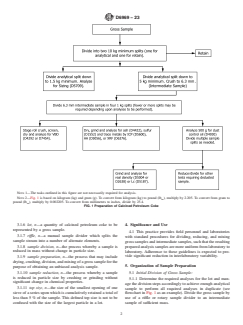
NOTE 1—The tasks outlined in this figure are not necessarily required for analysis.
NOTE 2—Fig. 1 is based on kilogram (kg) and gram (g). To convert from kilogram (kg) to pound (lb ), multiply by 2.205. To convert from gram to
m
pound (lb ), multiply by 0.002205. To convert from millimeters to inches, divide by 25.4.
m
FIG. 1 Preparation of Calcined Petroleum Coke
3.1.6 lot, n—a quantity of calcined petroleum coke to be 4. Significance and Use
represented by a gross sample.
4.1 This practice provides field personnel and laboratories
3.1.7 riffle, n—a manual sample divider which splits the
with standard procedures for dividing, reducing, and mixing
sample stream into a number of alternate elements.
gross samples and intermediate samples, such that the resulting
3.1.8 sample division, n—the process whereby a sample is prepared analysis samples are more uniform from laboratory to
reduced in mass without change in particle size.
laboratory. Adherence to these guidelines is expected to pro-
vide significant reduction in interlaboratory variability.
3.1.9 sample preparation, n—the process that m
...
This document is not an ASTM standard and is intended only to provide the user of an ASTM standard an indication of what changes have been made to the previous version. Because
it may not be technically possible to adequately depict all changes accurately, ASTM recommends that users consult prior editions as appropriate. In all cases only the current version
of the standard as published by ASTM is to be considered the official document.
Designation: D6969 − 17 D6969 − 23
Standard Practice for
Preparation of Calcined Petroleum Coke Samples for
Analysis
This standard is issued under the fixed designation D6969; the number immediately following the designation indicates the year of
original adoption or, in the case of revision, the year of last revision. A number in parentheses indicates the year of last reapproval. A
superscript epsilon (´) indicates an editorial change since the last revision or reapproval.
1. Scope*
1.1 This practice covers the preparation procedures necessary for the reduction and division of calcined petroleum coke samples
in order to generate appropriate analytical samples upon which physical and chemical analytical tests will be performed.
1.2 The values stated in either SI units or inch-pound units are to be regarded separately as standard. The values stated in each
system are not necessarily exact equivalents; therefore, to ensure conformance with the standard, each system shall be used
independently of the other, and values from the two systems shall not be combined.
1.3 This standard does not purport to address all of the safety concerns, if any, associated with its use. It is the responsibility
of the user of this standard to establish appropriate safety and healthsafety, health, and environmental practices and determine
the applicability of regulatory limitations prior to use.
1.4 This international standard was developed in accordance with internationally recognized principles on standardization
established in the Decision on Principles for the Development of International Standards, Guides and Recommendations issued
by the World Trade Organization Technical Barriers to Trade (TBT) Committee.
2. Referenced Documents
2.1 ASTM Standards:
D1552 Test Method for Sulfur in Petroleum Products by High Temperature Combustion and Infrared (IR) Detection or Thermal
Conductivity Detection (TCD)
D2638 Test Method for Real Density of Calcined Petroleum Coke by Helium Pycnometer
D4175 Terminology Relating to Petroleum Products, Liquid Fuels, and Lubricants
D4292 Test Method for Determination of Vibrated Bulk Density of Calcined Petroleum Coke
D4422 Test Method for Ash in Analysis of Petroleum Coke
D4930 Test Method for Dust Control Material on Calcined Petroleum Coke
D4931 Test Method for Gross Moisture in Green Petroleum Coke
D5004 Test Method for Real Density of Calcined Petroleum Coke by Xylene Displacement
D5056 Test Method for Trace Metals in Petroleum Coke by Atomic Absorption
D5187 Test Method for Determination of Crystallite Size (L ) of Calcined Petroleum Coke by X-Ray Diffraction
c
D5600 Test Method for Trace Metals in Petroleum Coke by Inductively Coupled Plasma Atomic Emission Spectrometry
(ICP-AES)
D5709 Test Method for Sieve Analysis of Petroleum Coke
This practice is under the jurisdiction of ASTM Committee D02 on Petroleum Products, Liquid Fuels, and Lubricants and is the direct responsibility of Subcommittee
D02.05 on Properties of Fuels, Petroleum Coke and Carbon Material
Current edition approved Jan. 1, 2017July 1, 2023. Published January 2017July 2023. Originally approved in 2003. Last previous edition approved in 20162017 as
D6969 – 16.D6969 – 17. DOI: 10.1520/D6969-17.10.1520/D6969-23.
For referenced ASTM standards, visit the ASTM website, www.astm.org, or contact ASTM Customer Service at service@astm.org. For Annual Book of ASTM Standards
volume information, refer to the standard’s Document Summary page on the ASTM website.
*A Summary of Changes section appears at the end of this standard
Copyright © ASTM International, 100 Barr Harbor Drive, PO Box C700, West Conshohocken, PA 19428-2959. United States
D6969 − 23
D6376 Test Method for Determination of Trace Metals in Petroleum Coke by Wavelength Dispersive X-ray Fluorescence
Spectroscopy
D7454 Test Method for Determination of Vibrated Bulk Density of Calcined Petroleum Coke using a Semi-Automated
Apparatus
3. Terminology
3.1 Definitions:
3.1.1 For definitions of terms used in this practice, refer to Terminology D4175.
3.1.2 analysis sample, n—the reduced and divided representative portion of the bulk sample, prepared for use in the laboratory.
3.1.3 composite sample, n—a sample, representative of an entire consignment of calcined petroleum coke, generated by mixing
portions of gross samples from different lots together in mass fractions proportioned to the consignment.
3.1.4 gross sample, n—the original, uncrushed representative portion taken from a shipment or lot of coke.
3.1.5 intermediate sample, n—a sample, representative of a gross sample, upon which no analysis is to be performed, yet required
for generation of analysis samples after undergoing further division and reduction.
3.1.6 lot, n—a quantity of calcined petroleum coke to be represented by a gross sample.
3.1.7 riffle, n—a manual sample divider which splits the sample stream into a number of alternate elements.
3.1.8 sample division, n—the process whereby a sample is reduced in mass without change in particle size.
3.1.9 sample preparation, n—the process that may include drying, crushing, division, and mixing of a gross sample for the purpose
of obtaining an unbiased analysis sample.
3.1.10 sample reduction, n—the process whereby a sample is reduced in particle size by crushing or grinding without significant
change in chemical properties.
3.1.11 top size, n—the size of the smallest opening of one sieve of a series upon which is cumulatively retained a total of less than
5 % of the sample. This defined top size is not to be confused with the size of the largest particle in a lot.
4. Significance and Use
4.1 This practice provides field personnel and laboratories with standard procedures for dividing, reducing, and mixing gross
samples and intermediate samples, such that the resulting prepared analysis samples are more uniform from laboratory to
laboratory. Adherence
...