

ASTM C1492-22
(Specification)Standard Specification for Concrete Roof Tile
General Information
- Abstract
ABSTRACT
This specification deals with the standards for concrete tiles intended for use as roof covering where durability and appearance are required to provide a weather-resistant surface of specified design. The tiles are manufacture from cement, water, and mineral aggregates and shaped during manufacturing by molding, pressing, or extrustion. The tiles may or may not contain inclusion of other materials. The tiles shall also be tested for the following requirements: dimensional tolerance, freeze thaw, transverse strength, permeability, and water absorption.
SCOPE
1.1 This specification covers concrete tiles intended for the use as roof covering where durability and appearance are required to provide a weather-resistant surface of specified design.
1.2 Tiles are manufactured from portland cement, water, and mineral aggregates with or without the inclusion of other materials.
1.3 Tiles are shaped during manufacturing by molding, pressing, or extrusion. The shaping method can be used to describe the tile.
1.4 Other constituents, such as chemical and mineral admixtures established as suitable for use in concrete, shall conform to ASTM standard specifications where applicable, or shall be shown by tests or experience not to be detrimental to the durability of concrete.
1.5 Tiles are generally planar or undulating rectangular shapes available in a variety of cross-sectional areas profiles, shapes, sizes, surface textures, and colors.
Note 1: Concrete roof tiles covered by this specification are made from lightweight or normal weight aggregates, or both.
Note 2: When particular features are desired, such as color, surface texture for appearance, or other special features, such properties should be specified by the purchaser. However. the local sellers should be consulted as to the availability of concrete roof tile having a desired feature.
1.6 The text of this specification references notes and footnotes, which provide explanatory material. These notes and footnotes (excluding those in tables and figures) shall not be considered as requirements of the standard.
1.7 The values stated in inch-pound units are to be regarded as standard. The values given in parentheses are mathematical conversions to SI units that are provided for information only and are not considered standard.
1.8 This international standard was developed in accordance with internationally recognized principles on standardization established in the Decision on Principles for the Development of International Standards, Guides and Recommendations issued by the World Trade Organization Technical Barriers to Trade (TBT) Committee.
- Status
- Published
- Publication Date
- 28-Feb-2022
- Technical Committee
- C15 - Masonry – Manufactured Masonry Units, Mortars and Grouts
- Drafting Committee
- C15.06 - Roofing Tile
Overview
ASTM C1492-22: Standard Specification for Concrete Roof Tile defines the requirements for concrete tiles used as roof coverings where durability, weather resistance, and appearance are important. Published by ASTM International, this standard addresses the manufacturing, testing, classification, and quality control of concrete roof tiles, ensuring they provide a durable, weather-resistant, and aesthetically pleasing surface. The specification covers tile materials, shapes, sizes, textures, colors, and performance requirements, making it an essential guideline for manufacturers, roofing professionals, architects, and builders.
Key Topics
- Material Composition: Concrete roof tiles must be manufactured from portland cement, water, and mineral aggregates. Optional admixtures and pigments may be included if proven not to affect durability.
- Manufacturing Methods: Tiles can be shaped by molding, pressing, or extrusion and are available in various profiles and surface textures.
- Types of Tiles: The standard classifies tiles into high profile, medium profile, low profile, and accessory tiles (such as ridge, rake, hip, and valley tiles).
- Performance Testing: Tiles must comply with requirements concerning:
- Dimensional tolerances
- Freeze-thaw resistance
- Transverse strength (flexural strength)
- Water permeability
- Water absorption
- Sampling and Inspection: Procedures for sampling tiles for quality disputes, third-party certification, and production verification are detailed, along with criteria for acceptance and rejection.
- Texture and Color: Purchasers can specify desired color and texture, which should be mutually agreed upon with suppliers and referenced to samples.
Applications
ASTM C1492-22 provides a benchmark for manufacturing and selecting concrete roof tiles for new construction, re-roofing, and repair projects in both residential and commercial buildings. Applications include:
- Residential roofing: Ensuring concrete roof tiles meet the structural and aesthetic needs in homes, especially in regions with challenging weather conditions.
- Commercial roofing: Providing durable, uniform roof surfaces for offices, schools, and institutional buildings.
- Architectural design: Supporting design flexibility by permitting a variety of profiles, colors, and textures to suit specific project requirements.
- Roofing system certification and compliance: Facilitating compliance with building codes, project specifications, and international best practices.
- Weather resilience: Ensuring roofs are resistant to freeze-thaw cycles, heavy rainfall, and wind-driven conditions as required by local climates.
Related Standards
The ASTM C1492-22 standard references several related ASTM specifications to ensure material and performance quality:
- ASTM C33/C33M: Specification for Concrete Aggregates
- ASTM C150/C150M: Specification for Portland Cement
- ASTM C331/C331M: Specification for Lightweight Aggregates for Concrete Masonry Units
- ASTM C260/C260M: Specification for Air-Entraining Admixtures for Concrete
- ASTM C595/C595M: Specification for Blended Hydraulic Cements
- ASTM C618: Specification for Coal Fly Ash and Raw or Calcined Natural Pozzolan for Use in Concrete
- ASTM C979/C979M: Specification for Pigments for Integrally Colored Concrete
- ASTM C494/C494M: Specification for Chemical Admixtures for Concrete
- ASTM C140/C140M: Test Methods for Sampling and Testing Concrete Masonry Units and Related Units
Practical Value
Compliance with ASTM C1492-22 assures that concrete roof tiles deliver consistent performance, weather resistance, and longevity. Manufacturers benefit from a clear set of product requirements; designers and specifiers gain confidence in product durability; and building owners receive roofs that perform reliably in diverse climates. Implementing this standard also supports quality assurance, risk mitigation, and streamlined project approvals, making it a cornerstone for the modern roofing industry.
Relations
- Effective Date
- 01-Feb-2024
- Effective Date
- 01-Dec-2023
- Effective Date
- 01-Dec-2023
- Refers
ASTM C67/C67M-19 - Standard Test Methods for Sampling and Testing Brick and Structural Clay Tile - Effective Date
- 01-Jul-2019
- Effective Date
- 01-Apr-2019
- Effective Date
- 15-Jul-2018
- Refers
ASTM C67/C67M-18 - Standard Test Methods for Sampling and Testing Brick and Structural Clay Tile - Effective Date
- 01-Feb-2018
- Effective Date
- 15-Dec-2017
- Effective Date
- 01-Oct-2017
- Effective Date
- 01-Oct-2017
- Effective Date
- 15-Jun-2017
- Effective Date
- 01-Jun-2017
- Effective Date
- 01-Apr-2017
- Effective Date
- 01-Feb-2017
- Effective Date
- 15-Dec-2016
Get Certified
Connect with accredited certification bodies for this standard

DIBt (Deutsches Institut für Bautechnik)
German Institute for Building Technology.
DIN CERTCO
DIN Group product certification.

Aboma Certification B.V.
Specialized in construction, metal, and transport sectors.
Sponsored listings
Frequently Asked Questions
ASTM C1492-22 is a technical specification published by ASTM International. Its full title is "Standard Specification for Concrete Roof Tile". This standard covers: ABSTRACT This specification deals with the standards for concrete tiles intended for use as roof covering where durability and appearance are required to provide a weather-resistant surface of specified design. The tiles are manufacture from cement, water, and mineral aggregates and shaped during manufacturing by molding, pressing, or extrustion. The tiles may or may not contain inclusion of other materials. The tiles shall also be tested for the following requirements: dimensional tolerance, freeze thaw, transverse strength, permeability, and water absorption. SCOPE 1.1 This specification covers concrete tiles intended for the use as roof covering where durability and appearance are required to provide a weather-resistant surface of specified design. 1.2 Tiles are manufactured from portland cement, water, and mineral aggregates with or without the inclusion of other materials. 1.3 Tiles are shaped during manufacturing by molding, pressing, or extrusion. The shaping method can be used to describe the tile. 1.4 Other constituents, such as chemical and mineral admixtures established as suitable for use in concrete, shall conform to ASTM standard specifications where applicable, or shall be shown by tests or experience not to be detrimental to the durability of concrete. 1.5 Tiles are generally planar or undulating rectangular shapes available in a variety of cross-sectional areas profiles, shapes, sizes, surface textures, and colors. Note 1: Concrete roof tiles covered by this specification are made from lightweight or normal weight aggregates, or both. Note 2: When particular features are desired, such as color, surface texture for appearance, or other special features, such properties should be specified by the purchaser. However. the local sellers should be consulted as to the availability of concrete roof tile having a desired feature. 1.6 The text of this specification references notes and footnotes, which provide explanatory material. These notes and footnotes (excluding those in tables and figures) shall not be considered as requirements of the standard. 1.7 The values stated in inch-pound units are to be regarded as standard. The values given in parentheses are mathematical conversions to SI units that are provided for information only and are not considered standard. 1.8 This international standard was developed in accordance with internationally recognized principles on standardization established in the Decision on Principles for the Development of International Standards, Guides and Recommendations issued by the World Trade Organization Technical Barriers to Trade (TBT) Committee.
ABSTRACT This specification deals with the standards for concrete tiles intended for use as roof covering where durability and appearance are required to provide a weather-resistant surface of specified design. The tiles are manufacture from cement, water, and mineral aggregates and shaped during manufacturing by molding, pressing, or extrustion. The tiles may or may not contain inclusion of other materials. The tiles shall also be tested for the following requirements: dimensional tolerance, freeze thaw, transverse strength, permeability, and water absorption. SCOPE 1.1 This specification covers concrete tiles intended for the use as roof covering where durability and appearance are required to provide a weather-resistant surface of specified design. 1.2 Tiles are manufactured from portland cement, water, and mineral aggregates with or without the inclusion of other materials. 1.3 Tiles are shaped during manufacturing by molding, pressing, or extrusion. The shaping method can be used to describe the tile. 1.4 Other constituents, such as chemical and mineral admixtures established as suitable for use in concrete, shall conform to ASTM standard specifications where applicable, or shall be shown by tests or experience not to be detrimental to the durability of concrete. 1.5 Tiles are generally planar or undulating rectangular shapes available in a variety of cross-sectional areas profiles, shapes, sizes, surface textures, and colors. Note 1: Concrete roof tiles covered by this specification are made from lightweight or normal weight aggregates, or both. Note 2: When particular features are desired, such as color, surface texture for appearance, or other special features, such properties should be specified by the purchaser. However. the local sellers should be consulted as to the availability of concrete roof tile having a desired feature. 1.6 The text of this specification references notes and footnotes, which provide explanatory material. These notes and footnotes (excluding those in tables and figures) shall not be considered as requirements of the standard. 1.7 The values stated in inch-pound units are to be regarded as standard. The values given in parentheses are mathematical conversions to SI units that are provided for information only and are not considered standard. 1.8 This international standard was developed in accordance with internationally recognized principles on standardization established in the Decision on Principles for the Development of International Standards, Guides and Recommendations issued by the World Trade Organization Technical Barriers to Trade (TBT) Committee.
ASTM C1492-22 is classified under the following ICS (International Classification for Standards) categories: 91.060.20 - Roofs. The ICS classification helps identify the subject area and facilitates finding related standards.
ASTM C1492-22 has the following relationships with other standards: It is inter standard links to ASTM C989/C989M-24, ASTM C140/C140M-23a, ASTM C90-23, ASTM C67/C67M-19, ASTM C150/C150M-19, ASTM C140/C140M-18, ASTM C67/C67M-18, ASTM C140/C140M-17b, ASTM C989/C989M-17, ASTM C618-17, ASTM C1157/C1157M-17, ASTM C140/C140M-17a, ASTM C595/C595M-17, ASTM C140/C140M-17, ASTM C989/C989M-16e1. Understanding these relationships helps ensure you are using the most current and applicable version of the standard.
ASTM C1492-22 is available in PDF format for immediate download after purchase. The document can be added to your cart and obtained through the secure checkout process. Digital delivery ensures instant access to the complete standard document.
Standards Content (Sample)
This international standard was developed in accordance with internationally recognized principles on standardization established in the Decision on Principles for the
Development of International Standards, Guides and Recommendations issued by the World Trade Organization Technical Barriers to Trade (TBT) Committee.
Designation:C1492 −22
Standard Specification for
Concrete Roof Tile
This standard is issued under the fixed designation C1492; the number immediately following the designation indicates the year of
original adoption or, in the case of revision, the year of last revision.Anumber in parentheses indicates the year of last reapproval.A
superscript epsilon (´) indicates an editorial change since the last revision or reapproval.
1. Scope ization established in the Decision on Principles for the
Development of International Standards, Guides and Recom-
1.1 This specification covers concrete tiles intended for the
mendations issued by the World Trade Organization Technical
use as roof covering where durability and appearance are
Barriers to Trade (TBT) Committee.
required to provide a weather-resistant surface of specified
design.
2. Referenced Documents
1.2 Tiles are manufactured from portland cement, water,
2.1 ASTM Standards:
and mineral aggregates with or without the inclusion of other
C33/C33MSpecification for Concrete Aggregates
materials.
C67/C67MTest Methods for Sampling and Testing Brick
1.3 Tiles are shaped during manufacturing by molding,
and Structural Clay Tile
pressing, or extrusion. The shaping method can be used to
C90Specification for Loadbearing Concrete Masonry Units
describe the tile.
C140/C140MTest Methods for Sampling and Testing Con-
crete Masonry Units and Related Units
1.4 Otherconstituents,suchaschemicalandmineraladmix-
C150/C150MSpecification for Portland Cement
tures established as suitable for use in concrete, shall conform
C260/C260MSpecification for Air-Entraining Admixtures
toASTM standard specifications where applicable, or shall be
for Concrete
shown by tests or experience not to be detrimental to the
C331/C331MSpecification for Lightweight Aggregates for
durability of concrete.
Concrete Masonry Units
1.5 Tiles are generally planar or undulating rectangular
C494/C494MSpecification for Chemical Admixtures for
shapes available in a variety of cross-sectional areas profiles,
Concrete
shapes, sizes, surface textures, and colors.
C595/C595MSpecification for Blended Hydraulic Cements
NOTE 1—Concrete roof tiles covered by this specification are made
C618Specification for Coal Fly Ash and Raw or Calcined
from lightweight or normal weight aggregates, or both.
Natural Pozzolan for Use in Concrete
NOTE 2—When particular features are desired, such as color, surface
C979/C979MSpecification for Pigments for Integrally Col-
textureforappearance,orotherspecialfeatures,suchpropertiesshouldbe
ored Concrete
specified by the purchaser. However. the local sellers should be consulted
as to the availability of concrete roof tile having a desired feature. C989/C989MSpecification for Slag Cement for Use in
Concrete and Mortars
1.6 The text of this specification references notes and
C1157/C1157MPerformance Specification for Hydraulic
footnotes,whichprovideexplanatorymaterial.Thesenotesand
Cement
footnotes (excluding those in tables and figures) shall not be
considered as requirements of the standard.
3. Terminology
1.7 The values stated in inch-pound units are to be regarded
3.1 Definitions—Thefollowingtermsareusedinconnection
as standard. The values given in parentheses are mathematical
with concrete roof tiles:
conversions to SI units that are provided for information only
3.2 batten lugs, n—protrusions on the underside of the tile
and are not considered standard.
designed to engage over the upper edge of tiling battens.
1.8 This international standard was developed in accor-
3.3 head lap, n—distance of overlap measured from the
dance with internationally recognized principles on standard-
uppermost course to the point that it laps over the undermost
course.
This specification is under the jurisdiction of ASTM Committee C15 on
Manufactured Masonry Units and is the direct responsibility of Subcommittee
C15.06 on Roofing Tile. For referenced ASTM standards, visit the ASTM website, www.astm.org, or
Current edition approved March 1, 2022. Published April 2022. Originally contact ASTM Customer Service at service@astm.org. For Annual Book of ASTM
published in 2001. Last previous edition approved in 2016 as C1492–03(2016). Standards volume information, refer to the standard’s Document Summary page on
DOI: 10.1520/C1492-22. the ASTM website.
Copyright © ASTM International, 100 Barr Harbor Drive, PO Box C700, West Conshohocken, PA 19428-2959. United States
C1492−22
3.4 high profile tile, n—tile with a rise to width ratio greater 5.1.5 Ground Granulated Blast Furnace Slag—
than 1:5. Specification C989/C989M.
5.1.6 Performance Specification C1157/C1157M.
3.5 interlocking tile, n—tiles with a system of ribs or
grooves enabling the lateral joining of adjacent tiles in the
5.2 Aggregates such as normal weight and lightweight shall
same horizontal row, with the overlapping lock covering the
conform to the following ASTM specifications, except that
underlapping lock.
grading requirements do not apply.
5.2.1 Normal Weight Aggregates—Specification C33/
3.6 length, n—maximum overall dimension of the tile mea-
C33M.
sured parallel to the water course.
5.2.2 Lightweight Aggregates—Specification C331/C331M.
3.7 low profile tile, n—tile with a rise equal to or less than
5.3 Admixtures shall conform to the following applicable
⁄2 in.
specifications.
3.8 medium profile tile, n—tilewitharisegreaterthan ⁄2in.
5.3.1 Air-Entrained Admixtures—Specification C260/
and a rise-to-width ratio of less than or equal to 1:5.
C260M.
3.9 nail hole, n—small opening passing partially or totally
5.3.2 Pigments—Specification C979/C979M.
through the tile to allow the penetration of a nail or screw for
5.3.3 Other Admixtures—Specification C494/C494M.
the purpose of fastening the tile to a support.
6. Standard Methods of Sampling Concrete Tile
3.10 non-interlocking tile, n—tiles that butt at the sides
without lapping adjacent tiles.
6.1 Tile sampling shall be appropriate for one of the
3.11 nose lugs, n—protrusion on the underside of the nose following three purposes:
6.1.1 Resolution of quality disputes.
of each tile, contoured to fit into the main water courses of the
tile immediately below, inhibiting the entry of wind-driven 6.1.2 Third party certification.
6.1.3 Production or job shipment verification.
rain.
3.12 profile, n—contour of the top surface of the tile when
6.2 Tilesamplingforthepurposelistedin6.1shallbetaken
viewed from the nose end. according to Table 1. To be rated as in compliance with this
standard, the indicated number of tile sampled in accordance
3.13 rise, n—vertical distance from the underside of the
with Table 1 must pass the specified test.
batten lug to the highest point of the surface profile.
6.2.1 In the event of a failure in any of the specified tests
3.14 side lap, n—continuous longitudinal overlap of a tile
indicated in Table 1, a second set of specimens shall be taken
on its neighbor.
and tested in accordance with the criteria listed in Table 2.
3.15 thickness, n—any vertical measurement of the cross
6.2.2 Provided that the number of failures in the re-test
section of the tiles excluding the lapping area, nose lugs, and
sample are less than the maximum allowed in Table 2, the lot
weather checks.
shall be rated as being in compliance with this specification.
3.16 weather checks, n—protrusionsbelowthetiledesigned
6.3 Sampling Procedure—Buyer and seller shall agree on
torestricttheflowofwaterbetweentwoconsecutivecoursesof
the method of sampling prior to shipment. The random
tiles.
sampling method shall be used.
3.17 width, n—maximum overall dimension of the tile
7. Standard Methods of Testing Concrete Roof Tiles
measured perpendicular to the length or water channel
7.1 The following tests are required on concrete roof tiles:
3.18 water course, n—valley portion of a profiled tile along
which water drains. 7.1.1 Dimensional Tolerances.
7.1.2 Freeze Thaw (see 7.3.1).
4. Classification
7.1.3 Transverse Strength.
7.1.4 Permeability.
4.1 Concreterooftilesmanufacturedinaccordancewiththis
7.1.5 Water Absorption.
specification are of the following types:
4.1.1 Type I—High Profile Tile.
7.2 Testing for Dimensional Tolerances and Weight:
4.1.2 Type II—Medium Profile Tile.
4.1.3 Type III—Low Profile Tile.
TABLE 1 Physical Testing Criteria
4.1.4 Type IV—Accessory Tile, shall include those tile such
NOTE 1—Number of tile to be sampled and tested for determining
as ridge, rake, hip, and valley tile used in conjunction with
compliance with this specification (see 6.2).
those tile listed in 4.1.1 – 4.1.3.
Job – Production Verification
5. Materials and Manufacture
Quality Third
Up to Over
Test Dispute Party
250 000 Tile 250 000 Tile
5.1 Cementitious materials shall conform to the following
Resolution Certification
applicable ASTM specifications.
Dimensional 5 5 5 5
5.1.1 Portland Cement—Specification C150/C150M. Transverse 3 5 3 5
Permeability 3 3 3 5
5.1.2 Modified Portland Cement—Specification C90.
Water Absorption 3 3 3 5
5.1.3 Blended Cement—Specification C595/C595M.
Freeze Thaw 5 5 Annual Test Annual Test
5.1.4 Pozzolans—Specification C618.
C1492−22
TABLE 2 Retest Criteria
individualmaximumwaterabsorptionnotgreaterthanthoseof
the previously tested sample.
NOTE 1—Retest criteria of the specific test that failed (see 6.2.1).
7.3.2 Only tile passing freeze-thaw testing shall be installed
NOTE 2—If 250 000 tiles were in the lot, then 32 specimens would be
inareassubjectedtoweatheringindicesof50orgreaterandlot
taken for the retest of the specific test that failed. If 3 or less of the 32
tags or certification that the lot of tile has passed the freeze-
specimens failed, the lot would be rated as passing; however, if 4 or more
of the 32 specimens failed, the lot would have failed the specific test. thaw testing accompanies the lot. See Fig. 1 for weathering
indices map.
Maximum Number of
Number of Tile Number of
Failures Allowed
7.3.3 Tile not tested for freeze-thaw shall state clearly that
in the Lot Specimens
for Acceptance
thelothasnotbeentestedforfreeze-thawacceptanceonalllot
Less than 151 3 0
tags or certification.
151–3200 13 1
3200–35 000 20 2
7.3.4 ModifyTest Methods C67/C67M procedure for freez-
35 001–500 000 32 3
ing and thawing as follows:
Over 500 000 50 5
7.3.4.1 The test specimens shall consist of five whole tile.
7.3.4.2 The freezing trays and containers shall be of suffi-
cient size and depth to allow the tiles to be completely
7.2.1 Dimensions—Thetotalvariationindimensionsoftiles
submerged in water when placed horizontally.
(length,width,andheight),whenmeasuredinaccordancewith
7.3.4.3 The tile shall be completely submerged in water
TestMethodsC140/C140M,shallnotbemorethan 65%from
when the trays are placed in the freezing chamber.
the manufacturer’s designated dimensions.
7.3.4.4 Tile shall be tested individually or shall be stacked
7.2.2 Weight—The total variation in weight of tiles, when
ontopofeachotherinthetray,providedthatspacersofatleast
measured in accordance with Test Methods C140/C140M and
⁄4 in. (6 mm) thick are used between adjacent tile and that the
Table1ofthisspecification,shallnotbemorethan 65%from
total stack is completely submerged.
the nominal weight specified by the supplier.
NOTE 3—Alarge capacity freezer is generally necessary to accomplish
7.3 Freezing and Thawing—Tiles shall be subjected to 50
freezing in the manner specified in Test Methods C67/C67M for trays
cycles of freezing and thawing of Test Methods C67/C67M as
containing more than one tile. It is permitted to use custom trays to
modified in 7.3.4.
enclose the tile(s) and minimize the volume of water required to
7.3.1 A lot shall be rated as passing without repeating a
completely submerge the tile(s).
freezing and thawing test provided that a previous lot made by
7.3.5 Tile is considered to have passed the freezing and
the supplier from similar materials, by the same production
thawing test if, at the completion of 50 cycles, all specimens
plant, and within the previous 12 months, passed the test, and
remain unbroken and no individual specimen loses more than
provided also that a sample of five tiles selected from the lot
1% of original dry weight.
hasanaverageandindividualminimumtransversestrengthnot
less than the previously tested sample and has average and 7.4 Transverse Strength:
FIG. 1Weathering Indices in the United States
C1492−22
7.4.1 Apparatus—The transverse breaking strength of tiles moving in a direction perpendicular to the plane of the tile and
shall be determined as described in the Modulus of Rupture atmid-span(thatis,equidistantfromeachofthelowersupport
(FlexuralTest) inTest Methods C67/C67M except as modified members). A schematic of the assembly for testing a typical
in 7.4.2 – 7.4.9. “S” tile is shown in Fig. 2.
7.4.2 Five tiles shall be tested wet after a 24-h submersion 7.4.5.1 The two support members and the loading member
inwateratatemperatureof75 610°F(24 66°C)orfivetiles shall each be of metal or hardwood with 1 in. (25 mm) 65%
shall be tested dry after heating in a ventilated oven for 24 h at wide faces. The faces shall be shaped (see Note 4) to closely
a temperature of 230 to 239°F (100 to 115°C). conformtotheprofileofthesurfaceofthetileuponwhichthey
7.4.3 Tiles shall be considered to comply with this specifi- bear during the test (the profile can, therefore, be different for
cation if they c
...
This document is not an ASTM standard and is intended only to provide the user of an ASTM standard an indication of what changes have been made to the previous version. Because
it may not be technically possible to adequately depict all changes accurately, ASTM recommends that users consult prior editions as appropriate. In all cases only the current version
of the standard as published by ASTM is to be considered the official document.
Designation: C1492 − 03 (Reapproved 2016) C1492 − 22
Standard Specification for
Concrete Roof Tile
This standard is issued under the fixed designation C1492; the number immediately following the designation indicates the year of
original adoption or, in the case of revision, the year of last revision. A number in parentheses indicates the year of last reapproval. A
superscript epsilon (´) indicates an editorial change since the last revision or reapproval.
1. Scope
1.1 This specification covers concrete tiles intended for the use as roof covering where durability and appearance are required to
provide a weather-resistant surface of specified design.
1.2 Tiles are manufactured from portland cement, water, and mineral aggregates with or without the inclusion of other materials.
1.3 Tiles are shaped during manufacturing by molding, pressing, or extrusion. The shaping method can be used to describe the
tile.
1.4 Other constituents, such as chemical and mineral admixtures established as suitable for use in concrete, shall conform to
ASTM standard specifications where applicable, or shall be shown by tests or experience not to be detrimental to the durability
of concrete.
1.5 Tiles are generally planar or undulating rectangular shapes available in a variety of cross-sectional areas profiles, shapes, sizes,
surface textures, and colors.
NOTE 1—Concrete roof tiles covered by this specification are made from lightweight or normal weight aggregates, or both.
NOTE 2—When particular features are desired, such as color, surface texture for appearance, or other special features, such properties should be specified
by the purchaser. However. the local sellers should be consulted as to the availability of concrete roof tile having a desired feature.
1.6 The text of this specification references notes and footnotes, which provide explanatory material. These notes and footnotes
(excluding those in tables and figures) shall not be considered as requirements of the standard.
1.7 The values stated in inch-pound units are to be regarded as standard. The values given in parentheses are mathematical
conversions to SI units that are provided for information only and are not considered standard.
1.8 This international standard was developed in accordance with internationally recognized principles on standardization
established in the Decision on Principles for the Development of International Standards, Guides and Recommendations issued
by the World Trade Organization Technical Barriers to Trade (TBT) Committee.
This specification is under the jurisdiction of ASTM Committee C15 on Manufactured Masonry Units and is the direct responsibility of Subcommittee C15.06 on Roofing
Tile.
Current edition approved Dec. 1, 2016March 1, 2022. Published December 2016April 2022. Originally published in 2001. Last previous edition approved in 20092016
as C1492–01(2009).C1492–03(2016). DOI: 10.1520/C1492-03R16.10.1520/C1492-22.
Copyright © ASTM International, 100 Barr Harbor Drive, PO Box C700, West Conshohocken, PA 19428-2959. United States
C1492 − 22
2. Referenced Documents
2.1 ASTM Standards:
C33C33/C33M Specification for Concrete Aggregates
C67C67/C67M Test Methods for Sampling and Testing Brick and Structural Clay Tile
C90 Specification for Loadbearing Concrete Masonry Units
C140C140/C140M Test Methods for Sampling and Testing Concrete Masonry Units and Related Units
C150C150/C150M Specification for Portland Cement
C260C260/C260M Specification for Air-Entraining Admixtures for Concrete
C331C331/C331M Specification for Lightweight Aggregates for Concrete Masonry Units
C494/C494M Specification for Chemical Admixtures for Concrete
C595C595/C595M Specification for Blended Hydraulic Cements
C618 Specification for Coal Fly Ash and Raw or Calcined Natural Pozzolan for Use in Concrete
C979C979/C979M Specification for Pigments for Integrally Colored Concrete
C989C989/C989M Specification for Slag Cement for Use in Concrete and Mortars
C1157C1157/C1157M Performance Specification for Hydraulic Cement
3. Terminology
3.1 Definitions—The following terms are used in connection with concrete roof tiles:
3.2 batten lugs—lugs, n—protrusions on the underside of the tile designed to engage over the upper edge of tiling battens.
3.3 head lap—lap, n—distance of overlap measured from the uppermost course to the point that it laps over the undermost course.
3.4 high profile tile—tile, n—tile with a rise to width ratio greater than 1:5.
3.5 interlocking tile—tile, n—tiles with a system of ribs or grooves enabling the lateral joining of adjacent tiles in the same
horizontal row, with the overlapping lock covering the underlapping lock.
3.6 length—length, n—maximum overall dimension of the tile measured parallel to the water course.
3.7 low profile tile—tile, n—tile with a rise equal to or less than ⁄2 in.
3.8 medium profile tile—tile, n—tile with a rise greater than ⁄2 in. and a rise-to-width ratio of less than or equal to 1:5.
3.9 nail hole—hole, n—small opening passing partially or totally through the tile to allow the penetration of a nail or screw for
the purpose of fastening the tile to a support.
3.10 non-interlocking tile—tile, n—tiles that butt at the sides without lapping adjacent tiles.
3.11 nose lugs—lugs, n—protrusion on the underside of the nose of each tile, contoured to fit into the main water courses of the
tile immediately below, inhibiting the entry of wind-driven rain.
3.12 profile—profile, n—contour of the top surface of the tile when viewed from the nose end.
3.13 rise—rise, n—vertical distance from the underside of the batten lug to the highest point of the surface profile.
3.14 side lap—lap, n—continuous longitudinal overlap of a tile on its neighbor.
3.15 thickness—thickness, n—any vertical measurement of the cross section of the tiles excluding the lapping area, nose lugs, and
weather checks.
For referenced ASTM standards, visit the ASTM website, www.astm.org, or contact ASTM Customer Service at service@astm.org. For Annual Book of ASTM Standards
volume information, refer to the standard’s Document Summary page on the ASTM website.
C1492 − 22
3.16 weather checks—checks, n—protrusions below the tile designed to restrict the flow of water between two consecutive courses
of tiles.
3.17 width—width, n—maximum overall dimension of the tile measured perpendicular to the length or water channel
3.18 water course—course, n—valley portion of a profiled tile along which water drains.
4. Classification
4.1 Concrete roof tiles manufactured in accordance with this specification are of the following types:
4.1.1 Type I—High Profile Tile.
4.1.2 Type II—Medium Profile Tile.
4.1.3 Type III—Low Profile Tile.
4.1.4 Type IV—Accessory Tile, shall include those tile such as ridge, rake, hip, and valley tile used in conjunction with those tile
listed in 4.1.1 – 4.1.3.
5. Materials and Manufacture
5.1 Cementitious materials shall conform to the following applicable ASTM specifications.
5.1.1 Portland Cement—Specification C150C150/C150M.
5.1.2 Modified Portland Cement—Specification C90.
5.1.3 Blended Cement—Specification C595C595/C595M.
5.1.4 Pozzolans—Specification C618.
5.1.5 Ground Granulated Blast Furnace Slag—Specification C989C989/C989M.
5.1.6 Performance Specification C1157C1157/C1157M.
5.2 Aggregates such as normal weight and lightweight shall conform to the following ASTM specifications, except that grading
requirements do not apply.
5.2.1 Normal Weight Aggregates—Specification C33C33/C33M.
5.2.2 Lightweight Aggregates—Specification C331C331/C331M.
5.3 Admixtures shall conform to the following applicable specifications.
5.3.1 Air-Entrained Admixtures—Specification C260C260/C260M.
5.3.2 Pigments—Specification C979C979/C979M.
5.3.3 Other Admixtures—Specification C494/C494M.
6. Standard Methods of Sampling Concrete Tile
6.1 Tile sampling shall be appropriate for one of the following three purposes:
6.1.1 Resolution of quality disputes.
C1492 − 22
6.1.2 Third party certification.
6.1.3 Production or job shipment verification.
6.2 Tile sampling for the purpose listed in 6.1 shall be taken according to Table 1. To be rated as in compliance with this standard,
the indicated number of tile sampled in accordance with Table 1 must pass the specified test.
6.2.1 In the event of a failure in any of the specified tests indicated in Table 1, a second set of specimens shall be taken and tested
in accordance with the criteria listed in Table 2.
6.2.2 Provided that the number of failures in the re-test sample are less than the maximum allowed in Table 2, the lot shall be rated
as being in compliance with this specification.
6.3 Sampling Procedure—Buyer and seller shall agree on the method of sampling prior to shipment. The random sampling method
shall be used.
7. Standard Methods of Testing Concrete Roof Tiles
7.1 The following tests are required on concrete roof tiles:
7.1.1 Dimensional Tolerances.
7.1.2 Freeze Thaw (see 7.3.1).
7.1.3 Transverse Strength.
7.1.4 Permeability.
7.1.5 Water Absorption.
7.2 Testing for Dimensional Tolerances and Weight:
7.2.1 Dimensions—The total variation in dimensions of tiles (length, width, and height), when measured in accordance with Test
Methods C140C140/C140M, shall not be more than 65 % from the manufacturer’s designated dimensions.
7.2.2 Weight—The total variation in weight of tiles, when measured in accordance with Test Methods C140C140/C140M and
Table 1 of this specification, shall not be more than 65 % from the nominal weight specified by the supplier.
7.3 Freezing and Thawing—Tiles shall be subjected to 50 cycles of freezing and thawing of Test Methods C67C67/C67M as
modified in 7.3.4.
7.3.1 A lot shall be rated as passing without repeating a freezing and thawing test provided that a previous lot made by the supplier
from similar materials, by the same production plant, and within the previous 12 months, passed the test, and provided also that
TABLE 1 Physical Testing Criteria
NOTE 1—Number of tile to be sampled and tested for determining
compliance with this specification (see 6.2).
Job – Production Verification
Quality Third
Up to Over
Test Dispute Party
250 000 Tile 250 000 Tile
Resolution Certification
Dimensional 5 5 5 5
Transverse 3 5 3 5
Permeability 3 3 3 5
Water Absorption 3 3 3 5
Freeze Thaw 5 5 Annual Test Annual Test
C1492 − 22
TABLE 2 Retest Criteria
NOTE 1—Retest criteria of the specific test that failed (see 6.2.1).
NOTE 2—If 250 000 tiles were in the lot, then 32 specimens would be
taken for the retest of the specific test that failed. If 3 or less of the 32
specimens failed, the lot would be rated as passing; however, if 4 or more
of the 32 specimens failed, the lot would have failed the specific test.
Maximum Number of
Number of Tile Number of
Failures Allowed
in the Lot Specimens
for Acceptance
Less than 151 3 0
151–3200 13 1
3200–35 000 20 2
35 001–500 000 32 3
Over 500 000 50 5
a sample of five tiles selected from the lot has an average and individual minimum transverse strength not less than the previously
tested sample and has average and individual maximum water absorption not greater than those of the previously tested sample.
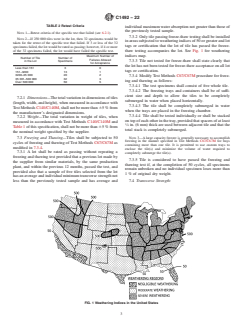
7.3.2 Only tile passing freeze-thaw testing shall be installed in areas subjected to weathering indices of 50 or greater and lot tags
or certification that the lot of tile has passed the freeze-thaw testing accompanies the lot. See Fig. 1 for weathering indices map.
7.3.3 Tile not tested for freeze-thaw shall state clearly that the lot has not been tested for freeze-thaw acceptance on all lot tags
or certification.
7.3.4 Modify Test Methods C67C67/C67M procedure for freezing and thawing as follows:
7.3.4.1 The test specimens shall consist of five whole tile.
7.3.4.2 The freezing trays and containers shall be of sufficient size and depth to allow the tiles to be completely submerged in water
when placed horizontally.
7.3.4.3 The tile shall be completely submerged in water when the trays are placed in the freezing chamber.
FIG. 1 Weathering Indices in the United States
C1492 − 22
7.3.4.4 Tile shall be tested individually or shall be stacked on top of each other in the tray, provided that spacers of at least ⁄4 in.
(6 mm) thick are used between adjacent tile and that the total stack is completely submerged.
NOTE 3—A large capacity freezer is generally necessary to accomplish freezing in the manner specified in Test Methods C67C67/C67M for trays
containing more than one tile. It is permitted to use custom trays to enclose the tile(s) and minimize the volume of water required to completely submerge
the tile(s).
7.3.5 Tile is considered to have passed the freezing and thawing test if, at the completion of 50 cycles, all specimens remain
unbroken and no individual specimen loses more than 1 % of original dry weight.
7.4 Transverse Strength:
7.4.1 Apparatus—The transverse breaking strength of tiles shall be determined as described in the Modulus of Rupture (Flexural
Test) in Test Methods C67C67/C67M except as modified in 7.4.2 – 7.4.9.
7.4.2 Five tiles shall be tested wet after a 24-h submersion in water at a temperature of 75 6 10°F (24 6 6°C) or five tiles shall
be tested dry after heating in a ventilated oven for 24 h at a temperature of 230 to 239°F (100 to 115°C).
7.4.3 Tiles shall be considered to comply with this specification if they comply with either the wet or dry transverse strength
required. The choice of method, wet or dry, shall be mutually agreed upon between specifier and supplier.
7.4.4 The span for the test shall be 12 in. (30.5 cm) 65 % or ⁄3 the length of the tile, whichever is greater. The span is measured
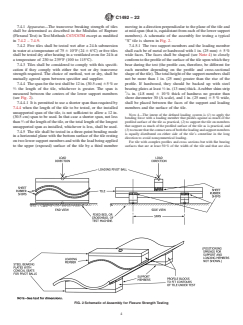
between the centers of the lower support members (see Fig. 2).
FI
...