

ASTM D7967-21
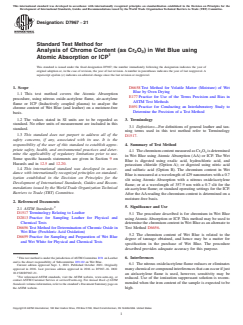
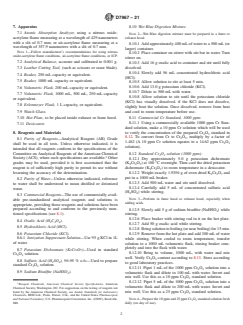
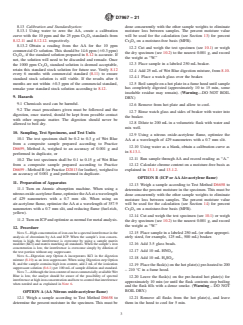
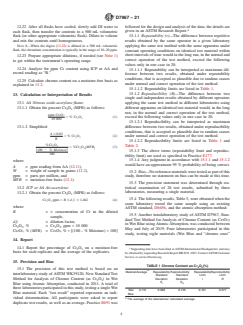
(Test Method)Standard Test Method for Analysis of Chrome Content (as Cr2O3) in Wet Blue using Atomic Absorption or ICP
General Information
- Abstract
SIGNIFICANCE AND USE
5.1 The procedure described is for chromium in Wet Blue using Atomic Absorption or ICP. This method may be used to determine the chromium content in Wet Blue as an alternate to Test Method D6656.
5.2 The chromium content of Wet Blue is related to the degree of tannage obtained, and hence may be a matter for specification in the purchase of Wet Blue. The procedure described provides adequate accuracy for this purpose.
SCOPE
1.1 This test method covers the Atomic Absorption procedure, using nitrous oxide-acetylene flame, air-acetylene flame or ICP (Inductively coupled plasma) to analyze the chrome content of Wet Blue (and leather) on a moisture-free basis.
1.2 The values stated in SI units are to be regarded as standard. No other units of measurement are included in this standard.
1.3 This standard does not purport to address all of the safety concerns, if any, associated with its use. It is the responsibility of the user of this standard to establish appropriate safety, health, and environmental practices and determine the applicability of regulatory limitations prior to use. Some specific hazards statements are given in Section 9 on Hazards and in 12.5 and 12.20.
1.4 This international standard was developed in accordance with internationally recognized principles on standardization established in the Decision on Principles for the Development of International Standards, Guides and Recommendations issued by the World Trade Organization Technical Barriers to Trade (TBT) Committee.
- Status
- Published
- Publication Date
- 31-Aug-2021
- Technical Committee
- D31 - Leather
- Drafting Committee
- D31.02 - Wet Blue
Buy Documents
ASTM D7967-21 - Standard Test Method for Analysis of Chrome Content (as Cr<inf>2</inf>O<inf>3</inf>) in Wet Blue using Atomic Absorption or ICP
REDLINE ASTM D7967-21 - Standard Test Method for Analysis of Chrome Content (as Cr<inf>2</inf>O<inf>3</inf>) in Wet Blue using Atomic Absorption or ICP
Overview
ASTM D7967-21 is the internationally recognized standard test method for determining chrome content, specifically as chromium(III) oxide (Cr₂O₃), in Wet Blue and leather materials using Atomic Absorption (AA) or Inductively Coupled Plasma (ICP) techniques. This standard, published by ASTM International, outlines procedures that provide reliable data for both manufacturers and buyers in the leather industry, supporting quality control, material specification, and trade requirements.
Wet Blue refers to semi-processed leather that has been tanned with chromium salts and retains moisture. Accurate analysis of chromium content in Wet Blue is essential for evaluating the degree of tannage, assessing compliance with purchase specifications, and ensuring product safety.
Key Topics
- Chromium Content Analysis: Testing is performed on a moisture-free basis, ensuring standardized results for chrome quantification.
- Analytical Methods:
- Atomic Absorption (AA): Utilizes nitrous oxide-acetylene or air-acetylene flame for analysis; applies suitable wavelengths and slit widths for accurate Cr₂O₃ measurement.
- Inductively Coupled Plasma (ICP): Provides an alternate, sensitive technique for chrome determination.
- Sample Preparation: Wet Blue samples are digested using specific acid mixtures, depending on the analytical approach.
- Calibration and Standardization: Requires preparation and validation of reference solutions to ensure precision in results.
- Precision and Interference Control: The method addresses potential interferences (notably from iron) and includes guidance on matrix matching and use of modifiers.
- Safety and Compliance: The standard highlights necessary laboratory safety, health, and environmental practices due to the use of hazardous chemicals and equipment.
Applications
- Quality Assurance in the Leather Industry: This test method is critical for verifying chrome content in Wet Blue, directly impacting product quality, durability, and buyer-supplier agreements.
- Specification and Purchase Contracts: Chrome content is often a required parameter in sourcing Wet Blue, making this standard essential for contractual compliance.
- Regulatory Compliance: Many regulations restrict chromium levels in leather products for environmental and health reasons. This standardized method ensures reliable data for compliance documentation.
- Research and Development: Laboratories conducting R&D on tanning processes or substitute materials utilize ASTM D7967-21 for comparative analysis of chrome levels across materials and processing methods.
- Alternative to Perchloric Acid Methods: This standard serves as an alternative to ASTM D6656, offering flexibility in testing method selection.
Related Standards
- ASTM D1517: Terminology relating to leather.
- ASTM D2813: Practice for sampling leather for physical and chemical tests.
- ASTM D6656: Test method for determination of chromic oxide in Wet Blue using perchloric acid oxidation.
- ASTM D6659: Practice for sampling and preparation of Wet Blue and Wet White for tests.
- ASTM D6658: Test method for volatile matter (moisture) of Wet Blue by oven drying.
- ASTM E177: Practice for use of terms precision and bias in ASTM test methods.
- ASTM E691: Practice for conducting interlaboratory studies to determine test method precision.
Practical Value
Adoption of ASTM D7967-21 enhances consistency, comparability, and credibility in the leather supply chain. Using well-established analytical methods for chrome analysis helps manufacturers, laboratories, and buyers:
- Ensure product quality by accurately verifying chromium content.
- Meet regulatory requirements and avoid compliance risks.
- Simplify trade and specification checks between suppliers and buyers.
- Streamline internal quality processes with a repeatable, reliable test.
- Support sustainable practices by monitoring and controlling chromium usage in leather tanning.
Careful adherence to this test method ensures accurate analysis of Wet Blue and leather, supporting industry best practices and global trade standards.
Relations
- Refers
ASTM D6658-08(2020) - Standard Test Method for Volatile Matter (Moisture) of Wet Blue by Oven Drying - Effective Date
- 01-Apr-2020
- Effective Date
- 01-Dec-2015
- Effective Date
- 01-Dec-2015
- Effective Date
- 01-Nov-2014
- Effective Date
- 01-May-2014
- Effective Date
- 01-May-2014
- Effective Date
- 01-Apr-2014
- Refers
ASTM D6658-08(2013) - Standard Test Method for Volatile Matter (Moisture) of Wet Blue by Oven Drying - Effective Date
- 01-May-2013
- Effective Date
- 01-May-2013
- Effective Date
- 01-May-2013
- Effective Date
- 01-Nov-2011
- Effective Date
- 01-Oct-2010
- Effective Date
- 01-Oct-2010
- Effective Date
- 01-Oct-2010
- Effective Date
- 01-Oct-2010
Buy Documents
ASTM D7967-21 - Standard Test Method for Analysis of Chrome Content (as Cr<inf>2</inf>O<inf>3</inf>) in Wet Blue using Atomic Absorption or ICP
REDLINE ASTM D7967-21 - Standard Test Method for Analysis of Chrome Content (as Cr<inf>2</inf>O<inf>3</inf>) in Wet Blue using Atomic Absorption or ICP
Get Certified
Connect with accredited certification bodies for this standard

Control Union Certifications
Global certification for agriculture and sustainability.

Hohenstein Institut
Textile testing and certification.

Bureau Veritas Bangladesh
Bureau Veritas certification services in Bangladesh.
Sponsored listings
Frequently Asked Questions
ASTM D7967-21 is a standard published by ASTM International. Its full title is "Standard Test Method for Analysis of Chrome Content (as Cr<inf>2</inf>O<inf>3</inf>) in Wet Blue using Atomic Absorption or ICP". This standard covers: SIGNIFICANCE AND USE 5.1 The procedure described is for chromium in Wet Blue using Atomic Absorption or ICP. This method may be used to determine the chromium content in Wet Blue as an alternate to Test Method D6656. 5.2 The chromium content of Wet Blue is related to the degree of tannage obtained, and hence may be a matter for specification in the purchase of Wet Blue. The procedure described provides adequate accuracy for this purpose. SCOPE 1.1 This test method covers the Atomic Absorption procedure, using nitrous oxide-acetylene flame, air-acetylene flame or ICP (Inductively coupled plasma) to analyze the chrome content of Wet Blue (and leather) on a moisture-free basis. 1.2 The values stated in SI units are to be regarded as standard. No other units of measurement are included in this standard. 1.3 This standard does not purport to address all of the safety concerns, if any, associated with its use. It is the responsibility of the user of this standard to establish appropriate safety, health, and environmental practices and determine the applicability of regulatory limitations prior to use. Some specific hazards statements are given in Section 9 on Hazards and in 12.5 and 12.20. 1.4 This international standard was developed in accordance with internationally recognized principles on standardization established in the Decision on Principles for the Development of International Standards, Guides and Recommendations issued by the World Trade Organization Technical Barriers to Trade (TBT) Committee.
SIGNIFICANCE AND USE 5.1 The procedure described is for chromium in Wet Blue using Atomic Absorption or ICP. This method may be used to determine the chromium content in Wet Blue as an alternate to Test Method D6656. 5.2 The chromium content of Wet Blue is related to the degree of tannage obtained, and hence may be a matter for specification in the purchase of Wet Blue. The procedure described provides adequate accuracy for this purpose. SCOPE 1.1 This test method covers the Atomic Absorption procedure, using nitrous oxide-acetylene flame, air-acetylene flame or ICP (Inductively coupled plasma) to analyze the chrome content of Wet Blue (and leather) on a moisture-free basis. 1.2 The values stated in SI units are to be regarded as standard. No other units of measurement are included in this standard. 1.3 This standard does not purport to address all of the safety concerns, if any, associated with its use. It is the responsibility of the user of this standard to establish appropriate safety, health, and environmental practices and determine the applicability of regulatory limitations prior to use. Some specific hazards statements are given in Section 9 on Hazards and in 12.5 and 12.20. 1.4 This international standard was developed in accordance with internationally recognized principles on standardization established in the Decision on Principles for the Development of International Standards, Guides and Recommendations issued by the World Trade Organization Technical Barriers to Trade (TBT) Committee.
ASTM D7967-21 is classified under the following ICS (International Classification for Standards) categories: 59.140.30 - Leather and furs. The ICS classification helps identify the subject area and facilitates finding related standards.
ASTM D7967-21 has the following relationships with other standards: It is inter standard links to ASTM D6658-08(2020), ASTM D6659-10(2015), ASTM D1517-15, ASTM D6656-14b, ASTM E177-14, ASTM D6656-14a, ASTM D6656-14, ASTM D6658-08(2013), ASTM E691-13, ASTM E177-13, ASTM E691-11, ASTM E177-10, ASTM D1517-10, ASTM D6659-10, ASTM D6656-01(2010)e1. Understanding these relationships helps ensure you are using the most current and applicable version of the standard.
ASTM D7967-21 is available in PDF format for immediate download after purchase. The document can be added to your cart and obtained through the secure checkout process. Digital delivery ensures instant access to the complete standard document.
Standards Content (Sample)
This international standard was developed in accordance with internationally recognized principles on standardization established in the Decision on Principles for the
Development of International Standards, Guides and Recommendations issued by the World Trade Organization Technical Barriers to Trade (TBT) Committee.
Designation: D7967 − 21
Standard Test Method for
Analysis of Chrome Content (as Cr O ) in Wet Blue using
2 3
Atomic Absorption or ICP
This standard is issued under the fixed designation D7967; the number immediately following the designation indicates the year of
original adoption or, in the case of revision, the year of last revision. A number in parentheses indicates the year of last reapproval. A
superscript epsilon (´) indicates an editorial change since the last revision or reapproval.
1. Scope D6658 Test Method for Volatile Matter (Moisture) of Wet
Blue by Oven Drying
1.1 This test method covers the Atomic Absorption
E177 Practice for Use of the Terms Precision and Bias in
procedure, using nitrous oxide-acetylene flame, air-acetylene
ASTM Test Methods
flame or ICP (Inductively coupled plasma) to analyze the
E691 Practice for Conducting an Interlaboratory Study to
chrome content of Wet Blue (and leather) on a moisture-free
Determine the Precision of a Test Method
basis.
1.2 The values stated in SI units are to be regarded as
3. Terminology
standard. No other units of measurement are included in this
3.1 Definitions—For definitions of general leather and tan-
standard.
ning terms used in this test method refer to Terminology
1.3 This standard does not purport to address all of the
D1517.
safety concerns, if any, associated with its use. It is the
responsibility of the user of this standard to establish appro- 4. Summary of Test Method
priate safety, health, and environmental practices and deter-
4.1 ThechromiumcontentmeasuredasCr O isdetermined
2 3
mine the applicability of regulatory limitations prior to use.
in Wet Blue using Atomic Absorption (AA) or ICP. The Wet
Some specific hazards statements are given in Section 9 on
Blue is digested using oxalic acid, hydrochloric acid, and
Hazards and in 12.5 and 12.20.
potassium chloride (Option A); or digested using nitric acid
1.4 This international standard was developed in accor-
and sulfuric acid (Option B). The chromium content in Wet
dance with internationally recognized principles on standard-
Blueismeasuredatawavelengthof429nanometerswitha0.7
ization established in the Decision on Principles for the
slit using Atomic Absorption with a nitrous oxide/acetylene
Development of International Standards, Guides and Recom-
flame; or at a wavelength of 357.9 nm with a 0.7 slit for the
mendations issued by the World Trade Organization Technical
air-acetylene flame; or standard operating settings for the ICP.
Barriers to Trade (TBT) Committee.
After theAAreading the chromium content is determined on a
moisture-free basis.
2. Referenced Documents
5. Significance and Use
2.1 ASTM Standards:
D1517 Terminology Relating to Leather
5.1 The procedure described is for chromium in Wet Blue
D2813 Practice for Sampling Leather for Physical and
using Atomic Absorption or ICP. This method may be used to
Chemical Tests
determine the chromium content in Wet Blue as an alternate to
D6656 Test Method for Determination of Chromic Oxide in
Test Method D6656.
Wet Blue (Perchloric Acid Oxidation)
5.2 The chromium content of Wet Blue is related to the
D6659 Practice for Sampling and Preparation of Wet Blue
degree of tannage obtained, and hence may be a matter for
and Wet White for Physical and Chemical Tests
specification in the purchase of Wet Blue. The procedure
described provides adequate accuracy for this purpose.
6. Interferences
This test method is under the jurisdiction ofASTM Committee D31 on Leather
and is the direct responsibility of Subcommittee D31.02 on Wet Blue.
6.1 The nitrous oxide/acetylene flame reduces or eliminates
Current edition approved Sept. 1, 2021. Published October 2021. Originally
manychemicalorcompoundinterferencesthatcanoccurifjust
approved in 2016. Last previous edition approved in 2016 as D7967–16. DOI:
10.1520/D7967-21.
an air/acetylene flame is used, however, sensitivity may be
For referenced ASTM standards, visit the ASTM website, www.astm.org, or
reduced. Use of the ionization suppressant solution is recom-
contact ASTM Customer Service at service@astm.org. For Annual Book of ASTM
mended when the iron content of the sample is expected to be
Standards volume information, refer to the standard’s Document Summary page on
the ASTM website. high.
Copyright © ASTM International, 100 Barr Harbor Drive, PO Box C700, West Conshohocken, PA 19428-2959. United States
D7967 − 21
7. Apparatus 8.10 Wet Blue Digestion Mixture.
7.1 Atomic Absorption Analyzer, using a nitrous oxide-
NOTE 2—Wet Blue digestion mixture must be prepared in a fume or
acetylene flame measuring at a wavelength of 429 nanometers exhaust hood.
with a slit of 0.7 mm; or air-acetylene flame measuring at a
8.10.1 Add approximately 400 mLof water to a 500 mL(or
wavelength of 357.9 nanometers with a slit of 0.7 mm.
larger) container.
NOTE 1—Follow manufacturer’s recommendations for using nitrous
8.10.2 Place container on stirrer with stir bar in water. Turn
oxide-acetylene flame conditions, air-acetylene flame conditions, or ICP.
stirrer on.
7.2 Analytical Balance, accurate and calibrated to 0.001 g.
8.10.3 Add 16 g oxalic acid to container and stir until fully
dissolved.
7.3 Leather Cutting Tool, (such as scissors or razor blade).
8.10.4 Slowly add 56 mL concentrated hydrochloric acid
7.4 Beaker, 250 mL capacity or equivalent.
(HCl).
7.5 Beaker, 1000 mL capacity or equivalent.
8.10.5 Allow solution to stir at least 5 min.
8.10.6 Add 13.0 g potassium chloride (KCl).
7.6 Volumetric Flask, 200 mL capacity or equivalent.
8.10.7 Dilute to 500 mL with water.
7.7 Volumetric Flask, 1000 mL, 500 mL, 250 mL capacity
8.10.8 Allow solution to stir until the potassium chloride
or equivalent.
(KCl) has visually dissolved. if the KCl does not dissolve,
7.8 Erlenmeyer Flask, 1 L capacity, or equivalent.
slightly heat the solution. Once dissolved, remove from heat
7.9 Watch Glass. and cool to room temperature before use.
7.10 Hot Plate, to be placed inside exhaust or fume hood. 8.11 Commercial Cr Standard, 1000 ppm:
8.11.1 Using a commercially available 1000 ppm Cr Stan-
7.11 Desiccator.
dard solution, make a 10 ppm Cr solution which will be used
to verify the concentration of the prepared Cr O standard in
8. Reagents and Materials
2 3
8.12. To convert from Cr to Cr O , multiply by a factor of
2 3
8.1 Purity of Reagents—Analytical Reagent (AR) Grade
1.462 (A 10 ppm Cr solution equates to a 14.62 ppm Cr O
2 3
shall be used in all tests. Unless otherwise indicated, it is
solution).
intended that all reagents conform to the specifications of the
Committee on Analytical Reagents of the American Chemical 8.12 Standard Cr O solution (1000 ppm):
2 3
Society (ACS), where such specifications are available. Other 8.12.1 Dry approximately 5.0 g potassium dichromate
grades may be used, provided it is first ascertained that the
(K Cr O ) at 100 °C overnight. Then cool the dried potassium
2 2 7
reagent is of sufficiently high purity to permit its use without dichromate (K Cr O ) to room temperature in a desiccator.
2 2 7
lessening the accuracy of the determination.
8.12.2 Weight exactly 1.9356 g of oven dried K Cr O and
2 2 7
put in a 1000 mL beaker.
8.2 Purity of Water—Unless otherwise indicated, reference
8.12.3 Add 500 mL water and stir until dissolved.
to water shall be understood to mean distilled or deionized
8.12.4 Carefully add 5 mL of concentrated sulfuric acid
water.
(H SO ) while stirring.
2 4
8.3 Commercial Reagents—The use of commercially avail-
NOTE 3—Perform in fume hood or exhaust hood, especially when
able pre-standardized analytical reagents and solutions is
adding acids.
appropriate, providing those reagents and solutions have been
prepared according to and conform to the previously men- 8.12.5 Slowly add5gof sodium bisulfite (NaHSO ) while
tioned specifications (see 8.1). stirring.
8.12.6 Place beaker with stirring rod in it on the hot plate.
8.4 Oxalic Acid (H C O ).
2 2 4
8.12.7 Add 50 g oxalic acid while stirring.
8.5 Hydrochloric Acid (HCl).
8.12.8 Bringsolutiontoboiling(ornearboiling)for15min.
8.6 Potassium Chloride (KCl).
8.12.9 Remove from the hot plate and add 300 mLof water
8.6.1 Ionization Suppressant Solution—Use 95 g KCl in 1L
while stirring. When cooled to room temperature, transfer
of water.
solution to a 1000 mL volumetric flask, rinsing beaker com-
pletely and into the flask with water.
8.7 Potassium Dichromate (K Cr O )—Used in standard
2 2 7
8.12.10 Bring to volume, 1000 mL, with water and mix
Cr O solution.
2 3
well. Verify Cr O content according to 8.13. Store according
2 3
8.8 Sulfuric Acid (H SO ), 96-98 % w/w—Used to prepare
2 4
to good laboratory practices.
standard Cr O solution.
2 3
8.12.11 Pipet 1 mL of the 1000 ppm Cr O solution into a
2 3
8.9 Sodium Bisulfite (NaHSO ).
volumetric flask and dilute to 100 mL with water. Invert and
mix well. Use this as a 10 ppm Cr O standard solution.
2 3
8.12.12 Pipet 5 mL of the 1000 ppm Cr O solution into a
2 3
Reagent Chemicals, American Chemical Society Specifications, American
volumetric flask and dilute to 200 mL with water. Invert and
Chemical Society, Washington, DC. For suggestions on the testing of reagents not
listed by the American Chemical Society, see Analar Standards for Laboratory
mix well. Use this as a 25 ppm Cr O standard solution.
2 3
Chemicals, BDH Ltd., Poole, Dorset, U.K., and the United States Pharmacopeia
and National Formulary, U.S. Pharmacopeial Convention, Inc. (USPC), Rockville, NOTE4—Preparethe10ppmand25ppmCr O standardsolutionfresh
2 3
MD. daily (on day of use).
D7967 − 21
8.13 Calibration and Standardization: done concurrently with the other sample weights to eliminate
8.13.1 Using water to zero the AA, create a calibration moisture loss between samples. The percent moisture value
curve with the 10 ppm and the 25 ppm Cr O standards from will be used for the calculation (see Section 13) for percent
2 3
8.12.11 and 8.12.12. respectively. Cr O on a moisture-free basis (MFB).
2 3
8.13.2 Obtain a reading from the AA for the 10 ppm
12.2 Cut and weigh the test specimen (see 10.1) or weigh
commercial Cr solution. This should be 14.6 ppm (60.3 ppm)
the dry specimen (see 10.2) to the nearest 0.001 g, and record
Cr O , if the standard solution prepared in 8.12 is accurate. If
2 3
the weight as “W.”
not, the solution will need to be discarded and remade. Once
12.3 Place sample in a labeled 250 mL beaker.
the 1000 ppm Cr O standard solution is deemed acceptable,
2 3
retain this standard stock solution for future use. Verify 8.12
12.4 Add 25 mL of Wet Blue digestion mixture, from 8.10.
every 6 months with commercial standard (8.11) to ensure
12.4.1 Place a watch glass over the beaker.
standard stock solution is still viable. If the results after 6
12.5 Boil sample on a hot plate in a fume hood until sample
months are not within 60.3 ppm of the commercial standard,
has completely digested (approximately 10 to 15 min, some
remake your standard stock solution according to 8.12.
insoluble residue may remain). (Warning—DO NOT BOIL
9. Hazards
DRY.)
9.1 Chemicals used can be harmful.
12.6 Remove from hot plate and allow to cool.
9.2 The exact procedures given must be followed and the
12.7 Rinse watch glass and sides of beaker with water into
digestion, once started, should be kept from possible contact
the beaker.
with other organic matter. The digestion should never be
12.8 Dilute to 200 mL in a volumetric flask with water and
allowed to boil dry.
mix well.
10. Sampling, Test Specimens, and Test Units
12.9 Using a nitrous oxide-acetylene flame, optimize the
10.1 The test specimen shall be 0.2 to 0.3 g of Wet Blue
AA at a wavelength of 429 nanometers with a 0.7 mm slit.
from a composite sample prepared according to Practice
12.10 Using water as a blank, obtain a calibration curve as
D6659, Method A, weighed to an accuracy of 0.001 g and
in 8.13.1.
performed in duplicate, or
12.11 Run sample through AA and record reading as “A.”
10.2 The test specimen shall be 0.1 to 0.15 g of Wet Blue
from a composite sample prepared according to Practice
12.12 Calculate chrome content on a moisture-free basis as
D6659 - Method B (or Practice D2813 for leather), weighed to
explained in 13.1.1 and 13.1.2.
an accuracy of 0.001 g and performed in duplicate.
OPTION B (ICP or AA Air-acetylene flame)
11. Preparation of Apparatus
12.13 Weigh a sample according to Test Method D6658 to
11.1 Turn on Atomic absorption machine. When using a
determine the percent moisture in the specimen. This must be
nitrousoxide-acetyleneflame,optimizetheAAatawavelength
done concurrently with the other sample weights to eliminate
of 429 nanometers with a 0.7 mm slit. When usi
...
This document is not an ASTM standard and is intended only to provide the user of an ASTM standard an indication of what changes have been made to the previous version. Because
it may not be technically possible to adequately depict all changes accurately, ASTM recommends that users consult prior editions as appropriate. In all cases only the current version
of the standard as published by ASTM is to be considered the official document.
Designation: D7967 − 16 D7967 − 21
Standard Test Method for
Analysis of Chrome Content (as Cr O ) in Wet Blue using
2 3
Atomic Absorption or ICP
This standard is issued under the fixed designation D7967; the number immediately following the designation indicates the year of
original adoption or, in the case of revision, the year of last revision. A number in parentheses indicates the year of last reapproval. A
superscript epsilon (´) indicates an editorial change since the last revision or reapproval.
1. Scope
1.1 This test method covers the Atomic Absorption procedure, using nitrous oxide-acetylene flame, air-acetylene flame or ICP
(Inductively coupled plasma) to analyze the chrome content of Wet Blue (and leather) on a moisture-free basis.
1.2 The values stated in SI units are to be regarded as standard. No other units of measurement are included in this standard.
1.3 This standard does not purport to address all of the safety concerns, if any, associated with its use. It is the responsibility
of the user of this standard to establish appropriate safety safety, health, and healthenvironmental practices and determine the
applicability of regulatory limitations prior to use. Some specific hazards statements are given in Section 9 on Hazards and in 12.5
and 12.20.
1.4 This international standard was developed in accordance with internationally recognized principles on standardization
established in the Decision on Principles for the Development of International Standards, Guides and Recommendations issued
by the World Trade Organization Technical Barriers to Trade (TBT) Committee.
2. Referenced Documents
2.1 ASTM Standards:
D1517 Terminology Relating to Leather
D2813 Practice for Sampling Leather for Physical and Chemical Tests
D6656 Test Method for Determination of Chromic Oxide in Wet Blue (Perchloric Acid Oxidation)
D6659 Practice for Sampling and Preparation of Wet Blue and Wet White for Physical and Chemical Tests
D6658 Test Method for Volatile Matter (Moisture) of Wet Blue by Oven Drying
E177 Practice for Use of the Terms Precision and Bias in ASTM Test Methods
E691 Practice for Conducting an Interlaboratory Study to Determine the Precision of a Test Method
3. Terminology
3.1 Definitions: Definitions—For Definitionsdefinitions of general leather and tanning terms used in this test method refer to
Terminology D1517.
4. Summary of Test Method
4.1 The chromium content measured as Cr O is determined in Wet Blue using Atomic Absorption (AA). (AA) or ICP. The Wet
2 3
This test method is under the jurisdiction of ASTM Committee D31 on Leather and is the direct responsibility of Subcommittee D31.02 on Wet Blue.
Current edition approved Sept. 1, 2016Sept. 1, 2021. Published October 2016October 2021. Originally approved in 2016. Last previous edition approved in 2016 as
D7967–16. DOI: 10.1520/D7967-16.10.1520/D7967-21.
For referenced ASTM standards, visit the ASTM website, www.astm.org, or contact ASTM Customer Service at service@astm.org. For Annual Book of ASTM Standards
volume information, refer to the standard’s Document Summary page on the ASTM website.
Copyright © ASTM International, 100 Barr Harbor Drive, PO Box C700, West Conshohocken, PA 19428-2959. United States
D7967 − 21
Blue is digested using oxalic acid, hydrochloric acid, and potassium chloride. chloride (Option A); or digested using nitric acid
and sulfuric acid (Option B). The chromium content in Wet Blue is measured at a wavelength of 429 nanometers with a 0.7 slit
using Atomic Absorption with a nitrous oxide/acetylene flame. flame; or at a wavelength of 357.9 nm with a 0.7 slit for the
air-acetylene flame; or standard operating settings for the ICP. After the AA reading the chromium content is determined on a
moisture-free basis.
5. Significance and Use
5.1 The procedure described is for chromium in Wet Blue using Atomic Absorption. Absorption or ICP. This method may be used
to determine the chromium content in Wet Blue as an alternate to Test Method D6656.
5.2 The chromium content of Wet Blue is related to the degree of tannage obtained, and hence may be a matter for specification
in the purchase of Wet Blue. The procedure described provides adequate accuracy for this purpose.
6. Interferences
6.1 The nitrous oxide/acetylene flame reduces or eliminates many chemical or compound interferences that can occur if just an
air/acetylene flame is used, however, sensitivity may be reduced. Use of the ionization suppressant solution is recommended when
the iron content of the sample is expected to be high.
7. Apparatus
7.1 Atomic Absorption Analyzer, Atomic Absorption analyzer using a nitrous oxide-acetylene flame measuring at a wavelength of
429 nanometers with a slit of 0.7 mm; or air-acetylene flame measuring at a wavelength of 357.9 nanometers with a slit of 0.7 mm.
NOTE 1—Follow manufacturer’s recommendations for using nitrous oxide-acetylene flame conditions.conditions, air-acetylene flame conditions, or ICP.
7.2 Analytical Balance, accurate and calibrated to 0.001 g.
7.3 Leather Cutting Tool, (such as scissors or razor blade).
7.4 Beaker, 250 mL capacity or equivalent.
7.5 Beaker, 1000 mL capacity or equivalent.
7.6 Volumetric Flask, 200 mL capacity or equivalent.
7.7 Volumetric Flask, 1000 mL, 500 mL, 250 mL capacity or equivalent.
7.8 Erlenmeyer Flask, 1 L capacity, or equivalent.
7.9 Watch Glass.
7.10 Hot Plate, to be placed inside exhaust or fume hood.
7.11 Desiccator.
8. Reagents and Materials
8.1 Purity of Reagents—Analytical Reagent (AR) Grade shall be used in all tests. Unless otherwise indicated, it is intended that
all reagents conform to the specifications of the Committee on Analytical Reagents of the American Chemical Society (ACS),
D7967 − 21
where such specifications are available. Other grades may be used, provided it is first ascertained that the reagent is of sufficiently
high purity to permit its use without lessening the accuracy of the determination.
8.2 Purity of Water—Unless otherwise indicated, reference to water shall be understood to mean distilled or deionized water.
8.3 Commercial Reagents—The use of commercially available pre-standardized analytical reagents and solutions is appropriate,
providing those reagents and solutions have been prepared according to and conform to the previously mentioned specifications
(see 8.1).
8.4 Oxalic Acid (H C O ).
2 2 4
8.5 Hydrochloric Acid (HCl).
8.6 Potassium Chloride (KCl).
8.6.1 Ionization Suppressant Solution—Use 95 g KCl in 1L of water.
8.7 Potassium Dichromate (K Cr O )—Used in standard Cr O solution.
2 2 7 2 3
8.8 Sulfuric Acid (H SO ), 96-98 % w/w—Used to prepare standard Cr O solution.
2 4 2 3
8.9 Sodium Bisulfite (NaHSO ).
8.10 Wet Blue Digestion Mixture.
NOTE 2—Wet Blue Digestion Mixturedigestion mixture must be prepared in a Fumefume or Exhaust Hood.exhaust hood.
8.10.1 Add approximately 400 mL of water to a 500 mL (or larger) container.
8.10.2 Place container on stirrer with stir bar in water. Turn stirrer on.
8.10.3 Add 16 g oxalic acid to container and stir until fully dissolved.
8.10.4 Slowly add 56 mL concentrated hydrochloric acid (HCl).
8.10.5 Allow solution to stir at least 5 min.
8.10.6 Add 13.0 g potassium chloride (KCl).
8.10.7 Dilute to 500 mL with water.
8.10.8 Allow solution to stir until the potassium chloride (KCl) has visually dissolved. if the KCl does not dissolve, slightly heat
the solution. Once dissolved, remove from heat and cool to room temperature before use.
8.11 Commercial Cr Standard, 1000 ppm:
8.11.1 Using a commercially available 1000 ppm Cr Standard solution, make a 10 ppm Cr solution which will be used to verify
the concentration of the prepared Cr O standard in 8.12. To convert from Cr to Cr O , multiply by a factor of 1.462 (A 10 ppm
2 3 2 3
Cr solution equates to a 14.62 ppm Cr O solution).
2 3
Reagent Chemicals, American Chemical Society Specifications, American Chemical Society, Washington, DC. For suggestions on the testing of reagents not listed by
the American Chemical Society, see Analar Standards for Laboratory Chemicals, BDH Ltd., Poole, Dorset, U.K., and the United States Pharmacopeia and National
Formulary, U.S. Pharmacopeial Convention, Inc. (USPC), Rockville, MD.
D7967 − 21
8.12 Standard Cr O solution (1000 ppm):
2 3
8.12.1 Dry approximately 5.0 g potassium dichromate (K Cr O ) at 100°C 100 °C overnight. Then cool the dried potassium
2 2 7
dichromate (K Cr O ) to room temperature in a desiccator.
2 2 7
8.12.2 Weight exactly 1.9356 g of oven dried K Cr O and put in a 1000 mL beaker.
2 2 7
8.12.3 Add 500 mL water and stir until dissolved.
8.12.4 Carefully add 5 mL of concentrated sulfuric acid (H SO ) while stirring.
2 4
NOTE 3—Perform in fume hood or exhaust hood, especially when adding acids.
8.12.5 Slowly add 5 g of sodium bisulfite (NaHSO ) while stirring.
8.12.6 Place beaker with stirring rod in it on the hot plate.
8.12.7 Add 50 g oxalic acid while stirring.
8.12.8 Bring solution to boiling (or near boiling) for 15 min.
8.12.9 Remove from the hot plate and add 300 mL of water while stirring. When cooled to room temperature, transfer solution
to a 1000 mL volumetric flask, rinsing beaker completely and into the flask with water.
8.12.10 Bring to volume, 1000 mL, with water and mix well. Verify Cr O content according to 8.13. Store according to good
2 3
laboratory practices.
8.12.11 Pipet 1 mL of the 1000 ppm Cr O solution into a volumetric flask and dilute to 100 mL with water. Invert and mix well.
2 3
Use this as a 10 ppm Cr O standard solution.
2 3
8.12.12 Pipet 5 mL of the 1000 ppm Cr O solution into a volumetric flask and dilute to 200 mL with water. Invert and mix well.
2 3
Use this as a 25 ppm Cr O standard solution.
2 3
NOTE 4—Prepare the 10 ppm and 25 ppm Cr O standard solution fresh daily (on day of use).
2 3
8.13 Calibration and Standardization:
8.13.1 Using water to zero the AA, create a calibration curve with the 10 ppm and the 25 ppm Cr O standards from 8.12.11 and
2 3
8.12.12. respectively.
8.13.2 Obtain a reading from the AA for the 10 ppm commercial Cr solution. This should be 14.6 ppm (60.3 ppm) Cr O , if the
2 3
standard solution prepared in 8.12 is accurate. If not, the solution will need to be discarded and remade. Once the 1000 ppm Cr O
2 3
standard solution is deemed acceptable, retain this standard stock solution for future use. Verify 8.12 every 6 months with
commercial standard (8.11) to ensure standard stock solution is still viable. If the results after 6 months are not within 60.3 ppm
of the commercial standard, remake your standard stock solution according to 8.12.
9. Hazards
9.1 Chemicals used can be harmful.
9.2 The exact procedures given must be followed and the digestion, once started, should be kept from possible contact with other
organic matter. The digestion should never be allowed to boil dry.
D7967 − 21
10. Sampling, Test Specimens, and Test Units
10.1 The test specimen shall be 0.2 to 0.3 g of Wet Blue from a composite sample prepared according to Practice D6659, Method
A, weighed to an accuracy of 0.001 g and performed in duplicate, or
10.2 The test specimen shall be 0.1 to 0.15 g of Wet Blue from a composite sample prepared according to Practice D6659, Method
B, - Method B (or Practice D2813 for leather), weighed to an accuracy of 0.001 g and performed in duplicate.
11. Preparation of Apparatus
11.1 Turn on Atomic absorption machine. Using When using a nitrous oxide-acetylene flame, optimize the AA at a wavelength
of 429 nanometers with a 0.7 mm slit. When using an air-acetylene flame, optimize the AA at a wavelength of 357.9 nanometers
with a 0.7 mm slit, and reducing flame (fuel-rich, yellow).
11.2 Turn on ICP and optimize as normal for metal analysis.
12. Procedure
NOTE 5—High concentration of iron can be a spectral interference in the analysis of chromium by AA and ICP. When the sample’s iron concentration
is high, the interference is overcome by using a sample matrix modifier (KCl) and matrix matching all standards. When the sample’s iron concentration
is low, the interference is overcome simply by dilution of the test portion without any suppressant.
NOTE 6—Digestion step Option A incorporates KCl in the digestion mixture (8.10) as an iron suppressant. When using Digestion step Option B, and the
sample contains high iron content, add 2 mL of the ionization suppressant solution (8.6.1) per 100 mL of sample dilution and standard.
NOTE 7—Although the iron content of most commercially available Wet Blue is low, the analyst should be aware of the possibility of spectral interference
at high iron concentration and how to control that interference when needed and as explained in Note 6.
OPTION A (AA Nitrous oxide-acetylene flame)
12.1 Weigh a sample according to Test Method D6658 to determine the percent moisture in the specimen. This must be done
concurrently with the other sample weights to eliminate moisture loss between samples. The percent moisture value will be used
for the calcula
...